Unlocking reaction time for humans: A Guide to Brain Speed
Jan 6, 2026
Picture a sprinter, muscles tensed, ready to explode from the starting blocks. That tiny sliver of time between the starter pistol's bang and their first powerful stride? That's reaction time in action. It's the raw processing speed of your nervous system—the total time it takes to notice a signal, figure out what it means, and physically respond.
What Is Human Reaction Time and Why It Matters
While we often think of reaction time in the context of elite athletes, it’s actually a fundamental measure of brain health that matters for every single one of us. It’s the invisible, lightning-fast process that governs countless daily actions.
Think about slamming on the brakes when the car ahead of you stops without warning. Or that split-second decision to lunge for a coffee mug you’ve just knocked off the counter. Both of these actions hinge on how quickly your brain can run through a critical sequence of events.
This rapid-fire chain can be broken down into three key stages:
Perception: Your senses—sight, sound, touch—pick up a stimulus. For example, your eyes see the brake lights of the car in front of you flash red.
Processing: Your brain gets to work, interpreting that sensory input and making a decision. It recognizes the red lights, understands it means "danger," and quickly forms a plan: "Hit the brakes!"
Response: Finally, your brain sends commands down through your motor neurons to your muscles, triggering the physical action. Your foot lifts off the gas and presses down firmly on the brake pedal.
A Window into Cognitive Health
Measuring how long it takes to complete this entire loop gives us a powerful glimpse into the efficiency of your central newous system. A snappy reaction time is a good sign that your neural pathways are firing on all cylinders. On the other hand, a noticeable slowdown can be an early whisper of underlying issues like fatigue, cognitive overload, or even certain neurological conditions.
Understanding the nuances of human reaction time is a huge area of focus in cognitive science, and it's a fascinating part of what you'd explore when studying psychology online.
Think about this: a driver's average reaction time to see a hazard and hit the brakes is about 1.5 seconds. At 100 km/h, your car travels over 40 metres in that time alone. It's a stark reminder of how fractions of a second can have life-or-death consequences.
Ultimately, keeping an eye on your reaction speed isn’t just some abstract exercise. It’s a practical way to gauge your brain's overall performance, reflecting your alertness, decision-making sharpness, and physical readiness.
By digging into what affects it and how to measure it properly, you can gain actionable insights into your own cognitive vitality. For a much deeper dive, check out our complete guide on human reaction time.
The Neurological Journey from Signal to Action
Every single reaction you make—whether it’s snatching your phone before it hits the floor or slamming on the brakes in traffic—is the grand finale of a biological relay race happening at lightning speed. It's not one single event, but a high-speed journey zipping through your nervous system.
Picture a baseball flying toward you. What happens inside your body in that sliver of a second is nothing short of a neurological masterpiece.
From Perception to Processing
It all kicks off with perception. The moment light reflecting off that baseball hits your retina, the sensory information is instantly translated into electrical signals. The first leg of the race has begun.
These signals don’t just meander; they shoot down specialized pathways called sensory neurons. Think of them as high-speed fibre optic cables running directly from your eyes to your brain's central command. To really get a handle on this, it helps to understand the intricate workings of neurons, the fundamental messengers in this incredible system.
Once that visual data arrives, it's routed to the occipital lobe at the very back of your head—home of the visual cortex. This area acts like an image recognition expert, instantly identifying the object ("ball!") and calculating its speed and trajectory. But just knowing what it is isn't enough to make you move.
This is where the brain's "command centre," the frontal lobe, takes over. The frontal lobe is in charge of executive functions like decision-making. It gets the report from the visual cortex and, in milliseconds, makes the call: "Catch it!" This is the processing phase, where your brain interprets the input and cooks up a plan.
This flowchart breaks down these core stages, from the initial perception to the final response.
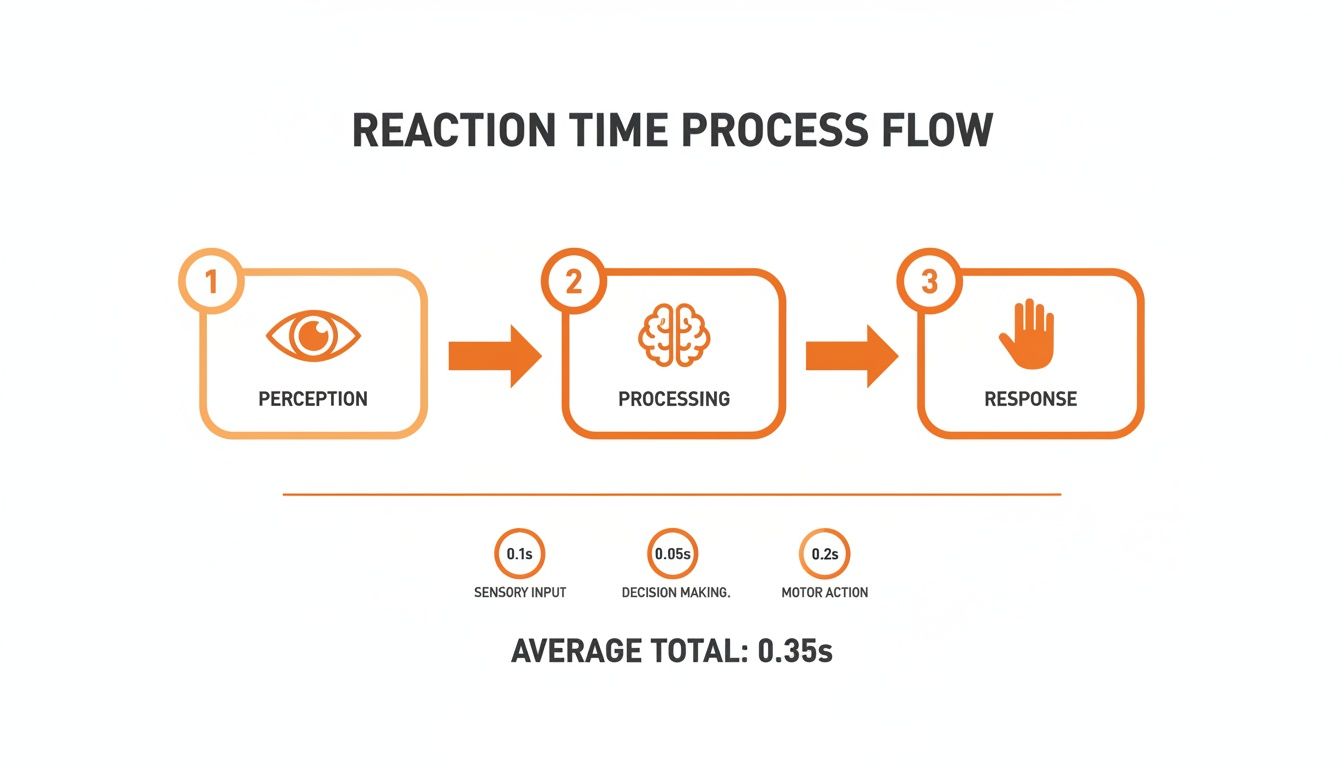
As you can see, a signal has to be perceived, processed, and finally acted upon. It's a clear, sequential chain of events happening at an almost unbelievable speed.
From Command to Coordinated Movement
With the decision made, the command centre sends out its orders. New electrical signals fly from the motor cortex (also in the frontal lobe) down another set of high-speed cables: the motor neurons. These are the direct lines to your muscles, carrying the exact instructions for a physical response.
But catching a ball isn't a crude, clumsy action. It takes incredible finesse. That's where a few other key brain regions jump in to help:
The Cerebellum: Tucked away at the base of your brain, the cerebellum is the master of fine-tuning. It adjusts the timing and force of your muscle contractions, ensuring your hand moves smoothly and accurately to meet the ball.
The Basal Ganglia: This group of structures helps select the right motor program—in this case, the "catch" movement—while telling other competing actions to stand down.
Finally, the signals hit the muscles in your arm and hand, causing them to contract in a perfectly timed sequence. Your arm extends, your fingers shape themselves, and you snag the ball. The entire trip, from seeing the ball to closing your hand around it, often takes less than 250 milliseconds.
The entire sequence—from sensory input to motor output—is a cascade of electrochemical signals. This really drives home that human reaction time isn't just about how fast your muscles are, but the total processing time your central nervous system needs to get the job done.
This complex, near-instantaneous process happens countless times a day without you ever having to think about it. Understanding this journey from signal to action shows us that a simple reaction is actually one of the most sophisticated operations your brain performs, showcasing a network built for incredible speed and precision.
Different Types of Reaction Time and How We Measure Them
When we talk about reaction time for humans, it’s not a single, one-size-fits-all metric. Think of it like a musician’s skill; there’s a world of difference between hitting a single, predictable note and improvising a complex jazz solo. Similarly, different types of reaction time tests dig into distinct layers of cognitive effort, from raw sensory processing to high-stakes decision-making.
Getting these distinctions right is absolutely crucial. Each type of test reveals a different piece of the puzzle about your nervous system's performance. To accurately gauge cognitive function, we have to move beyond simplistic speed tests and look at the specific mental legwork involved in a response.
Simple Reaction Time: The Purest Measure of Speed
Simple Reaction Time (SRT) is the most fundamental form of response. It’s all about measuring the tiny gap between a single stimulus appearing and your physical reaction to it. There's no decision to make, no choice to weigh. You just see it, and you go.
A classic example is a test where you press a button the moment you see any light flash on the screen. This task neatly isolates the baseline speed of your perception and motor pathways, stripping away the complexity of making a choice.
What it measures: The raw, unfiltered processing speed of your nervous system.
Practical Example: A sprinter exploding from the blocks the very instant they hear the starting pistol. They don't have to decide what the sound is—they just need to react.
Choice Reaction Time: Adding Decision-Making to the Mix
This is where things get more interesting. Choice Reaction Time (CRT) introduces a layer of complexity by presenting multiple possible signals, each demanding a different, specific response. Your brain is now forced to not only perceive the stimulus but also to correctly identify it and then select the right action from a menu of options.
Imagine a test that asks you to press the left button for a blue light but the right button for a red one. The extra milliseconds it takes to perform this task compared to a simple reaction test directly reflects your decision-making speed.
This added cognitive load isn't trivial. As more choices are introduced, the average human reaction time reliably increases—a principle known as the Hick-Hyman Law. It’s a powerful demonstration that even simple decisions take up measurable brain time.
Recognition Reaction Time: Filtering Out the Noise
Often called Discrimination Reaction Time, this is a smart hybrid of the first two. You're shown multiple different stimuli, but your job is to react to only one specific "target" and actively ignore all the others.
Think of a test where lights of various colours flash on the screen, but you must only press the button when you see the green one. This setup measures your brain's ability to quickly pick out a relevant signal while suppressing the impulse to react to all the irrelevant "distractor" signals. It’s a fantastic measure of sustained attention and cognitive control.
What it measures: Your ability to focus, tell stimuli apart, and inhibit incorrect responses.
Practical Example: A baseball batter who needs to swing at strikes but hold back on balls thrown outside the strike zone.
To make these concepts clearer, here’s a quick breakdown of how these tests differ.
Comparing Different Reaction Time Tests
Type of Reaction Time | Cognitive Process Measured | Example Scenario |
|---|---|---|
Simple | Raw speed of sensory perception and motor response. | Hitting the brakes the instant a traffic light turns red. |
Choice | Decision-making, information processing, and response selection. | Sorting mail into different slots based on the postal code. |
Recognition | Selective attention, stimulus discrimination, and impulse control. | A goalie blocking a penalty kick, ignoring the shooter's fake moves. |
Each of these tests tells a unique story about how the brain processes information and translates it into action.
Why Standardized Measurement Is So Important
While those fun online reaction tests can give you a rough idea of your speed, they simply aren't built for clinical or research purposes. They're riddled with variables that can throw off the results—things like monitor lag, internet connection speed, and inconsistent testing environments. This is where standardized, professional assessment tools become non-negotiable.
Platforms like those developed here at Orange Neurosciences provide the objective, reliable data that's essential for any meaningful analysis. By using controlled, evidence-based methodologies, our tools eliminate those confounding variables and deliver precise measurements for every type of reaction time.
This level of accuracy is paramount for tracking cognitive changes over time, evaluating the effectiveness of a new therapy, or making truly informed clinical decisions. By understanding these different reaction types, you can better appreciate what a specific test reveals about cognitive performance. To see how these measurements build a complete picture of brain health, explore our detailed guide on the average reaction time for humans and what the numbers really mean.
What Affects Your Reaction Speed?
Your reaction time isn't set in stone. Think of it less as a fixed number and more as a dynamic gauge of your brain's performance, constantly shifting based on a whole host of factors, both inside and out. Getting a handle on what speeds you up and what slows you down is the first real step toward protecting—and even sharpening—this vital part of your cognitive health.
The truth is, human reaction time is incredibly sensitive to your physical state, how much you're juggling mentally, and even your age. By pinpointing these influences, you can start making smart lifestyle choices that give your brain's processing speed the support it needs.
The Natural Arc of Life: Age and Reaction Time
One of the biggest players in the reaction time game is, without a doubt, age. Our cognitive abilities, speed included, tend to follow a natural curve throughout our lives.
Childhood and Adolescence: In these formative years, reaction times steadily get faster. The nervous system is still maturing, nerve fibres are getting better insulation (a process called myelination) which speeds up signals, and we get smarter about how we approach tasks.
Peak Performance (20s and 30s): Most of us hit our peak reaction speed in our mid-20s. At this point, the brain's processing highways are fully paved and operating at maximum efficiency.
Gradual Slowing (40s and beyond): Starting around age 40, a slow and steady decline in reaction speed begins. This is a completely normal part of aging, reflecting subtle shifts in the brain's structure and function.
But this slowdown isn't a destiny you have to accept. Staying active, both with your body and your mind, can put the brakes on this decline, helping you hold onto faster neural processing well into your later years. By taking on new challenges and staying physically active, you help keep those neural connections firing crisply. For more on how movement boosts cognition, check out our guide on eye-hand coordination exercises.
Lifestyle Impacts: Fatigue, Sleep, and Hydration
Your day-to-day habits have a direct and often immediate effect on how quickly you react. Even small tweaks to your routine can lead to noticeable changes in your response times.
A bad night's sleep is one of the worst offenders. When you're running on empty, your brain's prefrontal cortex—the command centre for attention and decision-making—gets sluggish. Research has shown that after just one night of poor sleep, reaction times can slow down significantly, sometimes to a level on par with the impairment caused by alcohol.
Fatigue, whether it’s from a tough workout or mental burnout, works in much the same way. It drains the cognitive fuel you need for quick processing, making it harder to stay alert and respond on time. Even being slightly dehydrated can make your blood a little thicker, hampering efficient oxygen flow to the brain and slowing you down.
Substances and Their Effects: Caffeine vs. Alcohol
What you put into your body can either sharpen your reaction speed or dull it. The most common examples, caffeine and alcohol, pull your central nervous system in opposite directions.
Caffeine (The Booster): As a stimulant, caffeine works by blocking adenosine, a chemical messenger in the brain that makes you feel relaxed and sleepy. This amps up neural activity, making you feel more alert and producing faster reaction times. A single cup of coffee might shave 25 milliseconds or more off your response time.
Alcohol (The Suppressor): Alcohol, on the other hand, is a depressant that puts the brakes on brain function. It messes with your judgment, coordination, and—crucially—your reaction time. This is a huge part of why driving under the influence is so incredibly dangerous.
The real-world consequences are sobering. Traffic safety data consistently shows a direct line between drunk driving and fatal crashes. According to a 2023 NHTSA report, alcohol-impaired driving fatalities in California shot up by 16.1% in 2021. This spike is directly linked to how alcohol can tack on an extra 20-50 ms or more to a simple reaction—a potentially fatal delay when you're behind the wheel.
Your reaction time is a sensitive barometer of your overall well-being. It reflects not just your neurological health, but also the immediate impact of your sleep, diet, and daily choices.
Cognitive Load and Digital Distractions
We live in a world of constant multitasking. We're answering emails during a video call, scrolling social media while watching a movie—and all this juggling creates a massive cognitive load.
When your brain is trying to process several streams of information at once, its resources get spread thin. That means there's less processing power left to respond to any single event, which naturally leads to slower reactions. The constant pings and notifications from our devices only make it worse, shattering our attention and making it nearly impossible to maintain the focus needed for a quick response.
By understanding these key factors, you gain the power to influence your own cognitive performance. Recognizing the toll of a sleepless night or the mental cost of multitasking allows you to take concrete steps—like making sleep a priority or focusing on one thing at a time—to keep your brain sharp and your reactions fast.
Using Reaction Time as a Clinical Assessment Tool
Reaction time is far more than just a measure of quickness; in a clinical setting, it’s a powerful and incredibly sensitive biomarker. It gives clinicians a precise, non-invasive window into how efficiently the central nervous system is operating, turning a simple speed metric into a vital tool for assessment and monitoring.
Think of it like running a diagnostic on a computer. A reaction time test doesn’t just show raw processing speed—it reveals the brain's real-world ability to receive, interpret, and act on information under controlled conditions. This kind of objective data helps move clinical evaluation beyond subjective observation and toward hard, quantifiable evidence.
Early Detection and Cognitive Monitoring
One of the most powerful applications for reaction time testing is in catching neurological changes early. Subtle increases in how long it takes someone to respond can be an early warning sign for neurodegenerative conditions, often appearing long before more obvious symptoms do.
For instance, in conditions like Parkinson's or Multiple Sclerosis, a gradual slowing of motor responses can be one of the very first measurable indicators. Tracking these tiny shifts over time gives clinicians a clear, objective timeline of a condition's progression.
Clinically, it's not always about raw speed. Sometimes, high variability in response times—big swings between fast and slow answers—can be a more telling sign of cognitive fatigue or attention deficits than a slow average speed.
Reaction time tests are also indispensable in concussion management. After a head injury, an athlete's reaction speed is almost always impaired. By monitoring how quickly it returns to their pre-injury baseline, medical staff can make crucial, data-driven decisions about a safe return to play. This kind of precise cognitive assessment is absolutely critical for preventing the risk of a second, more severe injury.
Evaluating Conditions and Treatment Efficacy
Reaction time assessment also plays a key role in understanding and managing a wide range of cognitive and developmental conditions.
Attention-Deficit/Hyperactivity Disorder (ADHD): Individuals with ADHD often show slower choice reaction times and much greater variability in their responses, which reflects underlying challenges with impulse control and sustained attention.
Stroke Rehabilitation: Tracking a patient's reaction speed provides therapists with an objective way to measure recovery. As response times improve, it suggests that neural pathways are successfully reorganizing and healing.
Medication Management: For certain conditions, changes in reaction time can help clinicians see if a medication is working as intended or if it's causing unintended cognitive side effects.
This data-driven approach is essential for personalizing care. Out in the real world, even small impairments in reaction time can have serious consequences. For example, an analysis of DUI data found that factors like age and impairment can stretch a person’s reaction time from a youthful 200 ms to over 300 ms in seniors. That tiny delay contributed to 1,370 alcohol-related driving deaths in California in 2021 alone. This highlights the urgent need for reliable measurement tools in clinical practice.
The Need for Precision with Standardized Tools
For reaction time data to be clinically useful, it has to be accurate, reliable, and standardized. Fun online tests might be entertaining, but they are completely unsuitable for medical evaluation because of variables like screen lag, inconsistent instructions, and distracting environments. This is why clinicians and researchers rely on professional-grade platforms.
Tools like OrangeCheck from Orange Neurosciences are designed specifically to meet these rigorous standards. By using evidence-based, game-like assessments, our platform provides clinicians with the dependable data they need to make informed decisions. Crucially, it allows for longitudinal tracking, which means a patient's cognitive performance can be monitored consistently over months or even years.
This ability to track cognitive changes over time replaces guesswork with precision. It empowers healthcare providers to spot issues earlier, tailor interventions more effectively, and ultimately, improve patient outcomes.
How to Accurately Assess and Improve Reaction Time
So, you're ready to take charge of your cognitive health. That's fantastic. Moving from simply being curious about your reaction time to actually doing something about it boils down to two key things: reliable measurement and a solid plan for improvement.
It's tempting to jump on a casual online test, and while they can be fun, they just don't cut it for any meaningful assessment of reaction time for humans. Variables like screen lag, internet speed, and inconsistent test designs mean the results are, at best, a ballpark figure. For any serious application, you need scientifically validated tools.
This is where professional-grade solutions come into the picture. Platforms like OrangeCheck from Orange Neurosciences use AI-powered, game-based assessments to generate a comprehensive cognitive profile in under 30 minutes. These tools aren't just games; they provide the hard data and consistent tracking needed for clinical use, swapping guesswork for precision.
Actionable Strategies to Improve Reaction Time
The good news is that improving your reaction speed is absolutely an achievable goal. It’s all about strengthening your cognitive and physical readiness through consistent practice. Here are a few evidence-based strategies to get you started:
Targeted Cognitive Exercises: Think of it like a workout for your brain. Engaging in activities that challenge you to process information quickly is key. A practical example is a "go/no-go" task where you press a button for one shape but not for another. You can check out a bunch of them in our guide to effective reaction time games.
Consistent Physical Activity: Don't underestimate the mind-body connection. Regular exercise, especially aerobic activities like running or swimming, gets the blood flowing to your brain and actually encourages the growth of new neural connections. Even a brisk 30-minute walk each day can make a measurable difference.
Mindfulness and Meditation: This might seem counterintuitive, but practising mindfulness is a powerful tool. It trains your ability to focus and filter out the noise. When you can perceive a stimulus clearly, without mental clutter getting in the way, you can initiate a response much faster. A simple five-minute breathing exercise can help center your focus before a task.
From Measurement to Meaningful Improvement
Accurately assessing your cognitive function is always the first step. A casual online test might give you a momentary snapshot, but it lacks the precision needed for reliable tracking or any kind of clinical insight. A true picture only emerges from a standardized approach that controls for those pesky external variables and measures your performance the same way, every time.
Reliable measurement is the foundation of improvement. Without objective data, you're navigating without a map, unable to tell if your efforts are truly making a difference in your cognitive performance.
This is why having a comprehensive platform is so valuable. It creates a powerful feedback loop. You can measure your baseline, implement strategies to get better, and then re-assess to see tangible, measurable progress. It's a methodical approach that empowers you to not just track, but actively enhance your brain's processing speed.
To see how our suite of tools can deliver the objective data needed to support you or your practice, visit the Orange Neurosciences website and request a personalized demo.
Still Have Questions About Human Reaction Time?
Let's dig into some of the most common questions people have about this fascinating cognitive measure.
What’s a “Good” Reaction Time, Anyway?
When you see something and have to react, the whole process takes, on average, about 250 milliseconds (ms). That’s a quarter of a second. For a practical example, this is about the time it takes to catch a ruler dropped between your fingers. Most of us fall somewhere in the 200-270 ms range.
Of course, elite athletes can be much faster, sometimes clocking in closer to 150-180 ms. But that number isn't static; it can change based on your age, how alert you are, and just how complex the task is.
Can You Genuinely Speed Up Your Reactions?
Absolutely. It’s not something you’re just stuck with. Things like consistent practice on a specific task, regular exercise, getting enough sleep, and even mindfulness practices can all chip away at your reaction time, making you quicker.
Specialized cognitive training is particularly powerful here. These programs are designed to strengthen the exact neural pathways your brain uses to fire off those fast, accurate responses.
Does Reaction Time Really Slow Down as We Age?
For most people, yes. We typically hit our peak reaction speed in our 20s, and from there, it begins a gradual, slow decline.
It's a completely normal part of aging. The good news is that an active lifestyle—both physically and mentally—can significantly buffer that decline, helping you keep your mental processing sharp for much longer.
How Reliable Are Those Online Reaction Time Tests?
They can be a fun diversion, but for any kind of serious assessment, they just don't make the cut. They aren't scientifically accurate.
Why? Too many variables. Things like your screen’s refresh rate, the lag from your mouse, and the lack of a controlled testing environment can throw the results way off. If you need reliable data for clinical or research purposes, you have to use professional, validated assessment tools.
Ready to stop guessing and get a clear, precise picture of your cognitive health? The AI-powered, game-based tools from Orange Neurosciences deliver the objective data you need to measure, track, and sharpen your cognitive performance. Visit our website to see how it works.
Orange Neurosciences' Cognitive Skills Assessments (CSA) are intended as an aid for assessing the cognitive well-being of an individual. In a clinical setting, the CSA results (when interpreted by a qualified healthcare provider) may be used as an aid in determining whether further cognitive evaluation is needed. Orange Neurosciences' brain training programs are designed to promote and encourage overall cognitive health. Orange Neurosciences does not offer any medical diagnosis or treatment of any medical disease or condition. Orange Neurosciences products may also be used for research purposes for any range of cognition-related assessments. If used for research purposes, all use of the product must comply with the appropriate human subjects' procedures as they exist within the researcher's institution and will be the researcher's responsibility. All such human subject protections shall be under the provisions of all applicable sections of the Code of Federal Regulations.


© 2026 by Orange Neurosciences Corporation