Early Childhood Longitudinal Study: A Practical Guide
May 9, 2026

A kindergarten teacher notices that one child can retell a story beautifully on Monday, then seems lost by Thursday. A clinician hears a parent ask the hardest question in early development: “Is this just a phase, or the start of something bigger?” One visit, one test, or one classroom observation rarely gives a confident answer.
Understanding Child Development Over Time

Children don't develop in straight lines. They surge, stall, compensate, catch up, and sometimes drift off course in ways that only become visible over months or years. That's why developmental work can feel uncertain even for experienced professionals. You're often trying to judge a trajectory while seeing only one point on the curve.
An early childhood longitudinal study solves that problem by following the same children over time. Instead of asking only, “How is this child doing today?” it asks, “How does this child change, and what seems to shape that change?”
Why one snapshot can mislead
A single low score in language, attention, or behaviour might reflect fatigue, stress, unfamiliar settings, or a temporary lag. The same is true in classrooms. A child who struggles with transitions in September may look very different after routines settle, peer relationships form, and sleep improves at home.
That's where many readers get tangled. They assume repeated measurement is just “more data.” It's not. It's a different kind of knowledge.
Consider three common situations:
A preschool educator sees weak fine motor control and wonders whether classroom expectations are too high, or whether broader developmental support is needed.
A paediatric clinician hears concerns about distractibility but can't tell whether the pattern is stable or situational.
A product team building a child-facing assessment tool wants to know which domains are worth tracking repeatedly because they predict later function.
Those are all time-based questions. You can't answer them well with one observation.
Practical rule: If your real question includes the words “still,” “later,” “growing,” “persistent,” or “worsening,” you're asking a longitudinal question.
This is also why educators increasingly care about learning environments that reveal thinking over time, not just performance in a narrow moment. If you work in schools, Kubrio's explanation of the shift from passive instruction to creation is useful because it frames learning as an active developmental process rather than a one-off result.
What this means in practice
Longitudinal thinking changes daily decisions. You stop asking only whether a child is below expectation and start asking whether the gap is narrowing, holding, or widening. That difference matters. A stable mild lag may call for monitoring and targeted support. A widening gap calls for faster, more coordinated action.
The same logic applies to physical and cognitive development together. A child's movement patterns, for example, can shape access to classroom tasks, play, and self-regulation. That's one reason many practitioners pair developmental observation with a stronger grasp of fundamental movement skills rather than treating motor development as separate from learning.
What Is an Early Childhood Longitudinal Study
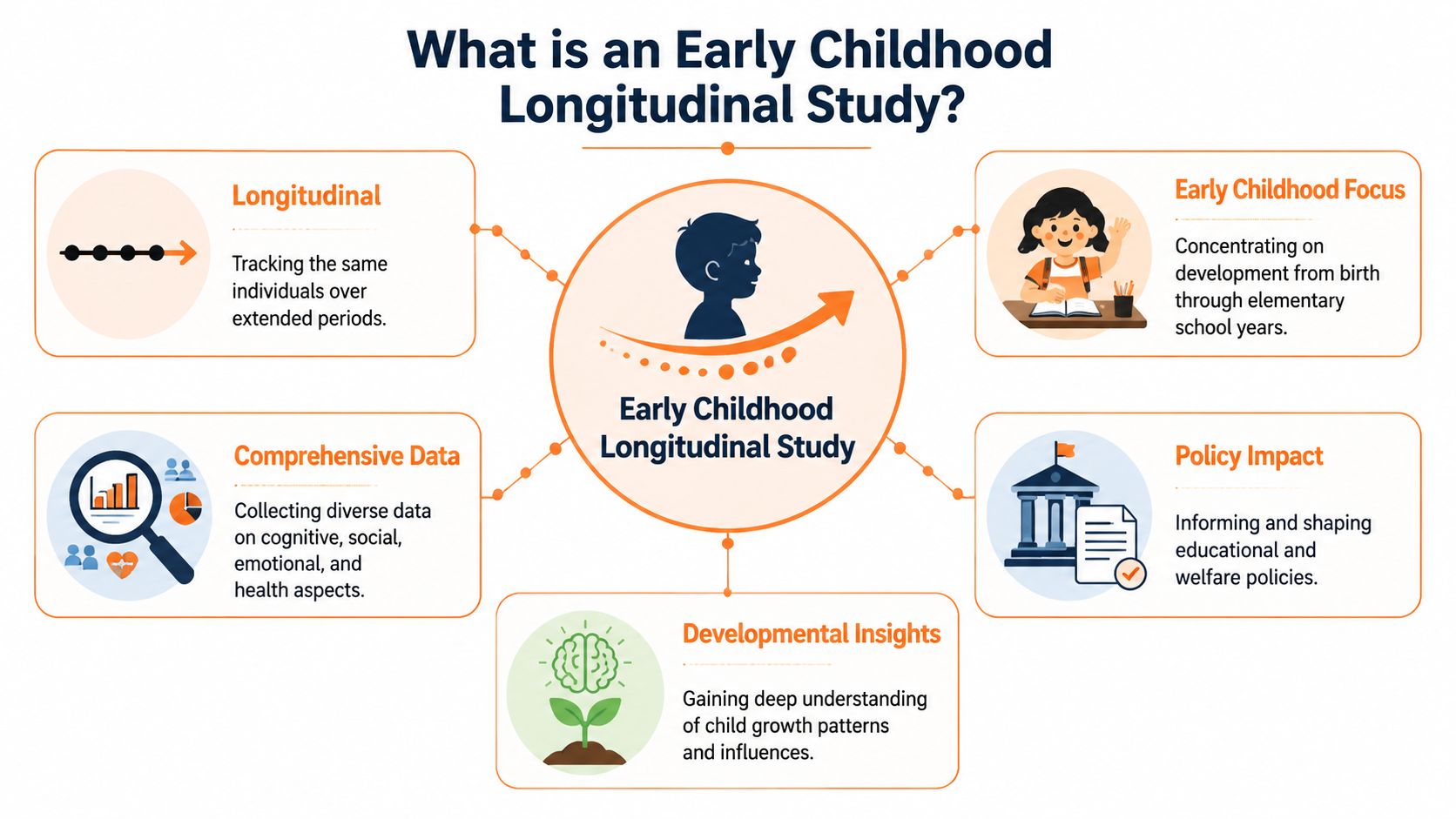
An early childhood longitudinal study is a research design that follows the same children across multiple points in time, usually from birth or school entry into later childhood. Researchers collect repeated information about development and the child's environment, then look for patterns in change.
The movie versus the photograph
The simplest analogy is this:
Study type | Think of it as | What it tells you well | What it misses |
|---|---|---|---|
Cross-sectional | A photograph | How different children compare at one moment | How any one child changed |
Longitudinal | A movie | How the same children develop over time | Less speed and convenience |
A cross-sectional study might compare groups of children at different ages and show that older children, on average, have stronger literacy or self-regulation than younger children. That's useful, but it doesn't show how one specific child travelled from one stage to the next.
A longitudinal study keeps returning to the same children. That allows researchers to notice patterns such as early strengths that remain stable, early challenges that resolve, and small differences that widen with time.
What researchers usually track
These studies tend to gather information across several layers of a child's life. Not every study measures the same things, but the logic is broad and cumulative.
Child development includes cognitive skills, language, behaviour, health, and social-emotional functioning.
Family context includes home routines, caregiver education, stress, and access to resources.
School and care settings include classroom experiences, teaching practices, and transitions.
Community context includes the wider conditions in which children grow up.
This multi-layered design matters because children don't develop in a vacuum. A reading score, for example, doesn't arise only from “ability.” It may reflect sleep, language exposure, hearing, teacher fit, emotional security, and opportunities for practice.
Why professionals should care
For clinicians and educators, longitudinal studies answer a question that short-term practice often can't. Which early signs deserve watchful waiting, and which ones deserve intervention now?
That's the practical power. When you know how development tends to unfold across time, your judgement becomes more calibrated. You can communicate risk more clearly to families, avoid overreacting to temporary fluctuations, and avoid underreacting to persistent patterns.
The value of a longitudinal study isn't that it predicts every child. It's that it teaches us which patterns are common enough to take seriously.
If you remember one idea, make it this. A cross-sectional study tells you where children are. An early childhood longitudinal study helps explain how they got there.
The Architecture of a Landmark Study

Good longitudinal studies look elegant from the outside and complicated underneath. Their usefulness depends on design choices made long before the first family enrols. Three parts do most of the heavy lifting: sampling, measurement, and ethics.
Sampling decides whose story counts
Researchers need a group of children broad enough to reflect the population they want to understand. If they recruit only from one clinic, one school board, or one neighbourhood, they may build a study that is tidy but narrow.
That's why major longitudinal projects usually aim for a nationally representative sample rather than a convenience sample. The gain is breadth. The trade-off is complexity, cost, and logistics.
A practical way to think about sampling is to imagine building a map. If your map includes only cities, you'll make bad decisions about rural roads. If your sample over-represents one kind of family or one type of school, your conclusions may travel poorly.
Measurement decides what change can be seen
After children are enrolled, researchers must decide which metrics to measure repeatedly. This stage determines whether many studies become informative in detail or frustratingly shallow.
The strongest designs don't rely on one global label such as “doing well” or “at risk.” They break development into domains that professionals can act on:
Attention and self-regulation matter because a child has to sustain effort, inhibit impulses, and shift between tasks.
Memory matters because new learning depends on holding and using information.
Executive function matters because planning, monitoring, and cognitive flexibility support both classroom learning and daily functioning.
Language, health, and social-emotional development matter because cognitive performance is always embedded in broader development.
If that sounds familiar to clinicians and school teams, it should. These are the same kinds of domains that make assessment actionable. When a profile shows weak sustained attention but stronger verbal reasoning, for instance, support planning looks different than when the main issue is language comprehension.
For teams designing digital systems or research pipelines, a technical primer like OMOPHub's guide for developers on OMOP studies can be helpful because it shows how cohort design choices shape what downstream analysis can and can't support.
Ethics decides whether the study deserves trust
Longitudinal research with children only works if families trust the process. Researchers are asking for repeated contact, sensitive information, and long-term participation. That creates ethical obligations that are much heavier than in a one-time survey.
A responsible study needs to protect privacy, obtain proper consent, minimise burden, and avoid turning participation into a stressful experience. It also needs to plan for what happens when family circumstances change.
Clinical translation: If a study's methods would feel intrusive or unclear to a parent in your office, they're probably too weak ethically.
Why this architecture matters outside research
The architecture isn't just academic. It affects what you can use in real life. If a study measured broad school outcomes but not adaptive function, it may be less helpful for therapy planning. If it tracked family context carefully, it may help clinicians avoid blaming the child for patterns rooted in stress, instability, or mismatch between demands and supports.
For practitioners who rely on standardised behaviour and functioning data, it also helps to understand how structured rating systems fit into a developmental picture. A solid overview of the Adaptive Behavior Assessment System 3 is useful here because adaptive behaviour often translates research insight into practical support targets at home and school.
Profiles of Groundbreaking Longitudinal Studies
A paediatrician sees a four-year-old with language delay, sleep disruption, and a parent who is worried but unsure whether the pattern is temporary. A kindergarten teacher sees a child from the same neighbourhood six months later and notices attention problems and weak early literacy. Each professional has one piece of the story. Longitudinal studies matter because they let us see the whole film instead of a single frame.
ECLS-K and the school years
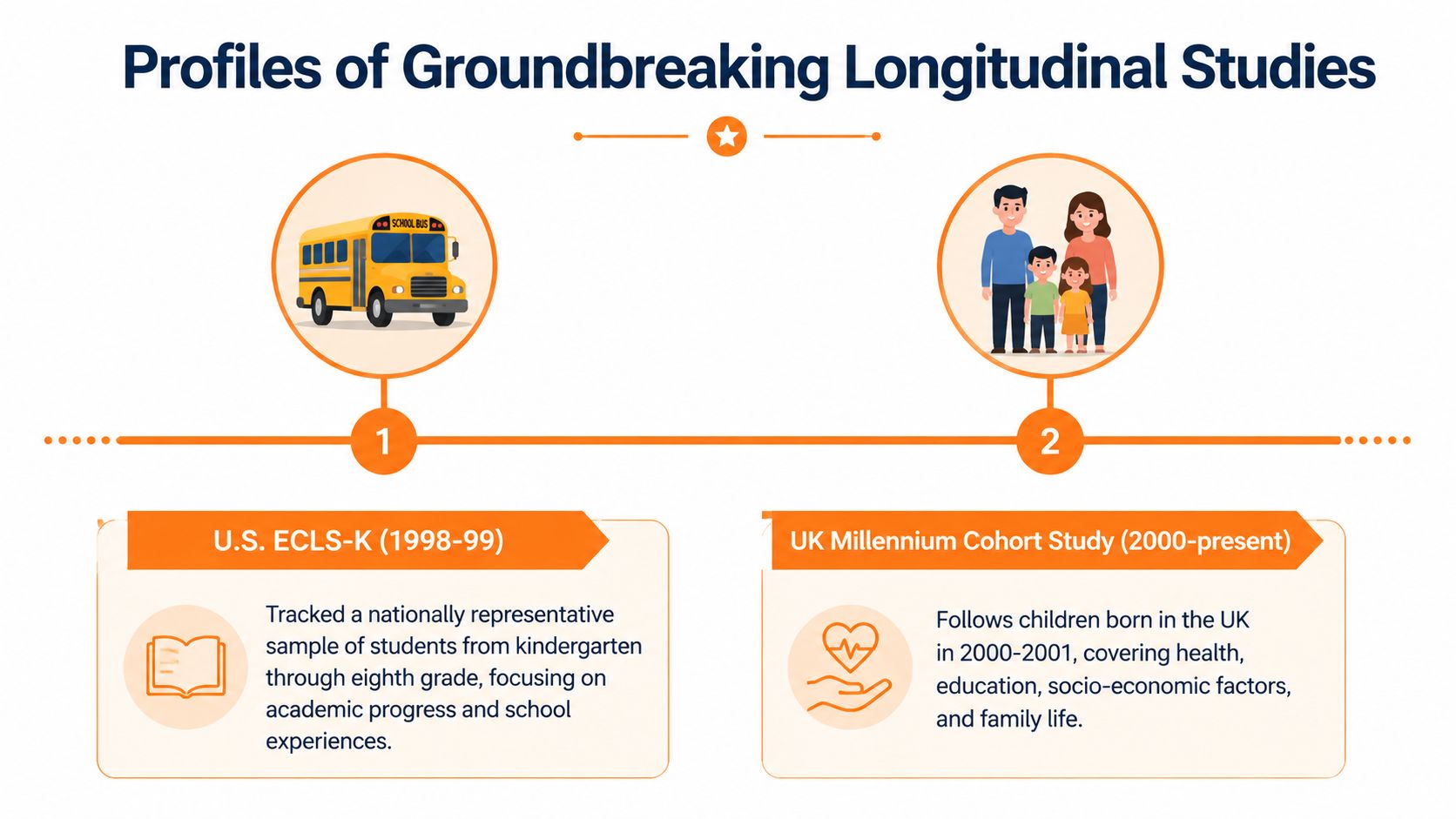
The ECLS-K:1998-99 followed a national sample of children from kindergarten through eighth grade according to the ICPSR series overview. For busy educators and clinicians, the value is straightforward. This study lets you ask a practical question with more confidence: which early school experiences tend to travel with children into later academic, behavioural, and social outcomes?
That matters because child development rarely moves in a straight line. A strong kindergarten year can support later learning, but it does not erase the effects of housing instability, health concerns, or family stress. ECLS-K is useful partly because it treats development like a braided rope. School, family, child characteristics, and community conditions are woven together, and the strength of the strand depends on all of them.
If you work in a classroom, clinic, or product team, that perspective changes decisions. It pushes teachers to look past a single test score. It helps clinicians ask whether a concern shows up across settings. It reminds digital health teams that a child-facing tool built without family and school context will miss part of the developmental picture.
ECLS-B and the earliest years
The ECLS-B tracked children born in 2001 from birth through kindergarten entry, as described in the same ICPSR overview. This cohort is especially useful for clinicians because infancy and toddlerhood are full of fast developmental change. Small differences can be hard to interpret in a single visit. Over repeated assessments, patterns become easier to see.
One of the most useful lessons from ECLS-B is simple: early differences in development and health can widen over a short period, and those differences are often tied to family and social conditions rather than a single child trait. That point helps professionals avoid a common error. A delay seen at 24 months is not just a smaller version of a school-age problem. It may reflect an interaction between biology, caregiving, stress, access to resources, and opportunity to learn.
The practical implication is clear. Waiting passively can cost time during a period when development is highly responsive to support. For a clinician, that may mean earlier follow-up and closer attention to family context. For an educator, it may mean stronger transition planning into preschool or kindergarten. For a digital health builder, it may mean designing screening and coaching tools that flag patterns across domains instead of treating sleep, language, behaviour, and motor concerns as unrelated checkboxes.
Looking beyond one country
The U.S. ECLS studies are not the only landmarks. Other cohorts, including the UK Millennium Cohort Study, have also helped researchers examine how health, caregiving, poverty, education, and policy shape child development over time. The broad lesson across these projects is remarkably consistent. Children do not develop in isolated domains, and early conditions often echo into later functioning.
That consistency is useful in practice. When different longitudinal cohorts point in similar directions, professionals can use the findings with more confidence while still adapting them to local settings and individual children.
Why these studies still matter
A well-built longitudinal study keeps paying dividends long after the original data collection period. Researchers return to these datasets to test new questions, compare methods, and refine developmental models. That gives front-line professionals something more useful than trivia. It gives them better judgment.
Group-level research and individual assessment serve different purposes, but they work best side by side. Longitudinal studies show which patterns deserve early attention. Child-level assessment shows what this child needs today. If your team uses structured academic or cognitive testing, a guide to the Canadian Cognitive Abilities Test for school-based assessment planning can help connect broad developmental evidence with day-to-day decision-making.
A landmark study sharpens your lens. That is why these cohorts still matter in clinics, classrooms, and child-focused technology design.
Challenges and Modern Analytic Approaches

Longitudinal studies are powerful, but they're never neat. Families move. Schools change. Measures evolve. Children mature in ways that make an assessment appropriate one year and awkward the next. If you've ever tried to compare a child's performance across changing tools or changing contexts, you already understand the problem.
The most common source of confusion
Readers often assume that if a study follows children for years, the main challenge is staying organised. A more significant challenge is preserving meaning. Researchers have to decide whether a score at one age is comparable to a score later on, whether missing data distort the pattern, and whether the children who remain in the study differ in important ways from those who leave.
That last issue is attrition. Think of it as a slowly leaking pipe in an otherwise well-built system. The study can still be useful, but only if researchers examine the leak carefully rather than pretending it doesn't exist.
How newer cohorts continue the work
The newest study, ECLS-K:2024, follows the kindergarten class of 2023-24 through fifth grade, as described by Westat's ECLS-K project page. The same source notes that analyses of earlier cohorts show why this matters. One related study found that maternal psychological distress was linked to lower cognitive test scores at age 3 and higher behavioural difficulties.
That kind of result is exactly why longitudinal work remains valuable. It captures how early environmental strain can show up later in development without reducing the child to a diagnosis or the family to a single risk label.
What modern analysis actually does
Researchers now use methods that are designed for messy developmental data. You'll often hear terms like growth curve modelling, multilevel modelling, or latent trajectories. The names can sound forbidding, but the basic idea is simple. Instead of asking only for an average score, these methods estimate a pattern of change.
A useful analogy is paediatric growth charts. Clinicians don't care only about one height point. They care about the line. Longitudinal modelling applies that same logic to cognition, behaviour, health, and schooling.
It handles uneven timing when children aren't assessed on exactly the same day or month.
It uses partial information rather than discarding every child with one missing visit.
It separates child differences from context effects more carefully than simpler approaches.
If you work with repeated assessments, it helps to understand what counts as stable versus noisy measurement. A practical reference on test-retest reliability statistics is useful because repeated data are only informative when the instrument can distinguish real change from measurement wobble.
Method in plain language: Good longitudinal analysis doesn't erase missingness and complexity. It models around them carefully.
From Data to Decisions Using ECLS Insights
The biggest mistake professionals make with longitudinal research is treating it as background reading rather than a decision tool. The point isn't to admire the design. The point is to change what you do on Tuesday morning when a child, parent, or teacher needs an answer.
For clinicians
A longitudinal mindset improves developmental surveillance. It pushes you to ask not just what symptom is present, but how long it has been present, whether it clusters with other concerns, and whether functioning is drifting.
A practical example helps. Suppose a child presents with inattention, weak frustration tolerance, and uneven early language. A single visit may not justify a firm conclusion. But longitudinal evidence teaches you to take clustered concerns seriously, especially when they persist across settings or begin to interfere with adaptive function.
That changes three habits in clinic:
Track patterns, not isolated symptoms. A recurring concern across visits usually tells you more than one dramatic complaint.
Ask about context every time. Sleep, caregiving stress, transitions, and classroom demands can amplify or mask developmental vulnerability.
Communicate uncertainty openly. “We need to watch the trajectory” is often more accurate and more useful than premature reassurance.
For educators
Teachers already think longitudinally, even if they don't use the term. They notice whether a child becomes more independent, less flexible, more avoidant, or more engaged over the term. Longitudinal research strengthens that instinct by showing that early differences can widen when support is delayed or poorly matched.
In schools, the practical question isn't whether data matter. It's which data matter enough to act on. Academic output alone usually isn't enough. You also need observation of regulation, language, participation, transitions, and task persistence.
A child who knows the material but can't sustain effort during group instruction needs a different response than a child who tries hard but doesn't grasp the language demands of the task. Longitudinal thinking prevents those two children from being collapsed into the same category of “struggling learner.”
For product and digital health teams
Early childhood longitudinal study insights become especially useful at this stage. Product teams often focus on usability and engagement first, then ask later whether the tool captures meaningful change. That order should be reversed.
A strong developmental tool should help users answer questions such as:
Product question | Longitudinal lens |
|---|---|
What should we measure? | Measure domains that are likely to change meaningfully and matter for function |
How often should we reassess? | Reassess often enough to detect trend, not just event |
What should reports highlight? | Highlight trajectory, variability, and domain pattern, not just a single score |
Who benefits most? | Identify users whose profiles suggest need for closer monitoring or referral |
For example, if a platform tracks attention, processing speed, memory, and executive function over repeated sessions, it can start to build a small developmental record rather than a one-off performance stamp. That's far more useful to clinicians and educators because they can see whether support is helping, whether inconsistency is decreasing, and whether a referral threshold is approaching.
A simple decision framework
When using insights from longitudinal research in practice, ask four questions:
Is this concern isolated or clustered?
Is the child stable, improving, or drifting?
Which context variables may be shaping the pattern?
What would we regret delaying?
That last question is often the best one. If support is low-risk and potentially helpful, waiting for certainty may cost more than acting early.
Longitudinal evidence rarely tells you to panic. It often tells you not to ignore a pattern just because it emerged gradually.
Putting Longitudinal Insights Into Practice
An early childhood longitudinal study gives us something frontline work often lacks. It shows development as a pathway rather than an incident. That shift matters for everyone around children, from paediatric specialists and psychologists to educators, therapists, and teams building assessment tools.
The practical lesson is straightforward. Better child decisions come from better developmental timelines. You need repeated observation, domain-specific measurement, and enough context to tell temporary fluctuation from meaningful change.
If your work involves identifying support needs, monitoring progress, or deciding when further evaluation is warranted, it helps to pair broad developmental evidence with tools that organise real-world assessment data clearly. A useful starting point is this guide to assessments for learning disabilities, which helps connect assessment choices to practical educational and clinical decisions.
The professionals who make the best calls for children usually aren't the ones chasing dramatic findings. They're the ones who can see patterns early, interpret them carefully, and act before small gaps become entrenched.
If you want to see how these longitudinal principles can be applied in day-to-day practice, explore Orange Neurosciences. Its platform is built to support rapid, structured cognitive assessment and ongoing tracking, helping clinicians, educators, and care teams turn developmental insight into clearer next steps.

Orange Neurosciences' Cognitive Skills Assessments (CSA) are intended as an aid for assessing the cognitive well-being of an individual. In a clinical setting, the CSA results (when interpreted by a qualified healthcare provider) may be used as an aid in determining whether further cognitive evaluation is needed. Orange Neurosciences' brain training programs are designed to promote and encourage overall cognitive health. Orange Neurosciences does not offer any medical diagnosis or treatment of any medical disease or condition. Orange Neurosciences products may also be used for research purposes for any range of cognition-related assessments. If used for research purposes, all use of the product must comply with the appropriate human subjects' procedures as they exist within the researcher's institution and will be the researcher's responsibility. All such human subject protections shall be under the provisions of all applicable sections of the Code of Federal Regulations.


© 2026 by Orange Neurosciences Corporation