Assessments for learning disabilities: A Practical Guide to Evaluation
Jan 30, 2026
Figuring out the world of assessments for learning disabilities can feel like a lot to take on. But it all starts with one simple question: why does this student need an evaluation? Getting to the heart of that question is the only way to pinpoint specific challenges and unlock the right support, making sure every student has a fair shot at success. This guide is here to provide actionable insights and practical examples to walk you through it.
Your First Steps in Understanding Learning Disabilities
Picture a student who is bright, curious, and a fantastic contributor to class discussions. Yet, when it's time to write, their thoughts just don't make it to the page. Or maybe they spend hours studying for spelling tests only to fail them time and again. It’s a story many parents and educators know all too well.
It's easy to see these struggles and assume it's about a lack of effort. But more often than not, the real issue is a fundamental difference in how that student's brain processes information.
A learning disability has absolutely nothing to do with how smart someone is. It's simply a term for when the brain is wired differently for learning specific skills—whether that's reading, writing, or math. That's why formal assessments are so critical. Think of them as a GPS for a complex journey; they give you a clear map to understanding and, ultimately, to effective support.
Demystifying the Assessment Journey
The goal here isn't just to get a diagnosis or a label. It's about gathering targeted information to answer very specific questions. You can think of it like a visit to the doctor's office. One test might check for allergies, while another looks at heart function. In the same way, different educational assessments are designed to look at distinct cognitive areas.
This journey usually unfolds in a few key stages:
Initial Observation: It starts by noticing a gap between a student's obvious potential and what they're actually achieving in the classroom.
Seeking Expertise: The next step is talking it through with teachers, school psychologists, or private clinicians who can offer professional insight.
Formal Evaluation: This is where specific tools are used to measure cognitive abilities and academic skills.
Actionable Plan: The results are then translated into a practical plan of support, like classroom accommodations or targeted interventions.
This structured approach is so important because learning disabilities are more common than most people think. They actually make up the largest category of special education enrolment. According to 2022–2023 data, California students with specific learning disabilities totalled 279,110, which is about 37 percent of all students receiving special education services.
The goal of an assessment is not to find what's "wrong" but to discover how a student learns best. It transforms confusion into clarity, providing a blueprint for building a supportive educational environment where every student can thrive.
Understanding this process empowers you to be a better advocate. It shifts the focus away from frustration and toward a proactive search for solutions. For those who want to get a head start on one of the most comprehensive evaluation types, you can learn more about what a neuropsychological assessment involves in our detailed guide. In the sections that follow, we'll break down each type of assessment so you can move forward with confidence.
Breaking Down the Four Types of Assessments
Trying to figure out which assessment for learning disabilities is the right one can feel overwhelming. It helps to think of it like a careful investigation. You wouldn't use a microscope to look at a star, and you wouldn't grab a telescope to examine a cell. In the same way, each type of assessment is a specific tool designed to answer a different, vital question about a student's unique learning profile.
Let's walk through the four main types you'll come across: Screening, Diagnostic, Neuropsychological, and Curriculum-Based assessments. Each plays a distinct role in building a complete picture of a learner's strengths and challenges.
Screening Assessments: The Smoke Detector
A screening assessment is your first alert. Think of it as a smoke detector: it's quick, efficient, and designed to let you know there might be a problem. It won’t tell you where the fire is or what caused it, but it signals that something needs a closer look.
These screeners are usually brief and given to large groups, like an entire grade level. They use standardized benchmarks to quickly flag students who might be at risk for a learning disability.
Who Performs It: Often administered by classroom teachers or school support staff.
When It’s Used: Right at the beginning when a general concern pops up, or as part of a school-wide prevention strategy.
Practical Example: A school might use a 10-minute digital reading screener for all second graders in September. The results quickly show which students are behind in foundational skills and may need further evaluation.
This proactive approach is rightfully gaining traction. California, for instance, has made major policy changes acknowledging that one in five children has a learning disability. Following the 2023 Education Omnibus Budget Trailer Bill, schools across the state must now universally screen for reading difficulties once a year from kindergarten through Grade 2. This mandate is fundamentally shifting how early literacy intervention is handled.
Diagnostic Assessments: Pinpointing the Source
If a screening tool sounds the alarm, a diagnostic assessment is the next logical step. Now, you’re calling in the specialist to find the exact source of the smoke. This is a much more focused, in-depth evaluation designed to either confirm or rule out a specific learning disability.
Instead of a broad sweep, diagnostic assessments use targeted, one-on-one tests to measure specific skills. For example, if dyslexia is on the table, the evaluation will zero in on areas like phonological awareness, decoding, and reading fluency. The results give you detailed data on how a student is performing compared to their peers. You can explore our guide on the Wechsler Individual Achievement Test for an example of a common tool used in these evaluations.
A diagnostic assessment moves beyond asking if there is a problem to defining what the problem is. Its goal is to provide a specific diagnosis that can guide targeted support and interventions.
Neuropsychological Assessments: The Brain's Blueprint
Sometimes, learning challenges are more complex, tangled up with other factors like attention, memory, or executive functioning. This is where a neuropsychological assessment comes in. It’s the deepest dive you can take, like getting a detailed blueprint of the brain’s wiring to see how different cognitive systems are working together.
This comprehensive evaluation looks far beyond just academic skills. It examines a wide range of brain functions:
Executive Functions: Skills like planning, organising, and self-control.
Attention and Concentration: The ability to focus and stick with a mental task.
Memory: Both short-term (working memory) and long-term recall.
Processing Speed: How quickly someone can take in and use information.
Visual-Spatial Skills: The ability to make sense of what you see.
This type of assessment is essential when you need to understand the why behind a student’s struggles, especially when the picture is muddled or multiple issues might be at play, like co-occurring ADHD and a learning disability.
This simple hierarchy shows the logical flow: a concern leads to assessment, which in turn leads to tailored support.
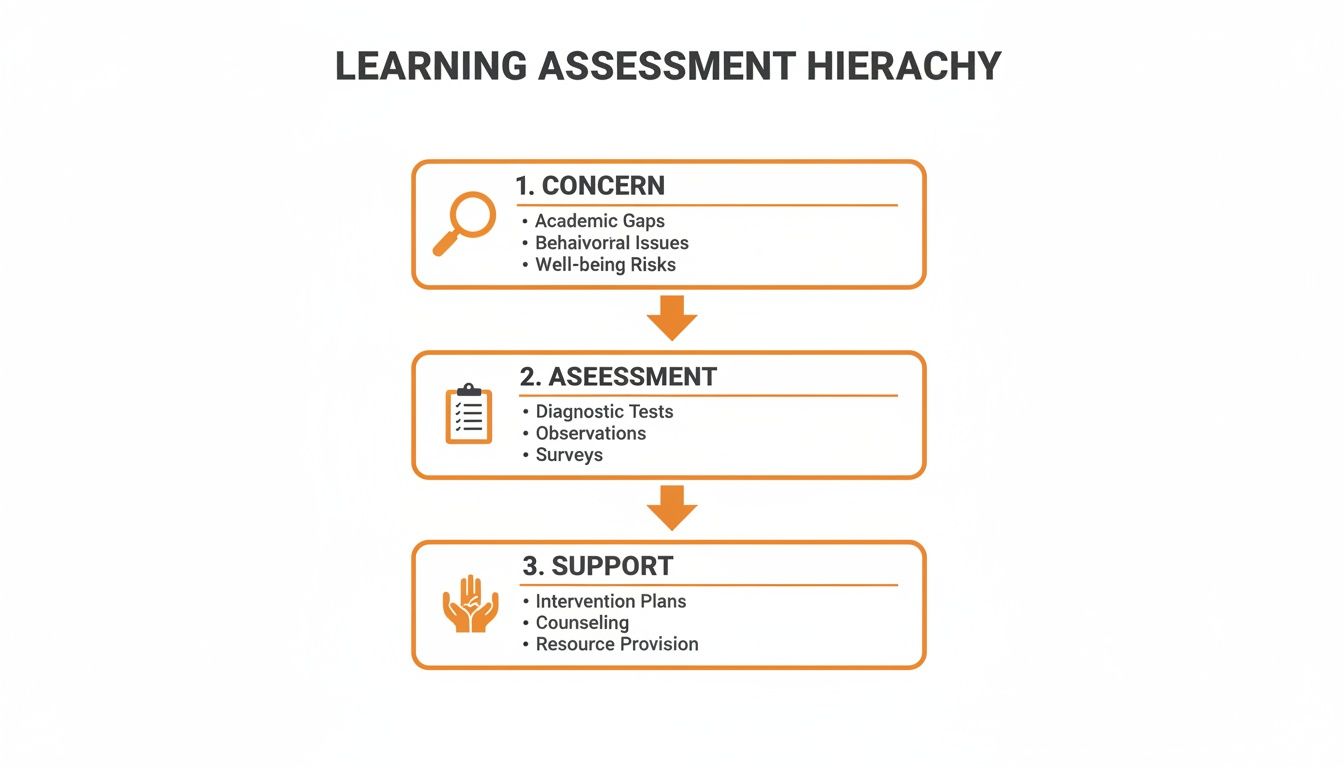
The visual makes it clear that evaluation is the critical bridge between identifying a challenge and providing effective help.
Curriculum-Based Assessments: The Real-World Check
Finally, Curriculum-Based Measurement (CBM) brings the assessment right back into the classroom. While other tests compare a student to a national average, CBM measures their progress directly within their school's own curriculum. It's a real-world performance check.
Think of it this way: a diagnostic test might show a student has the underlying skills to read, but a CBM will show if they can actually read and understand their science textbook. Teachers use short, frequent checks—like one-minute reading fluency passages or quick math problem sets—to track progress over time.
This approach is incredibly practical. It gives educators immediate feedback on whether their teaching strategies are working and allows for quick, on-the-fly adjustments to a student’s support plan.
Comparing Assessments for Learning Disabilities
To make things clearer, here’s a quick breakdown of how these four assessment types stack up against each other. Each has a specific job to do in the journey toward understanding and supporting a learner.
Assessment Type | Primary Purpose | Administered By | When It Is Used |
|---|---|---|---|
Screening | To quickly identify students who may be "at risk" for a learning disability. | Classroom Teachers, Support Staff | At the very beginning of a concern or as a school-wide preventative measure. |
Diagnostic | To provide a formal diagnosis of a specific learning disability (e.g., dyslexia, dyscalculia). | School Psychologists, Educational Diagnosticians | After a screening suggests a potential issue, to confirm and specify the problem. |
Neuropsychological | To understand the relationship between brain function and learning/behaviour. | Neuropsychologists | When learning challenges are complex, co-occur with other conditions (like ADHD), or don't have a clear cause. |
Curriculum-Based | To monitor a student's academic progress within the specific school curriculum. | Classroom Teachers, Special Educators | On an ongoing basis in the classroom to check if interventions are working and to guide instruction. |
From the broad sweep of a screener to the detailed blueprint of a neuropsychological evaluation, these tools work together to build a complete, actionable understanding of a student’s needs. Knowing the difference empowers you to ask the right questions and advocate for the right evaluation at every stage.
Navigating the Assessment Process Step by Step
Starting the assessment process for a learning disability can feel like being handed a compass without a map. It's a journey filled with questions and uncertainty. But when you break it down into clear, manageable steps, the path forward becomes much clearer. This section is your practical roadmap, guiding you through the five key stages, from that first gut feeling that something isn't quite right to building a powerful, actionable support plan.
Think of this as your guide. Each stage naturally flows into the next, giving you the information and confidence needed to support your child effectively.
Stage 1: Recognizing the Signs
Every assessment journey starts with simple observation. It begins when a parent, a teacher, or even the student themselves notices a persistent gap between their obvious potential and how they're actually performing. These aren't just one-off bad days; they're consistent patterns that hint at a deeper challenge.
Catching these signs early is the key to getting timely support. Be on the lookout for common indicators that might suggest it's time to seek an assessment.
Common Academic and Behavioural Indicators:
Reading and Writing: A real struggle with sounding out words, poor reading comprehension, messy handwriting, or difficulty getting thoughts organised on paper.
Mathematics: Trouble with basic math facts, understanding concepts like time and money, or getting stuck on multi-step problems.
Attention and Organisation: Difficulty staying focused, constantly losing belongings, struggling to follow instructions with multiple steps, or poor time management.
Social and Emotional: Unexpected frustration or meltdowns over schoolwork, low self-esteem, or actively avoiding tasks they find difficult.
Actionable Insight: Start a simple log on your phone or in a notebook. Jot down specific examples with dates, such as "March 15: Took two hours to complete a 10-problem math worksheet; cried in frustration." This data will be invaluable when you talk to the school.
Stage 2: The Initial Consultation
Once you've noted your concerns, the next step is to talk to someone. This initial consultation is all about sharing what you've seen with the right people—whether that's your child's teacher and the school support team or an independent clinical professional.
Go into this meeting prepared. Instead of saying, "He's bad at math," be specific: "He gets addition, but when he has to carry numbers over in bigger problems, he completely loses his way." Details like this paint a much clearer picture for the professionals. A crucial part of this stage is also ensuring you have all the necessary permissions in place. For a clear guide on this, you might want to review how to properly set up a digital consent form.
Stage 3: The Formal Evaluation
If the consultation leads to a recommendation for an evaluation, the formal testing process begins. This part can sound intimidating, but it doesn't have to be. The evaluation isn't just one big test; it’s a series of different activities designed to measure specific cognitive and academic skills.
It's helpful to explain to your child that this isn't about passing or failing. It’s about figuring out how their brain learns best. The sessions are usually one-on-one with a trained professional in a quiet space and might be spread over a few days to keep them from getting tired. The activities can feel like puzzles, games, or even regular schoolwork, all aimed at mapping out their unique learning profile.
Stage 4: Understanding the Results
After the evaluation, the professional scores the assessments and puts together a detailed report. Then comes the feedback session, where you sit down to go over the findings. This is your chance to ask every question you have and truly grasp what the results mean.
Don't hesitate to ask for things to be explained in plain language. Terms like "percentile rank" or "standard score" can be confusing, but they're important. A good evaluator will connect those numbers back to the real-world struggles you've been seeing at home and in the classroom.
The feedback session is where data becomes a story. It translates scores and statistics into a narrative about your child’s unique strengths and challenges, providing the clarity needed to build an effective support system.
Stage 5: Developing the Support Plan
This is the most critical stage of all: turning the results into action. The evaluation report isn't the finish line—it's the starting block for providing real, meaningful support.
This plan often becomes an Individualized Education Program (IEP) or a 504 Plan within the school system. These are formal documents that spell out exactly what supports will be put in place.
Accommodations are adjustments to the learning environment. Think extended time on tests or access to audiobooks. They level the playing field so a student can show what they really know.
Interventions are targeted, specialized teaching designed to build specific skills. A structured literacy program for a student with dyslexia is a perfect example.
This five-step process transforms concern into clarity and, ultimately, into a targeted plan for success. To see how our unique, evidence-based approach helps families on this journey, learn more about how we work at Orange Neurosciences.
Turning Assessment Results Into an Action Plan
Getting a detailed assessment report can feel like someone just handed you a complex scientific paper. It's packed with scores, charts, and technical jargon that can look pretty intimidating at first glance. But that report isn't the finish line; it’s the blueprint for building a targeted, effective support system for a student. The real magic happens when you turn those findings into a clear, practical action plan.

The first step is to cut through the clinical language. You'll see terms like standard scores and percentile ranks, which are just ways of comparing a child’s performance to a large, standardized group of their peers. For instance, a percentile rank of 25 simply means the student scored as well as or better than 25% of their peers, while 75% of students scored higher.
These numbers are objective, but the real story is in the cognitive domains they represent.
Connecting Data to Daily Challenges
A truly useful assessment report connects the dots between test scores and the real-world difficulties a child is facing. It goes beyond the numbers to explain why certain tasks are so hard. Let's break down how results in a few key cognitive domains show up in everyday life.
Working Memory: Think of this as the brain's "sticky note" system—it’s where information is held and worked on for a short time. A low score here can explain why a student can’t seem to follow multi-step instructions or forgets what they just read in a paragraph.
Processing Speed: This is all about how quickly a student can take in and make sense of information. Slower processing speed doesn't mean a student is less intelligent; their brain just needs a bit more time to get the job done. This is often why they can’t finish tests on time, even when they know the material inside and out.
Recent results from the 2023–24 California Assessment of Student Performance and Progress (CAASPP) show that achievement gaps are still a major issue, with only 47% of students meeting English language arts standards. While students with disabilities did see small gains, the data highlights an urgent need for tools that create objective cognitive profiles to guide effective support. These detailed assessments are key to figuring out who just needs a few instructional tweaks and who needs more comprehensive help. For a deeper dive, you can explore the CAASPP results and their implications for student support.
Building the Support Plan: Accommodations and Interventions
Once you understand the "why," you can build the "how." This action plan relies on two main tools: accommodations and interventions. They might sound similar, but they do very different jobs.
An accommodation changes how a student learns, removing barriers so they can access the same curriculum as their peers. An intervention changes what is taught, directly targeting and building a weaker skill.
Imagine a student's report shows a significant weakness in processing speed. This makes it incredibly difficult for them to take notes while also listening to a lecture.
A Practical Example of an Action Plan
Let's say an assessment reveals a standard score of 78 in processing speed (well below the average of 100) and a notable weakness in working memory.
Connect the Data: The evaluator explains that this profile makes it tough for the student to listen, process what's being said, and write it all down simultaneously. That's why their notes are patchy and they often miss important details in class.
Identify Accommodations: To remove this immediate barrier to learning, the support plan could include:
Getting a copy of the teacher's notes before class.
Permission to audio-record lectures to review later.
Extended time on tests and major assignments.
Identify Interventions: To build the underlying skills over time, the plan might recommend:
Targeted cognitive training games that focus specifically on improving working memory.
Explicit instruction in note-taking strategies, like using abbreviations, symbols, and templates.
This process transforms a confusing list of scores into a powerful toolkit. It gives you the evidence you need to advocate for specific, data-driven supports that get to the root of a student's struggles, making sure the assessment leads to real, meaningful change.
Ready to see how modern tools can provide the objective data needed to build these powerful action plans? Explore the innovative solutions at Orange Neurosciences to see how we help create clear cognitive profiles that lead to effective support.
The Power of Digital Cognitive Assessments Today
Technology is completely changing how we approach assessments for learning disabilities. The traditional route often means long wait times and multiple appointments, a frustrating process that can leave families and educators feeling stuck in limbo. But a new generation of digital cognitive assessment platforms is making the entire evaluation process faster, more objective, and far more accessible.
This shift takes us from a lengthy, drawn-out process to one of genuine efficiency and clarity. Instead of waiting months for an initial evaluation, a digital screener can deliver powerful, data-driven insights in as little as 30 minutes. That speed isn’t just about convenience—it’s about getting crucial answers sooner so the right support can be put in place right away.
Faster Insights and Objective Data
The biggest advantage of these digital tools is the immediate delivery of objective data. While valuable, traditional assessments often rely heavily on observation and subjective interpretation, which can sometimes lead to inconsistencies. Digital platforms take out the guesswork by using standardized, game-like activities to measure very specific cognitive skills.
These platforms can precisely measure key areas like:
Attention: The ability to stay focused on a task.
Memory: How well the brain encodes, stores, and brings back information.
Processing Speed: How quickly a person can perceive and react to information.
Executive Functions: Higher-level skills like planning, organising, and problem-solving.
By capturing thousands of data points in a short session, these platforms build a reliable cognitive profile. This data-first approach helps educators and clinicians see if a full, formal evaluation is truly necessary, saving time and resources for everyone.
For a deeper look into the specifics of these tools, you can learn more about how a cognitive assessment online provides the initial data needed to guide your next steps.
From a One-Time Snapshot to Ongoing Monitoring
Another huge benefit is the ability to easily track progress over time. A traditional neuropsychological report is a snapshot—a detailed picture of a student’s cognitive functioning at one specific moment. It's absolutely essential for diagnosis, but it isn’t practical for frequent reassessment.
This screenshot from the Orange Neurosciences platform shows how engaging, game-based activities are used to gather cognitive data. The clean, child-friendly interface is designed to make the assessment experience feel less like a test and more like play, which encourages genuine engagement and yields more accurate results.
Digital tools, on the other hand, are built for ongoing use. Their engaging, game-like format makes them perfect for monitoring how a student is doing after an intervention has been introduced. An educator can quickly run a follow-up screening to see if a new reading program is actually strengthening working memory, or if certain accommodations are having the intended effect.
This allows for a dynamic, responsive approach to support. Instead of waiting a year—or even three—for a formal re-evaluation, adjustments can be made almost in real-time, all based on objective performance data.
While these screeners are not a substitute for a comprehensive diagnostic evaluation performed by a qualified professional, they serve as a vital first step. They arm parents and educators with the concrete data needed to have more productive conversations and build smarter, more effective support plans right from the start.
Common Questions About Learning Disability Assessments
When you're trying to figure out the world of learning disability assessments, a lot of questions pop up. Getting clear, straightforward answers can make all the difference, helping you feel confident you're on the right path. Let's tackle some of those lingering uncertainties with practical, real-world information.
How Long Does the Assessment Process Take?
There's no single answer here—it really depends on the type of evaluation. A digital screening, for example, is designed for speed and can give you a valuable first look at the data in under 30 minutes.
A full, comprehensive evaluation, on the other hand, is a much deeper dive. Think of it as a multi-stage project: it starts with an initial consultation, moves into several hours of direct testing (often broken up into a few sessions so nobody gets tired out), and is followed by professional scoring and analysis. The whole thing wraps up with a feedback meeting to go over the findings. From the first phone call to getting that final report in your hands, the entire journey can take anywhere from a few weeks to several months. It all hinges on the professional's availability and how complex the evaluation needs to be.
Accommodation Versus Intervention
You'll hear these two terms a lot, often in the same sentence, but they mean very different things. Both are crucial parts of a support plan, and knowing the difference is key to advocating effectively.
An accommodation changes how a student gets information or shows what they know. It’s all about levelling the playing field. For example, a student with dyslexia might get audiobooks for their history class. They're still learning the same history, but the barrier of reading has been removed.
An intervention is a specific, targeted strategy meant to actually build a skill. For that same student, an intervention might be one-on-one instruction with a structured literacy program. The goal here isn't just to get around the reading difficulty but to directly improve their decoding and fluency skills.
A truly useful assessment report will recommend both: accommodations for immediate access to learning and interventions for long-term skill building. You can find more details on the kinds of tests for reading that help clinicians make these recommendations.
Can You Get a Diagnosis Outside of School?
Yes, you absolutely can. Schools conduct evaluations to figure out if a student is eligible for special education services under specific laws. But you always have the option to seek a private evaluation from a qualified professional, like a neuropsychologist or an educational psychologist.
Many families go this route. Sometimes they're looking for a second opinion, or they want a more comprehensive look at cognitive functions that go beyond academics. Other times, it's simply a way to get answers faster than the school system might be able to move. That private diagnostic report can then be brought to the school to help create an effective educational plan, like an IEP or 504 Plan.
How Often Should Reassessments Happen?
Legally speaking, students with an IEP must be formally re-evaluated at least once every three years. This is often called a triennial review, and its purpose is to see if they still qualify for and need special education services.
But that doesn't mean you should just wait three years to see how things are going. The best approach involves ongoing progress monitoring. Modern tools, especially digital cognitive screeners, make it possible to do much more frequent, informal check-ins. This gives you real-time data to see if the support plan is working, allowing for quick adjustments to interventions as a student's skills grow and change.
Think of the assessment process as the first, most important step toward unlocking a student's full potential. With the right data in hand, you can build a system of support that turns their challenges into their greatest strengths.
At Orange Neurosciences, our mission is to provide the objective, data-driven insights you need to make those big decisions with confidence. Our rapid digital cognitive assessments help pinpoint specific areas of need, so you can build targeted and effective action plans right from the start.
Discover how Orange Neurosciences can bring clarity to your assessment journey.
Orange Neurosciences' Cognitive Skills Assessments (CSA) are intended as an aid for assessing the cognitive well-being of an individual. In a clinical setting, the CSA results (when interpreted by a qualified healthcare provider) may be used as an aid in determining whether further cognitive evaluation is needed. Orange Neurosciences' brain training programs are designed to promote and encourage overall cognitive health. Orange Neurosciences does not offer any medical diagnosis or treatment of any medical disease or condition. Orange Neurosciences products may also be used for research purposes for any range of cognition-related assessments. If used for research purposes, all use of the product must comply with the appropriate human subjects' procedures as they exist within the researcher's institution and will be the researcher's responsibility. All such human subject protections shall be under the provisions of all applicable sections of the Code of Federal Regulations.


© 2026 by Orange Neurosciences Corporation