A Clinician's Guide to the Dyslexia in Adults Test
Feb 1, 2026
A formal dyslexia in adults test isn't just a reading quiz. It’s a specialized assessment run by a qualified professional, designed to get to the root of the cognitive patterns that point to dyslexia. Think of it as a deep dive into how your brain handles language, memory, and information, finally bringing actionable clarity to lifelong challenges.
Uncovering the Need for a Dyslexia in Adults Test
Many adults make their way through life with a nagging feeling that certain things are just… harder for them. It’s common to internalize these struggles, blaming a lack of intelligence or effort instead of recognising an underlying neurological difference. The decision to finally seek out a formal dyslexia test is rarely a sudden one. It's usually the result of years of quiet frustration and specific, recurring roadblocks that just can't be ignored anymore.

Often, the tipping point comes when the old coping mechanisms just aren’t cutting it anymore. A demanding new job, the pressures of higher education, or growing family responsibilities can suddenly make it impossible to keep up.
Real-World Triggers in the Workplace
In a professional setting, the signs of undiagnosed dyslexia can be subtle but have a major impact. This isn’t about being unable to read; it's about the speed and accuracy of processing written information under pressure.
The Misinterpreted Email: An employee consistently misses crucial details in long email chains, leading to project mix-ups. For example, they read an email about a deadline change but their brain doesn't flag the new date, causing them to miss it. They see the words, but synthesizing the key points quickly just doesn't happen.
The Avoided Report: A manager who is a brilliant verbal communicator constantly puts off or delegates writing detailed reports. The task of organizing thoughts, structuring paragraphs, and checking for errors feels monumental, so they find any reason to avoid it.
The "Careless" Mistake: An otherwise meticulous professional makes frequent spelling or grammar errors in crucial documents, such as writing "manger" instead of "manager," even after running spell-check multiple times.
These scenarios often spiral into performance anxiety, missed promotions, and a constant feeling of professional stress. The impact is huge, especially when you consider that 15% to 20% of people may have dyslexia, creating persistent barriers in their careers.
Academic and Personal Life Challenges
The reasons for seeking a dyslexia test extend far beyond the office. A university student might ace their oral exams and shine in class discussions but consistently bomb written tests and essays. At home, someone might wrestle with something as simple as organizing a shopping list, following a multi-step recipe, or keeping the family schedule straight.
An assessment is not a label of limitation; it is a map. It provides the coordinates to understand your own cognitive landscape, allowing you to navigate your strengths and find pathways around the challenges.
Ultimately, adults seek a dyslexia test for one simple reason: clarity. A diagnosis validates their lived experience, reframing a lifetime of struggle as a difference in brain wiring, not a personal failing. This understanding is the critical first step toward accessing effective strategies and support. Many adults pursue a diagnosis to better understand their learning profile and access appropriate services, such as those available for NDIS participants.
Screening vs. Diagnostic Testing: What Clinicians Need to Know
For any adult wondering if they might have dyslexia, the path forward can seem confusing. It typically involves two distinct stages: a screening and a full diagnostic test. Understanding the difference is crucial for a smooth and effective clinical process.
Think of it like this: a quick blood pressure check at a local pharmacy is a screener. It’s fast, accessible, and can flag a potential issue. But if the numbers are high, you’re sent to a cardiologist for a full workup—the diagnostic evaluation. One detects a signal, the other investigates it thoroughly.
Knowing when to use each tool is key to guiding adults from their initial concerns to a clear, helpful outcome without wasting time or resources.
The Role of a Dyslexia Screener
A dyslexia screening is the first quick check. Its job isn't to give a diagnosis, but to see if an individual shows the cognitive patterns commonly linked to dyslexia. It’s a fast, focused way to identify who might benefit from a deeper look.
Modern digital tools make this initial step incredibly efficient. A screener like Orange Neurosciences’ OrangeCheck, for instance, can measure key cognitive areas in under 30 minutes. It gives you objective data on things like processing speed and working memory, quickly highlighting red flags that justify moving forward.
This makes screeners incredibly practical in various settings:
Workplace Accommodations: An HR manager can use a screener to better understand an employee’s reported struggles before committing to a full, costly assessment.
University Support Centres: An accessibility advisor can use screening data to build a strong case for referring a student for formal diagnostic testing.
Primary Care: A family doctor can use a screener to gather preliminary evidence when a patient mentions lifelong difficulties with reading and writing.
When to Move to a Full Diagnostic Test
While a screener points to a possibility, a diagnostic test confirms it. This is the comprehensive, deep-dive evaluation required to officially determine if someone has dyslexia. It’s also critical for ruling out other conditions that can look similar, like ADHD or anxiety.
This process is far more involved and must be handled by a trained professional. For this level of evaluation, adults will need to see qualified psychologists who specialize in learning disabilities. A full assessment includes a detailed personal history, a battery of standardized tests, and careful clinical observation.
To help clarify the difference, here’s a simple breakdown:
Screening Tools vs. Diagnostic Assessments for Adult Dyslexia
Attribute | Dyslexia Screening (e.g., OrangeCheck) | Full Diagnostic Assessment |
|---|---|---|
Primary Purpose | To identify at-risk individuals quickly and affordably. | To provide a definitive clinical diagnosis and detailed cognitive profile. |
Who Conducts It | Can be administered by educators, HR professionals, or primary care providers. | Must be conducted by a licensed psychologist or qualified specialist. |
Time Commitment | Typically under 30 minutes. | Several hours, often spread across multiple sessions. |
Process | Often a digital, standardized questionnaire or series of cognitive tasks. | In-depth clinical interview, client history, and a battery of standardized tests. |
Outcome | A risk score or report indicating the likelihood of dyslexia. | A comprehensive diagnostic report detailing cognitive strengths and weaknesses. |
Next Step | Provides data to justify a referral for a full diagnostic assessment. | Forms the basis for legal accommodations (work/school) and tailored support plans. |
In short, the two work together to create a clear and logical pathway for adults seeking answers.
A screener asks, "Are there signs that suggest dyslexia might be present?" A diagnostic assessment answers, "Does this person meet the specific criteria for a dyslexia diagnosis, and what is their unique cognitive profile?"
The detailed report from a full diagnostic assessment is what an adult ultimately needs to secure formal accommodations at work or in school. It provides the roadmap for building a personalized support plan, helping them finally get the strategies and tools they need to thrive.
If you’re just starting this journey, a cognitive screening test online is an actionable and effective first step.
Decoding the Key Cognitive Areas in a Dyslexia Test
A thorough dyslexia in adults test isn't just a simple reading exercise. It’s a detailed investigation into the brain's "literacy engine," looking closely at the specific cognitive processes that have to work together to make reading and writing feel effortless. It has nothing to do with intelligence; it's all about figuring out the unique way someone's brain handles language-based information.
Think of it like a mechanic diagnosing a car problem. They don’t just take it for a spin. They pop the hood and check the engine, the transmission, and the electrical system to find the exact source of the trouble. A dyslexia assessment does something similar, isolating and measuring key cognitive skills to build a complete picture.
Phonological Awareness and Decoding
At the very core of reading is phonological awareness. This is the brain’s ability to hear, identify, and play with the individual sounds (or phonemes) inside spoken words. It’s what lets us instantly know that "cat" has three sounds—/k/, /æ/, and /t/—and that swapping the first sound for /b/ creates a new word.
For many adults with dyslexia, this process is anything but automatic. This has a direct knock-on effect on decoding, which is the skill of matching letters to their sounds to puzzle out unfamiliar words.
A practical example is an adult trying to pronounce a new client's name from an email, like "Siobhan." A neurotypical reader might sound it out in a split second, but someone with weaker phonological skills could find it almost impossible to connect those letters to the right sounds. This can lead to real hesitation and anxiety in professional settings, which is why the results of an auditory processing test can offer such crucial insights.
Reading Fluency and Comprehension
Tied directly to decoding are reading fluency and comprehension. Fluency isn't just about reading fast. It's about reading with accuracy, a natural pace, and the right expression. When decoding is a slow, mentally draining slog, fluency takes a massive hit. The brain pours so much energy into just figuring out the words that it has very little left over for understanding the meaning.
A classic experience for adults with dyslexia is getting to the bottom of a page in a report only to realize they have absolutely no memory of what they just read. Their mental bandwidth was completely maxed out by the mechanics of reading, leaving no room for meaning to sink in.
Here's an actionable insight: If this happens to you, try using text-to-speech software. Listening to the report while you follow along with your eyes can free up cognitive resources, dramatically improving your comprehension.
Rapid Naming and Processing Speed
Two other critical areas a dyslexia test will measure are Rapid Automatized Naming (RAN) and overall processing speed. RAN measures how quickly you can name familiar things like letters or colours. It's a test of your brain’s internal filing system—how efficiently can it find and pull up a basic piece of information?
Adults with dyslexia often have slower RAN scores. This isn't a vision problem. It's a bottleneck in the neural pathways that connect a visual symbol with its spoken name.
Here’s how this can play out in the real world:
At work: During a presentation, a team member is asked to quickly read numbers off a spreadsheet. Someone with slower RAN might hesitate, pause, or misread the figures. It’s not because they can't see them, but because that retrieval process is less efficient.
Processing speed is a wider measure of how quickly the brain can take in information, make sense of it, and then respond. This affects much more than just reading; it influences how quickly someone can jot down notes in a meeting.
The Role of Working Memory
Finally, there’s working memory—the brain's mental sticky note. It's your ability to hold and juggle a few pieces of information in your mind to complete a task.
For an adult with dyslexia, a deficit in working memory creates constant frustrations.
Practical Example: A manager gives a three-step verbal instruction: "First, pull last quarter's sales data, then cross-reference it with the marketing report, and finally, email me a summary of the top three trends." An employee with a working memory challenge might only remember the first step, or get the order mixed up. An actionable strategy for this employee is to always carry a notepad and immediately write down multi-step instructions, or to ask the manager to send a follow-up email.
By assessing all of these areas together, a comprehensive dyslexia test creates a detailed cognitive map. It pinpoints exactly where the breakdowns are happening, which is the first and most important step toward building targeted, effective support strategies.
The Clinical Workflow for Adult Dyslexia Assessment
For an adult, navigating the path toward a potential dyslexia diagnosis can feel daunting. That’s why, for clinicians, having a clear and structured process is so important. A well-defined clinical workflow isn't a rigid checklist; it’s a flexible roadmap that provides actionable steps.
This approach transforms uncertainty into a series of logical steps, guiding both the individual and the practitioner from that initial concern all the way to a clear plan forward.
Step 1: Initial Consultation and History Taking
The journey always begins with a conversation. The initial consultation is where you start to piece together the client's story, listening for recurring themes that pushed them to look for a dyslexia in adults test. This is about deeply understanding their lived experience.
Some powerful, open-ended questions to start with include:
"Can you walk me through specific situations at work or in your daily life where you feel frustrated or like you’re falling behind?"
"Tell me about what reading and writing were like for you as a kid. What came easily, and what was a real struggle?"
"Have you found yourself creating workarounds or little tricks to manage things like writing long emails or getting through dense reports?"
This qualitative information provides critical context that no standardized test can capture.
Step 2: Administering a Cognitive Screener
Once you have a good sense of the client's history, the next actionable step is to get objective baseline data—efficiently. This is where a cognitive screener becomes an invaluable part of the toolkit. Modern screeners, like Orange Neurosciences' OrangeCheck, can give you a quick, data-driven snapshot of key cognitive functions in under 30 minutes.
Instead of jumping straight to a lengthy and expensive full evaluation, a screener provides a low-stakes, evidence-based way to spot potential red flags in core areas like working memory or processing speed.
This is where we can see how different cognitive processes are all connected, building on one another from simply processing sounds to reading words and, finally, locking that information into memory.
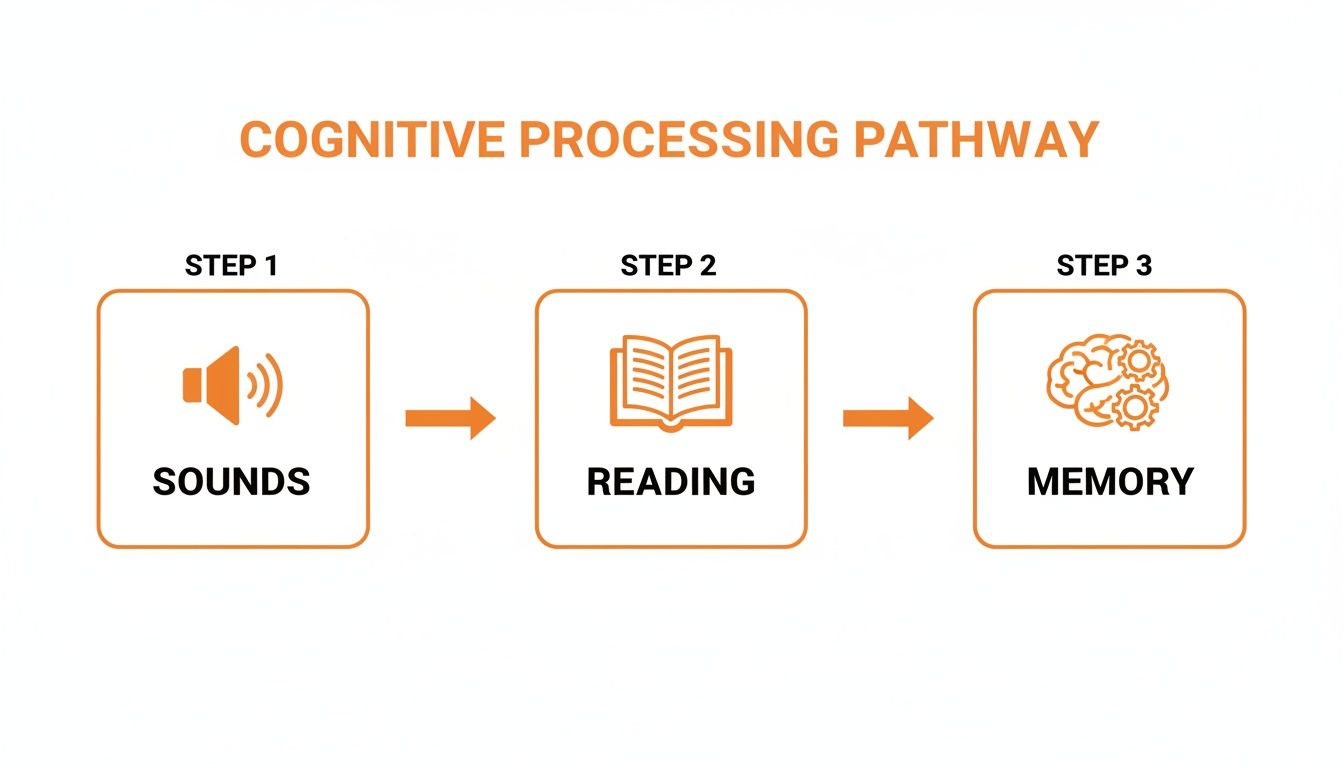
As the image shows, a breakdown at any point along this pathway—say, in how the brain processes sounds—can have a direct domino effect on higher-level skills like fluent reading and memory recall.
Step 3: Interpreting Screener Results and Referral
The screener results arm you with the data you need to make an informed clinical decision. Does the cognitive profile show patterns consistent with dyslexia? Are there significant weaknesses in phonological awareness or rapid naming that demand a closer look?
Armed with this objective data, you can confidently decide whether it's time to refer the client for a full diagnostic evaluation.
This step is absolutely crucial for ethical and efficient practice. It helps you avoid putting clients through unnecessary comprehensive testing while building a strong, evidence-based case for those who truly need it.
This data-driven approach allows you to provide a clear, justified referral to a neuropsychologist, ensuring the client's next step is the right one.
Step 4: The Comprehensive Diagnostic Evaluation
If the screener flags a high probability of dyslexia, a full diagnostic evaluation is the next step. This is the deep-dive assessment, usually conducted by a qualified psychologist, that ultimately leads to a definitive diagnosis.
This multifaceted process typically includes:
A detailed clinical interview that goes much deeper than the initial consultation.
A battery of standardized tests measuring everything from IQ and specific reading skills to memory, processing speed, and phonological abilities.
Careful clinical observation of how the individual actually tackles language-based tasks in real-time.
This comprehensive approach is essential not just to confirm dyslexia but also to rule out any other potential causes. You can learn more about all the components involved in a formal learning disabilities assessment.
Step 5: Delivering the Diagnosis and Final Report
With the evaluation complete, the clinician’s job is to analyze all the pieces of the puzzle and form a conclusion. This is summarized in a detailed report that clearly outlines the client’s cognitive strengths and weaknesses and confirms the diagnosis.
Delivering this news requires both sensitivity and clarity. The goal is to empower the client with a new understanding of themselves, reframing a lifetime of struggles not as a personal failing, but as a neurological difference.
Step 6: Developing a Personalized Intervention Plan
This is the final and most important step: turning the diagnosis into action. A diagnosis without a plan is just a label. Working collaboratively with the client, you can develop a personalized intervention strategy that makes sense for their life.
This plan should be full of actionable support, such as:
Workplace Accommodations: Requesting tools like text-to-speech software or asking for important instructions to be provided in writing.
Targeted Skill Building: Using specific tools to improve weaker areas, like phonological awareness or reading fluency.
Coping Strategies: Learning new methods for organization, such as using a digital calendar with reminders, or time management techniques like the Pomodoro method for tackling large projects.
This structured workflow ensures that every adult is guided through a clear, supportive, and effective process—leading them from uncertainty to empowerment.
Using Objective Data to Enhance Dyslexia Assessment
Modern clinical practice pairs expert judgment with hard, objective data to build a complete picture of an individual's cognitive function. This combination is especially powerful for a dyslexia in adults test, where concrete metrics can bring incredible clarity to the assessment process.
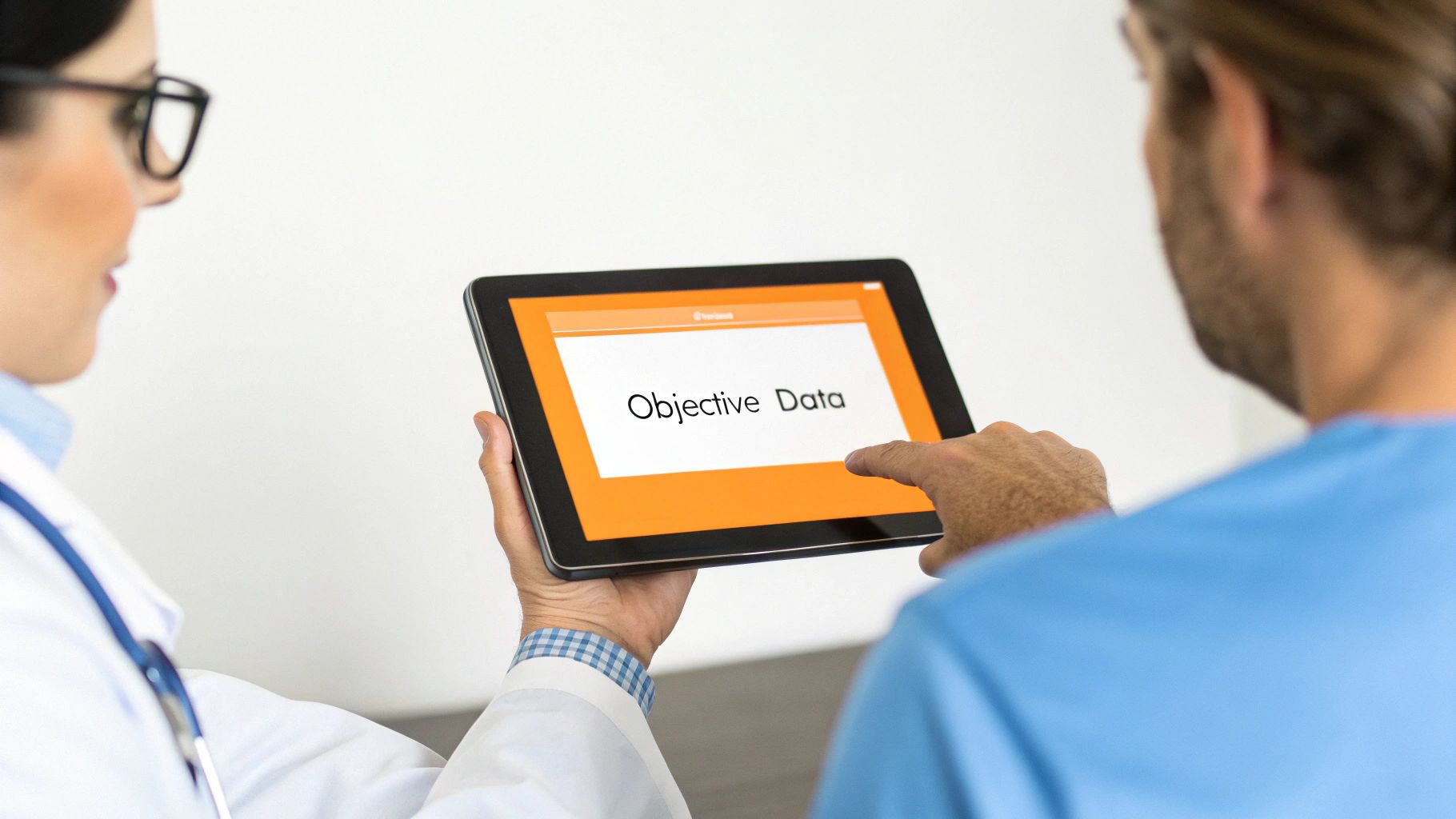
Platforms like Orange Neurosciences are designed to augment—not replace—a clinician’s expertise. By delivering precise, AI-powered measurements of key cognitive skills, they help remove the guesswork from the initial screening, allowing you to base your clinical decisions on reliable data points from the get-go.
Accelerating the Path to Diagnosis
One of the biggest hurdles in adult dyslexia assessment is the time it takes to get from an initial concern to a clear plan. A data-driven approach can dramatically speed up this journey.
Imagine getting a detailed cognitive profile that measures processing speed and working memory in under 30 minutes. That efficiency means you can quickly identify adults who show a cognitive pattern consistent with dyslexia and fast-track them toward the support they need.
Objective data acts as a powerful filter. It helps clinicians quickly distinguish between individuals who need a comprehensive diagnostic evaluation and those whose challenges might stem from other factors, ensuring resources are directed where they are most needed.
For an adult who has struggled for years, sometimes decades, this acceleration can be life-changing.
From Assessment to Actionable Intervention
The value of objective data doesn't stop once a diagnosis is on the table. It flows directly into creating an actionable plan for improvement. This is where tools that connect assessment with training become so invaluable.
For example, a platform like ReadON uses the initial cognitive data to create personalized, game-based training exercises. These are targeted activities built to strengthen the specific skills identified as weak points during the assessment, like phonological processing or reading fluency.
It creates a seamless transition from "What's the problem?" to "Here's what we're going to do about it."
Tracking Progress with Precision
Perhaps the most significant advantage of a data-driven approach is the ability to track progress with objective metrics. This creates a powerful and motivating feedback loop for both the clinician and the individual.
Instead of relying solely on subjective reports like, "I feel like I'm reading a bit better," you can point to concrete numbers that show real change.
Practical Example of Progress Tracking:
Baseline Score: An initial assessment shows an adult's processing speed is in the 25th percentile.
Intervention: They engage in targeted, game-based training for eight weeks.
Reassessment: A follow-up test shows their processing speed has improved to the 45th percentile.
This kind of quantifiable result is incredibly motivating. It provides tangible proof that their hard work is paying off. For clinicians, it validates the intervention plan and provides the data needed to refine strategies. Understanding the consistency of these measurements is key, and you can learn more about the importance of the reliability of test-retest data.
Your Questions on Adult Dyslexia Testing Answered
Taking the first step toward a dyslexia in adults test naturally brings up a lot of questions. This section tackles some of the most common questions head-on, giving you practical answers to move forward with confidence.
Where Can I Find a Qualified Professional for Adult Dyslexia Testing?
Finding the right person is the most important first step. You need a professional with experience assessing learning differences in adults. Your family doctor is often a great place to start, as they can provide a referral to a specialist, typically a registered neuropsychologist or clinical psychologist.
Here are a few actionable places to look:
Professional Organizations: Groups like the International Dyslexia Association often keep directories of qualified assessors in your local area.
University Accessibility Centres: Post-secondary schools are a fantastic resource. Their accessibility departments can usually point you in the right direction.
Ask Directly: When you find a potential assessor, ask them about their specific experience with diagnosing dyslexia in adults. It's crucial to find someone who understands the nuances of how dyslexia presents later in life.
What Accommodations Can a Diagnosis Provide at Work or School?
Think of a formal diagnosis as the key that unlocks legally recognized support. These accommodations aren't about getting an unfair advantage; they're about removing barriers so you can show what you're truly capable of.
In a university or college setting, this might look like:
Extended Time: Getting extra time on exams or major assignments.
Assistive Technology: Access to tools like text-to-speech software (which reads text out loud) or speech-to-text programs for writing.
Note-Taking Support: Access to a designated note-taker so you can focus on absorbing the lecture.
In the workplace, accommodations are customized to your specific job:
Real-World Example: An account manager who struggles to write long follow-up emails could get speech-to-text software. This lets them dictate their thoughts efficiently, focusing on the client relationship instead of the mechanics of typing.
Another Example: A project manager who has a hard time tracking verbal instructions during a busy meeting might request a simple follow-up email summarizing the key action items.
These small, practical adjustments can make a massive difference in day-to-day performance.
Is Getting a Dyslexia Test Worth It as an Adult?
Absolutely. For many adults, finally getting a diagnosis is an incredibly validating moment. It provides a real, neurological reason for lifelong challenges that might have been brushed off as laziness or a lack of intelligence.
Beyond the emotional relief, a diagnosis is a practical tool. It shifts the focus from "What's wrong with me?" to "What strategies and tools can I use to succeed?"
It's the official gateway to accommodations and empowers you to find targeted support. You can finally learn how your brain is wired and build strategies around your strengths. It’s a true investment in yourself, allowing you to move forward with greater self-awareness and control. For a closer look at the evaluation specifics, our guide on the Test of Reading Comprehension offers more detail.
Can Technology Like Orange Neurosciences Provide a Dyslexia Diagnosis?
This is a really important distinction. A tool like the Orange Neurosciences platform does not provide a formal dyslexia diagnosis. That's a clinical conclusion that can only be reached by a qualified professional after a thorough evaluation.
So where do we fit in? Our platform plays a different, but equally vital, role: objective assessment and screening. Think of us as providing the high-quality, objective data a clinician needs to make a confident, well-informed decision.
In under 30 minutes, our tools can generate a precise, evidence-based report on key cognitive functions like processing speed, working memory, and phonological awareness. This data-rich cognitive profile gives professionals a powerful advantage by:
Identifying Red Flags: It quickly highlights cognitive patterns often seen in dyslexia.
Justifying Next Steps: The hard data provides a solid, evidence-based reason to refer someone for a full diagnostic evaluation.
Making the Process More Efficient: It helps ensure that people who truly need a full assessment get one without unnecessary delays.
In short, our platform provides the "why"—the objective evidence—that helps clinicians confidently guide their clients toward the right diagnostic path.
At Orange Neurosciences, we are committed to empowering clinicians and individuals with the objective data needed to navigate the path to cognitive clarity. Our AI-powered assessment tools provide the rapid, reliable insights that support better-informed decisions, helping to bridge the gap between initial concern and effective action. To see how our platform can enhance your clinical practice, we invite you to visit our website at https://orangeneurosciences.ca or email us to request a demo.
Orange Neurosciences' Cognitive Skills Assessments (CSA) are intended as an aid for assessing the cognitive well-being of an individual. In a clinical setting, the CSA results (when interpreted by a qualified healthcare provider) may be used as an aid in determining whether further cognitive evaluation is needed. Orange Neurosciences' brain training programs are designed to promote and encourage overall cognitive health. Orange Neurosciences does not offer any medical diagnosis or treatment of any medical disease or condition. Orange Neurosciences products may also be used for research purposes for any range of cognition-related assessments. If used for research purposes, all use of the product must comply with the appropriate human subjects' procedures as they exist within the researcher's institution and will be the researcher's responsibility. All such human subject protections shall be under the provisions of all applicable sections of the Code of Federal Regulations.


© 2026 by Orange Neurosciences Corporation