Understanding Your Auditory Processing Test
Nov 11, 2025
An auditory processing test isn't about how well your ears hear sound. It’s a deep dive into how well your brain interprets it. While a standard hearing test checks for hearing loss, this evaluation looks at whether your brain can accurately recognize, remember, and make sense of what you're hearing, especially when things get noisy.
Why Normal Hearing Is Not the Full Story
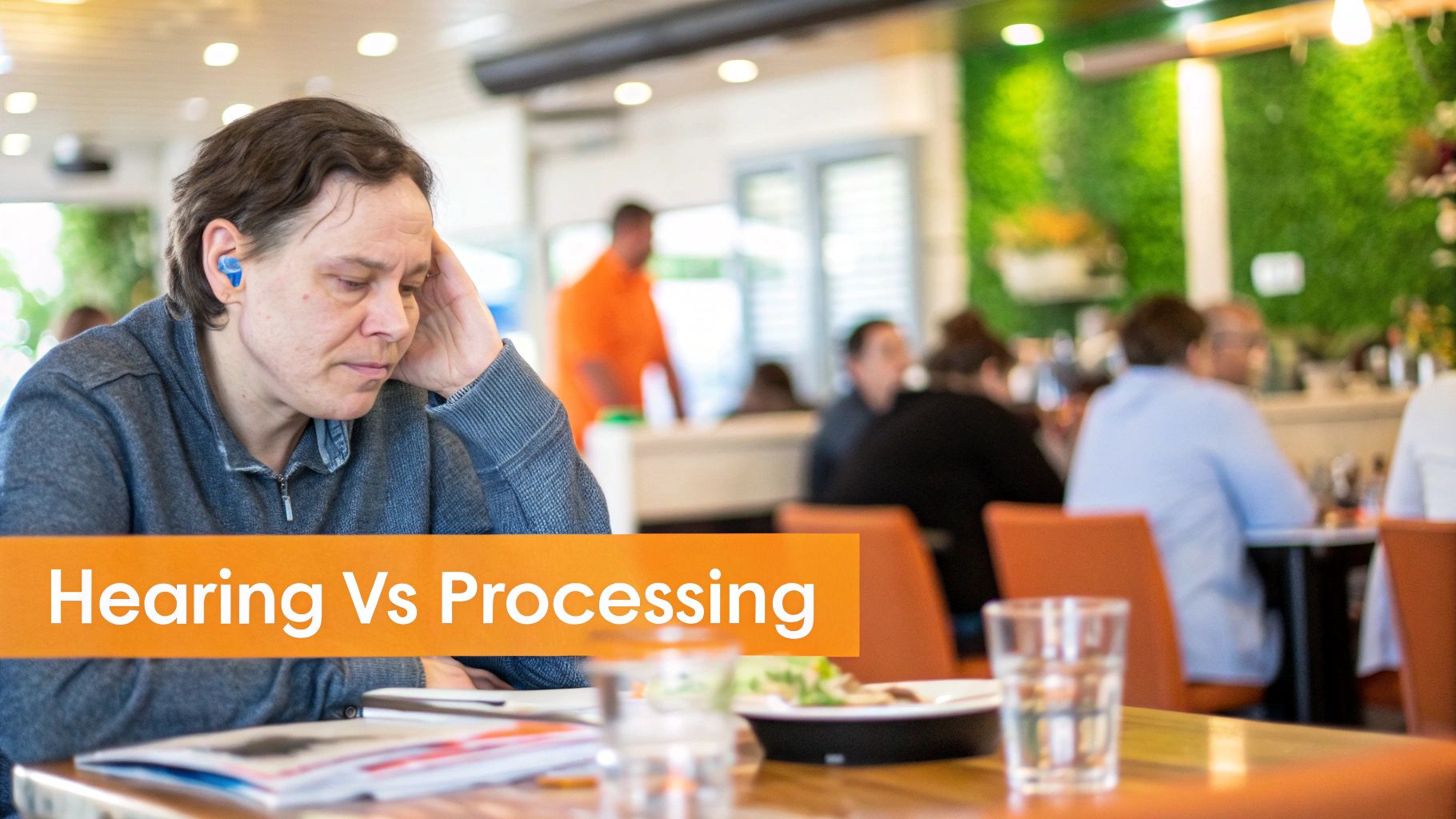
Have you ever passed a hearing screening with flying colours, but still find yourself completely lost in a conversation at a bustling café? That frustrating gap is where the real story lies.
Think of it this way: a standard hearing test is like checking if a microphone is turned on. It confirms that your ears can detect sound. An auditory processing test, on the other hand, checks if the sound engineer knows what to do with the audio. For example, can your brain filter out the clatter of dishes to focus on your friend’s voice? That’s what this test aims to find out.
This assessment gets into the neurological side of listening. It's the difference between hearing the individual notes in a song and actually understanding the melody. Your ears might pick up every note perfectly, but if your brain struggles to piece them together, the world can feel like a jumble of noise—even with perfect hearing.
Recognizing the Real-World Signs
The challenges that point to an auditory processing issue aren't hidden away in a lab. They show up in our daily lives, causing very real frustration. A child might constantly misunderstand instructions in a busy classroom, hearing "Put your books away" but missing the next part about lining up for recess. An adult might feel mentally drained after a simple phone call or always need to ask "what?" during group chats.
These aren't signs of low intelligence or a lack of attention. They point to a specific breakdown in how the brain is handling sound.
Actionable Tip: Spotting the Signs
Symptom or Challenge | Practical Example in Daily Life |
|---|---|
Trouble with Background Noise | Finding it almost impossible to follow a conversation in a restaurant or at a party. You hear voices, but can't distinguish the words. |
Difficulty Following Fast Speech | Feeling like you're always a step behind when someone talks quickly, often missing key words and losing the meaning of the sentence. |
Misunderstanding Questions | Your boss gives you a three-step instruction, but you only catch the first part and have to ask them to repeat the rest. |
Poor Auditory Memory | Forgetting spoken information almost immediately, like a phone number or a short list of items someone just asked you to pick up. |
Appearing Distracted | Being told you "weren't listening" even when you were trying your best to focus, because you're working so hard just to process the sound. |
Confusion with Similar Sounds | Having trouble telling the difference between words that sound alike, such as "seventy" and "seventeen," leading to mix-ups. |
Recognizing these patterns is your first actionable step. If these examples sound familiar, a formal auditory processing test is the only way to get real clarity and an accurate diagnosis.
A key piece of the puzzle is how closely auditory processing is tied to cognitive functions like working memory. Your ability to hold onto and work with spoken information is essential for understanding. A practical step you can take right now is to explore techniques to support your memory.
An evaluation pinpoints the specific areas of weakness, paving the way for a targeted plan to strengthen those skills. If you want to learn more about related cognitive functions, our guide on how to improve working memory offers practical strategies you can start using today.
Connecting Auditory Health to Brain Performance
Hearing isn't just about your ears; it’s a full-on brain activity. When your brain is constantly fighting to make sense of the sounds around you, it’s like running a marathon you never signed up for. This creates a massive cognitive load, soaking up the mental energy you need for other critical tasks like remembering, staying focused, and solving problems.
Think of your brain as a computer's main processor. If a buggy app is hogging all the processing power, everything else grinds to a halt. In a practical sense, after a noisy team meeting where you struggled to follow along, you might feel too mentally exhausted to tackle a complex report. That’s exactly what inefficient auditory processing does—it’s the faulty program that slows down your entire system.
This constant mental strain isn’t just a short-term problem, either. A growing body of research is pointing to a serious connection between untreated hearing loss and long-term cognitive health. When auditory stimulation drops, certain parts of the brain get less input, and that can potentially speed up cognitive decline.
The Long-Term Impact on Cognitive Vitality
Letting auditory processing issues slide can lead to more than just trouble with conversations. Studies reveal that people with untreated hearing loss are nearly three times more likely to have a history of falling, since sound is a big part of how we understand the space around us.
On top of that, the sheer effort of trying to hear can lead people to pull away from social situations, which is a known risk factor for cognitive decline. For anyone curious about how wider health strategies can support brain function, exploring functional medicine approaches to cognitive decline provides some really valuable context on supporting overall neurological health.
This is why an auditory processing test shouldn't be seen as just a hearing check-up. It's a proactive tool for brain health.
By identifying how efficiently your brain processes sound, you gain a clearer picture of your overall cognitive workload. This insight allows for targeted interventions that do more than just help you hear—they help your brain perform better.
Tackling these challenges head-on can free up a huge amount of mental bandwidth. This is where focused support, often through a structured neurorehabilitation program, really makes a difference. These programs work to retrain the brain, building stronger neural pathways so that processing sound becomes more automatic and less of a drain. By taking the time to understand and improve your auditory processing, you’re making a direct investment in your brain’s long-term vitality.
What to Expect During Your Evaluation
Stepping into an audiology clinic for the first time can feel a little intimidating, but an auditory processing test is a completely painless and non-invasive experience. The whole point is to figure out how your brain handles sound in a controlled, quiet setting.
Your evaluation will start with a simple conversation. This initial chat with the audiologist is incredibly important because it gives context to everything that follows. Come prepared with specific examples. Instead of just saying "I have trouble hearing," explain a recent situation: "Last week at the grocery store, I couldn't understand the cashier because of the beeping scanners and overhead announcements." Your real-world experiences are what guide the entire process.
After you've talked, you'll head into a sound-treated booth and put on a pair of headphones. From there, the audiologist will guide you through a series of listening tasks.
Demystifying the Test Components
Think of these tasks less like a medical test and more like a series of simple listening games. Each one is designed to simulate the real-world listening challenges you face every day, but in a structured way.
Let's break down what a typical evaluation looks like with practical examples of what you'll be asked to do.
Common Tasks in an Auditory Processing Evaluation
Test Type | What It Measures | Practical Example of What You'll Do |
|---|---|---|
Speech-in-Noise Tests | How well your brain filters out background noise to focus on speech. | You'll be asked to repeat a sentence like "The green grass grew" while hearing competing sounds, like crowd noise or static. |
Filtered Speech Tests | Your brain's ability to "fill in the blanks" with incomplete information. | You'll listen to words that sound muffled or distorted, as if someone is speaking through a door, and be asked to identify them. |
Dichotic Listening Tasks | How well your brain processes different information coming into both ears at once. | You might hear the number "four" in your left ear and "nine" in your right ear simultaneously and have to repeat both numbers. |
Temporal Processing Tests | Your ability to recognize and process the timing and order of sounds. | You'll listen to a series of high and low tones and be asked to identify their pattern, such as "high-low-high." |
These are just a few examples, but they all help the audiologist pinpoint exactly which auditory skill needs support.
This infographic helps visualize the journey sound takes from your ears to your brain and how that impacts your daily life.
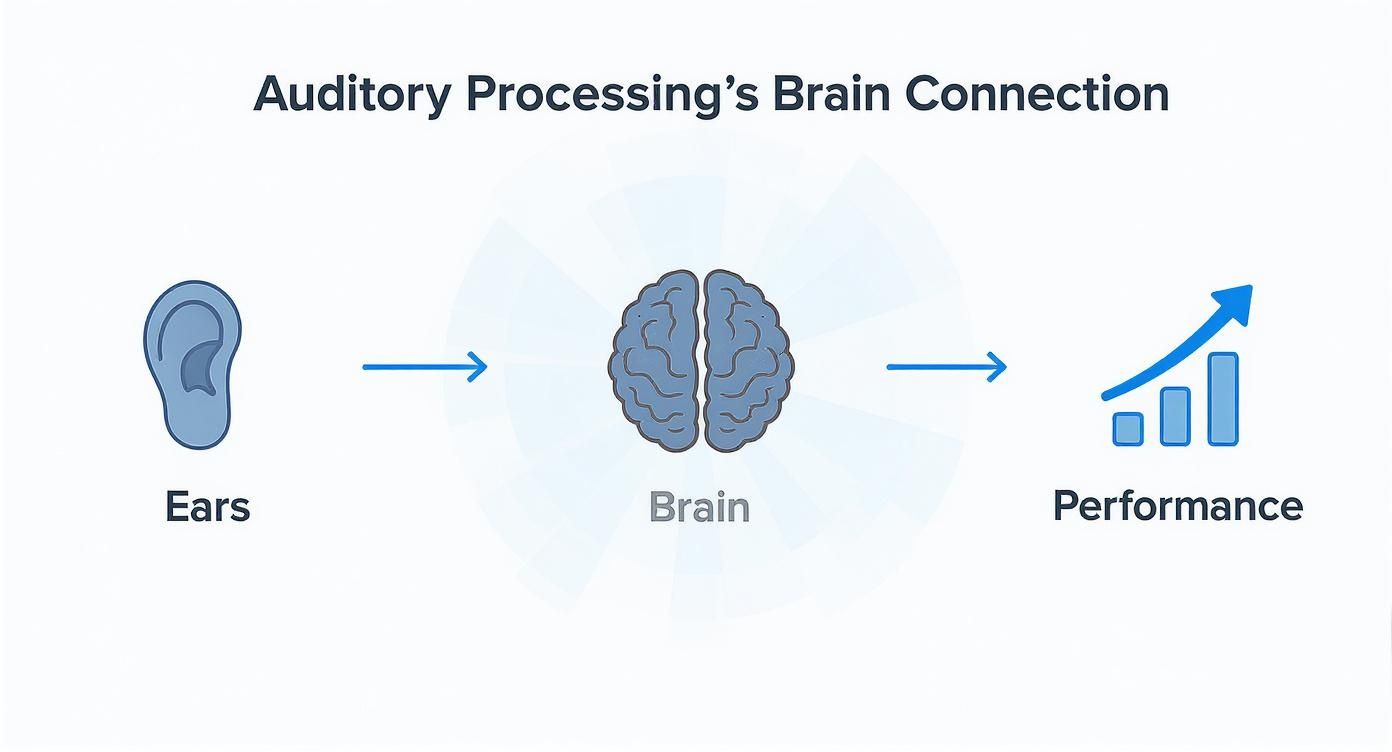
As you can see, effective auditory processing isn't just about hearing—it's about the brain making sense of what the ears detect.
Actionable Tip: Preparing for Your Appointment
To get the most accurate results from your auditory processing test, a few simple preparations can make a world of difference.
Get a good night's sleep: Being tired can definitely affect your attention and performance.
Eat a meal beforehand: You don't want to be distracted by a rumbling stomach.
Jot down examples: Before you go, make a quick list of specific listening situations where you've struggled.
It’s also really important to consider the timing of an evaluation, especially for kids. Because a child's auditory system is still developing, professional guidelines suggest that most auditory processing tests are best for children who are at least 7 or 8 years old. For a deeper dive, you can check out the Canadian guidelines for APD assessment.
The evaluation gives us a detailed snapshot of your auditory skills, but it's just one piece of the puzzle. To see how these findings fit into the bigger picture of your cognitive health, learn more about our comprehensive cognitive assessments and how they connect different aspects of brain performance.
Turning Your Test Results into an Action Plan
Getting the report back from an auditory processing test can feel like trying to read a foreign language. But that report isn’t just a pile of data—it's your personal roadmap showing you the way forward.
A diagnosis like Auditory Processing Disorder (APD) isn't the end of the road. Think of it as the starting line for getting the right kind of targeted support. The real magic happens when you turn those clinical findings into a practical, step-by-step plan.
Translating Scores into Practical Steps
Your test results will pinpoint specific areas where your auditory system is struggling. For example, a low score on a "speech-in-noise" task is the clinical explanation for why you can’t follow a conversation at a bustling family dinner. Here’s how to turn that finding into action:
Environmental Modifications: This means making simple tweaks to your surroundings. An actionable step is to choose a corner booth at a restaurant instead of a table in the middle. At work, move your desk away from high-traffic areas.
Compensatory Strategies: This is about learning new tricks to manage tough situations. A practical strategy is to tell people, "It helps me if I can see your face when you talk." You can also start using apps that transcribe voice to text during meetings.
Direct Intervention: This gets to the root of the issue with specific exercises and therapies designed to strengthen the weak auditory pathways in your brain, which we'll cover in the next section.
An APD diagnosis finally gives a name to your struggles. It validates what you’ve been experiencing and confirms the issue is neurological—it has nothing to do with not trying hard enough. This understanding is empowering, giving you the confidence to find solutions that are proven to work.
Actionable Tip: Key Questions to Ask Your Audiologist
To make sure you walk out of your follow-up appointment with a clear path forward, come prepared with these questions:
"Based on my weakest skill, what is one simple strategy I can start using at work/school tomorrow?"
"Can you give me a real-world example of how this specific weakness shows up in my daily life?"
"What kind of direct therapy or training do you recommend, and what does that look like in practice?"
This conversation is one of the most important parts of the whole process. It’s also a good time to remember that a staggering 77% of Canadian adults with measurable hearing loss had no idea they had it, according to these findings on unperceived hearing loss. While APD is different, it shows how easily we can adapt to auditory struggles without realizing help is available.
Your audiologist can point you toward the best next steps. To see how targeted exercises can retrain the brain, explore our evidence-based cognitive therapies designed to build stronger auditory skills.
How Modern Technology Can Retrain Your Brain
Getting a diagnosis from an auditory processing test isn't the end of the road. It's the beginning of a proactive journey, and today's technology provides the map. We can now actively retrain the brain to handle sound more effectively.
This is all thanks to neuroplasticity, which is the brain’s incredible, lifelong ability to rewire itself. Think of your auditory pathways as hiking trails. If one trail is overgrown, you clear it and walk it consistently until it becomes easy to navigate.
Modern auditory training programs do exactly this. They use targeted, repetitive exercises to strengthen the exact areas identified as weak during your auditory processing test.
How AI-Powered Training Works
Artificial Intelligence (AI) elevates this process by creating a training experience that is truly personal and adapts to your performance in real-time.
Here's a practical example: Imagine you're playing a game on a tablet where you have to identify a target word ("boat") spoken amidst background chatter. An AI-driven system can:
Adjust Difficulty Instantly: If you correctly identify "boat" three times in a row, the AI will increase the volume of the background chatter to make it more challenging. If you make a mistake, it will quiet the chatter, preventing frustration and helping you succeed.
Target Specific Weaknesses: If your test showed a weakness in processing rapid sounds, the training will focus on exercises that require you to distinguish between fast words like "cat" and "cap."
Keep You Engaged: These programs are designed to feel like play. This gamified approach makes it easier to stay consistent, which is crucial for building new neural pathways.
This adaptive approach is key. It keeps you working right at the edge of your current ability—that sweet spot where genuine learning and neural growth really happen.
Actionable Insight: From Training to Real Life
The objective here isn't just to get high scores in a game. It's about seeing real, tangible improvements.
Here's a practical scenario: Someone who struggles in noisy environments might begin with simple sound-filtering exercises. After a few weeks of consistent training, their brain learns to better isolate speech. The next time they're in a busy restaurant, they find they can actually follow the conversation without straining, turning an overwhelming experience into an enjoyable one.
As the technology continues to evolve, the wider applications of Artificial Intelligence in healthcare reveal just how many new and creative ways we have to tackle auditory retraining.
These modern tools take the insights from an auditory processing test and turn them into a clear, actionable plan. To see what this looks like in practice, we invite you to explore our solution at Orange Neurosciences. It’s not about just living with a diagnosis; it’s about taking control and retraining your brain for a clearer future.
Your Questions About Auditory Processing Answered
Stepping into the world of auditory health can feel a bit overwhelming, and it's completely normal to have questions. Here are clear, straightforward answers to some of the most common questions about the auditory processing test.
How Is an Auditory Processing Test Different from a Regular Hearing Test?
Think of it this way: a standard hearing test is like checking if your home's doorbell works. It confirms whether your ears detect sound. An auditory processing test is like finding out if anyone inside understands what the doorbell means—that someone is at the door.
A practical example of this difference: you might ace a regular hearing test by hearing a faint beep, but in an auditory processing test, you'd be asked to listen to two different beeps in a row and say which one was longer. It's a test of what your brain does with the sound.
Is Auditory Processing Disorder Only a Childhood Condition?
Not at all. While often noticed when kids struggle in school, APD affects adults, too. Many adults have lived with it undiagnosed, while others develop challenges later due to aging or a concussion.
For an adult, this creates practical hurdles at work, like having trouble following a fast-paced virtual meeting where audio quality isn't perfect, or feeling completely drained after a series of phone calls. An auditory processing test is just as important for adults to get a proper diagnosis and discover strategies that actually work.
The core problem is the same no matter your age: there's a disconnect between hearing and understanding. Pinpointing this gap is the first real step toward clear communication and making listening feel less like hard work.
What Actionable Steps Can I Take After the Test?
If the assessment uncovers a weakness, your audiologist will help create a personalized action plan. This isn't about a single magic fix, but a multi-layered approach designed to support you from every angle.
A solid plan usually includes a mix of these actionable strategies:
Direct Auditory Training: This involves targeted, game-like exercises designed to strengthen the specific neural pathways that are struggling.
Environmental Management: You'll learn simple tricks, like choosing a seat in a meeting room that faces the main speaker and has fewer distractions behind you.
Compensatory Skills: You'll learn to use other tools to help, like using noise-cancelling headphones in an open office or asking for a written summary of verbal instructions.
The whole point is to give you a complete toolkit for success, empowering you to feel confident in any listening situation.
Is This Type of Test Covered by Insurance?
Coverage for an auditory processing test can be a bit of a mixed bag, varying depending on your province and insurance plan. The most direct action you can take is to call your insurance provider and ask them specifically about your coverage for "audiological assessments" or "central auditory processing evaluations."
Many audiology clinics can provide you with the necessary paperwork to submit a claim. Don't let uncertainty stop you from getting answers; ask the clinic about their billing process and payment options.
Ready to move from questions to answers? The advanced tools at Orange Neurosciences give clinicians and educators the objective data they need to truly understand cognitive performance. Our platform combines precise assessment with engaging, game-based training to build stronger auditory skills and support overall brain health.
Discover how our evidence-based solutions can create a clear path forward. Visit us at https://orangeneurosciences.ca to see how we can help you or your clients turn insights into action.
Orange Neurosciences' Cognitive Skills Assessments (CSA) are intended as an aid for assessing the cognitive well-being of an individual. In a clinical setting, the CSA results (when interpreted by a qualified healthcare provider) may be used as an aid in determining whether further cognitive evaluation is needed. Orange Neurosciences' brain training programs are designed to promote and encourage overall cognitive health. Orange Neurosciences does not offer any medical diagnosis or treatment of any medical disease or condition. Orange Neurosciences products may also be used for research purposes for any range of cognition-related assessments. If used for research purposes, all use of the product must comply with the appropriate human subjects' procedures as they exist within the researcher's institution and will be the researcher's responsibility. All such human subject protections shall be under the provisions of all applicable sections of the Code of Federal Regulations.


© 2026 by Orange Neurosciences Corporation