A Practical Guide to Learning Disabilities Assessment
Dec 13, 2025
A learning disabilities assessment isn’t just a test; it’s a detailed evaluation designed to truly understand your child's unique learning profile. Think of it as creating a personalized roadmap that highlights specific challenges and strengths, pointing the way toward tailored educational support. With this guide, you'll get actionable insights and practical examples to help you navigate the process and find the best support for your child.
Navigating Your Child's Path to a Learning Assessment
Realizing your child might have a learning disability can feel completely overwhelming. The path forward often seems foggy, filled with more questions than answers. But initiating an assessment is the first real step toward getting clarity and finding the support that works.
It helps to think of the process less like a final exam and more like hiring a master key maker. Every child's mind is a unique lock, and a one-size-fits-all key just won’t do the trick. A proper assessment provides the exact blueprint needed to craft that perfect key—a set of strategies and supports designed specifically for them.
This guide is here to demystify that entire journey, from the first flicker of concern to building an actionable plan. Our goal is to give you the knowledge you need to navigate the system, advocate for your child, and help them rebuild their confidence to unlock their true potential. For many, simply understanding where to start is the biggest hurdle. If you're looking for that foundational support, explore the resources for parents and individuals on our website.
Understanding the Scope of Learning Needs
If you're on this journey, you are far from alone. In California's schools, learning disabilities are a significant reality for thousands of families. More than one in eight public school students—over 800,000 kids—received special education services in 2020. Learning disabilities consistently rank among the top three categories, making up an estimated 37% of those students, or roughly 296,000 individuals.
The journey often starts with conversations at school and with doctors. As you get ready for those important talks, learning how to effectively communicate about ADHD with medical professionals can be incredibly helpful for organizing your thoughts and advocating clearly.
An assessment is more than a diagnosis; it's a discovery process. It reveals not just the challenges but also the hidden strengths and unique ways your child thinks, providing the foundation for building a successful educational experience.
Ultimately, a learning disabilities assessment is about creating opportunity. It replaces guesswork with real data, allowing you to move from a place of worry to one of confident, informed action.
Recognizing the Signs That Point to an Assessment
As a parent or teacher, figuring out whether to seek a learning disabilities assessment can feel like guesswork. Is your child’s struggle just a temporary blip, or is it a sign of something deeper? The real key is to watch for consistent patterns that stick around, going beyond the typical bumps in the developmental road.
Think of these signs not as a diagnosis, but as important clues. For a young child just starting school, the signals are usually tied to the absolute basics of learning. You might notice they have a really hard time connecting letters to the sounds they make, a roadblock that can turn reading into a monumental chore.
Practical example: A child might consistently dodge reading aloud, not because they’re shy, but because it’s genuinely exhausting for them. They might also have a terrible time remembering simple sight words, no matter how much you practice, or struggle with rhyming—a critical early literacy skill.
Signs in Younger Learners
It's so important to know the difference between a normal learning curve and a potential learning disability. Sure, lots of kids mix up 'b' and 'd' now and then, but when that struggle continues for a long time, it could be a red flag. Here’s what to look out for in a real-world context:
Difficulty with Phonics: Think of a first-grader who, even with regular classroom teaching, just can't sound out simple words like 'cat' or 'sun' with any consistency.
Avoiding Reading Tasks: This could look like a second-grader who suddenly gets a headache or stomach ache every single time it’s reading time, but is perfectly fine during math or recess.
Trouble with Basic Math Concepts: A child might have a hard time connecting numbers to actual quantities, like not quite getting that the symbol '5' really means five toys.
Signs in Older Students and Adolescents
As kids get older and school gets harder, the signs of a learning disability often change. It becomes less about the foundational skills and more about the complex machinery of learning—things like organization, planning, and higher-level thinking. You might have a student who is incredibly smart and can talk your ear off about a topic but just can't seem to get those brilliant thoughts down on paper.
Practical example: A middle schooler might take hours to finish homework that should only take 30 minutes. This isn't laziness. Their brain is likely working overtime just to process the information, organize the steps, or stay focused. In the same way, they might understand a complex math theory when it's explained but fall apart when trying to solve a multi-step problem on their own. For parents wanting to get to the bottom of this, it's crucial to understand their learning behaviour to see the complete picture.
It's not about a lack of effort, but a difference in processing. An unusually long time spent on homework or a well-articulated idea that never makes it to the page are significant indicators that an assessment may be warranted.
Here are a few real-world examples for older students:
Disorganized Writing: A high school student has a fantastic grasp of a history topic but their essay is all over the place, with jumbled ideas that don't flow logically.
Poor Reading Comprehension: An eighth-grader can read the words on a page perfectly, but when they're done, they can't tell you the main idea or remember key details from the passage.
Challenges with Abstract Concepts: They may hit a wall in subjects like algebra or chemistry, where success depends on understanding symbols and abstract ideas.
By tuning into these specific, practical signs, you can shift from a place of worry to one of proactive support. Actionable insight: Keep a simple log of these observations with dates and specific details. This record will be invaluable when you talk to the school or a professional, making sure your child gets the help they need to truly shine.
The Comprehensive Assessment Process Explained
A formal learning disabilities assessment, often called a psychoeducational evaluation, can feel like a black box. But when you pull back the curtain, you’ll find it’s a structured, collaborative effort to create a complete and accurate picture of a student's unique learning profile. It’s a methodical process that moves from a broad overview to a detailed analysis, ensuring no stone is left unturned.
Think of it less like a single, high-stakes exam and more like a detailed investigation led by a team of specialists. It's like assembling a puzzle. Each professional contributes a unique piece—cognitive abilities, academic skills, emotional well-being—and only when they all click into place does the full picture of a child's abilities emerge.
This multi-faceted approach is absolutely essential because learning is complex. A struggle with reading isn't always just about phonics; it could be tied to working memory, attention, or even anxiety. A thorough evaluation connects these dots, looking past the symptoms to find the root causes of a student's challenges.
The following flowchart breaks down the key steps in recognizing the need for an assessment and turning those observations into action.
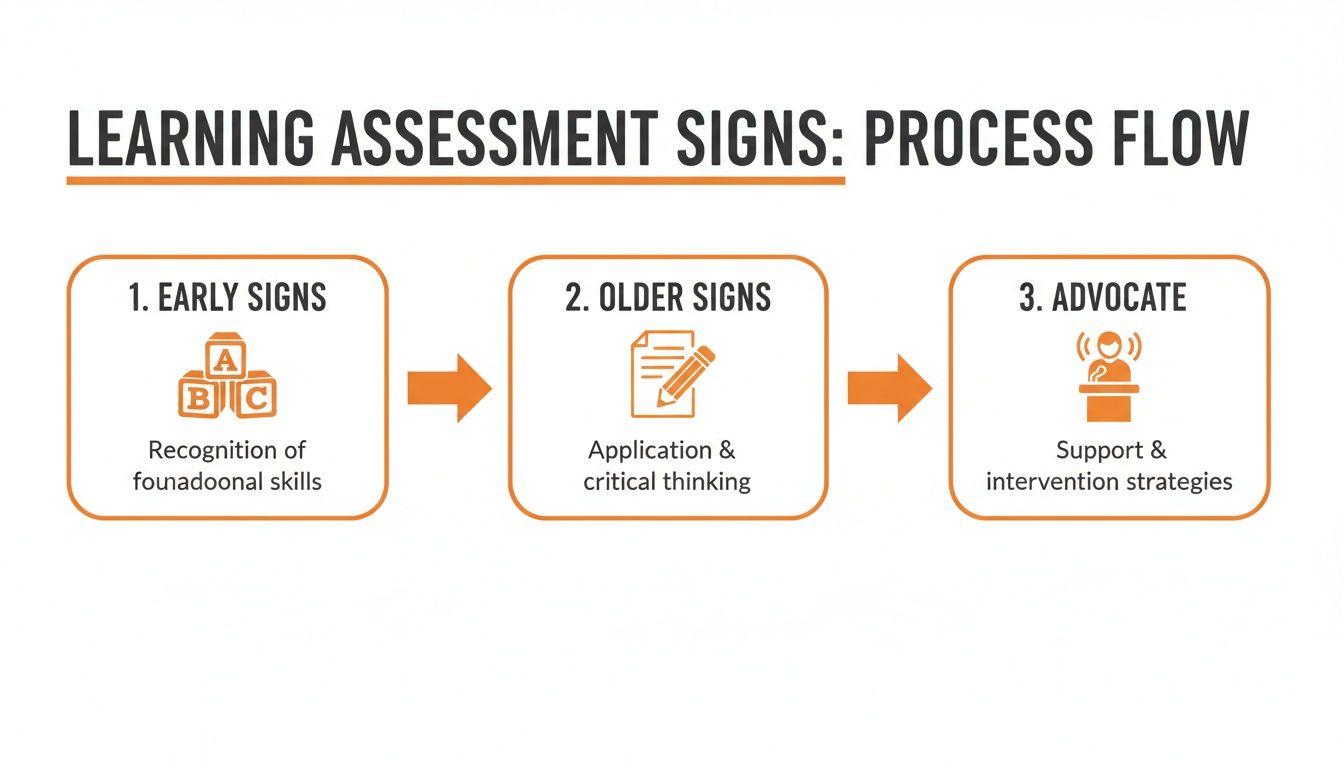
This visual shows why it's so important to spot the signs early on and then use those observations to advocate effectively, kicking off the formal assessment journey.
From Initial Screening to Full Evaluation
The journey almost always starts with a screening. This is like taking a quick temperature check. A screening tool is a brief, often informal, measure to see if a student might be at risk and needs a closer look. It’s not a diagnosis, but it’s a critical signpost that tells us further investigation is a good idea.
Sometimes, this proactive step is built right into the system. For instance, recent legislation mandates universal reading difficulty risk screenings for all students in kindergarten through second grade annually. This is a huge step forward in catching potential issues early, long before they become major roadblocks for a child.
If the screening raises a red flag, the process moves to a full and individual evaluation. This is the deep dive. It's a formal, multi-part assessment run by a multidisciplinary team to figure out if a student has a disability and requires special education services.
The Core Components of the Assessment
A comprehensive psychoeducational evaluation typically looks at three crucial areas. Each one provides a different lens for viewing the student's abilities, giving us that all-important holistic understanding.
Cognitive Assessment: This part measures the brain’s processing power. It looks at intellectual abilities like reasoning, memory, processing speed, and both verbal and non-verbal problem-solving. This isn't just about getting an IQ score; it’s about understanding how a student thinks. Practical example: A student might have fantastic reasoning skills but a weak working memory, making it tough to follow multi-step instructions like "Take out your math book, turn to page 52, and complete the odd-numbered problems." You can learn more about this detailed analysis in our guide on what a neuropsychological assessment involves.
Academic Achievement Testing: This piece measures what the student has actually learned in school. It assesses specific skills in reading (like decoding, fluency, and comprehension), writing (spelling, sentence structure), and mathematics (calculation, problem-solving). By comparing these results to the cognitive assessment, evaluators can spot any gaps between a student’s potential and their real-world performance.
Socio-Emotional and Behavioural Assessment: Learning doesn't happen in a vacuum. This part of the evaluation explores how a student’s feelings, behaviours, and social skills might be affecting their education. It often involves questionnaires for parents and teachers, interviews with the student, and observations in the classroom. Practical example: A student might be struggling to focus not because of a cognitive issue, but due to underlying anxiety about making mistakes in front of their peers.
The goal of a comprehensive assessment is not to label a child, but to understand them. It’s about building a bridge between their unique cognitive profile and the academic demands of the classroom.
The Multidisciplinary Team That Makes It Happen
A learning disabilities assessment is a team sport. No single person handles it alone; instead, a group of professionals brings their specific expertise to the table.
School Psychologist: Usually leads the assessment, administering and interpreting the cognitive and socio-emotional tests.
Special Education Teacher: Assesses academic achievement and offers crucial insights into classroom performance and what teaching strategies work best.
Speech-Language Pathologist: Gets involved if there are concerns about language processing, comprehension, or expression.
Occupational Therapist: Can assess the fine motor skills that impact things like writing (dysgraphia) or other hands-on classroom tasks.
Together, this team collaborates to analyze all the data. They create a report that does more than just list scores—it tells a story about the student. This detailed, transparent overview helps demystify the process, turning parental anxiety into actionable knowledge for you and your child.
Turning Assessment Results into Actionable Support
Getting a learning disabilities assessment report can feel overwhelming. It’s often a thick document, full of clinical language, charts, and numbers that seem to obscure more than they reveal. You might see terms like "standard scores," "percentiles," and "subtest analysis" and wonder what it all actually means for your child.
But that report is the roadmap. It’s the blueprint you need to build the right kind of support, tailored specifically to how your child’s brain works.
First, let's demystify those numbers. Think of a standard score as a way of seeing where your child’s performance lands on a bell curve compared to their peers. A score of 100 is right in the middle—perfectly average. Percentiles are a bit different; they tell you the percentage of peers your child scored higher than. So, a percentile rank of 60 means your child did better than 60% of the kids in the comparison group.
These numbers aren’t just labels; they're clues. Actionable insight: A low score in an area like working memory doesn’t just mean your child is “forgetful.” It helps explain why they might struggle to follow multi-step directions or take good notes in class. And that’s where the report starts to become a real action plan.
From Data Points to Daily Strategies
The real power of an assessment isn’t in the diagnosis itself, but in how it guides the practical, day-to-day interventions that make a difference. The goal is to draw a straight line from every finding in that report to a specific strategy you can use at home and that teachers can use in the classroom. This is how we turn abstract data into tangible change.
Let’s say the assessment points to a significant weakness in working memory. The report shouldn't just state that as a fact; it should recommend actionable supports.
At School: The teacher could give your child a copy of the lecture notes before class starts. This simple adjustment frees up their mental bandwidth to actually listen and understand, instead of getting bogged down trying to write everything down.
At Home: You could use checklists for the morning routine or for homework assignments. Breaking big tasks into smaller, concrete steps reduces the cognitive load and helps build confidence and independence.
An assessment report should be a living document, not a final verdict. Its purpose is to illuminate the path forward, providing clear, evidence-based recommendations that empower both educators and parents to create an environment where the child can thrive.
This translation from finding to action is absolutely critical. Consider the outcomes for students with learning disabilities in California. During the 2021-22 school year, only 16% of students with disabilities met or exceeded English language arts standards, while math proficiency was stuck between 11-13%. These aren't just numbers; they're a clear signal that we have to do better at turning assessment data into targeted, daily support. You can discover more insights about these California assessment results.
To connect the dots between common assessment findings and what you can do about them, let's look at some practical, evidence-based strategies for the classroom and home.
From Diagnosis to Action: Common Findings and Proven Supports
Common Finding (e.g., Dyslexia, Dysgraphia) | What It Means in Simple Terms | Example Classroom Accommodation | Example Home Support Strategy |
|---|---|---|---|
Dyslexia | Difficulty with reading, decoding words, and spelling, despite having the intelligence to learn. | Provide audiobooks or text-to-speech software for reading assignments. Allow extra time for tests. | Read aloud together every night. Use multisensory reading apps or games that connect sounds to letters. |
Dysgraphia | A struggle with the physical act of writing, spelling, and organizing thoughts on paper. | Allow the student to type assignments instead of handwriting. Grade based on content, not on neatness or spelling. | Practice typing on a keyboard. Use speech-to-text software for brainstorming ideas for homework. |
Dyscalculia | Significant trouble with math concepts, number sense, and recalling math facts. | Provide a calculator and a chart of math facts for all assignments and tests. Use graph paper to help line up numbers. | Play board games that involve counting and money. Use real-world examples for math, like baking or budgeting. |
Working Memory Deficit | Difficulty holding and manipulating information in the mind for short periods. | Break down instructions into single steps. Provide written checklists and visual aids for complex tasks. | Use planners and visual schedules for daily routines. Play memory games like "I went to the market and bought..." |
These strategies are not about making things "easier"—they are about making learning accessible. They level the playing field so your child can show what they truly know.
Building the Foundation for Formal Support
The findings from a thorough assessment are the foundation for formal support plans, like an Individualized Education Program (IEP) or a 504 Plan. These are legally binding documents that require the school to provide specific accommodations and services tailored to your child’s unique learning profile.
This is where your role as an advocate becomes so important. With the assessment report in hand, you can walk into those school meetings with confidence, ready to ask for specific, data-backed supports.
For Dyslexia: You can request access to audiobooks, the use of text-to-speech software, and extra time on tests.
For Dysgraphia: Accommodations might include permission to type assignments, access to a scribe for note-taking, or grading that focuses on content over mechanics.
For Executive Functioning Challenges: You could advocate for a visual planner, regular check-ins with a teacher on long-term projects, and seating away from classroom distractions.
These adjustments are essential for your child to demonstrate their knowledge and abilities. The assessment provides the evidence you need to make these requests. For families looking to build on school-based strategies, exploring various cognitive therapies can offer additional, targeted support for strengthening underlying skills at home. Ultimately, that report is your most powerful tool for ensuring your child gets the support they need not just to get by, but to truly succeed.
The Future of Assessment With Digital and AI Tools
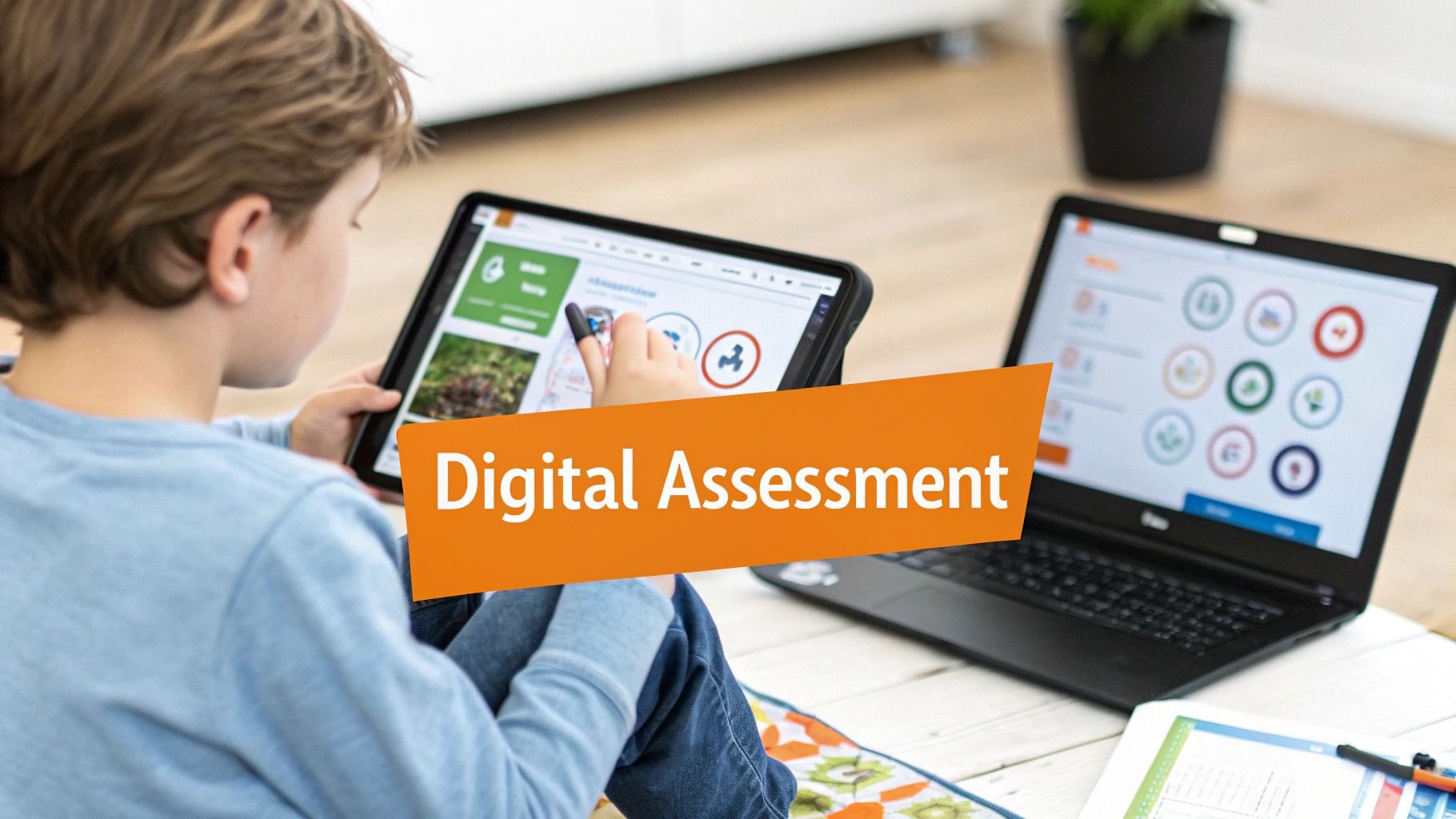
While the traditional learning disabilities assessment is incredibly detailed, it’s not without its drawbacks. The process can drag on, become expensive, and ultimately, it only gives you a static snapshot of a child’s abilities on one particular day. It’s like trying to understand a fast-moving river by looking at a single photograph.
But a real shift is happening right now. New technologies are bringing a more dynamic and continuous way to understand how a child thinks and learns. Digital and AI-powered tools are changing assessment from a rare, formal event into an ongoing process of discovery.
This change means we can get faster, more objective insights into a student’s cognitive profile. Instead of waiting weeks for a dense report, educators and parents can get immediate data to start making smart decisions right away.
A New Approach to Cognitive Profiling
This modern approach isn't about replacing the experts. It's about giving them powerful new tools to work with. Imagine an assessment that feels more like an engaging game than a sterile test. That’s exactly where platforms like Orange Neurosciences are making a difference.
Our gamified, AI-driven platform delivers a rapid and precise cognitive profile in under 30 minutes. It objectively measures crucial areas like attention, memory, processing speed, and executive function, pinpointing both strengths and weaknesses with incredible accuracy. This gives everyone a clear, data-driven starting point for any kind of support plan.
Practical example: A teacher could use a tool like this for a quick screening at the start of the school year. If the platform flags a potential weakness in a student's working memory, the teacher can immediately bring in strategies like visual checklists or breaking down instructions into smaller steps—long before a formal evaluation is even on the table.
Digital assessment tools open up access to cognitive insights for everyone. They provide objective, real-time data that empowers educators to act swiftly and confidently, complementing traditional methods with continuous monitoring and personalized support.
This doesn't make comprehensive psychoeducational evaluations obsolete. Far from it. Instead, it acts as a critical first step, helping to identify which students need that deeper dive while providing immediate, practical support for all.
The Power of Continuous Monitoring
One of the biggest wins with digital tools is the ability to track progress over time. A traditional assessment gives you a baseline, but it's hard to know if an intervention is truly working without frequent, consistent data points.
AI-powered platforms can monitor a student’s cognitive development day in and day out. As a child plays therapeutic games and completes exercises, the system gathers performance data, adjusts the difficulty in real time, and produces clear reports showing their progress.
For educators: This means you can see if a teaching strategy is actually landing and fine-tune your approach as you go.
For parents: You get clear, visual feedback on your child’s growth, making abstract goals feel like tangible achievements.
This move toward technology-assisted assessment is part of a bigger picture in education. As we look ahead, it’s vital to understand the key technological trends in education and how they are creating more personalized, data-informed learning environments.
Integrating Innovation with Established Practice
The goal here is integration, not replacement. These new tools provide the quick, objective data we need for early screening and progress monitoring, which fits perfectly with the deep, diagnostic insights from a full evaluation. This blended approach creates a far more complete and responsive system of support for neurodiverse learners.
Our work at Orange Neurosciences is all about making this vision a reality. By providing a platform that supports the entire journey—from initial screening to ongoing therapy—we help bridge the gap between assessment and action. You can learn more about how Orange Neurosciences supports neurodiverse learners with this integrated approach.
Ready to see how these innovative solutions can empower your students or support your child? Visit our website to learn more and request a demo to experience the future of cognitive assessment firsthand.
Your Questions About Learning Assessments Answered
Stepping into the world of a learning disabilities assessment can feel overwhelming, and it’s natural to have a lot of questions. Getting clear, straightforward answers is the first step toward feeling confident and prepared. Here’s a look at some of the most common concerns we hear from parents and educators in California.
How Long Does a Typical Assessment Take?
The whole journey, from the first referral to the final meeting to go over the results, can take anywhere from several weeks to a few months. The hands-on testing itself is almost always split into multiple sessions. This is done on purpose to keep kids from getting tired, which helps make sure the results are as accurate as possible.
The exact timing really depends on a few things: the evaluator’s schedule, how complex your child's needs are, and the specific processes of your local school district. Actionable insight: Ask for a rough timeline right at the beginning so you know what to expect.
School Assessment vs. Private Evaluation
So, what's the difference between an assessment done by the school and one you seek out on your own?
School-Based Assessment: This is handled by the school district, and it’s free. Its main job is to figure out if your child qualifies for special education services under laws like the Individuals with Disabilities Education Act (IDEA). If they do, this is what leads to an Individualized Education Program (IEP).
Private Evaluation: This is an assessment you set up and pay for with an independent professional. These evaluations can often dig deeper and might offer a more detailed diagnostic picture. While the school is legally required to look at the findings from a private evaluation, they still have to do their own assessment to officially determine eligibility for services.
Can a Child Outgrow a Learning Disability?
Learning disabilities are lifelong neurological differences. It’s about how the brain is wired. This means a child doesn't just "outgrow" something like dyslexia or dyscalculia in the same way they might outgrow a pair of shoes.
A learning disability is a difference, not a deficit to be cured. The goal of an assessment isn't to erase the disability, but to identify the specific strategies and supports that will allow an individual to leverage their strengths and manage their challenges effectively throughout their life.
With the right support and strategies in place, individuals learn powerful ways to compensate, allowing them to truly succeed in school, work, and life.
What if I Disagree with the School's Results?
If you feel the school's evaluation missed the mark, you have legal rights as a parent in California. You can request an Independent Educational Evaluation (IEE), which is often paid for by the school district. An IEE is done by a qualified expert who doesn’t work for the school, offering a vital second opinion to make sure the process is fair and thorough.
Feeling confident in your next steps is crucial. Orange Neurosciences provides rapid, objective cognitive profiling that can offer the clarity you need to complement a formal learning disabilities assessment and guide effective support strategies.
Discover how our AI-powered tools can create a personalized path forward for your child or students at https://orangeneurosciences.ca. If you have more questions or want to discuss your specific needs, please reach out to us. We’re here to help.
Orange Neurosciences' Cognitive Skills Assessments (CSA) are intended as an aid for assessing the cognitive well-being of an individual. In a clinical setting, the CSA results (when interpreted by a qualified healthcare provider) may be used as an aid in determining whether further cognitive evaluation is needed. Orange Neurosciences' brain training programs are designed to promote and encourage overall cognitive health. Orange Neurosciences does not offer any medical diagnosis or treatment of any medical disease or condition. Orange Neurosciences products may also be used for research purposes for any range of cognition-related assessments. If used for research purposes, all use of the product must comply with the appropriate human subjects' procedures as they exist within the researcher's institution and will be the researcher's responsibility. All such human subject protections shall be under the provisions of all applicable sections of the Code of Federal Regulations.


© 2026 by Orange Neurosciences Corporation