The Dementia Test MoCA A Clinician's Complete Guide
Mar 25, 2026
The Montreal Cognitive Assessment (MoCA) is a quick, 10-minute screening tool that helps clinicians detect the early signs of cognitive impairment and dementia. It's a key part of what many refer to as a dementia test, and it's highly valued for its ability to pick up on subtle changes that other tests might miss.
What Is the MoCA Test and Why Is It a Clinical Standard?
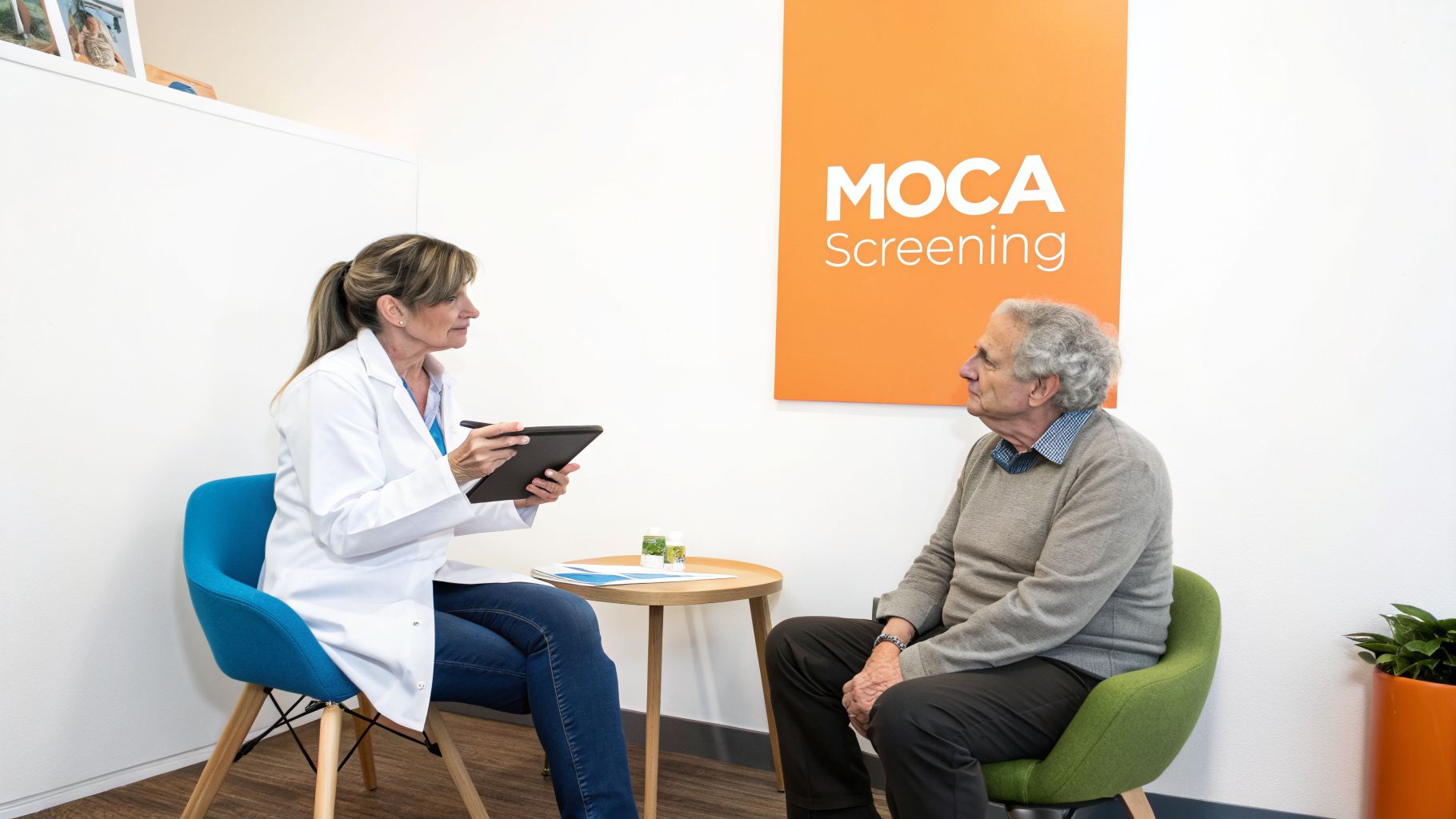
Imagine a patient comes into a clinic, worried about what they call "senior moments"—forgetting names more often, misplacing their keys again. A primary care physician needs a reliable, straightforward way to figure out what's going on. This is exactly where the Montreal Cognitive Assessment, or MoCA test, comes in.
Think of the MoCA as a vital first-look for the brain. It isn’t a diagnostic tool on its own, but it’s an incredibly effective screener. In about 10 minutes, a trained professional can walk a patient through a series of tasks that touch on several different areas of cognitive function.
A Sensitive Tool for Early Detection
The MoCA was specifically created to be a step up from older tests, which often couldn't detect mild cognitive impairment (MCI)—a condition that can sometimes be a stepping stone to dementia. Its design is especially sensitive to the quiet declines in executive function and attention that are often the earliest red flags.
The true strength of the MoCA dementia test is its sensitivity. It’s like a finely tuned smoke detector, able to spot the very first whispers of cognitive trouble long before a fire breaks out. This gives clinicians the prompt they need to investigate further, right when it matters most.
This sensitivity is precisely why so many clinicians rely on it. Where other tests might overlook the initial warning signs, the MoCA delivers a more detailed snapshot. It helps answer that crucial question: are these changes just a normal part of ageing, or is this something that needs a specialist's eye?
What Makes the MoCA a Go-To Choice?
For a quick reference, here's a rundown of what makes the MoCA so widely used.
Feature | Description |
|---|---|
Administration Time | Roughly 10-12 minutes, making it practical for busy clinical settings. |
Primary Purpose | A screening tool to detect mild cognitive impairment (MCI) and early dementia. |
Domains Assessed | Visuospatial/Executive, Naming, Memory, Attention, Language, Abstraction, and Orientation. |
Scoring | Scored out of 30 points. A score of 26 or higher is generally considered normal. |
Key Advantage | High sensitivity, particularly for MCI, compared to older screening tools. |
Accessibility | Available in multiple languages and formats (e.g., for visual or hearing impairment), with standardized training for administrators. |
This combination of efficiency and comprehensive screening is what solidifies its place as a clinical standard.
Several key factors are behind its widespread adoption in clinics across Canada and around the globe. Its standardized structure and scoring system make it a dependable benchmark for healthcare providers everywhere.
Practical and Efficient: The test is fast. It fits easily into a routine check-up without demanding a lot of time or resources.
Comprehensive Screening: It doesn’t just look at memory. By assessing multiple cognitive domains like visuospatial skills and language, it provides a well-rounded overview of a person's cognitive health.
An Actionable Starting Point: A low MoCA score gives a clinician a clear, evidence-based reason to refer a patient to a neurologist or geriatrician for a more thorough evaluation.
While the MoCA is a cornerstone paper-based tool, the world of cognitive assessment is always moving forward. For a broader look at the different screening options available, you might find our guide on various cognitive screening tests for dementia helpful.
Modern digital platforms, like those we've developed at Orange Neurosciences, are now adding an even deeper layer of analysis. These tools can complement traditional screeners by delivering precise, objective data on cognitive performance, helping to build more detailed patient profiles and guide the next steps in care. To learn how our solutions can integrate into your practice, visit our website or send us an email to get started.
Deconstructing the MoCA’s Cognitive Domains
The MoCA is much more than a simple checklist. It's a carefully crafted set of tasks, each designed to probe different corners of the mind. To really get a feel for its value, we need to go beyond just listing what it tests and dig into what each domain tells us about a person's real-world abilities. A score is just a number, but how a person gets to that number tells a much richer story.
Think of the brain as an orchestra. For a piece of music to sound right, every section—the strings, the woodwinds, the percussion—has to work in harmony. In the same way, our daily activities require multiple cognitive skills to fire at once. The MoCA acts like a conductor, checking in with each section of the orchestra to see if it’s on cue.
This is precisely why observing how someone completes a task is just as important as their final score. That brief moment of hesitation, a repeated question, or a flash of frustration can be a powerful clue for a clinician.
Visuospatial and Executive Function
The MoCA cleverly combines these two domains into a few key tasks. Visuospatial ability is how the brain makes sense of what the eyes see and understands where things are in space. Executive function is the brain's CEO—the part in charge of planning, organising, solving problems, and managing tasks.
Practical Example: The test asks a person to copy a 3D cube and draw a clock face showing a specific time.
Actionable Insight: Someone who struggles to draw the cube might have trouble navigating their own home, bumping into furniture or misjudging distances. Difficulty placing the hands on the clock correctly could signal problems with planning, which might show up as trouble managing a medication schedule or following the steps in a recipe. Even a bit of hesitation during the trail-making task (connecting numbers and letters in sequence) can point to early executive dysfunction, long before they start getting the answer wrong.
Memory and Delayed Recall
This part of the MoCA is straightforward but absolutely critical. The administrator reads a list of five common words, and the person is asked to repeat them back immediately. Then, after about five minutes of other tasks, they’re asked to recall those same five words.
This isn't just about remembering a grocery list. It's a direct test of the brain's ability to encode new information, store it, and then retrieve it later. This is a core function that is often one of the first to decline in conditions like Alzheimer's disease.
An inability to recall the words, even when given hints, is a significant red flag. It’s not about simple forgetfulness; it’s a potential sign that the brain’s "save" button for new memories isn’t working the way it should.
Language and Naming
Language skills are checked through a few different tasks. One involves naming less-common animals (like a camel or a rhinoceros) to test word-finding ability. Another asks the person to repeat a couple of complex sentences.
Practical Example: A person has trouble naming the animals.
Actionable Insight: This might manifest in their daily life as struggling to find the right words in a conversation, leading to frustration and even social withdrawal. If they can't repeat the sentences verbatim, it might point to problems with comprehension that could affect their ability to understand a doctor’s instructions or follow a complex conversation. You can learn more about the broader concepts of brain function by exploring our guide on what is cognitive function.
Attention and Concentration
Finally, the MoCA puts attention to the test. This includes tasks like tapping a hand every time a specific letter is read from a list and reciting a string of numbers both forwards and backwards. This domain is the bedrock for all other cognitive skills.
If a person's attention is poor, it's incredibly difficult for them to perform any other task well, from remembering words to following instructions. Difficulty here could explain why someone seems "checked out" or easily distracted in daily life, which can have a major impact on their safety and independence.
A Step-By-Step Guide to Administering and Scoring the MoCA
Giving a cognitive screen like the MoCA isn't just about reading questions off a page. To get results you can actually trust, you need a consistent, standardized process. Think of it as a carefully controlled experiment—everything from the quietness of the room to the exact words you use matters.
The whole point is to create a calm, focused space where the person feels at ease. A quiet room, free from distractions, is a must. Before you even start, have the official MoCA sheet, a pencil, and a timer ready. The most important thing? Stick to the script. Using the precise phrasing in the administration guide for every task is non-negotiable. It’s the only way to avoid accidentally giving clues or influencing the answers.
This consistency is what makes the MoCA a powerful tool. It means a score from your clinic can be reliably compared to one from a clinic halfway across the country.
Setting Up for Success
A little bit of prep work goes a long way in getting a reliable result. Taking a few minutes to set the stage can make all the difference.
Find a Quiet Space: Turn off the TV, close the door, and make sure you won’t be interrupted. Minimizing background noise is critical.
Build Rapport: Take a moment to explain what you're doing in simple, reassuring terms. A practical script might sound like: "We're just going to go through a few exercises to check on different thinking skills, like memory and concentration. It's a routine check, not a pass/fail exam, so just do your best."
Follow the Instructions: Administer every item in the order it's written. Sticking to the official instructions is what keeps the test standardized and the results valid.
This structured approach helps you see a person's true cognitive performance, without it being clouded by outside factors. The process doesn't just end with a score; it's about turning that score into a plan. This diagram shows how the tasks (the assessment) lead to insights (a cognitive profile), which then help shape a real-world intervention plan.
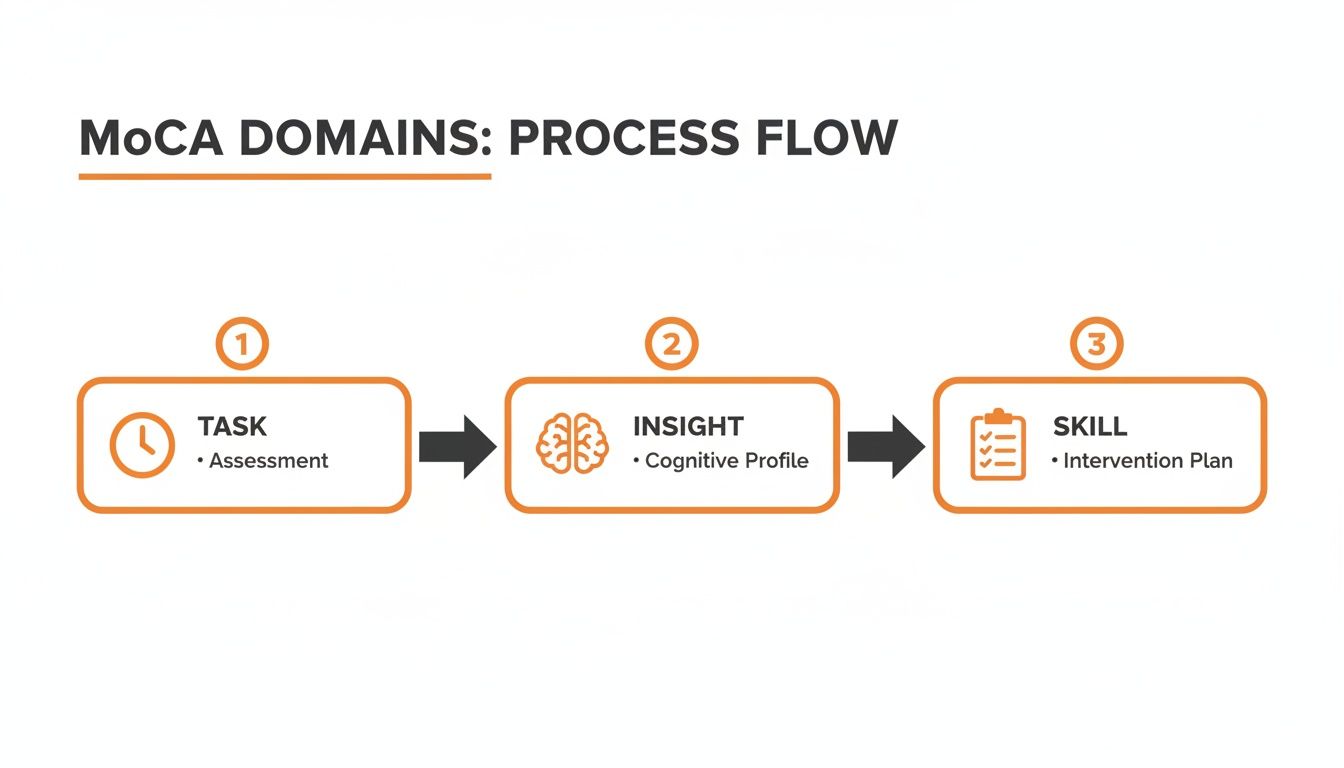
This flow from task to insight to skill really brings it home: the MoCA is more than a test. It’s the first step in creating a meaningful plan of action.
Navigating the 30-Point Scoring System
The MoCA is scored out of a total of 30 points. Generally speaking, a score of 26 or higher is considered normal. Anything below that cutoff suggests there might be some cognitive impairment, and it’s a signal that a more in-depth evaluation is needed.
For the most part, scoring is straightforward—you give points for correct answers on each task. But there's one critical adjustment built in to make the test fairer and account for how education can shape cognitive skills.
A one-point adjustment is added to the total score for any individual who has 12 or fewer years of formal education. This correction acknowledges that lower educational attainment can affect performance on certain tasks, ensuring the assessment is more equitable.
This simple adjustment shows the clinical thoughtfulness behind the test's design. For example, in large systems like California Correctional Health Care Services (CCHCS), the MoCA is a key part of their dementia screening protocol. A score of 25 or below automatically triggers a more comprehensive workup, and that one-point educational adjustment is standard practice. It helps them account for population differences and deliver the right level of care. You can read more about the findings from CCHCS on MoCA implementation in their published guidelines.
Why Context Is Everything in Scoring
A score is just a number until you put it into context. Here’s a practical example of why this matters.
Imagine two 75-year-old patients. Both take the MoCA and score a 25.
Patient A: Has a PhD and was a university professor. For someone with this background, a score of 25 could be a major red flag, likely pointing to a significant decline from their baseline. Actionable Insight: This warrants an immediate referral for a full neuropsychological evaluation.
Patient B: Left school after grade 10 to work. They have 10 years of formal education. Because it's 12 years or less, we add the one-point adjustment, bringing their final score up to 26. Actionable Insight: This score is now in the normal range. The next step is to continue monitoring at their next annual check-up, rather than an urgent specialist referral.
Suddenly, the picture changes. Patient A’s score of 25 is far more concerning, even though it started out identical to Patient B’s. This is why a clinician’s job isn't just to tally points; it's to interpret that final number within the full story of a person’s life—their education, their job, and their overall health.
This kind of detailed analysis is what separates a simple screening from a truly useful clinical assessment. For clinicians who want to take their assessments even further, digital tools can be an invaluable next step. Platforms like those from Orange Neurosciences, for example, offer objective, data-driven insights that perfectly complement what the MoCA shows you. To see how our solutions can enhance your workflow and patient care, connect with us through our website.
Interpreting MoCA Results: Sensitivity, Specificity, and False Positives
So, you have a MoCA score in hand. What does that number really tell you? Getting to the bottom of a score isn’t just about knowing the cutoff point. It's about understanding the statistical muscle behind the test, particularly its sensitivity and specificity. These terms can sound a bit academic, but for any clinician, they are the key to making sound judgments.
I often explain it like this: think of the MoCA as a highly advanced smoke detector. A great smoke detector is incredibly sensitive, meaning it catches the first whiff of real smoke (a true positive) without fail. At the same time, it needs to be specific, so it doesn't scream every time you sear a steak (avoiding a false positive).
A cognitive screening tool is no different. We need it to be sensitive enough to catch genuine impairment but specific enough not to raise alarms for healthy individuals.
The MoCA's High Sensitivity for MCI
The MoCA was specifically built to be a more sensitive tool than older tests, especially when it comes to detecting mild cognitive impairment (MCI). This is its real strength—picking up on the subtle cognitive shifts that other screens might miss. It’s calibrated to hear the quietest whispers of cognitive trouble, long before they become a roar.
A test with high sensitivity, like the MoCA, gives you confidence that you’re not overlooking a genuine problem. When a patient scores low, it’s a reliable sign that you need to dig deeper, significantly reducing the risk of a person’s condition going unnoticed.
Study after study backs this up. When it comes to telling the difference between MCI and normal aging, the MoCA consistently outperforms its predecessors. Some research shows its sensitivity can be as high as 96%. That level of accuracy is a game-changer for early intervention and care planning. You can explore the data yourself by reading the full research on MoCA's psychometric properties.
MoCA vs MMSE: A Head-to-Head Comparison
To really see the MoCA’s value, it helps to put it side-by-side with the older Mini-Mental State Examination (MMSE). While the MMSE was a foundational tool, most clinicians now lean on the MoCA for early detection, and the reasons become clear when you compare them directly.
Metric | MoCA | MMSE |
|---|---|---|
Primary Strength | High sensitivity for mild cognitive impairment (MCI) and executive dysfunction. | Good for detecting more moderate to severe dementia. |
Domains Tested | More emphasis on executive function and attention, providing a broader cognitive snapshot. | Less emphasis on executive function, making it prone to missing early, subtle signs. |
Ceiling Effect | Less prone to "ceiling effects," where highly educated individuals score perfectly despite having MCI. | High risk of ceiling effects, where impairment can be masked by a perfect score. |
Practical Application | Better suited for primary care settings where early detection is the main goal. | Can be useful for tracking progression in later stages of established dementia. |
This comparison highlights why the MoCA is often the preferred screener in modern practice. It’s simply a sharper tool for the job of early detection. For a deeper dive into these differences, our guide comparing the MoCA and MMSE breaks it down even further.
Understanding Limitations and False Positives
Here's the critical part: no screening tool is flawless. The MoCA's high sensitivity is a double-edged sword, as it can sometimes lead to false positives—flagging a healthy person as potentially impaired. This is where a clinician’s judgment becomes absolutely essential. A score is just one piece of a much larger puzzle.
Several factors can drag down a score, and it’s our job to spot them:
Anxiety and Depression: A person who is deeply anxious about being tested can easily stumble on attention and memory tasks. Their performance reflects their emotional state, not necessarily their cognitive ability.
Fatigue or Illness: Someone who is sleep-deprived, sick, or in pain simply won't be at their cognitive best.
Sensory Impairments: If a patient can't see the page clearly or hear your instructions properly, their score will suffer for reasons that have nothing to do with dementia.
Let's walk through a practical example. Imagine a 70-year-old man scores a 24 on the MoCA. That score, on its own, is a red flag. But as you were administering the test, you noticed he was fidgety and kept asking, "Am I failing this?" Afterward, he shares that his wife was recently hospitalized, and he hasn't been sleeping.
In this context, that score of 24 looks very different. It’s more likely a reflection of his acute stress and exhaustion than a sign of a neurodegenerative disease. Actionable Insight: The right move here isn’t an immediate referral for a dementia workup, but to address his anxiety, check in on his sleep, and schedule a re-screen in three months when life has settled down.
This is precisely where digital platforms can be so helpful. Tools from Orange Neurosciences offer objective, data-driven assessments that complement a one-time screening like the MoCA. By tracking cognitive performance over time in a low-stress, gamified way, you can build a richer dataset. This makes it far easier to tell the difference between a true, progressive decline and a temporary dip caused by life's other challenges.
Adapting the MoCA for Diverse Patient Populations
A truly effective dementia screen does more than just spit out a number. It has to account for the whole person sitting in front of you. While the MoCA is a powerful tool, its results can be easily skewed if we don't look at a patient's unique background. To use this test fairly and accurately, we have to look beyond a simple score and adapt our approach for the real, diverse people we see every day.
Things like education level, language, and even vision or hearing can all sway how someone performs. Simply applying a standard cutoff score without this context can lead to wrong conclusions and cause a world of unnecessary stress for patients and their families.
Moving Beyond the Standard Education Correction
The one-point adjustment for folks with 12 or fewer years of education is a decent start, but let's be honest—it’s not a complete fix. A person's life experiences, their culture, and their background shape their cognitive skills in ways a single point can't possibly capture.
Think about how age itself plays a role. We know from research that even cognitively healthy older adults can find certain MoCA tasks tricky. In fact, 46% of 80 to 94-year-olds score below the standard 26-point cutoff, and that number jumps to a staggering 61% for those in the 90-94 age bracket. This often comes down to struggles with specific tasks like copying the cube or verbal fluency, not necessarily an underlying cognitive impairment. This is why thoughtful adjustments are so critical to avoid over-diagnosing in our older populations, a point well-supported by studies on MoCA scores in the very elderly.
When you're administering the MoCA, it’s best to see it as a conversation starter, not a final verdict. Taking the time to document observations about a patient’s educational history, literacy, or unfamiliarity with a task provides the vital context that gives the final score its real meaning.
Addressing Language and Sensory Barriers
Language is another huge piece of the puzzle. How fluent a person is in the language of the test can dramatically change their score, especially on the verbal parts.
For multilingual patients: Someone might stumble on the verbal fluency task—naming as many words as possible that start with a certain letter—not because of a cognitive issue, but because their vocabulary is spread across two or three languages. It’s crucial to note this down.
For patients with hearing or vision loss: It’s simple, really. If a person can't hear the instructions properly or see the test paper clearly, their score won't be a valid measure of their cognition. Thankfully, there are official, validated versions of the MoCA designed to accommodate these needs.
Practical Clinical Scenario:
Imagine Dr. Chen is assessing Mr. Ivanov, an 82-year-old who moved to Canada 40 years ago. Mr. Ivanov scores a 23 on the English MoCA. Instead of just writing down the number, Dr. Chen makes these notes:
"Patient has 8 years of formal education in his home country. Adjusted score is 24."
"Showed significant hesitation on the verbal fluency task; English is his second language. He performed well on non-verbal tasks like clock drawing."
"Patient reported difficulty hearing the word list and required me to repeat it twice. This may have impacted his delayed recall score."
Suddenly, a worrying score of 23 transforms into a much clearer clinical picture. Actionable Insight: Dr. Chen's next step is to focus on re-testing Mr. Ivanov’s hearing and perhaps scheduling a follow-up assessment in his native language, rather than immediately assuming dementia. You can explore this topic further in our article on the importance of the language of assessment in cognitive testing.
Platforms like Orange Neurosciences are built with this kind of real-world adaptability in mind. Our assessments are designed to be accessible and give clinicians objective data that helps them see past a surface-level score. To see how our tools can support fair and accurate cognitive screening in your practice, we invite you to connect with us on our website.
The Next Steps After a MoCA Screening

A MoCA score is never the end of the story. Think of it as a critical first clue—a signpost pointing toward a potential issue, not the final destination. A score that falls below the normal range is a prompt for action, setting in motion a series of next steps to get a clear, complete picture of a person's cognitive health.
The journey doesn't end with that initial score; it truly begins.
After a concerning result, the immediate next step is almost always a referral. A family doctor will typically refer the patient to a specialist, like a neurologist or a geriatrician, for a much more in-depth workup.
This referral kicks off a comprehensive investigation to figure out precisely what’s going on. It’s a careful process of ruling out other possibilities and zeroing in on the root cause of the cognitive changes.
Building a Complete Clinical Picture
Once a patient sees a specialist, the diagnostic process broadens significantly. This is all about gathering more data points to connect the dots that the MoCA screening first revealed. This thorough evaluation usually involves several key components.
1. A Comprehensive Neurological Exam: The specialist will conduct a detailed physical and neurological exam. This means checking reflexes, balance, eye movements, and coordination to look for any signs of specific neurological conditions that could be causing the cognitive symptoms.
2. Detailed Lab Work: Blood tests are absolutely essential for ruling out reversible causes of cognitive impairment. A surprising number of conditions can mimic dementia symptoms, including:
Vitamin B12 deficiency
Thyroid problems
Kidney or liver issues
Certain infections
If one of these is the culprit, treating the underlying condition can often reverse the cognitive decline. It's a crucial step that can completely change the outcome.
3. Further Neuropsychological Testing: The MoCA is a fantastic screener, but a specialist may order a full neuropsychological evaluation. This is a much more detailed and lengthy assessment that provides a granular profile of a person's cognitive strengths and weaknesses.
A MoCA score is the initial alert, but the follow-up process is the deep investigation. It’s about moving from "something might be wrong" to "this is what is happening, and here is our plan."
From Screening to Strategic Action
This is where modern digital tools can provide immense value. After a MoCA screening flags a potential concern, a follow-up with a platform like Orange Neurosciences can offer a deeper, more objective look at specific cognitive functions.
For instance, if the MoCA showed a patient struggled with the trail-making task, our OrangeCheck platform can be used to get precise metrics on their processing speed and executive function. This objective data helps a neurologist prioritise their investigation, giving them a more detailed report before the patient even walks into their office.
This kind of information is invaluable, not just for diagnosis but for long-term care planning. If a screening suggests significant cognitive impairment, families may need to start considering important legal and care planning steps, such as getting guardianship of a parent with dementia, to ensure their loved one's well-being is protected.
This entire process is detailed and methodical. For a complete overview of what this involves, our guide to the comprehensive geriatric assessment in Canada offers an excellent breakdown of these steps.
Ultimately, the goal is to create a robust and personalised care plan. Objective data from digital assessments helps track the effectiveness of interventions over time, turning a one-time screening score into a dynamic roadmap for ongoing cognitive care.
To see how Orange Neurosciences can enhance your clinical workflow, from initial screening to long-term monitoring, contact us today. Discover how our tools can help you build more informed care plans and deliver better outcomes for your patients.
Your MoCA Questions, Answered
As one of the most common tools for checking cognitive health, the MoCA naturally brings up a lot of questions. Whether you're a clinician new to the test or a family member trying to understand the process, here are some straight-to-the-point answers to the things people ask most often.
Can a Family Member Give Someone the MoCA Test at Home?
This is a question we hear a lot, and the answer is a clear no. The MoCA test is built to be given by a trained healthcare professional, and for good reason.
Properly scoring and understanding the results isn't just about right or wrong answers. A clinician needs to interpret the responses in the context of a person's education level, their mood on that day, and any other health issues they might have.
Practical Example: Take the clock-drawing task. A professional sees far more than just a circle with numbers. They're trained to spot subtle errors in spacing or number placement that a family member would miss. Misinterpreting these could lead to a lot of unnecessary worry. An at-home attempt simply can't replace a proper clinical assessment.
How Often Should Someone Be Retested with the MoCA?
There’s no one-size-fits-all schedule; it really depends on the individual's situation. For a healthy person with no cognitive complaints, a single test might just serve as a good baseline for the future.
However, if there's a concern about mild cognitive impairment, a clinician might suggest repeating the test every 6 to 12 months. This helps them track any changes over time.
Actionable Insight: As a rule of thumb, a drop of two or more points from one test to the next is often seen as clinically significant. Consistent tracking is what allows a clinician to catch these small but meaningful shifts that might call for a specialist referral.
How is the MoCA Different From a Full Neuropsychological Evaluation?
It helps to think of the MoCA as a quick, effective smoke detector. It’s a 10-15 minute screening tool that’s brilliant at giving us that first signal that a potential problem might exist. It’s the initial alert that tells us something needs more investigation.
A full neuropsychological evaluation, on the other hand, is the entire team of firefighters and investigators arriving on the scene. This is a much deeper, multi-hour assessment run by a specialist.
It doesn't just confirm if there's a problem; it aims to find the specific cause (like Alzheimer's versus another form of dementia). This detailed cognitive profile helps build a comprehensive management plan. The MoCA is that crucial first step, and the full evaluation is the in-depth investigation that follows.
At Orange Neurosciences, our digital assessment tools are designed to work alongside screenings like the MoCA. They offer objective, ongoing data to track cognitive function with real precision. Find out how our platform can support your clinical workflow and patient care by learning more at https://orangeneurosciences.ca. To get started, you can contact us directly through our website or send an email for a personalized consultation.
Orange Neurosciences' Cognitive Skills Assessments (CSA) are intended as an aid for assessing the cognitive well-being of an individual. In a clinical setting, the CSA results (when interpreted by a qualified healthcare provider) may be used as an aid in determining whether further cognitive evaluation is needed. Orange Neurosciences' brain training programs are designed to promote and encourage overall cognitive health. Orange Neurosciences does not offer any medical diagnosis or treatment of any medical disease or condition. Orange Neurosciences products may also be used for research purposes for any range of cognition-related assessments. If used for research purposes, all use of the product must comply with the appropriate human subjects' procedures as they exist within the researcher's institution and will be the researcher's responsibility. All such human subject protections shall be under the provisions of all applicable sections of the Code of Federal Regulations.


© 2026 by Orange Neurosciences Corporation