A Clinician's Guide to the Brief Cognitive Rating Scale in 2026
Apr 3, 2026
Imagine needing a clinical roadmap to follow a patient's cognitive journey over time. The Brief Cognitive Rating Scale (BCRS) is exactly that—a tool built not just to test, but to stage cognitive decline. This gives you a clear, long-term view of a person's functional abilities, allowing you to create actionable care plans that make a real difference.
Getting to Know the Brief Cognitive Rating Scale

It helps to think of the Brief Cognitive Rating Scale less like a pop quiz and more like a structured clinical conversation. Its main job is to map the severity of cognitive changes, often linked to conditions like dementia, against the well-established Global Deterioration Scale (GDS).
Instead of a simple pass-fail result, the BCRS paints a much more detailed picture of a patient's state. The assessment itself is remarkably efficient, usually taking just 15 to 30 minutes to finish. This speed makes it a fantastic tool for busy clinical settings where every minute counts.
A Focus on Functional Staging
The BCRS has become an essential tool for staging cognitive decline in older adults, especially in geriatric rehabilitation and long-term care centres. To get a clear picture, let's look at its core components.
Brief Cognitive Rating Scale at a Glance
Component | Description |
|---|---|
Primary Goal | To stage the severity of cognitive decline based on clinical observation and patient interview. |
Axes Assessed | 1. Concentration, 2. Recent Memory, 3. Past Memory, 4. Orientation, and 5. Functioning/Self-Care. |
Scoring System | Each of the five axes is scored on a 7-point scale, from 1 (no cognitive decline) to 7 (severe cognitive decline). |
Staging | The average of the five axis scores determines the patient's overall GDS stage, providing a snapshot of their functional level. |
This staging method offers incredible practical value. It's not just a score; it's a guide to action.
Actionable Insight:
A score of 3 could point to mild cognitive impairment. Action: This is a signal to introduce memory aids, such as weekly pill organizers or automated reminders for appointments, while encouraging the patient to maintain their independence in daily tasks.
A score of 5 suggests a moderately severe decline. Action: This indicates a need for direct intervention. You can now advise the family to assist with complex decisions like financial management and help the patient choose appropriate clothing for the day, ensuring their safety and well-being.
The real power of the BCRS is its ability to turn complex clinical observations into a simple, standardized score. This score directly informs care planning, helps families set realistic expectations, and tracks how a condition is progressing over time.
This structured method is invaluable for healthcare professionals. Clinicians who want to use the BCRS in their practice might find opportunities in growing fields like remote psychiatry jobs, where objective cognitive assessments are becoming more and more crucial.
By understanding what the BCRS is, you can move beyond a simple "impaired" or "not impaired" diagnosis. To explore how to build a complete picture of a patient's cognitive health, visit our website and see our guide to cognitive screening tests for dementia.
Exploring the Five Axes of the BCRS
To get a real handle on the Brief Cognitive Rating Scale, you have to look past a simple checklist. Think of the BCRS as a diagnostic team, where each of the five axes is a specialist looking at a different piece of a person's cognitive health. When they put their findings together, the clinician gets a practical, functional picture of where the patient stands.
Let's meet these five specialists—the axes of Concentration, Recent Memory, Past Memory, Orientation, and Functioning/Self-Care—and see how they provide actionable insights.
Concentration and Recent Memory
First up is Concentration. This is the mind’s ability to zero in on a task and tune out distractions. A clinician doesn't just ask, "Can you concentrate?" They observe it.
Practical Example: Ask the patient to count backwards from 100 by sevens (100, 93, 86...). Someone with no impairment does this with ease. A person with a mild deficit might lose their place or get sidetracked by a noise.
Actionable Insight: If a patient struggles here, suggest practical strategies like minimizing distractions during important tasks (e.g., turning off the TV during mealtimes) or breaking down complex activities into smaller, manageable steps.
Right alongside concentration, we look at Recent Memory. This tells us how well they're forming and retrieving new short-term memories, which is often one of the first things to decline.
Practical Example: A simple but powerful question is, "What did you have for breakfast this morning?" An individual who is cognitively intact will recall the meal. Someone with a moderate impairment might say, "I know I ate, but I can't remember what," or invent an answer. This reveals a clear gap in their ability to record daily events.
Past Memory and Orientation
While recent memory looks at what's new, Past Memory checks the integrity of the brain's long-term archives. This is all about recalling deeply ingrained personal history and major world events.
Practical Example: A clinician might ask about major life events, like, "Where did you get married?" or "Can you name the last few prime ministers?" Forgetting a grandchild's name or a major historical event they lived through points to a deficit that goes beyond normal "senior moments."
Actionable Insight: Difficulty with past memory can be disorienting. Encourage families to use photo albums or create a "memory box" with familiar objects to help ground the patient and spark positive reminiscence.
Next, the Orientation axis acts as the mind’s internal GPS. It assesses a person’s basic awareness of their place in time and space. This is broken down into:
Time: Do they know today’s date, the day of the week, and the season?
Place: Are they aware of where they are (e.g., the name of the clinic or city)?
Person: Do they know who they are and can they recognize familiar people?
A subtle deficit might be being off by a day or two. A severe impairment would be a complete lack of awareness of the current year. For a deeper dive into another assessment, our guide on the Frontal Assessment Battery provides additional insights.
Functioning and Self-Care
Finally, we have the Functioning and Self-Care axis. This is where the rubber meets the road. It connects all other cognitive findings to real-world impact and directly measures a person's ability to live independently.
Practical Example: A clinician will often talk to a family member to get the full story. Can the patient still manage their finances? Do they dress appropriately for the weather? Are they taking their medications correctly?
Actionable Insight: A high score on this axis is a clear signal for intervention. This could mean setting up automated bill payments, organizing clothes by season in their closet, or implementing a locked pill dispenser. These practical steps directly enhance safety and quality of life.
How to Administer and Score the BCRS
Think of administering the Brief Cognitive Rating Scale (BCRS) less like a rigid test and more like a guided conversation that uncovers actionable information. It’s an art that blends structured questions with sharp clinical observation.
The real strength of the BCRS comes from its semi-structured interview format. You're not just talking to the patient; you're also bringing a reliable informant, like a close family member, into the conversation. This second perspective is essential for a grounded picture of their day-to-day life.
The Interview and Scoring Process
During the interview, your job is to gather information to rate the patient on each of the five axes, from 1 (no impairment) to 7 (severe deficit). It's not just about what they say, but how they say it. Do they hesitate? Do they get frustrated? Does their story match the caregiver's?
Here are a few ways to probe the key axes for actionable data:
Concentration: Ask, "Could you count backwards from 20 to 1?" As they do it, watch them. If they lose their place, it's an opportunity to recommend focus-enhancing strategies at home.
Recent Memory: You could ask the patient, "What did you have for your big meal yesterday?" Then, confirm with the informant. A discrepancy is a clear sign that memory aids, like a daily journal or whiteboard, could be beneficial.
Functioning/Self-Care: The informant's view is key here. Questions like, "Have you noticed if John is having trouble managing his finances?" or "Is he still dressing appropriately?" are incredibly revealing and point directly to where support is needed most.
The BCRS connects these cognitive abilities to how a person actually navigates their world.
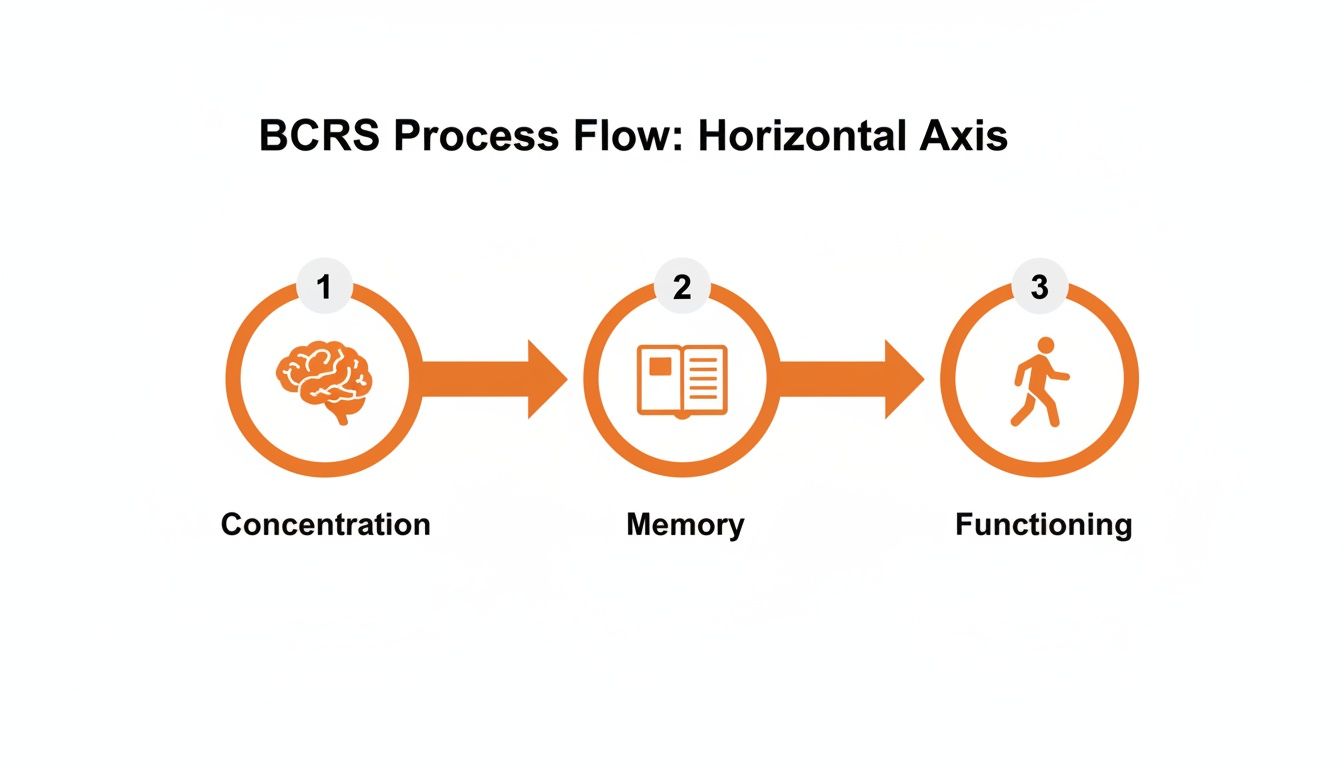
This flow from concentration, to memory, and finally to real-world functioning is exactly what the assessment is designed to map.
From Axis Scores to GDS Stage
Once you have a score for each axis, you simply calculate the average. This average score maps directly onto a stage of the Global Deterioration Scale (GDS), giving you a clear, standardized snapshot of the person's level of cognitive decline.
Actionable Example: Say your axis scores are: 3 (Concentration), 4 (Recent Memory), 2 (Past Memory), 3 (Orientation), and 4 (Functioning). The total is 16. Divide that by 5, and you get an average score of 3.2. This places the patient in GDS Stage 3 (mild cognitive impairment). Your action plan: You can now confidently tell the family that while their loved one is experiencing noticeable challenges, they can still function independently with some support, like setting up calendar reminders and simplifying financial tasks.
Of course, this is where your clinical judgment comes in. The numbers provide a framework, but you provide the context. As data from the Shirley Ryan AbilityLab's rehabilitation measures database shows, the BCRS is remarkably precise. This is how the scale helps us separate the worries of normal aging from the first signs of a clinical issue.
While the BCRS excels at staging, it's often used alongside other tools for initial screening. To see how different assessments fit together, get our guide with instructions for the MoCA.
Turning BCRS Scores into Actionable Care Plans

An assessment score is just a number until you put it to work. The true power of the Brief Cognitive Rating Scale is how it translates observations into real-world support that improves a person's quality of life. This is where we close the loop, moving from assessment to action.
A BCRS score gives clinicians a clear, functional stage to work from. This stage becomes the blueprint for building a personalized care plan and communicating with patients and families about what to expect.
From Score to Strategy: A Practical Guide
Different specialists can use the same BCRS results to create targeted actions. Because it provides a common language, it gets everyone on the same page.
Here’s how to turn a BCRS score into an actionable plan:
For the Neurologist: Seeing a patient’s average score shift from 3.5 to 4.5 over a year isn't just data—it's a trigger. Action: This objective change justifies adjusting medication, referring to cognitive therapy, and starting conversations with the family about long-term care planning.
For the Occupational Therapist: A patient scores a 5 on "Functioning/Self-Care" but only a 3 on "Recent Memory." Action: This tells the OT to prioritize daily living support. They can immediately work on setting up a visual medication schedule, organizing the kitchen for easier meal prep, and suggesting smart home devices for safety.
For the Primary Care Physician: A BCRS score of 4.0 or higher is a clear call to action. Action: Use this concrete evidence to make a compelling referral to a geriatric specialist or neuropsychologist, ensuring the patient gets the in-depth testing and resources they need without delay.
The goal is to move beyond simply staging a decline and toward actively supporting a patient’s remaining abilities. A BCRS score isn't an endpoint; it's the starting point for a dynamic, responsive care strategy.
Pairing the BCRS with Modern Digital Tools
This is where traditional scales and modern digital tools can create a powerful workflow. The BCRS gives you the "what"—the functional stage. Digital assessments provide the "why"—a granular, objective look at the underlying cognitive mechanics.
Actionable Workflow Example:
Administer the BCRS and find your patient is at GDS Stage 4 (moderate decline).
Use a rapid digital assessment, like OrangeCheck, to get precise, objective data on their attention, processing speed, and memory in under 30 minutes.
The digital report reveals a significant deficit in sustained attention, explaining the concentration issues you noted. Action: You can now design highly targeted, game-based cognitive therapies focused specifically on improving attention, and use the platform to track their progress with real numbers.
This combination validates your clinical judgment and gives you specific data to design powerful interventions. For more on this, our guide on cognitive assessment in dementia takes a deeper look at blending assessment methods.
Plugging BCRS scores into broader clinical decision support systems helps create truly tailored care plans. To see how our platform makes this a reality, explore the solutions at Orange Neurosciences. Contact us to learn how you can start building more effective, data-driven care plans today.
Understanding the BCRS: What It Does Well and Where It Falls Short
Before you bring any assessment into your practice, you need to know its strengths and boundaries. The Brief Cognitive Rating Scale is an incredibly useful tool for staging cognitive decline, but it's crucial to know what it can and can't do.
One of its biggest strengths is its rock-solid reliability. The BCRS shows excellent convergent validity with the Global Deterioration Scale (GDS), the gold standard for staging dementia. In plain terms, both tools almost always agree on the severity of a patient's condition.
Clinical Validity in Numbers
Research highlights how well the BCRS can differentiate between cognitive states. For instance, studies show individuals over 40 with subjective cognitive complaints have an average total BCRS score of 8.97 ± 1.6, while those with no cognitive issues score a much lower 5.74 ± 0.9. You can dig into the specifics in the full research paper on BCRS validity.
That statistical gap gives clinicians confidence, confirming the scale’s power to pick up on even subtle changes and track a patient’s journey over time.
Knowing the Scale’s Limitations
But it's absolutely crucial to know what the BCRS is not. It is a staging tool, not a diagnostic one. It tells you the severity of the decline, but it won't tell you the cause.
Using the BCRS to diagnose Alzheimer's is like using a ruler to diagnose a fever. The measurement is accurate, but it doesn't explain the underlying illness. A formal diagnosis always requires a comprehensive workup.
This is where a clinician's judgment is so important.
Practical Example: A patient with a lower level of education, or someone for whom English is a second language, might struggle with some verbal questions. Actionable Insight: If you don't account for this context, their score could be artificially high. Always interpret the final score as one piece of a much larger clinical puzzle, not a standalone verdict.
While the BCRS is fantastic for staging, other tools are built for initial screening. You can learn how different assessments stack up in our guide on MoCA vs MMSE.
Common Questions About the BCRS
Clinicians, patients, and families want to understand what the Brief Cognitive Rating Scale can—and can’t—do. Let's walk through common questions to help you use this scale effectively and provide clear answers.
Can the BCRS Diagnose Alzheimer's Disease?
The short answer is a clear no. The Brief Cognitive Rating Scale is a staging tool, not a diagnostic one.
Practical Analogy: A thermometer can tell you the severity of a fever, but it can’t tell you if it's from the flu or a bacterial infection. The BCRS works the same way. It measures the level of functional decline and tracks it over time, giving you a clear GDS stage.
Actionable Takeaway: A BCRS score provides crucial evidence to support a referral for a full diagnostic workup, which includes neurological exams, lab work, and often brain imaging. Use the score to justify next steps, not to make a final diagnosis.
How Is the BCRS Different From the MoCA or MMSE?
This is a fantastic question because it gets right to the heart of clinical workflow. The biggest difference is screening versus staging.
Screening Tools (MoCA, MMSE): These are first-line detectors designed to quickly check for the presence of cognitive impairment. They are like a smoke alarm.
Staging Tool (BCRS): The BCRS comes in after impairment is suspected. Its role is to determine the severity of that impairment—in other words, to tell you how big the fire is and how it’s affecting daily life.
The administration also differs. The MoCA and MMSE are direct tests given to the patient. The BCRS is a rating scale based on a semi-structured interview that includes crucial observations from an informant (like a family member), focusing on real-world function.
Actionable Insight: The MoCA might tell you a patient has a memory problem. The BCRS will tell you how that memory problem affects their ability to manage medications or pay their bills, giving you a clear path for intervention.
How Can Digital Tools Complement the BCRS?
This is where modern cognitive care really comes to life. The BCRS gives you the “what”—the functional stage. Digital tools deliver the objective “why” by pinpointing specific cognitive deficits.
Practical Synergy: You use the BCRS and find a patient is at GDS Stage 4 (moderate decline). You can then use a platform like Orange Neurosciences to get precise metrics on their attention, processing speed, and executive function in under 30 minutes.
This pairing allows you to:
Validate Your Judgment: Hard data from a digital assessment can confirm the attention struggles you observed.
Personalize Interventions: With granular data, you can design highly targeted, game-based cognitive exercises.
Track Progress Objectively: Use digital assessments to monitor progress with real numbers, creating a clear cycle of assessment, intervention, and support.
This integrated approach bridges the gap between traditional functional staging and truly data-driven cognitive healthcare.
By combining the functional insights of the Brief Cognitive Rating Scale with the precise, objective data from modern digital platforms, you can deliver a higher standard of care. To see how our AI-powered assessments and game-based therapies can fit into your clinical workflow, visit Orange Neurosciences and request a demo or email our team to learn more.

Orange Neurosciences' Cognitive Skills Assessments (CSA) are intended as an aid for assessing the cognitive well-being of an individual. In a clinical setting, the CSA results (when interpreted by a qualified healthcare provider) may be used as an aid in determining whether further cognitive evaluation is needed. Orange Neurosciences' brain training programs are designed to promote and encourage overall cognitive health. Orange Neurosciences does not offer any medical diagnosis or treatment of any medical disease or condition. Orange Neurosciences products may also be used for research purposes for any range of cognition-related assessments. If used for research purposes, all use of the product must comply with the appropriate human subjects' procedures as they exist within the researcher's institution and will be the researcher's responsibility. All such human subject protections shall be under the provisions of all applicable sections of the Code of Federal Regulations.


© 2026 by Orange Neurosciences Corporation