A Practical Guide to Cognitive Assessment in Dementia for Clinicians
Jan 25, 2026
Cognitive assessment for dementia isn’t just one test. It’s a series of evaluations looking at key thinking skills like memory, attention, and problem-solving. This process is crucial for clinicians to pinpoint specific cognitive impairments, monitor how they change over time, and tell the difference between normal aging and a potential neurodegenerative condition like Alzheimer’s disease. The ultimate aim is to create a detailed cognitive profile that informs a truly effective and actionable care plan.
Why a Practical Framework for Dementia Assessment Matters
For those of us on the front lines, the real challenge isn't just slapping a label on dementia—it's accurately mapping a patient's cognitive landscape to build a care plan that actually works. The traditional path can feel disjointed, often starting with a basic screening followed by a long, anxious wait for a specialist referral. This guide is designed to cut through that complexity, offering a practical framework that fits the reality of clinical settings.
We're moving past the textbook theories to tackle the daily hurdles you face. This means providing actionable insights for everything from managing a patient's anxiety to working within tight time constraints. The focus here is shifting from simply chasing a diagnosis to building a rich, holistic cognitive profile for continuous, adaptive care.
The Growing Need for Better Assessment Strategies
The urgency for better assessment protocols is thrown into sharp relief by public health data. In California alone, there are roughly 720,000 people aged 65 and older living with Alzheimer's disease. What’s more, 7.3% of Californians aged 45 and older report subjective cognitive decline, yet a staggering 23% of them have discussed these worries with a healthcare professional.
This gap is a clear call to action. We need objective, accessible assessment tools that can validate patient concerns early and efficiently, bridging the gap between suspicion and support.
From Initial Screening to a Comprehensive Profile
This guide will walk you through building a multi-faceted assessment strategy that you can tailor to each patient’s unique situation. You'll learn how to deploy quick, reliable screenings and, just as importantly, when to bring in more comprehensive digital tools like those from Orange Neurosciences.
Our goal is to empower you to make informed, efficient decisions that lead to better patient outcomes. These insights are vital for optimizing support, especially for individuals who need specialized dementia care. By the time you finish this guide, you’ll be ready to:
Select the right tool for the right clinical question.
Administer tests in a standardized, patient-centred way.
Interpret results to build meaningful, actionable care plans.
Document and monitor cognitive changes effectively over time.
A robust cognitive assessment does more than confirm a diagnosis. It provides the foundational data for personalized, proactive dementia care that can adapt as a patient's needs evolve.
Understanding these core principles is your first step. For a deeper dive into the fundamentals, our guide on what is a cognitive assessment is a great place to start.
Choosing the Right Cognitive Assessment Tools
Selecting the right tool for a cognitive assessment in dementia is the first real step toward a meaningful evaluation. With a whole range of instruments out there—from quick paper-and-pencil screeners to detailed digital batteries—the choice can feel a bit overwhelming. The key is to match the tool to the specific clinical question, the patient's context, and your practice's workflow.
The journey often kicks off with a brief cognitive screener. These are built for initial triage. They're quick, easy to administer, and can signal whether a deeper investigation is truly needed. Think of them as the vital signs check for cognition; they give you a high-level snapshot, not a definitive diagnosis.
Starting with Brief Cognitive Screeners
Brief screeners like the Mini-Cog are excellent for their speed and simplicity. The Mini-Cog combines a three-word recall test with a clock-drawing task, taking just a few minutes to complete. Its main job is to quickly flag individuals who might have a cognitive impairment and require a more thorough workup.
But their brevity is also their biggest limitation. A simple screener might miss subtle deficits, especially in executive function or complex attention, which can be early indicators of certain types of dementia. For example, a patient might pass a recall test with flying colours by remembering "apple, table, penny," but still struggle with planning multi-step tasks at home—a critical piece of the puzzle that a basic tool could easily overlook.
This infographic lays out a typical decision pathway for a cognitive assessment in dementia.
As you can see, the flowchart visualizes how a clinician moves from a patient's initial concern to a quick screen and, if needed, a full assessment. It's all about guiding a structured, logical diagnostic process.
Moving Beyond Screeners to Domain-Specific Testing
When a screener raises red flags or when the clinical picture is complex, it's time to bring in more targeted, domain-specific assessments. This is where you can dig into specific areas of cognition in much greater detail. The goal is to build a comprehensive profile that highlights a patient's unique cognitive strengths and weaknesses.
Think about these common scenarios:
For Suspected Memory Issues: If a patient's main complaint is forgetfulness, a more detailed memory test is in order. This goes beyond simple recall to assess immediate memory, delayed recall, and recognition. A practical example is reading a short story and asking the patient to recount the details immediately and again after 20 minutes.
For Executive Function Deficits: If family members report issues with judgment, planning, or problem-solving, tests that evaluate cognitive flexibility, inhibition, and working memory are crucial. An example task might be asking the patient to name as many animals as they can in 60 seconds (verbal fluency) or to alternate between drawing circles and triangles in a sequence. These deficits are often completely invisible in basic screenings.
For Language Difficulties: When a patient struggles with word-finding or comprehension, specific language assessments can help differentiate between various types of aphasia and cognitive decline. This could involve asking them to name objects shown in pictures or describe a complex scene.
Making the right choice between popular tools like the MoCA and MMSE can also be a sticking point. For a detailed comparison, you can explore our guide on MoCA vs. MMSE to see which best fits your specific needs.
Leveraging Evidence-Based Digital Platforms
Modern digital platforms offer a powerful way to conduct multi-domain assessments efficiently and with a high degree of precision. These tools can move past the limitations of traditional paper-based tests by providing objective, standardized scoring and detailed performance reports.
For example, a clinician might use OrangeCheck, which delivers a comprehensive cognitive profile across multiple domains in under 30 minutes. A patient may have scored perfectly well on a basic screener, but the digital assessment could reveal subtle yet significant deficits in executive function and processing speed. This level of detail allows for a much more accurate clinical picture and, ultimately, a more personalized and actionable care plan.
Digital assessment tools aren't just about convenience; they provide a depth of data that can uncover cognitive patterns missed by traditional screeners, leading to earlier and more precise interventions.
The need for accessible and precise tools is especially critical given the health disparities in cognitive health. In California, cognitive impairment affects a staggering 20.3% of adults aged 65 and older who do not have a prior dementia diagnosis. These figures reveal significant racial and ethnic inequalities, with Black older adults facing the highest burden. This disparity underscores the urgent need for equitable and rapid cognitive assessment tools that can serve diverse communities effectively. Read the full research about these cognitive health disparities.
Ultimately, choosing the right cognitive assessment tool comes down to a clinical decision based on a few key factors:
The Patient: Consider their age, education, cultural background, and any physical limitations like vision or motor impairments.
The Setting: A busy primary care clinic has very different needs than a specialized memory clinic.
The Question: Are you screening for potential problems, diagnosing a specific condition, or monitoring progression over time?
By thoughtfully navigating these considerations, you can build an assessment strategy that is both efficient and deeply insightful. For clinicians ready to see how digital tools can fit into their practice, a closer look at platforms from Orange Neurosciences is a logical next step.
Mastering Test Administration and Scoring
A cognitive assessment tool is only as good as the clinician using it. The way you administer a test can completely change the outcome, making standardized, patient-centred practices absolutely essential for getting valid and reliable data. Let's walk through actionable best practices for administration and scoring, so you can be confident your cognitive assessment in dementia is both accurate and insightful.
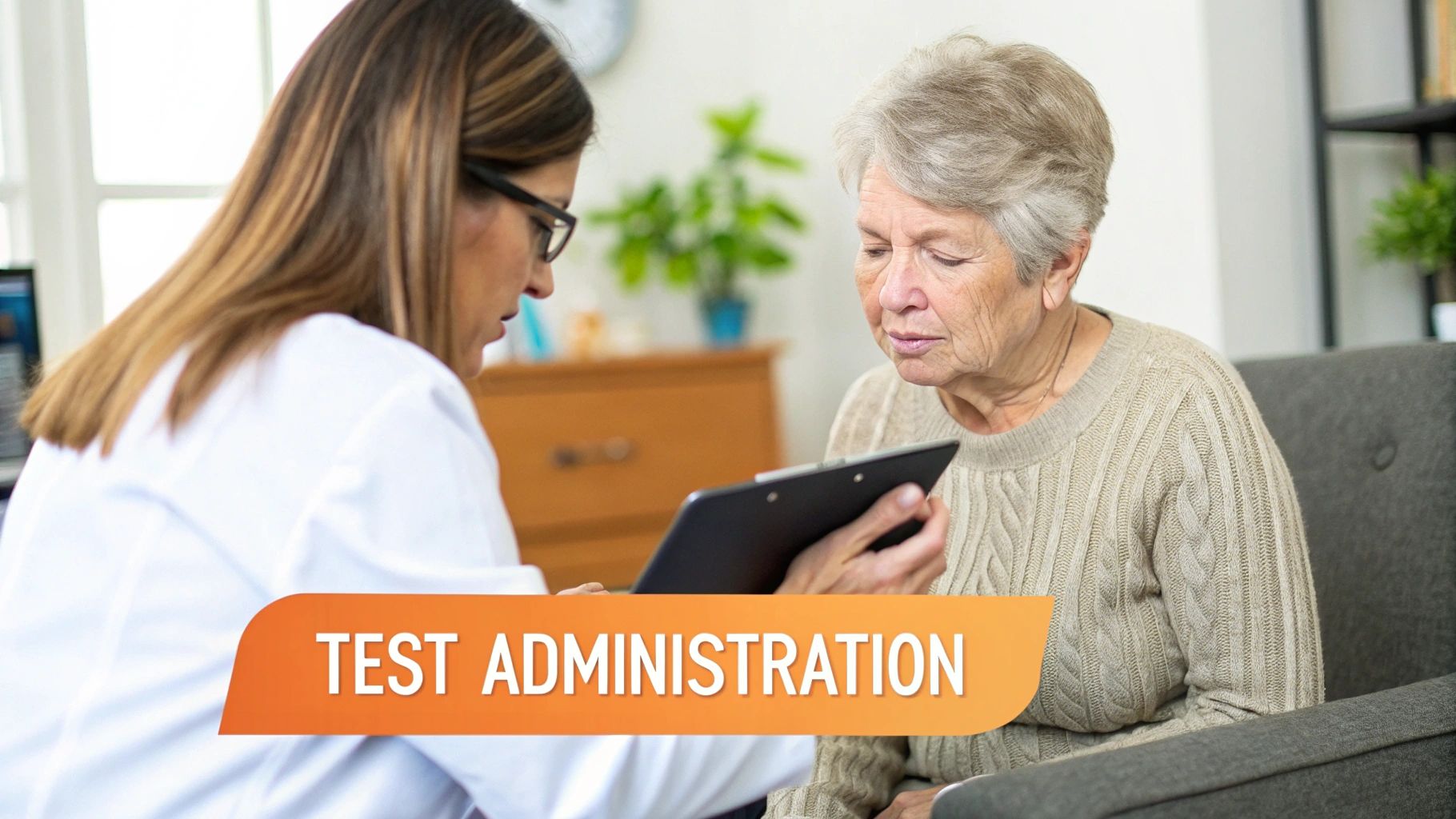
The process starts long before you ask the first question. Creating the right environment is a simple yet powerful step that many clinicians, pressed for time, can overlook. A patient's performance can easily be thrown off by distractions, anxiety, or physical discomfort, so preparing the setting isn't just a nicety—it's a non-negotiable part of a successful assessment.
Setting the Stage for Success
Think of the assessment environment as a controlled space you're creating to help the patient perform at their best. The goal is to strip away any cognitive load from external sources. That way, you're getting a true measure of their internal cognitive capacity.
A few small, actionable adjustments can make a world of difference:
Minimize Distractions: Find a quiet room, away from the hustle and bustle of the main clinic. Turn off phones, close the door, and clear any unnecessary clutter from their line of sight.
Ensure Physical Comfort: Is the lighting adequate? Is the temperature okay? Does the patient have a supportive chair? It’s always good practice to ask if they need a glass of water or to use the restroom before you begin.
Provide Necessary Aids: This one is critical. Make sure the patient has their glasses and hearing aids if they use them. Forgetting these can completely invalidate tests that rely on visuospatial or auditory processing. For example, asking a patient to draw a clock without their glasses is testing their vision, not their cognition.
The whole point is to measure cognitive function, not a patient's ability to cope with a distracting or uncomfortable room. Taking just five minutes to optimize the setting can save you from having to question the validity of your results later.
Building Rapport and Managing Anxiety
For many older adults, the idea of a cognitive assessment is incredibly intimidating. They might be worried about "failing" the test or what a potential dementia diagnosis could mean for their future. This performance anxiety can directly interfere with their cognitive abilities, especially attention and memory.
Your most effective tool here is building rapport. Start with a friendly, open conversation that has nothing to do with the test. Explain what you're about to do in simple, non-threatening language. Try saying, "Today, we're just going to do some brain exercises to get a baseline of your thinking skills. There are no right or wrong answers; the important thing is just to try your best."
This empathetic approach reframes the assessment from a high-stakes test to a collaborative activity. A patient who feels calm and reassured is far more likely to give you a true picture of their cognitive abilities.
Standardized Administration and Scoring
Once your patient is comfortable, sticking to standardized procedures is what makes the results reliable and comparable to established norms. Even tiny deviations can alter a test's difficulty and completely compromise its validity.
Let's take a common task as an example: the three-word recall. Standard instructions are to say the words clearly, ask the patient to repeat them right away, and then tell them you'll ask for the words again in a few minutes.
Here are some common mistakes I’ve seen:
Speaking too quickly or unclearly, which prevents the patient from properly encoding the information.
Giving hints during the recall phase, like "One of them was a colour."
Forgetting to note the immediate repetition, which itself gives you valuable data on attention and initial registration.
Scoring needs to be just as rigorous. Raw scores—simply the number of correct answers—are meaningless without context. They have to be compared against normative data, which are benchmarks established from large populations of healthy people matched for age, education, and sometimes gender. This comparison is what transforms a raw score into a meaningful metric, telling you if the patient's performance is within the expected range or if it suggests impairment.
For a detailed breakdown of how to properly administer a specific tool, our guide on the Montreal Cognitive Assessment instructions provides a clear, step-by-step walkthrough.
This is an area where digital platforms can significantly cut down on the risk of human error. Tools from Orange Neurosciences, for instance, present instructions and stimuli in a perfectly standardized way for every single patient. They also automate scoring and comparison to robust normative databases, freeing you to focus on what matters most: observing and engaging with your patient.
Translating Test Results into Actionable Care Plans
A cognitive assessment score is just a number until you bring it to life. The real value isn't in the raw data, but in how we translate that data into a story—a story that guides a practical, compassionate, and effective care plan for the patient and their family.

This is where clinical expertise really shines. It’s about looking past a single score to see the patterns of cognitive strengths and weaknesses. We synthesize everything we have—the test results, our own clinical observations, and what the family is telling us—to build a cohesive picture of how cognitive changes are actually impacting a person's day-to-day life.
Synthesizing Data into a Clinical Narrative
Let's walk through an actionable scenario. Imagine a 72-year-old patient, Mr. Davies. His family is worried about his memory, yet he scores within the normal range on a standard memory recall test. On paper, everything looks fine.
But a more detailed digital assessment, perhaps using a tool like OrangeCheck, can tell a completely different story. While his memory is relatively intact, his profile flags significant impairment in executive function and processing speed. Now that's a critical insight.
This specific pattern—spared memory but struggling executive function—is our starting point. It explains why he can remember his granddaughter's birthday but can't manage his finances or follow a multi-step recipe anymore. The problem isn't just about forgetting; it's a breakdown in planning, sequencing, and self-monitoring.
The most powerful insights often come from these dissociations in cognitive performance. When one domain is strong while another is weak, it gives us a clear roadmap for where to target support and interventions.
Communicating Findings with Empathy
Sharing these findings is a delicate conversation. The goal is to deliver information with clarity and empathy, focusing on what it means in real life, not just abstract scores.
Instead of saying, "Mr. Davies scored in the 15th percentile for executive function," we can frame it in a way that resonates with the family's own experience.
Practical Communication Example: "The tests show that while John's memory for past events is still quite good, the part of his brain that acts like a project manager—organizing and planning—is having some trouble. This is likely why he's finding it harder to keep track of bills or appointments, even though he remembers the events themselves."
This approach validates the family's concerns while offering a clear, non-alarming explanation. It also creates a natural opening for a collaborative chat about solutions, shifting the focus from problems to practical support. For more context, it can be helpful to understand the distinctions between conditions like mild cognitive impairment vs dementia.
Building a Comprehensive Care Plan
With a clear clinical narrative, we can build a targeted care plan. This should be a living document, created with the patient and their family, that addresses the specific needs the assessment uncovered.
For Mr. Davies, whose main challenge is executive dysfunction, the care plan would focus less on memory aids and more on structural supports.
Actionable Care Plan Components for Mr. Davies:
Safety Recommendations: Suggesting automated bill payments can prevent serious financial errors. A pill organizer or a medication reminder service becomes essential for medication adherence.
Non-Pharmacological Interventions: A large wall calendar or whiteboard can help outline daily and weekly routines. We can also teach the family how to break down complex tasks into simple, single-step instructions, such as laying out clothes for the day in the correct order.
Specialist Referrals: An occupational therapist is a perfect referral here. They can assess his home environment and teach practical strategies for managing daily tasks safely. A social worker could also help the family connect with valuable community resources.
The need for this kind of precise profiling and planning is only growing. New data has identified specific hotspots of Alzheimer's disease in California, with Orange County at 15.2% and Imperial County at 15.0% among adults over 65. With these numbers projected to double by 2040, using detailed cognitive profiles to guide care is more critical than ever.
The table below breaks down how specific assessment findings can be directly translated into practical actions.
From Assessment Data to Actionable Care Plan
Cognitive Domain Impairment | Practical Implication | Recommended Care Plan Action | Potential Referral |
|---|---|---|---|
Executive Function | Difficulty with planning, managing finances, medication adherence. | Set up automatic bill pay, use a dosette box, create simple daily checklists. | Occupational Therapist, Social Worker, Financial Advisor |
Episodic Memory | Forgetting recent conversations, appointments, or events. | Use memory aids like calendars, whiteboards, and phone reminders. | Geriatrician, Memory Clinic, Alzheimer Society |
Visuospatial Skills | Getting lost in familiar places, difficulty with driving or navigation. | Simplify home layout, label cupboards, consider driving assessment/cessation. | Occupational Therapist, Driving Assessment Centre |
Language (Aphasia) | Trouble finding words, understanding speech, or naming objects. | Encourage use of gestures, pictures; simplify communication for family. | Speech-Language Pathologist, Aphasia Support Group |
Ultimately, to see if these plans are working, clinicians should also consider employing robust impact measurement strategies. By translating test results into a holistic and actionable plan, we empower patients and their families with the real-world tools they need to navigate the challenges of cognitive decline.
Effective Documentation and Strategic Follow-Up
The cognitive assessment process doesn't end when the patient walks out the door. In many ways, that's just the beginning. The steps that follow—clear documentation and consistent long-term monitoring—are what turn a single assessment into a powerful tool for ongoing dementia care.
Without a solid report and a thoughtful follow-up plan, you're just collecting data points. With them, you can track disease progression, see if treatments are working, and ensure everyone on the care team is on the same page.
Crafting a High-Impact Clinical Report
Think of your report not as a data dump, but as the clinical story of your patient's cognitive health at this specific moment. A report filled with just numbers and percentiles is nearly useless to the next clinician—or even to you, six months down the road. It needs to paint a picture.
To make your report truly valuable and actionable, go beyond the raw scores. Be sure to include:
Behavioural Observations: How did the patient act during the testing? Were they anxious, distracted, or frustrated? Did they try to correct their own mistakes? For example, noting "Patient became visibly frustrated during the clock-drawing task and repeatedly erased their work" adds crucial context.
Clinical Interpretation: This is where your expertise shines. Connect the dots for the reader. For instance, write, "The patient's low score in executive function, paired with my observation of his difficulty shifting between tasks, likely explains the family's report of recent struggles with medication management."
Patient and Family Input: Ground the data in reality. Briefly mention the concerns that brought the patient in. Quoting a specific worry, like, "His wife states he has gotten lost twice in the last month while driving to the grocery store," makes the objective findings much more tangible.
A well-crafted report bridges the gap between objective data and functional reality. It tells the story of how cognitive deficits are affecting the patient's life, providing a clear foundation for targeted interventions and future monitoring.
Designing a Strategic Follow-Up Schedule
Dementia is, by its nature, a progressive condition. That makes regular reassessment an absolute cornerstone of good management. A one-off assessment gives you a snapshot; longitudinal data shows you the trajectory. This is how you make timely, informed adjustments to the care plan.
So, how often should you re-evaluate? Here's an actionable schedule based on the clinical picture:
For Mild Cognitive Impairment (MCI): I typically recommend reassessment every 6 to 12 months. This is the best way to monitor for any potential conversion to dementia.
For Established Dementia: An annual check-in is a good baseline. However, you'll want to test more frequently if there's a sudden decline in function or after you've introduced a new treatment.
This regular monitoring helps answer the big questions. Is their memory declining faster than we'd expect? Are new cognitive domains becoming impaired? Is their current support plan still cutting it?
Streamlining Follow-Up with Digital Tools
Keeping track of this longitudinal data is where digital platforms like Orange Neurosciences really come into their own. One of the classic problems with traditional paper-and-pencil tests is the "practice effect"—patients score better just because they remember the test from last time, not because their cognition has improved.
Modern digital tools get around this by randomizing test items, giving you a much cleaner, more accurate measure of true cognitive change.
Platforms from Orange Neurosciences provide objective, standardized data that creates a reliable benchmark. When you reassess a patient, the system can automatically compare their new results to their previous baseline, spitting out a clear, visual report showing any changes. This data-driven approach takes the guesswork out of tracking progression and makes your follow-up incredibly efficient. To see how this strengthens long-term management, check out our insights on ensuring continuity of care.
Ready to see how a digital platform can transform your workflow for documentation and long-term patient monitoring? Visit the Orange Neurosciences website to see exactly how our system works and request a demo.
Burning Questions About Cognitive Assessment in Dementia
Even with the best framework, the real world of clinical practice always throws a few curveballs. When you're sitting with a patient, theory can feel distant. Let's tackle some of the most common questions that pop up during cognitive assessments with practical, actionable answers.
How Should I Handle Patient Resistance or Anxiety?
It’s completely normal for a patient to feel on edge—or even get defensive—when you bring out an assessment. Nobody likes feeling tested, especially when they’re worried about what you might find. They might fear a dementia diagnosis or just feel judged.
The best approach is always rooted in empathy and honesty. Frame it in a gentle, non-threatening way. A practical script I often use is: "We're going to do a few brain exercises today, just to get a clear picture of how you're thinking. It helps us see your strengths and figure out where you might need a bit of extra support."
If someone is really pushing back, don’t force it. Try to dig a little deeper into their specific fear. Sometimes, just validating their feelings ("I get it, this can feel a bit intimidating") is enough to build the trust needed to continue. You can also break the assessment into smaller chunks over a few appointments to make it feel less like a high-stakes exam.
Rapport isn't just a box you tick at the beginning of an appointment; it's something you build continuously. A patient who feels respected is going to engage more honestly, which gives you a much truer look at their cognitive state.
Is It Dementia or Something Else?
This is one of the trickiest parts of the job: telling the difference between dementia and conditions that look similar, like depression or Functional Cognitive Disorder (FCD). FCD is a big one—it can cause very real memory and focus problems, but it isn't driven by neurodegeneration.
A comprehensive, multi-domain assessment is your best friend here. For instance, a patient with FCD might complain of severe memory lapses but then score perfectly fine on objective tests. That's a pattern you see less often in most dementias.
Here are actionable clues to look for:
Look for inconsistencies: Does the patient struggle to recall their own address but remembers the tiniest detail from your last appointment? That could be a clue.
Consider the emotional picture: FCD symptoms often flare up alongside anxiety, chronic pain, or deep fatigue. A really good patient history is invaluable.
Evaluate the symptom path: Dementia usually involves a slow, steady decline. FCD symptoms, on the other hand, can fluctuate wildly, often getting worse during times of high stress.
Catching these patterns can save a patient from an incorrect diagnosis and point them toward treatments that actually work for them, like cognitive rehabilitation for attention instead of dementia medications.
When Should I Use a Digital Assessment Over a Paper Test?
Look, traditional paper screeners like the MoCA or MMSE are great for a quick check. They have their place. But digital assessments bring a different level of precision to the table and are particularly useful in certain situations.
Think about reaching for a digital tool when you need:
To Catch Subtle Changes: Digital tests are often far more sensitive to tiny deficits in things like processing speed or executive function—the exact things paper screeners can easily miss in the early stages.
Objective Tracking Over Time: When you're monitoring a patient's progression, digital tools get around the "practice effect." Patients can't just get better at the test because they remember the questions from last time. This gives you a much cleaner line of sight into real cognitive changes.
A Deeper, More Complete Profile: If you need a detailed map of a patient's cognitive landscape to build a truly personalized care plan, a digital battery gives you that rich data in one efficient sitting.
Here’s a classic, actionable scenario: A family is reporting that their mom is struggling at home, but she sails through a brief paper screener in your office. A digital assessment could be the thing that uncovers the subtle executive dysfunction causing the real-world problems, giving you the objective data needed to validate the family's concerns and create a targeted safety plan.
The work of cognitive assessment is about so much more than just landing on a diagnosis. It's about building a deep, evolving understanding of a person's cognitive world so you can give them the absolute best care. Bringing precise, evidence-based tools into your practice is a huge part of that mission.
At Orange Neurosciences, we arm clinicians with the advanced digital tools needed to get rapid, objective cognitive insights. Our platform provides the detailed profiles you need to make better-informed decisions, create targeted care plans, and track patient progress with real confidence.
Discover how Orange Neurosciences can enhance your clinical practice today.
Orange Neurosciences' Cognitive Skills Assessments (CSA) are intended as an aid for assessing the cognitive well-being of an individual. In a clinical setting, the CSA results (when interpreted by a qualified healthcare provider) may be used as an aid in determining whether further cognitive evaluation is needed. Orange Neurosciences' brain training programs are designed to promote and encourage overall cognitive health. Orange Neurosciences does not offer any medical diagnosis or treatment of any medical disease or condition. Orange Neurosciences products may also be used for research purposes for any range of cognition-related assessments. If used for research purposes, all use of the product must comply with the appropriate human subjects' procedures as they exist within the researcher's institution and will be the researcher's responsibility. All such human subject protections shall be under the provisions of all applicable sections of the Code of Federal Regulations.


© 2026 by Orange Neurosciences Corporation