Instructions for MoCA: A Clinician's Guide to MoCA Administration
Feb 17, 2026
Administering the Montreal Cognitive Assessment (MoCA) is a standardized process, but it’s far from robotic. The whole thing is a 30-point test that you can typically get through in about 10-15 minutes.
At its core, you're guiding a patient through a series of tasks designed to check in on their memory, language, attention, and visuospatial skills. The key to getting results you can trust? Sticking to the standardized script. It’s what makes the scores reliable and comparable from one patient to the next.
A Clinician's Practical Guide to the MoCA
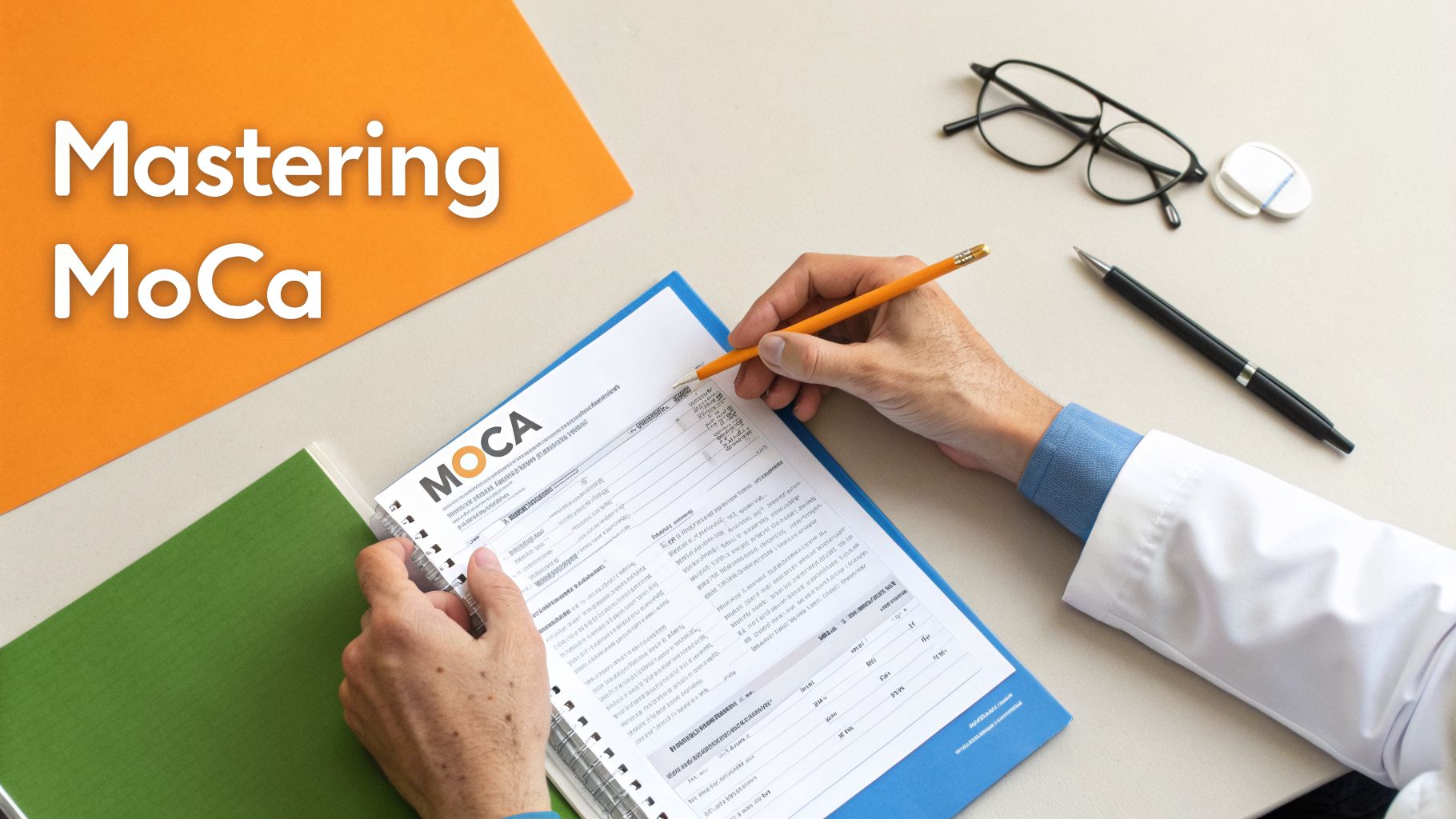
So, you want to get good at administering the MoCA. You've come to the right place. This guide is all about giving you actionable insights that go beyond just reading the instructions on the page. We’re not just listing steps; we’re diving into the clinical thinking behind them.
The MoCA is a go-to screening tool for a reason, especially for spotting mild cognitive impairment (MCI). On the surface, it’s a simple pen-and-paper test, but its real power is in the nuance. A properly run MoCA gives you a quick, powerful snapshot of a patient's cognitive health, helping you flag issues that might need a closer look.
It's crucial to remember that the MoCA isn't a diagnostic tool on its own. Think of it as a highly effective screener. Actionable Insight: Use a low MoCA score as a trigger for a next step—like a referral for full neuropsychological testing—not as a final diagnosis.
So, Where Does the MoCA Fit In?
Think of the MoCA as a vital first step in the diagnostic puzzle. Practical Example: A 72-year-old patient comes into your family practice mentioning they’ve been more forgetful lately. The MoCA is perfect here because it casts a wide net, assessing multiple cognitive domains. This makes it far more sensitive than older screeners, especially for catching those subtle deficits.
And it’s not just for flagging potential Alzheimer’s disease. The MoCA is incredibly versatile and useful across a range of conditions:
Post-stroke recovery: It’s great for tracking cognitive shifts after a stroke.
Parkinson's disease: Cognitive symptoms are a common non-motor feature, and the MoCA helps monitor them.
Traumatic brain injury: Useful for assessing deficits in executive function and attention.
Multiple sclerosis: Helps keep an eye on the cognitive fluctuations that can come with the disease.
Setting the Stage for an Accurate Assessment
Getting good at the MoCA starts well before you ask the first question. It’s a mix of sticking to the script while also building rapport with your patient. You need to create the right environment, deliver instructions clearly, and make the person feel at ease.
This foundation is non-negotiable for getting valid results. As you get more comfortable with the manual administration, you’ll also see how technology is starting to play a bigger role. It’s worth learning more about the evolution of cognitive assessments and how digital tools are shaping modern neuropsychiatry. But first things first—let’s master the hands-on process.
Setting the Stage for a Successful MoCA Administration
The validity of a MoCA assessment is decided long before you ask the first question. A successful administration really hinges on thoughtful preparation of both the environment and the person you're assessing. Getting this right ensures the results reflect cognitive function, not just a noisy room or a nervous patient.
Think of the right setting as non-negotiable. It needs to be a sanctuary from the typical hustle of a clinical environment. A ringing phone, a conversation down the hall, or a TV in the background can seriously skew results, especially on tasks that demand sustained attention.
Creating the Optimal Testing Environment
Your main goal here is to get rid of any cognitive load that isn't part of the test itself. A quiet, private room is the gold standard. Make sure it’s well-lit to prevent any strain for patients with visual impairments and that the temperature is comfortable.
Before the patient even walks in, get everything organised and ready. This small step conveys professionalism and helps the entire assessment flow smoothly.
Test Forms: Have a few clean, unmarked copies of the MoCA test form on hand. Double-check that you're using the correct version for your patient population.
Writing Instruments: Two sharpened pencils with erasers are a must. A backup prevents any interruption if a point breaks.
A Clear Workspace: The table or desk should be completely free of clutter. The only things the patient should see are the test form and a pencil when it's time to use them.
This level of readiness prevents you from fumbling for materials, which can easily break a patient's focus and dial up their anxiety. It's a simple but powerful way to maintain control over the assessment process.
The Art of Patient Preparation
How you introduce the MoCA can dramatically impact rapport and performance. Many people, particularly older adults, get anxious about "tests," immediately associating them with failure or a potential dementia diagnosis. Your role is to frame it as a routine check-in.
Start with a warm, reassuring tone and ditch the clinical jargon. Instead of saying, "I'm going to administer a cognitive screening tool," try a much gentler approach.
Practical Example: "Hello, Mr. Smith. Today, as part of your regular check-up, we're going to do a brief activity that helps us get a snapshot of different thinking skills, like memory and concentration. It's something we do with many of our patients to make sure we're supporting their overall health."
This kind of script normalizes the process, shifting the focus from a "test" to a collaborative health activity. It's also vital to get informed consent, explaining what the assessment involves and what will happen with the results in a way they can easily understand. You can discover more about the nuances of this approach by exploring our guide on the language of assessment.
Actionable Insight: Create a supportive atmosphere where the patient feels comfortable enough to give their best effort. Acknowledge that some questions might be tricky and that it's perfectly okay; the important part is just to try.
Inevitably, patients will have questions. Being prepared with empathetic and clear answers is crucial for building that initial trust.
Handling Common Patient Questions
Patient Question | Ineffective Response | Empathetic & Effective Response |
|---|---|---|
"Is this a test for dementia?" | "Yes, we're checking for memory problems." | "This activity helps us understand your thinking skills. Dementia is a complex diagnosis that involves much more than just this one check-in." |
"I'm not good at tests." | "Don't worry, it's easy." | "That's a very common feeling. Please don't worry about getting everything 'right.' Just do your best—that's all I ask." |
"Why do I have to do this?" | "It's just standard procedure." | "It’s a routine part of our care that helps us get a complete picture of your health, just like checking your blood pressure." |
By mastering these preparatory steps, you establish a foundation of trust and create an environment where you can get an accurate assessment. This careful setup ensures that the results you get are ones you can confidently interpret.
Executing the MoCA: A Task-by-Task Walkthrough
Once you’ve set the stage—the room is quiet, the materials are ready, and the patient feels at ease—it’s time to begin the assessment itself. I can't stress this enough: following the standardized instructions is everything. It isn't just a "best practice"; it's the only way to ensure the results are valid. Even a tiny deviation, like a gesture or an extra word, can nudge a patient’s response and throw off the entire score.
This guide will walk you through the precise scripts and offer practical advice to help you navigate each part of the MoCA with confidence. We’ll break down every task, from drawing cubes to recalling words, and flag some of the common hurdles you might encounter along the way.
Before you even start, it helps to visualize the flow of preparation that comes first. A smooth assessment always starts with a controlled environment and an organized administrator.
Visuospatial and Executive Functions
This first cluster of tasks really gets into higher-level cognitive processing—things like planning, visual perception, and the ability to switch between tasks. You have to be a stickler for the script here. It’s amazing how an unintentional nod or finger trace can give away a clue you didn't mean to.
First up is the Trail Making Test. Point to the sample section and say, exactly as written: "Please draw a line, going from a number to a letter in ascending order. Start here [point to 1] and draw a line from 1 to A, then to 2, and so on. End here [point to E]."
It's absolutely crucial that you correct any mistakes the patient makes on this practice run. Practical Example: If they connect 1 to 2, you must step in and say, "You need to go from a number to a letter. Please go from 1 to A, then from A to 2." But once they start the main test, your hands are tied. No corrections, no hints, no matter what.
Next is the Cube Copying task. The instruction is simple: "Copy this drawing as accurately as you can." That’s it. Don’t trace the cube with your finger or give any tips about its 3D nature. The whole point is to see if they can perceive and reproduce the shape on their own.
The final piece of this section is the Clock Draw. The instructions are very precise: "Draw a clock. Put in all the numbers and set the time to 10 past 11." To get full marks, they need to nail three things: a clear contour, all the right numbers in the right places, and the hands showing the correct time. Difficulties here can be quite telling, and we dive much deeper into this in our detailed guide on using the clock-drawing test for dementia screening.
Naming, Memory, and Attention
This part of the MoCA moves pretty quickly, assessing several different cognitive areas one after the other. Your timing and precision here are key.
For the Naming task, you just point to each of the three animals (lion, rhinoceros, camel) and ask, "Tell me the name of this animal." The answers are usually straightforward, but a hesitation or error can be an early sign of word-finding difficulties (anomia).
Now for the Memory task, a cornerstone of the assessment. You'll read a list of five words at a steady pace of about one per second. Say this: "This is a memory test. I am going to read a list of words that you will have to remember now and later on. Listen carefully. When I am through, tell me as many words as you can remember. It doesn’t matter in what order you say them."
Do not repeat the list. Once they've given you the words they remember, you go right into the second trial: "I am going to read the same list for a second time. Try to remember and tell me as many words as you can, including the words you said the first time." Read the list again, record their answers, and then give them a heads-up that you'll ask for these words one last time at the end.
This is what your scoring sheet looks like for this section—it’s laid out to make tracking their responses straightforward.
The Attention section comes next, starting with a forward digit span. Instruct them: "I am going to say some numbers and when I am through, repeat them to me exactly as I said them." Then, you'll switch to the backward digit span: "Now I am going to say some more numbers, but when I am through you must repeat them to me backwards."
The next task tests vigilance. You read a list of letters and give this instruction: "I am going to read a sequence of letters. Every time I say the letter A, I want you to tap your hand once. If I say a different letter, do not tap your hand." Finally, there's the Serial 7s subtraction, which demands sustained concentration.
Actionable Insight: A common pitfall is rushing the attention tasks. It's better to administer each one with a deliberate, calm pace. This gives the patient enough time to process the instructions and respond without feeling pressured.
Language, Abstraction, and Orientation
These final sections wrap up the MoCA by evaluating language skills, abstract thinking, and a person's basic awareness of their surroundings.
For the Sentence Repetition task, you'll ask them to repeat two sentences word-for-word. The first is, "I only know that John is the one to help today." The second is, "The cat always hid under the couch when dogs were in the room." Remember, you only say each sentence once.
Next up is Verbal Fluency, where the patient has to name as many words as possible starting with a specific letter (usually 'F') in one minute. The script is: "Tell me as many words as you can think of that begin with the letter F. I will tell you when to stop." You must time this for exactly 60 seconds. Don't accept proper nouns (like "Frank"), numbers, or different versions of the same word (like "friend" and "friendly").
The Abstraction task gets at their conceptual thinking. You'll ask them to explain what two items have in common. Start with the practice pair, 'banana – orange'. If they struggle, you can prompt them by asking, "How are they alike?" For the test pairs, 'train – bicycle' and 'watch – ruler', you just record their answer verbatim and score it later.
This leads to the Delayed Recall. Without any warning, you ask: "I read some words to you earlier, which I asked you to remember. Tell me as many of those words as you can remember." Make a note of which words they recall on their own. If they miss any, you can then offer a category cue (e.g., "One of the words was a type of fabric").
Finally, the test concludes with Orientation. This is a straightforward check of their awareness. You simply ask for the current date, month, year, day of the week, the name of the place you're in, and the city. By carefully following these steps for every MoCA you administer, you build a foundation of consistent and reliable data.
From Administration to Interpretation: Scoring the MoCA Accurately

Giving the MoCA with precision is only half the job. The real clinical value comes from scoring it just as accurately, turning a patient's responses into a meaningful number. This takes a meticulous eye, because small details in how you score can significantly shift the final result and, in turn, your clinical impression.
Scoring the MoCA isn't just about adding up points. It’s about applying a consistent, standardized set of rules to every single response. From the clock draw to the abstraction questions, each task has specific criteria. Mastering these rules is what makes your scoring both reliable and valid.
Navigating Key Scoring Nuances
Certain sections of the MoCA are well-known for causing scoring confusion. Let's walk through a few of the most common areas where mistakes happen and clear up how to score them correctly.
One of the trickiest items is the Clock Draw. To earn all three points, the patient has to nail three distinct elements:
Contour (1 point): The circle must be mostly round and completely closed. Minor wobbles are fine, but a really distorted shape doesn't get the point.
Numbers (1 point): All 12 numbers have to be there, with no extras or missing ones. They also need to be in the right order and placed in the correct quadrants on the clock face.
Hands (1 point): There must be two hands clearly pointing to the 11 and the 2 to show the time "10 past 11." Critically, the hour hand has to be noticeably shorter than the minute hand.
The Abstraction task is another area that demands careful judgment. Here, you're looking for the difference between a truly conceptual link and a more concrete one.
Practical Example: Scoring Abstraction
Prompt: "How are a train and a bicycle alike?"
2-Point Answer (Conceptual): "They are both modes of transportation." or "They are both ways to travel." This shows the person gets the abstract category they belong to.
1-Point Answer (Concrete): "They both have wheels." This is correct, but it’s a less abstract connection that focuses on a physical part rather than their function.
0-Point Answer: "One is big and one is small." This is just a comparison, not a similarity.
Actionable Insight: A great rule of thumb for scoring is to be conservative. If a response is ambiguous and doesn't clearly meet the criteria in the official MoCA instructions, it's usually best not to award the point. Consistency is far more important than leniency.
Calculating and Adjusting the Final Score
Once you've scored each item, you just add up the points to get a raw total out of 30. But wait—there’s one crucial adjustment you might need to make. The MoCA includes a correction for education to account for potential performance differences based on formal schooling.
You must add one point to the total score for any individual who has 12 years or less of formal education. This simple adjustment helps ensure the test is equitable and doesn't penalize people for having less schooling. The maximum possible score always remains 30, so if someone with 12 years of education scores a perfect 30, their final score is still 30, not 31.
This kind of standardized protocol is vital. The cognitive assessment market in the U.S. is projected to hit $7.88 billion by 2030, which really highlights how important it is to use these tools correctly. While broad market data is available, finding specific stats on MoCA protocols requires a more targeted search. You can also get more context by reading up on major cognitive health initiatives, like those at UCSF addressing imbalances in Alzheimer's research. Discover more insights about Alzheimer's research at UCSF.
Interpreting the Score in a Clinical Context
The standard cutoff for the MoCA is a score of 26 out of 30. Generally, a score of 26 or higher is considered within the normal range, while a score of 25 or below suggests there might be some cognitive impairment and warrants a closer look.
But remember, a score is never just a number. It's a piece of data you have to interpret within the bigger picture of the patient's life. Think about their medical history, current symptoms, functional abilities, and even their mood on the day of the test. A low score in a patient with known depression, for example, might be interpreted differently than the same score in someone with no such history.
To help you quickly reference these cutoffs, here's a simple breakdown:
MoCA Scoring Quick Reference
MoCA Score Range | General Interpretation | Recommended Next Step |
|---|---|---|
26 - 30 | Within normal limits; cognitive impairment unlikely. | Monitor as clinically indicated. |
18 - 25 | Mild Cognitive Impairment (MCI) may be present. | Further diagnostic evaluation is recommended. |
10 - 17 | Moderate Cognitive Impairment may be present. | Comprehensive neuropsychological assessment and specialist referral are strongly recommended. |
< 10 | Severe Cognitive Impairment may be present. | Specialist referral is essential for diagnosis and management. |
This table provides a great starting point, but the final score's main job is to guide your next steps, not to be a standalone diagnosis. For a much deeper dive into what different scores can mean, be sure to check out our guide on MoCA score interpretation. It will help you translate that number into confident, actionable clinical decisions.
Navigating Common Challenges and Special Circumstances
Clinical practice rarely fits neatly into a textbook. When you're administering the MoCA, you’re bound to run into situations that don't follow the standard script. Knowing how to handle these moments is what separates a novice from an expert and is the key to getting good, meaningful data.
This isn't about bending the rules for the sake of it, but adapting thoughtfully. The goal is always to balance strict standardization with compassionate, patient-centred care, whether you're dealing with patient fatigue, a subtle slip-up in your own administration, or specific patient needs.
Accommodating Diverse Patient Needs
Not everyone can approach the standard MoCA in the same way. Sensory impairments, language barriers, or a person's educational background can all skew the results if you don't adjust your approach. Luckily, there are official, validated versions of the MoCA built for exactly these situations.
Your first step is to figure out what the specific barrier is. Is the patient having trouble seeing the page? Are they dealing with profound hearing loss? Is literacy the main concern?
For Vision Impairments: If a patient has significant vision loss that glasses can't fix, the standard MoCA just won't work. You'll need to use the MoCA-Blind. It leaves out all the visual tasks and is scored out of 22 points.
For Hearing Impairments: For those with significant hearing loss, the MoCA-H is the way to go. The instructions are typically given in writing to make sure nothing gets missed.
For Low Literacy or Education: When a patient has low literacy or didn't have much formal schooling, the MoCA-Basic is a much better tool. It’s designed to keep reading and writing to a minimum while still giving you a solid look at key cognitive areas.
It is absolutely crucial to document which version you used. The scoring and what it means are different for each one, so if you don't make a note of it, the final score is essentially useless.
Avoiding Common Administration Pitfalls
Even experienced clinicians can slip into habits that mess with the MoCA’s standardization. Just being aware of these common mistakes is half the battle. One of the biggest and most frequent errors is giving away unintentional hints.
Practical Example: Not Giving Cues Imagine you're on the Naming task, and the patient just can't identify the rhinoceros. It’s so tempting to help, maybe by saying, "It's that big, grey animal with a horn on its..." But that's a phonemic cue, and it completely invalidates their response. The right move? Just mark the answer as incorrect and move on.
Another classic pitfall happens with the delayed recall. This part must be a surprise and should come only after you've finished the Orientation section. If you ask for the words too early or give a little warning like, "Okay, remember those words I told you earlier?" you're giving them an unfair leg up.
Actionable Insight: The integrity of the MoCA really comes down to sticking to the script. Any deviation, no matter how small or well-intentioned, introduces a new variable that can throw off the results. If you absolutely have to deviate, you must document it in your clinical notes.
This commitment to the protocol is more important than ever. As our population ages and brain health becomes a bigger focus, we need reliable screening tools. Just look at places like California, where projections show a significant rise in Alzheimer's cases, highlighting the need for consistent, high-quality assessments. Obtaining specific data on MoCA protocols across different regions requires targeted research, but the trend is clear. You can find more insights into the U.S. cognitive assessment market and where it's headed.
Documenting Accommodations and Deviations
Good documentation is your best friend—clinically and ethically. Whenever you use an adapted version of the MoCA or something unexpected happens, your notes need to paint a clear picture of what went down. This gives crucial context to the final score and ensures anyone who reads that file later understands exactly how you got that number.
Your documentation should always cover these points:
Reason for Accommodation: Be specific about why you couldn't do a standard administration. For example, "Patient has macular degeneration and was unable to see the test form."
Version Used: Name the exact version you administered, like "Administered MoCA-Blind."
Deviations Noted: Detail any unexpected events. For instance, "Patient became overly fatigued during Serial 7s; task was discontinued."
This level of detail makes your assessment transparent, defensible, and clinically sound. For teams looking to streamline this process, using a comprehensive online cognitive screening test can help build structured workflows that standardize both administration and documentation from the start.
Beyond Screening: The Future of Cognitive Assessment
The Montreal Cognitive Assessment is an invaluable screening tool, but let's be honest—its real power isn't in the final score. It’s in what that score prompts you to do next. A result below 26 is never a diagnosis. Think of it as a critical signal, a flashing light on your dashboard telling you it's time to look deeper under the hood.
Mastering the manual instructions for moca is one thing, but the future of cognitive health isn't about relying on a single number. It’s about building a comprehensive, granular profile of a person's unique cognitive abilities.
A simple screening score tells you that there might be a problem, but it often can't tell you why or where the specific deficits lie. Is a low score driven by poor memory, slow processing speed, or an underlying attention issue? That single number just can’t provide that level of clarity on its own.
From Screening Score to Actionable Profile
This is exactly the gap that platforms like Orange Neurosciences were built to fill. The MoCA is your initial radar sweep; it’s brilliant at picking up a signal. But once you have that signal, you need a more advanced tool to get a high-resolution image of what's really happening. Our AI-powered system provides just that.
In under 30 minutes, we move past a single score to deliver precise, objective measurements across multiple cognitive domains, including:
Sustained and Divided Attention
Working and Short-Term Memory
Executive Function
Processing Speed
Eye–Hand Coordination
This detailed cognitive profile gives you the specific, hard data you need to build a truly personalized and effective care plan.
Integrating Advanced Tools into Your Workflow
The goal here is to move seamlessly from a screening result to a comprehensive, actionable strategy. Instead of waiting weeks—or even months—for a full neuropsychological workup, you can get immediate, decision-ready data that integrates right into your clinical workflow.
Practical Example: A patient scores a 24 on the MoCA. A subsequent digital assessment reveals their memory is perfectly intact, but their processing speed is significantly impaired. This one finding changes your entire approach, pointing you toward entirely different interventions and support strategies than you would have used for a memory-focused plan.
Actionable Insight: The next step in cognitive care isn't just about identifying a problem; it's about precisely understanding its components. By pairing traditional screening methods with objective digital assessments, you can build care plans based on specific deficits, not just general scores.
This shift empowers clinicians like you to make better-informed decisions faster. It helps slash diagnostic delays and gets patients the targeted support they need, right when they need it. It’s time to elevate your practice from simple screening to precise cognitive profiling.
Discover how Orange Neurosciences can transform your approach to cognitive assessment. Request a demo on our website and see firsthand how our platform can provide the detailed insights you need to enhance patient care.
Common Questions About MoCA Administration
When you're running a cognitive screening, a lot of practical questions can pop up. Getting these details right is crucial for making sure your MoCA administration is consistent, accurate, and gives you a truly useful picture of your patient's cognitive health.
Let's walk through some of the most common scenarios you might encounter.
What If a Patient Refuses a Specific Task?
It happens. A patient might feel self-conscious or frustrated and simply refuse to do a task. The key here is not to pressure them.
Just mark the item as incorrect with a score of zero. It’s also good practice to make a quick note in the margin, like "refused." This refusal can be clinically significant on its own. If they offer a reason—for example, "I'm just no good at drawing"—jot that down. It gives you important qualitative data about their self-perception and how they handle challenging tasks.
Can I Administer the MoCA to Someone with Hearing or Vision Loss?
Absolutely, but you have to use the right tool for the job. The standard MoCA won't be appropriate.
For someone with severe vision loss, you'll need the MoCA-Blind, which completely removes the visual tasks. If a patient has a significant hearing impairment, the MoCA-H provides written instructions for them to follow.
Always, always document which version you used. The total score and how you interpret it will be different from the standard test, so this is a critical detail for their chart.
How Often Can I Re-administer the MoCA?
This is a great question, especially when you're tracking changes over time. To avoid "practice effects"—where a patient's score improves simply because they remember the test—it's best to wait at least one month between administrations.
Fortunately, you don't have to use the exact same test every time. The official MoCA website has several alternate versions available. Swapping between these different versions is the best way to monitor cognitive changes without familiarity skewing the results.
Ready to move beyond initial screening and get a detailed picture of cognitive function? Orange Neurosciences provides the objective data you need to build precise, effective care plans. Discover how our AI-powered platform can elevate your practice at https://orangeneurosciences.ca.
Orange Neurosciences' Cognitive Skills Assessments (CSA) are intended as an aid for assessing the cognitive well-being of an individual. In a clinical setting, the CSA results (when interpreted by a qualified healthcare provider) may be used as an aid in determining whether further cognitive evaluation is needed. Orange Neurosciences' brain training programs are designed to promote and encourage overall cognitive health. Orange Neurosciences does not offer any medical diagnosis or treatment of any medical disease or condition. Orange Neurosciences products may also be used for research purposes for any range of cognition-related assessments. If used for research purposes, all use of the product must comply with the appropriate human subjects' procedures as they exist within the researcher's institution and will be the researcher's responsibility. All such human subject protections shall be under the provisions of all applicable sections of the Code of Federal Regulations.


© 2026 by Orange Neurosciences Corporation