A Guide to Baseline Testing for Concussion in 2026
Apr 6, 2026
At its core, baseline concussion testing is simply a pre-season or pre-injury assessment that gives us a personalized snapshot of your brain's healthy function. This snapshot becomes an invaluable benchmark, helping doctors make much sharper, more objective decisions about recovery if a head injury ever happens.
What Is Baseline Concussion Testing
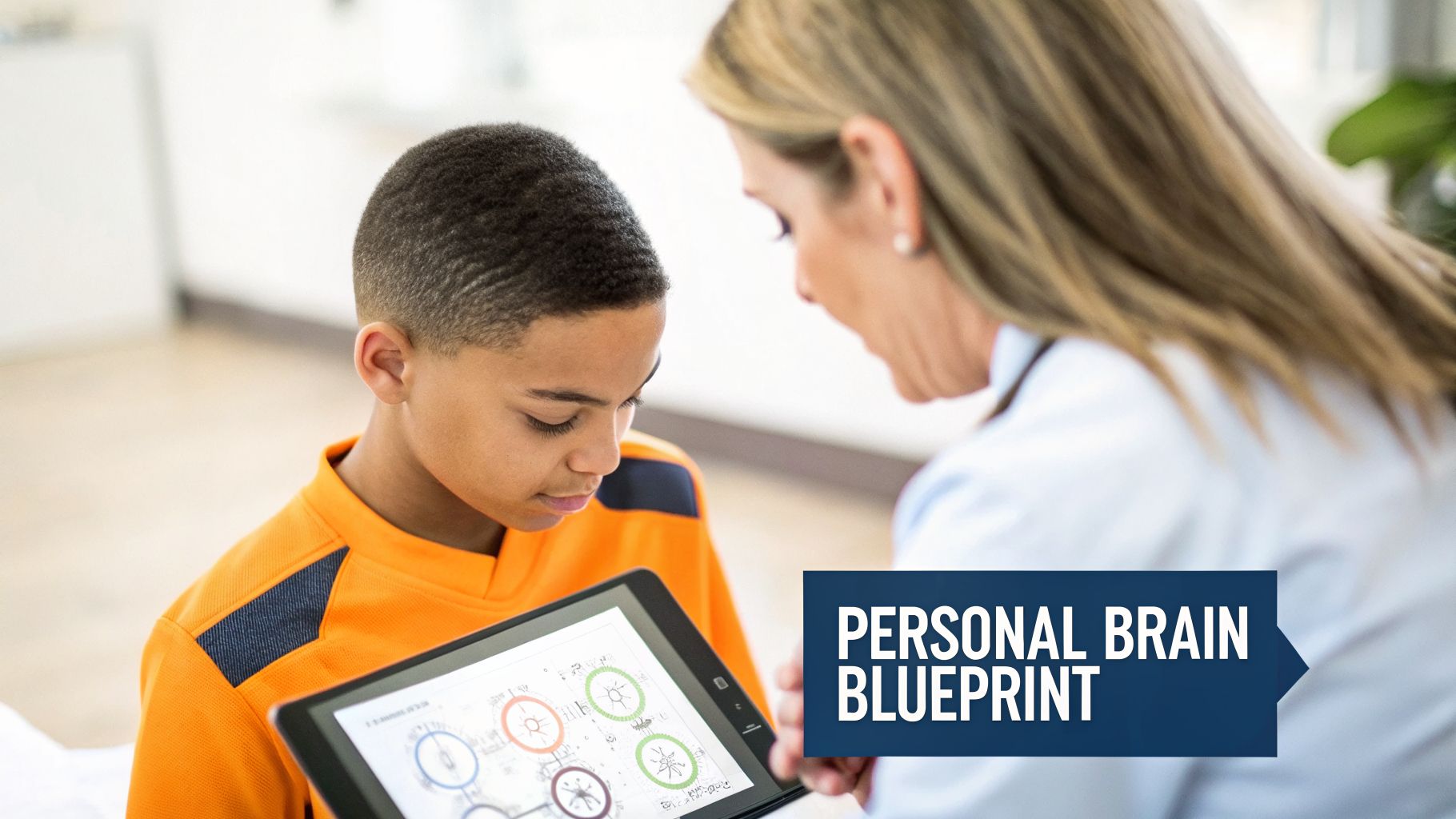
Think about trying to repair a complex piece of machinery without its original blueprint. That’s what concussion management often felt like before we had a clear picture of an individual’s brain function prior to their injury. Baseline concussion testing creates that personal blueprint for us.
Before any potential injury, a series of tests are run to measure key aspects of brain function. This goes far beyond just memory. It's a comprehensive look at how someone's brain performs on a normal day.
A baseline test provides an objective, individualized benchmark. It moves concussion care away from guesswork and toward data-driven, personalized medicine, which is crucial for safer return-to-play and return-to-learn decisions. For practical guidance, visit our website or email us to see how to implement this in your organization.
This approach is now widely seen as the gold standard for athletes and really, anyone in an at-risk environment. Instead of comparing an injured person to vague population averages, we can see exactly how their brain has changed by comparing it to their own healthy state.
Core Components of a Baseline Concussion Test
So, what are we actually looking at when we create this "brain blueprint"? A robust baseline test gathers data across several key domains that tell us how the brain is processing information. The goal is to get actionable insights you can use immediately after an injury.
The table below breaks down the core functions we measure and why each one is so critical for a complete picture of brain health.
Assessment Component | What It Measures | Why It's Important & A Practical Example |
|---|---|---|
Cognitive Function | Memory (verbal and visual), reaction time, and processing speed. | Example: A quarterback needs to process the field and react in under half a second. A slowdown here, even if they "feel fine," is a clear sign of injury. |
Balance & Postural Control | The ability to maintain stability, both standing still and during movement. | Example: If a gymnast who normally has perfect balance suddenly struggles with a simple one-legged stand post-impact, it points to a disruption in the brain's balance systems. |
Symptom Reporting | A standardized checklist of common concussion symptoms (headache, dizziness, etc.). | Example: A student reports "fogginess" and difficulty concentrating. This subjective data, paired with objective test scores, creates a full picture of the injury's impact. |
Visual Coordination | How well the eyes track, focus, and work together. | Example: A hockey player struggling to track the puck or a student getting headaches from reading a textbook could both have an underlying visual coordination issue from a concussion. |
By capturing this multi-faceted data before an injury, we establish a truly personal and reliable point of comparison. It's the foundation for more accurate and confident clinical decision-making down the road.
Why This Data Is a Game-Changer
Let's make this real. Imagine a young soccer player completes a digital baseline test before her season. We find her average reaction time is 350 milliseconds and her visual memory score is 88%.
Mid-season, she takes a hit and might even say she "feels fine." But a post-injury test shows her reaction time has slowed to 450 milliseconds and her memory score has dropped to 72%. This is hard, objective data showing the injury's true impact. This actionable insight tells the coach and parents, "She is not ready," taking the pressure off the athlete to make that call herself.
This is especially critical for young athletes. In Canada, we see thousands of sports-related concussions in kids under 18 every year, and protocols have had to evolve. Studies have consistently shown that when recovery is guided by baseline test comparisons, athletes get back to their sport and school work safely and often more efficiently. Having that personalized brain blueprint makes all the difference.
Our guide on complete concussion management digs deeper into how these tests fit into a full-circle care plan. To get actionable strategies for your team or clinic, visit our website or email our experts for a personalized consultation.
Why Objective Data Is a Game-Changer in Concussion Care
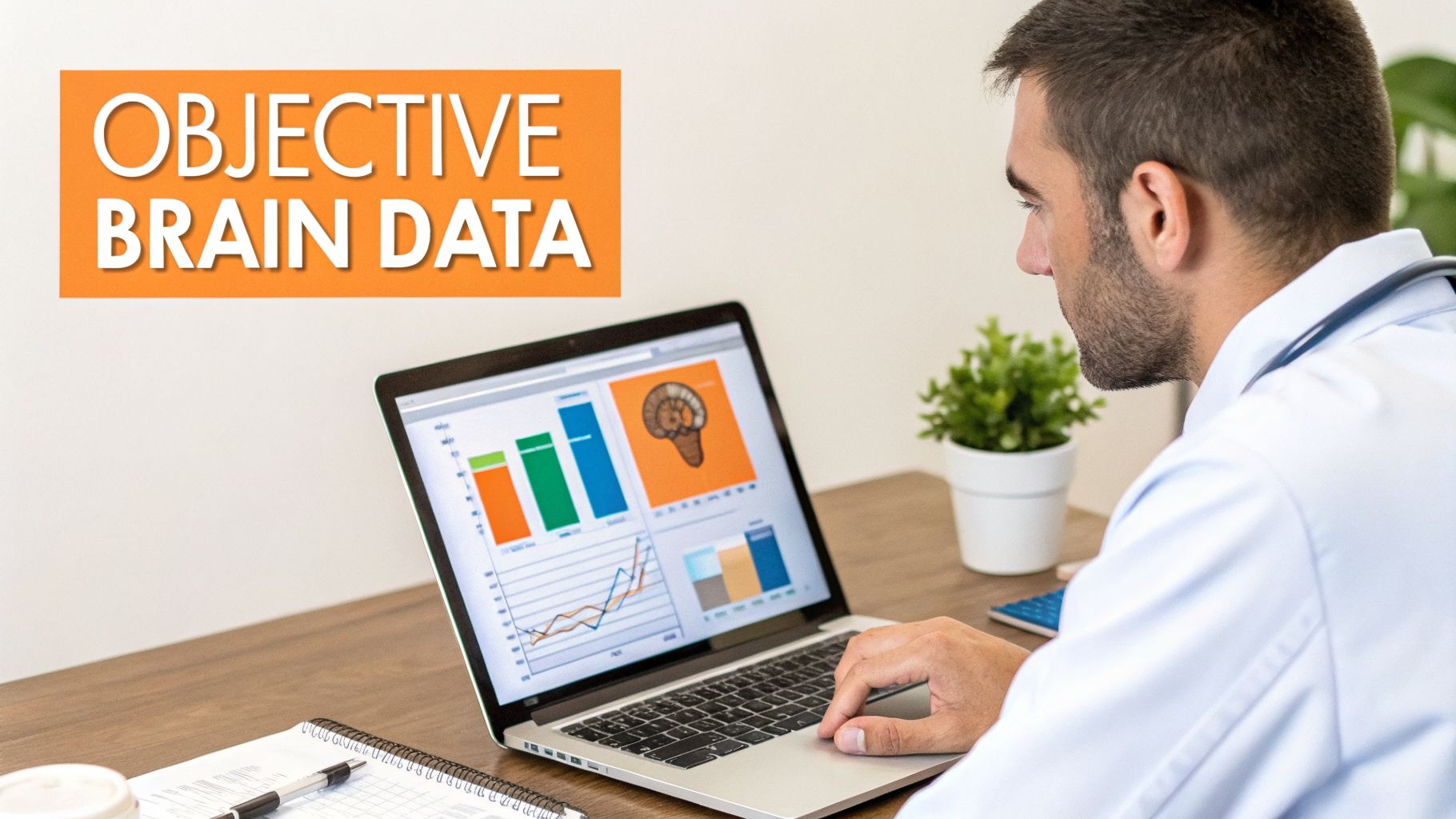
There's a reason we often call a concussion an “invisible injury.” You can’t see it on a standard X-ray or MRI, which makes it incredibly challenging to grasp the true extent of the damage. This is precisely why objective data from baseline testing for concussion doesn't just help—it completely changes the game.
Without that pre-injury snapshot, a clinician has to lean heavily on what the patient says they are feeling. But what happens when that patient is a determined athlete who's downplaying their symptoms to get back on the field? Or a child who simply can't find the words to describe what's wrong? Symptoms can be a fuzzy, unreliable guide. Hard data cuts through the noise.
When we can compare post-injury performance to a personal baseline, we take dangerous guesswork out of the equation. We shift the conversation from, "How do you feel?" to "How is your brain functioning today compared to its healthy state?"
Seeing the Unseen Cognitive Changes
A baseline test gives us something concrete—measurable proof of cognitive shifts that might otherwise fly under the radar. Think of it like having a high-definition recording of the brain’s performance that we can play back and compare, frame-by-frame, after an injury.
Let’s look at a practical example. A student-athlete takes a pre-season baseline test. A few months later, she takes a hard fall during practice. She tells her coach she feels "a little off" but insists she's fine to keep playing. A post-injury assessment, however, tells a different story:
A 15% drop in verbal memory scores, showing she’s struggling to recall information.
A 70-millisecond increase in reaction time, a tiny delay that could put her at serious risk for another injury.
Reduced visual processing speed, making it harder to track a fast-moving ball or even just read the board in class.
This objective data gives the clinician, coach, and parents the confidence to say, "Your brain is not ready." It becomes the clear, defensible reason for keeping her on the sidelines to protect her from far more serious harm. Combining this with other metrics, like understanding heart rate variability, can offer an even more complete picture of an individual's physiological recovery.
A major benefit of baseline data is its ability to protect against Second Impact Syndrome—a rare but catastrophic event where a second concussion occurs before the first has healed, potentially leading to severe brain swelling and devastating outcomes. This data provides the actionable proof needed to hold an athlete out of play.
Personalizing the Road to Recovery
Objective data doesn't just stop at the diagnosis. It’s the very foundation for building a personalized recovery roadmap. By pinpointing exactly which cognitive functions took the biggest hit—whether it's balance, memory, or processing speed—we can aim therapies directly at those deficits.
For instance, if a post-injury test shows a significant drop in visual coordination, the recovery plan can be built around specific eye-tracking exercises. If balance is the main issue, a physiotherapist can design a program focused on vestibular rehabilitation. This data-driven approach moves us away from a one-size-fits-all protocol and toward a plan that is truly tailored to the individual’s unique injury profile.
At the end of the day, baseline concussion testing provides the objective truth that symptoms alone can never offer. It empowers clinicians to make safer, data-informed decisions, confirms the brain has truly healed before a return to sport or school, and gives everyone involved invaluable peace of mind. Before you implement a program, learn about the reliability of these assessments in our detailed guide. For a demo of how this works in practice, contact our team at Orange Neurosciences.
Who Should Get a Baseline Test and When
Parents and athletes often ask us, "Does my child really need a baseline test?" It's a great question, and the answer usually comes down to a straightforward look at risk. While not everyone needs one, for certain groups, it’s one of the most important tools we have for protecting brain health.
Think of it as a personalized "blueprint" of your brain's normal function. If an injury happens, we're not guessing what your "normal" looks like; we have a clear, objective map to guide recovery.
So, who are the right candidates for this? It’s not just professional athletes—the list is probably broader than you imagine.
High-Priority Groups for Baseline Testing
Some activities and health histories simply carry a higher risk of head injury. For these individuals, getting a baseline test is a proactive, common-sense step. It’s no different than wearing a helmet or shin guards—it's a fundamental piece of safety equipment.
Youth and Student-Athletes: This is the most critical group. Anyone playing organized sports—especially contact sports like hockey, football, soccer, and lacrosse—should have a baseline. A child's developing brain is more vulnerable, and recovery is more complex.
Adults in High-Risk Sports: You don't have to be a pro to be at risk. Recreational athletes who love skiing, mountain biking, or rugby can benefit immensely from having that pre-injury data on file.
Individuals in High-Risk Professions: Certain jobs come with an inherent risk of head injury. We strongly recommend testing for first responders like police and firefighters, military personnel, and construction workers.
Anyone with a History of Concussions: If you’ve had a concussion before, your brain is more susceptible to future injuries. A new baseline provides an up-to-date snapshot of your cognitive function, which is crucial for accurately tracking any changes after another impact.
Practical Insight: A common misconception is that baseline testing is only for elite athletes. The reality is, it's a valuable tool for anyone at an elevated risk of head injury, no matter their age or skill level. This is about protecting every brain, not just the ones in the spotlight.
Finding the Right Time for Testing
Timing is everything. For a baseline test to be truly useful, it needs to be done when a person is healthy and at their cognitive best. This is the only way to ensure the data is a true reflection of their normal brain function.
The Ideal Timeline: The best window for baseline testing is during the pre-season or before the start of a new school year. This is usually a period of relative rest from high-risk activities, making it the perfect time to get a clean, reliable benchmark.
How Often to Retest: A baseline test isn't a one-and-done appointment, particularly for kids and teens whose brains are constantly changing.
For children and adolescents (under 18): We recommend repeating the test every one to two years. Cognitive functions naturally mature as a young person's brain develops. An old baseline from two or three years ago can be as unhelpful as having no baseline at all.
For adults (18 and over): An adult's baseline is generally stable for longer. Retesting every two to three years, or after any significant medical event, is a solid rule of thumb.
In regions with high youth sports participation, this has become standard practice. For example, with over 2.5 million young athletes in California, baseline concussion testing is a cornerstone of safety protocols, mandated for many high school athletes in contact sports. Studies from the area have shown that using baseline data improves diagnostic accuracy by 28% compared to just using general population averages. You can discover more about the complete guide to concussion baseline testing and how it is successfully implemented.
Making this part of your family’s annual health routine ensures you always have a current and accurate blueprint on file. If you're ready to take this actionable step, our team at Orange Neurosciences can help you integrate this process seamlessly. Email us for a step-by-step implementation guide.
How to Implement Digital Baseline Testing
If the thought of setting up a baseline testing program brings to mind stacks of paper and hours of administration, it's time for a new perspective. Getting started with baseline concussion testing is so much more straightforward than it used to be, thanks to modern digital platforms that have moved us far beyond clunky, paper-based methods.
Today’s best tools make the whole process seamless for clinics, schools, and entire sports organizations.
The real breakthrough is in systems that can deliver a fast, objective snapshot of a person’s cognitive function. Platforms like Orange Neurosciences have refined this down to a science, allowing for a comprehensive baseline to be captured in under 30 minutes. These assessments are not just simple reaction-time tests; they measure everything from attention and memory to eye-hand coordination, creating a rich digital blueprint of an individual’s healthy brain.
The diagram below gives a clear overview of who should be on the list for baseline testing, from young athletes just starting out to professionals at the top of their game.
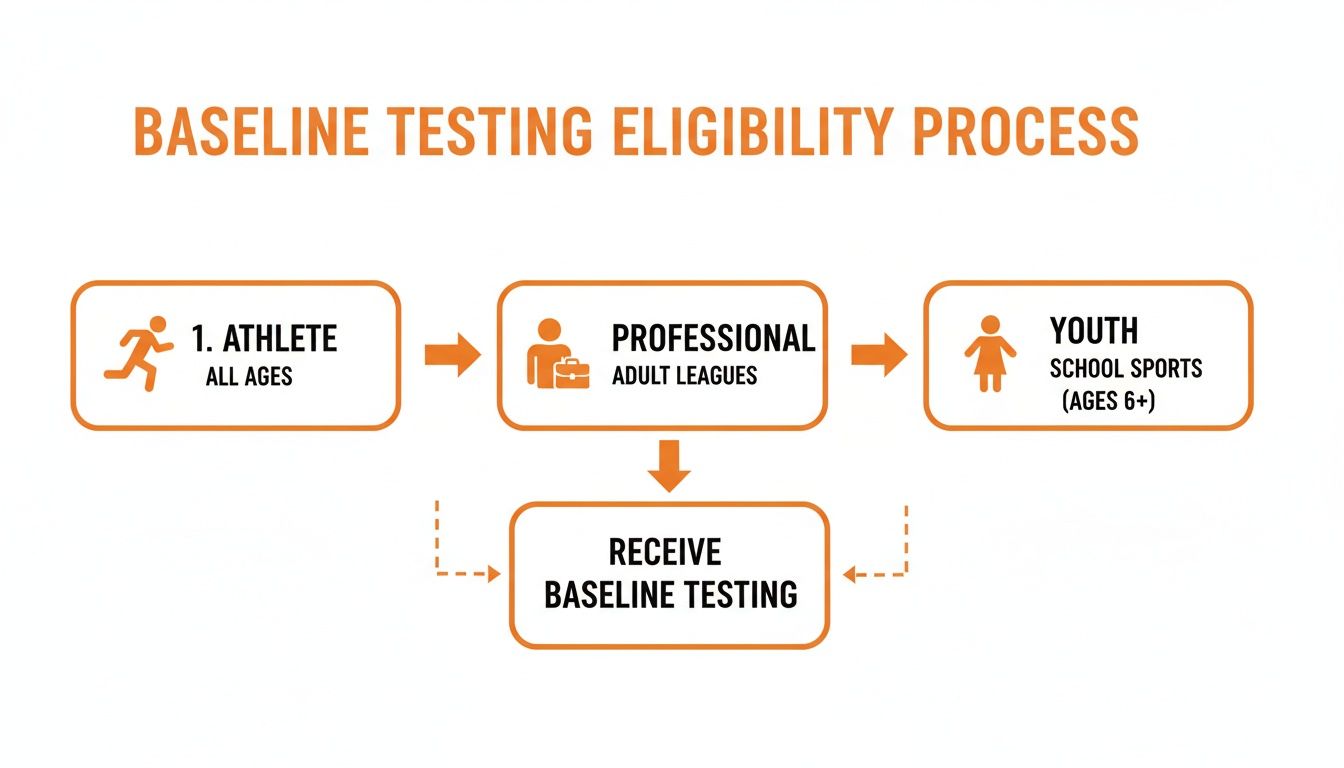
While athletes are an obvious and critical group, it's important to see that the need extends into various occupations and is especially crucial for any young person involved in sport.
Setting Up Your Program
A successful rollout isn't about adding another task to your plate. It's about weaving the testing into your existing workflow, making it a natural part of your annual health and safety protocols.
Practical Example: For a school or sports league, this can be incredibly efficient. Imagine setting up a few testing stations with tablets or laptops during team registration days or as part of the yearly physicals. You could assess dozens of athletes in a single afternoon, getting everyone’s baseline done before the season even starts.
The true power of going digital is the scalability and consistency. It doesn’t matter if you’re testing a single team of 20 or an entire school district of 20,000—every person gets the exact same standardized test, which means the data you collect is reliable and comparable across the board.
In a clinical setting, the process is just as simple. A baseline test can easily be added to the standard intake process for new patients, especially those in at-risk groups. The results are available instantly, giving the clinician a crucial piece of data to add to the patient's file for any future needs. You can find more practical details in our guide on conducting a cognitive assessment online.
Making Testing Engaging and Effective
One of the biggest problems with traditional testing, particularly with kids and teens, is keeping them engaged. A bored, distracted person won't give you their best effort, and that leads to unreliable results. This is where modern, gamified assessments have completely changed the game.
For Kids and Teens: When a cognitive assessment feels more like a fun challenge than a test, you get better focus and effort. Tools like OrangeCheck use engaging, game-like activities to measure cognitive function, which dramatically improves the accuracy of the baseline data.
For Adults: While the format might be engaging, the science behind it is absolutely serious. These assessments are built on decades of solid neuropsychological research, ensuring they precisely measure the cognitive domains they’re designed to. This gives clinicians a clear, objective picture of brain function.
By choosing a digital solution, you’re not just making your baseline testing program more efficient; you’re fundamentally improving the quality of the data you gather. This stronger foundation allows you to make better, more confident decisions about brain health and a safe return to activity for everyone in your care. Contact us via our website to see a live demo.
Understanding Your Test Results and Limitations
Getting a report from any medical test can be a bit much. When it comes to baseline concussion testing, the report is packed with valuable information, but it’s crucial to know what it’s telling you—and just as importantly, what it isn’t. A baseline test isn't some magic wand for diagnosis; it’s one very powerful piece of a much larger clinical puzzle.
Think of your baseline report as the original blueprint for your brain's performance. When a clinician suspects a concussion, they don't just look at the new scores on their own. They carefully compare the post-injury results to that original blueprint, looking for significant, meaningful drops in performance.
How Clinicians Read the Data
A trained healthcare provider knows exactly what to look for in the data. They aren't just checking if a score moved a point or two. They're hunting for statistically significant changes that point to a real disruption in cognitive function.
Practical Example: A post-injury report shows a 15% decrease in visual memory and a 75-millisecond slowdown in reaction time. A clinician sees this not as a minor blip, but as an actionable red flag. This objective sign tells them the brain is struggling and needs rest, even if the athlete claims they feel fine. This is where having your own unique baseline truly shines. It provides the clear, personalized evidence needed to make a confident assessment.
Acknowledging the Limitations and Pitfalls
To trust the data, we have to be honest about its limits. The single biggest threat to a baseline test's value is a poor effort from the person taking it. This is why a professionally supervised test is absolutely essential for getting results you can count on.
Here are two common issues we see:
"Sandbagging": This happens when someone deliberately performs poorly on their baseline test. The misguided idea is that if they get a concussion later, their post-injury scores won't look so bad in comparison, helping them get back to their sport sooner. Thankfully, modern tests have built-in validity checks to catch this, flagging results that are inconsistent or simply not humanly possible.
Poor Testing Environment: A test taken in a noisy, distracting room won't give you a valid baseline. The person has to be focused and in a quiet space to give their best cognitive effort.
Actionable Insight: A baseline test is only as good as the effort put into it. A supervised, focused environment is non-negotiable for creating a reliable benchmark that can be trusted to guide critical health decisions down the road. Never conduct a baseline test in a loud locker room or on a busy sideline.
It's also important to understand the role of normative data (population averages) versus these individual baselines. For instance, recent findings from collegiate athletics in California showed that for many athletes, comparing post-injury scores to population averages can be surprisingly effective. The research published on PubMed noted that for programs with tight budgets, this approach can be sufficient 88% of the time, allowing them to save resources for more focused testing on high-risk groups.
Ultimately, your baseline results give you the power to have informed, confident conversations with your healthcare providers, coaches, and family. It helps manage expectations and makes sure everyone is on the same page about what a safe recovery really looks like. For a deeper dive into the symptoms that follow a concussion, check out our guide on the Rivermead Post-Concussion Questionnaire.
Take Your Next Steps Toward Proactive Brain Health
You've seen the full picture of baseline testing—what it is, why that objective data is so critical, and how it can be put into practice. Now it’s time to move from knowing to doing. The benefits are clear: safer return-to-play decisions, recovery guided by real data, and the simple peace of mind that comes from being prepared.
It all comes down to shifting your approach from reactive to proactive. Instead of waiting for an injury and scrambling for answers, you’re creating a personalized brain blueprint, ready to guide care if it’s ever needed. That simple step can make all the difference in a person’s long-term well-being.
For Clinicians and School Administrators
If you’re responsible for the health and safety of athletes or students, setting up a baseline testing program is one of the most powerful moves you can make. The key is to weave it into your current workflow, not to add another burden.
Modern digital platforms, like the solutions we've developed at Orange Neurosciences, are designed for just that. Our system slots easily into annual physicals, team registration days, or standard clinical intake. Because the assessments are quick, engaging, and built to scale, you can efficiently test hundreds of individuals while knowing the data you collect is consistent and reliable.
A proactive brain health strategy provides a crucial safety net. By establishing objective benchmarks before an injury, you empower every stakeholder—from the coach to the physician to the parent—with the clear, data-driven insights needed to protect long-term cognitive function. For a practical guide on implementation, email us today.
For Parents and Individuals
Your next step is to start a conversation. You are your own best health advocate—and the same is true for your children. It's time to bring up baseline testing for concussion with your family doctor, your child’s coach, or the athletic director at their school.
Use what you’ve learned here to ask the right questions:
Does our school or league currently have a baseline testing program?
If not, what would it take to get one started?
As an individual, where can I get a baseline test done in my community?
This conversation is the first step toward building a culture of brain health awareness. Proactive measures, including comprehensive assessments, form the foundation of effective preventive medical care for athletes and anyone at risk.
The time to act is now, before an injury happens. Whether you are a clinician looking to elevate your standard of care or a parent wanting to protect your child, the tools are here. Contact our team at Orange Neurosciences today to learn how our digital solutions can become the cornerstone of your proactive brain health strategy.
Your Questions, Answered
When it comes to brain health and concussions, a lot of questions can come up. We get it. Let’s walk through some of the most common ones we hear about baseline testing for concussion to give you clear, straightforward answers.
Is Baseline Testing Just for Pro Athletes?
Not at all. While you see it all the time in professional sports, baseline testing is something we strongly recommend for athletes at every level—especially kids in local leagues. Their developing brains are just more vulnerable.
We're also seeing it used more and more by people in high-risk jobs, like first responders, and for anyone who’s had a head injury in the past. The idea is the same for everyone: having a snapshot of your brain's function before an injury is an incredibly powerful tool for managing a safe recovery.
Practical Example: A youth hockey league can implement baseline testing for every single player during registration. This creates a safety net that protects every child equally, not just the "star" players, and gives coaches and parents objective data to rely on.
How Reliable Are Computerized Baseline Tests?
Today's computerized tests, like the game-based assessments we’ve developed at Orange Neurosciences, are very reliable when they're done right. They even have built-in checks to spot when someone isn't giving their full effort or trying to "sandbag" their results by intentionally performing poorly.
Actionable Insight: For a baseline test to be truly accurate, it has to be done in a quiet space, supervised by someone who is trained to administer it. This isn't negotiable. It's the only way to get a trustworthy benchmark that can be used to make critical health decisions down the road.
If a test picks up on impossibly fast reaction times or answers that are all over the map, a trained administrator will spot it right away. This keeps a flawed "blueprint" from ever making it into a person's medical file, making sure any future comparisons are based on solid, valid data. For more information on ensuring test reliability, email us for our best-practices checklist.
Is It Too Late to Get a Baseline Test if the Season Has Already Started?
It’s never too late. The ideal time is definitely the quiet pre-season, before the bumps and bruises start. But getting a test done at any point is so much better than having no baseline at all.
As long as the person is healthy and hasn’t had a recent head injury, the test will give a valid picture of their current cognitive function. That data is still a crucial reference point if an injury happens later on. It's like getting a physical halfway through the year—it's still incredibly valuable information to have.
What Does It Cost? Is It Covered by Insurance?
A single baseline test usually costs somewhere in the $25 to $50 range. To make it easier for families, many schools or sports leagues will bundle this fee right into their yearly registration costs.
Whether it’s covered by insurance can really vary depending on your provider and plan. The good news is that as concussion awareness grows, more insurance companies are starting to see baseline testing for what it is: an important part of preventative health.
Our advice? The best thing to do is call your insurance provider directly and ask about your coverage. Here at Orange Neurosciences, we’re always working to create affordable and accessible solutions so this critical tool can get into the hands of as many schools, clinics, and families as possible. Visit our website for pricing information.
Ready to shift from reactive worry to proactive brain health? Orange Neurosciences gives you the objective data and seamless workflow you need to build a concussion safety program for today. Our AI-powered platform delivers fast, reliable cognitive profiles that empower better care decisions.
Explore how Orange Neurosciences can support your organization's brain health strategy.
Orange Neurosciences' Cognitive Skills Assessments (CSA) are intended as an aid for assessing the cognitive well-being of an individual. In a clinical setting, the CSA results (when interpreted by a qualified healthcare provider) may be used as an aid in determining whether further cognitive evaluation is needed. Orange Neurosciences' brain training programs are designed to promote and encourage overall cognitive health. Orange Neurosciences does not offer any medical diagnosis or treatment of any medical disease or condition. Orange Neurosciences products may also be used for research purposes for any range of cognition-related assessments. If used for research purposes, all use of the product must comply with the appropriate human subjects' procedures as they exist within the researcher's institution and will be the researcher's responsibility. All such human subject protections shall be under the provisions of all applicable sections of the Code of Federal Regulations.


© 2026 by Orange Neurosciences Corporation