A Clinician's Guide to the 1 Minute Concussion Test
Mar 13, 2026
A concussion isn't just a bump on the head—it's a mild brain injury that can throw normal brain function into chaos. While there's no single, foolproof test to diagnose one, a tool like the 1 minute concussion test gives clinicians a crucial, on-the-spot way to check for trouble and decide what to do next.
Why a Rapid Screen Belongs in Your Toolkit
In a high-stakes clinical setting, time is everything. Whether you're in a packed ER juggling traumas or in a family practice seeing a child after a fall at the playground, you need to make confident triage decisions, fast. This is exactly where a rapid concussion screen proves its worth.
Think of it as a vital sign check for the brain. Just as you’d quickly take a pulse or blood pressure, a one-minute screen gives you a snapshot of neurological function. It helps you quickly sort patients who need closer monitoring from those who need immediate, advanced care.
The Sobering Reality of Head Injuries
The need for this kind of efficiency is driven by some pretty stark numbers. In Canada, traumatic brain injuries (TBIs) happen at an incredible rate—affecting about 456 people every day. That’s one person every three minutes.
Since concussions account for 80-95% of all TBIs, we’re looking at a massive, often invisible, health issue where countless cases likely go unreported. As a clinician on the front lines, a quick and reliable screening tool isn't just a nice-to-have; it's a necessity.
Real-World Clinical Scenarios
Picture this: it’s a Saturday morning sports clinic, and a teen soccer player walks in after a collision on the field, complaining of a headache. A quick orientation and memory check can help you decide right then and there if they can be watched from the sidelines or if they’re done for the day. Having context on various sports injuries only reinforces why a fast, trustworthy screen is so vital in these moments.
Or, consider an older patient in your care home who has a minor fall. A one-minute test can help you tell the difference between simple disorientation and a potential concussion—a critical distinction, given their heightened risk for complications.
This rapid assessment isn’t about landing a final diagnosis in 60 seconds. It’s about quickly gathering enough objective data to make a sound clinical judgment about the next steps. It’s about protecting your patient and managing risk effectively. For a deeper dive, check out our guide on complete concussion management.
Conducting The 1-Minute Screen: A Practical Protocol
Alright, let's get practical. This one-minute screen is something you can put into practice today. The beauty of it is its simplicity. You don't need any specialized equipment—just a way to keep time, like your phone's stopwatch, and a space that’s quiet enough for the patient to focus.
The entire protocol is built around quickly checking three core cognitive areas that a concussion loves to disrupt: orientation, immediate memory, and concentration. Think of this less as a final diagnosis and more as a fast, structured way to grab some objective data when you’re facing that moment of uncertainty.
Setting The Stage For A Clear Assessment
The environment you're in really matters. Trying to check for subtle cognitive slips in a loud, busy hallway is a recipe for failure. If you can, pull the patient into a quieter room or even a calm corner. You need to know they can hear you clearly and concentrate without a dozen other things pulling at their attention.
Before you jump in, take a moment to explain what you're doing. A calm, reassuring tone goes a long way. Something as simple as, "I'm just going to ask you a few quick questions to see how you're feeling after that knock. This will only take about a minute," can help lower a patient’s anxiety and get them on board.
The Three Pillars Of The 1-Minute Test
This quick screen methodically pokes at different brain functions. Each part gives you a piece of the puzzle, and remember: how the patient answers can be just as telling as what they say.
Pillar 1: Orientation
This is your baseline check for the patient’s awareness of who, where, and when they are.
Actionable Example: Ask, "Can you please tell me your full name, where we are right now (city and clinic name), and what day of the week it is?" What to Look For: A quick, correct answer is a great sign. But keep an eye out for hesitation, a confused look, or if they struggle to name the specific location. An incorrect or significantly delayed answer is a red flag.
Pillar 2: Immediate Memory
Here, you’re testing the brain's ability to take in new information and spit it right back out.
Actionable Example: Say, "I'm going to say three words. I want you to repeat them back to me right away. The words are: apple, table, penny." Then, note their response. What to Look For: Most people can handle three words without a problem. If a patient only gets one or two, or immediately asks you to repeat them, it could signal a disruption in their cognitive processing.
Pillar 3: Concentration
This task assesses if the patient can hold their focus on a simple mental challenge.
Actionable Example: Instruct them, "Now, can you say the months of the year in reverse order, starting from December?" What to Look For: It’s normal to pause and think. What you’re watching for are major struggles. Do they get lost, become frustrated, skip around, or just give up? An inability to complete the task is a significant clinical indicator.
This quick screen is often the first formal step in the clinic, helping you decide what needs to happen next.
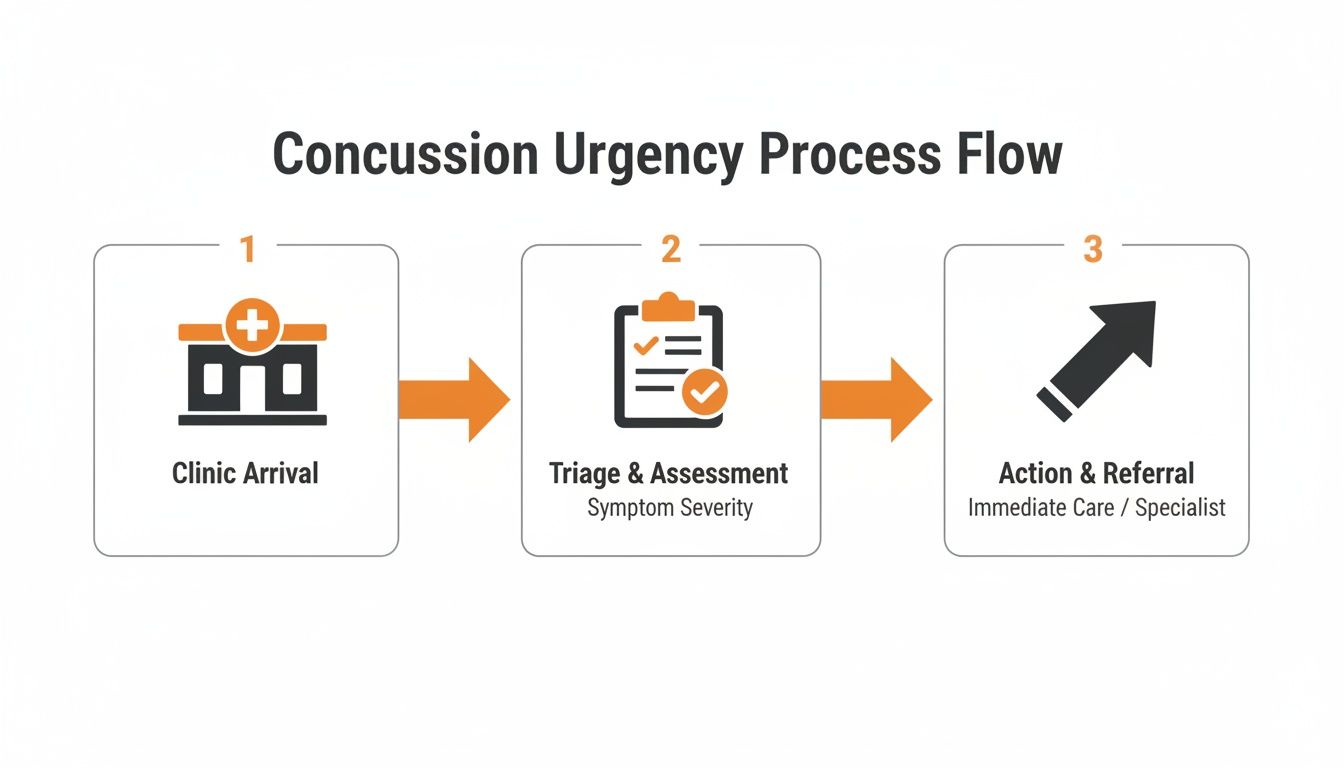
As you can see, this initial screen directly informs your triage and action plan, making it a pivotal moment in the patient's journey.
Beyond The Score: What Hesitation Tells You
The real clinical gold in this 1-minute concussion test isn't a pass/fail score. It’s in your observation. It’s all about the qualitative data.
Actionable Insight: Pay close attention to the patient's behaviour. Signs like slurred speech, visible frustration, emotional volatility, or taking an unusually long time to respond are all clinically significant observations, even if the final answers are correct.
For example, a patient might correctly recite the months backward but do it incredibly slowly, slurring their words as they concentrate. That’s not a clean "pass." These are the details you need to document, as they paint a much richer picture of their neurological state.
This kind of detailed observation, much like what we discuss in our guide to the Mini-Cog test, is what helps you build a complete clinical impression and decide on your next steps with confidence.
Interpreting Results and Recognizing Red Flags

You’ve finished the screen and jotted down your observations. Now for the most important part: what does it all mean, and what do you do next? Interpreting the results of a 1-minute concussion test isn’t about a simple pass or fail. It’s about piecing together a clinical picture from what the patient says, how they say it, and how they behave.
For instance, if a patient only recalls two of the three memory words, that’s a flag. While it’s not a definitive diagnosis on its own, it points to a potential issue with immediate memory, a classic deficit after a head injury.
The same goes for concentration. If they get tripped up halfway through reciting the months backward, that’s a potential lapse. It's much more significant than a simple pause to collect their thoughts. The key is to look at these errors in context with everything else you've noticed—their hesitation, any frustration, or even subtle slurring in their speech.
Turning Observations Into Action
A minor stumble might just call for a "watch and wait" approach, where you give the patient clear instructions on what symptoms to monitor at home. But if they're struggling across multiple parts of the screen, that’s your signal to escalate to a more comprehensive evaluation.
Actionable Insight: A "pass" on the screen with lingering behavioural signs—like irritability or slowed speech—is not a clean bill of health. Your action is to document these qualitative observations and consider them as strong indicators for further assessment, even with correct answers.
This is where your clinical judgment truly comes into play. The screen provides the data points; your expertise weaves them into a coherent plan.
Common Symptoms vs. Urgent Red Flags
One of the most critical skills in these moments is separating common post-concussive symptoms from urgent red flags. The first group requires monitoring and management. The second group signals a potential medical emergency and demands immediate action.
A good symptom questionnaire can help you gather structured feedback from the patient to get a clearer picture. For a detailed breakdown of what to ask, our guide on using a concussion symptom questionnaire can be a valuable resource.
To help you quickly tell the difference between what to watch and when to act, we’ve put together this quick reference table. It’s designed to help you distinguish between a symptom that needs monitoring and a sign that requires an immediate trip to the emergency room.
Concussion Red Flags: Signal vs. Symptom
Observation | Patient Report (Symptom) | Red Flag (Sign) | Recommended Action |
|---|---|---|---|
Headache | "I have a mild-to-moderate headache that's not getting worse." | "My headache is getting worse and worse," or a sudden, severe headache. | Emergency Medical Services |
Nausea | "I feel nauseous," or a single episode of vomiting. | Repeated vomiting (2 or more episodes). | Emergency Medical Services |
Consciousness | "I feel dazed, foggy, or 'out of it.'" | Any loss of consciousness, drowsiness, or inability to be awakened. | Emergency Medical Services |
Cognition/Speech | "I'm a little confused or have trouble concentrating." | Worsening confusion, slurred speech, or not recognizing familiar people. | Emergency Medical Services |
Motor Function | "I feel a bit clumsy or off-balance." | Seizures or convulsions; weakness or numbness in arms or legs. | Emergency Medical Services |
Pupils | Pupils appear equal and reactive to light. | One pupil is noticeably larger than the other. | Emergency Medical Services |
Thinking through these distinctions is a non-negotiable part of your assessment. Red flags like repeated vomiting or unequal pupils could point to a dangerous condition like an intracranial bleed or swelling.
Your ability to spot these signs confidently not only protects your patient from serious harm but also represents sound clinical risk management. When in doubt, always err on the side of caution and escalate.
How To Adapt The Screen For Children And Older Adults
The six-year-old who tumbled off the monkey bars and the 70-year-old who slipped on a rug both need a quick concussion screen. But as any clinician knows, you can’t approach them the same way. A one-size-fits-all concussion test is a recipe for missed diagnoses in kids and false positives in seniors.
Without thoughtful adjustments to the 1-minute concussion test, you're flying blind. The core principles of checking orientation, memory, and concentration are still your guideposts, but how you get there has to change. It all comes down to tailoring your questions and observations to the person right in front of you.
Screening Young Children
When you’re assessing a young child, abstract questions and complex instructions can fall flat, even when they’re perfectly healthy. Asking a first-grader to recite the months of the year backward isn't a test of their brain function—it's a test of their grade-one curriculum.
Here are some practical, actionable ways to adapt the screen:
Memory Words: Instead of "apple, table, penny," use simple words from their world. Practical Example: try "ball," "train," or "blue."
Concentration Task: Instead of months, try something age-appropriate. Practical Example: ask them to count backward from 10 or name three characters from the TV show Paw Patrol.
Observational Focus: With kids, non-verbal cues are gold. Look for unusual irritability, clinginess, excessive crying, or a sudden disinterest in a toy you offer them. These shifts in behaviour can be the most reliable signs of an injury.
It’s incredibly helpful for parents and caregivers to know what to watch for at home, too. A fantastic resource is A Parent's Guide to Signs of a Concussion in Kids, which breaks down both the subtle and obvious signs.
Screening Older Adults
The challenge with older adults is entirely different. Here, the key is to untangle new, injury-related symptoms from pre-existing conditions or the normal effects of aging. Slower processing speed or mild hearing loss isn't automatically a concussion red flag; it might just be their baseline.
Here’s how to fine-tune your approach for this group:
Account for Sensory Deficits: First things first, make sure they can hear you clearly and are wearing any necessary glasses. Speaking slowly and directly can make a world of difference.
Establish Their Baseline: This is crucial. If a family member or caregiver is present, ask them if the patient's current state is their normal. Practical Example: "Is this level of confusion usual for him, or is this new since the fall?"
Adjust Concentration Tasks: Reciting months backward can be tough for many older adults even on a good day. Practical Example: A much better gauge of concentration is asking them to name the days of the week backward.
Actionable Insight: The goal is to differentiate between a patient's baseline and a new, injury-related deficit. For older patients, a fall is a leading cause of concussions. Understanding how to adapt the screen is critical. For a deeper look into this population, consider our guide on the comprehensive geriatric assessment in Canada.
The numbers really highlight the need for this. Emergency departments across Canada see an estimated 46,000 concussion cases in children and youth every year. Meanwhile, falls are the primary cause of injury-related hospitalizations for adults over 65, making an adapted rapid screen absolutely essential in clinics, ERs, and care homes. You can discover more insights about these findings from the Government of Canada.
From A Rapid Screen To A Comprehensive Assessment
The 1-minute concussion test is a fantastic tool for immediate, on-the-spot triage. It gives you the power to make a quick, informed decision when every second counts. But what’s next when that screen flags a potential issue? A positive screen isn't a diagnosis—it's the first step in a much deeper investigation.
Think of the rapid screen as a smoke alarm. It’s brilliant at telling you there’s a potential problem, but it can't tell you how big the fire is or where it started. For that, you need a full workup. This is where we transition from that initial flag to a comprehensive assessment.
Moving Beyond The Initial Screen
A quick screen is perfect for those critical first moments, but it was never designed to capture the full, complex picture of a brain injury. A patient might breeze through a simple memory check but still be struggling with major deficits in executive function or processing speed—issues that only a more detailed evaluation will bring to light.
Even widely used tools have their blind spots. The Standardized Assessment of Concussion (SAC), for example, takes about five to six minutes and has a sensitivity of 80-94%. That’s solid, but it still means it can miss up to 20% of concussions.
Rapid tests are useful, but adding objective data is a game-changer. This is exactly why we developed our platform at Orange Neurosciences. For that 20% of patients who face prolonged symptoms, our tools can deliver detailed cognitive profiles in under 30 minutes, supporting reassessment and personalized interventions. You can read more about how new technologies are authorized to help assess concussions in Canada.
Validating Findings With Objective Data
This is where Orange Neurosciences can truly change the game for clinicians. Our AI-powered platform, OrangeCheck, provides the comprehensive and objective cognitive profile you need to go far beyond what a brief screen can show. In less than 30 minutes, you get hard, quantitative data on critical domains, including:
Memory (both short-term and working)
Attention (sustained and divided)
Executive Function (planning and problem-solving)
Processing Speed
Perception
This detailed report allows you to validate your initial clinical impression from the one-minute screen with concrete data. It effectively replaces guesswork with precision, giving you a clear and objective baseline of your patient’s cognitive function.
Actionable Insight: Integrating a tool like OrangeCheck into your workflow doesn’t just confirm a problem exists; it quantifies it. It establishes a firm baseline you can use to track recovery, measure the effectiveness of treatment, and make data-driven decisions about a patient’s readiness to return to work, school, or sport.
This level of detail is crucial when documenting symptoms and building out a recovery plan. For more on what to include in your documentation, you might find our guide on the Rivermead Post-Concussion Symptom Questionnaire helpful.
By combining your rapid screening skills with the deep analytical power of OrangeCheck, you elevate your standard of care. You’re no longer just identifying a possible concussion—you're truly understanding its specific impact on that individual patient.
Common Questions About The 1-Minute Concussion Test
Whenever you bring a new screening tool into your workflow, no matter how simple, questions are bound to pop up. The 1-minute concussion test is built for speed, but real confidence comes from knowing how to handle those tricky "what if" moments in the clinic. Let's walk through some of the questions I hear most often from fellow clinicians.
The big one is always about reliability. Can you really trust a one-minute screen? While this isn't a full-blown diagnostic, think of it as a highly effective triage tool. The value is in its ability to flag immediate issues that need a closer look. Research has shown that brief cognitive screens like this are sensitive enough to catch the initial signs of neurological disruption.
Another common concern is around documentation. How do you properly chart your findings from such a quick test? The key is to be descriptive, not just conclusory. A simple "pass/fail" note just doesn't cut it.
Actionable Example: Instead of writing "failed memory test," document: "Patient recalled 1 of 3 words ('apple') after one prompt, unable to recall 'table' or 'penny'. Showed visible frustration during concentration task." That level of detail is gold for tracking changes over time and justifying a more comprehensive assessment.
Handling Practical Challenges
What happens if your patient is in pain, anxious, or just plain uncooperative? These are real-world factors that can throw a wrench in any cognitive screen. If someone is highly distressed, the first job is always to stabilize and calm them. For an anxious patient, simply taking a moment to explain the purpose of the screen can make all the difference.
And if they still can't complete the test? Document that, too. An observation like, "Attempted 1-minute screen; patient was too agitated to participate and became frustrated during orientation questions," is a clinically significant finding on its own. It tells a story about the patient's state just as much as their answers would have.
The 1-minute test is your first step. When that screen points to a potential issue, the next step is to get a deeper, objective look into cognitive function. That’s where Orange Neurosciences comes in. Our AI-powered platform delivers a detailed cognitive profile in under 30 minutes, turning your initial observations into a data-driven action plan.
Ready to see how objective data can transform your concussion management? Visit our website to schedule a demo or sign up for our clinical newsletter to get more actionable insights delivered to your inbox.
Explore how to elevate your standard of care at orangeneurosciences.ca.
Orange Neurosciences' Cognitive Skills Assessments (CSA) are intended as an aid for assessing the cognitive well-being of an individual. In a clinical setting, the CSA results (when interpreted by a qualified healthcare provider) may be used as an aid in determining whether further cognitive evaluation is needed. Orange Neurosciences' brain training programs are designed to promote and encourage overall cognitive health. Orange Neurosciences does not offer any medical diagnosis or treatment of any medical disease or condition. Orange Neurosciences products may also be used for research purposes for any range of cognition-related assessments. If used for research purposes, all use of the product must comply with the appropriate human subjects' procedures as they exist within the researcher's institution and will be the researcher's responsibility. All such human subject protections shall be under the provisions of all applicable sections of the Code of Federal Regulations.


© 2026 by Orange Neurosciences Corporation