What Do Brain Zaps Feel Like? Causes & Relief

You may be reading this because something odd keeps happening. You turn your head, glance to the side, or start drifting off to sleep, and suddenly it feels like a tiny electric jolt flickers through your head. It's over almost immediately, but it's unsettling enough to make you stop and wonder if something is seriously wrong.
That reaction makes sense. Brain zaps are hard to describe, hard to predict, and often hard to explain to someone who hasn't felt them. Many people worry they're having seizures, damaging their brain, or missing a major neurological problem. Clinicians can feel a different kind of uncertainty, especially when a patient's description is vivid but brief and the neurological exam is otherwise unremarkable.
The first useful step is naming the experience clearly. When people ask what do brain zaps feel like, they usually want three answers at once. What is this sensation, why is it happening, and what should I do next? Those are the questions that matter most in the room with a worried patient and in the follow-up note a clinician writes after the visit.
That Sudden Jolt A Relatable Introduction
A common real-life version goes like this. Someone has recently lowered an antidepressant dose, missed a few tablets, or stopped a medication because they felt better or ran out. Two or three days later, they notice a strange flash-like sensation in the head when looking left, turning quickly, or getting into bed. It isn't exactly pain. It's more like a burst, a skip, or a brief internal shiver.
That combination of short duration, surprise, and disorientation is why brain zaps feel so alarming. The event is usually gone before the person can fully register it, which makes it harder to describe and easier to catastrophise. By the time they try to explain it, they're often saying things like “It felt electrical,” “My brain blinked,” or “I thought I was about to faint.”
Brain zaps often frighten people more because they're unfamiliar than because they're dangerous.
Clinically, this matters because the symptom is easy to dismiss if you haven't heard it described before. Patients may minimise it because it sounds strange. Providers may hear “shock in my head” and think first about seizure, migraine, or anxiety. Sometimes those alternatives do need consideration. But often the story becomes clearer once you ask about recent medication changes, timing, sleep disruption, and whether eye movements trigger the sensation.
Three practical questions usually bring order to the confusion:
What does it feel like in plain language? People need words they can use in an appointment.
Why is it happening? A sensible explanation reduces fear fast.
What should happen next? That includes both symptom relief and knowing when more formal follow-up makes sense.
If you're the person feeling this, you need reassurance without being brushed off. If you're the clinician hearing about it, you need a framework that respects both the sensory experience and the possible cognitive after-effects.
Describing the Sensation What Brain Zaps Actually Feel Like
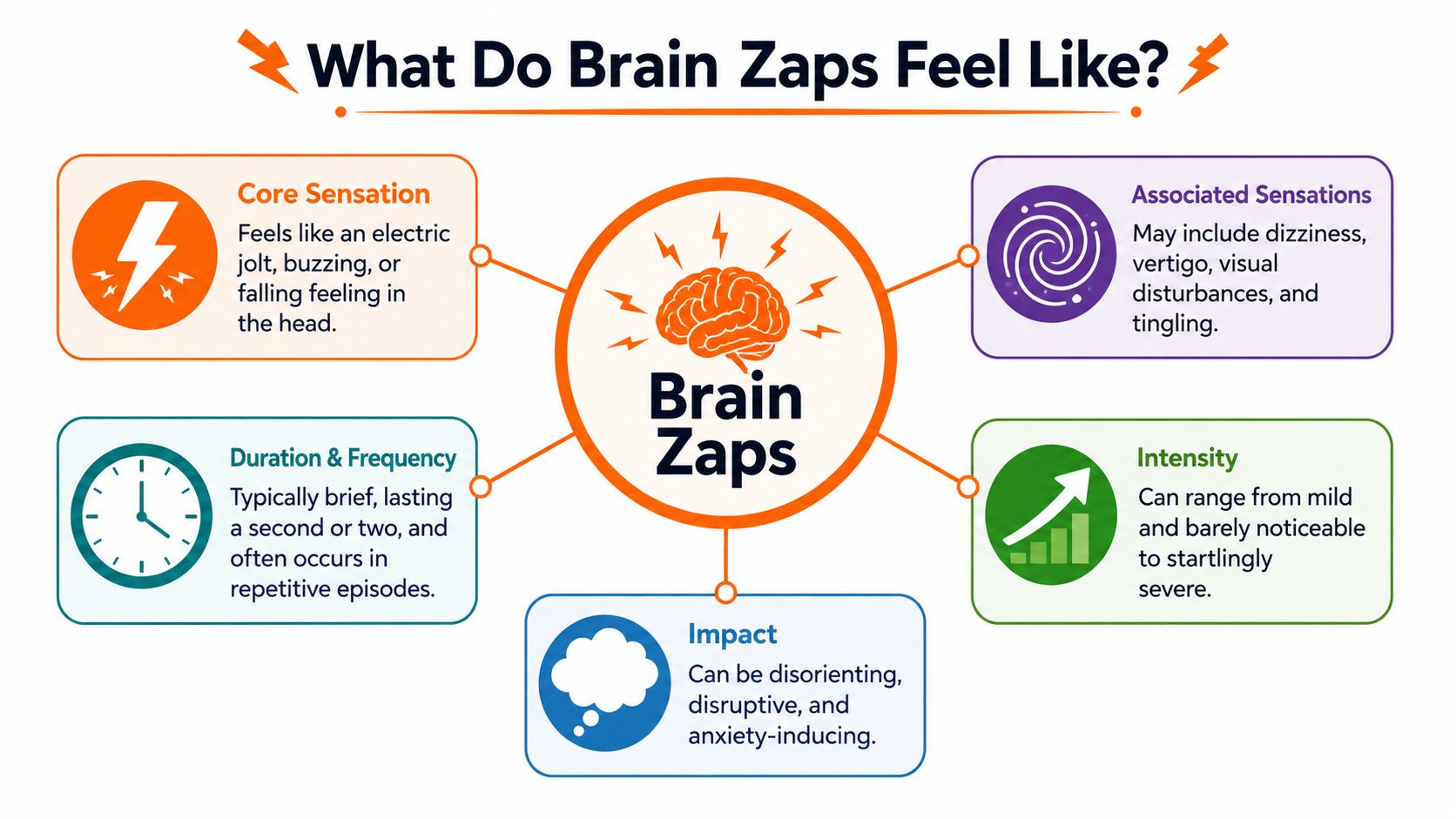
The clearest descriptions are usually sensory, not medical. People say it feels like a brief electrical jolt, a camera flash inside the head, a head hiccup, or a whoosh that passes through the skull and sometimes down the neck or arms. It's often not painful, but it can be extremely unsettling.
The core feeling
A useful clinical description is this: brain zaps are ultra-short sensory events, often lasting less than two seconds, and many people describe them as a non-painful “skipping” or “blinking” of consciousness, a “head hiccup,” or a “brain skip,” with rapid lateral eye movements or head turns as common triggers, as described by Medical News Today's overview of brain zaps.
That helps separate them from longer or more progressive neurological symptoms. A person may feel momentarily off-balance, briefly detached, or as if their brain “missed a frame.” The sensation tends to be abrupt, self-limited, and vivid.
“It's like static met a shiver inside my head, then disappeared.”
“I wouldn't call it pain. It's more like my brain stuttered for a split second.”
What people often notice around the zap
The zap itself is only part of the experience. The seconds around it can include:
A sound quality: Some people report a crackle, whoosh, or buzzing feeling.
A visual component: Others notice a flash-like sensation or fleeting visual disturbance.
A balance sensation: Brief vertigo or a split-second sense of being pulled off centre can happen.
A mental skip: Some describe a tiny interruption in continuity, as if their awareness blinked.
Readers often find this aspect confusing. If it involves sound, vision, and balance, they assume it must be a major neurological event. Not necessarily. Brain zaps can be multimodal, meaning they can involve more than one sensory channel at once while still remaining brief and non-painful.
A practical way to describe it in an appointment
If you're trying to explain what do brain zaps feel like to a clinician, this sentence works well:
Practical rule: “It's a sudden, brief electric or whooshing sensation in my head, often triggered when I move my eyes or turn my head, and it leaves me briefly disoriented.”
That description gives the provider the most useful clues. It covers quality, timing, trigger, and after-effect. Those four details usually tell us far more than the single phrase “I'm getting shocks in my head.”
The Science Behind the Shock Uncovering the Causes
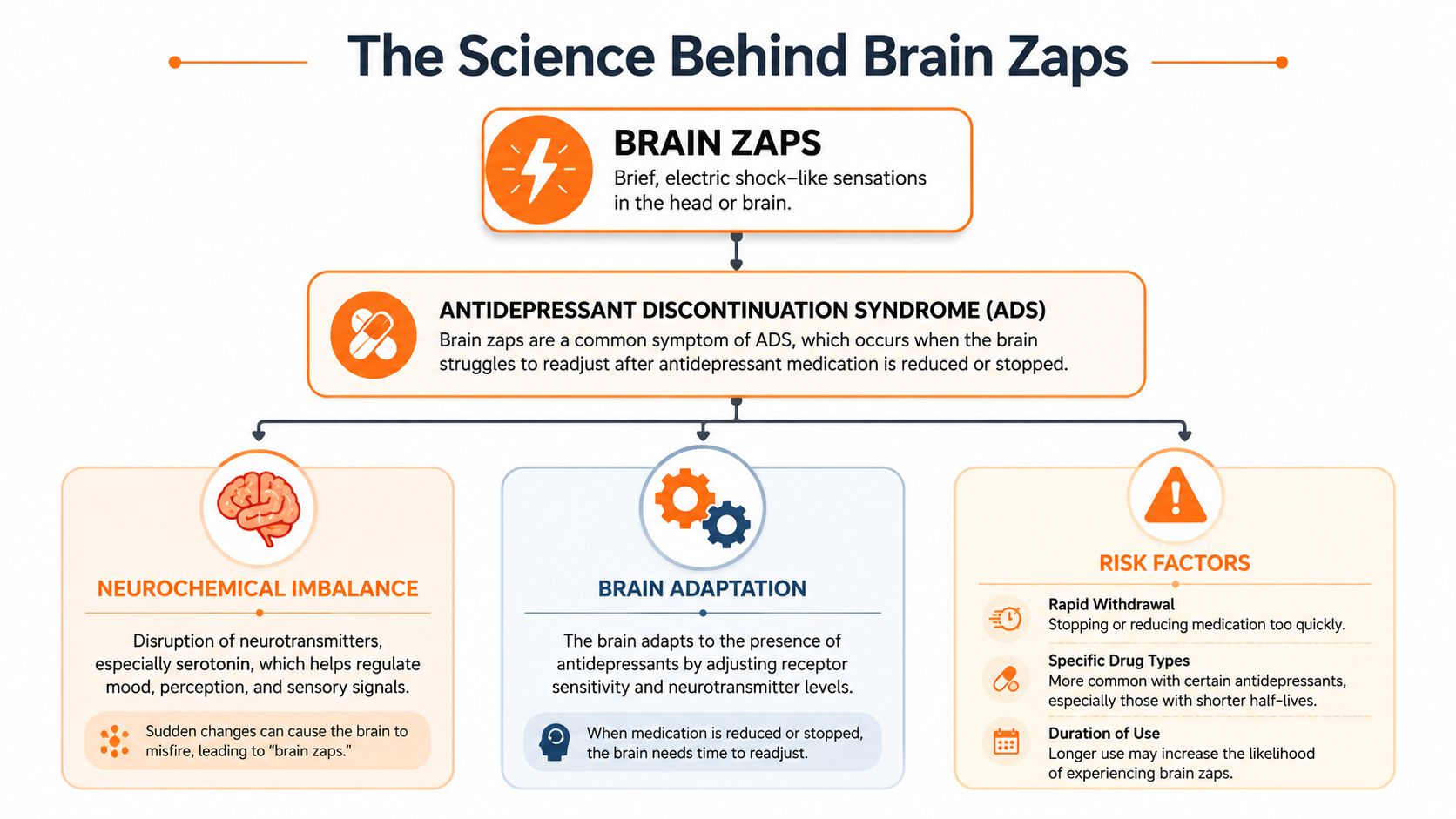
The most common explanation is antidepressant discontinuation syndrome. This happens when the brain is adjusting after a medication is reduced, stopped, or missed. SSRIs and SNRIs affect serotonin-related signalling over time. When that medication level changes, the nervous system can become temporarily irritable as it recalibrates.
Why antidepressant changes matter
A practical benchmark helps here. Approximately 50% of people who stop or reduce an antidepressant dose, particularly SSRIs and SNRIs such as Zoloft or Effexor, report brain zaps. Symptoms typically begin 2 to 5 days after the last dose, and medications with shorter half-lives are more strongly associated with onset, according to this clinical summary on causes of brain zaps.
That timing is one of the strongest clues in practice. If a patient says, “I felt fine at first, then a few days later I started getting these strange jolts,” withdrawal moves much higher on the list.
Shorter half-life medications deserve special attention because they leave the body faster. That creates a sharper transition for the brain. In day-to-day prescribing, that's why medications such as paroxetine and venlafaxine are often discussed carefully when planning taper schedules.
A simple neuroscience model
You don't need complicated jargon to understand the mechanism. Think of the brain as having adjusted its signalling system to a medication that has been present consistently. Remove that support too quickly and the system doesn't fail structurally. It becomes temporarily over-responsive. That's why the sensation is often described as a brief electrical misfire rather than pain.
For clinicians, this is also where medication review becomes practical, not theoretical. Enzyme pathways can affect how quickly a drug is metabolised and how sensitive a person may be to dose changes. If you want a concise refresher on medication metabolism, mastering P450 interactions is useful background reading. For patients who are already juggling stimulant or antidepressant questions, this related guide on ADHD medications and anxiety can also help frame broader medication conversations.
Other contributors clinicians should keep in mind
Antidepressant withdrawal is the best-known cause, but it isn't the only context in which people report a similar sensation. Clinically, it's sensible to ask about:
Missed doses: Even an unplanned interruption can matter.
Other withdrawal states: Some people notice similar symptoms during changes in sedating medications.
Heightened nervous system arousal: Anxiety, poor sleep, and fatigue can amplify perception of these events.
Mechanical triggers: Eye and head movement patterns can make a medication-related symptom feel even stranger.
The key point is reassuring. The working model is usually functional dysregulation, not structural brain injury.
Common Triggers and Symptom Patterns
One reason brain zaps feel unpredictable is that the trigger can be tiny. A person may not notice the pattern until they start paying attention. Then it becomes obvious. The zap shows up when they glance sideways while driving, look over a shoulder, roll over in bed, or blink and turn at the same time.

Triggers people commonly miss
Beyond medication withdrawal, brain zaps can also be associated with chronic stress, anxiety, sleep disruption, and nutritional factors such as low vitamin B12, as noted in LifeStance's discussion of brain zaps and related triggers. That doesn't mean every zap is caused by those factors alone. It means they can lower the nervous system's tolerance and make the symptom more noticeable.
In practical terms, patients often discover patterns like these:
Late evening worsening: Symptoms can feel stronger when the person is overtired.
Caffeine sensitivity: A usual coffee may suddenly feel less tolerable during withdrawal.
Stress spikes: Work pressure, family conflict, or panic can make each zap feel sharper.
Sleep transition effects: Some people notice them most while falling asleep or when waking suddenly.
A related clinical issue is that poor sleep and previous head injury symptoms can overlap in confusing ways. If the presentation includes persistent dizziness, attention problems, or post-injury complaints, this guide on the long-term effects of concussion can help frame differential thinking.
Why nights can feel worse
Some patients are especially distressed because the zaps cluster near sleep. The subjective experience is often, “Every time I'm about to drift off, I get another one.” That pattern can create a feedback loop. The person anticipates the next zap, becomes more alert, sleeps worse, and then notices symptoms even more.
There is also a future-dated research claim worth treating cautiously. A 2025 study from the UCSF Sleep Center reported that 68% of California patients with antidepressant withdrawal symptoms experienced a 40% increase in zap frequency during the first 30 minutes of REM rebound. Because that finding is future-dated, it should be viewed as a reported projection rather than settled current fact. Even so, the broader clinical lesson remains useful. Sleep-stage transitions may help explain why some people feel markedly worse at night.
If a patient says, “It's always worse when I'm exhausted or just falling asleep,” believe the pattern first, then organise the history around it.
A practical symptom diary
For one week, it can help to write down four details after each cluster:
Time of day
Recent trigger such as eye movement, turning, caffeine, or missed sleep
Whether medication timing changed
Any brief cognitive after-effect such as fog, clumsiness, or imbalance
That simple record often turns a frightening mystery into a manageable pattern.
Brain Zaps vs Other Neurological Events
The biggest fear is usually not discomfort. It's misinterpretation. People worry the zap is a seizure, stroke, or another serious neurological event. Sometimes further assessment is appropriate, but the symptom pattern often looks different once you compare features side by side.
Symptom Differentiator Brain Zaps vs Other Conditions
Feature | Brain Zaps | Partial Seizure | Migraine Aura |
|---|---|---|---|
Typical feel | Brief electric jolt, whoosh, or internal shock sensation | Can involve altered awareness, unusual sensory symptoms, or automatisms | Often visual or sensory disturbance that builds and evolves |
Pain | Usually non-painful | Variable | Often followed by headache, though not always |
Duration | Very brief, often under a few seconds | Usually longer than a fleeting jolt | Usually longer-lasting than a zap |
Common trigger pattern | Often linked to eye movement, head turn, or medication change | Not typically tied to looking sideways or turning the head in a reproducible way | Less commonly triggered by a quick eye or head movement alone |
Consciousness | Brief disorientation may occur, but not the classic seizure pattern of impaired awareness with post-event confusion | May involve impaired awareness or post-event confusion | Awareness usually preserved, though concentration may drop |
Motor signs | No typical full-body convulsion pattern | May include automatisms or focal motor activity | Not a convulsive event |
Clinical context | Often follows antidepressant reduction, missed doses, stress, or poor sleep | Depends on underlying seizure disorder or focal brain issue | Often occurs in people with migraine history |
Where confusion happens most
The overlap is real at the level of language. A patient says “shock,” “flash,” or “weird brain wave,” and everyone in the room starts thinking about very different disorders. That's why follow-up questions matter more than dramatic wording.
Ask things like:
Does it happen with a quick glance to the side?
Did it begin after lowering or missing a medication?
Is it painful, or mainly startling and disorienting?
Do you lose awareness in a sustained way, or is it more like a split-second skip?
The shortest description is often the most informative. “A split-second jolt when I move my eyes” points the history in a very different direction than “I black out.”
If the history includes concussion, ongoing dizziness, or cognitive complaints that are muddying the picture, structured symptom review can help. Tools such as the Rivermead Concussion Questionnaire are useful when clinicians need a more organised account of overlapping symptoms.
The reassuring distinction
Brain zaps are usually non-painful, very brief, and highly trigger-linked. That combination is one of their defining signatures. A symptom that is prolonged, progressively worsening, unrelated to medication context, or accompanied by clear focal neurological changes deserves more urgent evaluation.
Managing Brain Zaps Actionable Steps for Patients and Clinicians
People cope better when they have something specific to do. The management plan usually starts with one principle. Don't make abrupt medication changes on your own. Most of the preventable distress happens there.

For patients dealing with the symptom now
If you're in the middle of this experience, focus on reducing nervous system strain and improving the quality of information you bring to your prescriber.
Pause before changing anything else: Don't skip extra doses because the symptom scares you. Don't restart or stop medication without guidance.
Ask for a taper review: A slower plan is often the most practical intervention when the symptom is clearly linked to dose reduction.
Protect sleep aggressively: Keep a steady bedtime, lower late caffeine, and give your nervous system fewer reasons to stay activated.
Track the pattern: Note when it happens, what movement triggered it, and whether you were stressed, tired, or underfed.
A practical example helps. If someone notices zaps mostly when turning quickly at work after a poor night's sleep, that person can slow head movements, reduce stimulation where possible, and bring a one-page symptom log to their appointment. That won't eliminate every zap, but it often lowers fear and improves the conversation.
For clinicians trying to sort symptom from impact
Good management requires validation and measurement. Validation means telling the patient the symptom is real, recognisable, and often temporary. Measurement means not assuming that because the zap is brief, the broader effect is trivial.
A 2024 report found that 32% of adults in California who reported zaps also showed measurable declines in gaze-tracking and manual dexterity over six months, highlighting a gap between subjective reports and objective cognitive markers, as reported by Orange Neurosciences.
That doesn't mean every patient with brain zaps needs formal cognitive testing. It does mean clinicians should watch for cases where the story expands beyond a fleeting sensory event.
Consider objective follow-up when the patient reports:
Attention problems: They feel mentally “off” after repeated zaps.
Coordination changes: Driving, typing, or quick visual tracking feels less smooth.
Workplace impact: Reading screens, shifting gaze, or multitasking becomes harder.
Persistent uncertainty: The sensory complaint has improved, but functional complaints remain.
A structured mental health assessment guide can also help when withdrawal symptoms overlap with anxiety, mood change, or sleep-related distress.
“Your symptom may be brief, but if it's affecting concentration, eye tracking, or daily function, that part deserves attention too.”
The practical care plan
The best approach combines symptom relief with follow-up thinking:
Review medication timing and taper speed
Reduce trigger load such as exhaustion, stress, and excess caffeine
Document sensory features clearly
Escalate to cognitive assessment when function is drifting, not just when the zap itself sounds dramatic
That two-part framework helps both patients and clinicians avoid a common mistake. They either dismiss the symptom because it's transient, or they panic because it feels electrical. Neither response is ideal.
When to Seek Help and The Path Forward
Most brain zaps are frightening but temporary. The combination of brief duration, non-painful quality, and a clear medication or trigger history is usually reassuring. People often feel better once the symptom has a name and a pattern.
Still, there are times when waiting it out isn't the right move. A clinician review is sensible if the zaps are getting worse, lasting for many weeks, showing up without any obvious medication change, or arriving alongside more concerning symptoms such as sustained balance problems, marked cognitive decline, unusual weakness, or symptoms that don't fit the usual split-second pattern.
A simple decision guide
Contact a healthcare professional sooner when:
The timing doesn't fit: There was no medication reduction, missed dose, or clear trigger context.
The symptom is changing: It becomes more prolonged, more frequent, or less predictable.
Daily function drops: Reading, driving, screen use, or coordination feels noticeably worse.
The bigger picture worries you: Mood, sleep, concentration, or neurological symptoms are changing together.
For clinicians, the path forward is usually straightforward. Confirm the medication history carefully. Ask about eye-movement triggers, sleep disruption, stress load, and cognitive after-effects. If the sensory story is classic but the functional picture isn't improving, broaden the assessment.
If you're looking for a clinician with expertise in cognition, recovery, and symptom interpretation, this guide on finding a neuropsychologist near you is a useful starting point.
The most helpful mindset is neither minimising nor catastrophising. Brain zaps are real. They're often not dangerous. And they become much easier to manage when you pair symptom recognition with thoughtful follow-up.
If you want a clearer picture of how symptoms may be affecting attention, processing speed, eye-hand coordination, or other aspects of cognition, Orange Neurosciences offers tools and educational resources that can support your next conversation with a clinician. You can also explore the website or reach out by email to learn more about cognitive assessment and brain health follow-up.

Orange Neurosciences' Cognitive Skills Assessments (CSA) are intended as an aid for assessing the cognitive well-being of an individual. In a clinical setting, the CSA results (when interpreted by a qualified healthcare provider) may be used as an aid in determining whether further cognitive evaluation is needed. Orange Neurosciences' brain training programs are designed to promote and encourage overall cognitive health. Orange Neurosciences does not offer any medical diagnosis or treatment of any medical disease or condition. Orange Neurosciences products may also be used for research purposes for any range of cognition-related assessments. If used for research purposes, all use of the product must comply with the appropriate human subjects' procedures as they exist within the researcher's institution and will be the researcher's responsibility. All such human subject protections shall be under the provisions of all applicable sections of the Code of Federal Regulations.


© 2026 by Orange Neurosciences Corporation