Neuropsychology Near Me: Find Your Canadian Specialist

You've probably landed here after typing neuropsychology near me into a search bar because something feels off, but not in a simple way. A child is bright yet still falling behind. A parent repeats questions more often than usual. You're recovering from a concussion, stroke, or another neurological event and want to know whether the changes you notice are temporary, emotional, medical, or cognitive.
That search is only the start. The harder part is deciding whether you need neuropsychology at all, how urgently you need it, which provider is qualified for your situation, and what happens after the testing is over. Those choices matter because a good neuropsychological assessment doesn't just produce scores. It helps sort attention, memory, executive function, processing speed, language, and day-to-day functioning into a pattern that other clinicians, schools, and families can use.
Decoding Your Need When to Search for a Neuropsychologist
Uncertainty is normal at this stage. Many people don't know whether they need counselling, psychiatry, neurology, educational support, or a neuropsychological assessment. The easiest way to sort that out is to ask one question first: Do you need a detailed map of how thinking is working right now?

A neuropsychological evaluation is usually the right next step when the problem isn't just mood, behaviour, or stress in isolation. It's when you need to know whether difficulties with learning, memory, decision-making, attention, or mental speed reflect a brain-based pattern that should change the treatment plan.
When the search is routine and when it's more urgent
Some searches are routine. A student may have support at school but still struggles to retain instructions, complete multi-step work, or shift between tasks. An adult may have had lifelong focus problems and now wants clarification around ADHD, learning differences, or executive functioning.
Other situations need faster triage. Public-facing clinic information often doesn't explain this well, which is why it helps to separate routine learning and attention questions from potentially higher-risk concerns like new memory decline or post-stroke changes, as noted by Newton Neuro's guidance on neuropsychological evaluation referrals.
Practical rule: New decline is different from longstanding difficulty. A sudden or progressive change usually deserves faster medical review and clearer referral coordination.
Use this mental checklist:
Learning has always been hard: think about neuropsychology when you need diagnostic clarification, accommodations, or a stronger explanation of strengths and weaknesses.
Function changed after an injury or illness: concussion, stroke, seizures, neurological treatment, or infection often call for a cognitive baseline or follow-up assessment.
Memory problems are affecting daily life: missed appointments, repeated questions, medication mix-ups, or trouble managing finances should not be brushed off as “just stress.”
Mood treatment hasn't solved the problem: anxiety and depression can affect cognition, but persistent cognitive complaints may still need formal testing.
How neuropsychology differs from other services
A counsellor helps with coping, emotion, relationships, and behaviour change. A psychiatrist evaluates mental health symptoms, diagnoses psychiatric conditions, and may prescribe medication. A neuropsychologist focuses on how brain function shows up in thinking and behaviour, using standardised methods to measure it.
That distinction matters when families ask for “testing” but really need different things. If the question is, “How do I cope better?” counselling may fit. If the question is, “Why is my child not learning despite support?” or “Is this memory decline typical aging, depression, or something neurological?” neuropsychology becomes much more useful.
If you want a plain-language overview before calling clinics, Orange Neurosciences has a helpful explainer on what a neuropsychological assessment involves.
Your Search Strategy Finding Neuropsychology Services Near You
Once you know the search is justified, don't rely on one Google result and a polished homepage. Build a short list from several channels. That saves time and usually leads to better referrals.
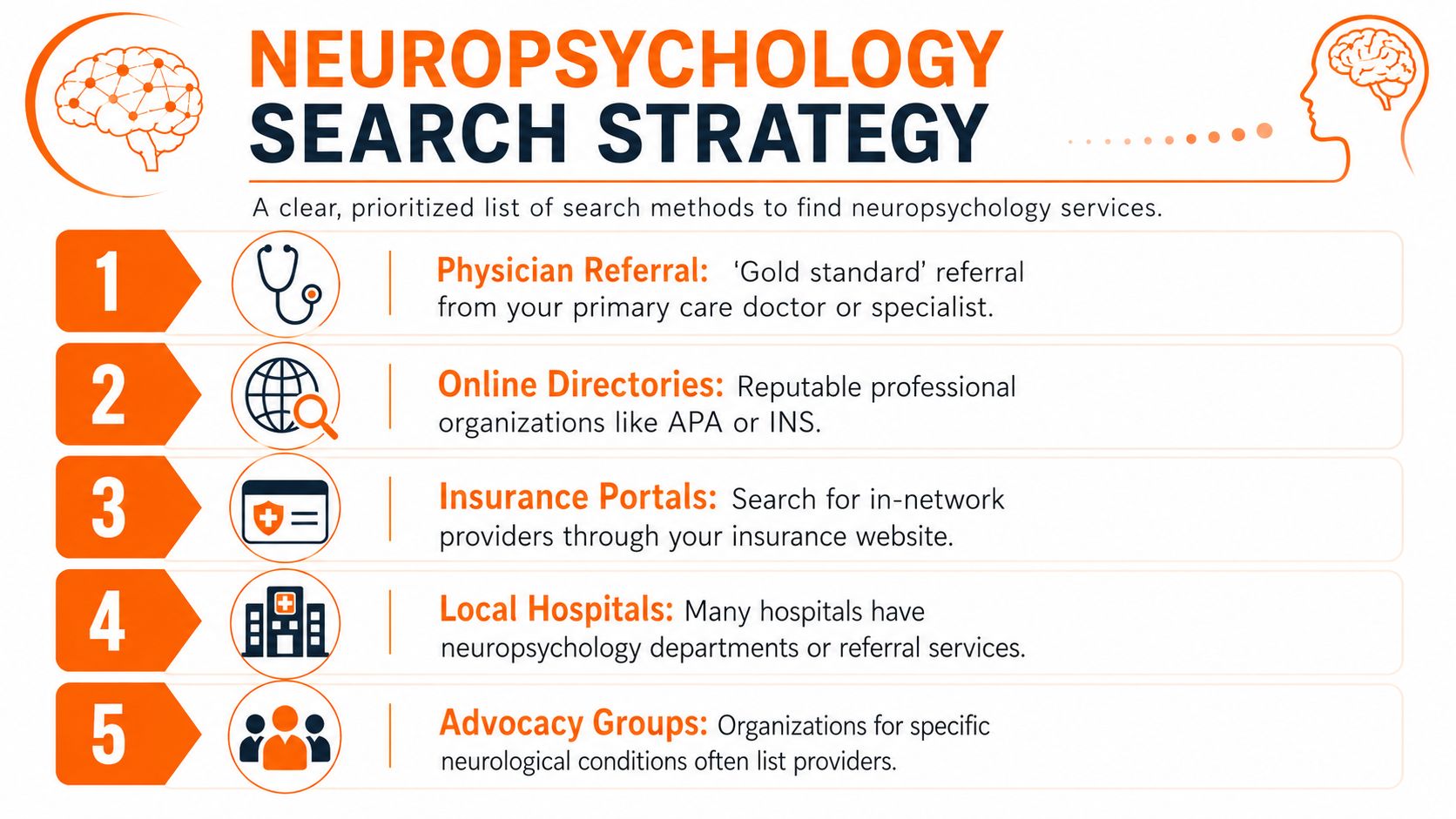
Start with the referral route if you can
The strongest starting point is often your family doctor, neurologist, developmental paediatrician, geriatrician, or rehabilitation physician. They already know the medical context, and their referral question is often what shapes a useful assessment.
A vague referral says, “Please assess cognition.” A better referral says, “Please clarify attention versus memory difficulty after mild traumatic brain injury,” or “Please assess capacity, executive function, and memory decline affecting medication management.” Better questions produce better reports.
Here's a practical example:
If a child is struggling in school, a paediatrician can flag developmental, medical, or sleep issues that may affect testing.
If an adult has new cognitive change, a neurologist can decide whether imaging, lab work, or urgent medical review should happen alongside the neuropsychology referral.
If recovery is the issue, a rehab team can use the results more directly in treatment planning.
Build your own shortlist if you don't have a referral
If you're searching independently, use more specific terms than neuropsychology near me. Generic searches often mix private clinics, therapy practices, and unrelated assessment services.
Try searches like:
[City] paediatric neuropsychologist
adult neuropsychology assessment [Province]
memory assessment [City]
concussion cognitive assessment [Province]
ADHD neuropsychological evaluation [City]
stroke cognitive assessment [City]
Then check each name against provincial regulatory listings, hospital systems, and established rehabilitation networks. If a provider works closely with neurology, geriatrics, paediatrics, rehab, or schools, that usually tells you more than a polished website does.
A practical next step for clinicians and referring teams is to review Orange Neurosciences resources for healthcare providers, especially if you're trying to sort who needs formal referral first and who may benefit from earlier objective screening.
Look for fit, not just distance
The closest clinic isn't always the best clinic. A provider who understands your exact question is often worth more than one who is geographically convenient.
Use this short comparison when reviewing search results:
Situation | Better fit to look for |
|---|---|
School and learning concerns | Paediatric focus, familiarity with accommodations and school documentation |
Memory decline in an older adult | Adult neuropsychology, memory clinic links, comfort with medical referrals |
Post-concussion or neurological recovery | Rehab-connected provider, experience with return-to-work or return-to-school planning |
Complex psychiatric and cognitive overlap | Provider comfortable integrating mental health, medication, and cognitive data |
A strong clinic usually tells you who they assess, what kinds of referral questions they answer, and how results are used after testing. If that's missing, ask before you book.
How to Vet and Choose the Right Provider
Many people lose time, finding a name, feeling relieved, and booking the first available appointment. That can work, but it often leads to the wrong type of assessment, a report that doesn't answer the actual question, or recommendations too generic to use.

The benchmark is straightforward. The American Psychological Association describes clinical neuropsychology as a specialty focused on brain-behaviour relationships through historical review, testing, and interpretation, which you can review in the APA overview of clinical neuropsychology. That means a real neuropsychological service is not just a few tests handed out in isolation. It is a structured process.
Questions worth asking on the first call
You don't need to interrogate the clinic, but you do need clear answers. Ask direct questions.
Who is interpreting the assessment? You want to know whether the neuropsychologist is directly involved in case formulation and final interpretation.
Do you work with this age group and concern? A provider may be excellent with dementia but not ideal for autism, ADHD, or paediatric learning issues.
What does the assessment include? Look for interview, background review, standardised testing, interpretation, and feedback.
How are results used afterward? Ask whether the report is suited for physicians, schools, rehab teams, workplace planning, or family guidance.
What is the follow-up process if the results raise medical concerns? Good clinics think beyond the test day.
What a good answer sounds like
A solid clinic answer is specific. For example:
“We review medical, developmental, and educational history first, tailor the test battery to the referral question, then provide a feedback meeting and written recommendations that can be shared with your physician or school.”
A weak answer is vague:
“We do cognitive testing and send a report later.”
The first answer tells you there is a process. The second tells you there may only be a product.
Red flags that matter
Not every red flag is dramatic. Often it's a pattern of missing clarity.
Credentials are hard to verify: if you can't tell who is licensed and what their actual role is, pause.
The clinic can't explain why their assessment fits your question: mismatch leads to disappointing reports.
Testing is sold without context: a battery of tests without a clear referral question often creates more confusion.
No one mentions feedback: if results aren't explained in plain language, the value drops sharply.
Orange Neurosciences also outlines a practical care model on how they work with cognitive assessment workflows, which can help readers think more critically about structure, data, and follow-through when comparing services.
Choose the provider who can answer your actual question
The best provider is not the one with the earliest opening. It's the one whose expertise matches the world decision in front of you.
If you need school supports, choose someone who writes useful educational recommendations. If you need clarity after a stroke or concussion, choose someone who understands neurological recovery. If you're worried about progressive memory change, choose someone comfortable working within a broader medical pathway.
That fit matters because the final report should help someone act. It should guide a family doctor, inform a neurologist, support a rehabilitation plan, or help a school organise accommodations. If it can't do that, the assessment may be technically correct but practically weak.
The Assessment Explained What Happens During and After Testing
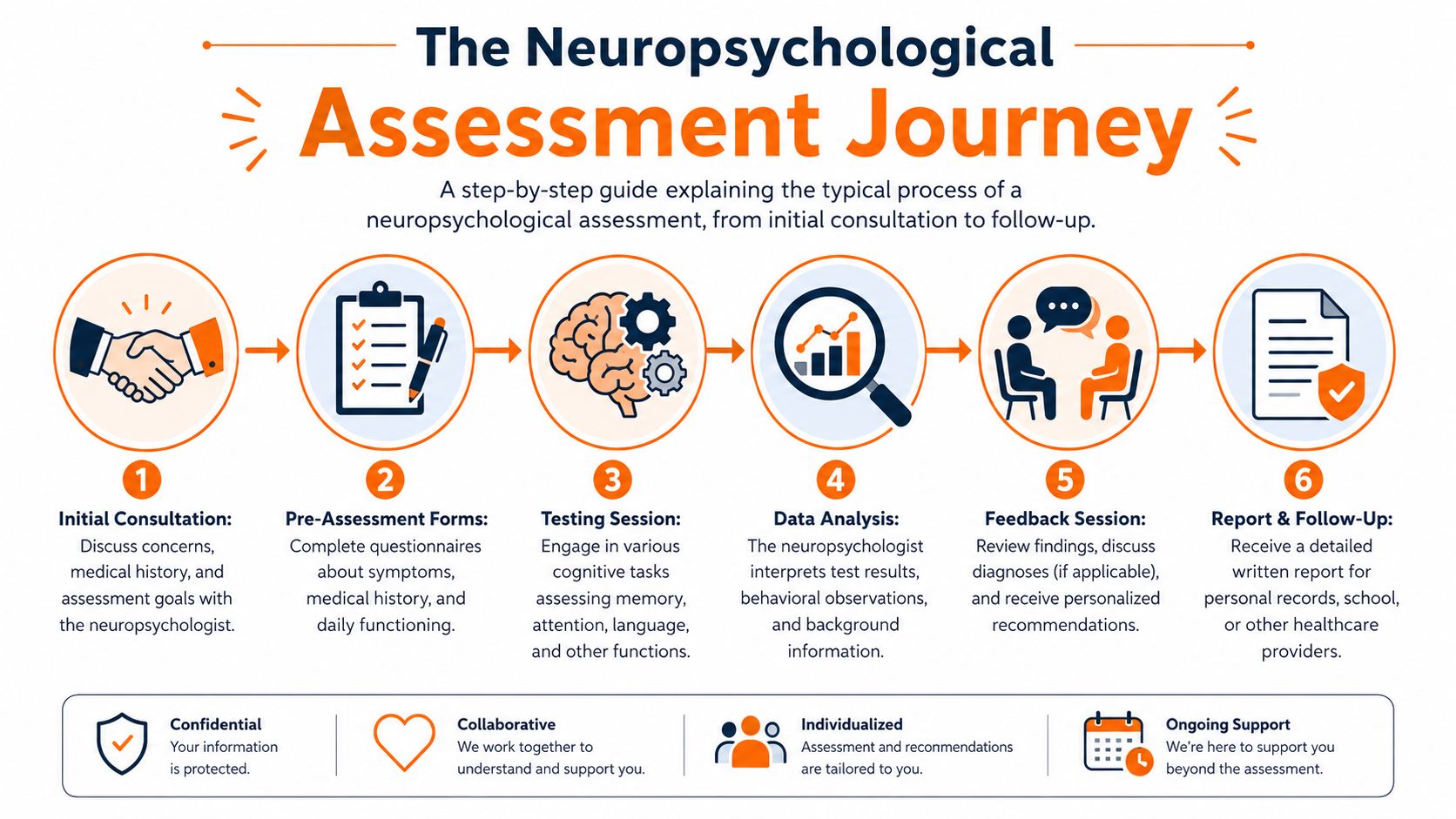
Individuals feel less anxious once they know what the day looks like. Neuropsychological testing is rarely a single dramatic exam. It's usually a series of tasks that, taken together, show how a person learns, remembers, focuses, reasons, and manages information.
What the testing day feels like
A typical assessment often starts with conversation. The clinician asks about the reason for referral, health history, school or work functioning, development, daily life, mood, medications, and observed changes. Families sometimes expect testing to begin immediately, but this history matters because test scores without context are easy to misread.
Then come the tasks. Some feel like puzzles. Some involve listening, repeating, remembering, drawing, sorting, naming, reading, or responding quickly. Others may be completed on paper or by computer. None of these tasks alone gives the answer. The pattern across them is what matters.
A child might do well when material is presented slowly one-on-one, yet struggle when speed, divided attention, or working memory demands increase. An older adult might report “memory problems,” but the deeper issue could be slowed processing or reduced executive control rather than storage failure. That difference changes recommendations.
Why one low score doesn't mean a diagnosis
This is one of the most misunderstood parts of neuropsychology. A single weak test score can happen by chance, especially in a longer battery. In older adults referred for subjective cognitive complaints, 33.58% would be expected to have at least one score below the 5th percentile by chance, 14.7% would have two or more, and 6.55% would have three or more, according to research on base-rate interpretation in neuropsychological assessment.
That's why skilled interpretation matters. The clinician looks for patterns across domains, not isolated dips. The same source notes that, when patterns are interpreted correctly, neuropsychological evaluation can differentiate Alzheimer dementia from non-dementia with nearly 90% accuracy.
Don't ask, “Was any score low?” Ask, “What pattern emerged, and what does that pattern mean in daily life?”
If you want a practical overview of the kinds of domains these evaluations can measure, Orange Neurosciences provides a useful page on cognitive assessments and the functions they examine.
What happens after the last task
The testing day isn't the end. The clinician still has to score, compare, interpret, and integrate the results with history and observation. That interpretive phase is where the assessment becomes clinically useful.
Then comes feedback. In a survey of licensed clinical neuropsychologists, 98.4% provided verbal feedback, 71.3% frequently gave in-person feedback, and the average feedback session lasted about 45 minutes. Sessions longer than 30 minutes were associated with higher patient satisfaction, as reported in a study on neuropsychological feedback practices.
That matters because many families leave testing with one real question: What do we do now? A good feedback meeting should answer that clearly.
The best feedback sessions do three things:
Translate scores into real life: not “low-average working memory,” but “multi-step spoken instructions may be hard to hold onto without written support.”
Separate findings from assumptions: not every memory complaint means dementia, and not every attention issue means ADHD.
Identify next actions: school accommodations, medication review, speech-language therapy, occupational therapy, counselling, neurology follow-up, rehabilitation, or watchful monitoring.
What the final report should contain
A usable report isn't just detailed. It is organised for action.
Look for:
Report element | Why it matters |
|---|---|
Referral question | Keeps the whole assessment tied to the real decision |
Background history | Explains what may shape the findings |
Test interpretation by domain | Shows strengths and weaknesses, not just scores |
Diagnostic impression if applicable | Clarifies whether a condition is supported, ruled out, or still uncertain |
Recommendations | Tells family, school, physician, or rehab team what to do next |
If the report is dense but the recommendations are generic, ask for clarification. The report should help people act differently, not merely describe performance.
Navigating Practicalities Insurance, Fees, and Telehealth Options
The clinical side gets most of the attention. The practical side is what often delays care.
Families commonly hit the same obstacles. They don't know whether a referral is required, what insurance will reimburse, whether part of the process can happen remotely, or what follow-up looks like once the report is delivered. Clinic websites often leave these details vague, even though many people searching locally are really trying to find a coordinated next step, as highlighted by Cambridge Health Alliance's neuropsychology service information.
Questions to ask before booking
Call both the clinic and your insurer. Ask the same question in two ways if needed. Administrative clarity can save weeks.
What exactly is included in the quoted fee? Intake, testing, scoring, report, and feedback aren't always packaged the same way.
Is a physician referral required for coverage or only recommended? Those aren't the same thing.
Will I receive a written report and a feedback appointment? If yes, ask whether both are included.
What happens after the assessment if more care is needed? Some clinics only send the report. Others coordinate with physicians, schools, or rehab teams.
Are there telehealth options for any part of the process? Intake and feedback may be more flexible than testing itself.
A cheap assessment that doesn't include useful feedback or follow-up can cost more in the long run if you need to repeat the process elsewhere.
Telehealth can help, but it has limits
Remote options can reduce travel and speed up intake, especially for people outside major urban centres. History-taking, collateral interviews, and feedback often work well by video when the clinic has a clear protocol.
Testing is more nuanced. Some tasks can adapt to remote delivery more easily than others. But complex cases, concerns about effort, sensory issues, severe language barriers, motor limitations, or the need for tightly controlled conditions may still favour in-person assessment.
That's why it helps to ask not just, “Do you offer telehealth?” but “Which parts are remote, and how does that affect the quality of the assessment for my situation?”
For readers trying to understand online options more broadly, Orange Neurosciences has a concise guide to online cognitive assessment and when it may fit.
Enhancing Your Journey with Objective Cognitive Data
The hardest part of this process is often the waiting. You know something needs attention, but specialist timelines, referral loops, and uncertainty slow everything down. That's where objective cognitive data can become useful before or between formal appointments.

A modern advantage in this field is the move toward precision neuropsychology. Recent literature describes AI-enabled tools as a growing frontier for improving assessment, with some digital tools showing 88.5% sensitivity and 83% specificity in distinguishing healthy from cognitively impaired individuals, and another application reporting 87.5% accuracy. The underlying shift is toward faster, more standardised cognitive profiling that supports earlier and more personalized decisions.
That doesn't replace a full neuropsychological evaluation when one is needed. It does make the pathway more efficient. Objective data can help a family doctor decide whether a referral should be expedited, help a rehabilitation team track change over time, or help a family walk into a consultation with more than a vague description of “brain fog” or “memory issues.”
This is especially useful when the question isn't yet diagnostic but still important. Has processing speed changed? Is attention broadly weak, or only under time pressure? Is a child's difficulty more consistent with executive-function strain than simple lack of effort? Good data won't answer every question, but it can sharpen the right next one.
If you want a faster starting point before a full referral, or a practical way to track cognition over time, Orange Neurosciences offers AI-powered tools that help clinicians, families, and educators gather objective cognitive data in a structured, accessible format. You can explore the platform on the website or reach out by email to see whether it fits your referral, screening, or follow-up workflow.
Orange Neurosciences' Cognitive Skills Assessments (CSA) are intended as an aid for assessing the cognitive well-being of an individual. In a clinical setting, the CSA results (when interpreted by a qualified healthcare provider) may be used as an aid in determining whether further cognitive evaluation is needed. Orange Neurosciences' brain training programs are designed to promote and encourage overall cognitive health. Orange Neurosciences does not offer any medical diagnosis or treatment of any medical disease or condition. Orange Neurosciences products may also be used for research purposes for any range of cognition-related assessments. If used for research purposes, all use of the product must comply with the appropriate human subjects' procedures as they exist within the researcher's institution and will be the researcher's responsibility. All such human subject protections shall be under the provisions of all applicable sections of the Code of Federal Regulations.


© 2026 by Orange Neurosciences Corporation