Theories of Personality Explained and Applied

You're in a case conference, staff meeting, or classroom discussion, and two capable professionals are describing the same person in completely different ways. One sees a quiet student as thoughtful and observant. Another sees withdrawal and possible anxiety. A clinician notices a pattern of self-criticism, while a teacher focuses on missed work and avoidance. The behaviour is the same, but the explanation changes what happens next.
That's why theories of personality still matter. They give professionals a disciplined way to move from impression to interpretation, and from interpretation to an appropriate question, assessment, or intervention. A theory doesn't replace judgement. It helps make judgement more transparent, testable, and useful.
Why Theories of Personality Still Matter Today
Personality theory has deep roots in Canadian psychology education. The University of Waterloo personality theory course materials trace the field through Freud, behaviour theories, Rogers, Kelly, trait theory, and the modern Big Five. That sequence matters because it shows personality psychology as a multi-framework discipline, not a contest in which one model permanently defeats all others.
Consider a learner who regularly avoids group discussion. A psychoanalytic lens might prompt questions about unresolved experiences, authority, or emotional conflict. A behaviourist might examine what happened after previous attempts to participate. A social-cognitive practitioner could ask what the learner expects will happen, and whether they believe they can succeed. A trait psychologist might assess patterns related to extraversion, emotional stability, or conscientiousness.
None of those questions is automatically the right one. Each theory directs attention toward different evidence.

Theory changes the next decision
A label such as “unmotivated” closes inquiry too quickly. A structured framework keeps the inquiry open:
What is stable? Does the pattern appear across settings and over time?
What is situational? Does it emerge only with unfamiliar people, difficult tasks, or public evaluation?
What is measurable? Can attention, working memory, processing speed, mood, or self-regulation add useful context?
What is changeable? Which habits, expectations, supports, or environmental conditions could improve functioning?
Personality theories are used by psychologists, counsellors, educators, researchers, physicians, and other professionals who need to understand individual differences. They can support case formulation, educational planning, research design, leadership development, and conversations about personal growth. They shouldn't be used as permission to make fast judgements about someone's worth or potential.
For readers who want a concise way to connect psychological concepts with applied practice, clinical knowledge summaries from Orange Neurosciences offer a useful companion resource.
The practical journey is straightforward. First, understand what theories are trying to explain. Then compare the major families, examine what research supports, and translate the strongest ideas into assessment, care planning, and everyday decision support.
What Personality Theories Try to Explain
A useful analogy is to think of personality as a person's operating system, not a single application. The operating system influences how the person processes information, responds to demands, and manages competing priorities. Yet the application, task, social environment, sleep, stress, and learning history can all change what an observer sees.
Personality theories try to organise several kinds of observations:
Patterns across time. Some tendencies remain recognisable, such as careful planning or frequent social approach.
Differences between people. Two people may face the same task but interpret and respond to it differently.
Changes within one person. Stress, development, relationships, illness, learning, and culture can alter how a tendency is expressed.
Motivation and meaning. People don't only behave. They pursue goals, protect identities, interpret events, and make choices.
Functioning and difficulty. A tendency can support adaptation in one environment and create friction in another.
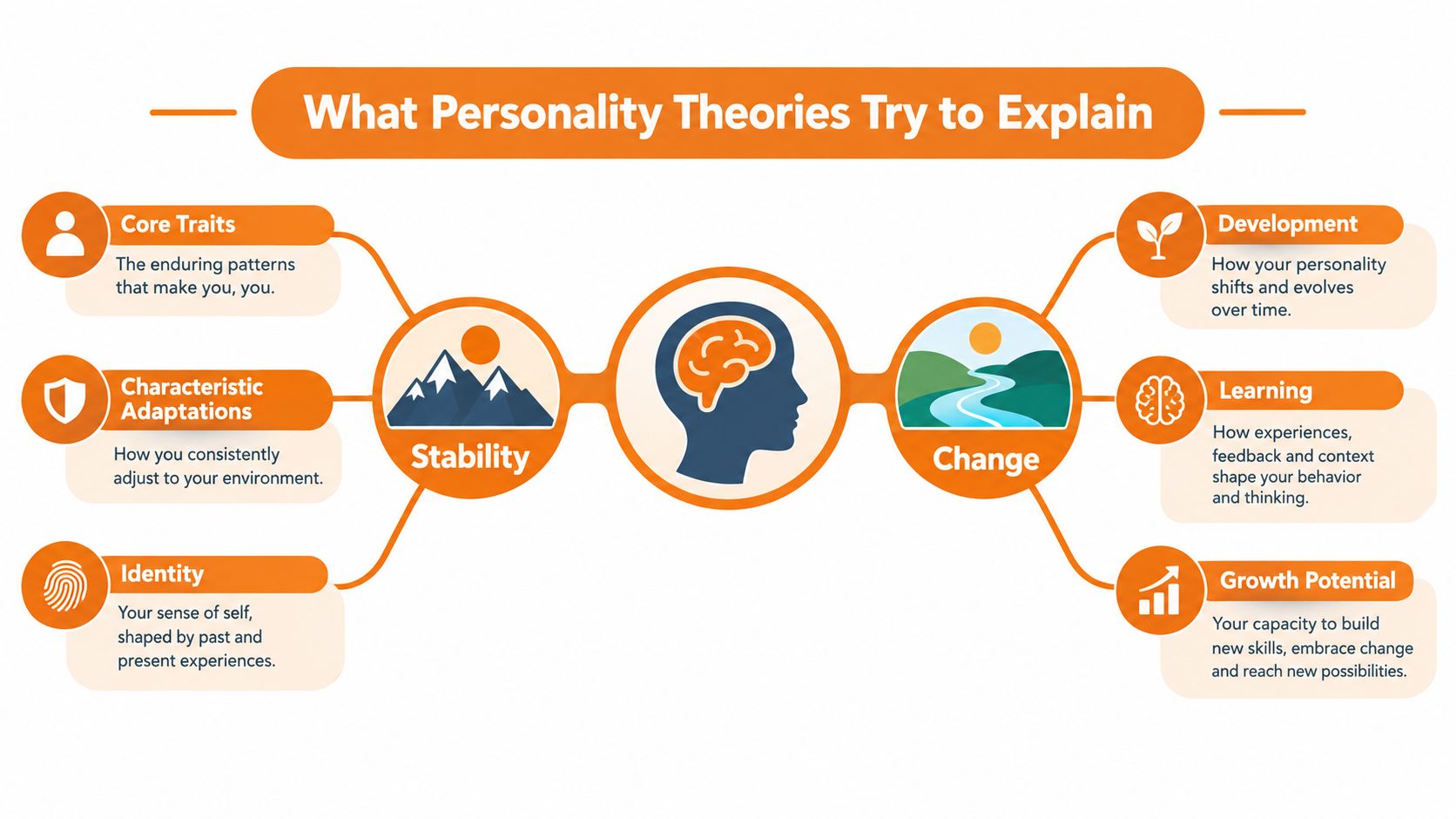
Stability isn't the same as fixedness
A trait is a relatively consistent tendency. A state is a temporary condition. Someone may generally be calm but become tense before an examination. Someone who usually enjoys company may prefer solitude during grief or exhaustion.
The weather analogy helps. Climate describes broad, recurring conditions. Weather describes what's happening today. A personality trait resembles climate more than a single afternoon, but even a climate doesn't tell you the exact weather on every day. A profile describes probabilities and tendencies, not destiny.
The Orange Neurosciences guide to cognitive function adds another important distinction. Personality and cognition overlap in everyday functioning, but they aren't interchangeable. Attention, memory, executive function, perception, processing speed, and eye–hand coordination can influence how a person performs, communicates, and copes, without being personality traits.
Practical rule: Treat a personality result as a prompt for better questions, not as a final explanation.
A good theory should help you make predictions that can be checked. If a person is described as “complex” in a way that explains every possible behaviour, the description may sound impressive but offers little practical value. Stronger frameworks specify what to look for, under which conditions, and how the information could guide support.
That is also why identity deserves care. A test score is not a complete person, and a theory is not a biography. The most responsible interpretation combines patterns, context, lived experience, observed functioning, and the purpose of the assessment.
Major Theories of Personality at a Glance
Each theory family acts like a different camera lens. A wide-angle lens helps you see the whole environment. A close-up lens reveals detail. The mistake isn't choosing one lens. The mistake is assuming that one lens can answer every question.
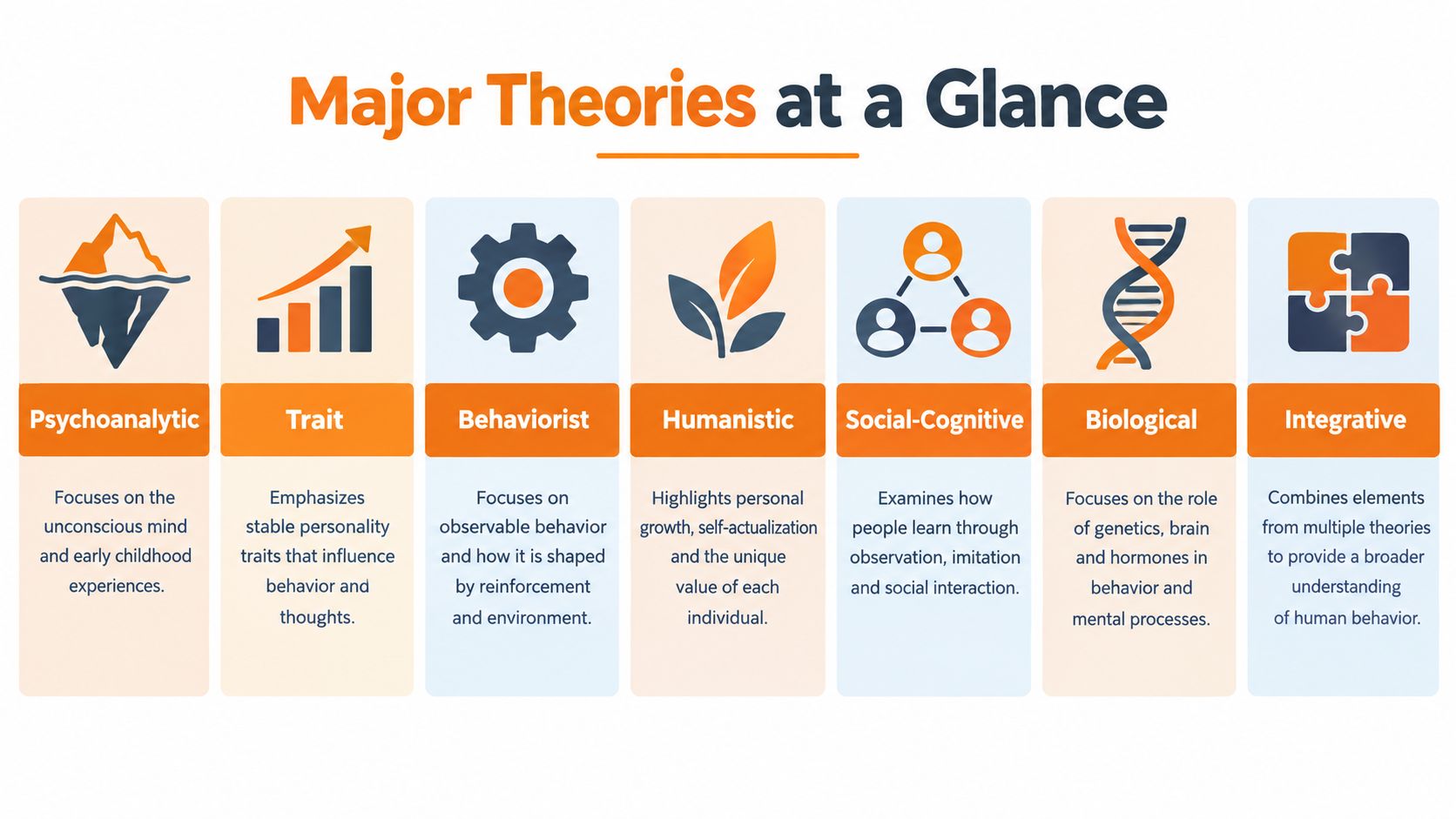
Seven useful lenses
Psychoanalytic and psychodynamic theories focus on unconscious processes, early relationships, internal conflict, and recurring emotional patterns. Their strength is depth. They can help a clinician explore why a person repeatedly expects criticism from authority figures, even when current supervisors behave supportively. Their limitation is that some concepts can be difficult to measure directly.
Trait theories describe relatively enduring dimensions, including the Big Five. They support comparison, structured measurement, and population-level research. They're useful when a team needs to discuss tendencies such as conscientiousness or openness without reducing a person to a type. Their weakness appears when broad dimensions are used to predict a highly specific behaviour without considering context.
Behaviourist theories concentrate on observable actions and learning through reinforcement, consequences, and environmental cues. They're practical when the question is, “What happens before and after this behaviour?” A school team might track whether a student begins assignments more often after receiving immediate feedback. This approach can be less informative when the central issue involves meaning, identity, or internal experience.
Humanistic theories emphasise dignity, self-awareness, personal growth, values, and the capacity for self-direction. They fit collaborative counselling and situations involving identity, life transitions, or purpose. Their relational focus is valuable, although broad ideas about growth require careful translation into observable goals.
Social-cognitive theories connect behaviour with beliefs, expectations, learning, self-efficacy, and reciprocal interactions between person and environment. They're especially useful when a person's performance changes after feedback or when confidence affects persistence. The model helps explain why the same individual can function very differently across tasks.
Biological and evolutionary theories examine temperament, genetics, brain systems, adaptation, and inherited tendencies. They can illuminate why some patterns appear early or remain relatively stable. They must be handled carefully, because biological influence doesn't mean inevitability, and evolutionary explanations can become speculative when they aren't linked to testable evidence.
Integrative theories combine compatible insights. A clinician might use trait information to describe a pattern, behavioural tracking to identify maintaining conditions, cognitive techniques to examine expectations, and a humanistic stance to preserve collaboration. Integration works best when each method has a clear purpose rather than when “everything” is included without a decision rule.
Theory Family | Core Focus | Strengths | Limitations |
|---|---|---|---|
Psychoanalytic | Unconscious processes, early experiences, internal conflict | Rich case formulation and pattern recognition | Some concepts are difficult to test directly |
Trait | Stable dimensions and individual differences | Structured measurement and comparison | Can overlook context and development |
Behaviourist | Learned behaviour and environmental consequences | Observable goals and practical tracking | May underemphasise meaning and inner experience |
Humanistic | Growth, values, identity, and relationship | Collaborative and person-centred | Broad constructs need operational definition |
Social-cognitive | Beliefs, learning, self-efficacy, and context | Explains situation-dependent performance | Requires careful assessment of interactions |
Biological | Temperament, genetics, and physiological systems | Connects personality with mechanisms | Influence can be mistaken for determinism |
Integrative | Selective combination of frameworks | Flexible, whole-person planning | Poorly organised integration can become vague |
Canadian academic training often bridges classical theory and measurement-based evaluation, with the Big Five taught alongside earlier psychoanalytic and humanistic traditions. That history encourages a sensible conclusion: use the model that best matches the question, then test its assumptions with relevant information.
What Research Really Supports and Where Theories Fall Short
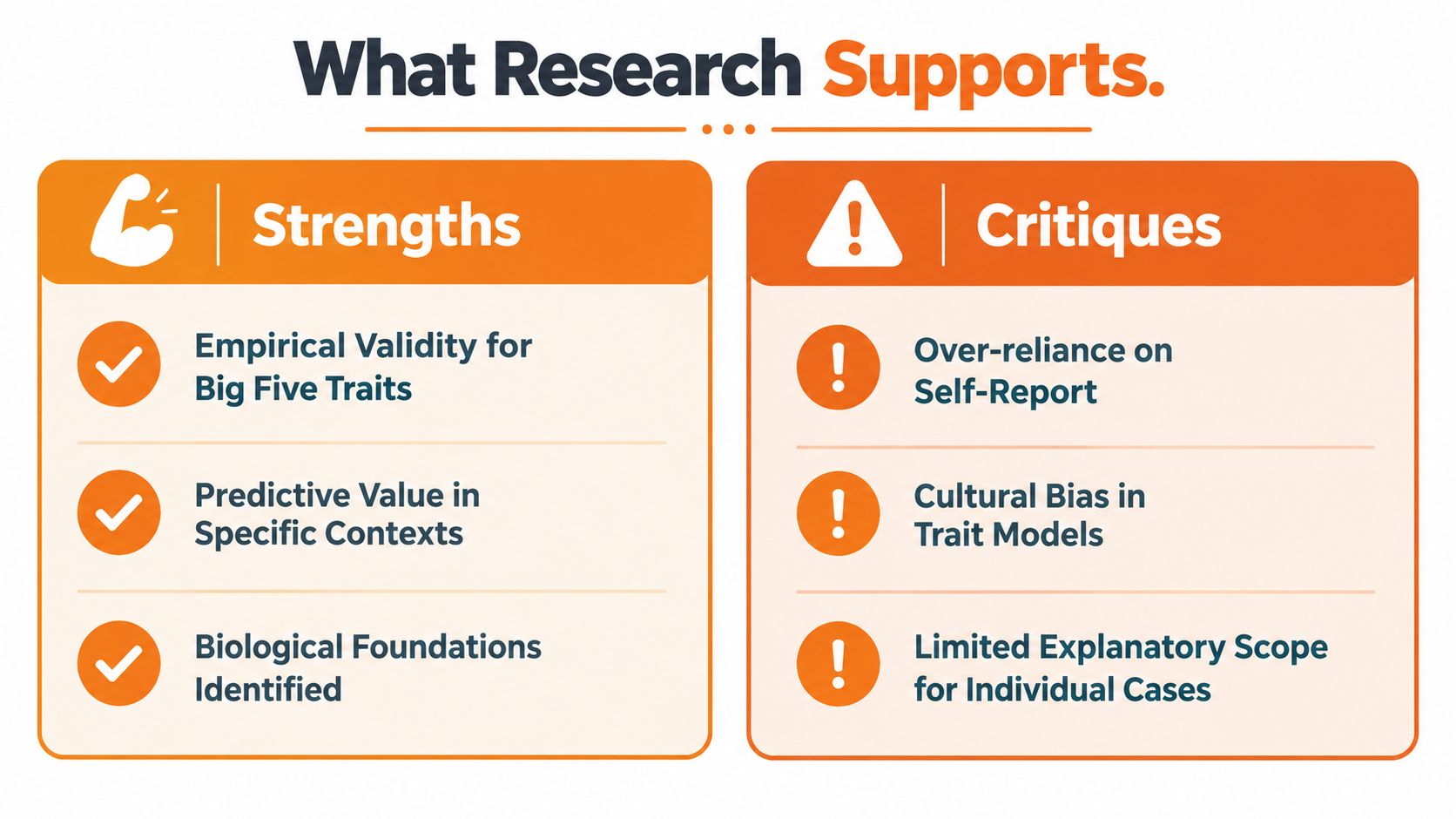
Research supports a measured version of trait thinking, not the idea that a short label can explain a whole person. Canadian data illustrate both the reach and the limits of modern personality measurement. The 16Personalities Canada profile includes 2,133,181 Canadian respondents out of 40,102,423 total respondents in its country profile, and reports that Canada is slightly more Introverted than Extraverted, more Intuitive than Observant, more Feeling than Thinking, slightly more Prospecting than Judging, and more Turbulent than Assertive. This is not a clinical census, but it demonstrates how personality-related data can be collected at substantial scale in the Canadian country profile.
Population-level patterns don't automatically produce valid individual conclusions. A person may differ from a group tendency, and a questionnaire response may reflect language, culture, mood, self-presentation, or the immediate setting. Canadian interpretation therefore benefits from local norming and cultural humility rather than universal cutoffs.
Traits can connect with real outcomes
A Canada-based analysis using Longitudinal and International Study of Adults data found that conscientiousness was positively associated with wages, while agreeableness, extraversion, and neuroticism were associated with negative wage returns in the published analysis. The finding doesn't mean conscientious people are destined to earn more, or that other traits are defects. It suggests that self-regulation, negotiation style, stress reactivity, work context, and opportunity can interact with personality in economically meaningful ways.
Cross-national research that includes Canada also reports comparatively lower neuroticism and higher conscientiousness and agreeableness among Canadians than Americans, while warning that cultural-response patterns affect interpretation in the comparative study. The practical lesson is simple. Use trait models to organise evidence, not to erase context.
Canadian practice still needs clearer guidance about which traits matter for a specific decision. The Canadian Psychological Association fact sheet on pre-employment personality assessment emphasises that personality is commonly measured with questionnaires, while reliable and valid instruments must target job-relevant traits rather than treat personality as one catch-all construct. The same source reports that Canadian hiring managers value reliability at 71%, honesty at 67%, and adaptability at 57%. Those preferences don't justify intuitive “culture fit” judgements. They strengthen the case for structured, trait-specific assessment.
A further caution comes from newer Canadian work on changing context. A 2025 study linked antagonistic traits such as narcissism and psychopathy with higher climate scepticism, while agreeableness and honesty-humility were linked with lower scepticism; openness was also among the strongest predictors, second only to left–right ideology as summarised in the study record. Other recent Canadian and longitudinal research connects personality with emotional responses during the COVID-19 pandemic and reports slight shifts in conscientiousness and extraversion across a major global stressor.
For assessment, that means retest and contextualise. A profile can be informative while still being sensitive to circumstances. To improve interpretation, teams should ask whether the instrument is reliable, whether it measures the intended construct, whether the language and norms fit the population, and whether the result changes an actual decision. The sensitivity and specificity guide provides helpful language for thinking about the trade-off between detecting possible concerns and avoiding unnecessary classification.
From Theory to Assessment and Clinical Care
Theory becomes clinically useful when it changes what a professional measures and does. A psychodynamic formulation may lead to a careful interview about recurring relationship patterns. A trait model may support a structured questionnaire. A behavioural formulation may produce a daily tracking plan. An integrative formulation can combine these elements, provided the team can explain why each one is present.
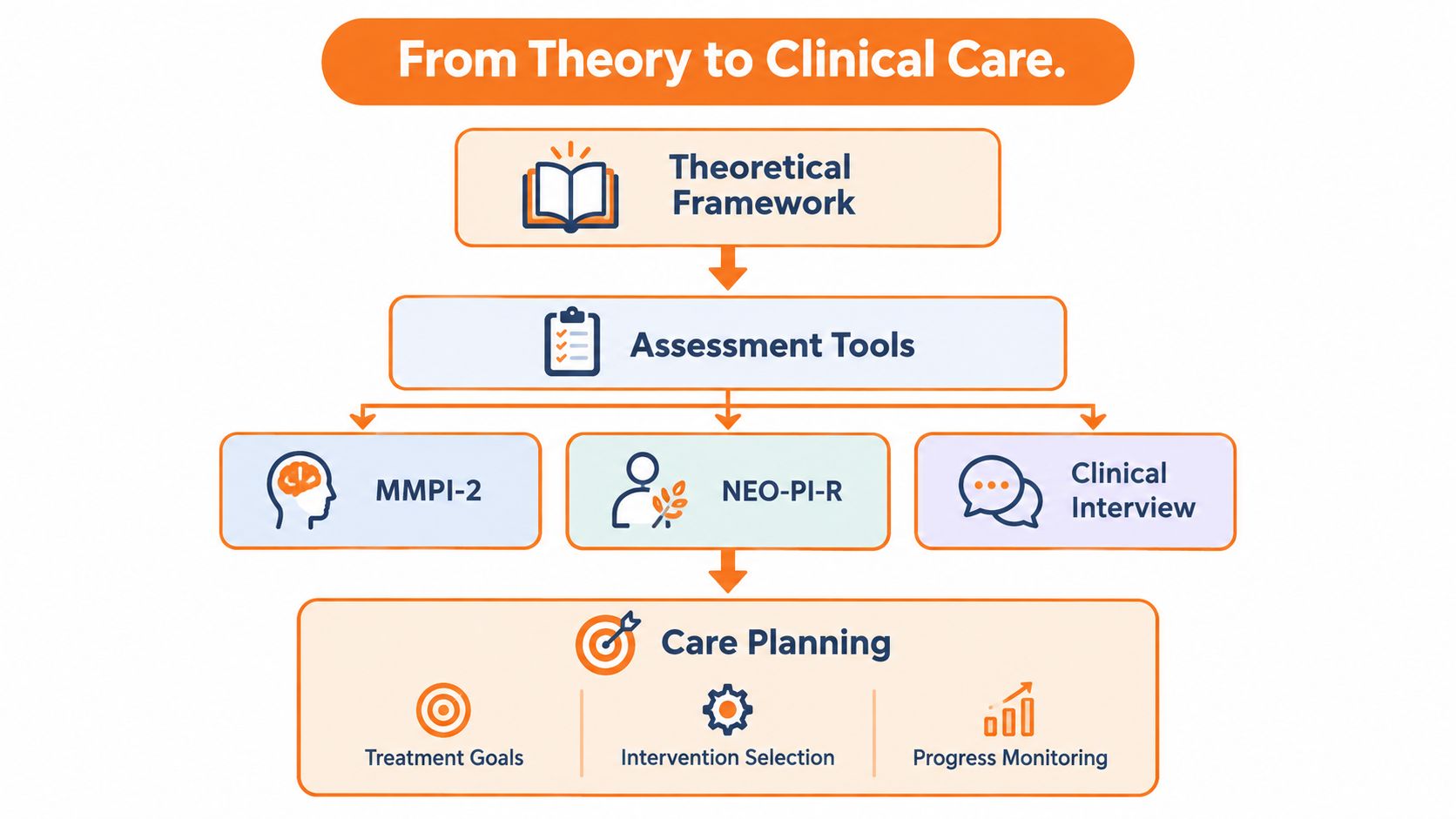
Start with the decision
Before selecting an instrument, name the decision the result should support. Is the team clarifying a referral question, planning therapy, identifying a learning support, understanding workplace functioning, or monitoring change? “Assess personality” is too broad to guide responsible measurement.
A structured adult personality and psychopathology measure such as the Personality Assessment Inventory can organise information across validity, clinical, treatment, and interpersonal functioning scales. It still requires qualified interpretation, attention to the referral question, and integration with interview and other evidence. A score should lead to a conversation about functioning, not become a diagnosis by itself.
Turn profiles into priorities
Suppose a rehabilitation client reports difficulty following through with home exercises. A profile might suggest that planning, stress management, or interpersonal support deserves attention, but the team should also examine memory, attention, fatigue, language, and the demands of the home routine. The resulting plan could include a written cue, shorter practice intervals, family coaching, and a scheduled review of adherence.
This approach supports enhancing practice with EBP, because evidence-based practice requires more than selecting a popular theory. It involves combining research, professional expertise, client values, and ongoing observation.
A practical workflow looks like this:
Clarify scope: Decide whether the activity is screening, assessment, formulation, or outcome monitoring.
Choose a valid measure: Match the instrument to the construct, population, language, and decision.
Triangulate: Compare self-report with interview, observation, cognitive findings, and relevant records.
Prioritise: Select a small number of actionable focus areas rather than producing an unfiltered list.
Monitor: Repeat appropriate measures and review whether support changes functioning.
The personality assessment inventory guide can help readers understand how a structured instrument fits into a wider assessment process. Ethical care also requires consent, privacy, clear communication about limitations, and referral to qualified professionals when results indicate a need for thorough evaluation.
Applying Personality Insights to Cognitive Assessment and Everyday Practice
Personality insights become more useful when they are paired with a clear workflow. A clinician may notice that a person appears hesitant, but a cognitive assessment can help distinguish reduced processing speed from low confidence, language barriers, fatigue, depression, unfamiliarity with the setting, or a stable preference for reflection. The personality lens suggests questions. Cognitive measurement helps test competing explanations.
The Orange Neurosciences guide to cognitive assessment describes the broader purpose of evaluating areas such as attention, memory, executive function, perception, processing speed, and eye–hand coordination. These findings don't replace personality assessment. They provide a different layer of information about how a person manages tasks.
A practical workflow
Begin with a rapid screen when the question is broad. In a community setting, a professional might use OrangeCheck to identify whether a fuller conversation or assessment is warranted. Screening should guide follow-up, not determine a diagnosis.
Build an individual profile when planning matters. Orange Neurosciences describes cognitive skills assessments that produce individualised profiles in under 30 minutes, with AI-driven decision support, benchmarking, and prioritised focus areas. The platform also supports multilingual delivery, which can help professionals consider whether language and cultural access affect the results.
Translate results into one next action. A school team might find that a learner's sustained attention and working memory need support during independent work. The immediate response could be shorter instructions, visual prompts, a quiet work option, and a review of completed tasks. Personality information may help the teacher understand whether the learner seeks reassurance, avoids uncertainty, or prefers independent pacing, but it shouldn't be used to excuse unmet learning needs.
Reassess after support has had time to operate. Repeat measurement can show whether the person is functioning differently, whether the plan needs adjustment, or whether the original interpretation was incomplete. Reporting tools that collate session data over time can help teams discuss progress using shared evidence rather than memory alone.
A profile is most valuable when it changes the next conversation, not when it merely adds another report to the file.
In research, schools, clinics, and supervised individual use, AI-driven decision support should remain within a clear scope. These tools can aid assessment and training, but they aren't medical diagnoses or treatments. Professionals retain responsibility for consent, interpretation, referral, and equitable implementation.
Putting It All Together and Taking the Next Step
Theories of personality are most useful when they help you ask a better question. Psychoanalytic models can deepen formulation, behaviourist models can clarify learning contingencies, humanistic models can protect dignity and agency, social-cognitive models can explain expectations, biological models can explore mechanisms, and trait models can organise measurable differences. Integrative practice brings these perspectives together without pretending that every model answers every question.
Use this short checklist before acting on a personality profile:
Name the decision: What will the result change?
Separate trait from state: Could stress, fatigue, illness, language, or context explain the current presentation?
Check the measure: Is it reliable, valid, appropriate, and interpreted by someone qualified?
Add cognitive and functional evidence: What do attention, memory, executive function, behaviour, and daily demands show?
Choose a practical response: Which support can the person and team implement now?
Plan follow-up: How will you know whether the response helped?
A profile shouldn't become a permanent identity label. It should support a respectful conversation about strengths, barriers, goals, and possible adaptations. When concerns are complex, persistent, or associated with safety, academic, occupational, or daily-living difficulties, seek an evaluation from an appropriately qualified professional.
Orange Neurosciences offers AI-powered cognitive assessment, rapid screening, individualised cognitive profiles, decision support, digital therapy resources, and progress monitoring for clinical, educational, and community settings. To connect personality theory with practical cognitive measurement and care planning, visit Orange Neurosciences and explore the tools and guidance available for your setting.

Orange Neurosciences' Cognitive Skills Assessments (CSA) are intended as an aid for assessing the cognitive well-being of an individual. In a clinical setting, the CSA results (when interpreted by a qualified healthcare provider) may be used as an aid in determining whether further cognitive evaluation is needed. Orange Neurosciences' brain training programs are designed to promote and encourage overall cognitive health. Orange Neurosciences does not offer any medical diagnosis or treatment of any medical disease or condition. Orange Neurosciences products may also be used for research purposes for any range of cognition-related assessments. If used for research purposes, all use of the product must comply with the appropriate human subjects' procedures as they exist within the researcher's institution and will be the researcher's responsibility. All such human subject protections shall be under the provisions of all applicable sections of the Code of Federal Regulations.


© 2026 by Orange Neurosciences Corporation