Clinical Knowledge Summaries: Your Practical Guide to Evidence-Based Care
Dec 23, 2025

At its core, a clinical knowledge summary is an expert-curated playbook for healthcare professionals. These summaries distill enormous amounts of medical research into clear, actionable guides for specific conditions. This allows you to make quick, evidence-based decisions right at the point of care, without having to dig through thousands of individual studies yourself. For example, instead of searching for the latest hypertension guidelines, a CKS gives you the diagnostic thresholds, first-line treatments, and follow-up schedules in one place.
What Are Clinical Knowledge Summaries
Imagine a master chef creating the ultimate recipe book. It wouldn't just list ingredients. It would explain why certain techniques work, offer substitutions for allergies, and give you a perfectly tested, step-by-step process for a flawless result. Clinical knowledge summaries (CKS) do exactly that, but for healthcare providers.
They solve one of the biggest challenges in modern medicine: the sheer volume of new research is overwhelming. It’s simply impossible for any single practitioner to keep up. A CKS bridges this gap, translating complex academic findings into a practical format that fits the realities of a busy clinic.
From Research Overload to Clinical Clarity
The whole point of a CKS is to move from theory to application. These documents aren't built for academic debate; they're built for action. A major purpose of clinical knowledge summaries is to enhance and simplify the complex process of understanding what clinical reasoning truly entails.
Think about it. A family doctor who suspects a patient has early-stage chronic kidney disease doesn't have time to read a dozen conflicting papers on the spot. Instead, they can turn to a CKS on the topic and get a clear, evidence-backed plan. This includes specific GFR thresholds for diagnosis, recommendations for ACE inhibitors, and guidelines on when to refer to a nephrologist.
A well-structured CKS provides the "what," the "why," and the "how" of evidence-based care in minutes, not hours. It transforms a mountain of data into a clear pathway for patient management, boosting both confidence and efficiency.
Anatomy of a Clinical Knowledge Summary
Think of a CKS as a multi-tool for decision-making. Each component is designed to answer a specific question you might have during a patient encounter.
This table breaks down the essential components of a CKS, showing what you can expect to find and how each part gives you an actionable insight for your clinical practice.
Component | Its Role in Your Daily Practice | Practical Example |
|---|---|---|
Diagnostic Criteria | Provides clear, concise checklists to confirm a diagnosis, often referencing standard classification systems. | Using the DSM-5 criteria checklist within a CKS to confirm a diagnosis of Major Depressive Disorder. |
Treatment Algorithms | Offers step-by-step flowcharts to guide therapeutic choices, from first-line options to alternatives. | Following a visual flowchart for managing type 2 diabetes that guides you from metformin to SGLT2 inhibitors based on patient comorbidities. |
Medication & Dosing | Gives practical prescribing information, including recommended dosages, contraindications, and common side effects. | Quickly referencing the recommended starting dose and titration schedule for an SSRI in an adult patient. |
Patient Counselling | Outlines key points to discuss with patients about their condition, treatment, and expected outcomes. | Using a bulleted list of "what to expect" when starting a new statin, including common side effects and when to call the clinic. |
From diagnosis to patient education, each part of the summary is there to give you the information you need, when you need it. Treatment algorithms, for example, are incredibly useful in complex cases like those requiring a detailed evaluation, which you can learn more about in our guide on what is a neuropsychological assessment.
Ultimately, these summaries are not meant to replace your professional judgment. They are designed to support it with the best available evidence, empowering you to provide high-quality care efficiently and confidently.
The Foundation of a Trustworthy CKS
Not all clinical knowledge summaries are created equal. When patient care is on the line, knowing what separates a reliable guide from a questionable one is everything. A trustworthy CKS isn’t just a random collection of facts; it’s a meticulously built resource grounded in a strict hierarchy of evidence.
Think of it like building a house. You wouldn’t pour a foundation with loose sand and decorative bricks, right? You’d use solid, reinforced concrete to make sure the structure is safe for years to come. The same principle holds true in the world of medical evidence.
The Evidence Hierarchy: Building a Solid Case
The real strength of a CKS comes directly from the quality of the evidence it’s built on. This is often pictured as a pyramid, where the most robust and reliable types of studies form the wide base, and the less definitive sources sit at the narrow peak.
Here’s how that structure typically looks, from the strongest evidence down to the weakest:
Systematic Reviews & Meta-Analyses: This is your concrete foundation. These studies gather and statistically analyze the results from multiple high-quality clinical trials on a specific topic, giving us the most powerful and dependable evidence possible.
Randomised Controlled Trials (RCTs): These are the load-bearing walls. As carefully designed experiments comparing a new treatment to a standard one (or a placebo), they are considered the gold standard for a single study.
Cohort & Case-Control Studies: Think of these as the sturdy roof and framework. These are observational studies that follow groups of people over time to spot risk factors and outcomes, offering valuable real-world insights.
Case Reports & Expert Opinions: These are the decorative bricks. While they can be useful for highlighting new or rare conditions, they’re based on individual experiences and lack the rigorous testing of higher-level evidence.
A truly reliable CKS builds its core recommendations on the strongest evidence available—systematic reviews and RCTs—which ensures its guidance is both effective and safe. For example, a recommendation to use a new anticoagulant would be based on multiple large-scale RCTs, not a single case report. Just as the consistency of a diagnostic tool is vital, so is the quality of the evidence behind it. You can dive deeper into the importance of consistency in our guide on test-retest reliability statistics.
This flowchart shows how raw information flows from initial research into practical application, with the CKS serving as that critical bridge.
As you can see, a massive body of research is first filtered and synthesized into a concise CKS, which in turn empowers evidence-based clinical practice.
Grounding Summaries in Canadian Data
For a CKS to be genuinely useful in a Canadian clinic, it has to reflect the local population. This is where key Canadian data sources become indispensable. They make sure the evidence is not only scientifically sound but also relevant to the patients walking through your door every day.
The rigorous, multi-step process behind each summary involves exhaustive literature searches, critical appraisals of study quality, grading the strength of recommendations, and extensive peer review by clinical experts. This system is designed for one purpose: to deliver unbiased, current, and trustworthy guidance.
Take the Canadian Health Measures Survey (CHMS), for instance. Since 2007, it has been a cornerstone for building clinical knowledge summaries in Canada. This ongoing survey provides direct health measurements, collecting data on health history, lifestyle, and even undiagnosed conditions.
Its findings, like the revelation that approximately 40% of Canadians aged 12 and older have high blood pressure, give clinicians a crucial national benchmark to compare their patients against. This makes the summaries far more relevant in a practical setting. When a CKS on hypertension management is informed by this data, its recommendations are better tailored to the Canadian population you serve.
Ultimately, the foundation of a trustworthy CKS rests on this dual commitment: a strict evidence hierarchy and relevance to local populations. When you use one of these summaries, you can be confident that you’re not just accessing information—you’re applying a rigorously vetted tool built to support the highest standard of patient care.
Bringing Clinical Knowledge Summaries into Practice
Knowing the theory is one thing, but making it work on a busy clinic day is the real test. Clinical knowledge summaries aren't just for reference; they're designed to be active, time-saving tools that jump from the page to the patient encounter in minutes. Think of them as practical guides that streamline your decision-making when the pressure is on.
To see what this looks like, let's follow a few healthcare professionals as they weave these summaries into their daily workflow. Each scenario shows how a CKS can bring clarity and confidence right to the point of care, highlighting the simple steps of finding, interpreting, and applying the evidence.

Scenario 1: A Family Doctor Confirms a Tricky Diagnosis
Dr. Evans, a family doctor, is with a 58-year-old patient presenting with vague symptoms: fatigue, joint pain, and an odd skin rash. The initial labs are inconclusive, but Dr. Evans suspects an early-stage autoimmune condition, maybe lupus. The presentation is atypical, so he needs to confirm the diagnostic criteria—and fast.
Instead of losing precious minutes digging through multiple journals, he turns to his clinic’s CKS portal.
Step 1 Locate the Summary: He types "Systemic Lupus Erythematosus" into the search bar. The relevant CKS pops up right at the top.
Step 2 Identify Key Recommendations: He jumps straight to the "Diagnosis" section. Here, he finds a clean, bulleted list of the ACR/EULAR classification criteria, complete with the point scores needed for a definitive diagnosis.
Step 3 Apply the Evidence: He quickly compares his patient's symptoms and labs against the checklist. The CKS confirms his suspicion was on the right track, but the patient falls just short of the threshold. It also provides the perfect next step: a list of recommended specialist referrals and follow-up tests for borderline cases.
In less than five minutes, Dr. Evans has validated his thinking, ruled out an immediate diagnosis, and mapped out a clear, evidence-based plan. This quick consult builds his confidence and ensures his patient gets the right care without any delays.
Scenario 2: A Nurse Practitioner Chooses a Second-Line Therapy
Next up is Maria, a nurse practitioner managing a patient with type 2 diabetes. Her patient's A1c hasn't improved even with consistent metformin use, the go-to first-line treatment. Maria needs to pick the best second-line medication, keeping the patient's history of cardiovascular risk top of mind.
She opens the CKS for "Type 2 Diabetes Management."
One of the biggest strengths of clinical knowledge summaries is how they translate complex treatment pathways into simple, visual formats. Treatment algorithms and flowcharts cut through the noise, letting clinicians see the recommended care sequence at a glance.
Inside the summary, Maria finds a treatment algorithm. The flowchart maps out the decision-making process based on specific patient factors. She follows the path for a "patient with established cardiovascular disease," which points her toward an SGLT2 inhibitor or a GLP-1 receptor agonist. The CKS even provides a neat comparison of the two drug classes, covering benefits, side effects, and prescribing notes.
This clear, visual guide lets Maria confidently choose the right medication and explain her reasoning clearly to the patient. It's a world away from trying to recall the nuances of multiple, constantly-changing guidelines from memory.
Scenario 3: A Pharmacist Counsels on a New Medication
Finally, we meet David, a pharmacist who just received a prescription for a patient starting an antidepressant for the first time. He needs to deliver effective counselling that’s easy to understand and remember. He uses a CKS to structure the conversation.
He pulls up the summary for "Depression in Adults" and clicks on the "Patient Information" tab. This section gives him everything he needs:
Key Counselling Points: A checklist of topics to cover, like how long the medication takes to work and why they shouldn't stop it abruptly.
Common Side Effects: A list of what to expect, all written in patient-friendly language.
Red Flag Symptoms: Clear warnings about when to seek immediate medical help.
Using the CKS as his script, David provides structured, accurate, and empathetic counselling. He makes sure the patient leaves feeling informed and in control. This standardized approach also helps cut down the risk of medication errors and improves patient adherence. Of course, understanding a patient's cognitive state is vital in these discussions, a process you can explore in our guide to performing a cognitive assessment online.
The Ripple Effect of Using Clinical Summaries
The real magic of a clinical knowledge summary isn't just about saving a few minutes in a single consultation. It’s about the ripple effect. That one decision, grounded in solid evidence, spreads outwards, touching you, your patients, and eventually, the entire healthcare system. It's a compounding value that starts small but quickly grows into something massive.
For you, the clinician, it’s a tangible confidence boost. You're not just relying on memory or scrambling to recall complex guidelines. Instead, you're minimizing the risk of diagnostic errors and grounding your treatment plans in the latest science. The result? A more efficient, less stressful practice where your energy is focused squarely on the patient, not on chasing down information.
For your patients, the impact is even more direct. They get care that isn't just well-intentioned but is backed by a global consensus of evidence. This leads to better health outcomes, improved safety, and a much deeper sense of trust in their care team.
Standardizing Care and Improving Outcomes
One of the most powerful system-wide benefits of adopting CKS is the way it standardizes care. When clinicians across a region—or even the entire country—are drawing from the same evidence base, it levels the playing field. A patient in a small rural clinic deserves the same standard of evidence-based care as one in a major urban hospital. Clinical summaries make that possible.
This consistency directly supports our national public health goals by ensuring best practices aren't just known, but are actively put into practice everywhere.
Clinical knowledge summaries act as a great equaliser. They democratise access to high-quality medical evidence, ensuring that every clinical decision, regardless of location, is built on a solid foundation of proven science. This is how we elevate the standard of care for everyone.
This push for standardization is backed by key national initiatives. Take Health Canada's Clinical Trials Database, launched on April 1, 2013. It's an essential resource for building robust clinical summaries, listing all authorized trials for human pharmaceutical and biological drugs since that date.
A huge 65% of these trials focus on oncology and cardiovascular diseases—two of Canada's biggest health challenges. Thanks to recent amendments, even more non-confidential clinical data is now publicly available, further strengthening the evidence base we all rely on. You can explore the full scope of this resource to get a better sense of the data shaping Canadian healthcare.
Driving Economic and Public Health Benefits
Beyond individual care, the ripple effect hits the economic health of our system. By pointing clinicians toward the most effective and efficient treatments, these summaries help slash waste and bring down healthcare costs.
Think about these compounding advantages:
Reduced Unnecessary Testing: Summaries provide clear criteria for when diagnostic tests are actually needed, preventing overuse and saving both time and money.
Promotion of Cost-Effective Treatments: The guidance is almost always structured to recommend proven, first-line therapies before more expensive or niche options.
Lower Rates of Adverse Events: By flagging potential drug interactions and contraindications upfront, CKS helps prevent costly complications and hospital readmissions.
This isn't just about trimming budgets; it's about reallocating our precious resources to where they can do the most good. A more efficient system frees up capacity to tackle urgent public health issues and invest in new models of care. When we weave evidence-based summaries into the very fabric of our healthcare system, we create a powerful, self-reinforcing cycle of improvement that touches every Canadian.
Want to see how these summaries can be seamlessly integrated into your own practice? The team at Orange Neurosciences is dedicated to bridging the gap between evidence and action. Contact us today to learn how our solutions can embed powerful decision support tools directly into your clinical workflow.
Integrating CKS into Your Clinical Workflow
Knowing about clinical knowledge summaries is one thing; making them a seamless, reflexive part of your daily practice is another challenge entirely. The real goal is to get CKS out of the "occasional reference" box and turn them into a tool that automatically surfaces evidence right when you're making a decision. This means moving beyond simple bookmarks and toward systems that put the information you need directly in your path.
A basic first step is to create a dedicated folder on your web browser's toolbar with links to your most trusted CKS sources. For example, create a "Clinical Tools" folder with one-click access to the top 3-4 CKS databases you use most. It’s a solid start, but it still forces you to stop what you're doing, switch applications, and manually hunt for the right summary.
A much better approach is to make CKS access a standard part of your patient workup. Just as you’d check vital signs or review recent lab results, you can build a habit of pulling up the relevant summary for a patient's primary complaint. This proactive step ensures the latest evidence is always part of the initial clinical picture.
The Gold Standard: EMR Integration
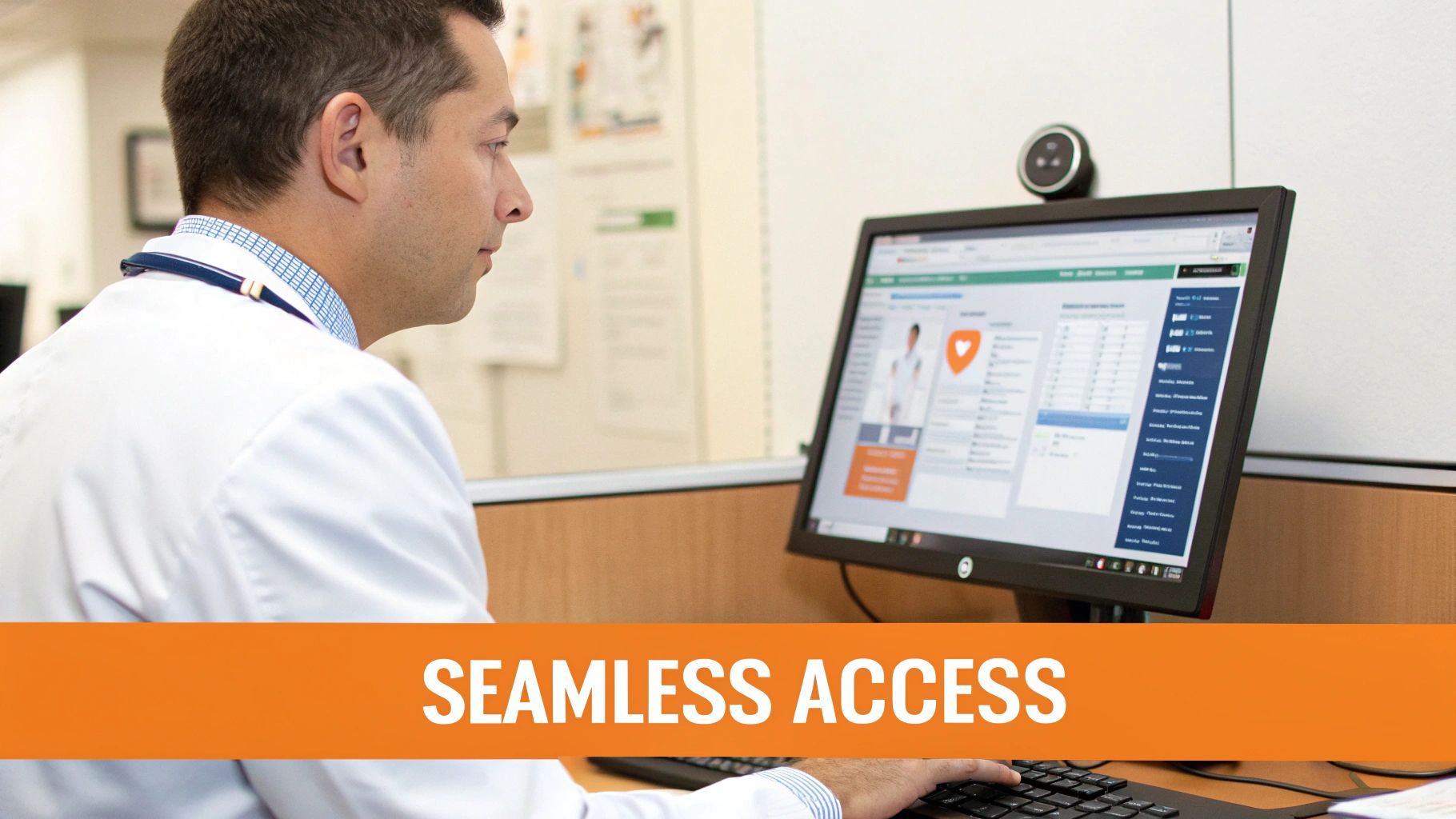
The true pinnacle of integration is embedding these summaries directly within your Electronic Medical Record (EMR) or Electronic Health Record (EHR) system. Picture this workflow: you enter a diagnosis code for "Type 2 Diabetes" into a patient's chart, and a link to the most current CKS on that topic automatically appears in a sidebar.
This isn't some far-off fantasy; it's the future of evidence-based care. Direct EMR integration kills the need to switch screens or contexts. The guidance you need shows up based on the patient data you're already working with.
This kind of context-sensitive support transforms a CKS from a passive document into an active clinical partner.
Actionable Steps for Deeper Integration
Whether you have full EMR integration or are just getting started, you can take these practical steps today to weave CKS into your daily rhythm:
Team Huddles: Spend five minutes in your morning huddle reviewing the CKS for a complex case scheduled that day. For example, "Okay team, we have a patient with resistant hypertension coming in at 10 AM. Let's quickly review the CKS algorithm for third-line agents." This gets everyone aligned.
Template Customisation: Many EMRs let you create custom note templates. For common conditions like asthma or COPD, add a field with a direct link to a key CKS, prompting you to review it during documentation.
Mobile Access: Bookmark your chosen CKS portals on your phone's home screen. This makes it easy to quickly pull up a dosing guide or check for interactions during patient rounds, right from your pocket.
The ultimate goal is to make accessing evidence-based care the easiest and most efficient option. When the right information is presented at the right time, following best practices becomes the path of least resistance.
At Orange Neurosciences, we’re committed to bridging the gap between clinical information and decisive action. Our platforms are designed to embed crucial data and decision support tools directly into your existing systems, making evidence-based practice feel like a natural extension of your work. To see firsthand how our approach can fit into your practice, learn more about how we work with clinicians and educators. We’re focused on creating solutions that remove guesswork and put reliable data at your fingertips, turning powerful resources like clinical knowledge summaries into an everyday reality.
Your Go-To Sources for Canadian Clinical Summaries
Okay, you see the value. Now, where do you find reliable, Canadian-focused clinical knowledge summaries? This curated list is your starting toolkit. We'll look at the unique strengths of each source, so you can quickly find the right guidance for your practice.
National and Provincial Health Authorities
Government-led sources are your bedrock for clinical guidance. They are fantastic for the big picture, especially public health priorities and national health data.
A perfect example is the peer-reviewed work from Statistics Canada’s Health Analysis and Modelling Division. Their Health Reports analyze national surveys to create critical summaries. For instance, a 2022 report using data from the Canadian Survey on Disability (CSD) showed that 27% of Canadians aged 15 and over (8 million people) have disabilities that impact their daily lives. For any clinician managing chronic conditions, that summary is pure gold. You can find more health data shaping Canadian practice directly from the source.
Leading Professional Associations and Societies
This is where you find specialized, practical guidance. Many of Canada's top medical and therapeutic professional bodies curate their own libraries of clinical summaries built by specialists, for specialists.
Here are a few actionable resources to bookmark:
The College of Family Physicians of Canada (CFPC): Their tools are tailored specifically for the realities of primary care, covering the wide range of conditions family doctors see every day.
The Canadian Cardiovascular Society (CCS): This is your go-to for in-depth guidelines and handy pocket guides on everything from atrial fibrillation to dyslipidemia.
Canadian Paediatric Society (CPS): Through their Caring for Kids resources, they provide a wealth of evidence-based information on child and youth health.
What makes these summaries so powerful is that they’re created by clinicians who live and breathe this stuff. They know the practical challenges and have already done the work of translating broad evidence into focused, actionable steps. Allied health professionals have their own indispensable resources, too. We actually take a closer look at this in our detailed guide on occupational therapy in Canada.
Consider these sources your bookmarkable toolkit. The right summary not only informs a single decision but also helps standardize care, improve patient outcomes, and align your practice with national quality benchmarks.
At Orange Neurosciences, our mission is to help you close the loop between finding this knowledge and applying it. Our platform gives you the objective cognitive data you need to act on this evidence with real confidence.
Ready to see how our tools can support your evidence-based practice? Explore our solutions on our website or email our team today to learn how we can help you make data-driven decisions faster.
Quick Answers to Common CKS Questions
Let's dive into some questions that often come up when practitioners first start using clinical knowledge summaries. Think of this as a quick FAQ to help you feel confident putting these tools to work.
How Often Are Summaries Updated?
This is a critical question—timeliness is everything. Reputable CKS sources have a strict and regular review schedule, typically reviewing and refreshing content every one to three years. However, if a major clinical trial is published that changes practice, updates happen much faster. For example, when a new medication is approved or a landmark study on a common condition is released, you can expect an "out-of-cycle" update. It's a living resource, constantly monitored to ensure the guidance you’re getting is current.
Do They Replace Clinical Judgment?
No, absolutely not. A CKS is a powerful decision-support tool, not a substitute for your clinical reasoning.
A clinical knowledge summary provides the evidence, but you, the clinician, must apply that evidence to the unique context of your individual patient's history, values, and circumstances.
Think of it as having a world-class consultant on call. A summary might recommend a specific first-line medication for hypertension, but your knowledge of a patient’s comorbidities (like chronic kidney disease) or past adverse reactions is what will ultimately steer your final decision. The summary informs your judgment; it never overrides it.
Are They Only for General Practice?
While many foundational summaries are designed with primary care in mind, the library of specialty-specific CKS is massive and growing. You'll find incredibly detailed summaries and guidelines across a huge range of medical fields, including:
Cardiology
Oncology
Pediatrics
Neurology
Mental health
The resources we shared earlier will point you toward top-tier sources that cover both general medicine and highly specialized fields. There’s a CKS to support nearly every practitioner.
At Orange Neurosciences, our mission is to empower you to act on this evidence with total confidence. Our AI-powered platform provides the objective cognitive data you need to support your clinical judgment, making it simpler to build precise, effective care plans. See how our tools can fit into your practice by visiting https://orangeneurosciences.ca.
Orange Neurosciences' Cognitive Skills Assessments (CSA) are intended as an aid for assessing the cognitive well-being of an individual. In a clinical setting, the CSA results (when interpreted by a qualified healthcare provider) may be used as an aid in determining whether further cognitive evaluation is needed. Orange Neurosciences' brain training programs are designed to promote and encourage overall cognitive health. Orange Neurosciences does not offer any medical diagnosis or treatment of any medical disease or condition. Orange Neurosciences products may also be used for research purposes for any range of cognition-related assessments. If used for research purposes, all use of the product must comply with the appropriate human subjects' procedures as they exist within the researcher's institution and will be the researcher's responsibility. All such human subject protections shall be under the provisions of all applicable sections of the Code of Federal Regulations.


© 2026 by Orange Neurosciences Corporation