What Rote Learning Means and When It Works

Repetition isn't the opposite of understanding. The more useful question is what gets repeated, when it gets repeated, and what the learner does with it afterward. A child may memorise multiplication facts and still need to understand multiplication. A multilingual student may recall a definition accurately while struggling to explain it in the language of instruction. A musician may repeat a scale until the fingers move smoothly, then use that fluency to interpret a piece expressively.
That's what rote learning means in practice: a tool for making information easier to retrieve. It can support learning, but it can't carry every learning goal on its own. The strongest approach combines purposeful memorisation with explanation, application, language access, and checks for transfer.
What Rote Learning Means in Plain Language
Rote learning is memorisation through repeated rehearsal. A learner encounters the same fact, word, sequence, or procedure again and again until recall becomes fast and increasingly automatic. The method focuses on storing and retrieving information, rather than beginning with a full explanation of how the information fits into a wider conceptual system.
Think about learning a phone number. At first, you look at the digits. Then you repeat them aloud, group them mentally, and try to recall them without looking. After enough deliberate practice, the number comes to mind when you need it. Singing the alphabet, reciting a favourite rhyme, or remembering a familiar chorus uses a similar memory process.
The act of memorising isn't automatically good or bad teaching. It's value-neutral. Its usefulness depends on the material, the learner's prior knowledge, the timing of practice, and the task that follows. Memorising a letter sequence can help a beginning reader recognise words. Memorising a passage in a language the learner barely understands may produce accurate sounds without much comprehension.
A useful distinction is between the cognitive act and the instructional design. Memorisation is what the learner does internally. Rote instruction is a broader teaching method that may include modelling, repetition, correction, and testing. You can use repetition inside a rich lesson, just as you can use it in a narrow drill.
Practical rule: Repeat the building block, then give the learner a reason to use it.
For example, a teacher might practise high-frequency words with children, then place those words in a short story. Resources on how to teach sight words effectively can help educators connect quick word recognition with reading activity rather than treating word practice as an isolated endpoint. Understanding how cognitive function supports attention, memory, and processing can also help adults choose a realistic practice demand.
Everyday Examples of Rote Learning in Action
At the kitchen table, a child says, “six times four is twenty-four” several times. The stored knowledge is a multiplication fact. The repetition cycle might involve reading a fact, covering the answer, recalling it, and checking the response. With practice, the child no longer counts groups or reconstructs the calculation each time. That speed matters because it leaves more mental space for a multi-step problem.
A spelling list follows the same pattern, although the target is different. A learner sees a word, says it, writes it, checks the letters, and tries again later. The memory trace includes the word's letter sequence and sound pattern. Repetition helps, but spelling becomes more useful when the learner also reads the word in sentences and notices related words.
Vocabulary flashcards offer another familiar example. A student reviews a term on one side and its meaning on the other before a language exam. The task stores a translation, definition, or pronunciation. If the learner only recognises the answer when it appears on the card, recall may remain fragile. Asking the student to use the word in a sentence makes the stored item more flexible. That connection between memory and language development is explored in resources on language acquisition.
Rote learning outside the classroom
A music student plays the same scale repeatedly. At first, the student concentrates on finger placement and order. Later, the movement becomes more automatic, allowing attention to shift toward rhythm and expression.
A learner preparing for a driving test memorises traffic signs and their meanings. The safety value lies in quick recognition, but real driving also requires applying those meanings while observing traffic, judging distance, and responding to changing conditions.
These examples show why rote learning can be useful. Fluent recall of letters, facts, symbols, and procedures can reduce the amount of effort spent searching for basic information. Repetition falls short when the learner must solve a new problem, explain a principle, or apply knowledge in an unfamiliar setting. Recognising rote learning in everyday life helps teachers and families decide whether the learner needs more recall practice, more explanation, or both.
What Research Says About When Repetition Helps
Repetition is not the opposite of understanding. Research instead points to a more useful question: when should rehearsal occur, and what should accompany it? A Canadian education analysis describes the rote-learning versus discovery-learning split as false, arguing that procedural and conceptual approaches work together in EdCan Network's analysis of the so-called math wars. A sensible sequence is to establish meaning, rehearse the parts learners must retrieve quickly, and then apply them in varied situations.
Repetition helps most when the target is stable and foundational. Letter recognition, basic arithmetic facts, spelling patterns, and phonological sequences become easier to access through fluent retrieval. The learner no longer has to search from scratch for each basic item, which can leave more working-memory capacity for the larger task. Automatic recall still needs meaning around it. A memorised symbol is useful only when the learner knows what it represents and when to use it.
Repetition can also strengthen links among ideas. Learning by association gives a fact more routes into memory, especially when practice connects it with examples, sounds, images, or related concepts.
Timing changes the result
Massed practice puts many repetitions close together. Answers may feel familiar by the end of the session, while later recall remains uncertain. Canadian research on study methods reported parallel gains in rote memorisation among learners who used spaced study (see the University of Waterloo-linked thesis in the Library and Archives Canada collection), which suggests that rehearsal timing matters, not only the total amount of repetition.
Spacing creates repeated chances to retrieve information after some forgetting. Retrieval practice adds another layer: the learner produces an answer before checking it, rather than repeatedly looking at the answer. A review of active learning methods linked flashcards, self-testing, retrieval practice, and concept mapping with stronger academic outcomes in the studies it examined (PubMed review).
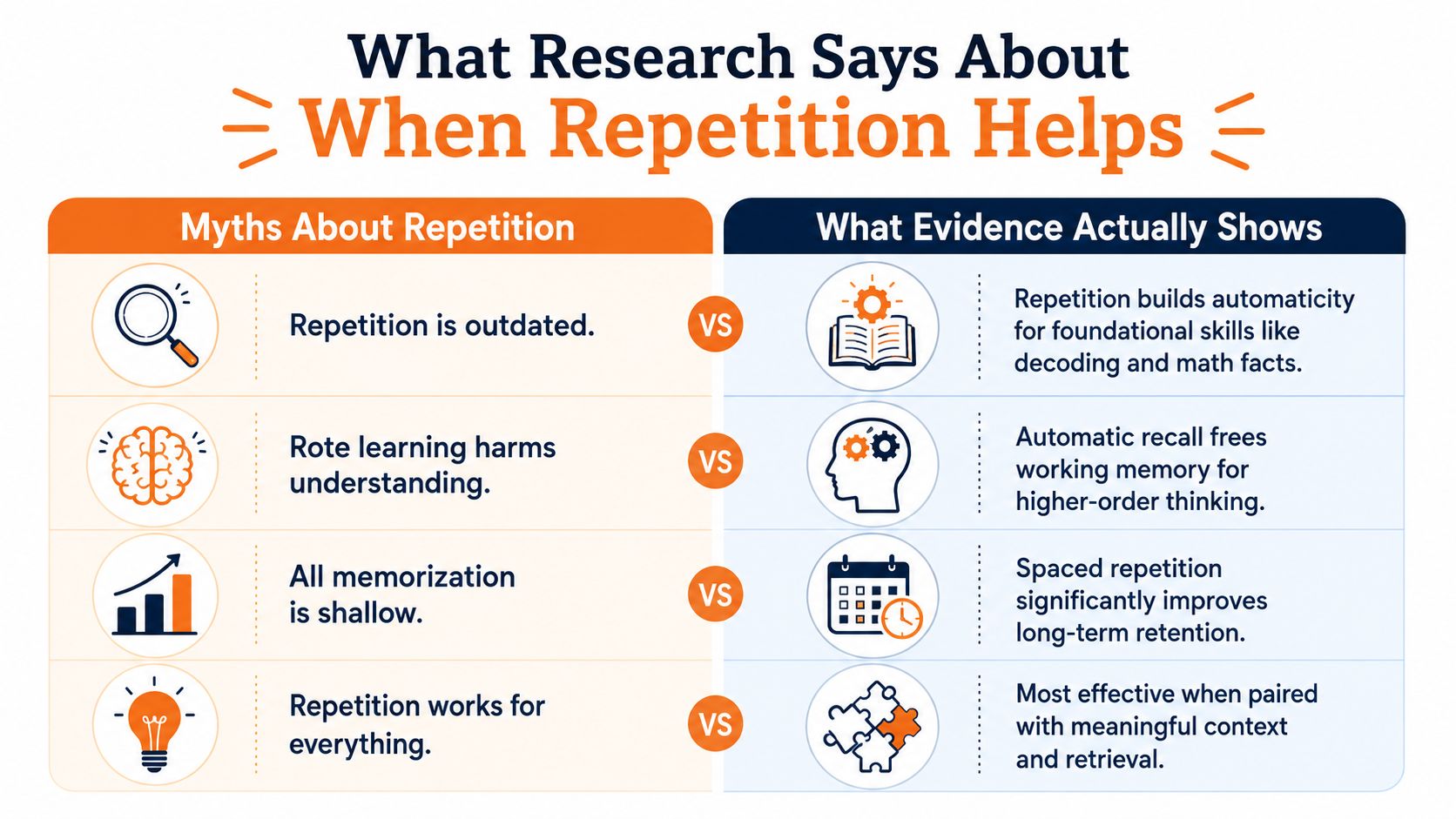
Recognition still differs from transfer. A learner may recognise a formula on a worksheet yet fail to choose it for a word problem. Repetition works better when learners first gain a meaningful foothold, practise retrieval across time, and encounter the knowledge in changing contexts. Families preparing learners for examinations can adapt GCSE spaced repetition techniques into a routine that supports recall without depending on one long cramming session.
Rote Learning and Meaningful Learning Compared
Rote learning aims to make information available through repeated rehearsal. Meaningful learning connects new information to prior knowledge, examples, explanations, and a conceptual structure. One asks, “Can the learner recall this?” The other asks, “Can the learner explain it, recognise when it applies, and use it?”
Consider multiplication. Recalling times tables is a rote task. Explaining multiplication as equal groups, choosing multiplication for a word problem, and checking whether an answer makes sense are meaningful or applied tasks. A learner needs both. Slow recall can consume attention during problem solving, but fast recall without conceptual understanding can leave the learner unsure what to do when the problem changes.
Dimension | Rote Learning | Meaningful Learning |
|---|---|---|
Primary goal | Fluent, automatic recall | Understanding, application, and transfer |
Typical task | Rehearsing times tables or vocabulary | Explaining a principle or solving a new problem |
During encoding | Repetition receives most attention | Connections and prior knowledge guide learning |
Strength | Makes stable facts easier to retrieve | Helps learners select and use knowledge |
Main limitation | May remain tied to the original wording | Takes more active explanation and application |
Best partner | Conceptual teaching and feedback | Fluency practice and retrieval |
Meaningful learning doesn't make memorisation unnecessary. A reader who understands a sound-letter relationship still benefits from repeated reading practice. A student who understands a mathematical principle still needs familiar formulas and facts available quickly. This relationship is part of how crystallized intelligence develops, as knowledge becomes stored and accessible for later use.
The order matters. Introduce the idea with concrete examples, check that the learner understands the language and relationships, then rehearse the stable elements. After that, ask the learner to use them in a different task. Rote learning and meaningful learning are better treated as complementary stages than as rival educational identities.
Practical Strategies to Make Rote Learning Stick
A good memory routine is short, active, and planned across time. It doesn't require endless worksheets. Start with one target, decide how the learner will retrieve it, and attach the fact to an explanation or use.
Build practice around four moves
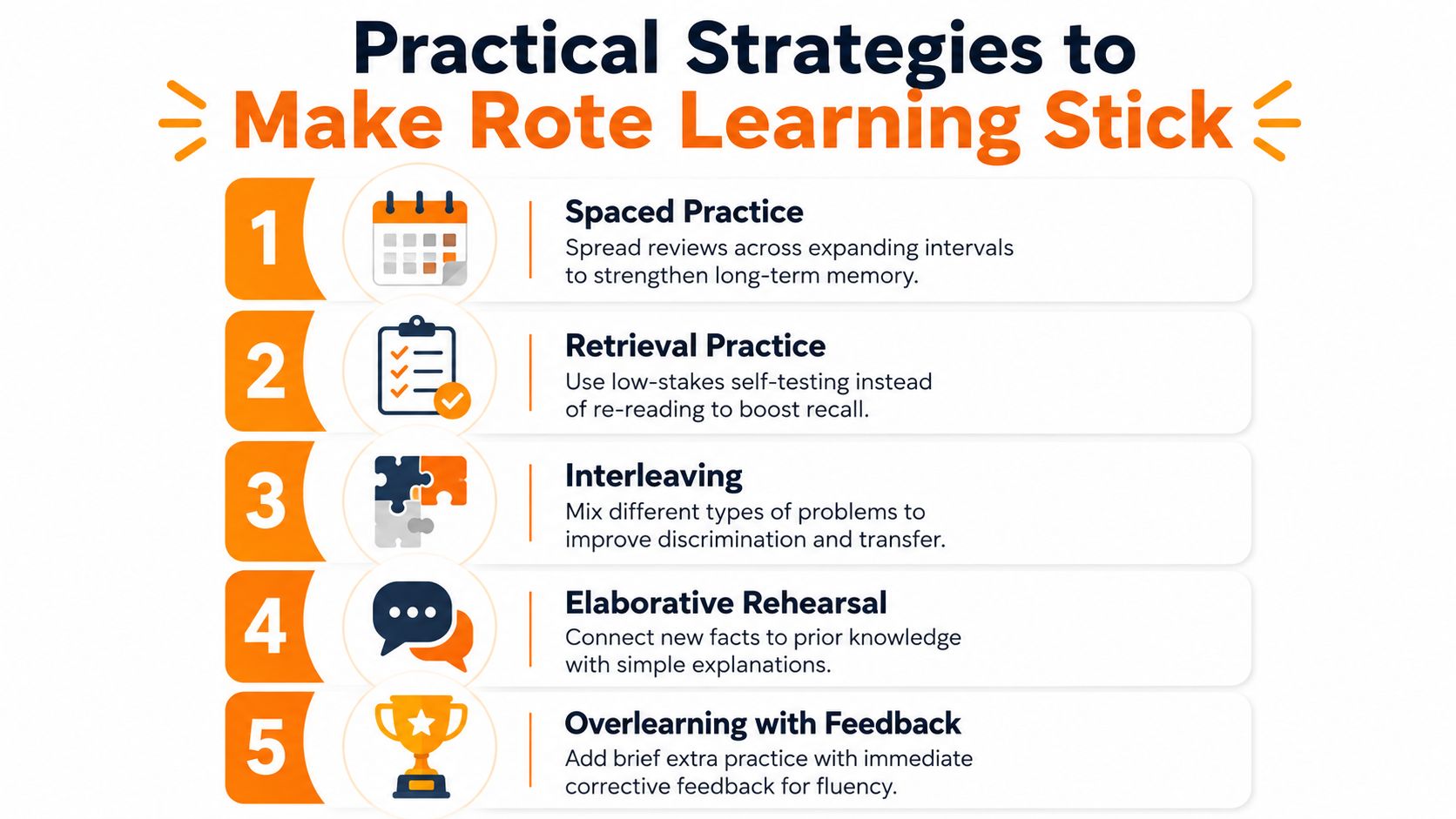
Space the reviews. Spread vocabulary reviews across several days instead of placing every repetition in one sitting. A teacher might introduce a small set of words, revisit them later in the week, and ask for recall again after a gap. The learner experiences some difficulty, which makes the later retrieval more informative.
Use retrieval, not rereading. Close the book and ask for the answer. A weekly multiplication quiz can be brief and low pressure. If a learner misses a fact, show the correct answer, ask for it again, and record the item for a later review. Rereading can create familiarity without proving that the learner can produce the knowledge.
Interleave related items. Mix different problem types rather than presenting one identical group at a time. A mathematics worksheet might combine addition, subtraction, multiplication, and division facts. The learner must identify which operation fits, which begins to connect recall with selection.
Add more than one representation. Pair spoken rehearsal with a visual, gesture, drawing, or movement. Children practising letter names might trace each letter while saying its sound and linking it to a simple image. Language learners can combine a spoken word, a picture, an action, and a sentence. Families seeking additional language-learning ideas may find ChatPal language tactics useful when adapting practice to real communication.
Give immediate feedback. Extra practice after an answer is accurate can help build fluency, but feedback must correct errors quickly. Don't let a learner repeat a wrong pronunciation or calculation until it feels familiar.
Avoid the common traps
Cramming compresses practice and can make performance look stronger than retention. Passive highlighting and copying answers also reduce the need to retrieve. Keep sessions manageable, use brief reviews, and stop when fatigue starts replacing attention. Guidance on working memory can help practitioners think about how much information a learner can handle at once.
Common Misconceptions and Equity Considerations
A strong rote score doesn't prove full understanding. A learner may recite a definition accurately because the wording has been rehearsed, yet struggle to explain it in a new context. Teachers should pair recall checks with application, explanation, or a worked example in the learner's own words.
The reverse assumption is just as risky. Weak recall doesn't automatically indicate weak ability. A multilingual learner may understand a concept but lack quick access to the vocabulary used in the assessment. In that situation, a low response can reflect language access rather than memory or reasoning. Canadian learning and citizenship-preparation resources describe supports such as linking old and new knowledge, using movement and drawing, and teaching information back to others, all of which can make memorisation a bridge toward comprehension (memory supports for citizenship preparation).
Check the assessment, not only the score
Language and communication conditions matter. California special education rules require assessments to be administered in a student's primary language or another mode of communication unless that isn't clearly feasible. When an interpreter is needed, the report must document that condition and possible limits on validity (California assessment regulation).
California guidance for dual-language learners also recommends using the child's native language and the form most likely to show what the child knows and can do. It describes a workflow that can include cross-cultural, non-discriminatory tools, a trained interpreter where needed, and documentation of score limitations (CalECSE assessment practices for dual-language learners).
A timed recall task, unfamiliar format, phonological demand, or language-of-instruction mismatch can conceal competence. For learners with dyslexia, ADHD, or other processing differences, working-memory load can also interfere with performance. Offer reasonable response time, consider oral responses when appropriate, and pair memorised tasks with applied checks. Rote learning should guide instruction, not become a verdict on the learner.
A Practitioner Checklist for Using Rote Learning Well
Rote work earns its place when the learner needs automatic recall of stable material, such as decoding patterns, formulas, safety facts, or vocabulary. It should sit inside a wider plan that introduces meaning, checks access to language, and tests whether the learner can use the knowledge beyond the original drill.
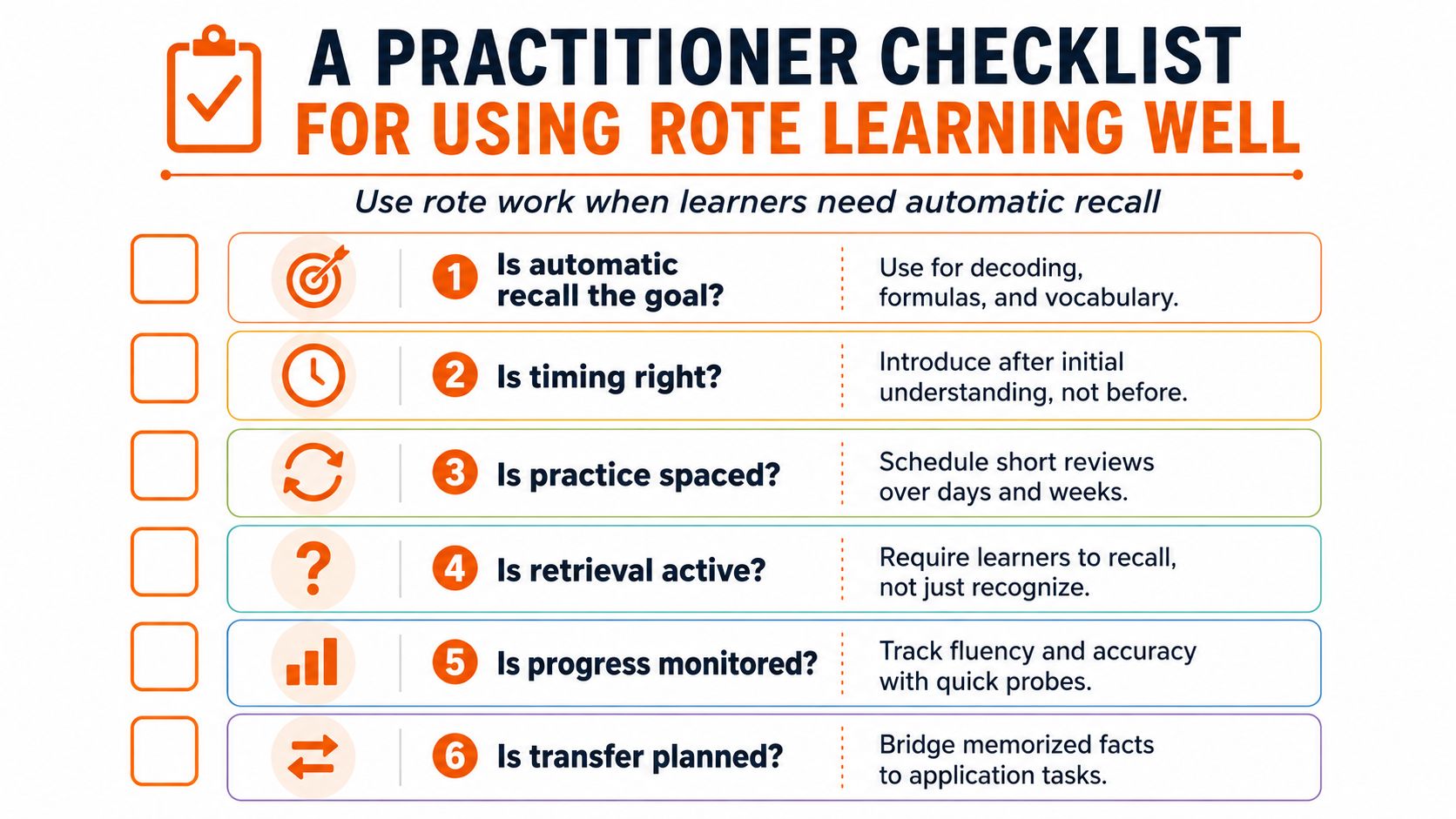
Ask these questions before assigning more repetition:
Is the content stable and procedural? Facts, symbols, sequences, and formulas are reasonable candidates. A complex judgement or open-ended explanation needs more than memorisation.
Is fluent recall the goal? If the learner must respond quickly and accurately, rehearsal may help. If the goal is reasoning, interpretation, or transfer, add application tasks.
Has the learner met the concept, not only the label? Show examples, use plain language, and ask the learner to explain the relationship before expecting durable recall.
Is practice spaced? Plan short reviews over days and weeks rather than one concentrated session.
Is retrieval active? Ask the learner to produce an answer, not merely recognise a highlighted one.
Will progress be monitored? Track accuracy, fluency, errors, and performance on an applied task.
Match the tool to the learning problem
Spaced practice: Review vocabulary on a planned rotation, then remove cards that are secure and revisit items that remain difficult.
Retrieval practice: Use a blank sheet for multiplication facts or ask a learner to explain a term without looking at the definition.
Interleaving: Mix word problems with different operations so the learner practises choosing a method.
Dual coding: Pair a spoken sound with a letter trace, image, or gesture.
Error correction: Give the accurate response immediately, explain the error briefly, and require another retrieval attempt later.
The final check is transfer. A child who memorises a decoding pattern should read it in unfamiliar words. A student who memorises a formula should decide when and how to use it. A learner studying vocabulary should use the words in a conversation, sentence, or written response.
For school and clinical teams, Orange Neurosciences offers cognitive skills assessments covering areas such as attention, memory, executive function, processing speed, perception, eye-hand coordination, and reading fluency, alongside adaptive digital exercises and progress tracking. Its tools can sit beside school plans by helping professionals establish baselines, monitor retention and fluency, and decide when conceptual scaffolding is more appropriate than additional drills. The platform supports multilingual delivery, but its assessments and training tools are aids for planning and monitoring, not medical diagnoses or treatments.
If you're deciding whether a learner needs more repetition or a different kind of support, visit Orange Neurosciences to explore cognitive assessment, adaptive digital therapy, and progress-monitoring tools for educational and clinical planning. Use the available information about attention, memory, processing speed, and reading fluency to build practice that strengthens recall while keeping understanding and equitable assessment in view.

Orange Neurosciences' Cognitive Skills Assessments (CSA) are intended as an aid for assessing the cognitive well-being of an individual. In a clinical setting, the CSA results (when interpreted by a qualified healthcare provider) may be used as an aid in determining whether further cognitive evaluation is needed. Orange Neurosciences' brain training programs are designed to promote and encourage overall cognitive health. Orange Neurosciences does not offer any medical diagnosis or treatment of any medical disease or condition. Orange Neurosciences products may also be used for research purposes for any range of cognition-related assessments. If used for research purposes, all use of the product must comply with the appropriate human subjects' procedures as they exist within the researcher's institution and will be the researcher's responsibility. All such human subject protections shall be under the provisions of all applicable sections of the Code of Federal Regulations.


© 2026 by Orange Neurosciences Corporation