What Is Crystallized Intelligence? Complete Guide 2026

Crystallized intelligence is the knowledge, vocabulary, and learned skills a person builds through education, experience, and cultural exposure. It usually keeps growing into later adulthood, even as fluid intelligence tends to change differently over the lifespan.
It is often said that intelligence peaks early and then declines. That advice is too simple, and it can lead families, teachers, and even clinicians to miss what a person does well. Crystallized intelligence is the part of cognition that lets someone use stored knowledge in real situations, from understanding a chart to explaining a concept they've seen many times before. It matters because what is crystallized intelligence is not just a school term, it's a practical way to understand how people learn, remember, and function in the world.
In a clinical setting, the distinction matters because a strong vocabulary score does not tell the whole story. In a classroom, it matters because a student may know far more than they can show on a novel task. In a family conversation, it matters because older adults often keep building knowledge even when speed or novelty-based reasoning becomes harder. If you want a broader framework for how intelligence is often divided, see the triarchic theory of intelligence.
Rethinking What Intelligence Really Means
The popular image of intelligence still leans toward speed, pattern spotting, and being quick with puzzles. That picture leaves out a major part of human ability. Knowledge is a cognitive strength in its own right. Crystallized intelligence refers to the skills people build over time, including vocabulary, general information, and learned procedures.
Why knowledge counts as intelligence
A child who knows the rules of a word game, a teacher who can explain a concept clearly, and an elder who can recall the right term in conversation are all drawing on stored knowledge. That stored knowledge is part of intelligent functioning, not a lesser substitute for it. One practical reason this matters is that people often judge ability by how fast someone responds, even though strong knowledge can support careful, accurate thinking.
The broader lifespan literature shows that crystallized abilities are often preserved better than fluid ability and may keep strengthening into later adulthood. A recent peer-reviewed review also describes crystallized intelligence as culturally valued knowledge built through education, experience, and acculturation, which helps explain why it behaves more like a durable knowledge store than a passing mental state. That matters in diverse settings, including Canada, where language exposure, schooling, migration history, and cultural norms can shape what someone knows and how they show it.
A person may know a great deal and still look weak on a task that depends on unfamiliar wording, an untested format, or assumptions from a different culture. That is one reason clinicians and educators should be careful about treating a single score as the whole picture. A strong vocabulary in one language, for example, does not always mean the same level of knowledge in another, and a person who has recently acculturated may carry rich knowledge that does not align neatly with the dominant test context.
Practical rule: When familiar tasks are handled well but new problems remain hard, the profile often reflects stored knowledge on one side and novel reasoning on the other.
The point is not that knowledge replaces reasoning. The point is that real-world thinking depends on both. That is why the distinction matters for teachers deciding what kind of support a learner needs, for clinicians interpreting test profiles, and for families trying to understand a parent's or child's strengths. A broader framework for how intelligence is divided is explained in this triarchic theory of intelligence overview. For a simple guide to how a child's verbal skills are often assessed, the Wechsler Intelligence Scale for Children guide is a useful companion.
Crystallized Intelligence Versus Fluid Intelligence
People often use “intelligence” as if it were one thing. A clearer picture comes from comparing crystallized intelligence with fluid intelligence, because they serve different roles in daily life and in assessment.
Two abilities, two jobs
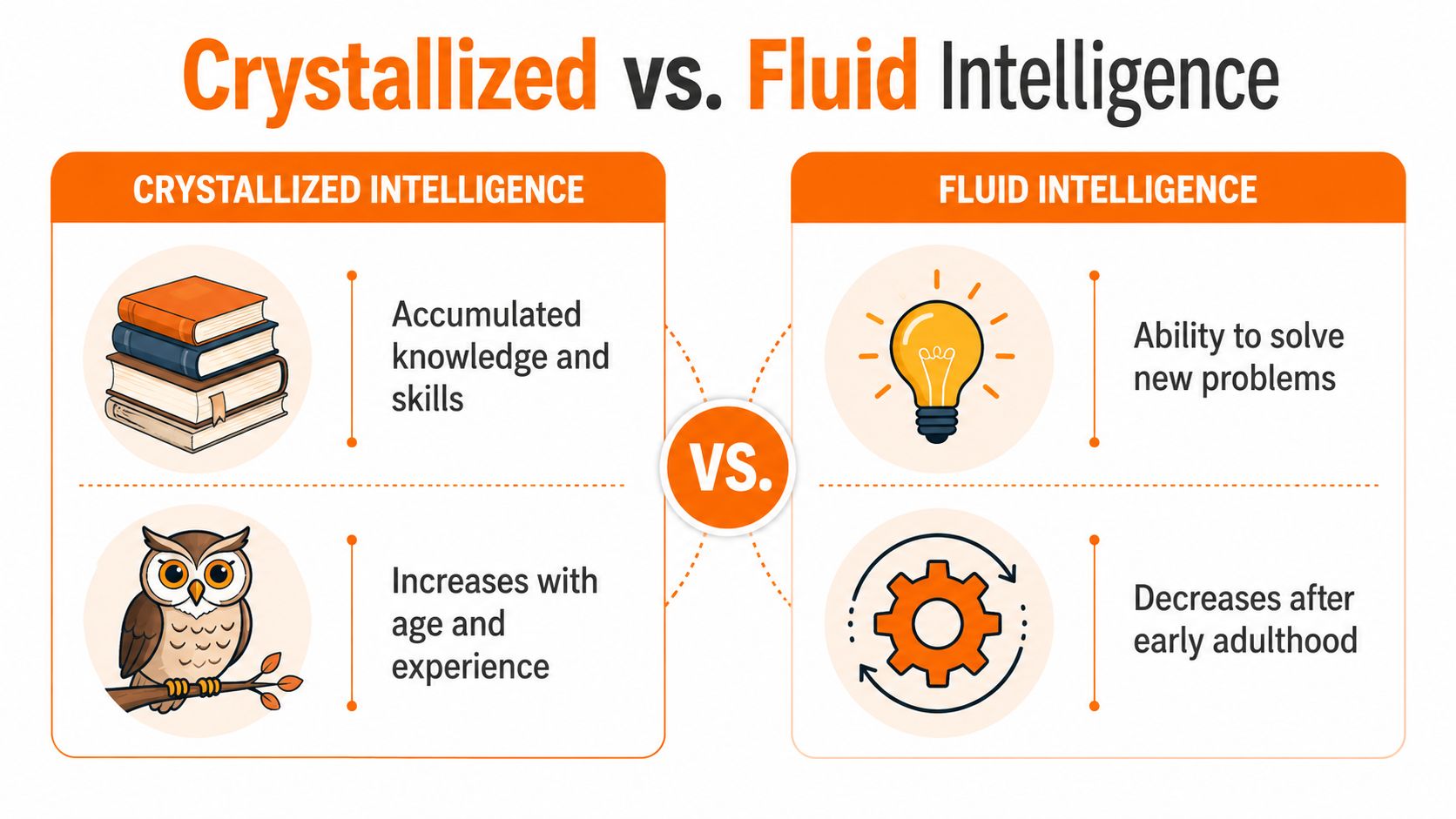
Fluid intelligence supports new problem-solving, pattern detection, and reasoning without depending on prior knowledge. Crystallized intelligence uses what's already been learned, including vocabulary, facts, and practiced rules. A child working out a brand-new logic puzzle is relying more on fluid reasoning. A retiree explaining the historical context of a public event is relying more on crystallized knowledge.
Here's a compact comparison.
Attribute | Crystallized Intelligence | Fluid Intelligence |
|---|---|---|
Definition | Accumulated knowledge, vocabulary, and skills learned through education, experience, and culture | Reasoning through new problems without depending on prior knowledge |
Everyday example | Defining a term, remembering a capital city, interpreting a familiar chart | Solving a new puzzle, working through an unfamiliar pattern, adapting to a novel task |
Development | Usually grows with age and learning | Tends to be stronger earlier in life and changes differently over adulthood |
What it reflects | Learned information and applied expertise | Novel problem-solving and pattern detection |
Common assessment style | Vocabulary, general knowledge, verbal tasks | Reasoning tasks and novel problem-solving measures |
A simple way to separate them is this, fluid intelligence asks, “What is the rule here?” Crystallized intelligence asks, “What have I already learned that applies?” Both matter in school, work, and healthcare, but they show up in different ways.
Daily life makes the contrast easy to see. A student trying to decode a brand-new abstract puzzle is using fluid reasoning. That same student explaining a historical event from a textbook is using crystallized knowledge. An older adult may be slower on a timed novelty task and still do very well when the question draws on long experience, professional expertise, or well-rehearsed language.
Culture and language shape that second ability more than many explanations admit. Vocabulary, examples, and background knowledge are built through schooling, family life, community norms, and acculturation, so a person can have strong crystallized intelligence in one language or setting and show less of it in another. That matters in Canada, where assessment should reflect the person's linguistic and cultural history rather than assume one shared knowledge base.
For readers who want to see how memory-rich activities can use familiar material in later life, the reminiscence therapy for elderly guide is a practical resource. It shows how past experiences can be brought into conversation and used in meaningful ways, which fits closely with crystallized intelligence.
For a broader contrast between cognitive profiles, the what is cognitive decline guide can help readers separate slower processing from loss of knowledge. For a simple guide to how verbal skills are often assessed in children, the Wechsler Intelligence Scale for Children guide is a useful companion.
How Crystallized Intelligence Changes Across the Lifespan
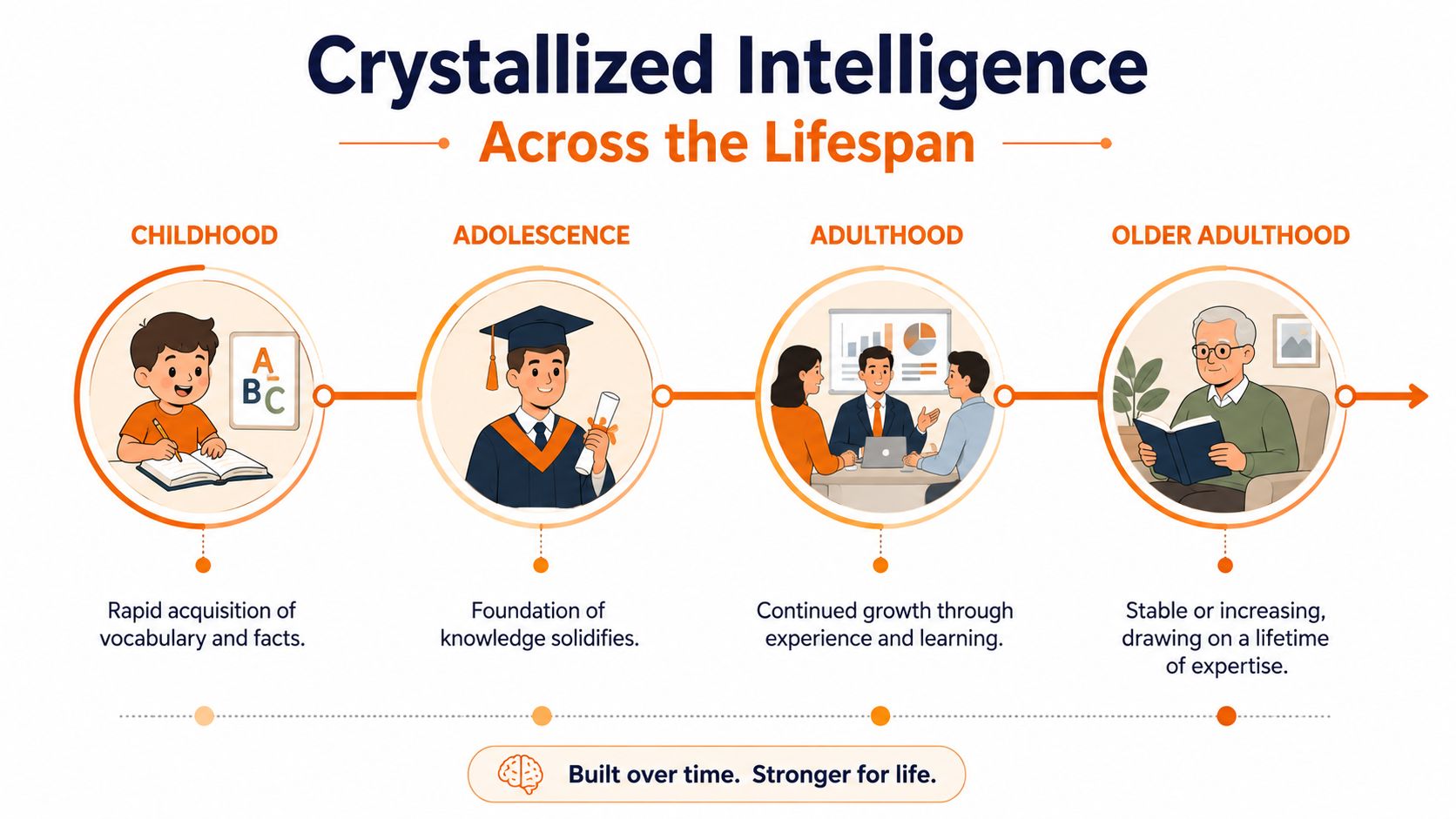
Crystallized intelligence usually does not follow the sharp rise-and-fall pattern people expect from speed-based abilities. It grows as education, language, and experience accumulate, and adult cognitive development research shows average gains can continue well into later adulthood. That helps explain why many older adults stay highly effective in familiar, knowledge-rich settings, even when other kinds of thinking become slower over time. The same pattern is also easier to understand if you picture knowledge as a well-stocked library, each new year adds more books, indexes, and cross-references that can still be used later.
Stability is part of the story
A recent peer-reviewed review summarized a meta-analysis showing that crystallized intelligence was highly stable in 14-year-olds. After reliability was taken into account, the stability coefficient was 0.92 over 1 year, 0.91 over 2 years, and 0.88 over 5 years. Those figures matter in practice because vocabulary and general knowledge are not flimsy traits that appear and disappear from one testing session to the next. They behave more like durable knowledge stores that can be sampled reliably.
That durability is one reason clinicians pay attention to verbal measures. If a young person performs consistently on vocabulary or learned knowledge tasks, those scores can help anchor interpretation of other test results. The profile may still be complex, because learning history, schooling quality, and language exposure all shape performance. Even so, crystallized skills remain useful markers when assessing prior learning, educational exposure, or long-standing strengths.
Development is not a straight line
This lifespan pattern also corrects a common misunderstanding about ageing. People often assume that cognitive ageing means universal decline, but change is uneven. Crystallized abilities generally strengthen through adulthood, while fluid abilities begin to decline earlier in adult life. The two curves do different work, so a person can lose speed yet keep, or even expand, their store of knowledge.
Historical test performance shows a similar pattern. A meta-analysis of the Flynn effect estimated annual gains for crystallized IQ of 0.21 points per year from 1912 to 2011, with faster gains earlier in the century, including 0.26 points annually before 1937, 0.04 points annually from 1937 to 1948, and 0.36 points annually until 1962. The historical interpretation is complex, but the broad message is clear. Knowledge-based ability can change over time, both within individuals and across generations, because schooling, language use, and cultural exposure keep shaping what people know and how they use it.
Age-related cognitive change is easier to interpret when you separate slower processing from loss of knowledge, which is why the what is cognitive decline guide can be helpful for readers comparing normal ageing with patterns that need closer review.
Clinical takeaway: A strong vocabulary score in later life should not be dismissed as “just habit”. It often reflects a real cognitive strength built across decades.
Recognizing Crystallized Intelligence in Everyday Life
The easiest way to spot crystallized intelligence is to watch what happens when a person is working with familiar information. A student who can read a new science chapter and connect it to earlier lessons is using stored knowledge to make sense of fresh material. A nurse who follows a familiar protocol during a complex shift is doing the same thing, just in a higher-stakes setting.

What it looks like in real settings
In school, crystallized intelligence shows up when a child uses learned terminology to understand a textbook chapter, or when they recall a historical fact without having to invent a solution from scratch. In the workplace, it appears when someone relies on professional expertise, established routines, or specialised language to complete a task efficiently. In healthcare, it shows up when staff use familiar procedures, clinical vocabulary, and prior training to make sound decisions.
Crystallized intelligence is not passive memory. Sources describe it as the ability to use acquired knowledge in the present, including established habits and practiced procedures (Study.com lesson). That means it supports action, not just recall. A person with strong crystallized ability may not be the fastest problem-solver in an unfamiliar situation, but they can often perform very well when the task draws on knowledge they already own.
Here are three simple examples:
A student: Uses background knowledge to understand a new chapter on cell biology rather than memorising it word for word.
A nurse: Applies years of training and protocol knowledge during a familiar patient interaction.
A retiree: Uses broad vocabulary and world knowledge to mentor younger colleagues or explain a concept clearly.
For readers who work with learners or older adults, a good question is, “Is this person struggling because the task is new, or because the knowledge base is thin?” That distinction changes the support plan.
The architecture-student image above is a good reminder that crystallized intelligence often looks like careful, informed work. The person is not improvising from zero. They're using accumulated knowledge to produce something accurate and useful.
For a related view of how cognition supports day-to-day functioning, the what is cognitive function guide helps connect knowledge skills to broader mental performance.
The Cultural and Linguistic Dimensions of Crystallized Intelligence
Crystallized intelligence is shaped by acculturation, education, language exposure, and cultural context. In Canada, that point matters because clinicians often assess bilingual, multilingual, immigrant, and Indigenous patients whose knowledge has been built in different languages and different social settings. A vocabulary score can reflect real knowledge, yet it can also reflect language opportunity, schooling history, and familiarity with the testing culture.

Why the same score can mean different things
Research definitions of crystallized intelligence describe it as accumulated knowledge gained through experience and culture, including domain-specific knowledge, expertise, and domain-general decision rules. That broad definition is helpful, but it also creates a fairness problem. Two people can arrive at the same score for very different reasons. One may have had far more exposure to the language of the test, while another may hold equally strong knowledge that is expressed in a different linguistic register, in a different community, or in a different school system.
Many simple explainers miss that distinction. They treat crystallized intelligence as if it were culture-free. It is not. In a Canadian assessment context, vocabulary tests and factual knowledge measures need careful interpretation when language exposure differs from the language used in testing. A person may understand the concept clearly and still not know the exact word the test expects.
A second nuance matters just as much. Higher crystallized intelligence is not always a universal advantage. It can support performance on familiar tasks and help with decision-making in known domains, yet it can also conceal weaknesses in novel problem-solving if clinicians or families focus too heavily on school knowledge and verbal fluency. The full cognitive profile still matters.
Assessment caution: A strong verbal score can reflect excellent knowledge, uneven language access, or both. Context decides which interpretation fits.
For clinicians, that means asking about the language of schooling, migration history, and everyday language use before drawing conclusions. For educators, it means not confusing English proficiency with general learning ability. For families, it means recognising that a child or parent may be capable in ways that do not show up on a narrow vocabulary test.
The language of assessment guide is a useful reference when testing needs to stay fair across different language backgrounds.
Using Crystallized Intelligence in Assessment and Intervention Planning
Crystallized intelligence is usually measured with vocabulary tests, general information subtests, and semantic retrieval tasks. Those measures do more than label a person as “strong” or “weak”. They help clinicians infer how much stored knowledge a person can access, how consistent that knowledge is, and how it fits with other cognitive abilities.

How to read the results
Vocabulary scores tell you about word knowledge and language exposure. General knowledge items show how broad a person's factual base is. Reading comprehension tasks reveal whether learned language can be used to make meaning from text. Verbal analogies show whether someone can recognise relationships between concepts using prior knowledge.
Those results become more useful when they're compared with fluid reasoning and other domains. A person with strong crystallized scores but weak fluid performance may function well in familiar settings but struggle when routines change. A person with the reverse pattern may be quick with new problems but need more support for school-based or work-based knowledge tasks.
A simple workflow helps:
Check the language history first. If the person is bilingual or multilingual, interpret verbal scores in context.
Compare knowledge-based and novelty-based tasks. Large differences between them often explain day-to-day performance better than a single score.
Use strengths to guide support. Familiar knowledge can be a bridge into new learning, especially in school and rehabilitation.
Document what the score means for the person's environment. A score matters more when it changes teaching, accommodations, or care planning.
That approach also helps in older adults, where preserved knowledge can support everyday decision-making and serve as a practical indicator of cognitive reserve. It's especially useful when the question is not “Is this person ageing?” but “What can they still do reliably, and where do they need support?”
If you're comparing assessment options, the find your ideal therapist with a quiz resource may help families think about fit and next steps in a structured way. For digital cognitive profiling, Orange Neurosciences offers validated assessment tools that generate objective profiles across domains, including knowledge-based abilities, which can be used alongside broader clinical judgement.
Key Takeaways and Next Steps for Cognitive Health
Crystallized intelligence is the knowledge-based side of cognition. It grows through education, lived experience, vocabulary, and culture, and it often stays strong or even improves across much of adulthood. Fluid intelligence works differently, so the two should not be treated as the same ability.
For assessment, the central question is not just how high a score is. It is what that score means in light of language history, schooling, age, and the demands of everyday life. That point matters especially in Canada, where cultural and linguistic diversity can make a single verbal score less straightforward than it first appears.
A good report invites careful interpretation. If you are reviewing one, look for whether verbal strengths are matched by reasoning strengths, whether language exposure may be raising or lowering the result, and whether the profile suggests strengths with familiar tasks, difficulty with novel tasks, or both. These patterns are often more useful than a single number because they connect test performance to real-world functioning.
Culture and acculturation shape what “knowledge” looks like. A person may show strong crystallized intelligence in one language, community, or school tradition, yet appear weaker if the test does not reflect that background. That is why interpretation should stay close to the person's history, not only the score on the page.
For a broader backdrop on brain adaptability, the neuroplasticity article is a useful companion read because it helps separate learned skill from changeable performance.
If you are thinking about next steps, the practical goal is to use crystallized strengths well. They can support teaching, workplace coaching, rehabilitation planning, and family conversations about what a person can do reliably right now. For a structured way to compare cognitive domains, Orange Neurosciences provides AI-powered cognitive assessment tools that can help clinicians, educators, and families profile knowledge-based ability alongside other areas of cognition. For readers who want to explore how these strengths fit into a wider cognitive picture, visit Orange Neurosciences and consider whether its assessment workflow fits your practice or your family's next step.
Orange Neurosciences' Cognitive Skills Assessments (CSA) are intended as an aid for assessing the cognitive well-being of an individual. In a clinical setting, the CSA results (when interpreted by a qualified healthcare provider) may be used as an aid in determining whether further cognitive evaluation is needed. Orange Neurosciences' brain training programs are designed to promote and encourage overall cognitive health. Orange Neurosciences does not offer any medical diagnosis or treatment of any medical disease or condition. Orange Neurosciences products may also be used for research purposes for any range of cognition-related assessments. If used for research purposes, all use of the product must comply with the appropriate human subjects' procedures as they exist within the researcher's institution and will be the researcher's responsibility. All such human subject protections shall be under the provisions of all applicable sections of the Code of Federal Regulations.


© 2026 by Orange Neurosciences Corporation