Learning by Association: Unlock Your Brain's Potential
Apr 8, 2026
A child taps a tablet and quickly learns that one sound means “good job” while another means “try again.” A family dog hears the cupboard open and runs to the kitchen before anyone has touched the food bowl. A patient in rehab begins to anticipate the next task after seeing the same visual cue several times.
None of this feels like “theory” when you are living it. It feels like daily life.
That is why learning by association matters so much. It is one of the brain’s most practical working tools. The brain links events, sensations, actions, and outcomes, then uses those links to predict what comes next. For clinicians, educators, and informed parents, that simple process helps explain attention, memory, behaviour, reading, habit formation, and recovery after injury.
When those links are clear, learning becomes more efficient. When they are weak, inconsistent, or misleading, people often look inattentive, forgetful, slow to respond, or easily overwhelmed. The good news is that associative learning is not just something we describe. We can observe it, measure it, and often strengthen it with thoughtful support.
The Invisible Threads Connecting Our World
A young child starts a new game. At first, the rules seem unclear. Then the child notices a pattern. A particular tone comes just before a reward appears on screen. After a few rounds, the child hears the tone and prepares before the reward arrives.
That small moment captures learning by association in action. The brain notices that two events tend to occur together and begins to connect them. Over time, that connection shapes expectation, attention, and behaviour.

This process is everywhere. A student links a letter pattern to a speech sound. An older adult links a pill organiser’s colour to the right time of day. A teacher notices that a visual cue helps a child transition between activities with less stress. These are not isolated tricks. They are examples of the brain building meaning through repeated connection.
Why people often misunderstand it
Many people hear “association” and think of shallow memorisation. That is too narrow. Learning by association is not only about memorising pairs. It is about building a functional network of links that supports cognitive function, including attention, working memory, language, and planning. A helpful overview of that broader cognitive picture appears in this guide on https://www.orangeneurosciences.ca/guide/what-is-cognitive-function.
Why it matters in practice
For professionals, associative learning offers a practical lens.
In assessment: it helps explain why a person succeeds with one cue but not another.
In intervention: it helps us choose better prompts, rewards, and task structures.
In everyday support: it helps families and teachers create routines the brain can predict.
Clinical takeaway: When a person “suddenly gets it,” that change often rests on associations becoming clearer, stronger, and more reliable.
How the Brain Builds Its Web of Knowledge
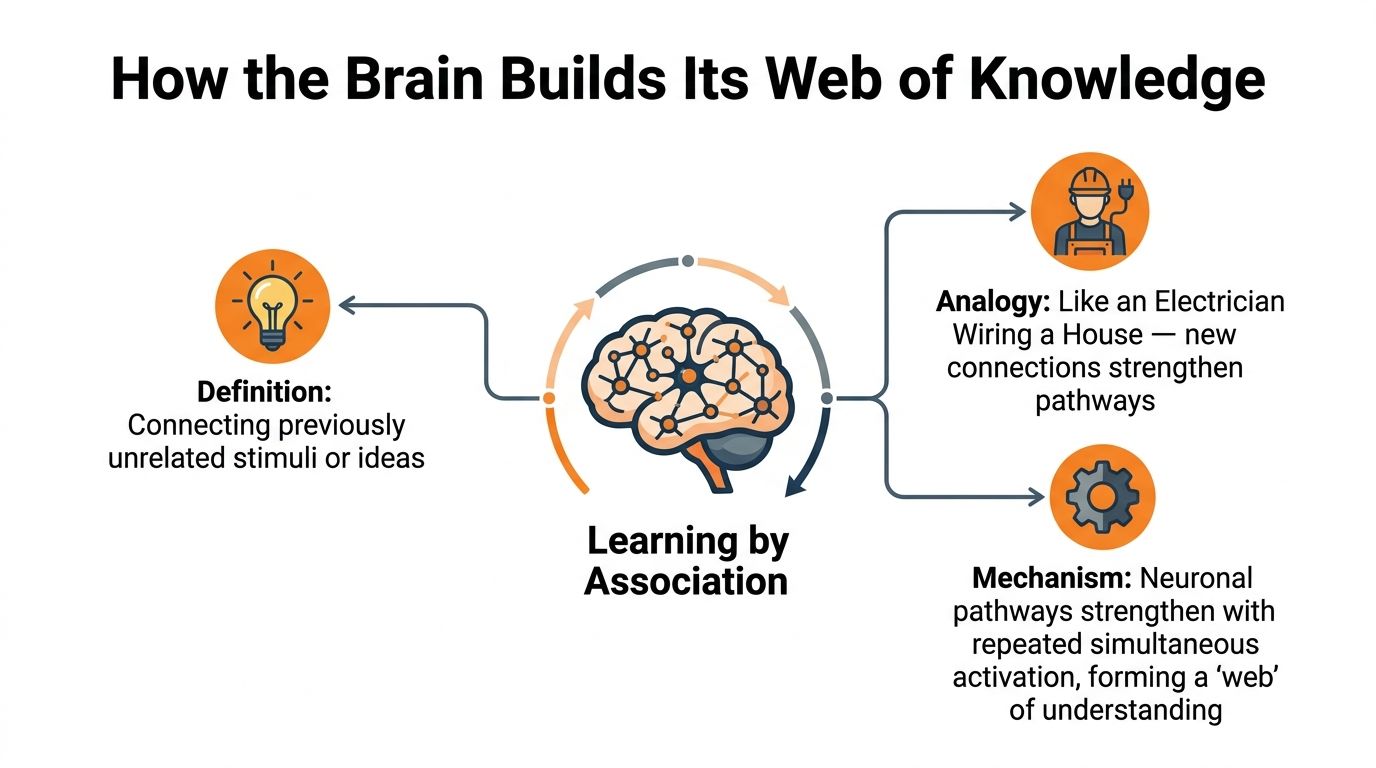
The brain is a master connector. It does not store experience as isolated bits floating around in separate boxes. It links them. Sound connects to meaning. Sight connects to action. Emotion connects to memory. Repetition strengthens those pathways.
That is the heart of learning by association.
A simple model of what is happening
Think of the brain like a home being wired. One switch must reliably turn on one light. If the electrician connects the wrong wires, the result is confusing. If the connection is weak, the light flickers. If the same correct pathway is reinforced again and again, the system becomes dependable.
Brains work in a similar way. Repeated experiences help the nervous system strengthen useful links. A visual symbol becomes linked to a sound. A social cue becomes linked to an expected response. A sequence of steps becomes linked to a familiar routine.
This is why repeated, meaningful experience matters more than random exposure. The brain is not just counting repetitions. It is detecting patterns that seem worth keeping.
What professionals mean by stronger connections
You may hear terms such as synaptic plasticity or “neurons that activate together become more strongly linked.” In plain language, this means experience can change how efficiently parts of the brain work together.
A few practical examples make this easier to grasp:
Reading: a child sees “sh” and increasingly links that letter pattern to one speech sound.
Rehab: a stroke survivor pairs a movement cue with a successful action until the response becomes easier to access.
Classroom learning: a student associates a colour-coded organiser with one category of task and retrieves the right response more consistently.
Some links form quickly. Others need guided repetition. Some are helpful. Some are misleading and need to be unlearned.
Why context matters so much
Associations rarely exist alone. They live inside context. A child may associate one prompt with success in a quiet therapy room but not in a noisy classroom. An adult may remember a strategy when looking at a written checklist but not during conversation. That does not mean the skill is absent. It may mean the cue is too weak, too unfamiliar, or competing with other information.
That is why brain-based support must consider more than accuracy. It must also consider setting, sensory load, timing, and task demands. Different brain regions contribute to these functions, which is one reason clinicians often find it useful to think in terms of whole systems rather than isolated symptoms. For a patient-friendly overview of this systems view, see https://www.orangeneurosciences.ca/guide/lobes-du-cerveau.
Where readers often get stuck
People commonly ask, “If the brain is always making associations, why do some people still struggle so much?”
Because not all associations are equally useful.
A person may learn the wrong link, such as connecting reading with frustration rather than success. A cue may be too subtle. The timing may be off. The reward may not matter to that person. Or the person may need more explicit support to notice the pattern.
Practical tip: If someone is not learning, do not first assume lack of effort. Check the cue, the timing, the environment, and the meaning of the consequence.
Exploring the Four Pillars of Associative Learning
Professionals often use one phrase, associative learning, to describe several different processes. That can create confusion. The clearest approach is to separate the major forms by mechanism and by how behaviour changes.
Classical conditioning
Classical conditioning links one stimulus to another.
The classic example is simple. A neutral cue is repeatedly paired with something meaningful, and eventually the neutral cue begins to trigger anticipation on its own. In modern practice, this can look far less dramatic than the textbook version. A child may hear a transition song and begin tidying up before the verbal instruction arrives. A therapy client may see a familiar screen layout and settle into a task more readily because the environment predicts success.
This form matters when we are shaping expectation, emotional readiness, and transitions.
Operant conditioning
Operant conditioning links behaviour to consequence. The person does something, then the outcome influences whether that behaviour is likely to happen again.
This is one of the most useful forms for intervention because it gives us direct tools for shaping practice. In a modern therapeutic example, fixed-interval reinforcement schedules in cognitive games yielded 35% higher repetition rates than fixed-ratio schedules for post-stroke patients in California senior care homes, supporting Thorndike’s Law of Effect in a contemporary context (Britannica on associative learning).
That finding matters for clinicians because it reminds us that the pattern of reinforcement is not a minor detail. It can change how persistently people engage.
Hebbian learning
Hebbian learning describes the nervous system basis behind repeated co-activation. It is less about a reward chart and more about what happens when pathways are repeatedly used together.
If a child repeatedly sees a symbol, says the sound, hears it back, and uses it in a meaningful word, those linked processes can become more efficient over time. This is one reason multisensory teaching can be so powerful. The brain is not learning in disconnected channels. It is weaving channels together.
Episodic associations
Episodic associations connect events across time and place. They help us remember that something happened there, with that person, after that event. This is how people build personal context.
In practical terms, episodic associations matter when helping someone remember routines, conversations, or therapy gains across settings. A strategy taught in clinic becomes far more useful when the person links it to breakfast at home, the school library, or the bus ride after work.
Comparing the four forms
Type | Mechanism | Nature of Behaviour | Clinical Example |
|---|---|---|---|
Classical conditioning | One cue predicts another event | Anticipatory, cue-driven | A transition sound helps a child prepare for the next activity |
Operant conditioning | Consequences shape future behaviour | Goal-directed, consequence-sensitive | A rehab game reinforces correct responses to increase practice |
Hebbian learning | Repeated co-activation strengthens pathways | Network strengthening | Repeated sound-symbol pairing supports reading |
Episodic associations | Events are linked in sequence and context | Contextual recall | A patient remembers a strategy because it is tied to a daily routine |
Why the distinctions matter
If a professional mixes these forms together, intervention can become muddy.
If the problem is anticipation: cue pairing may help.
If the problem is persistence: consequences may need adjustment.
If the problem is skill integration: repeated co-activation across senses may be the key.
If the problem is carryover: context linking may matter more than drill.
A useful way to think about this is through pattern detection. Some assessments ask whether a person can notice and use regularity quickly. That broader skill is closely tied to the way associative learning supports real-world performance. For related ideas, this pattern recognition resource is helpful: https://www.orangeneurosciences.ca/guide/pattern-recognition-test.
Key point: Two people can fail the same task for different associative reasons. Good intervention begins by identifying which pillar is under strain.
Measuring the Strength of Cognitive Connections
Associative learning sounds abstract until you try to assess it. Then the practical questions arrive quickly. How fast does the person detect a pattern? Do they improve after feedback? Do they transfer the rule to a new example? Do they rely on one kind of cue but miss another?
Those questions matter because real intervention depends on measurable differences, not guesswork.
What traditional assessment can miss
Observation remains valuable. Teachers, parents, and therapists often notice important patterns first. A student may learn better with sound than with print. A patient may respond to immediate feedback but lose momentum with delayed feedback. A child may remember routines in one room but not another.
Still, observation has limits:
It can be subjective: two professionals may describe the same behaviour differently.
It can be slow: subtle learning patterns take time to reveal themselves.
It can miss micro-patterns: small shifts in timing, accuracy, and consistency are hard to detect by eye.
What a more structured approach looks like
Modern digital assessment can present controlled cues, record responses precisely, and compare performance across task types. That matters because associative learning is often about patterns within patterns. The system can examine how a person responds over repeated trials, when improvement appears, and whether the person generalises what they have learned.
This is also where statistical association becomes useful at a larger scale. In one analysis of 14,985 subjects, California showed significantly fewer uninsured individuals than statistically expected, illustrating how association models detect non-random local patterns that would matter for benchmarking and interpretation (University of Michigan association analysis).
The clinical parallel is straightforward. If a dataset is large enough and the variables are defined carefully, we can detect patterns that are not obvious from casual observation alone.
What to measure in day-to-day practice
When clinicians or educators are trying to understand learning by association, these domains often help:
Cue detection: Does the person notice that one signal predicts another?
Learning rate: How quickly does performance change across repeated opportunities?
Error pattern: Are mistakes random, or do they follow a consistent bias?
Transfer: Can the person use the learned rule in a new setting?
Stability: Does the pattern hold over time?
Reliable measurement also requires consistency across sessions. If the same skill looks different every time it is tested, interpretation becomes difficult. That is why reproducibility matters in cognitive measurement, and why test consistency is worth understanding in plain language through resources such as https://www.orangeneurosciences.ca/guide/reliability-test-retest.
Clinical takeaway: Measure the pattern of learning, not just the final score. Two identical scores can hide very different cognitive processes.
Actionable Strategies to Boost Associative Learning
The most effective support plans do not treat associative learning as an abstract idea. They build it directly into daily tasks, therapy exercises, and home routines.

Pair cues on purpose
Many learners benefit when adults stop assuming the connection is obvious and instead make it explicit.
A practical example is pairing an auditory cue with a visual reward in digital therapy or structured learning. Higher-order conditioning can boost learning rates by 25-40%, and pairing auditory tones with visual rewards can potentially increase attention scores by 30% in short sessions (PMC article on higher-order conditioning).
That does not mean every tone-and-reward setup will work equally well. It means purposeful pairing can strengthen attention and expectation when the cue is meaningful and consistently delivered.
Use reinforcement with more precision
Rewards are often discussed too casually. Timing, predictability, and relevance all matter.
Try these adjustments:
Match the reinforcer to the learner: some people value praise, others value progress markers, choice, or brief game-based feedback.
Reinforce the specific behaviour you want: “Good job” is less useful than “You matched the sound to the symbol correctly.”
Keep the gap short at first: the closer the consequence is to the action, the easier it is for the brain to link them.
Build multi-sensory links
When one pathway is fragile, adding another can help.
For example:
Reading support: link the printed pattern, the spoken sound, and a tracing movement.
Daily routines: pair a visual schedule with a spoken prompt and a consistent location.
Rehab tasks: combine movement, verbal labelling, and immediate visual confirmation.
This does not mean “more stimulation is always better.” It means the cues should support the same association rather than compete for attention.
Teach in small, repeatable sequences
Associations strengthen when the brain can recognise the same core pattern across repetitions.
A helpful sequence often looks like this:
Show the cue clearly
Prompt the response
Provide immediate feedback
Repeat with minor variation
Fade support once the pattern becomes reliable
Professionals often move too quickly from assisted practice to independence. Some learners need a longer period where the link is becoming stable.
Make memory support concrete
Associative learning and memory support overlap. If a family is trying to strengthen retrieval, they often do better with linked cues than with isolated drilling. Resources on Memory Techniques can be useful when they translate memory support into practical routines, visual anchors, and retrieval prompts.
Adapt the strategy to the setting
Different groups need different versions of the same principle.
For clinicians: design tasks where the cue, response, and consequence are easy to identify and track.
For educators: use consistent classroom signals so students do not have to relearn the meaning of each transition.
For parents: attach new routines to existing ones, such as linking homework setup to a snack-and-desk sequence each day.
A related concern is working memory. If a child cannot hold the cue long enough to use it, the association may not consolidate well. Parents and professionals looking for direct supports can explore practical ideas at https://www.orangeneurosciences.ca/guide/how-to-improve-working-memory.
Practical tip: Do not ask, “How can I make this task harder?” Ask, “How can I make the key association clearer?”
Associative Learning in Action Case Studies
Theory becomes easier to trust when it matches the people we see.

A school-age child struggling with reading
A clinician works with a child who knows many letter names but reads haltingly. The problem is not simple exposure. The child has seen the material many times. The difficulty appears when printed patterns must trigger fast, reliable sound associations.
The intervention shifts away from broad practice and toward tighter pairings. The child repeatedly sees a grapheme, hears the sound, says it aloud, and then uses it in a short, meaningful word task. The sessions stay brief and structured. Errors are corrected immediately so the wrong link does not get repeated.
Over time, the child becomes less dependent on guessing. Reading starts to look less effortful because the sound-symbol associations are becoming more available under pressure.
An older adult in cognitive rehabilitation
An adult recovering from stroke has difficulty with initiation and sequence memory. Instructions are often understood in the moment but not carried through consistently. The rehab team introduces repeated cue-action pairings inside a predictable routine. The same visual marker appears before a task. The task follows the same broad sequence each time. Correct completion receives immediate feedback.
The goal is not to oversimplify the person’s world. It is to create enough stability that the brain can rebuild useful links. Once the sequence becomes more dependable, the team begins varying the context carefully so the association can transfer.
What these stories have in common
The details differ, but the logic is shared. Both people benefit when adults make the hidden pattern easier to detect, easier to repeat, and harder to mislearn.
This idea also fits research on learning tasks from California-based institutions. Humans reached 75% accuracy in inferential reasoning after 50 exposures, and the underlying work was refined over two decades to reduce errors to less than 10%, supporting the value of rapid, trial-based learning approaches (PMC study on associative vs statistical learning).
That finding helps explain why short, repeated opportunities can matter so much. The brain often learns best when it gets multiple clear chances to detect the rule.
Clinical takeaway: A good intervention often looks ordinary from the outside. Its power comes from how carefully the associations are chosen and repeated.
The Future of Brain Health and Ethical Considerations
The future of brain health will depend partly on how well we measure patterns that humans cannot easily see unaided. Digital tools can help identify subtle changes in response consistency, cue sensitivity, and learning efficiency. That is promising, especially in busy clinics, schools, and rehabilitation settings.
But better measurement is not enough on its own. Ethical use matters just as much.
What responsible practice requires
Professionals need to ask clear questions before using cognitive data:
What is being measured
How consistent is the measurement
How will the result guide support
Who can access the data
What claims should not be made from the result
Cognitive tools should inform care, not replace professional judgement. They should support families, not frighten them. They should identify patterns worth exploring, not label people too quickly.
Why interpretation still needs humans
Associative learning is shaped by attention, fatigue, sensory processing, mood, language background, and context. A score or pattern only becomes clinically useful when a thoughtful professional places it in the person’s real world.
That is also why families often need balanced education, not just outputs. A broader conversation about everyday brain support can include sleep, routine, task design, and practical strategies for cognitive longevity when attention and focus are part of the picture.
The most helpful future is one where digital tools make care more precise while clinicians keep the work humane. Used ethically, this approach can reduce guesswork, sharpen intervention planning, and help families understand not just what is hard, but why it is hard.
Frequently Asked Questions About Associative Learning
Is learning by association the same as rote memorisation
No. Rote memorisation usually refers to repeating information until it can be recalled. Learning by association is broader. It involves linking cues, meanings, actions, and outcomes so the brain can predict and respond more efficiently.
At what age can associative learning be strengthened
Very early. Children begin building associations from infancy. In practice, support can start whenever a child is engaging with routines, symbols, sounds, rewards, or social cues. The method should match the child’s developmental level.
How does associative learning relate to ADHD or dyslexia
It can be highly relevant. A person may struggle not because they cannot learn, but because cues are missed, reinforcement is too delayed, or sound-symbol links are not becoming automatic. Associative learning is one useful lens among several. It should never be the only lens.
Can adults improve associative learning after injury or illness
Often, yes. Adults can still form and strengthen useful associations, especially when practice is structured, meaningful, and repeated in context. Rehabilitation frequently depends on exactly this principle.
How can parents tell whether a child is not understanding the cue
Look for patterns. Does the child do better when the cue is visual instead of verbal? Better with immediate feedback than delayed feedback? Better in one room than another? Those differences often reveal where the association is breaking down.
What is the most common mistake professionals make
They often change too many variables at once. If the cue, task, reward, and environment all shift together, it becomes hard for the learner to detect what matters.
If you want a clearer way to assess cognitive patterns, guide intervention, and track progress with less guesswork, visit Orange Neurosciences. Their platform helps clinicians, educators, and families turn complex cognitive data into practical next steps for assessment, therapy, and ongoing care.
Orange Neurosciences' Cognitive Skills Assessments (CSA) are intended as an aid for assessing the cognitive well-being of an individual. In a clinical setting, the CSA results (when interpreted by a qualified healthcare provider) may be used as an aid in determining whether further cognitive evaluation is needed. Orange Neurosciences' brain training programs are designed to promote and encourage overall cognitive health. Orange Neurosciences does not offer any medical diagnosis or treatment of any medical disease or condition. Orange Neurosciences products may also be used for research purposes for any range of cognition-related assessments. If used for research purposes, all use of the product must comply with the appropriate human subjects' procedures as they exist within the researcher's institution and will be the researcher's responsibility. All such human subject protections shall be under the provisions of all applicable sections of the Code of Federal Regulations.


© 2026 by Orange Neurosciences Corporation