Non Linear Thinking: A Practical Guide

“Think outside the box” is weak clinical advice. It treats non linear thinking as an attractive form of creativity, when the more useful question is whether a person can shift, test, recover, and stabilise as conditions change.
In practice, cognition rarely moves in a clean line from stimulus to response. A patient may understand a rule, lose efficiency when the rule changes, persist with an old response, then recover after feedback. A student may generate several approaches but struggle to decide which one deserves verification. These transitions often matter more than a single correct answer.
For clinicians, educators, and rehabilitation teams, non linear thinking is best treated as a dynamic cognitive process. Digital assessment can preserve the sequence of responses, errors, delays, and recoveries that static summaries discard. That creates a more actionable profile of how someone performs under changing demands, not just whether they completed one task successfully.
Redefining Non Linear Thinking in Cognitive Care
The popular definition reduces non linear thinking to brainstorming, unusual ideas, or “thinking outside the box”. That description misses the feature practitioners can observe: the ability to move among competing interpretations and return to a useful response when circumstances change.
A cognitive task might begin with a stable sorting rule. Later, the rule changes without warning. The participant must inhibit the old strategy, identify the new relationship, tolerate an error, and regain a workable rhythm. This is not unstructured creativity. It's a sequence of transitions involving flexibility, monitoring, and recovery.
The distinction matters because a person can perform well on a static task yet struggle in ordinary situations that require several adjustments. Managing medication, following a changing rehabilitation plan, navigating a busy school environment, or responding to an unexpected instruction all demand more than recall. They require the person to reconfigure behaviour without losing the wider goal.
What clinicians can observe
Useful indicators include:
Switch cost: the change in speed or accuracy after a rule shift.
Perseveration: repeated use of a previous strategy after it no longer applies.
Error recovery: whether feedback produces correction, confusion, or repeated mistakes.
Response-time variability: whether performance remains stable or fluctuates sharply.
Stabilisation: how many trials the person needs before a new pattern becomes reliable.
These measures don't replace conventional scores. They add context. A domain score might indicate reduced executive efficiency, while the trajectory shows whether the main difficulty is switching, sustaining attention, or recovering from failure.
This approach is especially relevant when supporting people with early cognitive concerns. A practical resource on cognitive support for early memory loss can help families understand why day-to-day support should focus on function and adaptation, not only test labels. The same principle applies in clinical care: the useful profile is the one that guides the next decision.
From label to measurable process
A strong assessment workflow defines the task demand, records performance over time, and links the result to an intervention. The guide to cognitive function provides useful context for separating broad domains such as attention, memory, processing speed, and executive function.
Practical rule: If a task changes, preserve what happened before, during, and after the change. The transition may contain more clinical information than the final score.
The aim isn't to celebrate every unconventional response. Some divergence helps a person generate alternatives. Too much switching can increase cognitive load and delay action. Good care therefore measures whether flexibility remains purposeful, accurate, and recoverable.
Linear Metrics Versus Dynamic Cognitive Trajectories
A single score compresses a performance history into one value. That can be useful for communication, but it can also conceal the moment when performance broke down.
Linear assessment usually assumes that performance can be represented through an average, a total, or a stable relationship between difficulty and outcome. Dynamic assessment asks a different set of questions. Did the person slow gradually or collapse after a small increase in complexity? Did an error lead to correction or repetition? Did the person improve with feedback, and did that improvement hold?
Consider a patient who completes a memory task with an apparently adequate total score. During the task, however, response times become increasingly inconsistent, and the patient repeats an earlier strategy after the instructions change. A conventional summary may call the result broadly intact. A trajectory suggests a specific vulnerability in updating and recovery.
What each approach captures
Assessment Type | Primary Focus | Key Metrics | Limitation |
|---|---|---|---|
Linear | Overall level of performance | Total score, average accuracy, mean response time | Can hide fluctuations and transition failures |
Non-linear | Behaviour across changing demands | Switch cost, response-time variability, perseveration, recovery pattern | Requires repeated observations and careful interpretation |
The practical advantage of dynamic measures is not that they make every assessment more complex. It's that they help clinicians choose a more precise next step. If accuracy is stable but recovery is poor, the intervention may need graded rule switching and feedback. If speed falls only under high cognitive load, pacing and task structure may matter more than broad memory exercises.
Small changes can create large effects
Non linear trajectories often show threshold behaviour. A modest increase in task complexity may produce a disproportionate decline because the person has exhausted a compensatory strategy. Conversely, a small amount of useful feedback may help the person reorganise and improve quickly.
That pattern changes how reassessment should be designed. Repeat the relevant task conditions, record trial-level behaviour, and compare the response profile rather than relying only on a new total. The reliability and test-retest guidance is relevant here because a meaningful change must be distinguished from ordinary measurement variation.
A practical report might state: “Accuracy remains broadly stable, but switching becomes slower when the rule changes, with repeated use of the previous response pattern.” That is more actionable than “executive score reduced”. It tells the team what to practise, what to monitor, and what to discuss with the patient and family.
The Neuroscience of Metastable States and Chaos
The brain doesn't operate as a rigid chain of isolated steps. Neural systems temporarily organise themselves around a task, maintain enough stability to produce a useful response, and then reorganise when the context changes. Researchers associated with the University of California San Diego have described cognition through metastable states, in which neural activity remains temporarily coordinated while retaining the flexibility to transition.
A tightrope walker offers a useful analogy. Stability doesn't mean remaining motionless. The walker makes continual small adjustments in response to wind, posture, and movement. A system that's too rigid can't adapt. A system that's too unstable can't maintain a reliable direction. Effective cognition occupies the difficult middle ground between resilience and flexibility.

Why chaos doesn't mean randomness
A deterministic system follows rules, yet its behaviour can appear random when it is highly sensitive to initial conditions. Research associated with the University of California, Davis describes how nonlinear coupled components can generate deterministic chaos. In other words, complex behaviour doesn't require a system to be rule-free.
This principle has a direct assessment implication. Two people may receive the same instruction and begin with similar performance, but a small difference in fatigue, attention, confidence, or prior experience can lead their trajectories in different directions. The result isn't necessarily noise. It may reflect how the system responds to its starting conditions.
In 1979, Norman Packard, Doyne Farmer, and collaborators worked on reconstructing the geometry of a dynamical system from observed time-series data, a milestone in nonlinear time-series analysis described in the Davis account. The method challenged the assumption that useful data-generating processes are mainly linear, stationary, and independent. For cognitive care, the lesson is straightforward: repeated observations can reveal changing organisation that an average conceals.
Translating theory into clinical interpretation
A metastable state might look like a person who settles into an effective response pattern, then becomes less stable when the task changes. A phase transition might appear as a rapid shift from successful performance to perseveration. Complexity measures, recurrence characteristics, and state-transition frequency can help describe these patterns, but they shouldn't be treated as diagnoses by themselves.
The comparison of fMRI and MRI is useful background for understanding how different forms of neuroimaging answer different questions. Behavioural digital assessment adds another layer by showing how performance unfolds during repeated demands.
A single snapshot tells you where performance landed. A trajectory shows how the person got there.
Clinical teams should interpret these signals alongside history, language, education, medication, sleep, mood, and functional reports. Nonlinear analysis is valuable because it can expose organisation and change. It isn't valuable when its outputs are presented as a standalone explanation of a person's condition.
Integrating Rapid Digital Assessments into Workflows
A dynamic assessment only helps if the team can administer it consistently, interpret it quickly, and act on the result. The workflow should be short enough for routine use and structured enough to support comparison over time.
A practical implementation begins with a defined decision. Are you screening for a possible concern, establishing a rehabilitation baseline, prioritising educational support, or checking whether an intervention is helping? The answer determines which domains and transitions deserve attention.
A workable clinical sequence
Set the baseline. Record the participant's preferred language, relevant context, current concerns, and the task conditions. Document fatigue, sensory limitations, and whether assistance or interpretation was used.
Assess multiple cognitive domains. A rapid digital profile can examine attention, memory, executive function, perception, processing speed, and eye-hand coordination. The point isn't to collect every possible measure. It's to identify the pattern most relevant to the referral question.
Review transitions, not just totals. Look for switching difficulty, inconsistent response timing, repeated errors, and the point at which complexity overwhelms compensation.
Prioritise the next intervention. AI-driven decision support can help benchmark results, rank focus areas, and connect the profile to targeted digital therapy such as ReadON. The clinician remains responsible for interpretation and care planning.
Schedule the reassessment before discharge. Use comparable conditions at a defined interval so the next result can answer whether flexibility, recovery, speed, or accuracy changed.
The strongest workflow resembles a loop rather than a handoff. Assessment identifies a priority, the practitioner assigns a targeted activity, the participant completes it, and the next measurement tests whether the chosen strategy produced useful change. A concise discussion of empowering safer proactive care is relevant because decision support should improve preparation and consistency without replacing professional judgement.
Avoiding common implementation failures
The first failure is testing without a decision pathway. If nobody knows who reviews the result or what happens next, a digital report becomes another document in the chart.
The second is changing too many variables between assessments. Different instructions, devices, environments, or levels of support can make a trajectory difficult to interpret. Standardisation doesn't mean treating every patient identically. It means documenting the conditions well enough to understand what changed.
The third is confusing a rapid assessment with a diagnosis. A screening result can identify a need for further review. It cannot, by itself, explain the cause of a cognitive difficulty.
Teams considering assessment on demand should define ownership, escalation criteria, reassessment timing, and reporting requirements before rollout. Speed matters, but repeatability and follow-through determine whether the workflow improves care.
Guarding Metacognition in the Age of Generative AI
Generative AI can widen the search space quickly. It can propose analogies, alternative explanations, lesson ideas, or possible care-plan questions. That capability is useful, but it creates a serious trade-off: the system may produce more associations while the user performs less of the reasoning needed to test them.
A productive non linear process moves through two distinct phases. First, the person generates possibilities. Then the person evaluates evidence, compares competing explanations, checks constraints, and chooses an action. Undisciplined associative thinking stops after the first phase and mistakes novelty for quality.

A 2025 survey of 3,804 Canadian adults found that 48% of students who use generative AI believed their critical-thinking skills had deteriorated since adopting it, while 65% said peers use AI to avoid critical thinking, as reported by KPMG Canada. These findings don't prove that every use of AI weakens reasoning. They do show why practitioners should ask what cognitive work the user still performs.
A guardrail sequence that works
Generate independently first. Ask the learner, clinician, or professional to produce initial hypotheses before opening an AI tool.
Request alternatives, not an answer. Use AI to expand perspectives, then require the user to explain why each option might or might not fit.
Demand evidence for each leap. Separate observed facts, reasonable inferences, and unsupported speculation.
Compare competing explanations. Ask what evidence would favour one interpretation over another.
Return to linear verification. Check the source, apply the rule, document the decision, and identify who remains accountable.
For example, a rehabilitation trainee might ask AI for possible reasons a patient is perseverating after a rule change. The trainee should first record observed behaviour, then compare possibilities such as fatigue, comprehension, executive dysfunction, or task design. AI can expand the differential discussion, but it shouldn't decide which explanation is clinically valid.
Cognitive platforms should measure the transition from divergent generation to convergent evaluation. A person who produces many alternatives but can't reject weak ones needs different support from someone who generates few alternatives but evaluates them accurately. Metacognition is not the number of ideas. It's the capacity to know what you know, what you don't know, and what must be checked before acting.
Ensuring Equity Through Native-Language Delivery
A cognitive assessment can measure language difficulty instead of cognition when the participant doesn't fully understand the instruction. That risk is particularly serious for tasks involving verbal memory, sequencing, working memory, and executive decisions. A delayed response may reflect translation effort, unfamiliar phrasing, hearing difficulty, or anxiety rather than impaired cognitive flexibility.
Language access therefore belongs in the validity protocol, not in a late-stage accommodation checklist. Before testing, ask the participant which language they prefer for instructions, task interaction, and feedback. Record whether an interpreter was used, whether the participant switched languages during the task, and whether any item required explanation.
Canada's access gap makes this practical issue impossible to dismiss. In 2022, only 51% of adults in the official-language minority population received healthcare in their own official language when accessing hospital services. Language-concordant hospital care reached 83% in New Brunswick, 57% in Quebec, and 33% in Ontario, according to Statistics Canada.
Building a fair assessment process
A clinic can make language access operational by:
Collecting preference before arrival: Don't wait until the participant is seated at the test.
Using native-language instructions where available: Translation should preserve task meaning, not merely substitute words.
Documenting interpretation: Interpretation changes the testing context and belongs in the record.
Auditing completion by language group: Differences in incomplete sessions may reveal access barriers.
Reviewing feedback language: A valid result is less useful if the participant can't understand the recommendations.
The distinction between a cognitive concern and a communication barrier can change the entire care plan. A participant who appears slow in a second language may perform efficiently when instructions are delivered in the preferred language. A person who still shows switching and recovery problems across languages presents a different clinical question.
Teams working with multilingual systems may also benefit from a guide to domain specific models when considering how language technologies handle specialised terminology. The technical tool doesn't remove the need for human review. It reinforces the need to match language, culture, task design, and interpretation to the person being assessed.
The language of assessment guidance supports the same principle: fair measurement begins with understandable instructions. Without that foundation, dynamic metrics can look precise while measuring the wrong thing.
Closing the Loop with Connected Care Records
A one-time evaluation can identify a concern, but it can't show whether the chosen response worked. A connected record turns the assessment into a sequence of decisions.
Consider an older adult referred to a community rehabilitation team after family members notice difficulty managing changing routines. The initial digital assessment shows adequate performance on familiar attention tasks, but marked variability after instructions change. The clinician records the pattern, shares a concise summary with the therapist, and prioritises graded switching and error-recovery exercises.
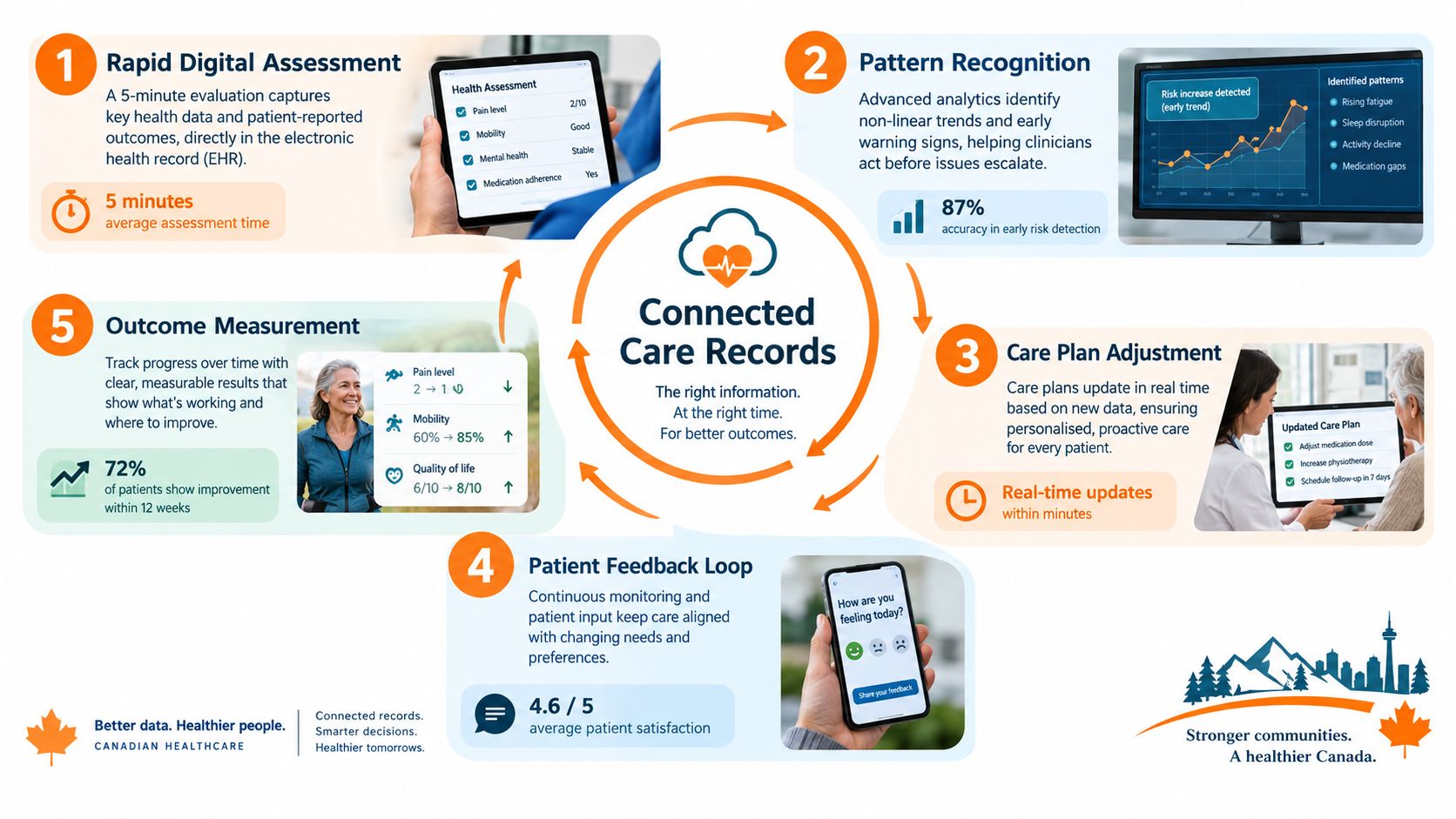
The therapist doesn't need to start with a broad, undefined programme. The report identifies a functional target, the therapist documents the intervention, and the next reassessment repeats comparable demands. If accuracy improves but response-time variability remains high, the plan may need pacing and endurance work. If recovery improves after errors, the team has evidence that the intervention is changing the relevant process rather than only producing familiarity with one task.
What the care loop must contain
A baseline: Record domain results and transition behaviour under known conditions.
An owner: Name the clinician or therapist responsible for reviewing the report.
A targeted action: Link the priority pattern to a specific intervention or support.
A feedback point: Schedule reassessment and record adherence, fatigue, language, and context.
A longitudinal view: Compare domain-level and transition-level change over time.
Digital coordination is already common, but incomplete information sharing still limits its value. In 2024, 92% of Canadian healthcare providers had access to a digital health system, yet only 52% used one to send or share clinical information with providers outside their main practice setting, according to Statistics Canada. A connected cognitive workflow must therefore specify which fields travel, who receives them, and when the updated result returns to the care team.
Record access can also reduce unnecessary visits when the information is clear and usable. Among Canadians who accessed their health records electronically, 34% said the information helped them avoid an emergency-department visit, and 45% said it helped them avoid an in-person visit with their regular care provider, according to the Canadian Institute for Health Information.
Those figures don't justify replacing clinical contact with dashboards. They support a better allocation of contact: use the record to decide whether a visit is needed, what it should address, and whether the current plan is producing progress.
Orange Neurosciences offers AI-powered cognitive assessment, individualized profiles, digital therapy, and reassessment workflows designed to track flexibility, recovery, and change over time. Visit Orange Neurosciences to explore how structured digital cognitive care can connect measurement with targeted action and ongoing review.

Orange Neurosciences' Cognitive Skills Assessments (CSA) are intended as an aid for assessing the cognitive well-being of an individual. In a clinical setting, the CSA results (when interpreted by a qualified healthcare provider) may be used as an aid in determining whether further cognitive evaluation is needed. Orange Neurosciences' brain training programs are designed to promote and encourage overall cognitive health. Orange Neurosciences does not offer any medical diagnosis or treatment of any medical disease or condition. Orange Neurosciences products may also be used for research purposes for any range of cognition-related assessments. If used for research purposes, all use of the product must comply with the appropriate human subjects' procedures as they exist within the researcher's institution and will be the researcher's responsibility. All such human subject protections shall be under the provisions of all applicable sections of the Code of Federal Regulations.


© 2026 by Orange Neurosciences Corporation