Math Solving Strategies: Tips for Educators & Parents

A learner is staring at a word problem. The numbers aren't especially hard, but nothing seems to stick. A parent tries to help and hears, “I'm just not a math person.” A therapist sees a child lose the thread halfway through a multi-step task. A teacher watches a capable student freeze the moment a problem looks unfamiliar.
That moment often gets misread as low ability.
More often, it's a breakdown in strategy, attention control, working memory, or confidence. Students don't fail math problems only because they don't know the content. They also struggle because the problem asks them to hold information in mind, plan a sequence, ignore distractions, choose a tool, and check whether the answer makes sense. Those are cognitive tasks, not just academic ones.
Good math solving strategies give learners a way in. They reduce overload, make thinking visible, and create repeatable routines that teachers, therapists, and parents can coach. When you connect each strategy to the cognitive skill it supports, your support becomes more precise and more effective.
Why Some Students Struggle with Math Problems
A Year 5 student reads this problem: “A concert sold child tickets for $2 and adult tickets for $5. If 10 tickets were sold for a total of $32, how many of each were sold?” The student knows addition. The student knows multiplication. But after two minutes, the paper is blank.
That blank page doesn't prove the student lacks ability. It often shows that the student doesn't yet have a method for starting.
Many adults have seen this pattern. A child can do isolated sums, then falls apart on a word problem. A bright teenager can explain the idea out loud, then loses marks because they skip steps. A client in therapy may understand the rule but can't organise the process under pressure. In each case, the issue may be less about “math talent” and more about the fit between the task and the learner's cognitive profile.
The hidden demands inside one problem
Word problems place several demands on the brain at once:
Language demand. The learner must decode what the question is asking.
Planning demand. They need a starting point, not just content knowledge.
Working memory demand. They must hold numbers, conditions, and partial steps in mind.
Self-monitoring demand. They need to notice when a path isn't working.
When one of those systems gets overloaded, students often look stuck, careless, or avoidant.
Practical rule: When a student says, “I don't get it,” first ask, “What part is breaking down?” Reading, planning, remembering, or checking?
That's why broad labels such as “weak at maths” aren't very helpful. Better support begins with sharper observation. If you're trying to understand whether math difficulty connects to a broader learning profile, a guide to assessments for learning disabilities can help frame what to look for.
Strategy changes the story
The most hopeful truth in math instruction is that problem solving is teachable. Students can learn how to underline key information, sketch a model, break a task into chunks, test a plan, and review their answer. Once those routines become familiar, the problem no longer feels like a wall. It becomes a sequence.
That shift matters emotionally as much as academically. Students who have a strategy are more willing to begin. And beginning is often the hardest part.
Understanding the Brains Math Engine
Math solving strategies work best when we understand what they're supporting. Think of the brain as a system with several parts running at once. One part manages attention and planning. Another holds bits of information temporarily. Another monitors whether the current approach is working. If one part gets overloaded, the whole process slows down.
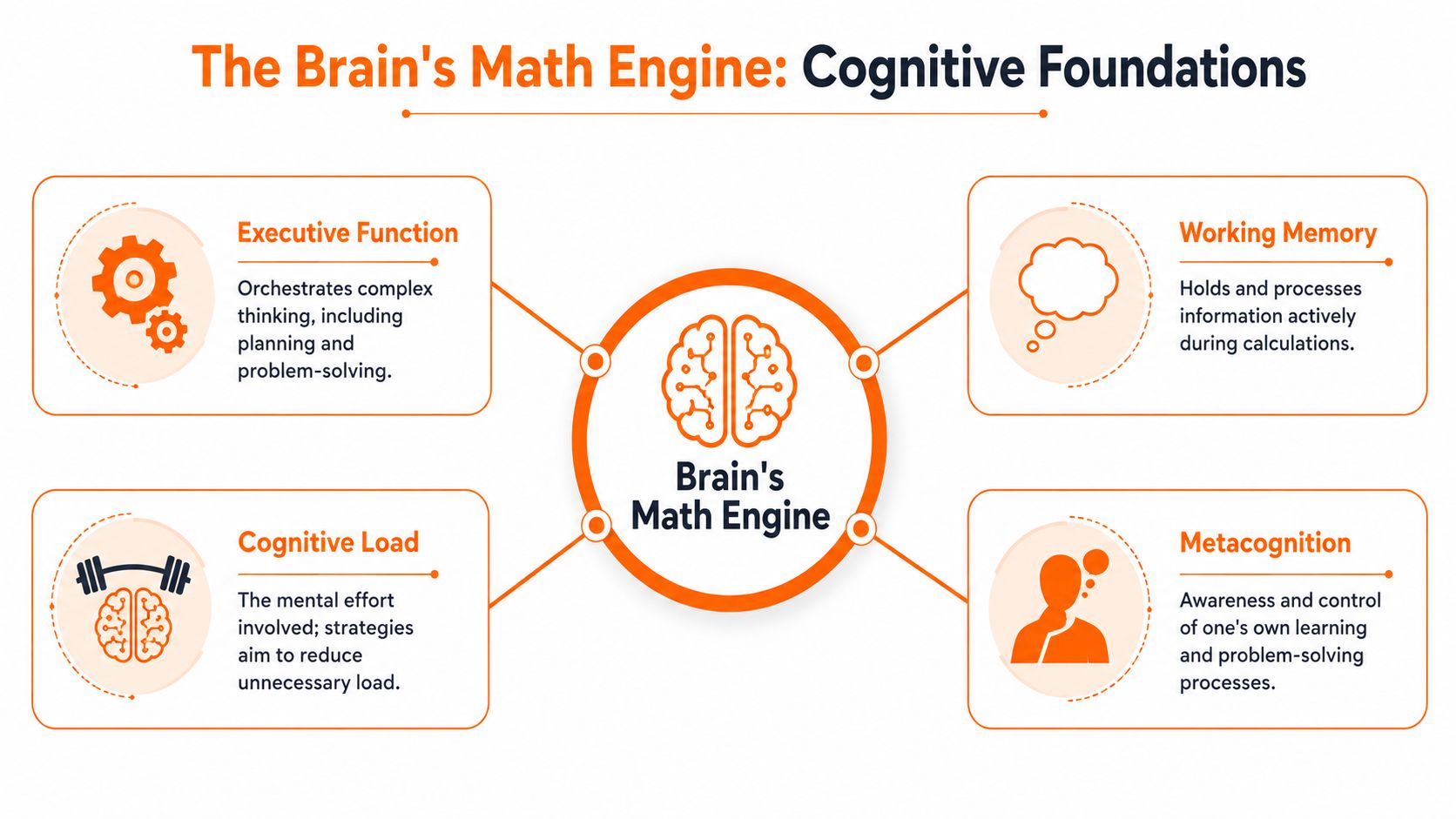
Executive function is the project manager
Executive function helps a learner start, plan, sequence, shift, and inhibit impulses. In math, that means deciding what the problem is asking, choosing a strategy, and resisting the urge to guess randomly.
A peer-reviewed study on expert problem solving found that expert problem-solving processes involve 29 discrete decision steps, with 100% of experts consistently framing the problem, planning the solution, interpreting information, reflecting on efficacy, and selecting initial goals; 94% of experts also monitor their solving approach mid-process (expert problem-solving processes). That finding matters because it shows that strong problem solvers don't just “see” answers. They manage a process.
For students, executive support often looks simple on the surface. A checklist. A worked example. A cue card that says: What do I know? What do I need? What's my first step?
Working memory is the mental sticky note
Working memory holds information long enough to use it. If a student reads a fraction problem, remembers the denominator rule, and then forgets the first number while computing the second, working memory may be the bottleneck.
Visual supports prove helpful. A learner who struggles to hold information mentally may do much better when they externalise it with boxes, labels, number lines, or sketches. The visual spatial sketchpad is a useful way to think about this. Some learners need to “see” the math to manage it.
Cognitive load and metacognition shape performance
Cognitive load is the amount of mental effort a task requires. If a worksheet includes dense language, unfamiliar layout, and multi-step calculations, the learner may spend their energy just keeping track.
Metacognition is the ability to notice and regulate one's own thinking. A metacognitive student asks, “Does this answer make sense?” A struggling student may stop the moment they reach any answer at all.
Strong math instruction doesn't just teach procedures. It teaches learners how to notice, pause, choose, and check.
When teachers, parents, and therapists tie a strategy to the cognitive function underneath it, support becomes much more targeted. Instead of saying “try harder,” we can say, “Let's reduce memory load,” or “Let's make the plan visible.”
A Toolkit of Proven Math Heuristics
Heuristics are practical decision tools. They don't guarantee an answer, but they help a learner move from confusion to action. For many students, the biggest win is knowing what to do first.
In Santa Ana College's evidence-based curriculum, George Pólya's four-step method is explicitly taught alongside techniques like “Solve a Simpler Problem,” where complex word problems are broken into distinct, solvable sub-goals before combining results (George Pólya's four-step method). That's one reason Pólya's framework remains so useful. It gives learners a structure they can return to across topics.
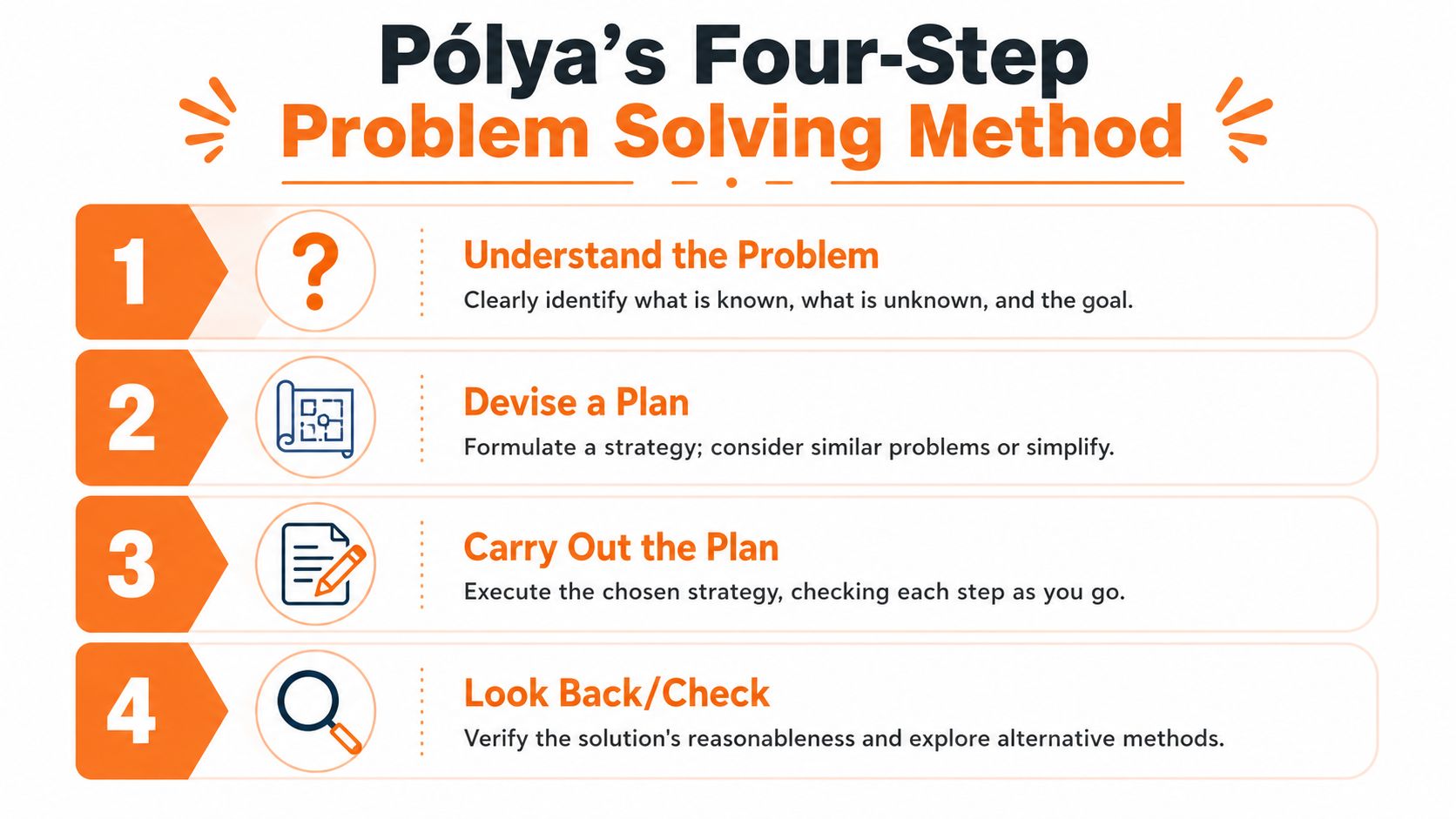
Pólya gives students a repeatable routine
A simple version looks like this:
Step | What the learner does | Cognitive function supported |
|---|---|---|
Understand | Restate the problem, identify knowns and unknowns | Language processing, attention |
Plan | Choose a method | Executive function |
Do | Carry out the steps | Working memory, sequencing |
Check | Review the answer | Metacognition |
Try it with the concert ticket problem. First, identify what's known: 10 tickets total, child tickets cost $2, adult tickets cost $5, total revenue is $32. Then plan. One route is to test combinations. Then do the calculations. Finally, check whether the combination fits both conditions.
Four practical heuristics worth teaching
Guess and check
This strategy helps when two unknowns must satisfy clear conditions. Start with an educated guess, test it, then adjust.
For the ticket problem, suppose there are 4 adult tickets and 6 child tickets. That gives $20 + $12 = $32. It works.
The strength of guess and check isn't randomness. It's the feedback loop. Students learn to use error information to move closer to the answer. That builds flexible reasoning.
Work backwards
This works well when the problem gives an end state. If a learner sees, “After spending half her money and then $6 more, Ava had $10 left,” they can reverse the operations. Add $6 to get $16. Double it to get the starting amount.
This supports students who struggle to build a forward plan. Reversing the steps often feels cleaner.
Find a pattern
Patterns reduce search. If students list outputs for a sequence or test a few cases in a geometry task, regularity often appears. Once they detect that structure, they don't need to solve each case from scratch.
Solve a simpler problem
If a fraction word problem feels too large, shrink it. Use smaller numbers first. If a student can't solve “three buses with changing passenger counts,” start with one bus. Simpler cases reveal structure.
A good heuristic isn't a trick. It's a way to reduce overload so the learner can see the structure of the task.
If you want a child-friendly companion resource with hands-on ideas, this guide to problem-solving strategies for children offers practical activities that pair well with school-based instruction.
For learners who need support carrying plans through to completion, executive function coaching can also complement strategy teaching.
Implementing Strategies with Worked Examples
Many students don't need more explanation. They need to watch someone think through a problem slowly and visibly. That's why worked examples are so effective. They reduce unnecessary decision-making at the start and show what organised thinking looks like in real time.
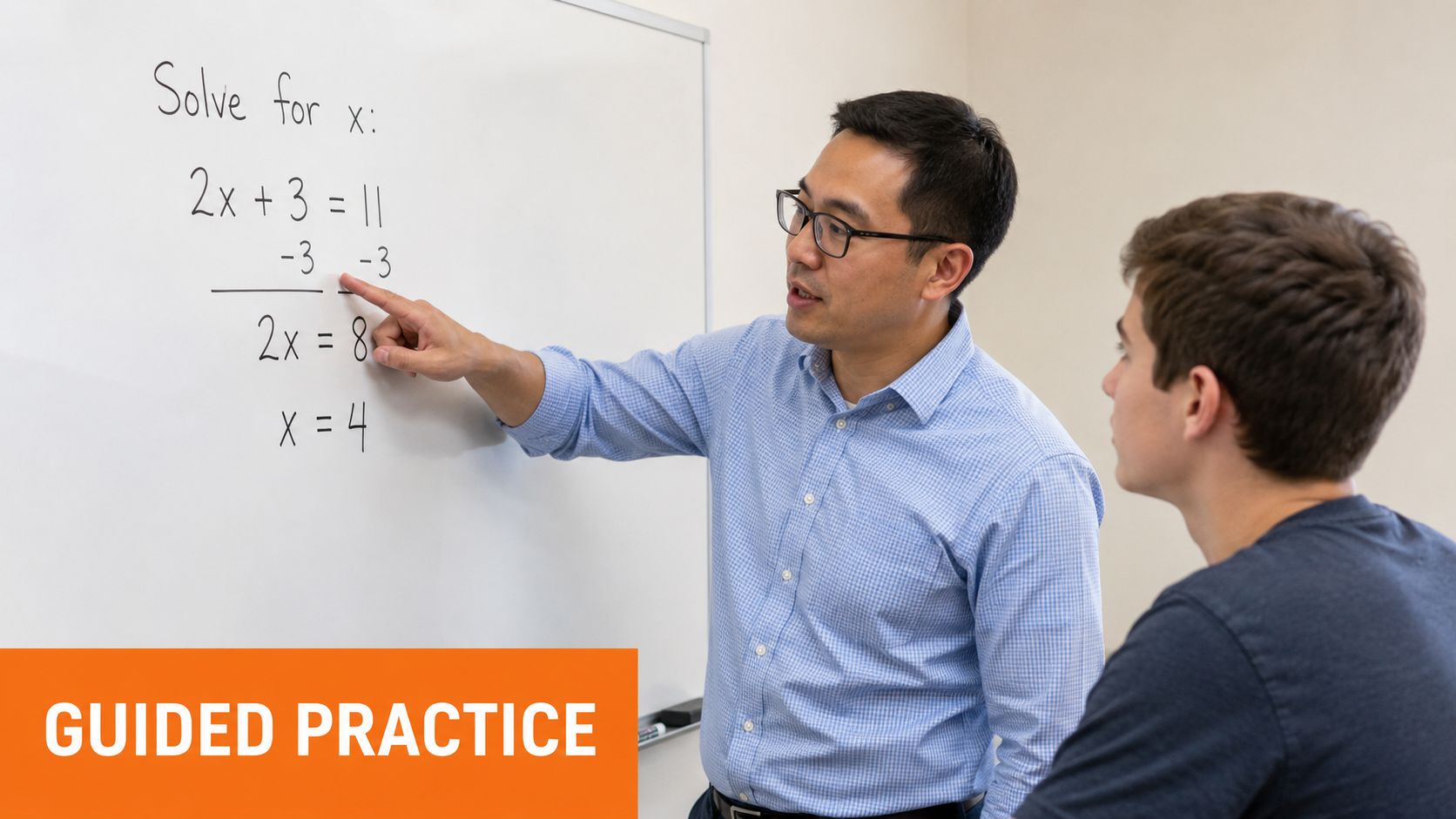
How to teach with worked examples
Choose one target problem type. Don't mix several new demands at once. If you're teaching two-step equations, stay with that structure first.
Model your thinking aloud. Say what you notice, what you're ignoring, and why you chose a step. Example: “I want the variable alone, so I'm undoing addition before division.”
Mark the structure visually. Circle known values, box the unknown, and label each operation. This helps learners who lose track mid-problem.
Pair one solved example with one new problem. Let students study the worked model, then try a similar item. Keep the pairing close enough that they can transfer the structure.
Prompt reflection after solving. Ask, “How was this one similar to the model?” That question builds strategy awareness.
A parent doing homework help can use the same method on scrap paper. A therapist can use it in a shorter session with verbal rehearsal. A classroom teacher can project one problem and annotate every decision.
Building fluency without overload
Some students understand problem solving but still get derailed by slow fact retrieval. When basic math facts consume too much effort, there's less capacity left for planning and checking.
One focused intervention is Cover-Copy-Compare. In Los Angeles school districts, the Cover-Copy-Compare strategy is proven to accelerate math fact retrieval speed by 30% in struggling students with just 5–10 minutes of practice per session, requiring students to repeat the process until 100% accuracy is achieved on a list of 10 facts (Cover-Copy-Compare strategy).
Here's what that looks like in practice:
Write 10 facts on a page.
Study one line.
Cover it.
Copy it from memory.
Compare your response with the original.
Repeat until the set is fully accurate.
When fluency practice is brief, structured, and accurate, it strengthens retrieval without turning practice into a frustrating endurance task.
For older students tackling systems of equations, a focused explainer on solving 3 variable equations for STAAR can be a useful worked-example resource because it breaks a complex algebra task into manageable moves.
Making Abstract Math Concrete and Manageable
Abstract math becomes more manageable when students can see it and separate it into parts. Two of the best math solving strategies for this are visualisation and chunking.
Think of visualisation like reading a blueprint for a house. The structure becomes clearer when it's drawn. Think of chunking like building with LEGO bricks. You don't build the whole model in one move. You assemble one section at a time.
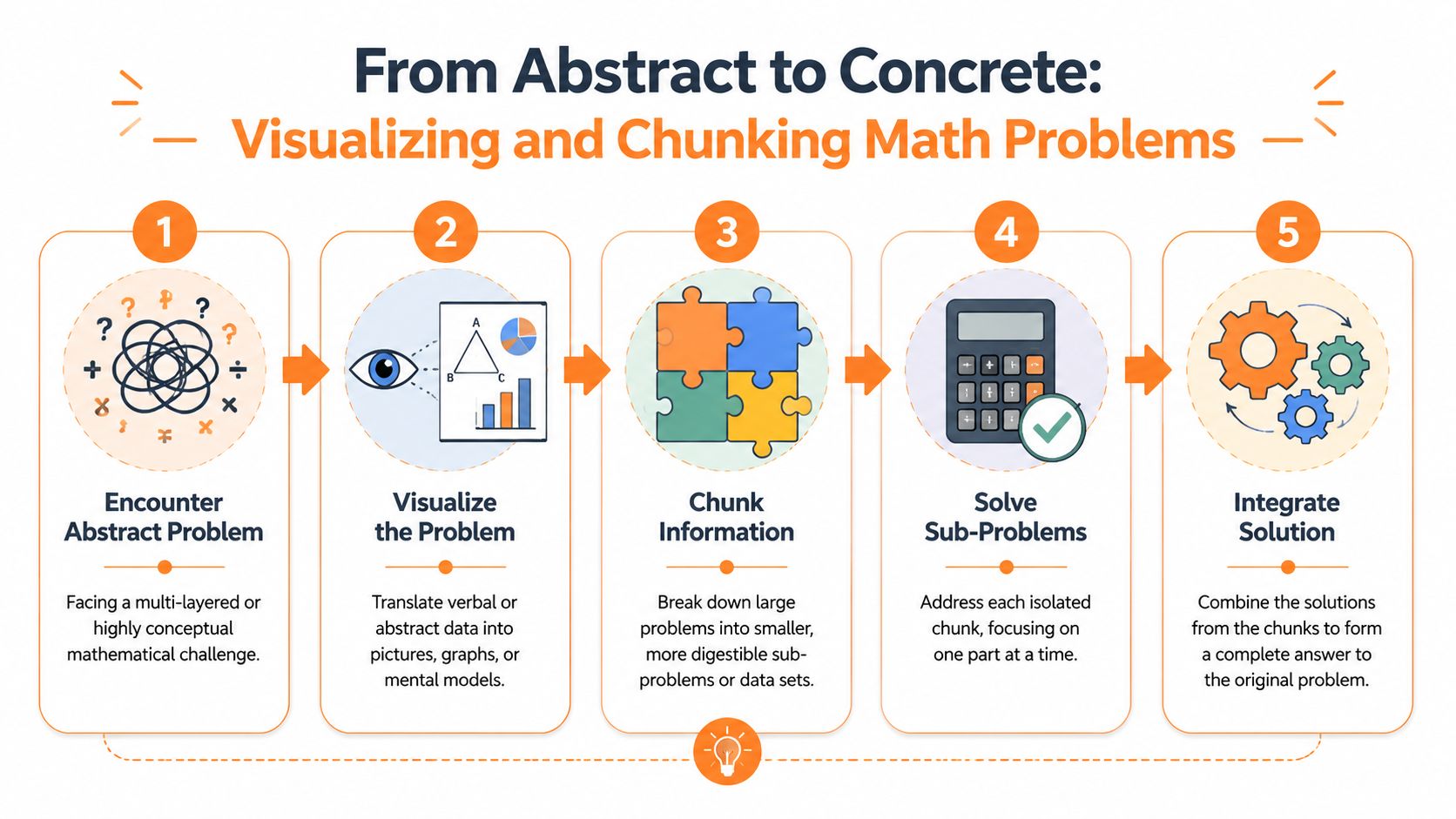
Use visualisation to reduce invisible thinking
A learner solving a ratio problem may benefit from a bar model. A student comparing fractions may understand faster with strips or circles. An algebra learner may need a table or balance sketch.
In California, the Standards for Mathematical Practice require students to use appropriate tools strategically, and proficiency in selecting the right tool correlates with a 28% increase in problem-solving accuracy on state exams compared to students relying solely on pencil and paper (use appropriate tools strategically). That's a powerful reminder that tool choice is part of problem solving, not an extra.
Useful tools might include:
Number lines for integer operations and fractions
Graph paper for alignment and place value
Bar models for comparison problems
Spreadsheets or graphing tools for patterns and data
Counters or tiles for operations and algebra concepts
Use chunking to create a starting point
Chunking works when a task feels too large to hold mentally. Instead of saying, “Do the whole page,” identify the first solvable unit.
For example, in a multi-step word problem:
Chunk 1. What facts are given?
Chunk 2. What is the question asking?
Chunk 3. Which operation fits each part?
Chunk 4. Solve each mini-part.
Chunk 5. Combine and check.
A child with weak working memory often benefits from writing each chunk on a separate line. A therapist might place each step on a card. A teacher might fold a worksheet so only one section is visible at a time.
If you're supporting learners who forget steps even when they understand the idea, this guide on how to improve working memory gives a useful lens for adapting instruction.
Personalizing Support for Every Learner
No single strategy fits every learner. The most effective support starts with a simple question: What's making this problem hard for this student?

In a Val Verde Unified pilot program, 43% of third graders achieved proficiency gains after two years of using the “notice and wonder” inquiry-based approach, yet teachers still report needing actionable scripts to translate these strategies into daily routines for varied learners (notice and wonder inquiry-based approach). That combination is familiar in real practice. A strong idea can still fail if adults don't have clear routines for implementing it.
If-then adaptations that help in real settings
If a student struggles with attention and task initiation, then use a visible start routine. Put “Read, underline, draw, solve, check” on a desk card. Reduce choices at first.
If a student has weak working memory, then externalise information. Use checklists, graph paper, visual models, and one-step-at-a-time directions.
If a student has math anxiety, then lower the threat level of the first step. Ask them to identify what they notice before asking them to solve. Early success creates traction.
If a learner has dyscalculia-like difficulties with quantity and number relationships, then prioritise concrete models, repeated comparisons, and slower pacing. Don't rush to symbolic work before quantity makes sense.
If a student can solve but rarely checks, then build in a fixed reflection routine. Ask for one sentence: “I know my answer makes sense because…”
Scripts adults can actually use
Many educators and parents know the theory but need language they can use tomorrow. Try these prompts:
“Tell me what you notice before you tell me the answer.”
“Show me where you might start, even if you're not sure it's right.”
“Let's hold less in your head and put more on the page.”
For students with overlapping attention and memory challenges, this guide on working memory and ADHD can help adults think more clearly about why a learner may understand a concept and still struggle to execute it consistently.
Personalisation doesn't mean creating a different curriculum for every student. It means adjusting the entry point, the scaffolds, and the feedback so the learner can use the strategy.
Building Long-Term Mathematical Confidence
Students build confidence when they stop seeing success as luck. They start trusting a process. That's the fundamental shift. Not from “bad at math” to “good at math,” but from “I freeze” to “I know what to do next.”
One reason reflection matters so much is that it strengthens both accuracy and self-awareness. In California statistics courses, a three-step strategy of Plan, Organize, and Reflect showed that students who document why a formula was used achieve a 34% higher success rate on complex problems than peers who skip documentation (Plan, Organize, Reflect). Writing the why helps students slow down, connect steps, and learn from their own process.
What progress should look like
Don't track only final answers. Also notice whether the learner:
Starts faster when faced with an unfamiliar problem
Uses a strategy independently without waiting for rescue
Explains their reasoning more clearly
Recovers after an error instead of shutting down
Those signs matter because confidence grows from repeated experiences of “I can work through this.”
For tutoring teams and learning centres that want more organised progress tracking, test prep center software can help structure workflows around instruction, practice, and follow-up.
The long-term goal isn't perfect performance on every page. It's a learner who approaches challenge with tools, language, and a plan. That learner is far more likely to persist, revise, and improve.
If you want to move from guesswork to a clearer picture of why a learner struggles with math, Orange Neurosciences offers rapid cognitive assessment that helps educators, clinicians, and families understand attention, memory, executive function, processing speed, and related skills that affect problem solving. Visit the site or reach out by email to explore how assessment-led support can guide more targeted, practical intervention.

Orange Neurosciences' Cognitive Skills Assessments (CSA) are intended as an aid for assessing the cognitive well-being of an individual. In a clinical setting, the CSA results (when interpreted by a qualified healthcare provider) may be used as an aid in determining whether further cognitive evaluation is needed. Orange Neurosciences' brain training programs are designed to promote and encourage overall cognitive health. Orange Neurosciences does not offer any medical diagnosis or treatment of any medical disease or condition. Orange Neurosciences products may also be used for research purposes for any range of cognition-related assessments. If used for research purposes, all use of the product must comply with the appropriate human subjects' procedures as they exist within the researcher's institution and will be the researcher's responsibility. All such human subject protections shall be under the provisions of all applicable sections of the Code of Federal Regulations.


© 2026 by Orange Neurosciences Corporation