Boost Focus with working memory and adhd: Practical Strategies
Jan 8, 2026
The link between working memory and ADHD is both direct and profound. The simplest way to think about it is to picture working memory as your brain's temporary RAM. For someone with ADHD, that system often gets overloaded, and fast. This isn't about a lack of willpower; it's a core neurobiological difference that makes holding onto and using information for immediate tasks a daily struggle.
Your Brain's RAM: The Link Between Working Memory and ADHD
Imagine your brain has a mental workbench or a temporary sticky note right in the front of your mind. That's your working memory. It’s the active cognitive system that lets you hold, process, and juggle information for whatever you're doing right now. It’s what you use to remember a phone number while you hunt for a pen, follow a multi-step recipe without losing your place, or hold someone's point in mind while you figure out how to reply.

For individuals with ADHD, this mental workbench often feels smaller or gets cluttered much more easily. Information can "fall off" before it has a chance to be used, leading to common frustrations that are so often misunderstood as carelessness or a lack of effort. A practical example is trying to remember a short grocery list like "milk, eggs, bread" while also navigating a busy store—the distraction of a sale sign might be enough to erase "bread" from your mental list.
How a Cluttered Workbench Affects Daily Life
When the brain’s RAM is constantly overloaded, even simple tasks can feel incredibly complex. It's the reason why someone might walk into a room and completely forget why they went there in the first place, or struggle to finish a thought because a new idea has already shoved the old one out.
To see how this plays out, let's look at some real-world scenarios. The following table shows how a simple daily task relies on working memory and how an ADHD-related challenge can interfere.
Working Memory in Action: Daily Scenarios
Daily Task | Typical Working Memory Function | Practical Example of an ADHD-Related Challenge |
|---|---|---|
Following Instructions | Holding a multi-step command (e.g., "Get your bag, put on your shoes, and meet me by the door") in mind long enough to complete all steps in order. | By the time the shoes are on, the other two parts of the instruction have vanished. The person gets their bag but forgets to meet by the door. |
Reading Comprehension | Keeping the beginning of a sentence or paragraph in mind while reading to the end to understand the full context and meaning. | After reading a dense paragraph in a textbook, you realize you have no idea what it said because your mind drifted, forcing you to reread it three times. |
Mental Math | Holding multiple numbers (like a bill total and a tip percentage) in your head simultaneously to perform a calculation (e.g., calculating a 15% tip). | You know the bill is $42, but by the time you calculate 10% ($4.20), the original total has "slipped away," making it impossible to add the next 5%. |
Participating in a Conversation | Listening to what someone is saying, holding onto their point, and formulating your own response at the same time without interrupting or losing the thread. | You have a brilliant point to add, but you're so focused on not forgetting it that you stop listening. By the time it's your turn to speak, your point is gone anyway. |
These examples highlight that the struggle isn't about understanding what to do, but about the brain's capacity to hold onto the information needed to do it.
The Neurobiological Reality Behind the Struggle
This isn't just a matter of "trying harder." The connection is deeply rooted in the brain's architecture and function. In fact, an enormous body of research shows that working memory is one of the most consistently and significantly impaired cognitive functions for people with ADHD.
Canadian and international studies have found that these deficits directly contribute to poorer reading and math scores, challenges with classroom behaviour, and a greater need for educational supports. This isn't speculation; it's a well-documented reality of the condition.
Actionable Insight: Recognizing that challenges with working memory and ADHD stem from a genuine difference in cognitive functioning is the first step toward finding effective support. This reframes the problem from a moral failing to a logistical one that can be solved with the right tools.
Understanding this crucial link empowers parents, educators, and clinicians to move beyond frustration and toward practical, effective solutions. Our comprehensive guide to ADHD offers more insights into this condition, providing a foundation for seeing that what often looks like inattention is actually a brain working overtime just to keep up.
The Daily Impact of Working Memory Challenges
That idea of a smaller or cluttered "mental workbench" isn't just a theory; it shows up in real, often frustrating, daily moments. When working memory gets overloaded, the consequences ripple through every part of life, from school performance and career growth to personal relationships. Seeing these real-world impacts is how we connect the dots between a clinical diagnosis and the lived experience of working memory and ADHD.

This constant cognitive juggling act is exhausting. What might look like carelessness or a lack of focus on the outside is really an internal fight against a system that’s already at full capacity.
In the Classroom
For a child or student, the classroom can feel like a minefield of working memory demands. A teacher gives a seemingly simple instruction, like, "Read the chapter, answer the odd-numbered questions, and then start on your summary." But that's three distinct pieces of information that have to be held in mind and put in order.
A student with working memory challenges might only catch the first part—"Read the chapter"—and completely lose the rest. This isn't defiance; it's a cognitive traffic jam. The mental sticky note simply ran out of room before all the details could be jotted down.
Here are a few other practical examples:
Losing Track Mid-Sentence: A student starts to answer a question, but by the time they're halfway through, the original point has completely vanished. They trail off, unable to finish their thought.
Note-Taking Nightmares: Trying to listen to the teacher, decide what's important, and write it down all at once is a classic working memory overload. The result is often a notebook full of half-finished sentences and random words.
Math Problem Breakdowns: In a problem like
(15 x 3) + 8, the student might calculate15 x 3 = 45, but by the time they've written it down, they've forgotten the+ 8part of the equation.
At the Workplace
For adults in a professional environment, the stakes are just as high. The modern job often means juggling multiple projects, staying on top of a constant flood of emails, and contributing to fast-paced meetings. Every single one of those tasks puts a heavy load on working memory.
An adult with ADHD might find themselves re-reading the same email three times because the key details slip away by the time they reach the end. They might have a brilliant idea in a meeting, but by the time there’s a pause to speak, the thought has already evaporated.
Actionable Insight: The constant mental effort to keep up can lead to serious stress and burnout. If you feel perpetually exhausted at work, it may not be the job itself but the hidden cognitive load. Recognizing this is the first step toward seeking accommodations or strategies to reduce that load.
For most, this isn't a temporary problem. Canadian prevalence data shows just how unrecognized working memory issues contribute to long-term costs. With studies showing that only about 15% of children with ADHD see their symptoms fully disappear in adulthood, these challenges are often lifelong. This means hundreds of thousands of Canadian students and workers are trying to get by every day with an impaired mental workspace. You can discover more about these long-term trends and their national impact.
In Personal Life
The effects of working memory and ADHD reach far beyond the school or office. They get woven into the fabric of daily personal life, creating friction in relationships and logistical headaches in just running a household.
For instance, a partner might ask, "On your way home, can you pick up milk, bread, and check the mail?" To someone with working memory challenges, that simple request can feel like a complex algorithm. The result? They walk in the door with only the milk, having completely forgotten the other two items.
This can spill over into:
Household Management: Forgetting to pay bills on time (even when the money is in the account), misplacing crucial documents like passports or keys, and finding it impossible to stick to a budget often stem from the difficulty of holding and acting on information.
Social Interactions: In a group conversation, you might try to follow multiple threads at once. This cognitive overload can cause you to "zone out" or appear uninterested, when in reality your brain has just hit its processing limit.
Emotional Regulation: When your brain is already working overtime just to manage basic tasks, there are fewer mental resources left to handle frustration. A small annoyance, like spilling coffee, can feel disproportionately overwhelming.
Ultimately, these daily struggles highlight why getting an objective assessment is so important. Pinpointing the specific nature of a working memory deficit is the first, crucial step toward finding support and strategies that actually work.
How to Get a Clear Picture of Cognitive Function
When you see the daily struggles—forgotten instructions, misplaced keys, unfinished projects—it's easy to wonder if a weak working memory is the real culprit. But how can you be sure? Relying on subjective checklists or simple observation just doesn't cut it when you need to build a truly effective support plan for working memory and ADHD.
Moving beyond guesswork requires hard data. Think of it this way: you wouldn't diagnose a car's problem just by listening to the strange noises it makes. You'd run a full diagnostic scan to pinpoint the exact issue. Without that clear picture of cognitive function, any attempt at intervention can quickly become a frustrating cycle of trial and error.
Moving Past Guesswork
For years, traditional neuropsychological tests have been the gold standard for cognitive assessment. These often involve exercises like the digit span, where someone has to repeat a sequence of numbers forwards and then backwards. While these tests have their place, they can be incredibly time-consuming, expensive, and often fail to capture how working memory performs under the pressures of a real-world classroom or office.
Fortunately, modern digital assessments offer a much more direct and efficient path. These tools deliver precise, objective data on specific cognitive strengths and weaknesses, often in just a fraction of the time.
Actionable Insight: For clinicians, educators, and families, a clear cognitive profile removes the uncertainty. It provides a solid baseline for creating effective interventions, justifying accommodations (like extra time on tests), and actually tracking progress over time.
This data-driven approach transforms cognitive support from a guessing game into a targeted, evidence-based strategy. It helps answer critical questions like, "Is the main challenge holding onto what they hear, what they see, or both?" The answers are absolutely crucial for designing support that makes a real difference.
The Power of Objective Data
Objective cognitive profiles offer a level of detail that subjective reports simply can't provide. They can quantify the specific gaps between different cognitive functions, revealing patterns that might otherwise fly completely under the radar.
This is especially true for bright individuals with ADHD who have often developed clever coping strategies that mask their underlying challenges. Research from Canadian collaborative mental healthcare presentations reveals a telling pattern in university students with ADHD. Even when their full-scale IQ is in the superior range (around 125), their Working Memory Index scores frequently hover near the average mark of 100. This creates a significant 20+ point gap that directly translates into procrastination, incomplete assignments, and difficulty managing complex readings. You can explore how digital tools help quantify these gaps and guide interventions in materials for campus clinicians and rehabilitation specialists.
Understanding these specific deficits allows for a much more precise response. For instance:
For Educators: If an assessment shows a student has strong visual working memory but a weaker auditory one, an effective accommodation is as simple as providing written instructions to back up verbal ones. This is an immediate, actionable change.
For Clinicians: A detailed profile helps differentiate working memory deficits from other attention-related issues, leading to far more accurate care plans.
For Individuals: Seeing your own cognitive strengths and weaknesses in black and white can be incredibly validating. It confirms that the struggle isn't a lack of effort but a tangible, neurobiological difference.
Building a Foundation for Success
Ultimately, a clear, objective picture of cognitive function is the foundation for any successful support strategy. Rapid, digital tools provide the necessary data to build that foundation quickly and accurately. They offer a concrete starting point for measuring the effectiveness of any intervention, whether it's behavioural therapy, academic accommodations, or cognitive training.
By moving away from guesswork and toward data-driven insights, we can create more effective, personalized support systems that lead to better outcomes. Exploring modern cognitive assessments is a critical first step in turning the challenges of working memory and ADHD into opportunities for targeted growth and success.
Actionable Strategies to Support Working Memory
Recognizing that a strained working memory is impacting daily life is the first crucial step. The next is taking meaningful action. The good news is that a whole range of evidence-based interventions can strengthen and support the brain’s mental workbench.
This isn’t about forcing the brain to work harder. Instead, these strategies help it work smarter by improving neural signaling, lightening the cognitive load, and building capacity over the long haul. Think of this as your playbook for managing the challenges of working memory and ADHD—practical, actionable solutions you can start using today.
Pharmacological and Supplemental Support
For many people, the journey to better working memory begins with medical support. Stimulant and non-stimulant medications prescribed for ADHD can be highly effective because they help fine-tune the brain’s neurotransmitter signaling. Imagine them boosting the signal strength between different brain regions, which makes it easier to focus and hold onto information.
When managed properly by a clinician, medication can create a stable foundation that allows other strategies to take hold and flourish. This improved neurochemical balance makes it much easier to engage with and benefit from behavioural and cognitive therapies.
Some people also explore other avenues for support, like nootropic supplements for enhanced cognitive performance. While these supplements are designed to support cognitive function, it’s always essential to discuss them with a healthcare provider first to make sure they’re a safe and appropriate choice for you or your child.
Powerful Behavioural and Coaching Techniques
Medication can set the stage, but behavioural strategies are the tools you use every day to manage cognitive demands. These techniques act like external scaffolding for your brain, helping you organize tasks in a way that doesn’t overwhelm a taxed working memory system. They are practical, simple to put into practice, and surprisingly effective.
The Pomodoro Technique: Don't just work until you're tired; work in focused 25-minute bursts with a timer, then take a 5-minute break. This prevents burnout and makes large tasks feel less daunting. For example, instead of "write report," your task becomes "work on report for 25 minutes."
Task Batching: Group similar tasks. Dedicate one hour to answering all your emails instead of checking them every 10 minutes. This stops your brain from constantly switching gears, which drains working memory.
Externalizing Information: Stop using your brain as a storage unit. Use a digital calendar for appointments, a notes app for ideas, and set phone reminders for everything—from taking medication to calling someone back. Every item you offload frees up precious mental RAM.
Targeted Cognitive Training
While accommodations help you work around working memory deficits, targeted cognitive training is designed to strengthen the system itself. This is where engaging, game-based platforms can directly exercise and build working memory capacity in a structured, measurable way.
This infographic shows just how far we've come in cognitive assessment, moving from simple guesswork to precise digital tools that can inform personalized training.
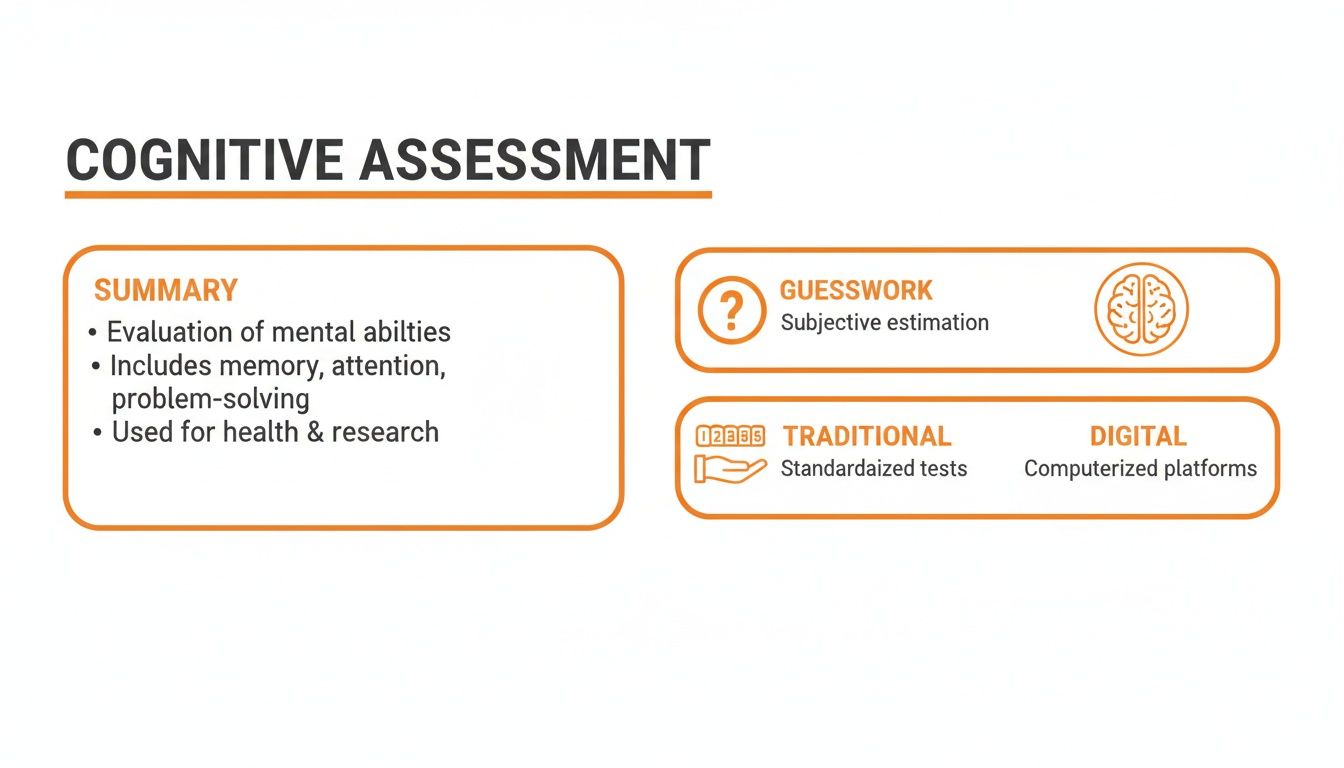
The real breakthrough here is that modern digital platforms give us the objective data needed to create training programs that zero in on specific weaknesses.
Actionable Insight: Unlike generic "brain games," scientifically designed cognitive training provides adaptive challenges that continuously push your limits—much like a personal trainer for your brain. This systematic approach is key to building stronger neural pathways and seeing measurable improvement.
These programs aren't a quick fix, but with consistent practice, they can lead to real, meaningful improvements in cognitive function over time. For a deeper dive into this process, check out our detailed guide on how to improve working memory.
Essential Environmental Accommodations
Finally, sometimes the simplest changes make the biggest difference. Modifying the environment can dramatically reduce the daily strain on working memory. These accommodations are simple adjustments that lower cognitive barriers at school, at home, and in the workplace.
For School and Work:
Provide Written Instructions: If you're a manager or teacher, always follow up verbal directions with a brief email or checklist. If you're a student or employee, don't be afraid to ask, "Could you please send that to me in an email so I don't forget?"
Use Noise-Cancelling Headphones: In an open office or noisy classroom, headphones are a non-negotiable tool to block out distractions that tax working memory.
Leverage Digital Tools: Use a speech-to-text app (like Otter.ai) during meetings to capture everything without having to take frantic notes. This lets you focus on participating.
Create a "Launch Pad": Designate one spot by the door for all essential items: keys, wallet, phone, work ID. This eliminates the frantic morning search, a common working memory failure point.
Here's a quick look at how these different strategies fit together.
Working Memory Support Strategies At a Glance
Intervention Type | Primary Focus | Practical Example |
|---|---|---|
Pharmacological | Improving neurotransmitter signalling to enhance focus and stability. | Taking prescribed medication as directed to create a consistent cognitive baseline. |
Behavioural/Coaching | Reducing cognitive load through external organization and structure. | Using a planner to write down all deadlines and appointments immediately. |
Cognitive Training | Directly strengthening working memory capacity through targeted exercises. | Committing to a 15-minute digital training session four times a week. |
Accommodations | Modifying the environment to lower cognitive barriers and reduce strain. | Requesting a quieter workspace or using noise-cancelling headphones at work. |
By combining these different strategies—from medical support to environmental tweaks—individuals, families, and educators can build a truly robust support system. This multi-layered approach addresses the challenges of working memory and ADHD from every angle, fostering resilience and creating a clear path toward success.
Building Your Personalized Cognitive Support Plan
Knowing the strategies is one thing, but actually weaving them into a plan that works is the real challenge. When it comes to managing working memory and ADHD, there’s no single magic bullet. The most successful approach is always a personalized one, layering multiple supports to build a strong foundation for success.
This roadmap will help you turn those insights into real-world action, creating a strategy that’s both dynamic and sustainable.
Start with a Clear Cognitive Baseline
Before you can build anything, you need to know what you’re working with. That’s why the first, most essential step is an objective, data-driven assessment. This moves you beyond guesswork and gives you a clear cognitive baseline, pinpointing specific strengths and weaknesses in working memory and other key executive functions.
This isn’t just about confirming a challenge; it’s about understanding its unique shape. For example, an assessment might show that someone’s verbal working memory is much weaker than their visual working memory. That one piece of information is incredibly powerful. It immediately tells you that strategies like visual aids, checklists, and mind maps will be far more effective than just relying on spoken instructions.
Actionable Insight: An objective baseline is your starting point and your compass. It ensures your efforts are targeted correctly from day one and gives you a concrete benchmark to measure progress against later.
Assemble Your Collaborative Team
No one should have to navigate this journey alone. The next step is to pull together a collaborative support team. This group works together, sharing insights and coordinating their efforts to make sure the plan is consistent and effective across all environments—whether that’s at home, school, or the office.
Your team might include:
A Clinician or Therapist to manage medical or therapeutic interventions.
An Educator or Academic Coach who can implement classroom strategies.
A Workplace Supervisor who can help establish reasonable accommodations.
Family Members who provide daily support and help maintain routines at home.
When everyone is on the same page, the entire support system becomes stronger and more seamless.
Select and Combine Your Interventions
With your baseline established and your team in place, it’s time to pick the right mix of interventions. Relying on a single strategy rarely works. The goal is to create a plan that supports the brain from multiple angles at once—both internally and externally.
For instance, a practical, personalized plan for a university student might look like this:
Intervention Category | Specific Action | Purpose |
|---|---|---|
Pharmacological | Taking prescribed medication consistently at the same time each morning. | To create a stable neurochemical foundation for focus before classes begin. |
Cognitive Training | Engaging in a targeted digital training program for 20 minutes before starting homework. | To "warm up" and exercise working memory capacity before a demanding study session. |
Accommodations | Using a note-taking app that records lectures and syncs with written notes. | To offload the cognitive demand of listening and writing simultaneously. |
Behavioural | Using the Pomodoro Technique and blocking out study time on a digital calendar. | To manage cognitive fatigue and create an external structure for study sessions. |
This kind of combination doesn't just help the student cope; it actively builds their cognitive skills while providing the external scaffolding needed to succeed. You can find more information about these integrated approaches by exploring various cognitive therapies that blend different methods.
Implement, Monitor, and Refine
Finally, an effective plan is never set in stone—it’s a living document. Once you’ve implemented your strategies, the work isn't over. The last, crucial step is to continuously monitor progress and refine the plan based on what’s working and what isn’t.
This is where that initial objective assessment becomes so valuable. Scheduling regular reassessments, perhaps every six months, provides clear data on whether your interventions are making a real, tangible difference.
If progress stalls, it’s not a failure; it’s just a signal to adjust. Maybe a different behavioural technique is needed, or perhaps an accommodation at work needs a slight tweak. By regularly checking in and making data-informed adjustments, you ensure the plan stays relevant and continues to provide the best possible support for the ongoing challenges of working memory and ADHD.
From Understanding to Taking Action on Your Cognitive Health
We've walked through how working memory challenges are a core part of the ADHD experience, but they absolutely don't have to be a permanent roadblock. By now, you've seen the direct line connecting your brain's "mental workbench" to daily life, the power of getting an objective look at what's going on, and the sheer number of evidence-based strategies out there for support.
The journey from feeling overwhelmed to feeling empowered starts with one single, informed step. You now have a much clearer picture of how working memory and ADHD interact, which makes this the perfect time to shift from knowing to doing.
Your Next Step: Don't let uncertainty keep you from building a stronger cognitive foundation. Taking proactive control is the most important step you can take for yourself, your child, or your patients.
We encourage you to move forward with this momentum. Visit our website to see how our rapid assessment tools work and how data-driven insights can clear the path toward lasting success and focus. If you're ready to see our platform in action, we invite you to sign up for our newsletter for exclusive insights or schedule a personalized demo to discover how our tools can support your specific needs.
For those of you helping adults navigate this, understanding the finer points of evaluation is crucial. Our guide on ADHD screening for adults offers more valuable perspective on this critical process. When you pair precise assessment with the right strategies, you create a clear roadmap toward improved cognitive function and overall well-being.
Your Questions, Answered
When you're trying to understand working memory and ADHD, a lot of questions come up. It's so important to get clear on the difference between a real neurocognitive challenge and what might just look like a personality trait. Let’s tackle some of the most common questions we hear.
Can You Actually Improve Working Memory in People with ADHD?
Yes, you absolutely can. While ADHD itself is a lifelong neurobiological condition, you can make significant gains in functional working memory. It’s not about rewiring the brain’s fundamental “hardware,” but more about optimizing its “software” through smart, consistent strategies.
Think of it like building physical strength. You might not be born a world-class powerlifter, but with the right training, diet, and technique, you can dramatically increase how much you can lift. In the same way, a mix of targeted cognitive exercises, behavioural strategies like using a planner, and simple environmental supports can strengthen the neural pathways your working memory relies on. Consistency is everything—it’s about building and maintaining those cognitive muscles.
Does a Weak Working Memory Just Mean Someone Is Lazy?
This is a deeply harmful and inaccurate myth. A weak working memory is a neurological difference, not a character flaw. Calling it laziness is like blaming someone who is nearsighted for not being able to read a sign across the street. It completely misses the biological reality of the situation.
The amount of mental effort someone with ADHD puts into just managing their working memory is often enormous, and completely invisible to an outside observer. For example, they might have to create a complex mental song just to remember three items from the store. What looks like laziness is often just sheer cognitive exhaustion.
Actionable Insight: It's critical to reframe this issue. Challenges with working memory and ADHD are rooted in brain structure and function, not in a person's motivation or will to succeed. This shift in perspective is key to finding compassionate and effective solutions.
How Can I Tell if It’s ADHD or Just Normal Forgetfulness?
We all misplace our keys sometimes or forget why we walked into a room. The real difference between everyday forgetfulness and an ADHD-related working memory deficit comes down to two things: persistence and impact.
Normal forgetfulness is usually random and doesn't throw your life off track. Working memory issues tied to ADHD, on the other hand, are chronic and show up everywhere. They consistently get in the way of your ability to perform at school, succeed at work, and maintain healthy relationships. A practical test is to ask: "Does this issue cause significant, recurring problems in my life?"
The only way to know for sure is through a professional, objective assessment. Gut feelings aren't enough. A formal evaluation gives you the hard data needed to distinguish a true cognitive deficit from life’s normal hiccups and points you toward a clear path for support.
Ready to stop guessing and get clear answers? Orange Neurosciences offers rapid, objective cognitive assessments that provide the data-driven insights you need to build a truly effective support plan. Explore our tools on our website and discover how a clear cognitive profile can change everything.

Orange Neurosciences' Cognitive Skills Assessments (CSA) are intended as an aid for assessing the cognitive well-being of an individual. In a clinical setting, the CSA results (when interpreted by a qualified healthcare provider) may be used as an aid in determining whether further cognitive evaluation is needed. Orange Neurosciences' brain training programs are designed to promote and encourage overall cognitive health. Orange Neurosciences does not offer any medical diagnosis or treatment of any medical disease or condition. Orange Neurosciences products may also be used for research purposes for any range of cognition-related assessments. If used for research purposes, all use of the product must comply with the appropriate human subjects' procedures as they exist within the researcher's institution and will be the researcher's responsibility. All such human subject protections shall be under the provisions of all applicable sections of the Code of Federal Regulations.


© 2026 by Orange Neurosciences Corporation