Marble Run Game Guide: Setup, Benefits, and Practical Uses

A child is kneeling beside a clinic table, staring at a fallen curve of track with the kind of concentration adults usually save for flat-pack furniture. He picks up the piece, tilts it, and mutters that the curve was too steep. That small comment tells you a lot. He noticed cause and effect, held the last attempt in mind, and chose a change instead of guessing.
That's why I keep returning to the marble run game in clinics, classrooms, and living rooms. It looks like play, and it is play, but it's also one of the cleanest ways to watch planning, attention, eye-hand coordination, and self-correction unfold in real time. You don't need a formal lab setup to see who rushes, who tests, who revises, and who gives up too early.
Most online advice treats marble runs as either gifts or simple STEM crafts. In practice, they work far better when you treat them as a structured task with clear rules, visible outcomes, and repeatable scoring.
What a Marble Run Game Really Is
In a therapy room, the useful moment usually isn't the successful run. It's the rebuild.
A seven-year-old sends the marble down. It hits the bend too fast, jumps the side, and lands on the mat. He pauses, lifts the curve, lowers the angle, and tries again. In that minute, you've seen a gravity-driven construction task doing several jobs at once. The child is builder, tester, and engineer.
A marble run game is a task where a player assembles or adjusts a pathway so a marble travels from a start point to an end point without stalling, flying off, or stopping short. That sounds simple, but every change matters. A steeper angle changes speed. A longer straight changes momentum. A sloppy junction turns a good idea into a failed run.
Science education materials frame marble runs as gravity-powered systems where changing the track angle changes marble speed and affects whether motion holds through curves and transitions, which is why early and repeated testing matters so much in practice (Science World marble run resource).
This is also why marble runs are different from passive toys. A passive toy can keep a child occupied. A marble run game asks the child to predict, act, observe, and revise. That loop is where the clinical value sits.
Practical rule: If the child can explain why the marble failed, you're no longer just watching play. You're watching active problem-solving.
It also functions as a rough measurement device without adding complicated equipment. You can observe run time, how often the marble falls, how many rebuilds happen before success, and whether the child changes one variable at a time or everything at once. If you already use visual reasoning tasks in practice, this kind of construction challenge pairs naturally with visual-spatial working skills because the child has to hold the planned pathway in mind while adjusting real pieces in space.
That combination of building, testing, and adjusting is what makes the marble run game worth using deliberately instead of casually.
Main Formats and How Each One Works
The four formats I see most often are wooden block runs, magnetic tile runs, gear-driven or chain-driven systems, and digital marble runs. Each asks for slightly different motor and cognitive work.
Wooden, magnetic, gear-driven, and digital formats
Wooden block runs rely on gravity and friction. The marble moves because the track slopes, and the surface quality decides whether the run feels smooth or sticky. These are often the easiest for observing spatial planning because the track pieces are visible and stable.
Magnetic tile runs work through magnetic coupling between tiles, with add-on chutes or tubes guiding the marble. They're popular because children can build vertically without complex supports. The trade-off is that a child may spend more effort keeping the structure upright than refining the marble path itself.
Gear-driven or chain-driven systems such as GraviTrax or K'NEX add kinetic transfer. The marble still uses gravity, but the system may include launches, switches, chains, or mechanical triggers. These are excellent for older children who need a richer planning challenge, but they can muddy observation if your real goal is basic attention or clean eye-hand data.
Digital or app-based marble runs use simulated physics. They remove fine motor load and let you isolate sequencing and planning. They're useful when hand function, fatigue, or setup time would otherwise block the task.
Think of all four like pouring water down sloping gutters. If the gutter angle is wrong, the surface rough, or the join uneven, the water won't go where you want. Marbles behave the same way.
Marble Run Formats at a Glance | Core Mechanism | Difficulty Control | Noise Level | Best Clinical Fit |
|---|---|---|---|---|
Wooden block runs | Gravity and friction | Easy to grade by changing height, length, and curves | Low | Fine motor, planning, quiet one-to-one work |
Magnetic tile runs | Magnetic coupling plus gravity | Moderate, especially for vertical builds | Moderate | Joint play, visual construction, home programmes |
Gear-driven systems | Kinetic transfer through mechanical parts | Broad range, but can become complex quickly | Moderate to high | Older students, sequencing, persistence |
Digital or app-based runs | Simulated physics | Very easy to grade through software rules | Very low | Reduced motor demand, remote practice, clean planning tasks |
What works best in real rooms
If I need the quietest setup for a clinic room, I choose wooden. If I need the easiest travel kit for home programmes, magnetic tiles usually win because they pack flat and tolerate quick setup. If I need to grade difficulty upward without changing the entire activity, gear-driven systems give me the most options, but they also increase distraction.
For families who want a simple engineering-style home extension, this marble roller coaster STEM activity is a useful example of how adults can keep the task hands-on without over-directing it. When I'm screening whether a child can hold a multi-step construction plan in mind, I also think about how the format taxes the visual-spatial sketchpad in working memory, because some builds demand much more mental rotation and location tracking than others.
Solo, Cooperative, and Competitive Play Modes
The useful part is that you don't need a different kit for a different goal. You change the rules, not the materials.
Solo mode for clean observation
Solo play is the clearest mode when you want to watch independent planning and self-correction. One child builds, tests, and fixes the path alone. In therapy, that gives you a cleaner view of who checks the angle before release, who notices misalignment, and who keeps rebuilding after a failure instead of abandoning the task.
This is the mode I use most when frustration tolerance is fragile. There's less social noise, less comparison, and fewer borrowed solutions.
Cooperative mode for language and joint planning
Cooperative play shifts the target. Now the task includes turn-taking, explaining ideas, listening, and revising with another person. The same marble run becomes a social-planning exercise.
A useful rule set comes from team-building versions of the task where the group must build a continuous pathway, the marble must never be exposed, it must never touch the floor, and only one designated team leader may touch the marble. If anyone touches it or drops it, the group restarts (marble run group activity rules). That structure is surprisingly effective in school groups because it forces role clarity and process discipline.
In cooperative mode, the strongest child doesn't need to build the fastest. The group needs to plan clearly enough that everyone can stay with the same idea.
Competitive mode for pressure and inhibition
Competitive mode suits older children, teens, and some adult rehab groups. Two sides build mirrored or near-mirrored tracks and race for the most successful run. What you observe here isn't just speed. You see inhibitory control under pressure, emotional regulation after mistakes, and whether a participant keeps rules when urgency rises.
If you already use fast-response tasks to look at attention and shifting, the same child may show similar patterns in a hands-on build, which is why I often connect this kind of observation with other timed decision-based games.
Cognitive and Developmental Benefits to Track
A good marble run game loads several skills into one visible task. That's useful because the behaviours are easy to spot without making the activity feel clinical.

The five skills that show up fastest
Sustained attention shows up when a child can watch the marble through multiple turns without looking away or reaching too soon.
Planning appears before the marble moves. You hear it in comments like, “This one has to go higher,” or, “I need the long piece first.”
Inhibitory control appears the moment the marble slows and the child wants to flick it forward but stops because the rule is to rebuild, not rescue.
Visuomotor coordination is on display every time a child places a connector slightly off-line and watches the marble drift into the wall instead of the centre of the channel.
Persistence is often the most useful to track. Some children tolerate one failed attempt and then shut down. Others keep refining.
What those skills look like in practice
In a classroom, one child may finish quickly but with constant trial-and-error dumping of pieces. Another may take longer, test small sections first, and succeed with fewer failed releases. The second child often gives you richer information about organised planning, even if the first child appears more energetic.
Canadian classroom guidance also treats marble runs as energy-conversion tasks, with variables such as marble size, ramp length, slope or height, and surface material affecting how well gravitational potential transfers into kinetic energy and how far the marble travels (BC Hydro marble run challenge). Clinically, those same variables become levers for changing difficulty without changing the whole activity.
A lot of parents benefit from seeing structured play described this way rather than as “just a toy”. This short guide on parent tips on structured play is a sensible companion for families who need practical language around routine, repetition, and clear goals. If you're documenting what you see, it also helps to tie the session back to broader definitions of cognitive function, especially when you need language that teachers, clinicians, and caregivers can all recognise.
What to write down: Did the child notice the error independently, change one thing, and test again? That tells you more than “played well for 10 minutes.”
Setting Up a Marble Run for Assessment and Therapy
A marble run works best for assessment when the room and rules stay predictable. Free play has a place, but if you want usable data, the build needs a repeatable structure.
Room setup and materials
Use a quiet corner, a flat surface around elbow height, steady overhead light, and a plain background so the marble is easy to follow visually. Lay out parts by type in separate trays. Straights together, curves together, connectors together, and any funnels or drop pieces in their own group.
Keep the task tools visible but simple:
Sorted materials: The child shouldn't waste effort hunting through a mixed bin.
A stopwatch: Time matters if you're comparing one attempt to another.
A tally sheet: Record success, time, and rule breaks while the run is fresh.
A clear release point and end point: Ambiguity weakens both the task and the scoring.
California classroom materials show a practical low-cost build method that works well when you need a reproducible setup. Students sketch the design, roll cardboard lengthwise around a pencil to create tracks, tape them to a box base, lean the box against a wall or chair to keep the angle, and use toothpicks under the tracks for support (California Museum of Science and Curiosity marble run instructions).
Measurable task rules
If I want the session to generate clean observations, I define the constraints before the child begins.
One useful geometry target comes from a design task requiring at least one crossover point a minimum of 5 cm above the track, plus a requirement that the marble come to a complete stop at the end of the course (Let's Talk Science marble run lesson). That gives the child a concrete spacing and end-state goal.
For speed-based tasks, California school engineering materials use a clear threshold where the rolling time from start to cup must be less than 5 seconds (LAUSD marble rollercoaster challenge). I like this because it's easy to explain and easy to compare across trials.
A simple scoring sheet
Keep the scoring practical. One line per trial is enough.
Sample Marble Run Scoring Sheet | Run Completed | Time (s) | Rule Breaks | Notes on Changes |
|---|---|---|---|---|
Trial 1 | Yes or No | Record time or N/A | Note touch, restart, dropped marble | Lowered left curve |
Trial 2 | Yes or No | Record time or N/A | Note touch, restart, dropped marble | Added support under straight |
Trial 3 | Yes or No | Record time or N/A | Note touch, restart, dropped marble | Reduced starting height |
Trial 4 | Yes or No | Record time or N/A | Note touch, restart, dropped marble | Widened final landing |
This setup pairs well with routine occupational therapy assessment because it gives you observable behaviour rather than impressions alone.
Adapting Tasks for Ages and Abilities
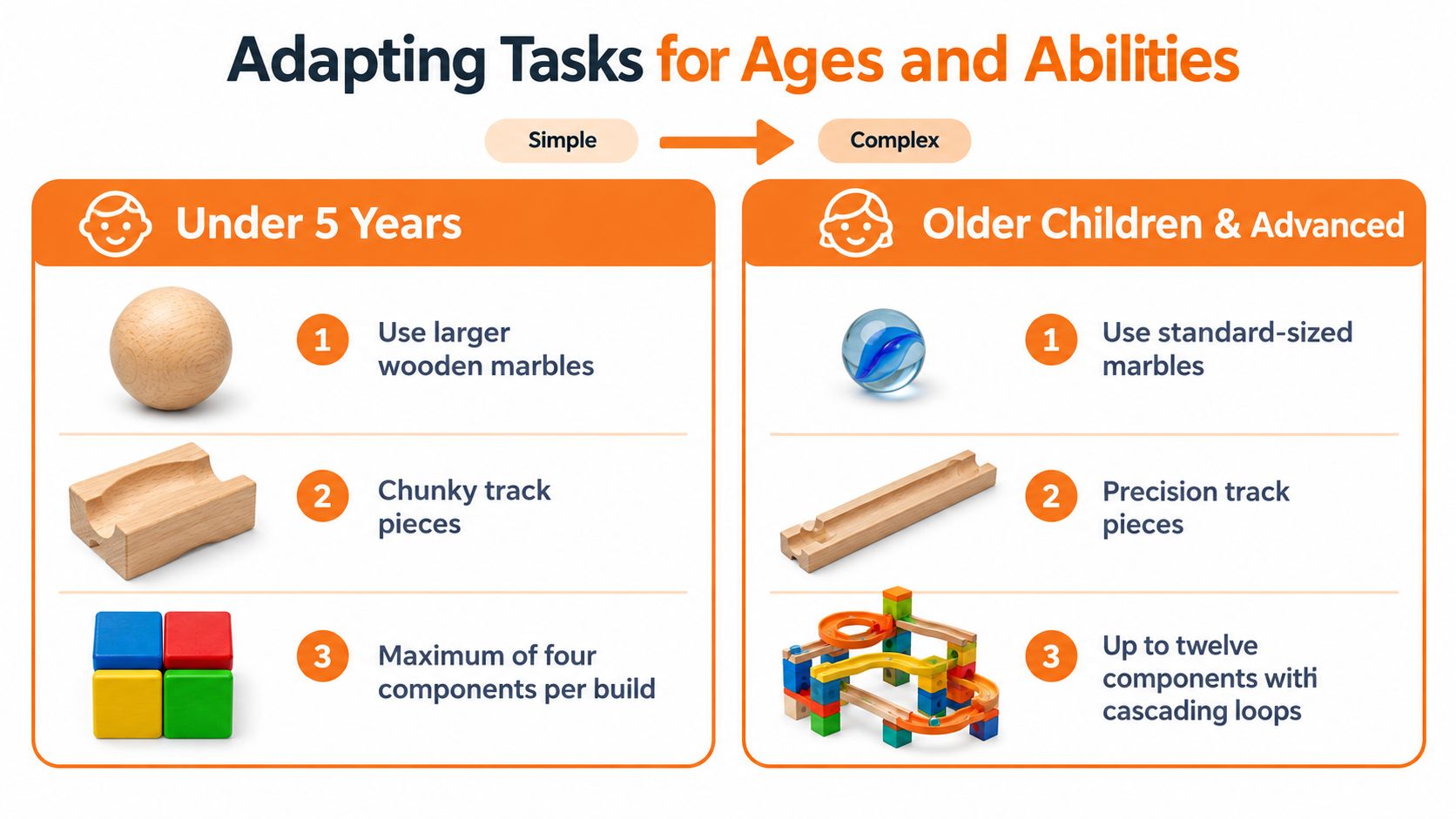
The best adaptations change one variable at a time. If you alter the materials, the rules, and the timing all at once, you won't know what helped.
Younger children and early builders
For children under five, use larger marbles, chunky pieces, and short builds. I usually cap the build at a small number of components and keep the path visually obvious. At that age, the target is often simple sequencing and successful release, not precision engineering.
What doesn't work well is giving a young child a large mixed kit with multiple path options and expecting clean planning. That often shifts the task from problem-solving to rummaging.
School-age children, older students, and adults
For primary-aged children, the task gets stronger when you add a no-touch rule after release and a time target. That shifts the focus from “make something” to “build, observe, and self-monitor”.
Older students and adults in rehabilitation usually need narrower tolerances to stay engaged. Useful adjustments include:
Tighter end targets: Add a small landing zone or require the marble to stop in a specific area.
Extra route demands: Require more than one direction change or a crossover.
Dual-task load: Ask the participant to count runs, remember a short sequence, or explain the plan while building.
Adaptations for common challenges
Specific impairments call for specific substitutions.
Tremor or reduced motor steadiness: Use weighted bases, wider channels, and rubberised surfaces that don't slide.
Low vision: Use high-contrast marbles, matte light-coloured tracks, and a dark mat underneath.
Attention difficulties: Keep builds short, present one goal per attempt, and use a visible timer only if it helps rather than pressures.
Language load concerns: Demonstrate the first rule physically instead of relying on long verbal instructions.
A useful buying and planning issue in Canada is that marble run products can look similar while functioning very differently, with listings ranging from under C$35 budget sets to C$449.99 premium Cuboro sets, across magnetic, wooden, gear-driven, and motorised formats (Canada marble run product overview). That's exactly why choosing by goal works better than choosing by appearance.
Linking Marble Runs to Digital Cognitive Tracking
A marble run session produces more useful data than many people realise. Not deep data. Useful data.

What to log after each run
A one-page sheet is enough if you use it consistently. I'd record:
Completion time
Error count
Rebuild attempts
Rule violations
A short note on persistence or strategy
Once you collect the same few observations over repeated sessions, the task stops being a one-off activity and starts functioning like a trend line. You can compare home and school performance. You can see whether faster completion comes at the cost of more rule breaks. You can notice whether planning improves before speed does.
Turning play into trackable progress
There's still an equity and classroom-use gap in Canadian coverage. Educational material does link marble runs to mechanics, energy, and Ontario science expectations, but the available resource base is still much closer to a lesson sheet than a broad outcomes framework for inclusion, classroom adoption, or clinic use (Western Engineering marble run activity).
When clinicians or educators want to formalise those observations, a digital platform can help organise repeated notes into comparable metrics. Orange Neurosciences is one option for that kind of tracking. Its tools support cognitive assessment, progress reporting, and repeat measurement, so marble run observations around attention and planning can sit beside other structured task data rather than living in scattered session notes.
A good score sheet doesn't replace clinical judgement. It gives that judgement a stable place to land.
A Practical Checklist and Where to Go Next
If you want to use a marble run game well this week, keep the setup simple and the rules concrete.

A short practitioner checklist
Choose one format: Match the kit to the goal first. Wooden for quiet precision, magnetic for flexible builds, gear-driven for complex sequencing, digital for reduced motor demand.
Set one measurable constraint: Use a clear target such as a run under 5 seconds or a build with a crossover that sits at least 5 cm above the track, based on the linked classroom design tasks already noted above.
Define the scoring rule before starting: Decide what counts as success, what counts as a rule break, and whether the child gets unlimited rebuilds or a fixed cap.
Add one adaptation per participant: Change only what the child needs, such as a larger marble, stronger contrast, or fewer parts.
Log the result the same day: Record what changed between attempts while the session is still fresh.
The marble run game works best when you stop treating it as filler. It's a compact, observable task that can reveal far more than “likes construction toys” or “needs help with focus”. If you want the session to carry into school reports, caregiver feedback, or future treatment planning, write down what the child built, what failed, what changed, and what finally worked.
If you're ready to move from informal observation to structured tracking, Orange Neurosciences offers cognitive assessment and therapy tools that can help organise session data from activities like marble runs into clearer progress patterns. It's a practical next step for clinicians, educators, and families who want attention, planning, and coordination work documented in a way that can be reviewed and shared.

Orange Neurosciences' Cognitive Skills Assessments (CSA) are intended as an aid for assessing the cognitive well-being of an individual. In a clinical setting, the CSA results (when interpreted by a qualified healthcare provider) may be used as an aid in determining whether further cognitive evaluation is needed. Orange Neurosciences' brain training programs are designed to promote and encourage overall cognitive health. Orange Neurosciences does not offer any medical diagnosis or treatment of any medical disease or condition. Orange Neurosciences products may also be used for research purposes for any range of cognition-related assessments. If used for research purposes, all use of the product must comply with the appropriate human subjects' procedures as they exist within the researcher's institution and will be the researcher's responsibility. All such human subject protections shall be under the provisions of all applicable sections of the Code of Federal Regulations.


© 2026 by Orange Neurosciences Corporation