Double Decision Games: What They Are and How They Work

A clinician can often spot the problem before a formal assessment confirms it. A student watches a busy screen, identifies the central object, then hesitates when a second signal appears at the edge of vision. An older adult reports that driving feels less comfortable, yet performs adequately on a simple reaction-time task. A person recovering from concussion responds accurately, but too slowly when attention must be divided.
These moments explain the appeal of double decision games. They place two perceptual decisions into the same brief trial, then adjust the challenge as the user responds. The result isn't a complete cognitive assessment or a promise of broad improvement. It's a focused way to examine and train speeded attention within a wider, evidence-informed workflow.
Why a Dual-Target Speed Task Belongs in Your Toolkit
Single-target reaction tasks show whether someone responds quickly to one stimulus. They reveal less about the executive cost of dividing attention between a central event and information appearing in the periphery. That distinction matters when a clinician is examining concussion-related concerns, ADHD, rehabilitation needs, or age-related changes in cognitive performance.
Double Decision focuses on the point where these demands meet. It combines:
Central discrimination, such as identifying one type of vehicle.
Peripheral detection, such as locating a road sign.
Divided attention, because both decisions occur within the same trial.
Speeded response selection, because the person must preserve accuracy as the display becomes more demanding.
The task therefore provides a focused window into processing two competing signals quickly enough to guide a response. It does not explain every reason a person may work slowly, miss information, or struggle in daily activities. Interpretation still depends on history, symptoms, observation, and other measures.
Practical rule: Use the task as one focused probe, not as a stand-alone explanation for a person's difficulties.
Its brief format can fit within a broader appointment, while the dual demand may reveal difficulty that remains hidden during quiet, single-focus testing. A clinician might use it alongside symptom inventories after concussion, classroom observations during an ADHD evaluation, or functional measures in an older-adult programme. Educators can use the results to decide whether a learner needs fuller assessment, rather than assuming that slow work reflects motivation.
The cognitive assessment tools guide can help clinicians position a speed-and-attention task beside measures of memory, executive function, and functional performance. This makes Double Decision useful as one component of a digital cognitive care workflow, where a focused task contributes a specific observation and other tools supply the wider context. Double Decision is an anchor for a workflow, not the workflow itself.
What Double Decision Games Are
A driver checks a road sign while tracking a vehicle ahead. Double Decision recreates that split-second problem on a screen: two visual targets appear together, one near the centre and one in the peripheral field. The user classifies both before making two corresponding responses.
A typical trial follows four steps:
A central image appears briefly. The user decides whether it shows a car or a truck.
A peripheral road sign appears away from the centre. The user decides whether it points left or right.
The user gives both answers with two button presses or taps.
The programme adjusts display timing according to performance.
The central image calls for focused discrimination. The peripheral sign requires the user to register information outside the fovea. Because both targets must remain available, the task tests coordinated visual attention rather than a single reaction to one object.
Why adaptation matters
The task is built around the speed-accuracy tradeoff. As performance improves, the display duration shrinks. If accuracy falls, the programme can reduce the demand. This adaptive titration keeps the challenge close to the person's perceptual limit, rather than leaving an experienced user underchallenged or overwhelming someone who is struggling.
That feature distinguishes the proprietary Posit Science and BrainHQ Double Decision task from generic mobile applications marketed as double decision games. An app may show two objects or request rapid taps without using adaptive timing or validated scoring. Before comparing results, a clinician should identify the exact programme, stimulus version, scoring system, and access conditions.
The practical setup is modest. A session generally takes 5 to 10 minutes and requires a screen plus a keyboard or touchscreen. Within a digital cognitive care workflow, the task can serve as one focused speed-and-attention measure, while history, symptoms, functional observation, and other assessments supply the clinical context. For a broader examination of response-based digital exercises, see this guide to reaction time games.
The Cognitive Targets Behind the Task
The task's mechanics map onto several related abilities, but they shouldn't be treated as interchangeable. A user needs peripheral visual processing speed to register the sign, central perceptual discrimination to identify the vehicle, and divided attention to keep both targets active. Inhibitory control also matters because the user must resist responding to only the most visually salient item.
The executive component appears when both signals arrive close together. The user has to map each classification onto the correct response, preserve the decision rule, and avoid allowing one target to disrupt the other. That is why a high score shouldn't automatically be labelled “strong executive function”. The task directly measures speeded perceptual decision-making. Executive control is a reasonable interpretation of the coordination required, but it remains an inference unless supported by broader measures.
The task has roots in the ACTIVE speed-training programme, and related work has examined whether processing-speed training can affect driving and everyday activities. The most defensible clinical interpretation is that adaptive perceptual practice may support performance on closely related speed and attention outcomes, while transfer to broad cognition or daily independence requires separate measurement.
For clinicians explaining what processing speed means, a useful analogy is a busy receptionist. The receptionist isn't merely seeing messages. They're identifying which message belongs to which person, holding several details briefly, and routing each one without confusing the channels.
Cognitive Domain | Task Mechanism | Real-World Transfer |
|---|---|---|
Peripheral visual processing | Detecting a target outside central gaze | Noticing relevant information at the side of a roadway or classroom |
Central discrimination | Classifying the central object | Rapidly distinguishing visual categories |
Divided attention | Processing central and peripheral targets together | Managing concurrent visual demands |
Inhibitory control | Resisting an incomplete or incorrect response | Avoiding impulsive responses when signals compete |
Stimulus-response mapping | Linking each classification to the correct input | Selecting the appropriate action under time pressure |
These skills also matter beyond clinical testing. Readers supporting students can review this resource on college readiness and executive function for a broader view of planning, attention, and self-management. Double Decision can contribute a focused processing measure, but it can't establish how a student organises assignments, monitors deadlines, or manages complex academic demands.
How Double Decision Compares to Broader Cognitive Training
A patient may improve on a repeated Double Decision session while still needing help with planning, memory, or daily routines. That outcome is not contradictory. Double Decision is a focused, high-load exercise that combines two related perceptual classifications at speed. A broader computerized suite may sample memory, reasoning, language, and other attention skills. CANTAB or CNS Vital Signs serves a different role again, offering multiple measures to support clinical interpretation rather than repeated practice of one demanding mechanism.
The distinction is useful when choosing a tool. Training asks whether performance changes with practice on a target task. Assessment asks how the person performs across tasks, contexts, and functional demands. The ACTIVE trial provides an important reference point for speed-of-processing training in healthy older adults. It does not establish that every commercial brain game has the same evidence, or that one exercise can replace a full evaluation.
A speed score also needs a functional question beside it. Timed Activities of Daily Living and driving-related tasks can help examine whether change extends beyond the screen. If in-task responses become faster while familiar routines remain difficult, the functional findings should shape the next clinical decision.
Broader care may combine targeted drills with cognitive remediation therapy, strategy coaching, environmental supports, and fuller rehabilitation planning. Hearing and communication deserve attention in programmes for older adults because sensory barriers can reduce participation and increase cognitive load. This resource on hearing loss cognitive health in Boca Raton offers relevant background for considering that part of the assessment.
Format | Session Length | Primary Target | Evidence Base | Best Fit |
|---|---|---|---|---|
Double Decision | Brief, repeated practice | Speeded divided attention | Specific task and speed-training research | Focused perceptual training and progress tracking |
Multi-domain cognitive suite | Varies by programme | Several cognitive abilities | Depends on the individual modules | General cognitive engagement and broader practice |
Neuropsychological battery | Longer appointment | Multiple domains and patterns | Standardised clinical assessment | Diagnostic formulation and differential assessment |
Classroom or rehabilitation programme | Scheduled blocks | Selected cognitive and functional skills | Programme-specific | Structured support in school or care settings |
The practical rule is clear. Choose the format according to the question you need answered. Use Double Decision for a focused, adaptive speed-and-attention exercise, then pair it with measures tied to the person's actual goals. That combination places the task within an evidence-informed cognitive care workflow, rather than treating a single score as a complete picture.
Protocols and Outcome Measures That Hold Up in Practice
A usable protocol starts with consistency. Set the display at a comfortable, calibrated level, keep the viewing distance stable, reduce distractions, and use the same response method where possible. A keyboard may suit one clinic, while a touchscreen may be more accessible in a school or senior setting. Record the setup rather than assuming that every score reflects cognitive change alone.
A practical programme can use 10 to 15 minutes per session, 4 to 5 sessions per week, across at least 8 to 10 weeks, following a dosage pattern described in the protocol plan. The schedule should remain realistic for the setting. A school may place sessions at a predictable time, a clinic may supervise the first attempt and review later sessions, and a senior residence may need staff support for login, seating, hearing, vision, and fatigue.

Match dosage to outcomes
Don't treat completion as the primary outcome. Select measures before training begins:
Visual attention and speed: Useful Field of View, Digit Symbol, or relevant NIH Toolbox Cognition Battery sub-scores.
Executive sequencing: Trail Making A and B, interpreted with care and alongside other findings.
Functional performance: Timed Activities of Daily Living or driving-scene measures when those activities are clinically relevant.
Daily experience: The Cognitive Failures Questionnaire can capture perceived slips that may not appear during a brief computer task.
Build a simple loop: baseline, midpoint review, post-test, and a later booster check. A later reassessment is useful because practice familiarity can make early gains look larger than they are, while untrained abilities may not change at the same pace. Clinicians can also review this resource on test-retest reliability before interpreting repeated scores.
Documentation prompt: Record the stimulus version, latency thresholds, errors, response method, attendance, and perceived effort at every review point.
Adapting the Task Across Age and Impairment
A child who is six may understand the rule but lose the thread when the screen changes too quickly. An instructor can use larger targets, slower onset, cartoon-style stimuli, shorter blocks, and an assistance mode that supports the first practice trials. The accommodation should make the rule understandable without removing the divided-attention demand that gives the task its meaning.
An adolescent returning after concussion presents a different problem. The clinician may begin with a lower load, monitor symptom flare-ups, and combine the task with symptom ratings and functional observations. Dual-task approaches in concussion research use the same broad logic, asking whether a person can manage competing demands rather than perform one isolated response.
Adaptation should preserve the construct
For adults over 65, pacing, lighting, hearing support, and rest can matter as much as the software. A person who performs poorly after a tiring appointment may be showing reduced endurance rather than a stable processing limitation. In a rehabilitation setting, a speech-language pathologist may collaborate on post-stroke attentional retraining, while ADHD coaching may pair the task with behavioural rating scales and practical routines.
For mild cognitive impairment, shorter blocks and clear feedback cues can reduce unnecessary frustration. For children, instructors can use concrete language such as, “find the middle picture, then check the sign at the side,” instead of introducing abstract terminology.
The same principle applies across users: change access conditions without changing the therapeutic target unless you document the change. If the clinician slows every display, enlarges every target, or provides repeated cues, the resulting score may no longer represent the standard task. That doesn't make the adaptation wrong. It means the score must be labelled accurately and interpreted within that version.
Limits, Risks, and Ethical Use
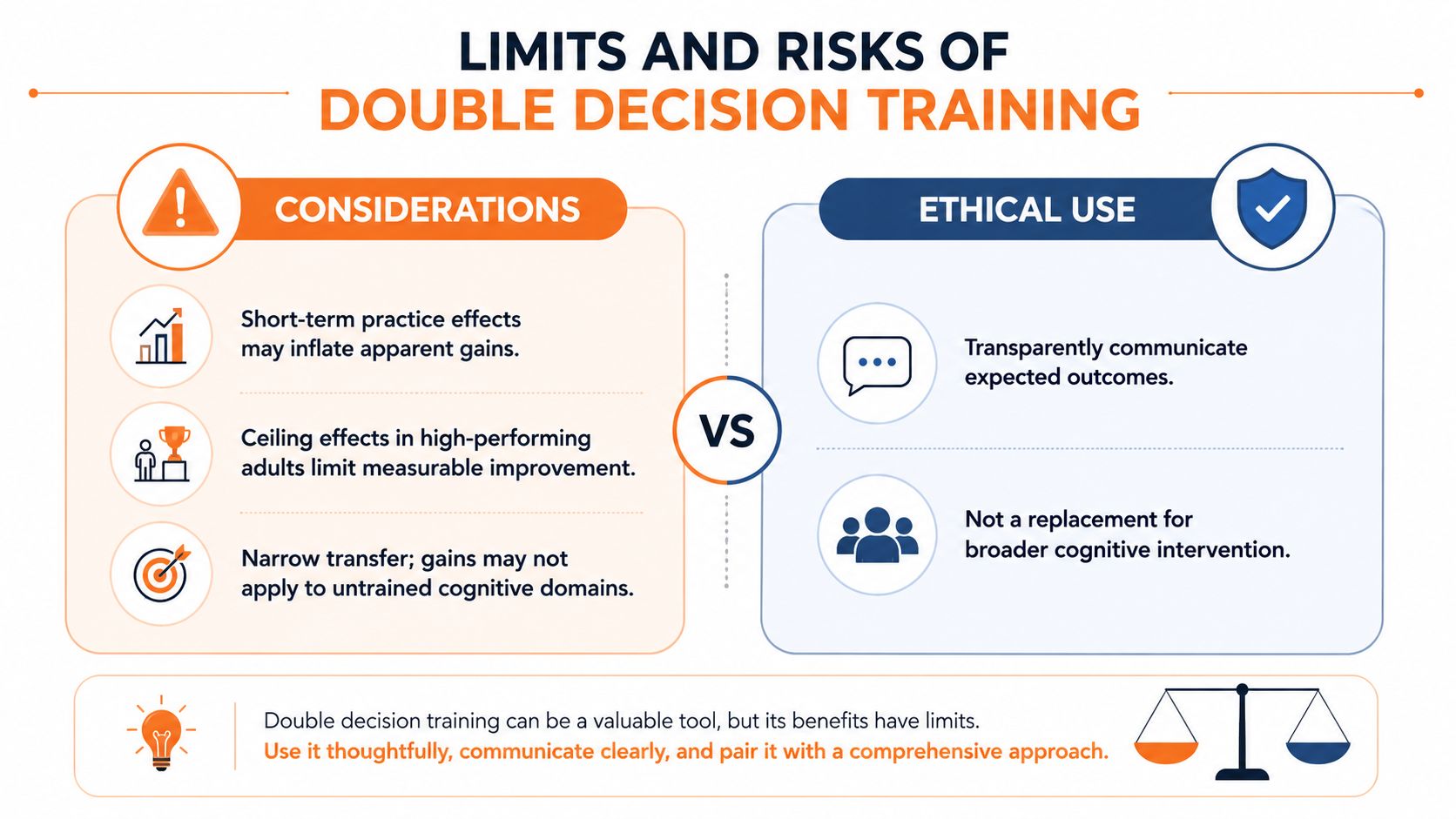
A fast, engaging task can create a misleading sense of certainty. Repeated exposure may produce practice effects, especially when the user learns the response pattern. High-performing adults may also reach a ceiling, leaving little room for measurable improvement. Even a genuine gain on the exercise may remain narrow if the person hasn't practised the everyday skill that matters to them.
The task can't replace a full neuropsychological battery. It also shouldn't be used when conditions make the score difficult to interpret, including severe visual impairment, uncontrolled movement disorders, acute psychiatric crisis, substantial fatigue, or post-concussive symptom flare-ups. These situations call for clinical judgement, accommodation, postponement, or a different assessment approach.
Keep the language proportionate
Marketing confusion is another risk. Vendor explanations may present Double Decision as an updated version of a speed-training task from the ACTIVE lineage, while independent Canadian implementation evidence remains limited for reimbursement, rural access, bilingual delivery, subgroup response, and routine clinical outcomes. The Quebec study described in Canadian coverage is relevant, but it involved 92 relatively healthy older adults, so its findings shouldn't be generalised automatically to people with dementia, stroke, ADHD, or concussion. The intervention group completed 30 minutes of daily training for 10 weeks and showed a 2.3% increase in acetylcholine upregulation, compared with a natural average decline of about 2.5% per decade, as reported in the Canadian Double Decision study summary.
Tell families that the exercise measures and trains a specific set of speeded attention skills. Obtain consent for repeated testing, explain how results will be used, and avoid making students feel that performance is a grade. A responsible explanation is honest without being dismissive: the task is useful for a targeted question, but it can't diagnose a condition, predict a person's future, or substitute for broader care.
Bringing Double Decision Into Your Workflow
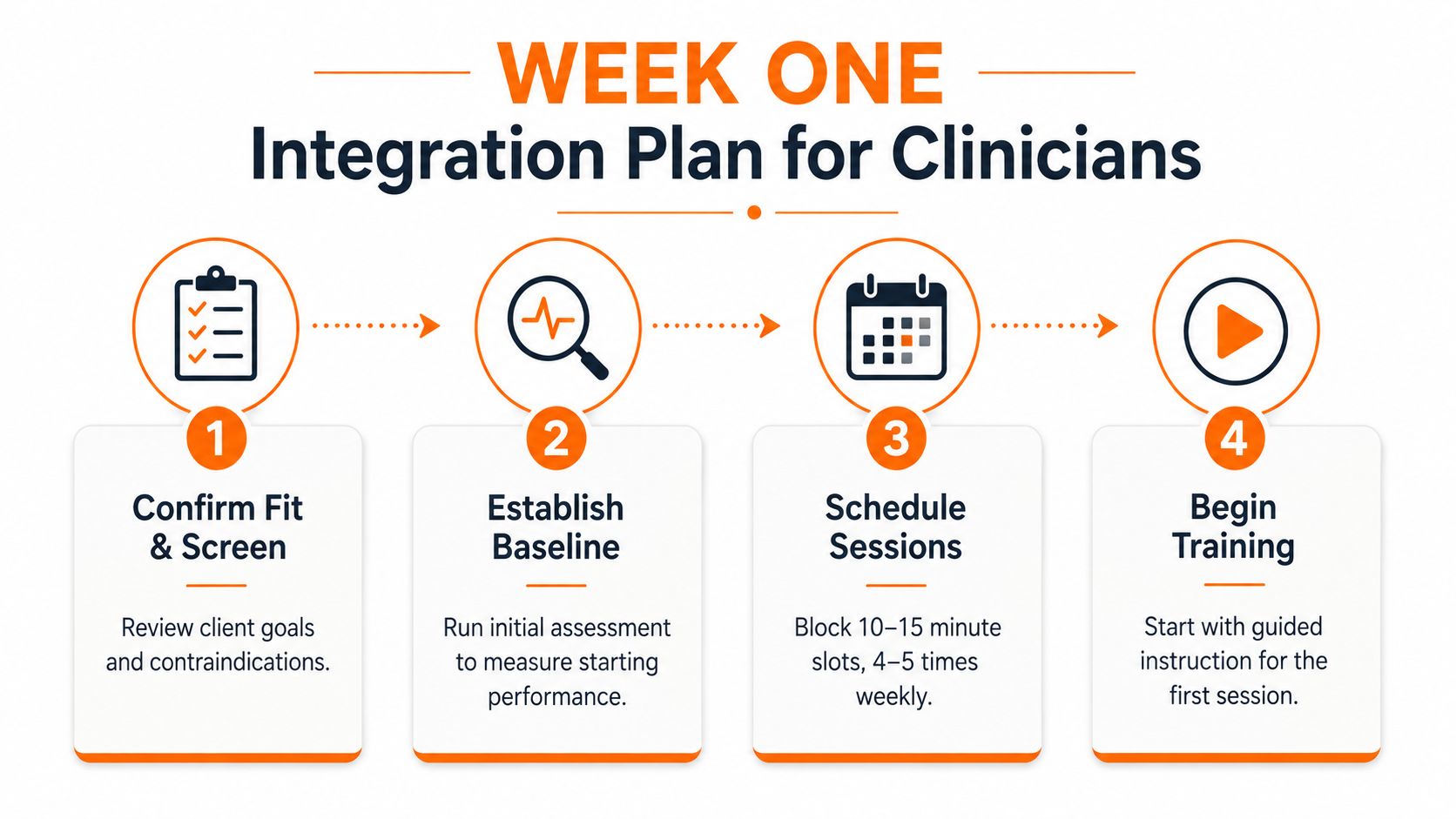
A busy clinician can begin with a small, documented pilot rather than adding a complex programme all at once.
Confirm fit. Review the client's goal, vision, movement, fatigue, symptoms, and consent. Decide whether the task is appropriate for screening, training, or outcome monitoring.
Establish a baseline. Run the task beside one complementary attention or processing measure. Record the stimulus version, errors, latency thresholds, response device, and perceived effort.
Schedule practice. Block short sessions several times each week and identify who will support access, positioning, instructions, and symptom monitoring.
Compare with function. Re-test after the planned block, then compare the result with a meaningful goal, such as classroom completion, safer visual scanning, or driving-related processing.
The Canadian context deserves careful interpretation. A Québec government summary describes a study of 129 students aged 12 to 17 in which five weeks of NeuroTracker training increased measured attention by 10%, while a separate Canadian longitudinal cohort of 1,467 youth found that video-game play at age 12 positively predicted ADHD symptoms at age 13. Together, these findings support a measured position: high-load training can produce measurable attention-related changes, but game exposure and design aren't uniformly beneficial. The Québec research summary is useful context when discussing why task structure matters.
Escalate to a full clinical evaluation when results conflict with classroom, work, driving, or family observations, or when the person reports substantial impairment outside the programme. Orange Neurosciences offers objective cognitive assessment and game-based training tools, including Double Decision within ReadON, where the exercise can be assigned when visual-processing difficulty is identified. The platform is one option for organising assessment, targeted practice, and reassessment, rather than a replacement for clinical judgement.
Visit Orange Neurosciences to review how its assessment and targeted training tools can place Double Decision inside a broader cognitive-care workflow. Use the platform details to plan a focused baseline, guide practice, and track whether changes connect with the world goals that matter to your client, student, or family.

Orange Neurosciences' Cognitive Skills Assessments (CSA) are intended as an aid for assessing the cognitive well-being of an individual. In a clinical setting, the CSA results (when interpreted by a qualified healthcare provider) may be used as an aid in determining whether further cognitive evaluation is needed. Orange Neurosciences' brain training programs are designed to promote and encourage overall cognitive health. Orange Neurosciences does not offer any medical diagnosis or treatment of any medical disease or condition. Orange Neurosciences products may also be used for research purposes for any range of cognition-related assessments. If used for research purposes, all use of the product must comply with the appropriate human subjects' procedures as they exist within the researcher's institution and will be the researcher's responsibility. All such human subject protections shall be under the provisions of all applicable sections of the Code of Federal Regulations.


© 2026 by Orange Neurosciences Corporation