Boost Your Reflexes With Reaction Time Games
Dec 11, 2025
When you hear "reaction time game," you might picture a simple online test where you click a button when the screen changes colour. But they're so much more than that. These games are powerful tools, not just for fun, but for measuring and actually sharpening your brain's processing speed.
Whether it’s a basic web-based tester or a sophisticated training platform, these games are all designed to do one thing: calculate the time it takes for you to see something, process it, and physically react. This guide provides actionable insights on how to use them effectively.
What Are Reaction Time Games Anyway?
Imagine your nervous system is a high-speed data cable. On one end, you have a sensor (your eyes). In the middle, a processor (your brain). And on the other end, an action (your hand clicking a mouse). Reaction time games measure exactly how fast a signal travels through that entire circuit. The final time isn't just about finger speed; it's the total duration of a complex neural journey.
This entire process unfolds in milliseconds, and it's a fundamental part of how we interact with the world. A practical example is slamming on the brakes in traffic or snatching a glass mid-fall. We're constantly putting our reaction skills to the test. These games just give us a structured, measurable way to see how we're doing and find ways to improve.
The Core Types of Reaction Tasks
Not all reactions are created equal. Different games focus on different types of tasks, and each one tells us something unique about our cognitive processing. Getting a handle on these distinctions is the first step to understanding their real value.
Simple Reaction Time: This is the most straightforward task. You have one predictable signal and one set response. A sprinter exploding off the blocks at the sound of the starting pistol is a perfect real-world example. There’s no decision-making involved—just a signal followed by a pre-planned, immediate action.
Choice Reaction Time: Now, things get a bit more interesting. This task presents multiple signals, each demanding a different response. Picture a hockey goalie facing a penalty shot; they have to instantly decide whether to block left, right, high, or low based on the shooter's subtle movements.
Recognition Reaction Time: This is all about filtering out the noise. A video gamer might see several enemy attacks trigger at once, but they have to respond only to the one that poses a direct threat, ignoring the rest. It's about spotting and reacting to the correct stimulus among a sea of distractions.
Why This Measurement Matters
Clocking these speeds isn't just for bragging rights. The data from reaction time games has some serious real-world applications. In a clinical setting, it can help gauge cognitive function related to attention disorders. For athletes, especially in the world of esports, shaving off even 10-20 milliseconds can be the difference between a win and a loss. To see how technology is pushing these boundaries, it's worth exploring how Augmented Reality Games are creating new, immersive ways to train these skills.
Reaction time is a direct measure of your brain’s processing efficiency. It reflects the speed at which your neural pathways can transmit signals from perception to action.
At the end of the day, these games offer a clear window into your cognitive performance. The connection between quick thinking and quick action is foundational to so many skills we rely on. Improving that connection often comes down to targeted practice, which is where these tools shine.
To see how these concepts fit into the bigger picture of cognitive training, check out our guide on eye-hand coordination exercises. Once you understand the fundamentals, it’s easy to see why these digital tools are so incredibly valuable.
The Brain Science Behind Faster Reflexes
Ever wonder what’s actually happening in your brain when you react to something? It's far more than just "fast reflexes." It's a high-speed biological cascade, a perfectly timed sequence of billions of neurons firing. This incredible journey—from seeing something to making a move—is the essence of what reaction time truly measures.
Think of it like a lightning-fast relay race happening inside your head. The starting pistol fires the moment a stimulus, like a shape changing colour in a game, hits your eyes. Your visual system instantly converts this light into an electrical signal that zips down your optic nerve.
But this signal doesn't just go from point A to point B. It arrives at a complex processing hub in the back of your brain, the occipital lobe, where the real work begins. Your brain has to decode the information and figure out what it just saw and what it means.
The Neural Relay Race
Once your brain understands the signal, the decision-making kicks in. This is where higher-level cognitive functions take over. Your brain's frontal lobe—the command centre for planning and executive function—has to choose the right response.
For a simple "see it, click it" task, this decision is almost instantaneous. But for more complex scenarios, like choosing between multiple targets, this stage takes a bit longer. The brain accesses memory, weighs the options, and finally issues a command. This entire cognitive process is a critical part of your total reaction time and hinges on your brain's efficiency.
At its core, reaction time is a measure of neural efficiency. It’s the speed at which your brain can perceive information, process its meaning, and send a precise command to your muscles. Faster reflexes are the direct result of a faster brain.
After the decision is made, the final leg of the relay begins. The command travels from the motor cortex in your brain, down through the spinal cord, and along a vast network of nerves to the specific muscles needed for the action—in this case, your hand and fingers. The race only ends when those muscles contract and you make the click. The entire journey happens in a fraction of a second.
Rewiring Your Brain for Speed
Here’s the most fascinating part: you can make this whole process faster. This isn’t wishful thinking; it’s a fundamental property of the brain called neuroplasticity. Just as lifting weights strengthens your muscles, consistently playing reaction time games strengthens the neural pathways involved in that task.
Every time you play, you're essentially paving a clearer, more efficient superhighway for those electrical signals. The connections between neurons, called synapses, become stronger and more robust. Your brain literally learns to anticipate the task, cutting down processing time and making the entire perception-to-action sequence smoother.
Myelination: With repeated practice, the nerve fibres along these critical pathways build up a fatty sheath called myelin. Think of it as insulation on a wire—it allows electrical signals to travel significantly faster.
Synaptic Pruning: Your brain also gets better at tuning out distractions and filtering out irrelevant signals, dedicating more resources to the task at hand. This improved focus directly contributes to quicker, more accurate responses.
Strengthening these neural connections isn’t just about raw speed. It also boosts other critical cognitive skills. To dive deeper into this, check out our detailed guide on how to improve executive function.
Ultimately, faster reflexes aren't an innate gift you either have or you don't. They are a trainable skill, directly tied to how efficiently your brain operates. By engaging in targeted training with reaction time games, you are actively remodelling your neural architecture for peak performance. The result is a brain that can process information and react to the world with greater speed and precision.
Choosing The Right Type of Reaction Game
Not all reaction time games are created equal. Just like a sprinter trains differently than a marathon runner, the game you choose should line up perfectly with your specific cognitive goals. Picking the right tool for the job is the first step, ensuring you're sharpening the exact skills you want to improve.
The world of reaction time games covers everything from dead-simple, single-stimulus tests to complex scenarios that require you to think on your feet. This variety is a huge advantage, as it allows for highly targeted training. Whether you're an esports athlete looking to tighten up your in-game decision-making or a clinician assessing cognitive function, understanding the different categories is key.
This flowchart helps visualize the core decision: are you trying to build raw processing speed, or is your goal to improve accuracy and decision-making skill?
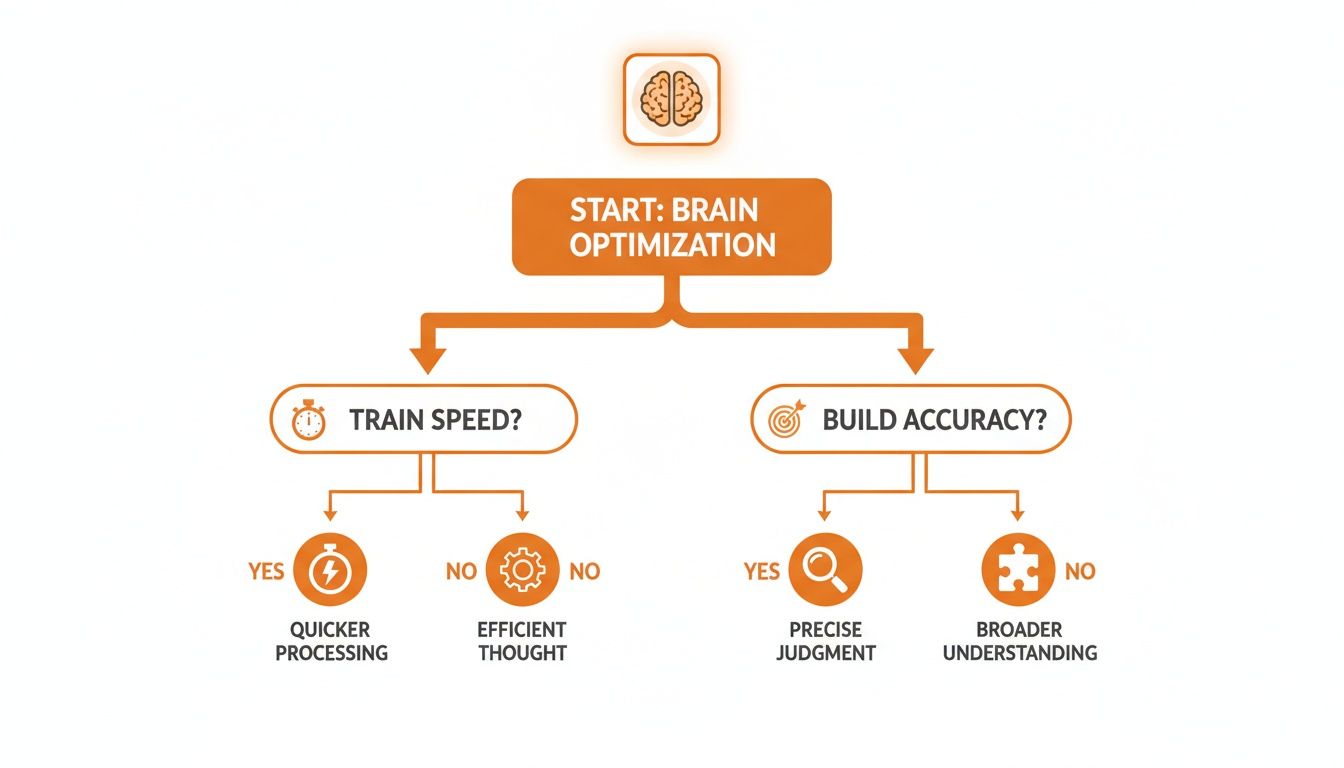
As you can see, the path you take depends entirely on your main objective. This choice will guide you toward games that prioritize either speed-based drills or challenges focused on precision.
Simple Reaction Time Games
These are the most basic type of reaction game, honing in on one thing and one thing only: pure processing speed. The task is straightforward—you see a single, predictable stimulus and perform a single, pre-set action as fast as you can.
What they train: These games directly target the core neural pathway from perception to action. They build raw reflex speed without adding the complexity of decision-making, improving how fast your brain can spot a signal and fire off a command to your muscles.
Practical Example: The classic online test where you "click when the screen turns green" is a perfect illustration. There's no choice or strategy involved, just the immediate need to react. Think of it as the digital equivalent of a sprinter exploding from the blocks at the sound of the gun.
Best for: Establishing a baseline reaction speed, warming up before more complex cognitive tasks, or training for activities that demand an immediate, pre-planned response.
Choice Reaction Time Games
Here's where things get more interesting. These games introduce decision-making into the mix, presenting multiple potential stimuli that each require a different response. This forces your brain not just to react, but to first identify the stimulus and then select the correct action.
Choice reaction time is a more realistic measure of cognitive agility. In most real-world scenarios, from driving to competitive sports, we don't just react—we have to choose the right reaction from several possibilities.
For example, a game might flash different coloured shapes on the screen, requiring you to press one key for a red circle and another for a blue square. This task measures both your processing speed and your decision-making accuracy under pressure, making it a much more comprehensive cognitive workout.
Recognition and Go/No-Go Games
This category takes choice reaction time a step further by adding the crucial element of inhibition. In these games, you're shown a stream of stimuli but are told to react only to a specific target while ignoring all the others.
This is often called a Go/No-Go task. It trains your brain to filter out irrelevant information and suppress impulsive actions—a vital executive function skill. The ability to withhold a response is just as important as the ability to initiate one quickly.
Practical Example: Imagine a game where various letters flash on the screen, but you must only click the mouse when you see the letter 'X'. Clicking on any other letter by mistake results in a penalty.
Best for: Improving focus, attention control, and impulse management. These games are especially valuable for athletes who need to ignore feints and for anyone looking to boost their concentration.
For a deeper look into improving this key cognitive skill, you might find our guide on how to improve focus and concentration helpful.
To make the differences clearer, here’s a quick comparison of the main game types and what they're designed to do.
Comparison of Reaction Time Game Types
Game Type | Primary Use Case | Cognitive Skills Measured | Best For |
|---|---|---|---|
Simple Reaction | Baseline speed assessment | Pure processing speed, motor reflex | Athletes (e.g., sprinters), basic cognitive screening |
Choice Reaction | Decision-making under pressure | Processing speed, selective attention, decision-making | Gamers, drivers, complex sports (e.g., team sports) |
Go/No-Go | Impulse control and attention | Sustained attention, response inhibition, focus | Individuals with ADHD, athletes (e.g., batters, goalies) |
Ultimately, the best reaction time game is the one that directly targets your needs. By figuring out whether your goal is to build raw speed, sharpen your decision-making, or fine-tune your focus, you can pick a tool that delivers effective, targeted training and helps you see measurable results.
How Your Gear and Gaming Habits Impact Speed
Think of your brain's processing power as the engine for quick reflexes. But the hardware you use and the habits you build? That’s your transmission and tires—they decide how much of that power actually hits the road. In the world of reaction time games and competitive esports, the link between your tech, your training, and your speed is undeniable. Shaving off even a few milliseconds can be the difference between winning and losing.
It’s tempting to dismiss gear as a minor detail, but when you're measured in fractions of a second, the right technology gives you a real, measurable edge. This isn't about luxury; it's about closing the gap between what happens on screen and your physical response.
This is more than just a theory; it’s a reality backed by stats. Look at how top-tier competitive gaming has evolved. Displays with refresh rates of 144Hz, 240Hz, and even 360Hz slash display latency, getting visual information to your eyes almost instantly. This alone can trim vital milliseconds off your response. Pair that with a low-latency gaming mouse to minimize input lag, and you're getting your reflexes much closer to their true neurological limit.
Optimize Your Hardware for Lower Latency
Latency, or lag, is the arch-nemesis of a fast reaction time. It’s that tiny delay between an action happening in the game and you seeing it, or the delay between your keypress and the action registering on screen. Your gear is your first line of defence against it.
High-Refresh-Rate Monitors: A standard 60Hz monitor shows you 60 images per second. A 144Hz or 240Hz monitor more than doubles or quadruples that. The takeaway is simple: you see things happen sooner, which gives you more time to react.
Low-Latency Peripherals: A gaming mouse with a high polling rate reports its position to your computer hundreds of times per second (e.g., 1000Hz), cutting down input lag. Mechanical keyboards actuate faster, ensuring your command registers the very instant you decide to make a move. Even your choice of device matters, which is why serious mobile gamers spend time researching the best gaming phones.
These upgrades aren’t just for the pros. Any player can feel the difference in responsiveness. Your gameplay just feels smoother and more connected to your actions.
Your gear doesn't make you faster, but it removes the barriers that make you slower. The goal is to create a setup where the only limitation is your own neural processing speed.
Beyond Gear: The Power of Deliberate Practice
Here’s the catch: the best equipment in the world is useless without effective training. Pro esports athletes don’t just grind games for hours on end; they engage in what’s known as deliberate practice. This is all about focusing intensely on specific, measurable skills and constantly pushing their own limits.
Instead of just queueing for another match, a pro might spend an hour on a specialized platform built to train one single skill, like flick-shot accuracy or target-switching speed. They pour over their performance data, pinpoint weaknesses, and then use targeted reaction time games to turn those weak spots into strengths.
This methodical approach is what separates good players from great ones. By drilling specific scenarios over and over, players build a deep-seated "muscle memory" and an intuitive feel for game patterns. It allows them to anticipate an opponent’s next move and start reacting before the stimulus even fully registers, essentially bypassing the slower, more conscious parts of decision-making.
Putting Reaction Time Training Into Practice
It's one thing to understand the science behind reaction speed, but quite another to actually start improving it. To get real results from reaction time games, you can't just play more—you have to play smarter.
Whether you're a clinician mapping out a patient's progress, a teacher helping a student, or just someone looking to sharpen your own mind, the approach is the same: choose the right tools and use them with a clear purpose.
For professionals, this means starting with scientifically validated platforms. These aren't your average app store games; they provide reliable, hard data for accurate assessments and engaging therapy. That precision is what allows you to track progress over time and know for sure if your intervention is working.
For individuals and gamers on a personal quest, the journey begins with a bit of self-awareness. It’s about knowing what your scores actually mean, setting goals you can realistically hit, and picking training apps built on real cognitive science, not just flashy graphics.
For Clinicians and Educators
When you bring reaction time games into your practice, everything hinges on structure and validity. The goal isn't just a high score; it's about gathering objective data to inform a larger care or educational strategy. You're looking for patterns and measuring genuine change.
Here are a few actionable steps to get you started:
Establish a Baseline: Before any training begins, you need a starting point. Use a validated assessment tool to get a clear measurement of reaction time, attention, and processing speed. This is the benchmark all future progress will be measured against.
Select Appropriate Games: Not all games are created equal. Choose tasks that target the specific cognitive skill you want to address. A simple stimulus-response game is great for raw processing speed, but a Go/No-Go task will give you much better insight into impulse control.
Track Progress Consistently: Regular reassessments are key. To ensure the data is reliable, conduct them under similar conditions each time. You're looking for trends over weeks and months, not just the small ups and downs from one session to the next. This data-first approach takes the guesswork out of the equation.
A validated game offers far more than just a score. It provides a standardized metric you can trust to reflect genuine cognitive function, making objective tracking possible—an absolute must for clinical and educational success.
For Individual Users and Gamers
If you're training on your own, you can be more flexible, but you still need a plan. The idea is to move from mindless playing to what we call deliberate practice.
First, get a handle on your scores. Don't obsess over a single result—your reaction time will naturally shift depending on how tired you are, if you've had coffee, or how focused you feel. Instead, look at your average performance over a week. Is the trend line heading in the right direction?
Next, set clear, realistic goals. "Get faster" is too vague. Try something concrete, like, "I want to decrease my average choice reaction time by 15 milliseconds over the next month." This makes your progress real and keeps you motivated. It’s also worth remembering that skills like reaction speed are tied to other cognitive functions. For a closer look at these connections, our guide on how to improve working memory offers some great insights.
By making smart choices, you can find the reaction time games that are perfectly aligned with your goals. To find a validated game designed for your specific needs—whether it’s for a clinical evaluation or to gain a competitive edge—explore the solutions available on our website.
Building Your Weekly Training Regimen
Anyone who's mastered a skill knows that sporadic effort doesn't cut it. Real progress comes from consistency. Integrating reaction time games into your weekly routine is the same—it doesn't have to be a huge commitment, but it absolutely needs a plan.
A structured schedule is what turns casual play into meaningful training, helping you avoid burnout while getting real, measurable results.
The "right" schedule isn't one-size-fits-all. For a clinician, it's about building a progress-tracking workflow. For a teacher, it's a quick way to prime students for learning. For a serious gamer, it’s a set of drills to gain a competitive edge. The goal is the same: be intentional.
For Clinicians: A Progress-Monitoring Workflow
In a clinical setting, reaction time games are fantastic tools for getting an objective baseline of a patient's cognitive function and tracking how they respond to treatment over time. A simple, structured workflow makes the data you collect consistent and powerful.
Initial Assessment: The first session is all about setting the benchmark. Use a standardized game to measure a patient's simple, choice, and recognition reaction times. This gives you a clear, objective starting point.
Weekly Check-ins: At the start of each weekly appointment, have the patient complete a short, 10-minute session. Using the same game under similar conditions is crucial for monitoring progress and spotting any meaningful changes or trends.
Monthly Review: Step back and look at the data collected over the month. Are you seeing steady improvement? That's a great sign your interventions are working. If things have plateaued, it might be time to adjust the treatment plan.
For Educators: A Classroom Focus Booster
Sometimes, the best way to get students ready for a challenging lesson is with a quick mental warm-up. A short, engaging game can do wonders for sharpening focus and getting everyone's brain in the right gear.
Practical Example: Before diving into a math lesson, get the class to play a 5-minute "Go/No-Go" game on their tablets. The task is simple: tap the screen only when a specific shape appears. It’s a fun exercise that trains selective attention and impulse control, paving the way for a more focused and engaged classroom.
For Individuals and Gamers
If you're training for personal improvement or to level up your gaming skills, balance is everything. Go too hard, and you'll hit mental fatigue. Go too easy, and your progress will crawl. A well-planned week helps you find that sweet spot.
Here’s a sample schedule that mixes intense work with crucial recovery:
Monday & Thursday (High-Intensity): Dedicate 15 minutes to a variety of choice reaction time drills. The goal here is to push your speed and accuracy to their limits.
Tuesday & Friday (Skill-Focus): Spend 10 minutes zeroing in on a specific weakness. A Go/No-Go game, for instance, is great for improving impulse control. Training attention is a huge piece of the puzzle, and you can dive deeper in our guide on how to improve attention span.
Wednesday (Active Rest): Kick back with a less demanding game. Choose something fun that still keeps your reflexes engaged but doesn’t feel like a workout.
Saturday & Sunday (Rest): Take these days completely off. Your brain needs downtime to consolidate what you've learned and strengthen those neural pathways. Rest isn't optional; it's part of the training.
By following a structured plan like this, you transform random gameplay into a powerful tool for cognitive enhancement. To get started with validated games and assessment tools, explore the solutions available on the Orange Neurosciences website.
Your Top Questions About Reaction Time Games
When you start digging into reaction time training, a few questions always seem to pop up. It doesn't matter if you're a clinician, an athlete, or just someone curious about sharpening your mind—getting clear answers is the key to using these powerful tools effectively. We've pulled together the most common questions to give you some straightforward insights.
This part of the guide is all about tackling those common concerns, so you can understand the finer points of using reaction time games for real, lasting improvement.
Can I Actually Improve My Reaction Time for Good?
Absolutely. With consistent practice, you can definitely make lasting improvements. Your brain has this amazing ability called neuroplasticity, which is just a fancy way of saying it can build stronger, faster connections for the tasks you repeat. Think of it like paving a dirt road—the more you use it, the smoother and faster it gets.
So while your genetics might set a starting point, dedicated training can seriously sharpen how quickly you process information and react. The catch? These gains are often specific to the task you’re training. To keep your edge, you need to keep practicing, just like you’d go to the gym to maintain muscle strength.
Lasting improvement isn't about chasing a single high score. It's about building more efficient neural "highways" through consistent practice. Over time, this training helps make your brain's entire perception-to-action sequence quicker and more automatic.
Are Those Free Online Reaction Tests Accurate?
Honestly, the accuracy of free online tests is all over the map. They can be a fun way to get a quick, informal idea of where you stand, but they come with a lot of baggage. Things you have no control over—like your computer’s processing power, monitor lag, or even a slow internet connection—can add precious milliseconds to your score. That makes the results pretty unreliable for anything serious.
If you need dependable and valid measurements, especially for clinical assessments or research, you have to use a scientifically validated platform. These systems are specifically designed to control for all those outside factors, giving you standardized, trustworthy data you can actually count on.
How Long Does It Take to See Results?
That's the million-dollar question, and the answer is: it depends. A few things come into play, like your starting skill level, how consistent you are with your training, and the specific reaction time games you're using. That said, many people start to feel a noticeable difference within just a few weeks of consistent practice—think 10-15 minutes a day, 3-5 times a week.
But if you're aiming for significant, long-term gains, you should be thinking in terms of months, not weeks. Progress isn't always a straight line, either. You might hit a plateau where it feels like you're not improving, but that’s a completely normal part of the learning process. Stick with it.
Ready to go beyond basic online tests and start a training program built on science? Explore the assessment and training tools offered by Orange Neurosciences to get reliable data and build a structured plan for cognitive enhancement. You can learn more by visiting us at https://orangeneurosciences.ca.
Orange Neurosciences' Cognitive Skills Assessments (CSA) are intended as an aid for assessing the cognitive well-being of an individual. In a clinical setting, the CSA results (when interpreted by a qualified healthcare provider) may be used as an aid in determining whether further cognitive evaluation is needed. Orange Neurosciences' brain training programs are designed to promote and encourage overall cognitive health. Orange Neurosciences does not offer any medical diagnosis or treatment of any medical disease or condition. Orange Neurosciences products may also be used for research purposes for any range of cognition-related assessments. If used for research purposes, all use of the product must comply with the appropriate human subjects' procedures as they exist within the researcher's institution and will be the researcher's responsibility. All such human subject protections shall be under the provisions of all applicable sections of the Code of Federal Regulations.


© 2026 by Orange Neurosciences Corporation