BAI Scoring Interpretation Guide for Clinicians

A completed Beck Anxiety Inventory lands on your desk with one total score and almost no story. The patient may have selected a high response for dizziness, trembling, or a racing heart, but the number doesn't tell you whether those symptoms reflect panic, medication effects, a medical condition, situational stress, or anxiety that is interfering with daily life.
That's why BAI scoring interpretation is more than matching a total to a severity table. The score is a structured signal. The interview, functional history, medical context, cultural and language factors, and repeated observations give that signal meaning. A clinician, counsellor, school team, rehabilitation provider, or EAP professional can use the result to decide whether to reassure, monitor, refer, or broaden assessment.
This guide moves from scoring mechanics to clinical judgement. You'll learn how to calculate and explain the result, compare two recognised banding systems, work through practical examples, interpret change over time, and document the result clearly. For a wider overview of screening choices, see this guide to mental health screening tools.
Introduction to BAI Scoring Interpretation in Practice
Consider a patient who completes the BAI before an appointment and receives a total in the moderate range. The patient asks, “Does this mean I have an anxiety disorder?” A rushed answer turns a screening result into a diagnosis. A better answer treats the score as a starting point: it identifies symptom burden, then invites questions about onset, triggers, physical health, sleep, avoidance, mood, and functioning.
The Beck Anxiety Inventory, or BAI, measures anxiety symptoms, but it doesn't establish a diagnosis by itself. A high total can support the decision to complete a fuller assessment. A lower total doesn't remove the need to ask about distress, safety, impairment, or symptoms that the questionnaire may capture less effectively.
Practical rule: Interpret the score as a prompt for the next clinical question, not as the final clinical conclusion.
A structured approach helps several groups. Clinicians need consistent triage language and defensible notes. Counsellors and therapists need a way to compare a patient's current symptom burden with their own baseline. Researchers and programme teams need stable categories when they report findings. Families and patients need an explanation that is accurate without making a single questionnaire feel like a verdict.
What the score can contribute
The BAI can help you describe the frequency and intensity of anxiety-related symptoms within the measure's scope. It can support a conversation about whether symptoms are mild and manageable, substantial enough to warrant referral, or severe enough to require prompt clinical attention.
It can also improve handoffs. A referring professional might document the total, the severity band used, prominent symptoms, functional effects, relevant medical factors, and the planned follow-up. That gives the next practitioner more than an isolated number.
What it cannot settle
The BAI doesn't tell you whether symptoms are caused by panic, generalised anxiety, trauma-related distress, depression, medication, substance use, sleep disruption, or a physical illness. It also doesn't replace a culturally and linguistically appropriate assessment, particularly when the administration language isn't the patient's strongest language.
By the end of a careful review, the useful outcome isn't just a label. It's a clear decision about what to ask next, who should be involved, how urgently to respond, and what information should be tracked over time.
How the BAI Is Scored and What the Total Means
The BAI contains 21 items, and each item contributes to a total score on a 0–63 scale. The total comes from adding symptom frequency and intensity across all items, so the final number represents the combined burden recorded by the respondent, not a percentage and not a diagnostic probability. The Shirley Ryan AbilityLab overview of the Beck Anxiety Inventory describes this same item count, score range, and severity framework.
A practical way to explain the calculation is to think of each item as a signal channel. One channel might register very little distress, while another registers a strong physical symptom. The total adds the signals together. It doesn't tell you that every symptom is equally important, and it doesn't show which symptom is driving the result, so item-level review still matters.

A reliable scoring routine
Use the same basic check each time:
Confirm completion. Look for unanswered items before interpreting the total. A missing response can make the sum incomplete.
Verify each response. Enter each item once and preserve the selected response value.
Add the item scores. The total must fall within the BAI's 0–63 range.
Review the pattern. Note whether the score is driven mainly by physical sensations, fear-based experiences, tension, or several symptom groups.
Add context. Record the time frame used, the patient's own description, and the effect on work, school, relationships, sleep, or daily tasks.
A patient may understand the result more easily if you avoid psychometric jargon. You might say, “This questionnaire adds your responses across 21 anxiety symptoms. Your total suggests how much anxiety-related distress you reported within the questionnaire, but it doesn't tell us the cause or provide a diagnosis. Let's look at what you've been experiencing and what support would be useful.”
The BAI should also be distinguished from other tools rather than treated as interchangeable with them. For example, the Beck Depression Inventory scoring guide addresses a different symptom domain. Someone seeking a low-barrier first step may also find an online anxiety screening tool useful, provided the result is treated as screening information rather than a substitute for professional assessment.
Severity Bands and Cutoffs You Can Apply Today
The most commonly used clinical interpretation divides the BAI total into four bands: 0–7 minimal, 8–15 mild, 16–25 moderate, and 26–63 severe anxiety. Under this framework, 16 is the first score typically classified as at least moderate, while 26 or above enters the severe range. These thresholds can help a California clinic, school programme, or community service decide whether to monitor symptoms, explore referral, or arrange a fuller assessment. The BAI scale reference from AISel presents the same fixed bands and highlights the practical significance of a score at or above 16.
The labels are useful, but they aren't self-explanatory. A score in the mild band may still interfere with sleep or participation. A score in the severe band may reflect acute distress that needs prompt evaluation, while the questionnaire alone still won't identify the underlying condition.
Two banding systems, one score range
An alternate historical interpretation uses 0–9 normal or no anxiety, 10–18 mild-to-moderate, 19–29 moderate-to-severe, and 30–63 severe. The historical discussion of BAI interpretation in a peer-reviewed article shows why older reports and publications may use different labels for the same total.
Score Range | Standard Clinical Band | Alternate Historical Band |
|---|---|---|
0–7 | Minimal | Normal or no anxiety within 0–7 |
8–9 | Mild | Normal or no anxiety within 8–9 |
10–15 | Mild | Mild-to-moderate |
16–18 | Moderate | Mild-to-moderate |
19–25 | Moderate | Moderate-to-severe |
26–29 | Severe | Moderate-to-severe |
30–63 | Severe | Severe |
The table isn't showing a disagreement about the direction of symptoms. Higher totals indicate greater symptom burden under both approaches. The difference is where each publication places the descriptive boundaries. For clinical triage, choose the framework required by your service, instrument manual, protocol, or reporting standard, then state that framework in the note.
For research or prevalence reporting, don't combine results that used different categories. Record the banding system so readers can distinguish a change in labels from a change in the underlying score. This same discipline helps when reviewing a patient's older report alongside a newer assessment. If the categories differ, compare the actual totals and the clinical context before concluding that the patient's condition has changed.
Worked Examples That Make Scores Concrete
A total becomes easier to interpret when you can show how it was built. The following examples are educational illustrations using permitted response values, not diagnostic case studies. In practice, preserve the patient's actual item responses and never infer symptoms that weren't reported.
Example one with a minimal total
During a general wellness check, a patient reports little anxiety-related distress. The item responses are mostly low, with the total calculated as 1 + 1 + 1 + 1 + 1 + 1 + 1 = 7 across the relevant responses and zero for the remaining items. A total of 7 falls in the standard minimal band.
A suitable patient explanation might be: “Your responses add up to 7, which falls in the minimal range under the standard interpretation. That result doesn't rule out every concern, so I'd still like to know whether anything is affecting your sleep, concentration, safety, or daily activities.”
A concise chart statement could read: BAI total 7, standard minimal range. Responses indicate low reported anxiety symptom burden at this administration. No diagnosis inferred from the questionnaire. Reviewed current stressors, functioning, and need for monitoring.
Example two with situational stress
A student completes the BAI during a period of acute academic and family stress. The item pattern includes several mild responses and a smaller number of more intense physical symptoms. The total is 4 + 3 + 3 + 2 + 2 + 1 + 1 = 16, with zero for the remaining items. Under the standard framework, 16 is moderate, although the context suggests that situational stress may be contributing.
The conversation should acknowledge both facts: “Your total is 16, which reaches the moderate range on this scoring system. Let's explore when these symptoms began, what happens around stressful events, whether you're avoiding activities, and whether the symptoms continue when the immediate pressure eases.”
The chart can say: BAI total 16, standard moderate range. Symptoms reported during significant situational stress, including physical anxiety features. Further assessment recommended to clarify persistence, triggers, functional impact, and appropriate support.
Example three with severe symptoms and impairment
An adult reports intense anxiety symptoms and says the distress is disrupting work attendance, sleep, and ordinary tasks. The responses sum to 8 + 8 + 8 + 7 + 7 + 6 + 6 + 6 + 6 + 4 + 3 = 69, which is outside the BAI's possible range and therefore signals a calculation or data-entry error. Correcting the entries to valid item-level values produces a total of 30, which falls in the standard severe band.
That correction matters. A severe label should never be assigned until the clinician verifies that each item was entered once, that no response was duplicated, and that the total remains within the 0–63 range. The interpretive statement might read: BAI total 30 after item-level verification, standard severe range. Patient reports substantial functional interference. Result supports prompt clinical assessment, including medical and psychiatric context, safety review, comorbidity screening, and treatment planning. BAI is not used as a standalone diagnosis.

The wording stays empathetic in all three examples. A score describes a reported experience at a particular time. It doesn't define the person.
Clinical Interpretation Beyond the Number
A BAI total can rise because the respondent is experiencing anxiety, but the same physical sensations can occur in other contexts. Dizziness, trembling, sweating, breathlessness, chest sensations, gastrointestinal discomfort, or sleep disturbance may relate to a medical condition, medication, substance use, withdrawal, acute stress, or another mental health presentation. The score should therefore trigger differential assessment, not automatic diagnostic closure.
Check the symptom source
Start by asking when the symptoms began and how they behave. Do they occur suddenly or persist throughout the day? Are they tied to specific situations? Does the person avoid places, activities, or conversations because of fear? Have there been recent medication changes, illness, sleep disruption, or increased use of substances that could alter bodily sensations?
Somatic overlap deserves particular care. A respondent who experiences frequent physical symptoms may endorse several BAI items strongly even when anxiety isn't the only or primary explanation. That doesn't make the score invalid. It means the clinician must interpret the symptom pattern alongside examination, history, and the person's own account.
Screen parallel concerns
Anxiety and depression can occur together, so a BAI result shouldn't end the mood assessment. Ask about loss of interest, low mood, hopelessness, energy, concentration, and safety. The Patient Health Questionnaire 9 interpretation guide can help clinicians understand how a depression-focused questionnaire differs from an anxiety inventory.
A practical response ladder can keep decisions proportionate:
Reassure and educate: Consider this when symptoms are limited, functioning is intact, and the wider review raises no immediate concern.
Monitor: Repeat assessment within the service's established process while tracking triggers, sleep, functioning, and treatment engagement.
Refer: Use this option when symptoms persist, distress is meaningful, functioning is affected, or the patient wants support.
Expand assessment: Consider medical review, psychiatric evaluation, trauma assessment, or broader cognitive and functional assessment when the pattern is complex or unexplained.
Clinical judgement belongs beside the score. The same total can lead to different next steps for two people because their histories, risks, medical contexts, and functional effects differ.
Limitations Psychometrics and Tracking Change Over Time
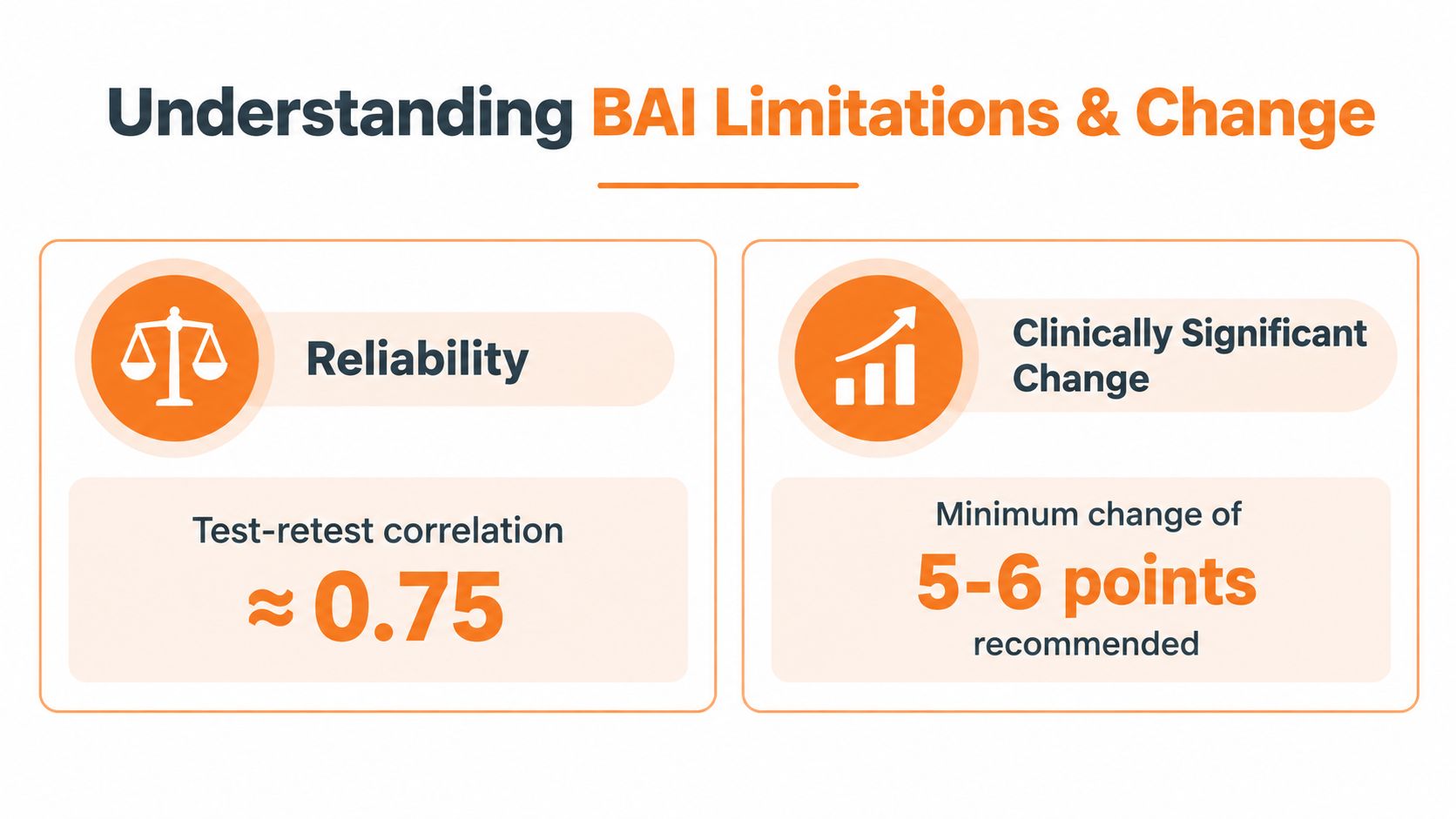
A lower BAI score at follow-up can be encouraging, but a small change isn't automatically meaningful improvement. Symptoms fluctuate with sleep, pain, stress, medication timing, recent events, and the way a patient understands the items on a particular day. For progress monitoring, pair the total with the patient's functioning and symptom story.
The sample interpretive report provides a stricter reliable-change approach: a later BAI score must move above 42 or below 33 for the stated statistically significant change rule to be met, as described in the BAI sample interpretive report. This is not the same as moving from one severity band to another. It illustrates why clinicians should record the method used when interpreting change.
Use consistent conditions
For a useful reassessment, keep the administration process as consistent as possible. Record the assessment date, language, setting, relevant intervention, major stressors, and any changes in health or medication. Ask what changed in daily life, not only whether the number went down.
A patient might report, “I'm still worried, but I'm sleeping better and I've returned to work.” Another might show a lower total while continuing to avoid essential activities. The number and the functional outcome should be considered together, because neither one fully captures recovery on its own.
Connect anxiety tracking with cognitive workflows
Cognitive assessment uses a similar principle, but often relies on comparison with normative data. Guidance for cognitive assessment describes converting performance to Z-scores with a mean of 0 and standard deviation of 1, then comparing results with age-appropriate norms to determine whether performance falls within expected limits. The Canadian Longitudinal Study on Aging cognitive norms guidance provides this normative framework.
That comparison mindset is useful when BAI results sit inside a broader cognitive pathway. Don't treat a raw anxiety total as a universal norm for every California population or language group. The available sources don't provide California-specific normative BAI datasets, so local teams should state that they're applying general cutoffs and interpret them with population, language, and setting in mind. For more detail on interpreting repeated measurements, review this resource on test-retest reliability statistics.
California's language-access context makes this especially important. The California Health Care Foundation reports that nearly 6.5 million Californians aged five and older have a primary language other than English and limited English proficiency (California Health Care Foundation language-access overview). The California Department of Public Health reports that adults with limited English proficiency are more likely to report fair or poor health than adults who speak English very well, 40.9% versus 15.4%, and more likely to lack current health insurance, 17.4% versus 9.6% (California Department of Public Health health equity report). These figures support a practical safeguard: use language-ready workflows whenever possible, and don't mistake English-language friction for symptom severity or cognitive difficulty.
Next Steps Documentation and Integrating Into Cognitive Care
A useful BAI note should let another professional understand the result without repeating the entire encounter. Include the total, the interpretation framework, notable symptom pattern, context, limitations, and plan.
A concise documentation template
BAI administered in [language and setting]. Total score: [score] on the 0–63 scale. Using [named interpretation framework], result falls in the [band] range. Prominent reported symptoms: [symptoms]. Context and functional impact: [summary]. Medical, medication, sleep, cultural, language, and comorbidity considerations: [summary]. BAI is interpreted as a screening measure and not a standalone diagnosis. Plan: [reassurance, monitoring, referral, medical review, broader cognitive or functional assessment, and follow-up].
California teams should also embed validated cognitive screening into routine care where appropriate. The state's aging-plan guidance calls for validated screening questions in managed-care health-risk assessments and initial intakes, and notes that Medicare's annual wellness visit includes a brief, validated structured cognitive assessment tool (California Master Plan for Aging stakeholder report).
Billing requires its own operational check. The Dementia Care Aware guide states that the Cognitive Health Assessment may be billed once per year per provider for Fee-for-Service Medi-Cal beneficiaries aged 65 and older, using code 1494F. It also states that cognitive impairment evaluation and care planning typically lasts 50 minutes and uses CPT 99483, which can't be reported with 1494F (California cognitive screening and billing guide). Verify payer rules and local implementation details before scheduling or billing.

For broader cognitive workflows, use the BAI as one component of a pathway that may include symptom screening, functional review, validated cognitive measures, multilingual administration, reassessment, and coordinated handoff. Explore cognitive assessment tools when you need a structured way to connect anxiety findings with attention, memory, executive function, and everyday functioning.
Orange Neurosciences offers AI-supported cognitive assessments, multilingual delivery, rapid cognitive profiles, and reassessment workflows that can complement careful BAI scoring interpretation. Visit Orange Neurosciences to explore under-30-minute assessment options, or email the team for help designing a language-ready workflow for your clinic, school, rehabilitation service, care home, or EAP programme.

Orange Neurosciences' Cognitive Skills Assessments (CSA) are intended as an aid for assessing the cognitive well-being of an individual. In a clinical setting, the CSA results (when interpreted by a qualified healthcare provider) may be used as an aid in determining whether further cognitive evaluation is needed. Orange Neurosciences' brain training programs are designed to promote and encourage overall cognitive health. Orange Neurosciences does not offer any medical diagnosis or treatment of any medical disease or condition. Orange Neurosciences products may also be used for research purposes for any range of cognition-related assessments. If used for research purposes, all use of the product must comply with the appropriate human subjects' procedures as they exist within the researcher's institution and will be the researcher's responsibility. All such human subject protections shall be under the provisions of all applicable sections of the Code of Federal Regulations.


© 2026 by Orange Neurosciences Corporation