Should You Test Dementia Online? A Practical Guide
Nov 28, 2025
If you've found yourself searching for an "online dementia test," you're probably looking for some clarity. Let's get the most important thing out of the way first: these online screeners are a preliminary check-up for your cognitive health, not a medical diagnosis. Their job is to flag potential concerns so you have a solid starting point for a conversation with your doctor.
What to Know Before You Take an Online Dementia Test
The thought of taking any kind of cognitive test can be nerve-wracking. But understanding what these online tools are—and what they are not—is the first step toward taking control.
Think of an online screener like a smoke alarm. It’s brilliant at alerting you to a potential problem, but it can’t tell you if it's just a bit of burnt toast or a serious fire. For that, you need a professional to investigate. An actionable first step is to use the screener's result as a reason to book that appointment, giving you and your doctor a concrete place to begin the conversation.
These tests guide you through a series of tasks meant to measure different aspects of your thinking. You might be asked to remember a list of words, solve a few simple puzzles, or spot patterns. The idea is to get a quick snapshot of cognitive functions like your memory, attention, and problem-solving skills.
Setting Realistic Expectations
It’s absolutely critical to go into an online dementia test with the right mindset. A concerning score does not automatically mean you have dementia, and a "normal" score doesn't completely rule out an underlying issue, either. So many factors can affect your performance on any given day.
Temporary Influences: A bad night's sleep, high stress levels, anxiety, or even coming down with a cold can throw off your cognitive performance. A score might just reflect a bad day, not your true baseline.
Other Conditions: Memory and thinking problems aren't exclusive to dementia. Conditions like functional cognitive disorder (FCD), depression, or even certain vitamin deficiencies can show up with very similar symptoms.
The Test's Limitations: At the end of the day, these are simplified tools. They can’t possibly capture the full, complex picture of your brain health like a comprehensive clinical evaluation can.
A concerning result from an online test isn't a verdict; it's a signal. It gives you a concrete reason to book an appointment with your healthcare provider and start a real conversation about your cognitive health. That proactive step is the most powerful one you can take.
Your Result Is a Conversation Starter
The real power of taking an online test is in how you use the result: as a catalyst to seek professional medical advice. Instead of getting hung up on a number, use it to help frame your concerns with a professional.
For instance, you could say to your doctor, "I've been misplacing my keys more often lately, so I took an online screener and the result suggested I should speak with you." This is far more actionable than just saying, "I think my memory is getting worse."
This gives your doctor a clear, actionable place to start. A quick online screener provides a snapshot, but a clinical diagnosis is a deep-dive, multi-faceted process conducted by healthcare professionals.
Here's a quick comparison to see what each provides:
Online Screener vs Clinical Diagnosis at a Glance
Feature | Online Screener | Clinical Diagnosis |
|---|---|---|
Purpose | Preliminary check to flag potential issues. | Comprehensive evaluation to identify the cause of symptoms. |
Who Conducts It | Self-administered online. | Conducted by a team of healthcare professionals. |
What It Measures | A limited set of cognitive functions (e.g., memory, attention). | Brain function, medical history, physical health, blood tests, and often brain imaging. |
Outcome | A score or risk level indicating if a follow-up is needed. | A specific medical diagnosis and a personalized treatment or management plan. |
Time Commitment | Typically 10-20 minutes. | Several appointments over weeks or months. |
This table really highlights that a screener is just the first step on a potential journey.
To get a better sense of what a full evaluation involves, our guide on a cognitive assessment online breaks down the key differences between a quick check-up and a thorough clinical workup. Taking this first step is how you move from a place of uncertainty to one of clarity and action.
How Online Cognitive Tests Actually Work
Ever wondered what’s really going on behind the screen when you take an online cognitive test? It’s far more straightforward than you might think. A good way to look at it is like a 'check engine' light for your brain. It's not there to give you a full diagnostic, but it will alert you to a potential issue that needs a closer look from a professional.
These tests are essentially digital, interactive versions of the pen-and-paper tasks that clinicians have trusted for decades to assess brain function. They cleverly translate proven neuropsychological methods into engaging, almost game-like formats you can do right from home.
Digital Tasks That Measure Brain Function
When you start one of these tests, don't expect a trivia quiz. You'll be guided through a series of carefully designed activities, with each one targeting a specific cognitive skill that can be affected in the early stages of dementia. These digital exercises are built to capture objective data about how your brain is performing.
So, what does that actually look like? Here are a few common examples:
Memory Recall: A test might show you a list of ten everyday items—like a key, an apple, or a book—and then ask you to remember as many as you can a few minutes later. This simple task is a direct measure of your short-term memory, a function often impacted by conditions like Alzheimer's disease.
Executive Function: You might find yourself playing a digital card-sorting game. First, you'll sort cards by colour, but then the rule suddenly changes, and you have to sort by shape instead. This tests your mental flexibility and ability to adapt, which are key parts of your executive function.
Attention and Processing Speed: A classic task involves asking you to quickly tap a specific shape or letter every time it pops up on the screen, while ignoring all the others. This gauges how quickly and accurately your brain can process visual information and stay focused.
So how does it all come together? An online test generates a score by comparing your performance on these tasks against an established baseline for people in your age group. A result that falls outside the typical range is what flags a potential concern, triggering the recommendation to speak with a healthcare professional.
From Clicks to Cognitive Insights
Every single click, every correct answer, and even every moment of hesitation is timed and recorded. This raw data is then fed into an algorithm that calculates a performance score for different cognitive domains. It’s not just about whether you get the answer right; it’s also about how quickly and consistently you perform.
This simple flowchart shows the proper way to use an online screening tool—it’s the first step, not the last word.
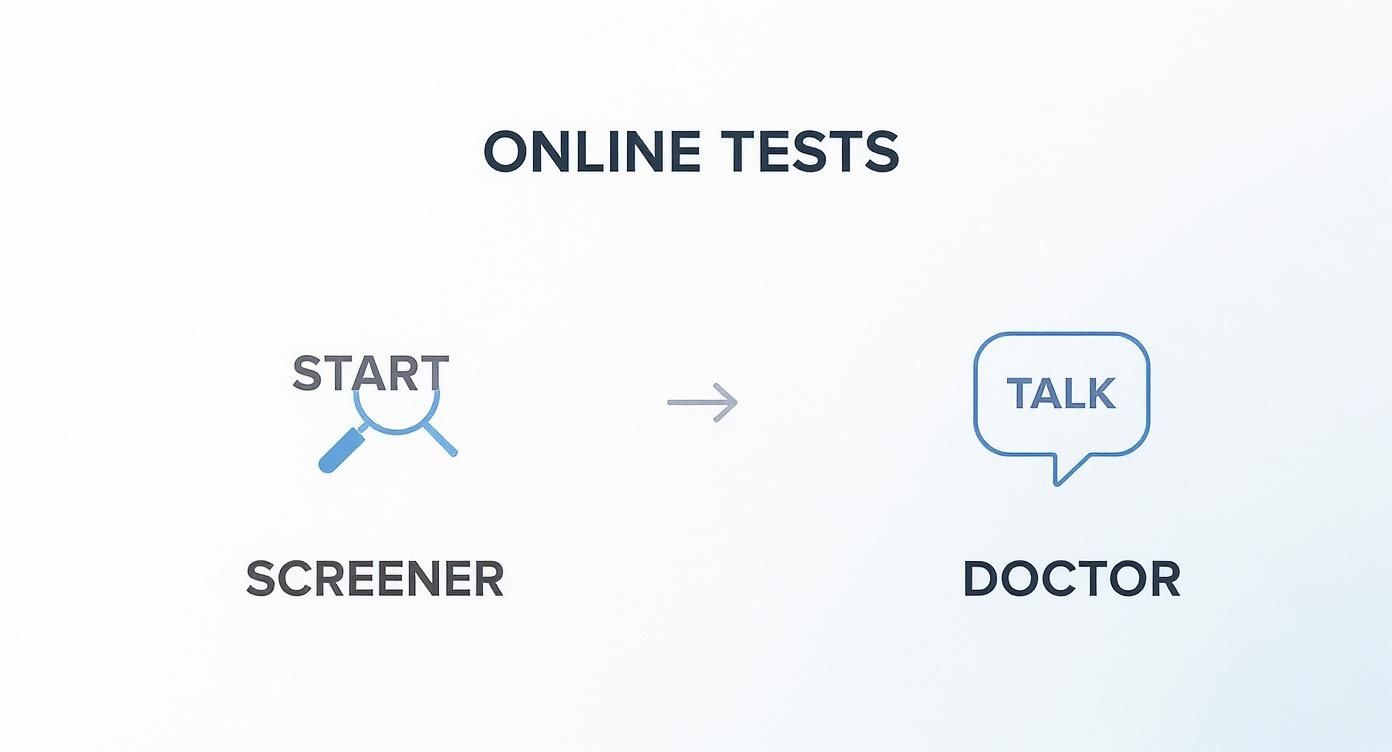
As you can see, an online screener is designed to start a conversation with your doctor, not to replace it. For these tools to be useful, their reliability is paramount. If you'd like to learn more about how that's measured, take a look at our guide on test-retest reliability statistics for cognitive assessments.
At its core, the process is designed to be simple for you, the user, while gathering meaningful data points for analysis. It’s a powerful method of translating interactive tasks into a quantifiable snapshot of your cognitive health.
Weighing the Pros and Cons of At-Home Screening
Deciding to test dementia online from the comfort of your home can feel like a positive, proactive move. While these at-home screeners certainly have their benefits, it's just as crucial to understand their limitations and potential downsides. An honest look at both sides is the key to using these tools responsibly and avoiding unnecessary stress.
The biggest draw is obvious: accessibility. For many, the very thought of bringing up memory concerns with a doctor is intimidating, which can lead to long delays in getting help. An online test can feel like a much smaller, more manageable first step—something you can do privately, on your own terms, without any stigma attached.
The Upside: Why People Turn to Online Screening
Taking a cognitive screener at home puts you in the driver's seat. It's a way to gather some initial information without having to schedule an appointment, travel to a clinic, or sit in a waiting room.
Here are the main benefits people find:
Immediate Access: You can take a test the moment you feel a flicker of concern, rather than waiting weeks or even months for a specialist appointment. That immediacy can turn a vague worry into a concrete reason to act.
Privacy and Comfort: Being in a familiar, private space can significantly reduce the anxiety that often comes with a clinical setting. This might even lead to a more accurate snapshot of your typical cognitive state.
Early Awareness: An online test can act as an early warning flare. For someone who might otherwise brush off minor memory lapses, a concerning result can be the nudge they need to book that professional evaluation.
These advantages make online tests a valuable starting point for a lot of people. But that convenience comes with some serious risks that you need to think about before you click "start."
The Downsides: Hidden Risks and Pitfalls
The single biggest drawback of any at-home test is the lack of clinical supervision. A doctor or psychologist is trained to consider countless factors that an online algorithm simply can't see. This gap can lead to misinterpreted results and a whole lot of emotional turmoil.
A common trap is the risk of false reassurance. Someone might get a good score on a test even though they're noticing real-world problems, like getting lost in familiar places or struggling with daily finances. That 'good' score might convince them to put off a crucial doctor's visit, allowing a potential condition to progress.
On the flip side, a 'bad' score can create a tidal wave of panic. A person's performance on any given day can be easily thrown off by temporary factors.
Think about this: a 55-year-old has had a brutally stressful week at work and a few nights of terrible sleep. They decide to take an online test, and the score comes back flagging a high risk for cognitive decline, triggering immense anxiety. In reality, their performance was likely dragged down by simple fatigue and stress, not a brewing neurological issue.
This is why understanding the subtle differences between cognitive conditions is so vital. For instance, the signs of conditions like mild cognitive impairment vs dementia can overlap, and an online test is not sophisticated enough to tell them apart.
Here’s a quick summary of the key risks to keep in mind:
Potential Risk | Why It Matters |
|---|---|
False Reassurance | A 'normal' score might lead someone to ignore genuine, real-life symptoms and delay getting essential medical advice. |
Unnecessary Anxiety | A 'concerning' score could be caused by temporary issues like stress, poor sleep, or even a technical glitch, leading to needless worry. |
Lack of Context | Without a clinician, there's no one to place the results in the context of your overall health, medications, and life circumstances. |
Misinterpretation | Online tests are screeners, not diagnostic tools. It's a dangerous but common mistake to treat a screening result like a final diagnosis. |
Ultimately, while the impulse to test dementia online is completely understandable, it's a tool that requires a balanced view. It can be a helpful first step, but only when you see it for what it is—a single piece of a much larger puzzle that has to be put together with the guidance of a healthcare professional.
How to Choose a Reputable Online Cognitive Test
Navigating the world of online health tools can sometimes feel like walking through a minefield. When you search to test dementia online, you’ll find everything from scientifically grounded screeners to quizzes that are little more than entertainment. Learning to separate the credible tools from the unreliable ones is absolutely essential for getting meaningful results and avoiding a whole lot of unnecessary anxiety.
It’s important to remember that not all online tests are created equal, but you can definitely learn to spot the good ones. A reputable cognitive test isn't just a random list of questions; it's a carefully designed tool, often built on decades of clinical research. Your goal here is to find a screener that acts as a responsible first step—not one that makes dramatic or unfounded claims.
Checklist for a Credible Online Screener
Think of this as your quality-control checklist. A trustworthy tool will tick most, if not all, of these boxes. If a test you're considering falls short on these points, it's a strong signal to look somewhere else.
Look for Institutional Backing: Is the test developed by or affiliated with a recognized university, hospital, or neuroscience research organisation? This connection adds a crucial layer of scientific credibility and suggests the methodology has been properly vetted.
Read the Fine Print: A reputable screener will be crystal clear about its limitations. You should see disclaimers stating explicitly that the test is not a diagnostic tool and that results must be discussed with a healthcare professional. They aren't trying to hide anything.
Check for a Clear Privacy Policy: Your cognitive health data is sensitive, period. The platform should clearly explain what information it collects, how it’s stored, and whether it's shared with third parties. If you can't easily find a privacy policy, that's a major red flag.
Review the Science (If Possible): Some of the best tools will mention the scientific principles or specific validated assessments their digital test is based on. You don’t need to be a scientist to understand it, but seeing this level of transparency is a very good sign.
Our suite of cognitive assessments, for example, is built on a foundation of evidence-based neuropsychological principles. This ensures that every task is designed with scientific rigour from the ground up.
Major Red Flags to Avoid Immediately
Just as important as knowing what to look for is knowing what to run away from. Certain characteristics are immediate giveaways that a test is likely unreliable, or even worse, predatory. If you see any of these, just close the tab and continue your search.
Be extremely wary of any tool that promises a definitive diagnosis. An online quiz simply cannot diagnose dementia or any other complex medical condition. Such claims are not only inaccurate but also deeply irresponsible.
Here are some clear warning signs that should make you think twice:
Guarantees of a Diagnosis: This is the biggest red flag of all. A real screener’s purpose is to flag potential issues for a doctor to investigate, not to deliver a final verdict.
Requests for Payment for Results: While some professional platforms may have associated costs, be cautious of sites that let you take a "free" test but then demand payment to unlock your score. This is often a tactic used to exploit worry and fear.
Lack of Transparency: If you can't find any information about who created the test, what it measures, or how it works, don't use it. Credible sources are always open about their methodology.
Overly Simplistic or "Fun" Questions: If the test feels more like a social media quiz (e.g., "Which historical figure's memory do you have?"), it has zero scientific value for assessing your cognitive health.
To get a better feel for the landscape of digital diagnostic aids and how to select appropriate evaluations, you might want to explore these broader mental health assessment tools. By being a discerning user, you can ensure the tool you choose is a genuinely helpful step on your health journey, giving you a reliable starting point for a productive conversation with your doctor.
What to Do With Your Online Test Results
So, you’ve completed an online screener and have a result in front of you. This is probably the most important moment in the entire process—not because of the score itself, but because of what you do next. No matter the outcome, whether it was reassuring or raised some flags, your next step is always the same: schedule an appointment with a healthcare professional.
Think of an online test as a tool for turning a vague worry into a concrete reason to act. It's a fantastic starting point, but it isn't—and never will be—a substitute for a proper medical diagnosis. Your result is like a permission slip to start a productive, informed conversation about your cognitive health with someone who can give you real answers.
Taking this proactive step is crucial. The scale of cognitive health challenges is growing, making early and accurate professional assessment more critical than ever. In California, for example, caregivers are projected to provide 1.9 billion hours of unpaid care in 2025 alone, a staggering number that highlights the personal and economic impact of conditions like Alzheimer's. This is precisely why using a screener to kickstart a clinical discussion is so vital for effective, long-term management. For a deeper look at the regional impact, you can explore the full Alzheimer's report on California.
Preparing for Your Doctor's Appointment
Walking into your appointment well-prepared can make a world of difference. It shifts the conversation from a general "I'm worried about my memory" to a focused discussion backed by specific examples and data points. This helps your doctor grasp the full context of your concerns right from the start.
Your online test result is your conversation starter. It’s the piece of information that opens the door, but the real, meaningful details will come from you. Be ready to share specific, real-world examples of what you've been noticing.
To make your visit as productive as possible, it helps to gather some information beforehand. You can jot these points down in a notebook or on your phone to bring with you.
What to Bring and Discuss
A little prep work goes a long way. Having your thoughts organised helps ensure you don't forget any key details during your consultation. It also shows your doctor that you're an engaged partner in your own health.
Here’s a simple checklist of what to prepare:
The Name of the Test You Took: Let your doctor know which online screener you used. Reputable tests have different methodologies, and this information provides helpful context.
Your Specific Concerns (with Examples): This is the most crucial part. Instead of just saying you're forgetful, provide concrete examples.
Instead of: "My memory is bad."
Try: "I've gotten lost twice in the last month while driving to the grocery store I've gone to for years."
Instead of: "I'm misplacing things."
Try: "I found my car keys in the refrigerator last week, and I’ve been putting my wallet in different places every day."
A List of Your Medications: Include everything—prescriptions, over-the-counter drugs, vitamins, and supplements. Some medications, or combinations of them, can cause cognitive side effects that mimic dementia symptoms.
Notes on Other Health Issues: Mention any other conditions you're managing, like high blood pressure, diabetes, sleep apnea, or a history of depression. These can all have an impact on cognitive function.
This structured approach helps ensure your concerns are heard and properly documented. It also plays a vital role in building a long-term partnership with your healthcare provider. For more insight into why this collaborative relationship is so important, check out our guide on the continuity of care in cognitive health.
By taking these proactive steps, you are transforming a simple online test result into a powerful tool for your health. You are moving past the uncertainty and taking direct, meaningful action—the best path forward for your peace of mind and long-term well-being.
Why Accessible Dementia Screening Matters More Than Ever
Taking an interest in your own cognitive health goes far beyond a personal check-up; it’s a vital piece of a much larger public health puzzle. When you choose to test dementia online, you aren’t just looking for peace of mind. You're taking a proactive first step in tackling a massive societal challenge. The simple truth is that our population is aging, which means the number of people at risk for cognitive decline is growing dramatically and putting an immense strain on our healthcare system.
Understanding this bigger picture helps clarify why having accessible, early screening options is so critical. It’s all about shifting our mindset from a reactive one—where we wait for symptoms to become obvious and severe—to a proactive one. We need to empower people to spot potential concerns much sooner. This early awareness is the crucial first step toward seeking professional medical advice, which ultimately leads to better management, planning, and support down the road.
The Scale of the Challenge
The numbers really do paint a stark picture, especially in heavily populated areas. Take California, for example, which carries the largest Alzheimer's disease burden in the entire United States. Roughly 720,000 people there are living with the condition.
Zoom in further, and Los Angeles County alone accounts for about 190,000 of those cases—the highest of any county in the nation. With projections showing a potential 127% jump in cases by 2040, these stats scream for more accessible, early detection tools. You can dig deeper into these critical California health statistics to grasp the full scope of what we're facing.
By using a validated online screener to start a conversation with your doctor, you are participating in a crucial public health movement. You're helping to bridge the gap between initial concern and professional diagnosis, which is essential for timely intervention and care.
This proactive approach is a win for everyone. For individuals and their families, it opens up the conversation about planning and support much earlier. Beyond the clinical side, families often need to think about long-term arrangements, including understanding the principles of dignified elderly care that ensure comfort and independence are always prioritized.
How Individual Action Creates Collective Impact
Every single person who takes their cognitive health seriously is helping to build a more informed and prepared society. When more of us identify and address potential cognitive changes early on, it creates a positive ripple effect throughout the entire healthcare system.
Here’s how your proactive step helps everyone:
Reduces Diagnostic Delays: Early screening pushes people toward timely medical consultations, cutting down on years of uncertainty and fast-tracking access to support.
Empowers Families: Getting an earlier start on the conversation with a doctor gives families precious time to learn, adapt, and make important care decisions together, not in a crisis.
Lessens Healthcare Strain: When concerns are addressed before they hit a crisis point, it helps ease the heavy load on emergency rooms and hospitals.
At the end of the day, accessible tools that encourage you to test dementia online are about so much more than a score. They’re about building a culture of cognitive health awareness. Your personal journey to find clarity is a powerful act that, when multiplied across thousands of others, helps create a more resilient healthcare system for all of us.
Answering Your Top Questions
Stepping into the world of online cognitive tools can feel a bit overwhelming, and it's natural to have questions. Let's clear up some of the most common concerns people have when they consider taking an online dementia test.
Can an Online Test Give Me a Dementia Diagnosis?
No, absolutely not. An online test is, at its core, a preliminary screening tool. Its job is to flag potential cognitive issues that might need a closer look, but it can never provide a medical diagnosis.
Think of it like using a home blood pressure cuff. It can tell you if your reading seems high, signaling a potential problem, but it can’t diagnose you with hypertension. A formal dementia diagnosis is a much deeper process, involving a comprehensive evaluation by a qualified healthcare professional. This includes a thorough review of your medical history, physical exams, and sometimes even blood work or brain imaging.
Just How Accurate Are These Online Tests?
The accuracy really runs the gamut. Screeners that have been carefully developed and validated by reputable scientific or medical institutions are generally more reliable. Still, it's critical to remember that no online test is 100% accurate.
So many things can influence your score on any given day. If you're feeling stressed out, didn't sleep well the night before, or are trying to concentrate with the TV blaring in the background, your performance might take a hit. That's why you should treat the result as a starting point for a conversation with your doctor, not as a final verdict on your cognitive health.
I'm Worried About My Memory. What's the First Step?
If you have any concerns at all about your memory or cognitive health, the single most important thing you can do is schedule an appointment with your doctor. Bringing an online test result can be a great way to open up that conversation, but it's no replacement for professional medical advice.
To make that appointment as productive as possible, try to jot down specific examples of what you've noticed beforehand. For instance, instead of just saying "I'm forgetful," you could say, "I've missed two appointments this month because I forgot to write them down." This kind of concrete information is incredibly valuable for your doctor.
Your privacy is paramount. Reputable platforms will always have a clear, easy-to-find privacy policy that explains exactly how your data is collected, stored, and used. If you can't find this information, it's a major red flag.
Taking that first step to understand your cognitive health is a powerful one. If you're looking for a scientifically-backed tool to gather reliable information for a productive conversation with a healthcare provider, Orange Neurosciences offers evidence-based cognitive assessments designed for clarity and precision. Explore our tools to get a clearer picture of your cognitive profile today at https://orangeneurosciences.ca.
Orange Neurosciences' Cognitive Skills Assessments (CSA) are intended as an aid for assessing the cognitive well-being of an individual. In a clinical setting, the CSA results (when interpreted by a qualified healthcare provider) may be used as an aid in determining whether further cognitive evaluation is needed. Orange Neurosciences' brain training programs are designed to promote and encourage overall cognitive health. Orange Neurosciences does not offer any medical diagnosis or treatment of any medical disease or condition. Orange Neurosciences products may also be used for research purposes for any range of cognition-related assessments. If used for research purposes, all use of the product must comply with the appropriate human subjects' procedures as they exist within the researcher's institution and will be the researcher's responsibility. All such human subject protections shall be under the provisions of all applicable sections of the Code of Federal Regulations.


© 2026 by Orange Neurosciences Corporation