Your Guide to Cognitive Tests Online
Nov 9, 2025
Online cognitive tests are, at their core, a quick checkup for your brain. They offer a snapshot of your mental performance in key areas like memory, attention, and problem-solving.
Think of it like a fitness tracker for your mind. Just as you might track your steps to monitor physical health, these assessments provide a practical way to measure and understand your cognitive health from your computer. For example, if you've been feeling "off" or less sharp, a test can give you objective data to see if your memory or attention scores have changed. This provides valuable, actionable insights for anyone curious about their cognitive profile.
A Health Checkup for Your Brain
We track so many aspects of our physical health—why should our brain be any different? Online cognitive assessments offer a simple, accessible way to get a baseline reading of your mental abilities without the immediate need for a clinical appointment. This creates a private, low-stakes environment to explore your cognitive strengths and weaknesses.
For many people, this is the first step toward proactive brain health. It’s like noticing you’re a bit slower on your usual running route; a cognitive test can flag if your mental "speed" or memory recall isn't quite what it used to be. This awareness is empowering, giving you the control to investigate further and take action if needed.
Why Are People Turning to Online Tests?
The real appeal of cognitive tests online is their convenience and the practical knowledge they deliver. Instead of waiting for a noticeable issue to pop up, you can periodically check in on your cognitive functions. This proactive approach is catching on for a few key reasons:
Personal Benchmarking: Establish a baseline of your cognitive function. For example, your first test serves as your starting point. Six months later, you can test again to see if your new sleep habits have improved your attention score.
Identifying Strengths: Discover which cognitive areas you naturally excel in. If you score high in problem-solving, you can lean into that strength in your career or hobbies. This can be incredibly motivating.
Flagging Areas for Improvement: Pinpoint specific skills, like short-term memory, that might benefit from targeted action. A low score here could prompt you to start using memory-aid techniques, like the method of loci.
Empowering Conversations: Walking into a doctor's office with objective data—like a report showing a decline in your processing speed over the last year—can make conversations about your cognitive health far more focused and productive.
Moving From Curiosity to Action
The goal here isn't to hand you a scary diagnosis. It’s about providing a clear, understandable snapshot of where your abilities stand right now. This information helps to demystify brain health, turning it from an abstract worry into something measurable and, more importantly, manageable.
If you'd like to explore the fundamentals, you can learn more about what cognitive assessment entails in our detailed guide.
A cognitive test provides the 'what'—a snapshot of your current mental performance. Understanding this data is the first step toward figuring out the 'why' and deciding on the 'what's next.'
Ultimately, these tools are all about gaining practical knowledge. By understanding your unique cognitive profile—your personal strengths and the areas that could use a little more support—you can move from just wondering about your brain health to taking concrete, actionable steps to improve it. The insights you gain can guide everything from your daily habits to more formal professional consultations.
What Cognitive Tests Actually Measure
When you sit down to take one of the many cognitive tests online, what’s really being measured? It’s not a simple pass/fail on how “smart” you are. A much better way to think about it is like a personal trainer assessing your fitness—they don't just look at one thing, but test your strength, flexibility, and endurance separately to get the full picture.
Imagine your brain is a world-class orchestra. For the music to sound right, every single section—the strings, the brass, the woodwinds, the percussion—has to be perfectly in sync. Cognitive tests are like listening to each of these sections individually, isolating them to check their performance. This gives you a much clearer understanding of your overall cognitive symphony.
This infographic breaks down three of the core areas you'll often see assessed in these tests: memory, problem-solving, and processing speed.
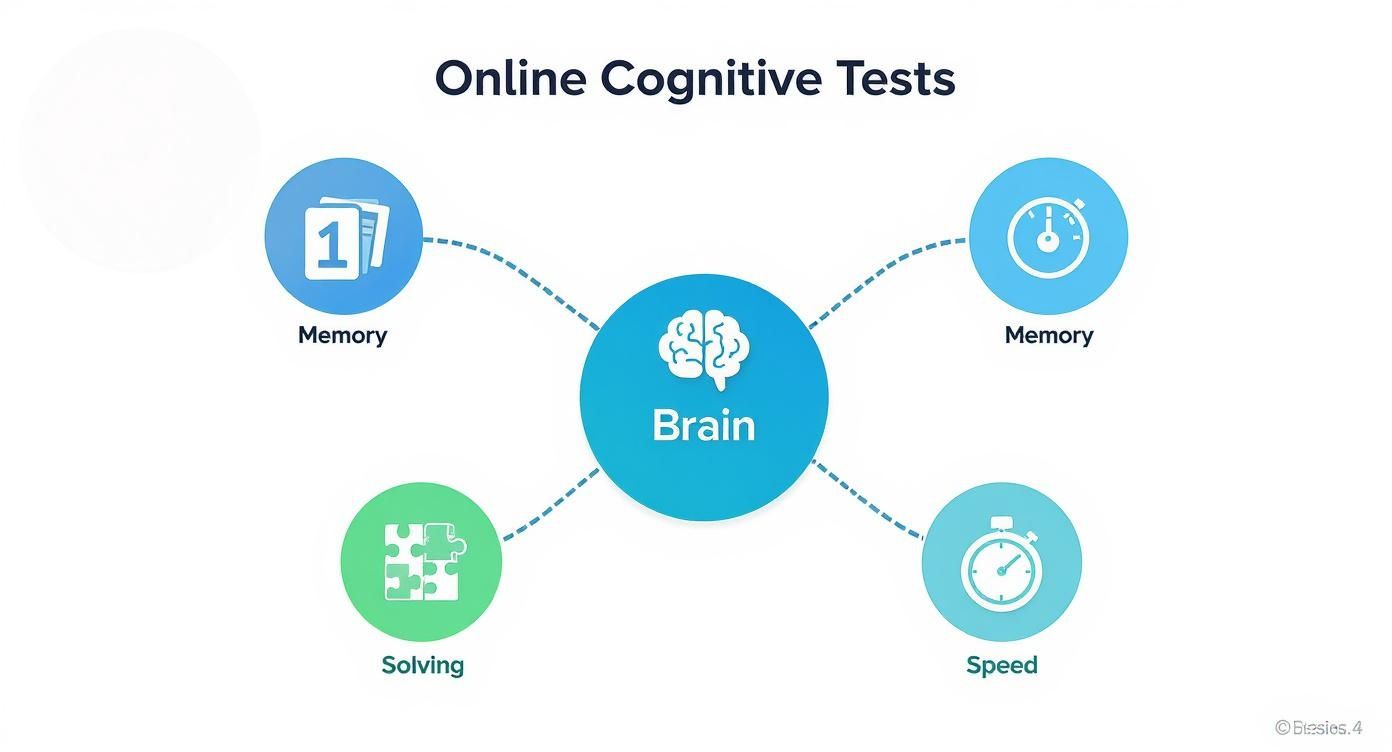
As you can see, these domains are distinct, but they're also deeply interconnected. They form the very foundation of how we function every day, from remembering a grocery list to making a complex, life-altering decision.
Unpacking the Core Cognitive Domains
Let's pull back the curtain on the scientific jargon and see what these terms actually mean in the real world. Each cognitive domain is responsible for a different part of how you think, act, and navigate your day-to-day life.
Working Memory: Think of this as your brain's temporary sticky note. It’s the mental workspace you use to hold a phone number in your head just long enough to dial it. A practical example is remembering a list of three items a colleague asks you to bring to a meeting as you walk to the supply closet. An online test might measure this by asking you to recall a sequence of numbers or letters that just flashed on the screen.
Executive Function: This is the CEO of your brain. It's in charge of planning, organising, and making decisions. It’s what helps you manage your time to hit a deadline or resist the urge to check social media during a meeting. For example, when planning a trip, your executive function helps you budget, book flights, and organize an itinerary. Tests often gauge this with tasks that require you to sort objects based on changing rules.
These high-level functions don't operate in a vacuum; they're supported by other fundamental abilities.
Attention and Processing Speed
Attention acts as the gatekeeper for your brain, deciding what information gets priority. It's not just one skill, but a whole collection of them. Sustained attention is what lets you focus on a long report, while selective attention helps you tune into a friend's voice in a loud café. Another critical piece of this puzzle is how our brains handle sensory input, a topic we explore more deeply in our guide on auditory processing testing.
Then there's processing speed—how quickly you can take in information, make sense of it, and react. It's that mental agility that allows you to respond to a sudden change in a traffic light. A typical online task might involve matching symbols to numbers as quickly and accurately as you can.
Cognitive skills are a team sport. Your executive function leans heavily on your working memory to hold key information while you make a decision. At the same time, your processing speed directly impacts how quickly you can shift your attention to something new.
Cognitive Skills and How They're Tested Online
To bring this all together, let’s connect these cognitive domains to everyday tasks and the types of online tests that measure them. Understanding this connection helps demystify the "why" behind any assessment you might encounter.
Here’s a simple breakdown:
Cognitive Domain | What It Helps You Do | Example Online Test Task |
|---|---|---|
Working Memory | Remembering a verification code while logging into an account. | Recalling a sequence of flashing lights in the correct order. |
Executive Function | Planning the steps and ingredients needed to cook a new recipe. | Playing a game where you must sort cards by colour, then shape. |
Attention | Focusing on a single speaker during a conference call with multiple participants. | Clicking on a specific target shape while ignoring distractors. |
Processing Speed | Quickly scanning a menu at a restaurant to decide what to order. | Rapidly identifying whether two displayed patterns are the same or different. |
By looking at it this way, it becomes clear that cognitive tests aren't mysterious evaluations of intelligence. They're practical tools designed to measure the specific mental muscles you use every single day. This kind of detailed insight is the first step toward better understanding your brain and finding pathways for growth and support.
The Role of Online Assessments in Education
In the world of education, online cognitive tests are quickly moving from being niche tools to indispensable resources for teachers. Think of them as a special kind of lens, giving educators a much sharper, more detailed picture of each student’s unique learning profile. This kind of insight allows us to move beyond the old "one-size-fits-all" approach and start building learning environments that are genuinely personal and far more effective.
These assessments give us objective data on the bedrock cognitive skills that make learning possible—things like working memory and attention. So, when a student is struggling, these tools help get to the "why." For example, is a difficulty with reading actually rooted in an auditory processing issue? Pinpointing the specific cognitive hurdle is the crucial first step toward providing support that actually works.
Creating Data-Driven Learning Paths
Once you understand a student's cognitive profile, you can start to tailor your teaching methods to match. This data-driven strategy isn't about slapping labels on kids; it's about empowering them by adapting the educational experience to fit their specific needs. It helps teachers, and entire school administrations, make smarter decisions that can lead to real, measurable improvements in student outcomes.
This process breaks down into a few key actions:
Early Identification: Online assessments can flag potential learning differences, like the early signs of dyslexia or ADHD, long before they might be noticed through observation alone. This allows for timely intervention before a student falls behind.
Personalized Support: For instance, if a test shows a weakness in working memory, a teacher can take immediate action by breaking instructions into smaller, numbered steps or using visual aids to support comprehension.
Progress Monitoring: By using assessments regularly, educators can track a student's cognitive development. This shows whether interventions are hitting the mark and allows for adjustments, providing a clear path to improvement.
By measuring the specific cognitive skills that learning is built on, educators can shift from guessing what a student needs to knowing how to help them succeed. This simple change can transform a classroom into a far more responsive and supportive space for everyone.
As education continues to evolve, many of these online assessments are being woven into the fabric of a broader AI-powered learning platform. This can take personalization to the next level by automating the process of tailoring educational content based on a student's real-time performance.
Large-Scale Implementation and Its Challenges
The power of cognitive tests online isn't limited to individual classrooms; they are also being used in large-scale educational programs. A real-world example of this comes from California, where these assessments are widely used.
In a recent school year, for example, 16,297 English learner students with significant cognitive disabilities were assessed using the Summative Alternate ELPAC. While the scale is impressive, the data also revealed a serious challenge: the percentage of these students achieving English proficiency actually dropped from 23.4% to 19.3%. This highlights a critical point—these tools aren't a magic bullet and require constant evaluation and the right support strategies to be effective.
This kind of large-scale data is incredibly valuable for policymakers and school districts, helping them allocate resources more effectively. For educational leaders thinking about bringing these tools into their own systems, our work with academic institutions provides deeper insights into how to build a truly effective cognitive assessment framework.
Ultimately, whether it's for a single student or an entire district, the goal is the same: to use precise data to unlock every student's full learning potential.
How to Choose a Reliable Cognitive Test Online
With a flood of options popping up online, it can be tough to tell the difference between a fun brain game and a scientifically validated assessment. It really comes down to this: a reliable tool is built on a solid foundation of research, ensuring its results are both meaningful and consistent.
Think of it like choosing a thermometer. You want one that’s properly calibrated to give you an accurate reading, not one that just spits out a random number. Not all cognitive tests online are created equal, and knowing what to look for is the key to making a confident choice.
Look for Scientific Backing
This is the most critical piece of the puzzle. Is the test backed by actual scientific evidence? A credible platform will be completely open about the research behind its assessments. They should be able to show that their tests are valid (meaning they measure what they claim to measure) and reliable (they produce consistent results over time).
Actionable tip: Look for an "Our Science" or "Research" page on their website. If you can’t find any mention of validation studies, peer-reviewed publications, or university partnerships, be cautious. This scientific rigour is what separates a clinical-grade tool from a simple quiz.
Verify the Test's Purpose and Scope
A trustworthy cognitive assessment has a clear, specific job. Is it designed to screen for general cognitive health? Does it zero in on specific domains like memory and attention? Or is it meant to track recovery after an injury? The provider should state this purpose right upfront.
A well-designed cognitive test isn't a vague IQ test. It’s a targeted measurement tool designed to provide specific data about distinct brain functions, helping you understand your unique cognitive profile.
Be wary of tests that make big, undefined claims. The best tools will give you a detailed breakdown of the cognitive domains they assess, like executive function, processing speed, or working memory. Understanding the scope helps you pick a test that lines up with what you actually need.
Prioritize Data Privacy and Security
When you take a cognitive test online, you're sharing sensitive personal health information. Because of this, a rock-solid privacy policy isn't just a nice-to-have—it’s non-negotiable. Before you begin any assessment, take a minute to check out the platform’s privacy policy and terms of service.
A reputable provider will be transparent about:
How your data is collected and stored. Look for details on encryption and secure servers.
Who has access to your data. Your information should always be confidential and never shared without your direct consent.
Compliance with health data regulations. The platform must adhere to established privacy standards.
Ensure Accessibility and Ease of Use
Finally, the best assessment in the world is useless if you can't complete it without a technical headache. A high-quality, modern platform should be straightforward for anyone to use, regardless of their tech skills.
Practical example: An early version of one leading platform required users to download a specific app, which created a barrier. It was later updated to work on any device with a standard web browser. Now, users can start an assessment just by clicking a link sent via email, making it far more accessible.
Choosing a reliable online test is crucial for getting results you can trust. If you're looking for a curated list of trusted platforms, you can explore these 7 Best ADHD Testing Online Options. By keeping these practical criteria in mind, you can confidently select a tool that is not only scientifically sound but also secure and user-friendly, like the assessments in our evidence-based solution.
Interpreting Your Results and Taking Action
Finishing a cognitive test is a great first step, but the real magic happens when you understand what the results mean and how to use them. Getting a score can feel a bit intimidating, but it’s crucial to see it not as some final judgment, but as a single data point on your wider wellness journey.
Think of it like taking your blood pressure at home with a cuff. That reading gives you a valuable snapshot of where you are right now, helping you see how you compare to a healthy range. It’s the beginning of a conversation, not the final word.
The results from cognitive tests online offer that same kind of snapshot. They give you objective information that empowers you to take the next proactive steps for your brain health.
Understanding Percentiles and Performance Ranges
Many cognitive assessments deliver results as a percentile. This might sound a bit technical, but the idea is actually quite simple. A percentile score shows you how your performance stacks up against a large, standardized group of people who are similar to you in age and background.
For example, scoring in the 75th percentile for memory doesn't mean you answered 75% of the questions correctly. It means you performed as well as or better than 75% of the people in that comparison group. This context is what makes the score meaningful—it normalizes your results and gives you a much better benchmark than a raw score ever could.
Cognitive test results are not a diagnosis. They are a screening tool designed to highlight your cognitive strengths and identify areas that may warrant further attention. They are a guide for what to do next, not a label.
Seeing a score that's lower than you hoped for in one area doesn't automatically point to a serious issue. All sorts of things can temporarily affect performance, like being tired, stressed out, or even just taking the test in a noisy room. The key is to treat the results as useful information, not a reason to panic.
From Data to Actionable Next Steps
Once you have your results in hand, you can build a clear, actionable plan to move forward. What you do next will naturally depend on your personal goals and what the data is telling you.
Here is a practical, structured approach to take:
Establish a Baseline: Your first test result is your starting line. It’s a vital benchmark you can use to measure any changes down the road.
Track Over Time: Set a calendar reminder to take the assessment again in three to six months. This helps you spot trends and see if your lifestyle changes are having a positive effect.
Share with a Professional: If your results bring up any concerns, share the report with your doctor. This objective data can lead to a much more productive and focused conversation.
Adopt Brain-Healthy Habits: Let your results be your motivation. If attention was an area for improvement, you could start with a 10-minute daily mindfulness exercise. For practical tips, check out our guide on how to improve executive function.
The Clinical Value of Online Assessments
Web-based cognitive assessments are quickly becoming a staple in both research and clinical settings, which really speaks to their reliability and usefulness. In California, for instance, these exact kinds of tools are being used in sophisticated clinical trials.
One such trial at UCSF for adults aged 60–85 is looking into how combining digital cognitive exercises with non-invasive brain stimulation might help those with mild cognitive impairment (MCI). This shows the level of trust researchers place in remote, standardized assessments to collect reliable data on a massive scale. You can find more details about this UCSF clinical study on their official page.
This clinical context is important. It shows that the data you get from a high-quality online test is the very same type of information that's helping to advance our collective understanding of brain health. By taking a responsible and proactive approach, you can turn your test results into a powerful tool for managing your cognitive wellness for the long haul.
Weaving Cognitive Testing into Your Wellness Routine
It’s easy to see a cognitive test as a one-time snapshot, a quick check-up you do once and then forget about. But that misses the real magic. Think of it less like a final exam and more like tracking your fitness or monitoring a healthy diet—it’s an essential, ongoing part of your wellness strategy.
This completely shifts the goal of cognitive tests online. They stop being a tool just for finding problems and become a powerful way to actively maintain and even boost your mental fitness for the long haul. When you make it a habit, you start gathering the data you need to see exactly how your lifestyle choices are fuelling your brain.
Making It a Proactive Habit
Turning this into a regular practice is much simpler than it sounds. The key is to find a consistent check-in schedule that fits your life, transforming a single test into a long-term companion for your brain health.
Here are a few practical ways to get started:
Set a Quarterly Reminder: Pop a "Cognitive Check-in" on your calendar every three months. This rhythm is often perfect for spotting meaningful shifts without testing so frequently that you get a "practice effect."
Pair It with Other Health Goals: Tie your cognitive assessment to another wellness milestone, like your annual physical or the start of a new fitness plan. This helps anchor it as a core piece of your overall health puzzle.
Keep a Simple Journal: When you get your results, jot down a few notes about your sleep, stress levels, and diet from that week. Over time, you’ll begin to connect the dots and see clear patterns emerge.
Your test results are a direct feedback loop from your brain. They show you the real-world impact of your daily habits, providing powerful motivation to stick with positive changes and adjust what isn’t working.
Connecting the Dots Between Your Results and Your Lifestyle
This is where the true value of regular testing shines—seeing how your scores link directly to your actions. For example, you might notice your processing speed score is higher after a month of consistently getting seven to eight hours of sleep. On the flip side, a period of high stress at work could show up as a lower score in your attention domain.
This kind of direct feedback is incredibly motivating. It takes brain health from an abstract idea to something tangible that you can actively influence. Noticing these patterns empowers you to make smarter, more informed decisions about your health, day in and day out.
Ready to take that first step and establish your cognitive baseline? You can begin your journey with a reliable, evidence-based assessment on our platform today. Or, subscribe to our newsletter for more actionable insights and tips to keep your brain performing at its best.
Frequently Asked Questions
Stepping into the world of cognitive tests online can feel a bit overwhelming, and it’s natural to have questions. Let's clear up some of the most common ones so you can move forward with confidence.
Are Online Cognitive Tests as Accurate as In-Person Exams?
This is a great question, and the answer requires a little nuance. Online cognitive tests are fantastic screening tools, but they aren't meant to replace a full, in-person evaluation with a specialist.
Think of it like this: an online test is like a home blood pressure cuff. It's incredibly useful for regular check-ins, monitoring your health from home, and spotting potential red flags. A practical example would be using it to see if your scores dip during a particularly stressful month at work.
However, for a formal diagnosis, you'd still go to your doctor. They can conduct a much deeper, more comprehensive assessment that takes the full picture into account. Use online tests to track trends and flag concerns, but always turn to a qualified professional for a definitive evaluation.
How Often Should I Take a Cognitive Test?
The ideal timing really depends on what you're trying to achieve. If you're just looking to get a general baseline of your cognitive health, taking a test once or twice a year is probably enough to see how things are trending over the long term.
But if you're actively monitoring a specific concern—maybe you're recovering from a concussion or want to see how a new diet is affecting your focus—testing every three to six months can give you much richer data. Just be careful not to test too often. You might run into the "practice effect," where your scores go up simply because you're getting used to the test format, not because your underlying brain function has actually improved.
An online cognitive test is a single data point, not a final verdict. Consistent testing over time is what transforms individual scores into a meaningful story about your brain health, revealing patterns and the true impact of your wellness habits.
Can I Improve My Cognitive Test Scores?
You absolutely can. Your scores are a snapshot of your brain's current health, and your brain is powerfully influenced by your daily habits. While you can't exactly "cram" for a cognitive test, you can definitely strengthen the underlying functions it measures.
The key is building consistent, healthy habits. It’s the small things you do every day that make the biggest difference. Here are some actionable steps:
Regular Physical Exercise: Try a brisk 30-minute walk each day. This gets blood flowing to your brain and helps support new neuron growth.
A Balanced Diet: Add more leafy greens and fatty fish (like salmon) to your meals. These are packed with brain-boosting nutrients.
Quality Sleep: Aim for 7-8 hours per night. This is when your brain consolidates memories and clears out metabolic waste.
Stress Management: Practice 5-10 minutes of mindfulness or deep breathing exercises daily. This can improve focus and memory.
Your test scores can be a great motivator here. Seeing your memory or attention scores tick upward after a month of prioritizing sleep, for instance, gives you real, tangible proof that your hard work is paying off.
Ready to gain a clearer understanding of your cognitive profile? The evidence-based tools at Orange Neurosciences provide objective data to help you establish a baseline and track your progress. Explore our assessments today.
Orange Neurosciences' Cognitive Skills Assessments (CSA) are intended as an aid for assessing the cognitive well-being of an individual. In a clinical setting, the CSA results (when interpreted by a qualified healthcare provider) may be used as an aid in determining whether further cognitive evaluation is needed. Orange Neurosciences' brain training programs are designed to promote and encourage overall cognitive health. Orange Neurosciences does not offer any medical diagnosis or treatment of any medical disease or condition. Orange Neurosciences products may also be used for research purposes for any range of cognition-related assessments. If used for research purposes, all use of the product must comply with the appropriate human subjects' procedures as they exist within the researcher's institution and will be the researcher's responsibility. All such human subject protections shall be under the provisions of all applicable sections of the Code of Federal Regulations.


© 2026 by Orange Neurosciences Corporation