A Clinician's Guide to the Wisconsin Card Sorting Test
Jan 14, 2026
The Wisconsin Card Sorting Test (WCST) is one of the classic tools in neuropsychology for a reason. At its core, it measures something we all use every day: cognitive flexibility. Think of it as your brain's ability to pivot—to change your thinking when the rules of the game suddenly shift.
The WCST gets to the heart of executive functions like problem-solving and strategic planning by asking you to sort cards based on hidden, changing criteria. By understanding the results, you gain actionable insights to build targeted support strategies for your clients.
Understanding the Wisconsin Card Sorting Test
Imagine you're driving in a new city. For the first few kilometres, you follow the red signs to get downtown. Easy enough. But then, without warning, the red signs start leading you to the suburbs. To stay on track, you have to figure out the new rule—maybe now you're supposed to follow the square-shaped signs, regardless of colour.
The Wisconsin Card Sorting Test operates on this exact principle. It’s not a memory test or a pop quiz. It's a direct window into how well you can adapt your strategy based purely on feedback.
This assessment gives clinicians profound insights into executive functions—the high-level mental processes that let us plan our day, stay focused, and juggle multiple tasks. By watching how someone reacts to the rule changes, a clinician can see their capacity for set-shifting, which is just a technical term for moving from one mental framework to another.
Struggling with this skill can point to challenges with frontal lobe function, an area of the brain that's critical for decision-making. This makes the WCST a foundational tool within the broader field of neuropsychology. If you want to learn more about the bigger picture, you can explore our detailed guide on what is neuropsychological assessment.
How the Test Works in Practice
The test itself has a simple, elegant design. You're given a stack of response cards and asked to match them, one by one, to four key "stimulus" cards. The cards have different shapes, in different colours, and different quantities (for example, one red triangle, two green stars, three yellow crosses).
Here’s the catch: you're not told the rule for sorting. Is it by colour, shape, or number? You have to figure it out.
After you place a card, the examiner gives you a single piece of feedback: "right" or "wrong." That's it. From this simple feedback, you have to deduce the current rule. Once you get a certain number of sorts correct in a row, the rule changes without any warning. Now you have to ditch your old, successful strategy and start the process of discovery all over again.
The image below shows a classic WCST setup. You can see the four stimulus cards along the top and the response cards that need to be sorted.
This straightforward format uncovers incredibly complex cognitive processes. It's a powerful way to understand how the brain learns and adapts. Developed back in 1948 by Esta Berg and David Grant, the WCST has become a cornerstone for assessing frontal lobe function in people with brain injuries, neurodegenerative diseases, and various mental health conditions. For a deeper dive, you can learn more about the WCST's history and application on labvanced.com.
How to Administer and Score the WCST
Knowing what the Wisconsin Card Sorting Test is and actually running one are two different things. Whether you're using the classic pen-and-paper method or a modern digital tool, the goal is the same: to watch how well a person can figure out and adapt to changing rules with only the bare minimum of feedback.
The Traditional Administration Process
In the traditional setup, a clinician lays out four static stimulus cards. The participant gets two decks of 64 response cards and is told to match each card to one of the four stimulus cards, based on whatever rule they think is correct. The clinician’s job is surprisingly simple but absolutely crucial: they can only say "right" or "wrong" after each card is placed.
Think of it this way: a participant places their first card—a single red triangle—under a stimulus card showing four red stars. They've guessed the rule is colour. The clinician says, "right." Great! They keep sorting by colour, getting positive feedback each time.
The real test, however, kicks in after 10 consecutive correct sorts.
Suddenly, without any warning, the rule shifts from "colour" to "shape." The participant, still confidently sorting by colour, will now hear "wrong." Their challenge is to let go of the strategy that was just working perfectly and figure out the new rule through trial and error. This loop of sorting, getting feedback, and adapting is the very core of the test.
This process flow diagram breaks down that fundamental cognitive loop.
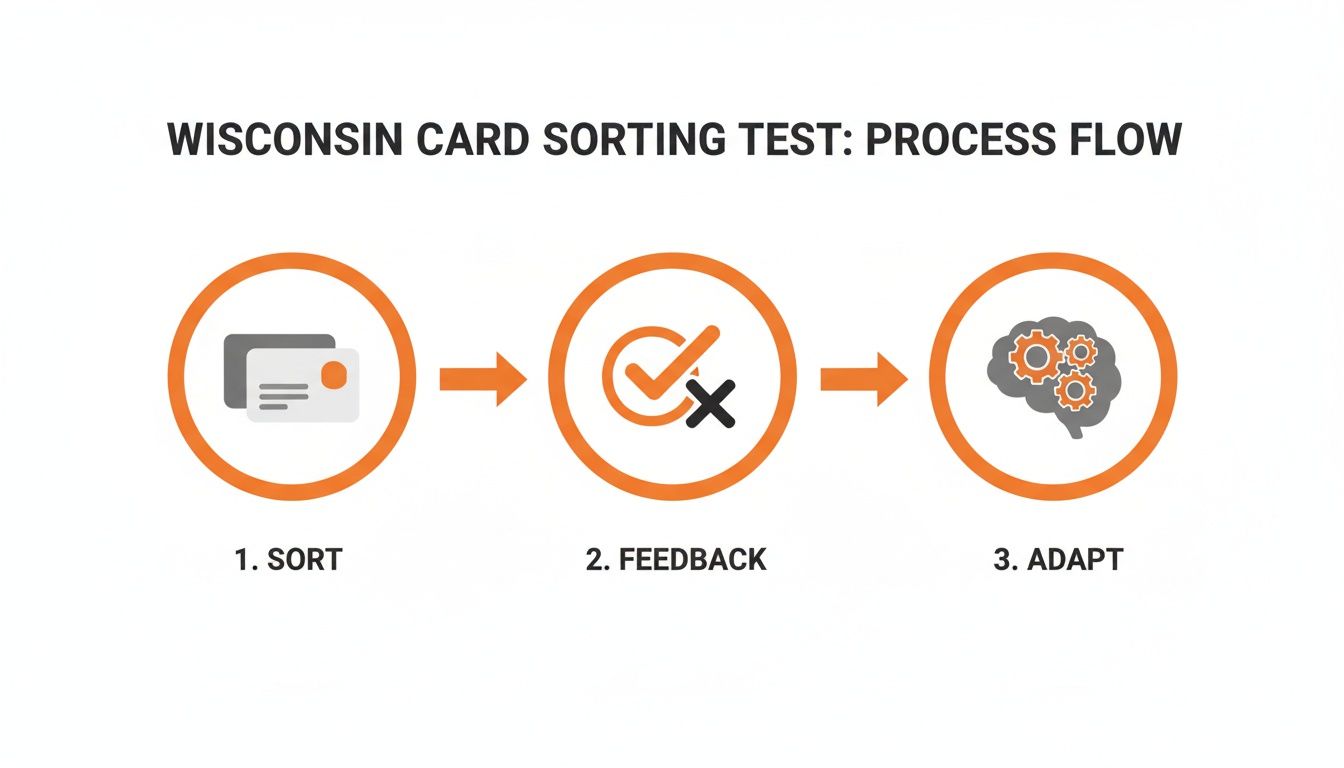
As you can see, success hinges on the person’s ability to constantly cycle through this process: sort, process the feedback, and then adapt their strategy.
Modern Digital Administration
While the hands-on method is the foundation of the WCST, digital platforms like Orange Neurosciences now automate this entire process. This doesn't just save a ton of time for the clinician; it also guarantees a perfectly standardized test every single time, removing the chance of human error in giving feedback or shifting the rules. The participant simply interacts with a screen while the software handles the rules, tracks every response, and calculates the scores on the fly.
The real power of digital administration is the incredible precision it offers. Every single response is timed and logged, creating a much richer dataset than just "right" or "wrong." This level of detail is invaluable for tracking subtle changes in cognitive function over time.
Demystifying Key Scoring Metrics
Scoring the WCST is much more nuanced than just tallying up correct answers. The most meaningful data comes from digging into the types of mistakes made. Two key error types give us the deepest look into a person's executive function.
Perseverative Errors: This is the big one. A perseverative error happens when someone keeps using a rule that is no longer correct. For example, the rule has switched from "colour" to "shape," but they continue matching red cards to red cards. Every time they do this, it's a perseverative error. This pattern points directly to cognitive rigidity—an inability to shift their mental set.
Non-Perseverative Errors: These are essentially random mistakes that don't fit with any previous or current rule. A high number of these might suggest the person is having trouble forming a consistent strategy in the first place, or perhaps they're struggling to stay focused on the task.
By understanding what these different errors mean, clinicians can turn a set of scores into real, actionable insights about a person's problem-solving skills and mental flexibility. These metrics often work hand-in-hand with other assessments, which you can explore in our guide to the Frontal Assessment Battery. Learning to properly interpret these error patterns is what truly unlocks the value of the Wisconsin Card Sorting Test.
Interpreting Results and Clinical Error Patterns
Scoring the Wisconsin Card Sorting Test is really just the first step. The true clinical magic happens when you look past the raw numbers and start to piece together the story they tell about an individual's executive function. It's the patterns of errors, often more than the final score itself, that reveal how a person thinks, adapts, and tackles problems.
When we understand these patterns, we can build a detailed profile of a person’s cognitive strengths and challenges. It turns a simple score into a practical roadmap for creating targeted, effective therapeutic support.
Decoding Perseverative Errors
The single most telling metric in the WCST is the number of perseverative errors. As we mentioned earlier, this isn't just any old mistake. It's a very specific error where the person keeps using a rule that is no longer correct, even after getting feedback that it's wrong. This is a powerful sign of cognitive rigidity and a classic indicator of frontal lobe dysfunction.
Practical Example: Picture an adolescent with ADHD who quickly figures out that "shape" is the first sorting rule. Great. But when the rule silently shifts to "colour," they keep sorting by shape, ignoring the "wrong" feedback over and over. This isn't because they don't understand the task; it's because they have a hard time letting go of a strategy that just worked for them. Each time they stick with that old rule, they rack up another perseverative error.
Actionable Insight: A high count of perseverative errors suggests that the individual's "mental brakes" aren't working as they should. They get stuck in one way of thinking and struggle to pivot. This insight can directly inform therapy, guiding you to focus on cognitive behavioural techniques or specific exercises designed to improve flexible thinking and the ability to disengage from old patterns.
This pattern is a hallmark of difficulty with set-shifting and often appears in conditions that impact the brain's frontal systems. Thankfully, modern digital platforms can automatically flag these specific errors, saving clinicians a ton of time and giving them immediate, precise data to work with.
Other Critical Error Patterns to Watch For
While perseverative errors tend to steal the spotlight, other patterns add important layers to the story. Spotting these nuances is essential for getting a complete picture of an individual's cognitive profile. For a closer look at how these patterns fit into the bigger clinical picture, check out our guide on how to test for executive dysfunction.
Here's a breakdown of the key error patterns and what they might suggest about an individual's cognitive processes.
Common WCST Error Patterns and Their Clinical Implications
Error Pattern | Description | Potential Clinical Implication | Actionable Insight |
|---|---|---|---|
Perseverative Errors | Persisting with a sorting rule after receiving negative feedback. | Suggests cognitive rigidity and potential frontal lobe dysfunction. | Target interventions on set-shifting and flexible problem-solving. |
Failure to Maintain Set | Correctly identifying a rule but then making random errors before the category is complete. | May indicate problems with sustained attention or working memory. | Focus on strategies to improve focus and working memory, such as mindfulness or chunking tasks. |
High Non-Perseverative Errors | Making random mistakes that don't match the current rule or any previous one. | Often points to a failure to form a coherent strategy, possibly due to confusion or inattention. | Simplify instructions for complex tasks and provide structured problem-solving frameworks. |
Inefficient Initial Sorting | Taking an unusually high number of trials to achieve the first sorting category. | Indicates difficulty with initial concept formation or learning from feedback. | Begin with highly structured, guided learning activities to build confidence and skill. |
By analyzing these different error types together, you can build a much more specific and useful clinical narrative. For instance, two people might have the same total errors, but one has mostly perseverative errors (pointing to rigidity), while the other has mostly non-perseverative errors (suggesting inattention). This actionable data leads to two very different, personalized support strategies.
Clinical Applications Across Different Populations
The real magic of the Wisconsin Card Sorting Test isn't just what it measures, but who it can help. Its simple yet elegant design pulls back the curtain on our adaptive thinking, making it an essential tool for professionals in a surprisingly wide range of fields. From neurology clinics to school psychology offices, the WCST provides a clear, objective lens to see cognitive flexibility in action.
This versatility is its greatest strength. It gives practitioners a reliable way to quantify executive dysfunction that’s relevant to the real world. The test closes the gap between abstract cognitive theory and the practical challenges people face every day, offering insights that shape everything from brain injury rehabilitation to classroom support strategies.
In Neuropsychology and Brain Injury Recovery
For a neuropsychologist working with a patient who's had a traumatic brain injury (TBI), the WCST is a cornerstone of their assessment toolkit. After an injury, especially to the frontal lobes, people often struggle with a kind of mental gridlock, or cognitive rigidity. They find it incredibly difficult to pivot from one task to another or change their approach when the rules of a situation shift.
Practical Example: A TBI patient gets stuck trying to make breakfast because the brand of cereal they always use is gone. Instead of adapting by choosing something else, they become agitated and can't move forward. The WCST can quantify this exact type of mental roadblock. A high perseverative error score provides objective data to build a rehab plan focused on step-by-step problem-solving and flexible thinking exercises.
The Wisconsin Card Sorting Test provides a common language for clinicians. A score showing significant perseverative errors is universally understood as a marker for cognitive rigidity, allowing for clearer communication and more coordinated care across different specialists.
Supporting Students in Educational Settings
In a school, a psychologist might pull out the WCST to get a better handle on a student with autism spectrum disorder (ASD) or attention-deficit/hyperactivity disorder (ADHD). For example, a student with ASD might be a master of rule-based, systematic thinking but find it deeply unsettling when routines or expectations suddenly change. The WCST can paint this picture with remarkable clarity.
Practical Example: A student with ADHD excels in math class (a subject with clear rules) but struggles when a project requires creative, open-ended thinking. Their WCST results might show a "failure to maintain set"—they figure out the rule, but their attention wanders, and they make inconsistent errors. This insight gives the teacher an actionable strategy: provide visual cues and frequent check-ins to help the student stay on track, rather than assuming they don't understand the assignment. For a deeper look at these kinds of challenges, you can explore our detailed guide on ADHD assessment and support strategies.
Use in Geriatric Care and Neurodegenerative Conditions
The WCST is also incredibly valuable in geriatric care, especially for tracking the cognitive changes that come with aging and conditions like dementia. As neurodegenerative diseases like Alzheimer's progress, executive functions are often the first to show signs of decline.
Actionable Insight: By using the test over time, clinicians can map this decline. A patient who once breezed through the test with few mistakes might, a year later, show a big jump in perseverative responses. This objective data is crucial for tracking the disease's progression, seeing if treatments are working, and giving families practical advice, such as simplifying daily routines and using visual aids to reduce cognitive load.
The test’s ability to work across such diverse groups is one of its core strengths. In fact, the Wisconsin Card Sorting Test has been validated for an incredibly wide age range, from 6.5 years all the way up to 89 years old. This allows for consistent assessment across nearly the entire human lifespan, making it a powerful tool for charting both developmental milestones and age-related cognitive changes. You can discover more insights about the test's broad validation across different populations on wikipedia.org.
Limitations and Considerations in Modern Practice
While the Wisconsin Card Sorting Test is a cornerstone for measuring cognitive flexibility, it’s not a magic bullet. No single test can possibly paint a complete picture of a person's executive function, and it's crucial for any good practitioner to approach the WCST with a balanced, critical perspective.
The test is brilliant at isolating set-shifting—that ability to ditch one strategy and adopt another. But it tells you very little about other vital executive skills like long-term planning, impulse control, or emotional regulation. For a truly holistic assessment, you have to pair the WCST with other tools. Think of it like a diagnostic puzzle. The WCST provides a critical piece, but you need other assessments to see the full image of a person’s cognitive health.
The Practical Hurdles of Manual Administration
Beyond its focused scope, the traditional, hands-on version of the WCST comes with some significant practical headaches. Administering and scoring the test by hand is slow. For busy clinicians, this is a major hurdle, eating up valuable time that could be spent on patient interaction and treatment planning.
On top of that, manual scoring is just plain vulnerable to human error. A simple miscalculation or a momentary lapse in concentration can skew the results, potentially leading to the wrong interpretation. This kind of inconsistency makes it incredibly difficult to reliably track a patient's cognitive changes over time. You can learn more about why that matters in our guide to understanding test-retest reliability.
Relying solely on manual WCST administration is like trying to time a marathon with a stopwatch that sometimes skips a beat. You get a general idea, but the precision needed for meaningful progress tracking is lost. Digital automation removes this variability, ensuring every measurement is consistent and accurate.
Addressing Potential Bias in Interpretation
Another critical factor to keep in mind is the potential for bias when you're interpreting WCST results. Things like a person's educational background, cultural context, or even their level of anxiety on test day can all influence performance. A timed, abstract task like sorting cards might not land the same way for everyone, and it’s vital to consider these variables to avoid jumping to the wrong conclusions.
For example, someone with limited formal education might struggle with the abstract nature of the test, a response that could be mistaken for cognitive rigidity. Similarly, a person from a cultural background that prioritizes collaborative problem-solving might approach the task differently than someone who is used to individual, timed tests.
Educational Background: Performance can be influenced by prior experience with standardized testing and abstract reasoning tasks.
Cultural Context: Different cultural approaches to problem-solving and feedback can affect how a person engages with the test.
Test Anxiety: High levels of anxiety can impair performance, leading to more errors that don't accurately reflect an individual's true cognitive abilities.
This critical perspective doesn't diminish the value of the Wisconsin Card Sorting Test. Instead, it shines a spotlight on the clear advantages of modern, digital platforms. By automating the tedious and error-prone parts of administration and scoring, digital tools help sidestep these limitations. This frees up clinicians to dedicate their expertise where it matters most—interpreting nuanced results, considering the whole person, and designing effective care plans that lead to better outcomes.
The Future of Digital Cognitive Assessment
The evolution of the Wisconsin Card Sorting Test—from a hands-on, time-consuming task to a razor-sharp digital tool—represents a massive leap forward in how we approach cognitive care. This isn't just about making things easier; it's about unlocking a much deeper, more useful understanding of a person's executive function.
When we digitize assessments like the WCST, we go way beyond a simple "right" or "wrong" score. Instead, we capture a rich stream of data points, from response times and subtle error patterns to the actual learning curve unfolding in real time. For busy clinicians, the benefits are immediate and tangible: pinpoint accuracy, huge time savings, and solid data tracking to monitor a patient's progress over the long haul.
From Raw Data to a Clear Cognitive Profile
At Orange Neurosciences, our platform doesn't just digitize the Wisconsin Card Sorting Test; it weaves it into a seamless workflow. This process transforms raw performance data into a clear, understandable cognitive profile, directly connecting the dots between evaluation and intervention. And as we think about where technology is headed, looking into the wider world of AI in healthcare assessment offers a fascinating glimpse into what's next.
Picture a clinical workflow that flows effortlessly from one step to the next:
Administer a Test Battery: A clinician runs a series of assessments, including a digital WCST, right on a tablet.
Receive an Instant Report: The second the test ends, the platform generates an AI-powered report that automatically flags important patterns, like a high number of perseverative errors.
Assign Personalized Therapy: Armed with these precise insights, the clinician can immediately assign personalized, gamified therapy exercises built to target the exact executive function weaknesses the test uncovered.
This all happens within one cohesive system, finally closing the age-old gap between assessment and actual treatment.
The real power of an integrated platform is its ability to create a continuous feedback loop. Assessment data informs therapeutic strategy, and progress within the therapy exercises provides real-time data for ongoing adjustments to the care plan.
Making Precise Cognitive Care a Reality
This integrated approach gives clinicians the tools to deliver more effective, evidence-based cognitive care than ever before. It cuts out the guesswork and the administrative headaches, freeing up professionals to focus their expertise on what really matters: improving their patients' outcomes. The result is a system that's not just more efficient but also far more responsive to the unique needs of every individual.
We invite you to see this in action. Visit the Orange Neurosciences website to discover how our platform is making precise, data-driven cognitive assessment and therapy a reality for clinicians, educators, and patients today. It’s time to move beyond static scores and embrace a more dynamic, insightful approach to brain health.
Burning Questions About the WCST
To wrap things up, let's tackle some of the most common questions that pop up for clinicians, educators, and researchers using the Wisconsin Card Sorting Test. Think of this as the practical, need-to-know details that build on the rest of the guide.
How Long Does the Wisconsin Card Sorting Test Take?
The timing really depends on how you're administering it. If you're going the traditional route with physical cards, you can expect the Wisconsin Card Sorting Test to take anywhere from 20 to 30 minutes. That includes setup, giving instructions, and then the painstaking process of scoring by hand.
But this is where modern tools make a huge difference. Computerized versions, like the one integrated into the Orange Neurosciences platform, slash that time considerably. Digital administration is usually done in under 15 minutes, and the best part is the scoring is instant and automatic. That's a huge time-saver, freeing you up to focus on what really matters: interpreting the results and caring for your client.
Is the WCST a Standalone Diagnostic Tool?
This is a critical point: No, it's not. The WCST is an incredibly insightful assessment tool, but it should never be used as a standalone diagnostic instrument. It gives you a sharp, focused look into one specific cognitive skill—cognitive flexibility—but it can't diagnose a condition all on its own.
Actionable Insight: A high number of perseverative errors is a big red flag for frontal lobe dysfunction. But you'll see that same pattern in people with a traumatic brain injury, ADHD, or schizophrenia. A qualified professional must put the WCST results into a much bigger picture, looking at the client's history, clinical interviews, and other neuropsychological tests to land on an accurate diagnosis.
The WCST provides a critical piece of the puzzle. It tells you how a person’s executive function might be struggling, but it doesn't tell you the ultimate why. That requires a comprehensive clinical assessment.
Can the WCST Be Used with Children?
Absolutely. The WCST is validated for kids, generally from age 6.5 and up. It’s a staple in pediatric and school settings for a reason—it’s excellent for tracking the development of executive functions as a child grows.
In a school setting, a psychologist might use it to pinpoint why a student with ADHD, autism, or a learning disability is struggling to switch between tasks or adapt to new classroom rules. The key when using the Wisconsin Card Sorting Test with younger people is to make sure you're comparing their scores to age-appropriate normative data. This is another area where digital platforms are a huge help, as they often handle this automatically to ensure the interpretation is spot-on.
What Is a Perseverative Error vs. a Non-Perseverative Error?
Getting this distinction right is the secret to a meaningful WCST interpretation. They sound similar, but they point to very different underlying issues.
A perseverative error is what happens when a person gets stuck. Practical Example: The sorting rule changes from "colour" to "shape," but they just keep sorting by colour, even when they get feedback that they're wrong. This is a classic sign of cognitive rigidity—an inability to shift their thinking.
A non-perseverative error is more like a random guess that misses the mark. The card they played doesn't match the current rule, but it also doesn't match the previous one they were stuck on. These kinds of errors often suggest the person is having trouble forming a strategy in the first place, or maybe they're just struggling with attention.
Ready to move beyond manual assessments and unlock deeper cognitive insights? The Orange Neurosciences platform integrates the Wisconsin Card Sorting Test into a seamless digital workflow, providing instant, precise results that empower better clinical decisions.
Discover how our AI-powered tools can save you time and enhance your practice at https://orangeneurosciences.ca. Or, if you have specific questions, reach out to our team—we’re here to help you get started.
Orange Neurosciences' Cognitive Skills Assessments (CSA) are intended as an aid for assessing the cognitive well-being of an individual. In a clinical setting, the CSA results (when interpreted by a qualified healthcare provider) may be used as an aid in determining whether further cognitive evaluation is needed. Orange Neurosciences' brain training programs are designed to promote and encourage overall cognitive health. Orange Neurosciences does not offer any medical diagnosis or treatment of any medical disease or condition. Orange Neurosciences products may also be used for research purposes for any range of cognition-related assessments. If used for research purposes, all use of the product must comply with the appropriate human subjects' procedures as they exist within the researcher's institution and will be the researcher's responsibility. All such human subject protections shall be under the provisions of all applicable sections of the Code of Federal Regulations.


© 2026 by Orange Neurosciences Corporation