A Guide to the Test for Executive Dysfunction
Nov 10, 2025
A test for executive dysfunction isn't just one single exam. Think of it more as a series of evaluations designed to get a clear picture of how your brain plans, organises, and gets things done.
These assessments are a massive step toward figuring out specific cognitive challenges and, more importantly, building support strategies that actually work. They take us beyond simple observation and give us real, objective data about your unique mental wiring. If you suspect you or a loved one is struggling, getting the right test is the first actionable step toward clarity.
What Is Executive Dysfunction and Why Test for It

Imagine your brain has its own internal project manager—a skilled CEO running your entire life. This "manager" is your set of executive functions. It juggles everything from mapping out your day and deciding what’s important to managing your time and keeping your impulses in check.
When that system is running smoothly, you move through your day with relative ease. You make it to appointments, bills get paid, and you can tackle a multi-step project like assembling IKEA furniture without wanting to throw it out the window.
But what happens when that project manager starts to struggle?
Recognizing the Signs of a Stressed System
This is where executive dysfunction comes in. It happens when this internal CEO is facing some serious hurdles. We’re not talking about laziness or a lack of motivation here; it’s a genuine difference in cognitive wiring that can make everyday tasks feel like climbing a mountain.
The signs usually show up as persistent patterns of behaviour. You might recognise some of these practical examples:
The Procrastination Loop: You have a massive work deadline, but you find yourself deep-cleaning the fridge or falling down a social media rabbit hole—anything to avoid starting the main task. Actionable Insight: This isn't just poor time management; it can signal a breakdown in 'task initiation'.
Time Blindness: You constantly underestimate how long something will take. A "quick trip to the store" turns into an hour-long ordeal, resulting in you being perpetually late for meetings and appointments, no matter how hard you try. Actionable Insight: This points to challenges with planning and mental forecasting.
Mental Clutter: Your mind feels like a browser with a hundred tabs open at once. During a meeting, you can't focus on the speaker because you're simultaneously thinking about an email you forgot to send, what to make for dinner, and a comment someone made yesterday. Actionable Insight: This suggests difficulty with 'working memory' and 'attentional control'.
These aren't just minor quirks; they can create huge amounts of stress, strain relationships, and hold you back at work. So many people describe it as feeling like they're working twice as hard as everyone else just to keep their head above water.
The goal of a professional assessment isn't just to get a label. It's about gaining a clear, objective understanding of your cognitive strengths and weaknesses to build a personalised toolkit for success.
From Self-Awareness to Actionable Clarity
Noticing these patterns in yourself is the first step. The next is getting real clarity through a professional evaluation. Going for a test for executive dysfunction is a powerful move toward understanding the "why" behind the struggles. It helps sort out what's occasional disorganisation versus a consistent cognitive challenge that needs specific strategies.
The process turns that vague feeling of frustration into solid, actionable data. An assessment can pinpoint whether the main difficulty is with working memory (like remembering multi-step instructions), cognitive flexibility (switching between tasks), or emotional regulation (managing frustration when things go wrong). To get a better handle on the basics, you can learn more about what is a cognitive assessment in our detailed guide.
Ultimately, testing gives you a roadmap. It helps you, your family, and any professionals you work with find the right tools—from simple reminder apps to specific therapeutic techniques—that actually sync up with how your brain works. It’s all about paving the way for meaningful, positive change.
Exploring Different Types of Executive Function Tests
Pinpointing executive dysfunction isn’t a one-size-fits-all affair. A good clinician won’t rely on a single test. Instead, they act like a detective, gathering different kinds of evidence to build a complete picture of your unique cognitive profile.
To get the full story, professionals use two main categories of tools: performance-based tests—think of these as hands-on cognitive challenges—and rating scales, which gather crucial insights from real-world observations. Each one provides a unique piece of the puzzle, and together, they create a detailed map of your executive functioning.
Performance-Based Tests: Uncovering How You Think
Performance-based tests are direct, in-the-moment tasks where you're asked to solve specific cognitive problems. These aren't pass-fail exams. They're carefully designed exercises meant to measure skills like mental flexibility, attention, and planning in a controlled environment.
These tests give clinicians clean, objective data on how your brain processes information when a specific demand is placed on it. A couple of classic examples you might encounter are:
The Stroop Test: Picture the word "BLUE" printed in bright red ink. Now, you're asked to say the colour of the ink, not the word you just read. It’s surprisingly tricky! This test is a fantastic measure of your response inhibition—your brain’s ability to hit the brakes on a gut reaction (reading the word) to stick to the actual task (naming the colour). Actionable Insight: Difficulty here might explain why you often interrupt people or act on impulse without thinking through the consequences.
Wisconsin Card Sorting Test (WCST): In this test, you're given a set of cards and told to sort them according to a rule you have to figure out on your own (maybe it’s by colour). Just as you get the hang of it, the clinician changes the rule without warning (now it's by shape). The WCST is all about cognitive flexibility, showing how well you can adapt your thinking when the goalposts move. Actionable Insight: A struggle with this test could explain why you find it so hard to switch gears when a plan suddenly changes at work.
Other tools, like the Frontal Assessment Battery, offer a quick but valuable screening of several key executive functions at once. We break this down in more detail in our guide to the Frontal Assessment Battery.
Rating Scales: Capturing Real-World Behaviour
While performance tests show what you can do in a structured setting, rating scales tell us what you actually do in the messy reality of daily life. These are detailed questionnaires filled out by you, a parent, a partner, or a teacher.
The questions zero in on specific behaviours related to planning, organisation, emotional control, and working memory. A practical example of a question might be, "How often do you misplace items needed for a task (e.g., keys, phone, wallet)?" or "How often do you have an overly emotional reaction to a minor setback?"
By combining direct performance data with real-world behavioural observations, clinicians can see the full picture—the difference between your potential cognitive abilities and how those abilities show up amidst the distractions and demands of daily life.
One of the most trusted and widely used rating scales is the Behavior Rating Inventory of Executive Function (BRIEF). It provides a structured way to gather observations about someone's behaviour at home or school, adding critical context that you just can't get from a single testing session.
The insights from scales like the BRIEF are vital, especially when assessing kids. A study in California highlighted this perfectly when it used the BRIEF to evaluate school-aged children with congenital heart disease (CHD). The findings were staggering: children with CHD had over four times the odds of showing parent-reported executive dysfunction compared to their peers, particularly with working memory and cognitive flexibility. Yet, despite this massive risk, the study found these children were no more likely to be receiving school services, pointing to a huge gap in support. You can read more about these important California findings on executive dysfunction and the urgent need for better screening.
Ultimately, a truly thorough assessment for executive dysfunction needs both types of tools. Performance tests provide the objective data, and rating scales add the human context. This blended approach is what allows clinicians to develop strategies that will actually make a difference in your life.
Navigating a Professional Evaluation Step by Step
Walking into a professional evaluation for executive dysfunction can feel a little intimidating, but knowing what’s coming helps demystify the whole process. Think of it as creating a personalized user manual for your brain. It's a structured, collaborative journey designed to uncover your cognitive strengths and pinpoint the exact areas where you face challenges.
The goal isn't to put you under a microscope. It's about getting a clear, objective look at how your mind works in different situations. From that first chat to the final feedback session, every step is built to give you clarity and real, actionable insights.
The Initial Consultation Meeting
Your first step is simply a detailed conversation with a neuropsychologist or a trained clinician. This isn't a test; it's a guided discussion where you get to share your story and the struggles you've been having. The clinician’s job is to listen and truly understand your experiences from your point of view.
During this meeting, they'll likely ask open-ended questions to get a feel for your daily life. It’s a good idea to come prepared with practical examples. A clinician might ask:
"Can you walk me through how you approach a large, multi-step project, like planning a vacation?"
"How do you typically manage your time on an average weekday? Where do things fall apart?"
"Describe a recent situation where you felt overwhelmed or frustrated by a task. What happened?"
This conversation provides crucial context that a standardized test alone just can't capture. It helps the professional pick the right assessment tools for your unique situation and makes sure the evaluation is focused on your specific concerns.
The Testing Session Itself
The core of the evaluation is the testing session. This almost always happens in a quiet, one-on-one setting, free from distractions. This is key to ensuring the results accurately reflect your cognitive abilities, not your ability to tune out a noisy office. Many people worry this will feel like a tough exam, but most find the tasks are more like puzzles or brain games.
These activities are designed to measure specific executive functions, such as:
Working Memory: You might be asked to listen to a short story and then recall specific details from it.
Inhibitory Control: A task could involve pressing a button for every letter that appears on a screen except for the letter 'X'.
Cognitive Flexibility: You may be asked to sort objects by one rule (e.g., colour) and then suddenly switch to a new rule (e.g., shape).
The clinician is observing more than just your answers; they're looking at how you approach the problems. Do you plan out a strategy first? Do you get frustrated when the rules change? These observations are just as valuable as the final scores.
Remember, the purpose of a test for executive dysfunction is not to judge you but to gather objective data. There are no "right" or "wrong" ways to complete these tasks—only information that helps build a clearer picture of your cognitive profile.
To keep track of everything, clinicians need to document their observations and test results with precision. Throughout the evaluation, many rely on specialized medical documentation software to maintain detailed and organized client records.
The infographic below gives a great overview of the typical flow of an assessment, from what you report to the final insights.
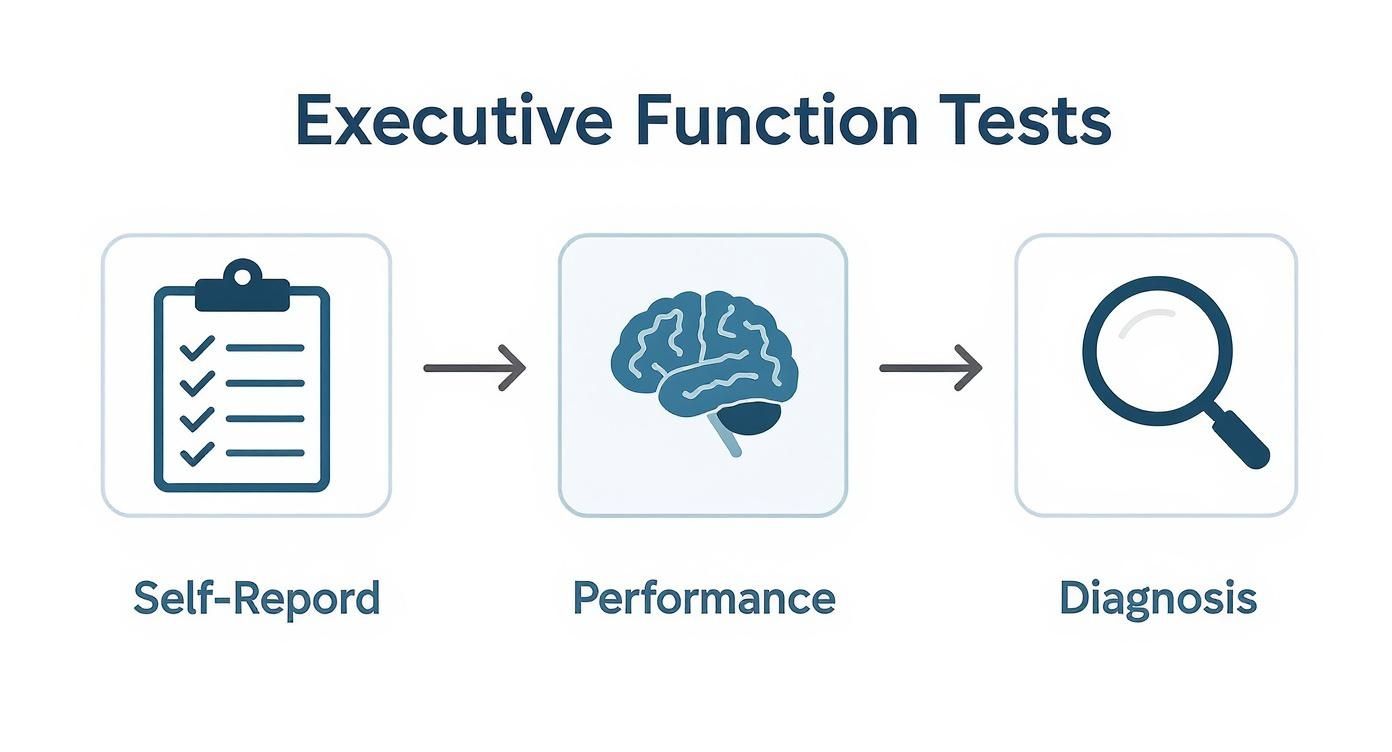
This visual roadmap shows how information from different sources—your personal experiences, your performance on tasks, and the professional’s analysis—all comes together to form a complete understanding.
To give you an even clearer picture, here's a simple breakdown of what to expect during your assessment journey.
What to Expect During Your Evaluation
Evaluation Stage | What Happens | Your Role |
|---|---|---|
Initial Consultation | A detailed interview about your history, challenges, and goals. | Share specific, real-life examples of your struggles. |
Testing Session | You'll complete a series of standardized tests and activities, like puzzles or computer-based tasks. | Try your best on each task, but don't stress about "passing." |
Scoring & Analysis | The clinician scores your tests and integrates all the data from the evaluation. | This happens behind the scenes; you just need to wait for your follow-up. |
Feedback Session | You'll meet with the clinician to review the results, discuss the diagnosis, and create an action plan. | Ask questions, seek clarification, and collaborate on next steps. |
This table maps out the key milestones, showing that it’s a well-defined process with a clear beginning, middle, and end.
The Feedback and Planning Session
After the testing is done, the clinician scores the assessments and puts together a comprehensive report. The final, and arguably most important, step is the feedback session. This is where you meet again to go over the results in detail.
The clinician will translate the technical scores into meaningful, real-world terms. They’ll connect the dots between a specific finding, like "difficulty with task initiation," and your daily experience of procrastinating on that big work project.
This meeting is a two-way conversation. It's your chance to ask questions, get clarification, and make sure you really understand the findings. More importantly, the session will pivot to what comes next. You'll get practical recommendations and strategies tailored to your profile, which might include behavioural strategies, potential workplace accommodations, or referrals to other specialists. The process can feel complex, but resources are available. For those exploring different assessment formats, you can learn more about the structure and benefits of a cognitive assessment online.
Ultimately, you will leave with a much deeper understanding of your own cognitive wiring and, most importantly, a clear, actionable plan to move forward.
How to Understand Your Test Results and Plan Next Steps
Getting back a detailed report from a test for executive dysfunction can feel like you've been handed a document in a foreign language. It’s often packed with clinical terms, scores, and graphs that look pretty intimidating at first. But that document is actually an incredibly powerful tool—think of it as a personalized roadmap, translating your unique cognitive profile into real-world insights.
The trick is to look past the raw numbers and see what they actually mean for your daily life. A good clinician will walk you through it, but having a solid grasp of the concepts yourself empowers you to take the driver's seat. The whole point is to turn that diagnostic data into a practical, life-changing action plan.
Decoding the Numbers and What They Mean for You
Your report will probably throw around terms like percentiles, standard scores, and standard deviations. Don't let them scare you. These are just ways of comparing your performance to a large, standardized group of people around your age. It's a bit like a growth chart at the doctor's office—it’s all about context, not a pass-or-fail grade.
Here’s a practical example: seeing a low percentile score in working memory isn't just a number on a page. It's the real-life frustration of forgetting the multi-step instructions your boss just gave you. It’s walking into the kitchen and having absolutely no clue what you came for.
The most important part of your results isn't the score itself, but the story it tells. It connects a specific cognitive challenge, like 'impaired inhibitory control,' to a real-world behaviour, like frequently interrupting others in conversations.
Figuring out these connections is the first real step toward finding strategies that stick. A thorough evaluation doesn't just zero in on weaknesses; it also shines a light on your strengths. Maybe you’re fantastic at creative problem-solving. That's a strength you can lean into to build unique organizational systems that actually work for your brain.
Translating Test Findings into Actionable Strategies
Once you’ve got a handle on what the results are saying, the focus shifts to making a plan. This is where the assessment truly proves its worth. It gives you the "why" behind your challenges, which then tells you "how" to start addressing them. A solid plan links every finding to a concrete, practical strategy.
Let’s break down what this looks like with a few practical examples:
Finding: Difficulty with Task Initiation (that feeling of being stuck and unable to start).
Actionable Step: Try the "2-Minute Rule." If a task like "take out the trash" or "reply to one email" takes less than two minutes, just do it immediately. This simple trick builds momentum that can carry you into bigger projects.
Finding: Impaired Working Memory (trouble holding onto information for short periods).
Actionable Step: Go all-in on external aids. Use your phone's calendar for every single appointment, use a dedicated app like Todoist for your to-do list, and use your phone's voice recorder to capture fleeting ideas before they vanish.
Finding: Low Cognitive Flexibility (finding it hard to switch gears or adapt to unexpected changes).
Actionable Step: Practice "task batching." Instead of answering emails as they come in, set aside two specific 30-minute blocks each day to clear your inbox. This cuts down on the mental strain of constantly shifting focus.
This data-driven approach is also your best tool for getting the right support at school or work. With a formal report in hand, you can ask for specific accommodations like extended time on exams, getting instructions in writing, or having access to a quiet workspace. These aren't special favours; they are necessary adjustments that level the playing field.
Ultimately, your test results are not a final verdict. They’re a starting point. They give you the clarity you need to stop fighting against your brain and start working with it, creating a life that feels less like a struggle and more like a success.
Why Your Environment and Life Experience Shape the Results
A score from an executive dysfunction test gives us a valuable snapshot, but it’s just that—a snapshot. It doesn’t tell the whole story. Your brain doesn't work in a bubble; it's deeply wired into your daily life. Things like chronic stress, how well you’re sleeping, and your personal history can have a huge impact on your performance on any given day.
Think of your executive functions as a high-performance car. Even the most powerful engine will sputter if it's running on bad fuel or driving on a bumpy, treacherous road. Your environment and life experiences are the fuel and the road—they directly affect how well your cognitive engine runs.
Understanding this connection is everything. It helps us shift from seeing challenges as just an internal problem to viewing them as a complex dance between your brain and your world. This compassionate, big-picture view is the key to finding support strategies that work for the whole person, not just a list of symptoms.
The Heavy Toll of Stress and Trauma
Chronic stress is one of the biggest culprits that can temporarily hamstring your executive functions. When your body is constantly on high alert, your prefrontal cortex—the brain's CEO—gets sidelined. Your brain reroutes its resources to survival mode, which makes it much harder to plan, focus, and keep your emotions in check.
For example, someone juggling a demanding job, financial worries, and caring for a sick parent might find their working memory starts to fail. They might forget appointments or lose track of conversations. It’s not because they have an underlying disorder, but because their cognitive tank is completely empty from stress.
It's so important to remember that performance can change from day to day. A bad day, a stressful week, or a period of intense emotional strain can temporarily look a lot like executive dysfunction. This is why context is crucial in any assessment.
Trauma can have an even deeper, more lasting impact. We know that adverse childhood experiences (ACEs) can actually change how the brain develops, especially in the areas responsible for executive control. This means that things that happened in the past can create real, ongoing challenges with skills like impulse control and emotional regulation—and that will absolutely show up in test results.
How Sleep and Physical Health Factor In
Sleep is when your brain does its nightly maintenance—recharging, storing memories, and cleaning out metabolic junk. When you're sleep-deprived, your executive functions are one of the first things to go. You might feel that classic "brain fog," struggle to concentrate, and make poor decisions, all hallmark signs of an executive system running on fumes.
Think of a new parent getting only a few hours of choppy sleep each night. Of course, they're going to find it harder to organize their day or manage their temper. This isn't a permanent state; it’s a direct consequence of their current situation. To see just how linked these functions are, you can read our guide on the connection between concussions and sleep, which dives deeper into how brain health and rest are intertwined.
Societal Pressures and Systemic Factors
It's not just about what's happening in our personal lives. Broader social and structural issues play a massive role, too. Research from California shows how systemic inequities can create environments that put a heavy strain on cognitive health, especially for marginalized communities.
Just look at the disproportionate impact the COVID-19 pandemic had on essential workers. It led to increased stress, trauma, and less access to healthcare resources—all risk factors for executive dysfunction. When you layer these social inequities with systemic racism, which has been recognized as a public health crisis, you can see how they contribute to different cognitive outcomes. For a closer look at these findings, you can read the full report from the California Department of Public Health.
Recognizing these outside influences is incredibly empowering. It validates that your struggles are real and deeply connected to your life experiences. This understanding opens the door to developing more effective, compassionate support, helping you build an environment where your brain can truly shine.
Your Questions About Executive Dysfunction Tests, Answered
Deciding to get a test for executive dysfunction is a big step, and it naturally comes with a lot of questions. Thinking about the costs, the time involved, and what the process actually looks like can feel overwhelming. Let’s clear up some of the most common concerns to help you move forward with confidence.
Our goal here is to give you the straightforward, practical information you need to make the best decision for yourself or someone you care about.
How Much Does a Neuropsychological Evaluation Cost?
The price tag on a comprehensive neuropsychological evaluation can swing quite a bit. Factors like where you live, the psychologist’s level of experience, and just how deep the testing needs to go all play a role. A full assessment isn't a quick check-up; it’s a detailed process that involves hours of one-on-one testing, followed by careful scoring, analysis, and pulling it all together in a report.
You can generally expect the cost to be somewhere in the range of a few thousand dollars. While that might sound like a lot, it’s helpful to see it as an investment in a lifetime of better support, understanding, and strategies that actually work.
Before you commit, always ask for a clear breakdown of the costs. Any reputable clinic will be upfront about their fees for the initial consultation, the testing sessions, and the final feedback meeting where they walk you through the results.
Will Insurance Cover the Cost of an Assessment?
This is easily one of the most common—and most important—questions we hear. The short answer is: it really depends. Navigating insurance coverage for neuropsychological testing can be tricky, as it varies wildly from one provider and plan to another.
Some insurance plans will cover a portion of the evaluation, particularly if it’s considered "medically necessary." This usually means you’ll need a referral from your family doctor or a psychiatrist, who is asking for the assessment to answer a specific diagnostic question (like ruling out ADHD or checking for cognitive changes after an injury).
Here are a few actionable steps you can take:
Call Your Insurance Provider Directly: This is the best first step. Ask them specifically about coverage for neuropsychological testing. The clinic can give you the CPT (Current Procedural Terminology) codes you’ll need to ask about.
Request a Pre-authorization: The clinic assessing you can often submit a request to your insurance company beforehand. This gets you a clear "yes" or "no" on what they're willing to cover.
Ask About Out-of-Network Benefits: Even if a clinician isn't in your network, your plan might still have benefits that cover a percentage of the bill. It's always worth asking.
Getting a handle on your coverage from the start can save you from any surprise bills later on.
What Is the Timeline from Start to Finish?
Getting an assessment is more of a journey than a one-off appointment, and it usually unfolds over several weeks. Knowing what to expect can help you plan and manage your own expectations.
From your very first phone call to holding the final report in your hands, the whole process typically takes between four to eight weeks.
Here’s what that journey usually looks like:
Initial Contact and Consultation (Weeks 1-2): This kicks off with your first call to the clinic, filling out intake forms, and having an initial interview to discuss your concerns.
The Testing Session (Weeks 3-4): The testing itself is often done over one or two sessions, with each one lasting several hours.
Scoring, Interpretation, and Report Writing (Weeks 5-7): This is all the behind-the-scenes work. The clinician dives deep into your results, analyzes the data, and crafts a detailed, personalized report.
Feedback Session and Final Report (Week 8): You’ll meet with the clinician again to go over the findings, ask all your questions, and get your final report with tailored recommendations.
This timeline allows for a truly thorough evaluation, ensuring the final report is as thoughtful and comprehensive as possible.
Online Screeners vs. Professional Diagnosis: What’s the Difference?
If you’ve been looking for answers online, you've no doubt stumbled upon countless free quizzes claiming to be a "test for executive dysfunction." While they can be a decent starting point for self-reflection, it’s absolutely crucial to understand their limits.
An online screener is an informal tool that might flag potential areas of concern. A professional diagnosis, on the other hand, is a formal medical conclusion reached by a qualified clinician using standardized, evidence-based assessments.
Think of it this way: using an online screener is like Googling your symptoms when you feel sick. It might give you a clue, but you wouldn’t trust it to diagnose a serious illness. For that, you go to a doctor for proper tests and a real diagnosis.
A professional evaluation offers a level of depth, accuracy, and context that no online quiz can ever match. And importantly, only a formal diagnosis can be used to request official accommodations at school or work.
At Orange Neurosciences, we understand that the journey toward cognitive clarity begins with reliable data. Our AI-powered platform provides rapid, objective cognitive profiles to help clinicians and educators make better-informed decisions. While our tools do not provide a diagnosis, they offer valuable insights to guide the next steps in your care. Explore how we can support your path to understanding at https://orangeneurosciences.ca or contact us to learn more about our innovative assessment tools.

Orange Neurosciences' Cognitive Skills Assessments (CSA) are intended as an aid for assessing the cognitive well-being of an individual. In a clinical setting, the CSA results (when interpreted by a qualified healthcare provider) may be used as an aid in determining whether further cognitive evaluation is needed. Orange Neurosciences' brain training programs are designed to promote and encourage overall cognitive health. Orange Neurosciences does not offer any medical diagnosis or treatment of any medical disease or condition. Orange Neurosciences products may also be used for research purposes for any range of cognition-related assessments. If used for research purposes, all use of the product must comply with the appropriate human subjects' procedures as they exist within the researcher's institution and will be the researcher's responsibility. All such human subject protections shall be under the provisions of all applicable sections of the Code of Federal Regulations.


© 2026 by Orange Neurosciences Corporation