A Guide to the Wechsler Intelligence Scale for Children
Feb 24, 2026
When a child is struggling or showing exceptional talent in school, parents and educators often want to understand why. The Wechsler Intelligence Scale for Children (WISC) is one of the most trusted and widely used tools psychologists have to answer that question. It’s far more than a simple "IQ test"; it's a comprehensive diagnostic instrument designed to paint a detailed picture of how a child thinks, reasons, solves problems, and learns.
Think of it not as a pass/fail exam, but as a practical roadmap to unlock a deeper understanding of a child's cognitive world and create an actionable plan for their success.
What Is the Wechsler Intelligence Scale for Children
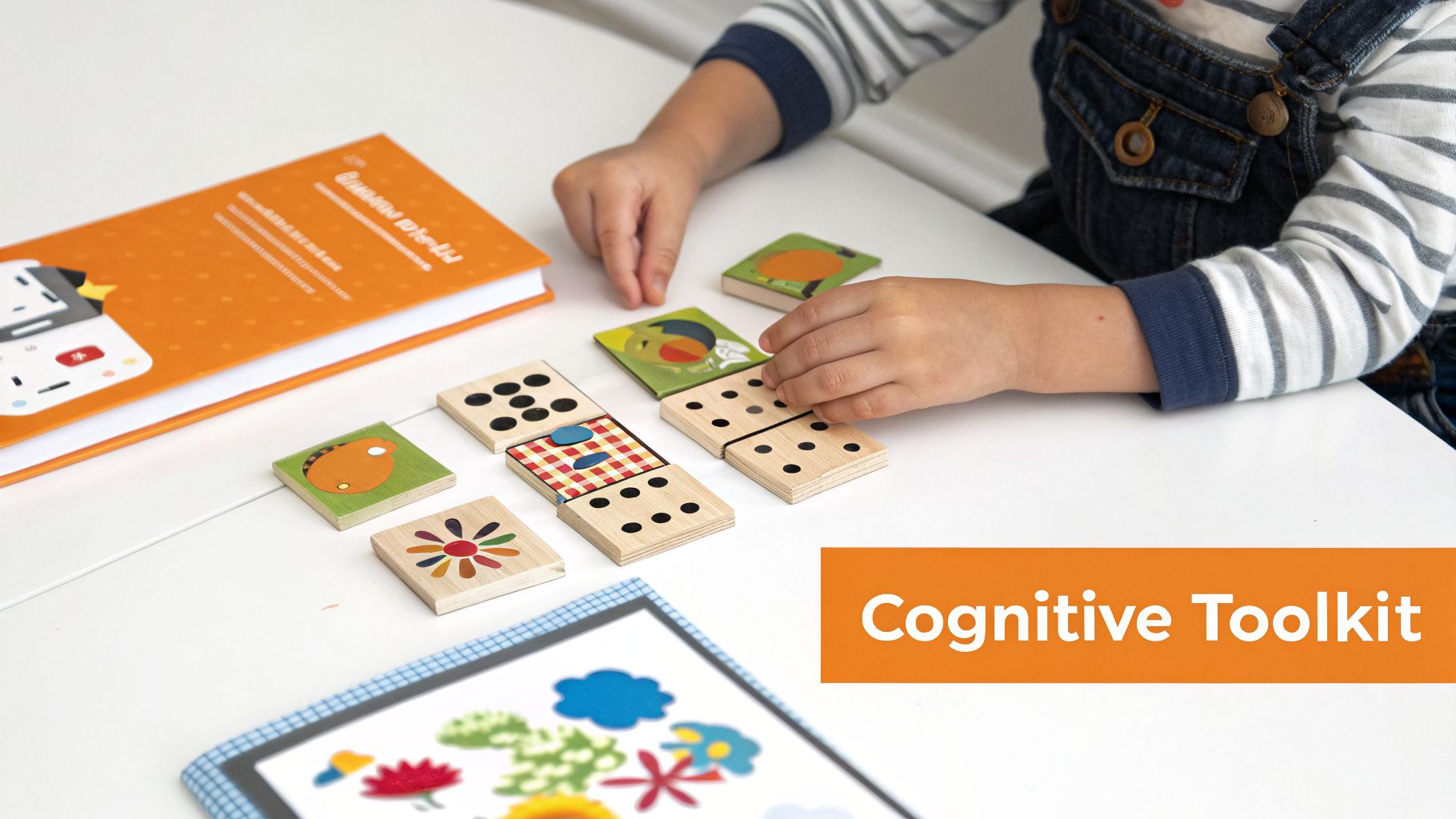
Imagine trying to understand a complex machine with just one dial. That’s what a single IQ score can feel like. The WISC, on the other hand, is like a master toolkit for exploring the intricate machinery of a child's mind. Each tool in this kit—or subtest—is carefully designed to measure a specific cognitive skill.
One subtest might assess verbal reasoning and vocabulary, while another looks at how well a child can spot patterns and solve visual puzzles. By using all these tools together, a qualified psychologist can build a rich, detailed map of a child's intellectual landscape. This map shows not just their overall ability, but their unique cognitive strengths and the specific areas where they might need a bit more support.
A Diagnostic Map, Not a Scorecard
The real power of the WISC is its diagnostic capability. It's not about labelling a child with a number. It’s about generating actionable insights that inform educational planning, help identify learning disabilities, or highlight intellectual giftedness. It helps us get to the bottom of critical questions with practical answers.
Practical Example: A parent asks, "Why does my child read beautifully but get completely stuck on multi-step math problems?" The WISC might reveal that while their verbal skills are high, their working memory is weak, making it hard to hold numbers in their head while solving the problem. This insight leads to a direct strategy: teach them to use scratch paper to offload the mental work.
The insights gained from the WISC are foundational. They allow parents, educators, and clinicians to move from guesswork to evidence-based support, creating strategies that align with a child’s specific learning profile.
To really appreciate what the WISC offers, it helps to have an understanding of key statistical concepts like standard deviation, which underpins how the test is scored and interpreted.
The Canadian Context of the WISC-V
To ensure the WISC is fair and accurate, the current version, the WISC-V, has been carefully adapted for different populations. For us here in Canada, the Wechsler Intelligence Scale for Children-Fifth Edition: Canadian (WISC-VCDN) was standardized using a large sample of English-speaking Canadian children.
This Canadian-specific version accounts for our unique cultural and demographic nuances, ensuring the results are as relevant and precise as possible. This commitment to detail is what makes the WISC-VCDN such a reliable tool for assessing cognitive abilities across the country.
This individualized, in-depth approach is at the heart of any good cognitive evaluation. To see how it fits into the bigger picture, you can check out our guide on what is cognitive assessment.
A Look Inside the WISC-V: The Five Core Areas of Cognition
To really get a feel for what the Wechsler Intelligence Scale for Children tells us, you have to look past the single, final score. Instead, think of a child's brain as having different cognitive engines, each one powering a different kind of thinking. A psychologist’s job is to see how each engine is running. Are they all humming along together, or is one working overtime to make up for another?
The WISC-V groups these abilities into five Primary Index Scores. When you understand what each index means, you can translate the clinical jargon into a real-world map of a child's cognitive strengths and weaknesses—a map that shows how they handle everything from classroom assignments to daily chores.
Verbal Comprehension Index (VCI)
The Verbal Comprehension Index (VCI) is all about thinking with words. It looks at a child's ability to pull from their vocabulary and use word-based knowledge. This index reflects their verbal reasoning skills and the information they’ve picked up from school, family, and the world around them.
Practical Example: A child with a strong VCI might be the one who can effortlessly explain the rules of a complicated board game, pick up on subtle humour, or summarize the main point of a story they just heard. On the flip side, a child with a weaker VCI might find it hard to define words or get their ideas across clearly in a book report.
Visual Spatial Index (VSI)
The Visual Spatial Index (VSI) is about thinking in pictures. It assesses how well a child can see visual details, understand how objects relate to each other in space, and build geometric designs from a model. It’s the skill of seeing how different parts fit together to create a whole.
Practical Example: This is a skill we use all the time, whether we're reading a map, putting together IKEA furniture from a diagram, or just trying to copy a drawing accurately. A child who excels in this area is often a natural with LEGOs or can fly through a jigsaw puzzle.
Fluid Reasoning Index (FRI)
The Fluid Reasoning Index (FRI) gets at a child’s ability to spot underlying patterns and relationships between visual objects and then use that logic to solve brand-new problems. This isn't about what a child has already learned; it's about their ability to problem-solve on the spot when they run into something they’ve never seen before.
Practical Example: A student uses fluid reasoning when they face a new kind of math problem. They have to identify the pattern, figure out the hidden rule, and apply it to get the answer, all without being explicitly taught the method. It's the "aha!" moment when they crack a logic puzzle.
This type of reasoning is at the very heart of what we call intelligence—the ability to adapt and tackle novel challenges. It’s less about what you know and more about what you can figure out.
Working Memory Index (WMI)
Think of the Working Memory Index (WMI) as a mental sticky note. It’s about the ability to hold a few pieces of information in your mind, juggle them around, and use them to finish a task. It holds just enough information for the job at hand before it disappears.
Practical Example: Following multi-step instructions—like "Put your homework in your backpack, get your lunch money, and then meet me by the door"—is a perfect example. A child with a lower WMI might remember the first step but lose track of the rest, leading to frustration for both parent and child.
For a closer look at how these skills operate, our guide can help you learn how to improve executive function.
Processing Speed Index (PSI)
Finally, the Processing Speed Index (PSI) measures how quickly and accurately a child can scan visual information, make sense of it, and respond. This isn't a measure of how smart they are, but rather how efficiently their brain can handle simple tasks, especially when the clock is ticking.
Practical Example: This skill has a direct impact on how fast a child can copy notes from the board, finish a timed worksheet, or find a specific cereal on a crowded grocery store shelf. Slow processing speed can make a very bright child seem like they're struggling simply because they can't keep up with the classroom's pace.
To tie this all together, the table below breaks down how these five cognitive areas, and the subtests that measure them, connect to skills we use every day.
Overview of WISC-V Primary Index Scales and Core Subtests
Primary Index Scale | What It Measures | Example Core Subtest | Actionable Insight & Example Skill |
|---|---|---|---|
Verbal Comprehension | The ability to use learned verbal knowledge and reason with words. | Similarities (Explaining how two things are alike). | A high score suggests strong verbal expression; perfect for class discussions. A low score might mean the child needs help organizing thoughts before speaking. |
Visual Spatial | The ability to analyze visual details and understand spatial relationships. | Block Design (Recreating a pattern using red-and-white blocks). | Strong skills here are great for STEM fields. A child who struggles may benefit from using graph paper to align math problems. |
Fluid Reasoning | The ability to identify patterns and solve novel problems without prior knowledge. | Matrix Reasoning (Choosing the missing piece that completes a visual pattern). | This is core problem-solving. A child who excels here is a natural strategist; a child who struggles can be taught to break problems into smaller steps. |
Working Memory | The ability to hold and mentally work with information for a short time. | Digit Span (Repeating a sequence of numbers forwards and backwards). | A weak score explains why a child forgets instructions. Action: Use checklists and give one instruction at a time. |
Processing Speed | The speed and accuracy of visual scanning and decision-making. | Coding (Using a key to quickly copy symbols). | A low score can cause anxiety on timed tests. Action: Request extended time for assignments to let them show what they know. |
By looking at performance across these different areas, a psychologist can build a detailed and nuanced picture of how a child learns, which is far more useful than any single number could ever be.
What to Expect During a WISC Assessment
For many parents and children, the thought of a formal cognitive assessment can be a bit nerve-wracking. But the WISC is designed to be a highly structured, one-on-one experience that feels more like a series of engaging puzzles than a test. The whole process is meant to be as comfortable and child-friendly as possible.
The assessment always happens in a quiet setting, free from distractions, with a trained examiner. A big part of the examiner's job is building a good rapport with the child, making them feel at ease before they even begin. They'll often frame the tasks as "brain games" to keep things light and engaging.
This diagram shows the five main cognitive areas the WISC-V is designed to measure.
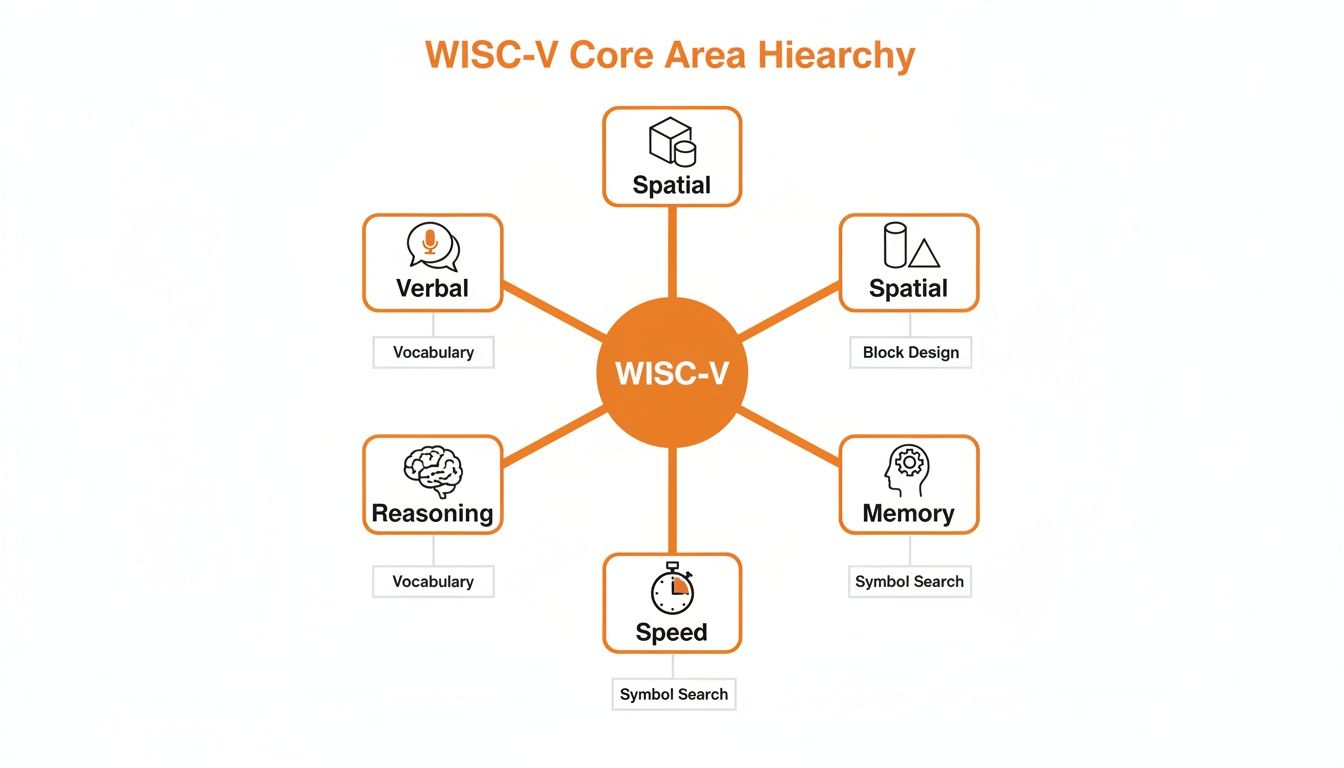
It’s a great visual reminder that the assessment is looking at a wide range of skills, not just a single, narrow definition of "intelligence."
The Standardized Environment
Every WISC assessment follows a strict, standardized script. This means the examiner reads instructions word-for-word, presents tasks in a specific sequence, and follows exact timing rules. This isn't just about being rigid; it’s about fairness and reliability.
This standardization ensures that every child, no matter who or where they're tested, gets the exact same experience. Think of it like a carefully controlled science experiment—by keeping the conditions identical, we can be confident that the results accurately reflect the child's abilities compared to their peers.
Scoring Beyond the Numbers
An examiner’s role goes much deeper than just marking answers as right or wrong. They are also skilled observers, taking detailed notes on how a child behaves and approaches the tasks. These notes provide critical context that a score alone can never capture.
A psychologist isn't just listening to what a child says, but observing how they arrive at an answer. This qualitative data is often as revealing as the quantitative score itself.
For instance, an examiner will pay close attention to things like:
Persistence and Frustration Tolerance: Does the child stick with a tough puzzle, or do they give up easily? This could indicate resilience or a need for confidence-building.
Problem-Solving Style: Is their approach quick and impulsive, or more slow and methodical? This gives insight into their executive functioning.
Attention and Focus: Can they stay focused on a task, or is their attention wandering? This is key for identifying potential attention-related challenges.
Need for Clarification: Do they often ask for instructions to be repeated, showing uncertainty? This might relate to auditory processing or working memory.
These observations help build a much richer, more holistic picture of the child. A low score on the Digit Span subtest (a measure of working memory) tells one story. But knowing whether the child was distracted versus trying their absolute best and still struggling tells a much more complete one. You can learn more in our detailed guide on the Digit Span Test.
This combination of scores and observations helps the clinician understand not just a child’s cognitive profile, but their unique learning style and how they face challenges.
Turning WISC Results Into Actionable Insights

The Wechsler Intelligence Scale for Children gives us far more than just a set of numbers; it tells a detailed story about the unique way a child's mind works. A skilled clinician knows that the assessment doesn’t end with the scores. The real work begins when they start looking for the patterns, the gaps, and the one-of-a-kind profiles that explain what a child is experiencing every day.
The true power of a WISC assessment is unlocked when we turn this data into a practical, real-world action plan. It’s all about connecting the dots—linking a specific subtest score to a child’s daily frustrations or hidden talents, and building a roadmap for support that works both at home and in the classroom.
Decoding the Cognitive Profile
A child’s cognitive profile is almost never a flat line. Most kids have a unique landscape of peaks and valleys across the five main index scores. These patterns are incredibly revealing and can often solve mysteries about a child's learning that have puzzled parents and teachers for years.
Think of it as a detective story. A single clue might not mean much on its own, but a pattern of clues can crack the case wide open. For example, a child might have a sky-high Verbal Comprehension Index but a much lower Working Memory Index. This is the classic "knows it but can't show it" student.
This profile perfectly explains why they can have a deep, insightful conversation about a novel they’ve read, yet completely stumble when their teacher gives them a three-step instruction. The knowledge is absolutely there, but the mental “sticky note” they need to hold onto information and act on it just isn't as strong.
The goal is to move beyond labels and understand the mechanics of a child's learning. By identifying the specific cognitive processes that are strong and those that are challenging, we can create targeted strategies that actually work.
From Score Patterns to Practical Strategies
Once we have a clear picture of the cognitive profile, a psychologist can translate it into concrete, actionable recommendations. This is the moment the assessment truly starts to make a difference in a child’s life. The plan should offer specific supports tailored to the child's unique brain.
Here’s how WISC results can translate directly into action:
Challenge: A low Visual Spatial Index (VSI). The child has trouble lining up math problems, loses their place while reading, and their handwriting is a mess.
Actionable Insight: The root cause isn't laziness; it's a genuine difficulty organizing visual information.
Recommendation: Use graph paper to help keep numbers neatly in columns for math. A simple ruler or reading guide can help them track lines of text. Worksheets with clear visual boundaries can also make a huge difference.
Challenge: A low Processing Speed Index (PSI). The child understands the material but can never seem to finish timed tests and takes forever to copy notes from the board.
Actionable Insight: This isn't a motivation problem. Their brain just needs a bit more time to process visual information and respond.
Recommendation: Provide extended time on tests. Give them a copy of the teacher’s notes to reduce the pressure of rapid copying. Break down big assignments into smaller, more manageable chunks.
These strategies aren’t about making things "easier." They’re about creating an environment where a child can show what they truly know, without being held back by a specific cognitive weak point. This is also a fundamental step in any formal learning disabilities assessment.
The Importance of Context and Norms
Interpreting scores also means knowing who the child is being compared to. Interestingly, research has shown that Canadian kids tend to perform a bit differently than their American counterparts on the WISC.
A 2018 analysis revealed that Canadian children consistently score higher on the WISC-V, with the overall Full Scale IQ being about 1.4 points higher. The biggest gap was found in the Visual Spatial Index. These findings are precisely why Canada developed its own norms—to ensure a child’s performance is accurately measured against their true peer group.
When interpreted with care and expertise, the WISC is an incredible tool for advocacy. It gives parents and educators the precise information they need to build a bridge from a child's potential to their performance, finally turning confusion into clarity and targeted action.
A Balanced View of the WISC Strengths and Limitations
To truly be an effective advocate for a child, you have to understand both what the Wechsler Intelligence Scale for Children can do and where its boundaries are. This powerful assessment is a cornerstone of clinical and educational psychology for good reason, but like any tool, it has specific jobs it does well and inherent limits. A clear-eyed view is the only way to make sure its results are used wisely and ethically.
The WISC’s greatest strength is its rock-solid psychometric foundation. It’s one of the most rigorously developed and validated cognitive assessments in the world. This means its results are consistent, dependable, and actually measure what they claim to measure.
The Power of a Standardized Tool
One of the biggest advantages of the WISC is its diagnostic precision. By comparing a child's performance to a large, representative sample of their peers, it gives us objective data that can pinpoint specific cognitive strengths and weaknesses. This shifts the conversation from subjective classroom observations to insights backed by evidence.
Practical Example: A teacher might simply say a student is "struggling with math." A WISC profile could reveal that the child has excellent fluid reasoning but a significant weakness in working memory. This detail explains why they can’t keep track of multi-step problems. That level of detail is exactly what’s needed to build interventions that work, like using a calculator or writing down steps.
The true value of the WISC lies in its ability to generate a detailed cognitive map. It doesn't just tell us if a child is struggling; it provides a strong hypothesis as to why, guiding us toward targeted, meaningful support.
This precision is built on decades of research into its reliability. You can explore this concept more in our guide explaining the importance of test-retest reliability in psychological assessments.
Understanding the WISC's Limitations
For all its strengths, the WISC is not a complete picture of a person. An IQ score should never, ever be treated as a permanent, unchangeable label that defines a child’s entire potential. It’s a snapshot of specific cognitive skills at one particular moment in time.
It’s also crucial to accept that the test doesn’t—and can't—measure everything that makes a child successful and happy in life.
What the WISC Doesn't Measure:
Creativity and Artistic Talent: The ability to think outside the box and come up with novel ideas isn't captured.
Emotional Intelligence: Skills like empathy, self-awareness, and social grace are completely outside its scope.
Resilience and Grit: A child's determination and ability to push through setbacks aren't quantified.
Motivation and Work Ethic: The drive to learn and apply oneself is a personality trait, not a cognitive score.
Cultural and Contextual Considerations
A child’s performance on the WISC can also be influenced by their linguistic and cultural background. The test relies heavily on vocabulary and knowledge that are common in mainstream Canadian and Western cultures. A child who is a recent immigrant or for whom English is a second language might be at a disadvantage—not because of their cognitive ability, but because of a lack of familiarity with the specific cultural content.
This is why a comprehensive evaluation is non-negotiable. The WISC is only one piece of the puzzle. To build a truly holistic picture, a clinician has to integrate the test results with other vital information, such as:
Interviews with parents and teachers
Direct behavioural observations in different settings
School records and samples of the child’s work
By weaving all these elements together, we can ensure the Wechsler Intelligence Scale for Children is used as it was meant to be: as a powerful diagnostic tool that informs and supports a child's journey, rather than limiting it.
Beyond the WISC: Monitoring Progress with Digital Tools
The Wechsler Intelligence Scale for Children gives us a deep, diagnostic snapshot—a foundational map of a child’s cognitive abilities at a single point in time. It’s an incredibly powerful tool. But what comes next? After the assessment, how do we know if our interventions are actually working? This is where modern technology steps in to complement traditional methods in a really powerful way.
The WISC is far too intensive and standardized to be used for frequent re-testing. Its whole purpose is diagnosis, not ongoing progress monitoring. This creates a natural gap: we have the initial, crucial insight, but we lack a practical way to measure change over time without repeating the entire diagnostic marathon.
The Bridge Between Diagnosis and Progress
This is where digital assessment platforms build a crucial bridge. Think of the WISC like a specialist mechanic running a comprehensive diagnostic to find a core issue with your car’s engine. You wouldn’t have them strip down the engine every week just to see if a tune-up is helping. Instead, you'd glance at the car's own dashboard—the speedometer, the fuel gauge—for daily updates.
Digital tools, like Orange Neurosciences' OrangeCheck, act as that cognitive dashboard. They provide quick, engaging, game-based assessments that can regularly track specific cognitive areas like attention, working memory, and processing speed. These tools give us the frequent data points we need to see what's changing, for better or worse.
An Actionable Cycle of Assessment and Intervention
When you combine the WISC with these digital tools, you create a powerful and dynamic cycle of care. The WISC identifies the primary challenge, and digital tools give us the means to track and manage the solution.
This approach shifts the focus from a one-time diagnosis to a continuous loop of targeted support and data-driven feedback. It empowers clinicians and parents with clear, objective data showing what interventions are making a difference.
Let’s take a real-world example. Imagine a child whose WISC results point to a significant weakness in processing speed. That insight is invaluable, but the real goal is to see improvement.
Step 1: Diagnosis: The WISC pinpoints a processing speed deficit as a key barrier to learning.
Step 2: Intervention: The child starts using a targeted intervention tool, like ReadON, which offers engaging, game-based exercises designed to strengthen this exact skill.
Step 3: Monitoring: Using a tool like OrangeCheck, the child completes brief, weekly assessments. These sessions measure processing speed in a fun, low-pressure way, tracking small but meaningful improvements over time.
This cycle gives parents and clinicians a clear line of sight into what’s working, allowing them to adjust strategies based on real data, not just observation. While focusing on these cognitive tools, it's also helpful for clinical practices to consider exploring broader healthcare technology solutions that improve the overall management of patient care.
Connecting Data to Real-World Challenges
The value of this approach is backed up by data from the WISC itself. Research on the Canadian version of the test highlights just how much specific cognitive weaknesses affect children with certain diagnoses.
For instance, in Canadian special populations, over 70% of children diagnosed with ADHD or reading disorders show a specific pattern: their working memory and processing speed scores pull down their overall Full Scale IQ. This data underscores exactly why monitoring these specific domains is so critical for these kids. You can find more details in this WISC-IV CDN technical report.
By pairing the deep diagnostic power of the Wechsler Intelligence Scale for Children with the nimble, ongoing monitoring of digital platforms, we can create a more responsive and effective system of support for every child.
See how Orange Neurosciences complements traditional assessments with real-time cognitive insights. Explore our platform today to start tracking progress.
Your WISC Questions, Answered
If you're a parent or educator exploring the world of cognitive assessments, you've probably got questions. Let's tackle some of the most common ones about the Wechsler Intelligence Scale for Children.
How Long Does the WISC-V Test Take?
You can expect a standard WISC-V administration to take somewhere between 60 and 90 minutes.
Of course, this is just a ballpark. The actual time can vary quite a bit. A younger child might naturally work at a different pace than a teenager, for instance. A psychologist might also decide to include a few extra subtests to get a more detailed look at a specific skill, which would extend the session. It's always done one-on-one in a quiet space, which ensures the results are a true reflection of the child's abilities without distractions.
Does the WISC Accurately Measure Intelligence?
This is a fantastic question, and the answer has a bit of nuance. The WISC is considered the gold standard for measuring specific cognitive skills—things like verbal reasoning, visual-spatial skills, working memory, and processing speed. In that respect, its reliability and validity are excellent. It gives an incredibly accurate snapshot of those abilities.
But "intelligence" itself is a huge, multifaceted concept. The WISC doesn't, and isn't designed to, measure other vital qualities that are just as important for a happy, successful life, such as:
Creativity and out-of-the-box thinking
Emotional intelligence and empathy
Grit and perseverance
The WISC is brilliant at measuring the cognitive skills it's built to assess. The results are most powerful when seen as one important piece of a comprehensive evaluation—not as the final word on a child’s potential or self-worth.
Can My Child Study for the WISC Test?
The short answer is no, and you absolutely shouldn't try. Attempting to "prep" your child for the WISC is strongly discouraged because it can completely invalidate the results. The test would end up measuring how well they were coached, not their genuine cognitive abilities.
It's designed to see how a child naturally approaches and solves new problems, not how well they can memorize answers. Think of it like an eye exam: you can't study to see the letters on the chart more clearly. The goal is to get an accurate measurement of how their eyes function naturally.
The best preparation is simple: make sure your child gets a good night's sleep and has a healthy meal beforehand. You can also ease any nerves by explaining that they'll be doing some interesting "brain puzzles" with a friendly professional. Keeping it low-key is the best approach.
Understanding your child's cognitive profile is the first step toward providing the right support. While the WISC offers a deep diagnostic snapshot, Orange Neurosciences provides the tools to monitor progress and strengthen cognitive skills over time.
Discover how our game-based assessments and interventions can complement traditional evaluations by visiting https://orangeneurosciences.ca. Contact us for a demo to see how our platform can provide the actionable insights you need.
Orange Neurosciences' Cognitive Skills Assessments (CSA) are intended as an aid for assessing the cognitive well-being of an individual. In a clinical setting, the CSA results (when interpreted by a qualified healthcare provider) may be used as an aid in determining whether further cognitive evaluation is needed. Orange Neurosciences' brain training programs are designed to promote and encourage overall cognitive health. Orange Neurosciences does not offer any medical diagnosis or treatment of any medical disease or condition. Orange Neurosciences products may also be used for research purposes for any range of cognition-related assessments. If used for research purposes, all use of the product must comply with the appropriate human subjects' procedures as they exist within the researcher's institution and will be the researcher's responsibility. All such human subject protections shall be under the provisions of all applicable sections of the Code of Federal Regulations.


© 2026 by Orange Neurosciences Corporation