A Clinician's Guide to Visual Motor Integration Beery Testing
Jan 15, 2026
The visual motor integration beery test is a cornerstone assessment for clinicians trying to understand how well a person's eyes and hands work together. At its core, it measures the ability to translate what you see into what you do. It’s a skill that underpins everything from writing your name to catching a ball. This guide provides actionable insights and practical examples to help you leverage the Beery VMI in your practice.
Decoding Visual Motor Integration with the Beery VMI
Picture a quarterback scanning the field, locking onto a receiver, and throwing a perfect spiral right into their hands. That seamless connection—seeing the target, processing the distance and speed, and coordinating the muscles to make the throw—is visual motor integration (VMI) in action.
This hidden skill powers countless everyday tasks we barely think about. For a child, strong VMI is critical for learning to form letters, cutting along a line with scissors, or even something as simple as buttoning a shirt. For an adult, that same skill is at play when driving a car, typing on a keyboard, or following instructions to build furniture.
Identifying the Gaps Between Seeing and Doing
So, what happens when there's a hiccup in that process? A child might look at the letter 'A' and know exactly what it is but find their hand just won't cooperate to draw it correctly. This disconnect between seeing and doing can be a huge source of frustration in the classroom and make daily life a real struggle.
This is exactly where the Beery-Buktenica Developmental Test of Visual-Motor Integration, or the Beery VMI as it's more commonly known, comes in. It's a standardized assessment that gives clinicians a clear window into this complex process. The test itself is deceptively simple: copy a series of geometric shapes that get progressively harder.
The Beery VMI isn't a drawing contest. It’s a precise measure of how the brain integrates visual information with motor output. A child’s attempt to copy a simple circle, a cross, or a square can reveal profound insights into their neurodevelopment.
By carefully analyzing these drawings, occupational therapists, psychologists, and educators can pinpoint exactly where the breakdown is happening. The assessment helps answer crucial questions:
Is the person having trouble perceiving the shape correctly in the first place?
Is the challenge rooted in poor fine motor control?
Or is the real problem in the integration—the communication highway—between the visual and motor systems?
Actionable Insight: The answer to these questions dictates your intervention plan. A child who struggles with visual perception needs exercises like visual memory games ("what's missing from this picture?"). A child with poor motor control needs hands-on activities like threading beads or using therapy putty. The Beery VMI provides the data to choose the right path.
This foundational skill is also tied closely to how well we understand our body's position in space. You can learn more about this in our guide to spatial awareness and its meaning. By catching these challenges early, we can set individuals up for success by building the skills they need to thrive.
What the Beery VMI Actually Measures
The Beery VMI isn't just a single, catch-all test. Think of it more like a diagnostic system with three specialized tools, each designed to isolate and examine the distinct skills that underpin visual motor integration. This is key, because it lets a therapist move past a simple "pass/fail" and get to the heart of where a child's struggles truly lie.
Let's use a practical example. Imagine you're building a complex Lego model from a set of instructions. To succeed, you need three separate abilities working in harmony.
First, you have to be able to see the instructions and understand the blueprint—recognizing the different shapes and how they're supposed to connect. Second, you need the fine motor skills to actually handle the tiny bricks—picking them up, orienting them, and snapping them firmly into place. Finally, you need to put it all together: looking at the instructions, then picking up the right piece and placing it exactly where it needs to go.
This perfectly captures what the Beery VMI assesses. It meticulously breaks down the process to figure out if a child's difficulty is with the seeing, the doing, or that crucial step of putting the two together.
This flowchart gives a great visual of that entire seeing-planning-doing sequence.
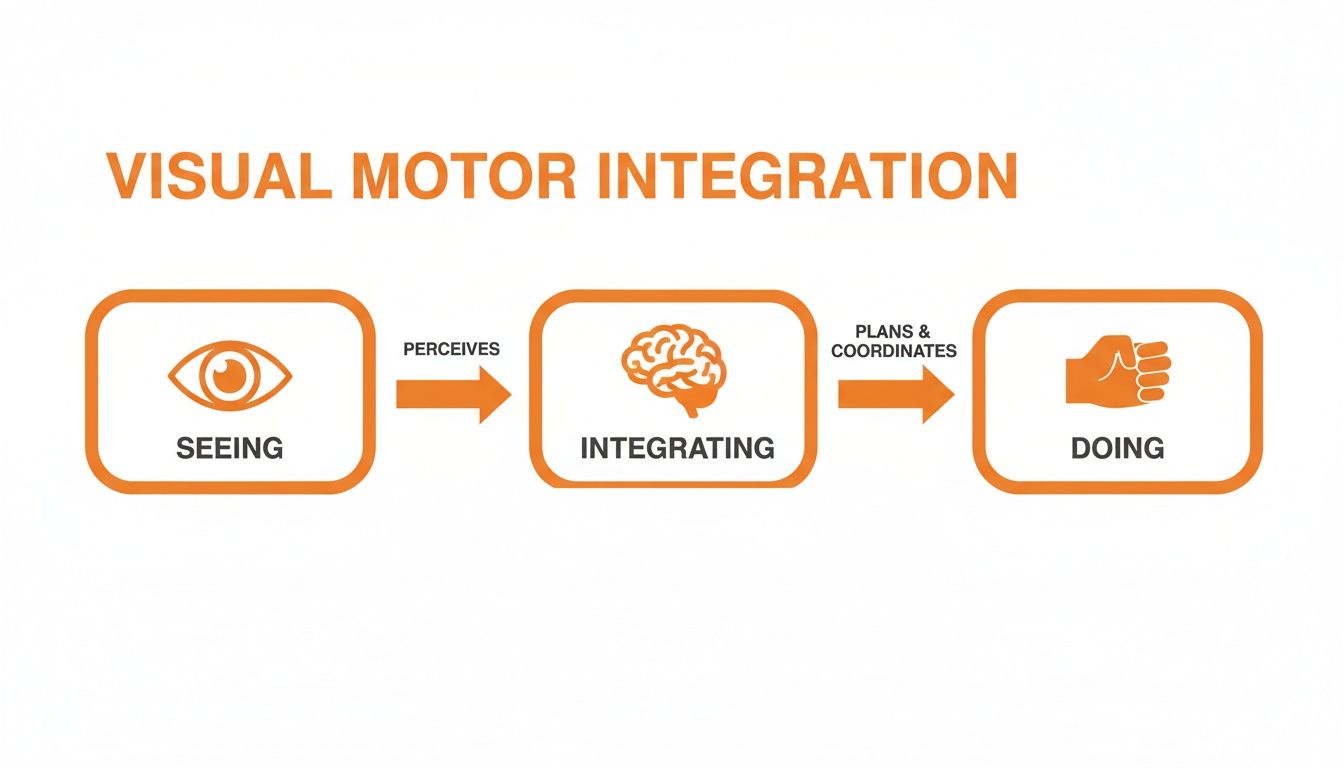
As the diagram shows, even a simple action relies on a complex chain of events in the brain. A breakdown can happen at any link in that chain.
The Three Pillars of the Beery VMI
The assessment is built on three distinct but related subtests, each zeroing in on one of those core abilities. This structured approach provides a clear, comprehensive map of a child's strengths and weaknesses, which is exactly what's needed to create targeted, effective support strategies.
The Main VMI Test: This is the core assessment, just like building the full Lego model. It evaluates how well a child can look at a series of geometric shapes and copy them. It's the ultimate test of how effectively their eyes, brain, and hands are communicating and working as a team.
Visual Perception Subtest: This test isolates the "reading the blueprint" skill. Here, the child simply looks at a shape and has to find its identical match from a group of similar options—no drawing required. It purely measures how accurately they perceive and differentiate visual details.
Motor Coordination Subtest: This part focuses only on the "handling the bricks" skill. The child is asked to draw lines within specific printed paths, testing their fine motor control, pencil grasp, and hand steadiness without the added challenge of interpreting a complex shape. This skill is tightly linked to the brain's visual-spatial sketchpad, which acts like a mental notepad for holding and manipulating visual information.
By comparing the scores from these three distinct areas, a clinician can uncover incredibly revealing patterns. For instance, a high score on Visual Perception but low scores on both Motor Coordination and the main VMI test paints a clear picture: the child understands what they see but struggles with the physical act of drawing.
A significant gap between any of the subtest scores is a critical diagnostic clue. It tells a story about the child's unique neurodevelopmental profile, allowing for interventions that address the root cause of their difficulty, not just the symptoms.
From Test Components to Real-World Skills
So, why does breaking it down this way matter? Because these individual components directly map onto a child's ability to succeed in the classroom and at home. This isn't just theory; the assessment's reliability is well-established. Its test-retest reliability coefficients range from 0.84 to 0.88, and with trained examiners, interrater reliability can be as high as 0.98.
The table below breaks down what each test really measures and connects it to the practical, everyday skills we often take for granted.
Components of the Beery VMI Assessment System
Test Component | Core Skill Assessed | Example Daily Activity |
|---|---|---|
VMI (Main Test) | The ability to integrate visual perception with fine motor skills. | Copying notes from the board, writing legibly, and tying shoelaces. |
Visual Perception | The ability to accurately see, differentiate, and remember visual information. | Recognizing letters and numbers, finding a specific toy in a messy bin, and completing puzzles. |
Motor Coordination | The ability to control and coordinate fine motor movements with precision. | Using scissors to cut along a line, buttoning a coat, and using utensils to eat without spilling. |
This detailed breakdown helps everyone—therapists, teachers, and parents—understand that a challenge with "messy handwriting" might actually be rooted in a visual perception issue, a motor coordination delay, or the integration of the two. By pinpointing the specific weak link, the Beery VMI paves the way for a much more precise and effective plan of action.
Administering and Scoring the Beery VMI
Getting valid and reliable results from the visual motor integration beery assessment hinges on a precise, standardized process. Even tiny changes to the protocol can throw off the data, making it far less useful for clinical interpretation. It all starts with setting the right stage.
This means finding a quiet, well-lit room without any distractions. The child needs to be sitting comfortably at a table that’s the right height for them, with their feet flat on the floor. This simple setup ensures their posture isn't getting in the way of their fine motor skills.
Following the Standardized Protocol
Sticking to the test manual isn’t just a suggestion—it's non-negotiable. Giving the Beery VMI is more than just handing a kid a pencil and the test booklet. Clinicians have to use the exact verbal instructions from the manual, without adding their own encouragement or trying to rephrase the directions.
Practical Tip: Create a simple checklist for your assessment kit: the test booklet, two sharpened pencils with erasers, and a copy of the standardized instructions. This ensures you never have to improvise, which maintains the test's validity.
The test itself isn't timed, but you do want to encourage the child to work at a steady pace. The whole point is to see their best effort under conditions that are the same for everyone. This strict adherence is what makes the test a dependable measure, no matter which child or clinician is involved.
A core principle in standardized testing is ensuring every child gets the exact same experience. This consistency is what gives a clinician the confidence to compare a child’s score to the normative data and draw real conclusions about their visual motor integration skills.
Once the drawing is done, the focus shifts to scoring, which is just as methodical. This part of the process is all about turning the child’s drawings into objective scores using the detailed criteria in the manual.
From Drawings to Raw Scores
Each geometric shape the child copies is marked on a simple pass/fail basis. The manual is packed with clear, illustrated examples of what counts as a pass. For example, to pass the circle, the shape has to be closed without any major overlaps or flat spots. For a square, the corners need to be reasonably sharp, and the sides should be relatively straight and equal in length.
Scoring isn't about artistic flair; it’s a technical check for accuracy. You get a raw score by adding up the number of correctly copied shapes until the child misses the mark on three in a row. This "ceiling" rule is there to prevent the child from getting frustrated and helps keep the assessment moving efficiently.
Converting Raw Scores into Meaningful Data
A raw score on its own doesn't tell you much. The real magic happens when you convert this number into standardized scores, which is how you compare a child's performance to a massive, representative sample of their peers.
The conversion process breaks down into a few key steps:
Calculate the Raw Score: Add up the number of correctly copied items before the child hits the three-consecutive-failures ceiling.
Find the Standard Score: Use the normative tables in the manual to turn that raw score into a standard score, based on the child’s exact age. Standard scores usually have a mean (average) of 100 and a standard deviation of 15.
Determine the Percentile Rank: The tables also give you a percentile rank. This number tells you the percentage of peers in the sample who scored at or below the child's level.
Identify the Age Equivalent: This score shows the average age at which a particular raw score is usually achieved.
Let's walk through an example to make this clearer. A 7-year-old child named Leo takes the VMI and gets a raw score of 18. The clinician consults the table for his age and finds this score translates to a standard score of 92 and a percentile rank of 30. This tells us Leo’s visual motor integration skills fall within the average range—he performed better than 30% of other 7-year-olds. This kind of data-driven approach is a cornerstone of many occupational therapy assessments.
By moving methodically from administration to scoring and finally to interpretation, clinicians can transform a few simple drawings into a powerful set of data, giving them a clear and objective picture of a child’s visual-motor abilities.
Interpreting Scores in a Clinical Context
A score from the visual motor integration beery test is just a number. It's the skilled clinician who gives it meaning, transforming that raw data into a story that explains a child’s unique strengths and challenges. This is where the real work begins—looking beyond a single score to find the patterns that tell us what's really going on.
One of the most powerful things about the Beery VMI is its ability to show us the gaps between its three core parts. A significant difference between a child's Visual Perception score and their Motor Coordination score is a huge diagnostic clue. It helps us zero in on the source of the difficulty with surprising clarity.
Analyzing Performance Patterns
Think of it like being a detective. If a child aces the Visual Perception subtest but struggles with both the Motor Coordination and the main VMI test, the evidence points to a specific conclusion. The child can see and understand the shapes just fine, but they have trouble with the physical act of drawing them.
Actionable Insight: For this child, your plan should focus on building fine motor skills. Practical activities could include rolling Play-Doh into snakes, using tweezers to pick up small objects, or playing with building blocks. The goal is to strengthen the hand muscles and improve control.
On the other hand, a child might have great motor skills but a low visual perception score. This pattern suggests they have the physical control, but they're struggling to make sense of the shapes they need to copy. This distinction is absolutely crucial for creating an effective plan to help them.
The key takeaway here is that the Beery VMI isn't just about the final number; it's about the relationship between the scores. Understanding these patterns helps us move from a vague concern like "messy handwriting" to a specific, actionable insight about how a child's brain is working.
This level of detailed analysis is a vital piece of the puzzle when building a complete picture of a child's abilities. You can see how this fits into a bigger evaluation by reading our guide on what is a neuropsychological assessment.
The Importance of a Holistic View
As insightful as these patterns are, the Beery VMI should never be used on its own. A test score is just a snapshot of how a child performed on one particular day, in one particular setting. To build a truly complete picture, we have to mix these hard numbers with real-world observations.
This holistic approach means we need to:
Observe the child directly: Watching how a child takes the test is priceless. Are they rushing? Are they hesitant? How do they hold their pencil? These little observations provide context that numbers alone just can't.
Talk to caregivers: Parents and teachers hold a wealth of information about a child’s everyday life. They can tell us about struggles with tying shoes, using scissors, or playing sports.
Review other assessments: We need to look at the Beery VMI results alongside findings from other educational or psychological evaluations to form a single, cohesive story.
Considering External Influences
It's also critical to think about other factors that could be impacting a child's performance. Things like attention, focus, and overall cognitive ability play a huge role. A child with attention difficulties might get a low score not because of a visual motor integration issue, but simply because they couldn't stay focused on the task.
Research on children with autism spectrum disorder (ASD) makes this point perfectly. Studies have shown that a child’s overall cognitive ability is a major factor in their Beery VMI performance. When researchers accounted for IQ, a score gap previously seen between children with ASD and their peers vanished. This just goes to show how important it is to consider the whole child during interpretation.
After interpreting the scores, clinicians often recommend targeted support. This might involve bringing in engaging fine motor toys to build those underlying skills in a way that feels like play. By combining test data, real-world observations, and a deep understanding of the child, we can avoid jumping to the wrong conclusions and create support plans that actually work. The goal is always to connect the dots and provide meaningful help where it's needed most.
Understanding the Beery VMI’s Limitations
While the Beery VMI is an incredibly powerful and reliable tool, it’s crucial for any responsible clinician to know its boundaries. After all, no single test can ever tell a child's whole story. The Beery VMI is a fantastic screening instrument for quickly flagging potential visual-motor challenges, but it was never designed to be a comprehensive diagnostic tool on its own.
Its main job is to raise a red flag about a potential issue, not to explain every little detail of why that issue exists. Understanding this difference helps us set realistic expectations and use the test as it was meant to be used—as one important piece of a much larger puzzle.
A Key Consideration: Sensitivity to Change
One of the biggest limitations to keep in mind is the test's sensitivity to change. Imagine trying to measure your weight loss with a scale that only shows numbers in five-kilogram chunks. It’s great for spotting a major change over a year, but it’s going to completely miss the slow, steady progress of losing half a kilogram each week.
The Beery VMI is a bit like that. It’s highly reliable for showing consistent performance over long periods, but it might not be granular enough to pick up on the small—but very meaningful—gains a child makes in therapy from one month to the next.
This is a big deal when it comes to using the Beery VMI as a primary way to measure progress. A child’s score might not budge, even when they’re making real, functional progress in the classroom. If we only look at the test score, we get a misleading picture of their development.
Research backs this up. One longitudinal study, for example, found that the Beery VMI scores for children with ASD who were receiving therapy didn't change much over a school year. This was despite their occupational therapists observing clear functional improvements in their day-to-day skills. It’s a perfect illustration of why we need to supplement the Beery VMI with other ways of tracking progress. If you're interested, you can explore more about these findings and the importance of using multiple assessment tools.
Strategies for a Fuller Picture
To work around this limitation, the best approach is to pair the Beery VMI with more functional, observation-based assessments. This helps create a richer, more accurate picture of a child’s progress and makes sure those small victories don't go unnoticed.
Here are a few practical strategies clinicians can use:
Observe Functional Tasks: Actually watch the child write their name, use scissors, or tie their shoes. Take notes on improvements in their speed, accuracy, and confidence during these real-world activities. For example: create a simple checklist for buttoning a shirt and time them once a month.
Use Dynamic Assessments: Instead of just scoring the final drawing, pay attention to the process. Note the strategies the child uses, where they pause, and how they try to fix mistakes.
Incorporate Reports from Parents and Teachers: The adults who see the child every day have invaluable insights. Actionable Tip: Create a short, simple questionnaire for parents to fill out weekly, asking them to rate their child’s independence on tasks like getting dressed or packing their school bag.
By treating the Beery VMI as an excellent starting point rather than the final word, we can build a more complete and compassionate understanding of a child’s journey. This balanced approach ensures we celebrate every single step of progress, whether a standardized test can measure it or not. For more actionable strategies on building these crucial cognitive skills, see how Orange Neurosciences supports clinicians and families.
From Assessment to Action with Digital Tools
After a visual motor integration beery assessment flags a potential challenge, the next question is always, "What now?" The test results are incredibly valuable, but they’re the starting point, not the finish line. Think of them as the map that shows you exactly where to focus your efforts. This is where modern digital tools come in, bridging the gap between identifying a problem and effectively treating it.
While traditional pen-and-paper exercises certainly have their place, technology offers a far more dynamic and engaging way to build the exact skills the Beery VMI measures. Digital platforms can transform therapy from something that feels like a chore into an exciting challenge, which makes all the difference in a child’s motivation and progress.
Elevating Therapy with Technology
Imagine turning handwriting practice into a game where a child traces constellations in the night sky. That’s the power of digital intervention. It takes the core principles of visual-motor therapy and wraps them in an experience that feels like play, not work. But this approach isn't just about fun; it’s about delivering adaptive, data-driven exercises that build directly on the insights from the Beery VMI.
The best digital tools do more than just put old exercises on a screen. They provide real-time feedback, automatically adjust the difficulty based on performance, and capture precise data on progress. This gives clinicians a level of insight that traditional methods simply can't match.
At Orange Neurosciences, this is exactly what we do. Our game-based platforms are designed to be the ideal next step after a visual motor integration beery assessment. We zero in on strengthening the foundational cognitive and motor skills that the test evaluates, turning those clinical insights into actionable, measurable progress.
Data-Driven Interventions for Better Outcomes
One of the biggest wins with digital tools is the ability to track performance in real-time. Instead of waiting for the next formal reassessment, clinicians can see progress—or sticking points—from one session to the next, looking at metrics like response time, accuracy, and consistency.
This immediate feedback loop lets you:
Tailor Interventions: Quickly see which exercises are hitting the mark and adjust the therapy plan on the fly.
Demonstrate Progress: Use objective data to show parents and educators tangible improvements in a child’s skills.
Increase Engagement: Keep kids motivated by celebrating small wins and showing them exactly how far they’ve come.
Practical Example: Our tools can track subtle improvements in a child’s ability to follow a moving target on screen—a skill that directly mirrors the eye-hand coordination needed for writing. This granular data helps you make smarter decisions and deliver more effective care. You can explore a variety of these targeted activities in our detailed guide to eye-hand coordination exercises.
By pairing the diagnostic power of the Beery VMI with the therapeutic potential of digital solutions, you create a seamless journey from assessment to action. Discover how the Orange Neurosciences platform can elevate your clinical practice and help your clients achieve their full potential. Visit our website today or contact us for a personalized demo.
Your Top Questions About the Beery VMI, Answered
When you're trying to understand a child's development, assessments can feel a bit overwhelming. Let's clear up some of the most common questions that clinicians, teachers, and parents have about the Beery VMI and what it really tells us.
What Is the Target Age Range for the Beery VMI?
One of the best things about the Beery VMI is its incredible flexibility. The full version is designed for literally anyone from age 2 to 100. There's also a shorter form tailored specifically for the little ones, from ages 2 through 7.
This massive age range makes it a go-to tool for all sorts of situations. You might use it to screen a toddler for potential developmental delays, get to the bottom of a third-grader's handwriting struggles, or even help an adult recovering from a stroke regain their visual-motor skills.
How Long Does It Take to Administer?
It’s surprisingly quick. The main test, where the individual copies a series of geometric shapes, usually takes just 10 to 15 minutes. That’s it.
The two add-on tests, which look at Visual Perception and Motor Coordination separately, are even faster—about 5 minutes each. This means you can get a comprehensive picture in under 30 minutes, which is a huge plus in a busy clinic or a packed school day.
This efficiency is a game-changer. It means we can gather vital data on visual-motor integration without pulling a child out of class for a long time or eating up an entire therapy session. It respects everyone's time while delivering powerful insights.
Does the Beery VMI Measure Intelligence?
This is a critical point: No, the Beery VMI is not an IQ test. Its job is very specific and focused—it measures how well a person’s eyes, brain, and hands work together as a team.
While strong visual-motor skills can certainly support academic learning, this test doesn't evaluate things like abstract reasoning, verbal skills, or logical problem-solving. Think of it less like a broad intelligence snapshot and more like a high-powered magnifying glass on a very particular set of neurodevelopmental skills.
Who Is Qualified to Administer the Beery VMI?
To get results you can trust, the Beery VMI needs to be given by a trained professional. This typically includes people like occupational therapists, psychologists, and educational specialists who have a background in standardized testing.
Proper training is non-negotiable. It’s what ensures the test is administered and scored correctly, which is the foundation for any meaningful interpretation and, ultimately, for helping the individual succeed.
Ready to turn assessment insights into effective action? The Orange Neurosciences platform complements the findings from the Beery VMI with engaging, data-driven digital therapies that build foundational cognitive and motor skills. Discover how our tools can enhance your practice and support better outcomes.

Orange Neurosciences' Cognitive Skills Assessments (CSA) are intended as an aid for assessing the cognitive well-being of an individual. In a clinical setting, the CSA results (when interpreted by a qualified healthcare provider) may be used as an aid in determining whether further cognitive evaluation is needed. Orange Neurosciences' brain training programs are designed to promote and encourage overall cognitive health. Orange Neurosciences does not offer any medical diagnosis or treatment of any medical disease or condition. Orange Neurosciences products may also be used for research purposes for any range of cognition-related assessments. If used for research purposes, all use of the product must comply with the appropriate human subjects' procedures as they exist within the researcher's institution and will be the researcher's responsibility. All such human subject protections shall be under the provisions of all applicable sections of the Code of Federal Regulations.


© 2026 by Orange Neurosciences Corporation