Understanding Spatial Awareness Meaning for Parents
Nov 29, 2025
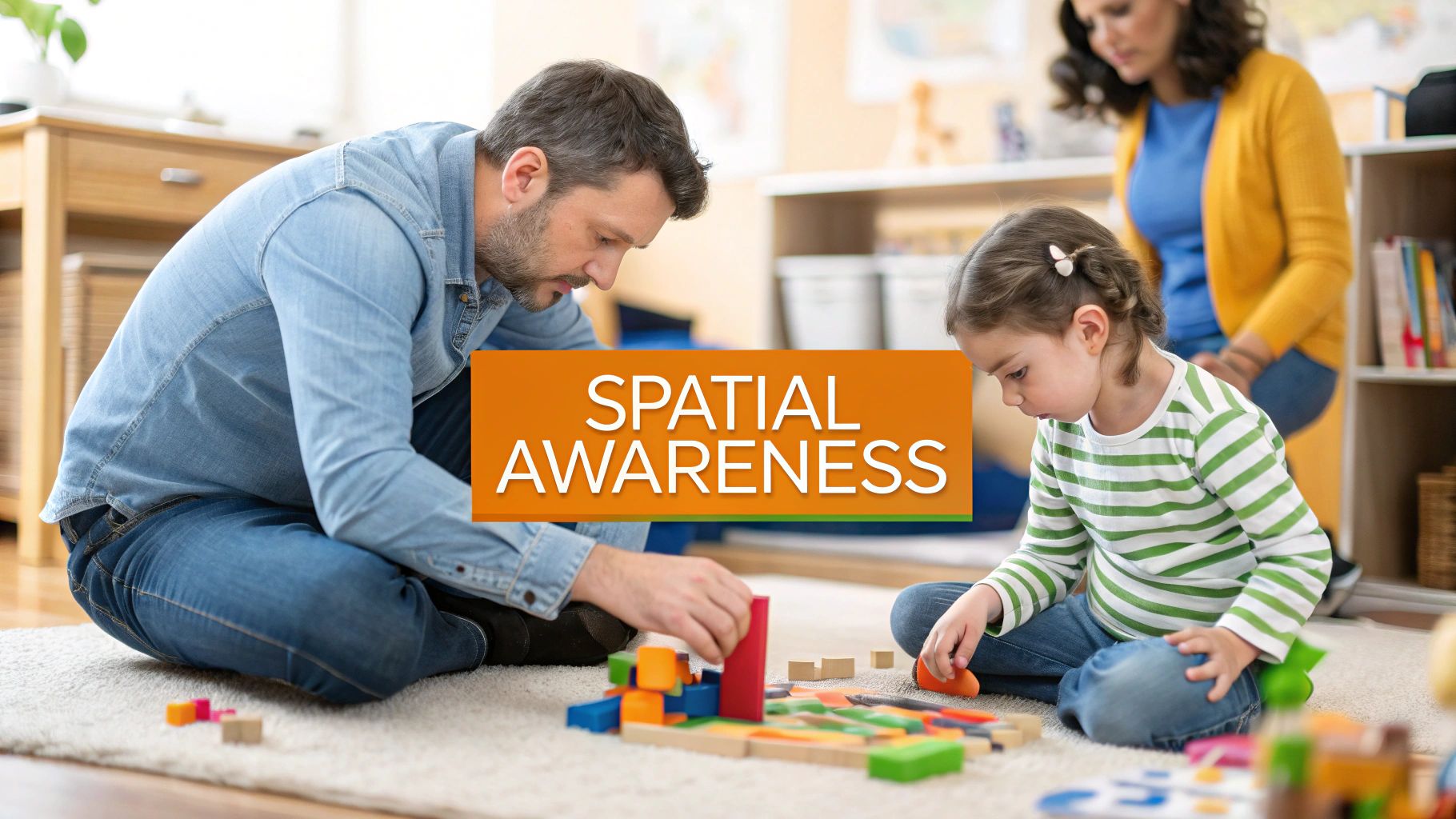
Think of spatial awareness as your brain’s built-in GPS. It’s that gut feeling of knowing exactly where you are in relation to everything—and everyone—around you.
It's the unsung hero that lets you weave through a bustling crowd without a single bump, or perfectly parallel park on the first attempt. This ability isn’t just about movement; it’s a cornerstone of how we learn, interact, and make sense of our physical world. For parents, understanding this skill is the first step in helping your child build a strong foundation for learning and life.
What Does Spatial Awareness Actually Mean?
Spatial awareness goes far beyond just navigating from point A to point B. It’s a core cognitive skill that allows us to interpret our world in three dimensions. It’s the magic behind a child stacking a tower of blocks so high it almost touches the ceiling, or catching a ball thrown from across the yard.
This internal mapping system is always on, crunching thousands of calculations a minute without us even noticing.
When this skill isn't fully developed, even simple, everyday tasks can feel monumentally hard. For example, trying to tie your shoelaces without an intuitive sense of how the loops need to go over and under becomes a frustrating puzzle. Or imagine the challenge of assembling a piece of furniture when you just can't mentally rotate the pieces to match the diagram.
The Key Components of This Skill
This complex ability isn't just one thing. It's really a blend of several distinct skills working in harmony, letting us engage with our surroundings smoothly and effectively. Breaking them down helps clarify what "spatial awareness" truly means in a practical sense.
Before we dive deeper, here's a quick look at the core components that make up spatial awareness and what they might look like in your child's world.
Core Components of Spatial Awareness
Component | What It Means for Your Child | A Real-World Example |
|---|---|---|
Understanding Position | Knowing where something is in space, relative to their own body. | Reaching for a crayon and knowing it’s in front of them and below their eyes. |
Judging Distance | Accurately figuring out how far away things are. | Pouring juice into a glass without it overflowing or spilling. |
Visualizing Relationships | Mentally picturing how different objects fit or relate to each other. | Knowing a square block won't fit into a round hole without even trying. |
These components are more than just a list; they are the fundamental building blocks your child uses to interact with their world confidently.
"Spatial awareness isn’t just a physical skill; it’s deeply connected to our mental attention and sense of self. When we understand our position in the world, we can navigate it with confidence and precision."
Ultimately, these skills lay the groundwork for more advanced thinking. They are intimately linked to the ability to plan and carry out movements—a concept known as praxis. You can explore this connection further in our guide on reading difficulties and praxis).
Mapping Your Child's Spatial Development Journey
A child’s grasp of the world around them doesn't just appear overnight. It’s a slow-burn process of discovery, built piece by piece from their very first moments. The development of spatial awareness begins in the crib and evolves through every stage of childhood, turning simple movements into complex, powerful cognitive skills.
It all starts with infants. When a baby deliberately reaches out for a dangling rattle, they’re running their first real-world experiments in cause, effect, and distance. That tiny action is actually a monumental leap, forging the connection between their own movement and an object out there in the world.
As they grow into toddlers, their world—and their ability to navigate it—expands. Successfully walking around the coffee table instead of bumping into it is a massive win. It shows they're building an internal map of their environment and their body's place in it.
From Playtime to Problem-Solving
By the time they reach their preschool years, these foundational skills are blossoming into something far more sophisticated. This is when you’ll see a child master a jigsaw puzzle, mentally rotating the pieces to find the perfect fit before they even pick it up. You see it when they build an elaborate block tower, intuitively understanding balance, size, and where to place the next piece.
These early, play-based wins are incredibly important. They're literally building the neural pathways for later success, both in the classroom and in life—from understanding geometry in math class to excelling in sports that demand quick positional judgements.
This diagram shows a simplified timeline of how a child's spatial understanding grows, starting with their own body and expanding outward to objects and, eventually, other people.
As you can see, self-awareness forms the bedrock upon which all other spatial understanding is built.
To get the full picture, it helps to place these skills within the broader context of overall childhood development milestones. Every spatial skill is deeply intertwined with motor, cognitive, and social growth, weaving together a rich tapestry of abilities.
A child’s play isn't just a frivolous activity; it’s the serious business of learning how the world works. Every stacked block and completed puzzle is a lesson in spatial reasoning.
As these abilities become more polished, they directly impact a child’s capacity to organize their thoughts and belongings, follow multi-step instructions, and even read a map. If you're curious about how these skills are measured and want deeper insights into your child's cognitive profile, you can learn more about professional cognitive assessments. They can help pinpoint both strengths and areas needing a bit more support.
Understanding this journey helps us appreciate how every tiny step contributes to a giant leap in how they see and interact with their world.
How Spatial Skills Fuel Academic Success
Strong spatial awareness is far more than just a handy life skill; it's a powerful academic advantage that has a direct line to a child's performance in the classroom. Think of it as the invisible engine driving success in subjects that demand abstract thinking, especially in the critical fields of Science, Technology, Engineering, and Math (STEM).
When a child can mentally rotate objects, visualize problems in their head, and understand how parts fit into a whole, they’re set up for a much deeper level of learning.
This connection is probably most obvious in mathematics. Geometry, for instance, is almost entirely a spatial discipline. A child with well-developed spatial skills can intuitively grasp concepts like volume, area, and angles because they can actually picture the shapes and their relationships in their mind's eye. For example, they can see in their head how a flat shape folds into a 3D cube, which is a form of problem-solving that goes worlds beyond just memorizing formulas.
Beyond Geometry: The Broader Impact
But the benefits certainly don't stop at math class. Once you understand the spatial awareness meaning in an academic context, you start to see its wide-reaching influence everywhere.
Science: Making sense of charts and graphs requires understanding the spatial relationships between data points. Visualizing molecular structures in chemistry or planetary orbits in physics is impossible without strong spatial reasoning.
Reading and Writing: It might surprise you, but even literacy skills are supported by spatial awareness. Consistently spacing letters, organizing thoughts into paragraphs, and following a line of text across a page all rely on an underlying sense of space and order.
Problem-Solving: Whenever a teacher asks a student to "visualize the problem," they are tapping directly into spatial skills. The ability to create a mental model is a cornerstone of critical thinking across every single subject.
Unfortunately, when these skills are underdeveloped, significant learning hurdles can pop up. Research in California schools painted a stark picture, showing that gaps in spatial skill development directly correlate with achievement gaps in mathematics, particularly in lower-performing districts.
One study found that only 6% of California's 15-year-olds could transfer their spatial knowledge to solve unfamiliar problems. Even more concerning, 29% struggled with even the most basic spatial tasks. You can dig into the findings and their implications by reading the complete research on spatial skills in schools.
Building a Foundation for Future Opportunities
Nurturing these skills from a young age doesn't just improve report cards; it opens up a world of future opportunities. The ability to think spatially is a prerequisite for so many high-demand careers, from architecture and engineering to surgery and graphic design.
By fostering spatial skills, we are not just teaching children how to solve a math problem. We are equipping them with a versatile cognitive tool that will help them innovate, create, and navigate an increasingly complex world.
Ultimately, recognizing the academic importance of spatial awareness is the first step. The next is taking action. If you're wondering how to identify your child's cognitive strengths and areas for growth, our objective digital assessments can provide the clear, actionable insights you need. Discover how our tools can help you support your child's academic journey by visiting our website today.
Spotting the Signs of Spatial Challenges
Knowing what spatial awareness is is one thing, but how can you tell if a child might be struggling with it? Spotting the signs isn't about jumping to conclusions or diagnosing a problem. It’s about being an observant, supportive guide on their developmental journey.
These challenges often look different depending on a child's age. What might seem like minor quirks in a toddler can evolve into more noticeable difficulties as they grow.
It's important to remember that every child develops at their own pace. A bit of clumsiness here and there or a messy backpack is perfectly normal. What we're looking for is a consistent pattern of challenges across different environments—at home, on the playground, and in the classroom. The goal is to notice these patterns with empathy, not alarm.
Think of these signs as simple, observable behaviours. Recognizing them is the first step to providing the right kind of encouragement and, if needed, seeking a bit of extra guidance.
Common Signs in Younger Children
For preschoolers and kids in the early years of elementary school, difficulties with spatial awareness often show up in how they physically interact with the world. You could say their internal "GPS" just needs a bit more calibration.
Frequent Clumsiness: More than typical toddler tumbles, this might look like constantly bumping into furniture, door frames, or other people, even in familiar spaces.
Frustration with Building Toys: While other kids happily stack blocks, a child with spatial challenges might get easily frustrated, unable to make LEGOs fit the way they imagine.
Difficulty with Puzzles: They may struggle to see how a puzzle piece needs to be turned to fit, often trying to force it into place instead of mentally rotating it first.
Mixing Up Left and Right: Long after the typical age, they might consistently confuse directional words like "up," "down," "in," and "out" when you give instructions like, "put the toy in the box."
What to Look for in Older Children
As children get older, the demands on their spatial skills ramp up. Challenges that were once mostly physical can now appear in their schoolwork and organizational skills, requiring a different lens of observation.
By observing how children organize their space and manage their belongings, we gain valuable insights into their spatial processing abilities. Messiness isn't just messiness; sometimes, it's a sign of a deeper cognitive challenge.
Here’s what you might notice:
Messy and Disorganized Handwriting: This often involves poor spacing between letters and words, difficulty staying on the lines, and inconsistent letter size.
Trouble with Team Sports: They might struggle to understand their position on a field, judge the distance to a ball, or navigate the movements of their teammates.
Difficulty Organizing Their Backpack or Desk: Their belongings might seem perpetually jumbled, as they struggle to logically fit books, folders, and supplies into a confined space.
To help you identify potential challenges across different developmental stages, we've put together a simple comparison table.
Common Signs of Spatial Awareness Difficulties
Age Group | Potential Signs You Might Notice | What It Can Look Like in Daily Life |
|---|---|---|
Toddlers & Preschoolers | Frequent bumping and tripping, frustration with puzzles or stacking blocks, difficulty with simple "in/out" or "up/down" instructions. | Constantly running into the coffee table, getting upset trying to build a tower, struggling to put shapes into a shape sorter. |
Early Elementary | Confusion between left and right, messy handwriting with poor spacing, trouble copying shapes or letters, avoiding games like catch. | Putting shoes on the wrong feet, writing letters that drift off the line, struggling to draw a simple house or a star. |
Older Children & Teens | Difficulty reading maps or graphs, challenges with team sports positioning, a consistently disorganized locker or bedroom. | Getting lost in a familiar neighbourhood, struggling to understand plays in soccer, having a backpack that's a "black hole." |
Remember, this table is just a guide. Seeing one or two of these signs occasionally is rarely a cause for concern, but a consistent pattern might be worth looking into.
If you recognize a consistent pattern of these signs and want to explore the next steps, learning more about an assessment for occupational therapy can provide a clearer path forward. Visit our website to discover how objective digital tools can help identify your child’s unique cognitive profile and guide supportive interventions.
Building a Pathway to STEM Careers
Strong spatial skills do more than just help a child navigate the playground or succeed in math class. They build a direct pathway to the most innovative careers of the future. The ability to grasp the professional importance of spatial awareness is critical, forming the bedrock for success in Science, Technology, Engineering, and Math (STEM).
Think about it. These fields demand an advanced ability to visualize, manipulate, and reason about objects in three dimensions. An architect imagining a skyscraper, a surgeon navigating delicate anatomy, or an engineer designing a circuit board all rely on strong visuospatial skills—it is completely non-negotiable.
Where Spatial Skills Shine
Look at the modern workforce. A video game designer has to construct entire virtual worlds from scratch, intuitively understanding how light, shadow, and physics interact. A data scientist needs to visualize complex datasets, spotting patterns and relationships that are totally invisible in a simple spreadsheet.
These aren't niche abilities; they are core competencies.
The ability to see with the mind's eye is what separates good from great in fields driven by creation and problem-solving. It's the engine of innovation.
The Predictive Power of Spatial Ability
The link between a child's early spatial skills and their future career isn't just a theory; it's backed by decades of solid research. One landmark study tracked high school students in California for over a decade and found a powerful connection.
Students who showed strong spatial skills were far more likely to pursue and succeed in STEM careers like engineering and computer science compared to their peers. This research confirmed that a teenager's spatial ability is a reliable predictor of their future professional path. You can read the full study on how spatial skills forecast STEM careers.
This connection highlights a crucial point. When we invest in developing these skills early on, we aren't just helping a child build better LEGO towers. We're giving them the cognitive tools they'll need to solve the complex problems of tomorrow.
Creating a More Diverse Future
Investing in spatial awareness training for all children is also a matter of equity. Historically, a lack of focus in this area has created a bottleneck, preventing many talented students—particularly women and individuals from underrepresented groups—from entering lucrative and rewarding STEM fields.
By focusing on these foundational skills, we can help level the playing field and foster a more diverse and capable workforce. For educators and administrators in academic institutions, recognizing this link is the first step toward building curricula that truly prepare every student for success.
Ultimately, by understanding the profound connection between a child's play and their future potential, we can give them the support they need to build, create, and lead. If you’re ready to take the next step, our objective cognitive assessments can provide the data-driven insights needed to support this critical area of development. Explore our solutions on our website to learn how we can help.
Actionable Ways to Boost Spatial Skills at Home
Knowing the theory is one thing, but putting it into practice is where the real learning begins. The good news? You don't need any specialized equipment to nurture these critical skills. Your own home is the perfect training ground, packed with opportunities for fun and effective development.
By turning everyday moments into skill-building exercises, you make growth feel like play, not work. A few simple, intentional adjustments to your daily routine can make all the difference in helping your child understand their place in the world.
Creative Play and Construction
Creative play is an absolute powerhouse for helping children grasp the spatial awareness meaning in a tangible way. Through play, they learn how objects relate, connect, and fit together, building foundational skills in mental rotation and seeing how parts form a whole.
Puzzles and Blocks: You can't go wrong with the classics. Jigsaw puzzles require a child to analyze shapes and mentally twist them around. Building blocks teach principles of balance, size, and how parts form a whole.
Drawing and Sketching: Encourage your child to draw things from different perspectives. Ask them to sketch their bedroom from the doorway or draw their favourite toy as if they were looking down from the ceiling. This sharpens their ability to visualize objects in three-dimensional space.
Building Toys: Getting hands-on is key. Incorporating engaging building games into playtime is an excellent and direct way to foster spatial reasoning. For a great list of ideas, check out this guide to the best building games for kids.
Active Fun and Movement
Our body is our first and most important reference point for understanding space. That’s why activities that get kids up and moving are absolutely essential for building body awareness and learning to navigate their environment.
An obstacle course in the living room isn't just a way to burn off energy; it's a dynamic lesson in navigating directions like over, under, and around.
Here are some practical ideas:
Build an Obstacle Course: Use pillows, chairs, and blankets to create a path your child must navigate by going over, under, and through objects.
Play "Simon Says": Use commands that involve spatial directions, such as "Simon says take two steps to your left" or "Simon says put your hands behind your back."
"I Spy" with Directions: Instead of colors, use directions. "I spy something above the TV" or "I spy something to the right of the bookshelf."
Many of these movements also support hand-eye coordination. For more targeted ideas, feel free to explore our list of eye-hand coordination exercises.
If you notice consistent challenges during these activities, or if you're looking for a more structured way to understand your child's cognitive profile, our digital tools can offer clarity. Visit Orange Neurosciences to see how our objective assessments provide the clear insights needed to support your child’s development.
Still Have Questions About Spatial Awareness?
Once you start digging into the meaning of spatial awareness, it's natural for more questions to pop up. Here are some clear, straightforward answers to the queries we hear most often from parents and educators.
Can Adults Improve Their Spatial Awareness?
Absolutely. It’s never too late. The brain’s incredible ability to adapt and rewire itself—a process known as neuroplasticity—means you can always sharpen these skills. All it takes is a little intentional practice.
A few simple ways to challenge your internal GPS include:
Learning a new sport like tennis or basketball, where you constantly have to judge distances and predict where a ball (and other players) will go.
Playing certain video games, especially ones that require you to navigate complex 3D maps or solve spatial puzzles.
Tackling a hands-on DIY project, like assembling furniture from a diagram, which forces you to mentally rotate objects and see how they fit together.
Is Poor Spatial Awareness a Learning Disability?
By itself, poor spatial awareness isn't considered a learning disability. However, it can be a major piece of the puzzle for certain diagnosed conditions, such as Dyspraxia or Non-Verbal Learning Disability (NVLD).
If you’re seeing consistent struggles, it's really important to talk to a professional for a proper evaluation instead of trying to figure it out on your own.
When a child consistently has trouble with age-appropriate spatial tasks, a conversation with their teacher or paediatrician is always a proactive and supportive first step.
These experts can help you understand if the difficulties are just part of a normal developmental curve or if they signal that a more thorough assessment is needed.
At Orange Neurosciences, our digital cognitive assessment tools give you objective, data-driven insights to help pinpoint a child’s unique strengths and challenges. This kind of information is invaluable for parents, educators, and clinicians looking to create a clear path forward. Explore our solutions to learn more.

Orange Neurosciences' Cognitive Skills Assessments (CSA) are intended as an aid for assessing the cognitive well-being of an individual. In a clinical setting, the CSA results (when interpreted by a qualified healthcare provider) may be used as an aid in determining whether further cognitive evaluation is needed. Orange Neurosciences' brain training programs are designed to promote and encourage overall cognitive health. Orange Neurosciences does not offer any medical diagnosis or treatment of any medical disease or condition. Orange Neurosciences products may also be used for research purposes for any range of cognition-related assessments. If used for research purposes, all use of the product must comply with the appropriate human subjects' procedures as they exist within the researcher's institution and will be the researcher's responsibility. All such human subject protections shall be under the provisions of all applicable sections of the Code of Federal Regulations.


© 2026 by Orange Neurosciences Corporation