The Clinician's Guide to the Rivermead Post Concussion Questionnaire
Feb 12, 2026
When a patient is recovering from a head injury, how can you tell if they're actually getting better? Feelings like "brain fog" or dizziness are frustratingly vague. This is where the Rivermead Post-Concussion Symptoms Questionnaire—often just called the RPQ—comes in. It’s a standardized tool clinicians use to measure the severity of symptoms after a head injury.
Think of it as a way to turn those subjective, hard-to-pin-down feelings into solid data you can track over time. This guide will give you practical, actionable insights on how to use the RPQ to improve patient care.
What Is the Rivermead Post Concussion Tool?
Imagine trying to track a fever without a thermometer. You'd be stuck with vague descriptions like "feeling a bit warm." The Rivermead Post Concussion Symptoms Questionnaire acts like a symptom thermometer for brain recovery. It doesn't diagnose the concussion itself, but it gives a clear, numerical score to the severity of post-concussion symptoms, which is essential for monitoring a patient's progress.
This standardized approach brings much-needed structure to the conversation between a patient and their practitioner. Instead of a patient just saying, "I feel a bit off," they can rate the severity of 16 specific symptoms, from headaches to irritability, on a clear, consistent scale.
Turning Subjective Feelings into Measurable Data
The real genius of the RPQ is how it translates a person's private experience into objective numbers. This is critical because so many post-concussion symptoms are invisible to an outside observer.
A patient might say they feel "foggy," for instance. The RPQ digs deeper, asking them to rate specific issues that contribute to that feeling, like:
Poor concentration
Taking longer to think
Forgetfulness
By putting a score on each of these, a clinician can see exactly what "brain fog" means for that patient and whether it's improving, staying the same, or getting worse with each visit. It creates a reliable record of their journey. For a look at other assessments, you can check out our guide on the concussion symptom questionnaire.
The real power of the RPQ lies in its ability to chart change. A single score offers a snapshot, but a series of scores over weeks or months tells the full story of a patient's recovery.
This subjective data becomes even more powerful when you pair it with objective cognitive assessments. While the RPQ tells you what the patient feels, platforms like Orange Neurosciences can show you how their brain is actually performing. Combining these two perspectives gives you a complete clinical picture, leading to more precise and effective treatment plans.
To see how our platform can fit into your practice, visit our website to get started.
How to Administer and Score the RPQ
Using the Rivermead Post Concussion Questionnaire effectively starts with getting the administration right. The process itself is pretty simple, but clear instructions are key to making sure the data you gather is accurate and clinically useful. Your main job is to capture a reliable snapshot of how the patient is feeling right now, compared to before their injury.
First things first, you need to explain the task to the patient. Make it clear they will be rating 16 common post-concussion symptoms based on how they've felt over the last 24 hours. This tight timeframe is what makes the RPQ so powerful for tracking daily changes and immediate recovery progress.
The most critical instruction, though, is to ask the patient to compare their current symptoms to how they felt before the injury. This is the cornerstone of the RPQ's value. It helps you and the patient tease apart new or worsening symptoms from any pre-existing conditions, giving you a much cleaner picture of the injury's true impact.
Understanding the RPQ Scoring Scale
The RPQ uses a straightforward 0-4 rating scale to put a number on symptom severity. This simple system is how we turn subjective complaints ("I feel dizzy") into objective data points that we can actually track and measure over time.
Here's how the scale works:
0 – Not experienced at all: The patient hasn't had this symptom.
1 – No more of a problem: The symptom is there, but it’s no worse than it was before the injury.
2 – A mild problem: The symptom is noticeable but isn't really getting in the way of daily life. For example, a student might notice mild headaches but can still complete their homework.
3 – A moderate problem: The symptom is a consistent presence and definitely disrupts daily routines. For example, a patient’s irritability might be causing friction with their family.
4 – A severe problem: The symptom is debilitating, making it extremely difficult for the patient to function. For example, a severe sensitivity to light might prevent someone from going to the grocery store.
This is how the RPQ takes what a patient is feeling inside and turns it into measurable data that clinicians can work with.
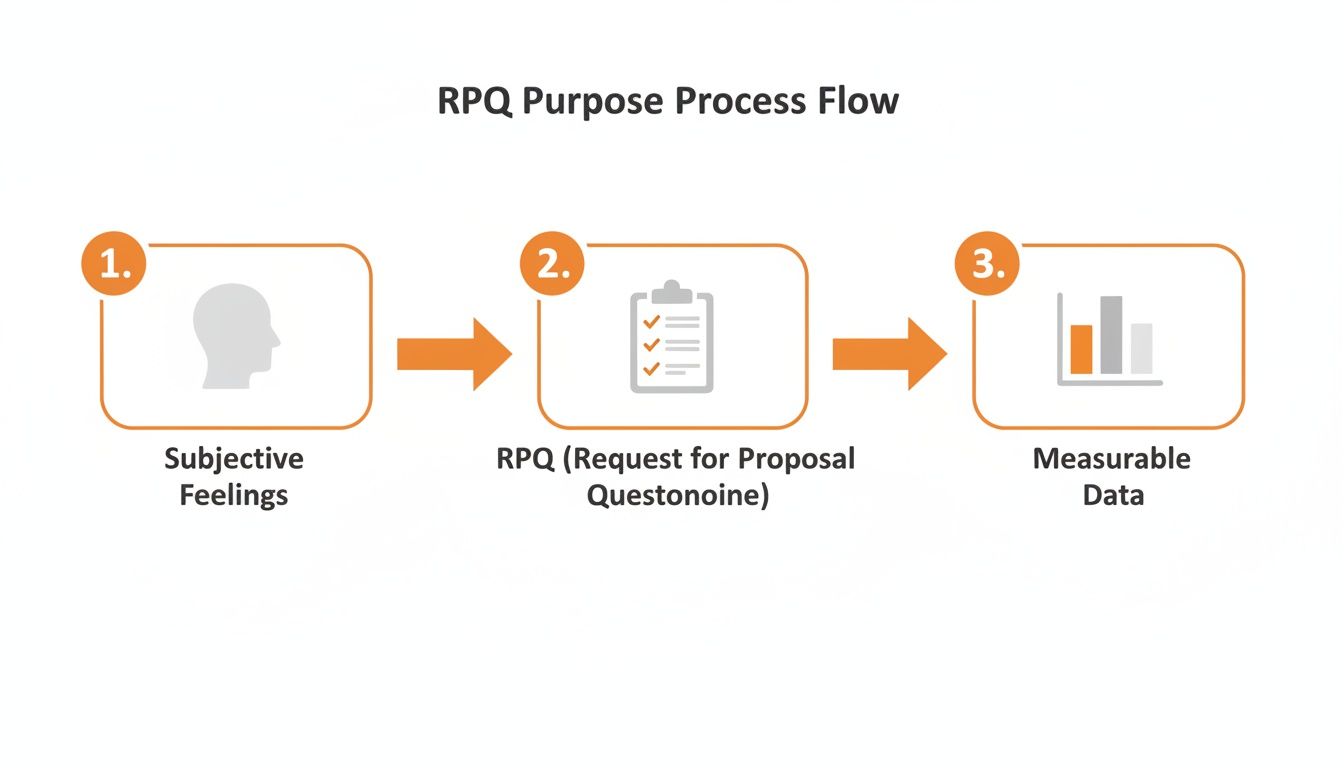
It’s a powerful way to translate a personal experience into a quantifiable score, making it possible to consistently monitor how someone is recovering.
Calculating the Total Score and Sub-Scores
Once the patient has filled out the questionnaire, adding up the score couldn't be easier. You simply sum the ratings for all 16 items. The total score will fall somewhere between 0 and a maximum of 64, with higher scores pointing to a greater symptom burden.
For a quick reference, here's a simple breakdown of the scoring system.
RPQ Scoring At a Glance
Rating Scale | Description | Symptoms Assessed | Total Score Calculation |
|---|---|---|---|
0 | Not experienced at all | 16 common post-concussion symptoms | Sum the scores for all 16 items. |
1 | No more of a problem than before the injury | Covers physical, cognitive, and emotional domains | Score ranges from 0 (asymptomatic) to 64 (severe). |
2 | A mild problem | Includes headaches, dizziness, fatigue, irritability, etc. | Sub-scores can be calculated for deeper insights. |
3 | A moderate problem | Differentiates pre-injury from post-injury symptoms | A higher total score indicates greater symptom severity. |
4 | A severe problem | Simple for patients to self-report | Quick and easy for clinicians to calculate. |
This table provides a high-level view of how each component of the RPQ comes together to create a clinically meaningful picture.
But the RPQ offers more than just one number. To get a more nuanced understanding, you can look at two key sub-scores:
RPQ-3: This score is the sum of the first three items—headaches, dizziness, and nausea/vomiting. It gives you a quick snapshot of the patient’s core physical symptoms.
RPQ-13: This is the total for the remaining 13 items, which dig into cognitive, emotional, and sensory symptoms like forgetfulness, irritability, and sensitivity to light.
These sub-scores let you zero in on specific problem areas. For instance, a high RPQ-13 with a low RPQ-3 might tell you that cognitive and emotional issues are the real drivers of the patient's distress, not the physical ones. This kind of insight helps you tailor your treatment plan right where it's needed most. For a different lens on patient assessment, you can explore the MoCA assessment instructions in our other guide.
This level of detail is invaluable for creating personalized care plans and tracking recovery with genuine precision. Feel free to email our team to see how our platform can help you integrate these kinds of assessments into your digital workflow.
Interpreting RPQ Scores to Guide Patient Care
A score from the Rivermead Post-Concussion questionnaire is just a number until a clinician applies their expertise. The real art is turning these numbers into actionable insights that genuinely guide patient care, helping you see the full story of their recovery, not just a single snapshot in time. It’s less about chasing a specific number and more about understanding the patterns that emerge over time.
Think of it like being a weather forecaster instead of just reading today's temperature. A single high score might be a blip on the radar, but a string of high scores that refuse to budge is a clear sign that the current treatment plan needs another look.
Tracking Trends to Understand Recovery
The true power of the RPQ comes from tracking trends. When you administer the questionnaire at regular intervals, you can start to map out a patient’s recovery journey and spot one of three key patterns:
Improvement: A steady drop in the total score is great news. It shows the patient is responding well to treatment and their symptoms are finally starting to ease up. Actionable Insight: Use a graph of their scores to visually demonstrate their progress, which can be highly motivating.
Plateau: If the scores level off and the patient stops improving, they may have hit a wall in their recovery. This is your cue to re-evaluate their therapy and figure out what’s holding them back. Actionable Insight: Revisit their rehab exercises or consider if an unaddressed issue, like poor sleep, is stalling progress.
Regression: An increase in scores is a red flag. It signals a potential setback or a new issue that needs your immediate attention. Actionable Insight: Ask the patient what changed. Did they overexert themselves? Experience a new stressor? This helps you pinpoint the cause and adjust their plan.
This long-term data is where the RPQ really proves its worth. It turns a simple checklist into a dynamic map of your patient’s progress.
A declining RPQ score is one of the best ways to validate a treatment plan and build a patient's confidence. On the flip side, a fluctuating or stubbornly high score is a clear call to action, urging a deeper clinical investigation.
This approach is backed by solid Canadian research. For example, a study at the Hull-Ellis Concussion and Research Clinic in Toronto followed adults with concussions and confirmed the RPQ's reliability. The average total score was 21.0 out of 64, pointing to a moderate symptom load that clinicians need to monitor carefully. The strong link between RPQ scores and other assessment tools just reinforces its value for tracking recovery.
The chart below, from the same study, shows how RPQ and SCAT scores changed over 16 weeks, illustrating a typical recovery path.

This visual data clearly shows the general downward trend in symptom severity over time—exactly what you want to see in a successful recovery.
Using Scores to Inform Clinical Decisions
Interpreting RPQ scores helps steer specific clinical actions. For instance, a patient with consistently high scores on cognitive items like "poor concentration" or "forgetfulness" is a perfect candidate for objective cognitive testing. This lets you back up their subjective complaints with hard data. It's also important to consider adjunctive therapies; for example, you might explore how HBOT for Brain Health and Cognitive Function could address persistent neurological symptoms.
Ultimately, the RPQ should never be used on its own. It’s one piece of a much larger puzzle that includes your clinical observations, the patient’s history, and objective assessments. You can learn more about how to build a complete concussion management strategy in our guide.
By bringing all these elements together, you can create a truly personalized and effective care plan for every patient.
Navigating Clinical Limitations and Normative Data
To get the most out of the Rivermead Post Concussion questionnaire, we have to be honest about its limitations. While it’s fantastic for tracking how a patient's symptoms change over time, its subjective nature means a high score isn't a diagnosis on its own. It's really just a starting point for a deeper clinical conversation, not the final word.
One of the biggest challenges is that post-concussion symptoms often overlap with the annoyances of everyday life. Think about it: fatigue, headaches, irritability—these are common complaints for anyone dealing with stress, a bad night's sleep, or anxiety. This is precisely why establishing a solid pre-injury baseline is so critical whenever possible.
The goal is not to treat the number on the page, but to understand the patient behind the score. The RPQ is a catalyst for clinical inquiry, helping you ask the right questions to uncover the root causes of a patient's distress.
Understanding Baseline Symptoms in Healthy Individuals
Context is everything when looking at RPQ results. Without a sense of what's "normal," it's easy to read too much into a patient's score. For instance, a patient might report mild fatigue, but were they already feeling that way before their injury? This is where normative data becomes an essential guide for your clinical judgment.
This is especially true when working with Canadian populations. A key study in British Columbia looked at symptoms very similar to those on the RPQ in a group of healthy volunteers. The findings were eye-opening: between 35.9% and 71.8% of people without a brain injury reported having at least one of these symptoms. Fatigue and nervousness, for example, were reported by up to 57.3% of healthy individuals.
This really highlights the risk of over-pathologizing common complaints. It also underscores the RPQ's true value: comparing a patient's current state to their own pre-injury self. For a complete breakdown of these findings, you can explore the full Canadian study on post-concussion symptoms.
The image below gives a clear snapshot of how often specific symptoms pop up among healthy community volunteers. It’s a valuable reference for understanding what a baseline might look like.
As you can see, things like headaches and fatigue are quite common even in a non-injured population. This just reinforces the need to score carefully and comparatively.
Combining Subjective and Objective Data
Acknowledging these limitations leads us to a more balanced assessment strategy. The RPQ gives you the "what"—what the patient is feeling and experiencing. But objective cognitive assessments can give you the "how"—how their brain is actually performing on specific, measurable tasks. Pairing these two sources of information creates a much more robust and evidence-based clinical picture.
Here's a practical example of this in action:
Subjective Report (RPQ): A patient reports "moderate" difficulty with concentration (a score of 3).
Objective Data (Cognitive Test): A platform like Orange Neurosciences reveals a measurable 20% decrease in their processing speed and sustained attention scores compared to their baseline.
Actionable Insight: Now you know the "foggy" feeling isn't just subjective. You can assign specific cognitive drills targeting attention and speed, and then use both the RPQ and the objective test to measure improvement.
This combination moves you beyond guesswork. When you can integrate real-time cognitive data on executive function and eye-hand coordination with the patient's self-reported RPQ scores, you can start to distinguish pathological symptoms from everyday ones and deliver truly personalized therapy. To make sure your assessment tools are consistent and dependable, take a moment to review our guide on test-retest reliability.
Ultimately, this integrated approach helps clinicians build effective, evidence-based interventions that get to the heart of the matter. To see how Orange Neurosciences can help you pair subjective reports with objective data in your own practice, send us an email to connect with our team.
Weaving the RPQ Into Your Modern Practice

Leaving paper forms behind is the single biggest step you can take to unlock the true power of the Rivermead Post Concussion questionnaire. When you bring the RPQ into a digital workflow, it stops being a static checklist and becomes a living, breathing part of your clinical process. The result? You save a ton of time and gain much deeper insight into your patient's recovery.
Just picture this: a patient checks in and completes their RPQ on a clinic tablet in the waiting room. Before they even walk into your office, their responses are scored, analyzed, and graphed out. This simple switch from paper to a screen completely changes the conversation.
The Upside of Going Digital
Taking the RPQ digital brings immediate, tangible benefits to any clinic. The efficiency boost is about so much more than saving paper; it frees you up to focus on what really matters—your patient—instead of getting bogged down in administrative work.
Here’s what you stand to gain:
Automatic Scoring: Forget manual calculations and the risk of human error. Total scores and sub-scores appear instantly, giving you reliable data on the spot.
Clear Data Visualization: The right software can automatically chart a patient’s RPQ scores over time. This makes it incredibly easy to see trends, spot when progress has stalled, or notice a regression with just a quick glance.
Smooth EHR Integration: No more manual data entry. The results can be sent directly to the patient’s electronic health record (EHR), keeping their file complete and current.
This kind of automation doesn't just save precious minutes in every appointment; it also pulls the patient into the process. When they can see their progress mapped out visually, they become more invested and involved in their own recovery.
From Subjective Reports to Data-Driven Care Plans
A digital RPQ acts as the perfect link between a patient’s personal experience and the hard data you need to build a solid care plan. It sets up a streamlined, data-first approach from the moment a patient walks through the door.
By digitizing the RPQ, you create a seamless workflow where subjective feelings are captured and quantified before the consultation even starts. This arms you with clear, actionable data, freeing you up to focus entirely on the clinical conversation.
This is also the natural starting point for more advanced, objective testing. When a patient’s digital RPQ results flag ongoing cognitive or emotional symptoms, it's the perfect trigger for a deeper look with objective tools. This is where a platform like Orange Neurosciences comes in as the logical next step.
Our platform picks up where the subjective insights from the Rivermead Post Concussion questionnaire leave off, providing concrete cognitive metrics. You can learn more about this approach by checking out our guide on cognitive assessment online. For practices or academic institutions looking to expand their work with the RPQ, exploring options like the Ontario Research Support Funding can also open up new resources.
By combining the RPQ’s patient feedback with our objective cognitive data, you can create truly data-driven care plans that see the whole picture of recovery. It’s an integrated approach that takes the guesswork out of the equation and puts your practice on the leading edge of concussion management.
Common Questions About the RPQ
Once you get the hang of the Rivermead post concussion questionnaire, a few practical questions almost always pop up when it's time to actually use it in a busy clinic. Let's walk through some of the most common ones to give you clear, straightforward guidance for applying the RPQ with confidence.
Can the RPQ Be Used to Diagnose a Concussion?
In a word, no. Think of the RPQ as a symptom monitoring tool, not a diagnostic one. A formal concussion diagnosis always requires a comprehensive clinical evaluation by a qualified healthcare professional.
What the RPQ does is provide critical, quantifiable data on symptom severity. This data supports your overall evaluation and helps you track the patient's recovery journey, but it should never be used on its own to make a diagnosis.
How Often Should I Administer the RPQ to a Patient?
This really depends on where the patient is in their recovery. The key isn't a magic number, but consistency. Being consistent is what allows you to build a clear and reliable picture of their recovery trajectory.
Acute Phase (First 1-4 Weeks): Early on, things can change quickly. Administering the RPQ at each follow-up visit, maybe weekly, is a great way to keep a close eye on their symptoms.
Post-Acute Phase: Once recovery is underway and symptoms start to level off, you can begin to space out the assessments. Shifting to every few weeks or once a month helps track those longer-term patterns and ensures progress is still heading in the right direction.
This regular rhythm transforms the questionnaire from a simple form into a powerful narrative of a patient's journey over time.
Think of the RPQ as a progress journal, not just a one-time report. Regular entries are what reveal the true story of a patient's recovery, highlighting improvements, plateaus, or setbacks that require your attention.
What Is the Main Difference Between the RPQ and SCAT5?
This is a great question because while both are staples in concussion care, they play very different roles. The SCAT5 is a multi-faceted tool built for the immediate, on-field assessment right after a suspected injury. It's a quick snapshot that combines symptom checklists with balance and cognitive tests.
The Rivermead post concussion questionnaire, on the other hand, is a dedicated tool laser-focused on one thing: quantifying the severity of 16 common post-concussion symptoms over time in a clinical setting. You could say the SCAT5 is the initial incident report, while the RPQ serves as the ongoing progress log for follow-up care.
How Does Objective Cognitive Testing Complement the RPQ?
This is where you get a truly complete picture. The RPQ tells you what the patient feels; objective cognitive testing shows you how their brain performs. That distinction is crucial for building a care plan that’s truly based on evidence.
Here's a practical example. A patient might report "mild" concentration issues on the RPQ, which is valuable subjective insight. But an objective test from a platform like Orange Neurosciences can pinpoint specific deficits in their processing speed or sustained attention that are causing that feeling. Your actionable insight is to assign targeted brain-training exercises to improve processing speed and use both the RPQ and the objective test scores to track their progress.
When you combine these subjective and objective data points, you effectively take the guesswork out of the equation. It allows you to design much more targeted rehabilitation plans that address both the patient's reported experience and their objectively measured cognitive function, ultimately leading to more effective and personalized care.
By integrating subjective tools like the RPQ with objective data, you build a comprehensive clinical picture that leads to better patient outcomes. At Orange Neurosciences, our AI-powered platform provides the precise cognitive metrics you need to complement patient-reported symptoms. Visit us online to see how our tools can help you take the guesswork out of cognitive care.

Orange Neurosciences' Cognitive Skills Assessments (CSA) are intended as an aid for assessing the cognitive well-being of an individual. In a clinical setting, the CSA results (when interpreted by a qualified healthcare provider) may be used as an aid in determining whether further cognitive evaluation is needed. Orange Neurosciences' brain training programs are designed to promote and encourage overall cognitive health. Orange Neurosciences does not offer any medical diagnosis or treatment of any medical disease or condition. Orange Neurosciences products may also be used for research purposes for any range of cognition-related assessments. If used for research purposes, all use of the product must comply with the appropriate human subjects' procedures as they exist within the researcher's institution and will be the researcher's responsibility. All such human subject protections shall be under the provisions of all applicable sections of the Code of Federal Regulations.


© 2026 by Orange Neurosciences Corporation