Mastering the Peabody Individual Achievement Test
May 16, 2026

A referral lands on your desk. The student is struggling, the teacher wants clarity, and the family doesn't need a three-appointment psychoeducational battery unless the first pass supports that next step. In that moment, the peabody individual achievement test often comes back into the conversation for one reason: it gives you a broad academic snapshot without turning a screening question into a full diagnostic project.
That's where the PIAT still earns its place. It's not the tool for every referral, and it shouldn't be stretched into answering questions it was never built to answer. But when you need a norm-referenced look at general academic functioning, especially to sort out whether concerns appear broad, specific, or inconsistent, it remains practical.
Used well, the PIAT helps you answer a very applied question: Do we need to go deeper, and if so, where? Used poorly, it can create false confidence, especially when language, culture, attention, or uneven instruction are major parts of the picture.
Your Practical Introduction to the PIAT

Most referrals don't begin with elegant diagnostic questions. They begin with statements like “he's behind in reading”, “math is suddenly harder”, or “we're not sure whether this is a learning issue, attention issue, or school-fit issue”. In those cases, a broad achievement measure can give you a clean starting point.
The PIAT works best when you need coverage more than depth. It can help a school psychologist decide whether a student's academic concerns look isolated or widespread. It can help a clinician get a baseline before deciding whether more detailed academic or neurocognitive testing is warranted. It can also support homeschool or independent assessment workflows when families want a structured snapshot rather than a curriculum-based review.
A useful companion to this decision-making process is a broader review of cognitive assessment tools used in modern practice. Achievement scores tell you what a student is doing. Cognitive data can help explain why the pattern may be occurring.
When I'd reach for it first
The PIAT is a good first tool when:
The referral question is broad: You need an overview of academic strengths and weaknesses, not a fine-grained diagnosis on day one.
Time matters: You want a practical screening step before committing to a larger battery.
You need norm-referenced context: Classroom grades and work samples are useful, but they don't tell you how a student is performing relative to age peers in a standardised framework.
The setting is mixed: School, clinic, and independent practice all have situations where a year-round, individually administered academic screener is useful.
Practical rule: Use the PIAT when the question is “What does the academic profile look like?” Don't use it alone when the question is “Why is this student struggling?”
What it won't do for you
It won't replace a full learning disability assessment. It won't settle language-versus-learning questions by itself. And it won't tell you which exact instructional subskills need intervention planning in the way a more diagnostic tool or careful curriculum-based data review can.
That distinction matters. The PIAT is often most helpful at the front end of a workflow, not the end of one.
Understanding the PIATs Purpose and History

The PIAT makes more sense once you stop thinking of it as a school exam. It wasn't built to mirror a local classroom sequence or a specific provincial curriculum. It was built as a broad, standardised, norm-referenced achievement measure.
Historically, the test was introduced in 1970 by Lloyd M. Dunn and Frederick C. Markwardt, and later updated into the PIAT-R/NU in 1997–1998. The revised and normative update expanded the usable age range to ages 5 through 22 and was designed for kindergarten through grade 12. The update also added written expression to the earlier five core areas of general information, reading recognition, reading comprehension, mathematics, and spelling, as described in EBSCO's overview of the Peabody Individual Achievement Test.
Why that history still matters
That history explains why the PIAT still shows up in practice even when newer tools are available. Its design goal was never narrow diagnostic precision. Its design goal was efficient academic surveying across a wide range of ages and settings.
For Canadian users, that's still relevant. You may need a tool that can be administered year-round, used individually, and interpreted in a standardised way whether the student is seen in a school board setting, private clinic, or homeschool context. The PIAT fits that kind of workflow better than many people expect.
What the test is actually for
Think of the PIAT as a structured checkpoint.
It helps answer questions such as:
Is the concern general or domain-specific
Does the student show a meaningful split between reading and maths
Are there enough signs of weakness to justify a deeper psychoeducational referral
Is the presenting concern reflected in norm-referenced achievement data, or does the profile look more mixed
The PIAT is most useful when you respect its role as a screener. Problems start when practitioners ask a screening instrument to function like a full diagnostic battery.
A common mistake is to over-interpret a single low area as if it automatically identifies a disorder. It doesn't. A low score can support concern. It doesn't explain causation on its own.
The practical takeaway
The PIAT's long history is not just a trivia point. It tells you how to use it properly. This is a broad K to 12 screening tool, not a curriculum mastery test and not a standalone diagnostic instrument. If you use it with that purpose in mind, it remains useful. If you expect more, you'll end up writing conclusions the data can't fully support.
Exploring the PIAT Test Batteries and Subtests
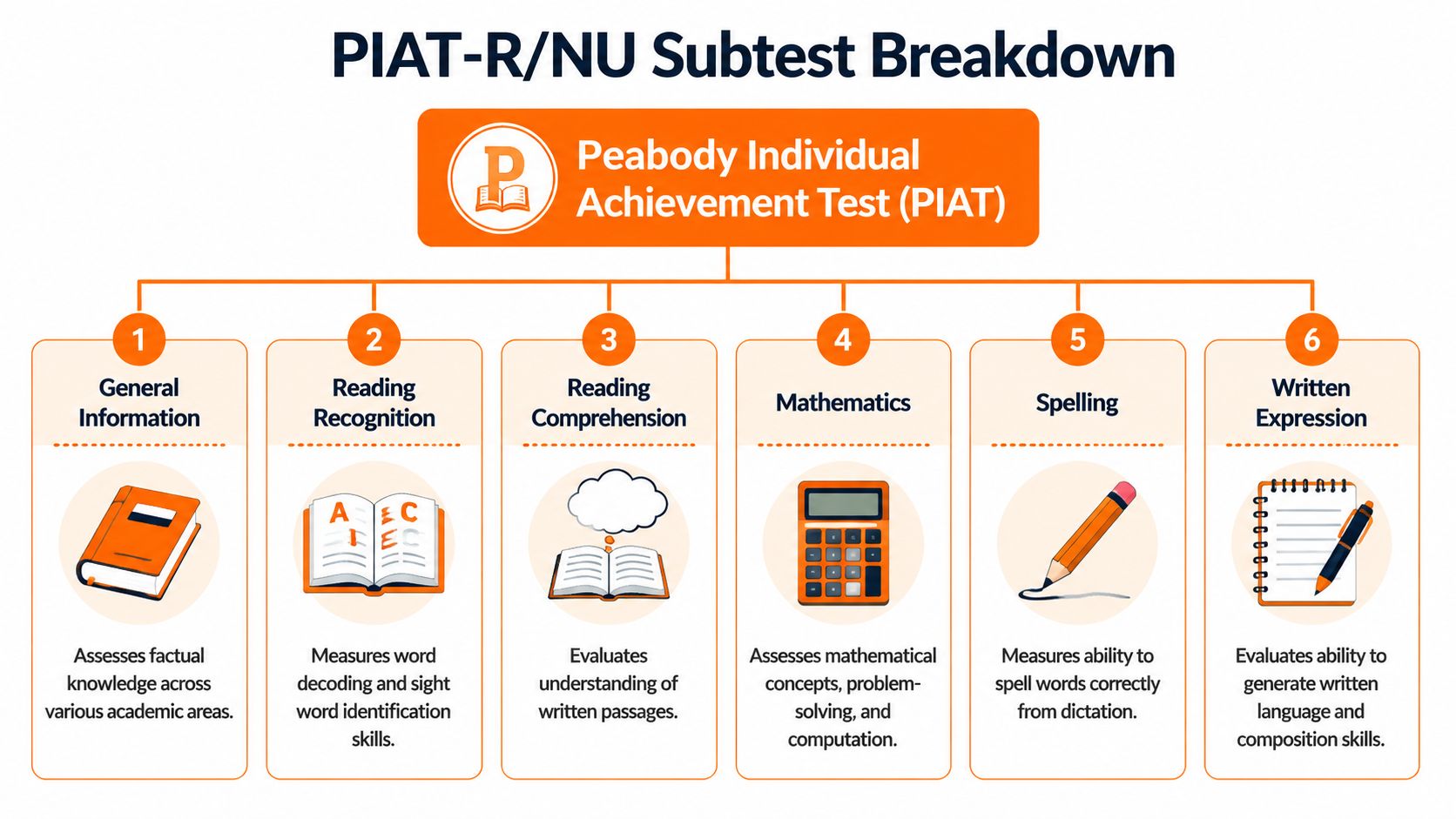
The PIAT-R/NU covers six core academic areas. That breadth is the main reason practitioners still use it. You can move across factual knowledge, reading, maths, spelling, and writing without switching instruments or creating a fragmented first-pass assessment.
For readers comparing broad achievement tools, this guide to individual achievement tests in practice is a helpful companion because the PIAT makes the most sense when viewed alongside other survey-style and diagnostic achievement measures.
The six subtests in working language
Here's what each subtest helps you look at in real practice.
Subtest | What it helps you notice | Practical example |
|---|---|---|
General Information | Breadth of learned factual knowledge | A student who seems verbally bright in conversation may still show weak academic knowledge retrieval |
Reading Recognition | Word identification and decoding-style performance | Useful when teachers report inconsistent single-word reading |
Reading Comprehension | Understanding of written material | Helpful when oral language sounds stronger than independent reading performance |
Mathematics | Broad maths attainment across increasing difficulty | Good first-pass data when concerns include computation and applied concepts |
Spelling | Accuracy in written word production from dictation | Often useful when written work looks weaker than oral responses |
Written Expression | Ability to generate written language | Can reveal whether output demands are a major bottleneck |
What scores in these areas usually mean in practice
A high Reading Recognition score with weaker Reading Comprehension may suggest that the student can identify words but struggles to construct meaning. That doesn't prove a language disorder, but it tells you where to look next.
A student with stronger General Information and Reading Recognition, but weaker Written Expression, often needs a closer look at output demands. In school reports, this is the child who “knows more than they can get onto paper”.
When Mathematics is the only clear weakness, you still shouldn't jump straight to a specific maths disorder conclusion. You need classroom data, history, and often more targeted measures to know whether the issue is calculation, concept development, working memory load, language demands in word problems, or uneven instruction.
The mathematics subtest as a model of how PIAT works
The maths subscale is one of the clearest examples of the PIAT's efficiency. According to the NLSY79 Child Supplement description of PIAT Mathematics, it contains 84 multiple-choice items arranged in increasing difficulty and is described as a broad measure of mainstream educational attainment with strong test-retest reliability and concurrent validity.
That structure matters in day-to-day use.
It starts broad: You're not testing one narrow classroom strand.
It increases in difficulty: You can quickly see where performance begins to break down.
It uses basal and ceiling logic: The student doesn't need to grind through every item.
It gives a benchmark: You can tell whether the maths profile appears generally in line with age peers before deciding whether more detailed follow-up is needed.
A broad maths score is useful for triage. It is not the same thing as a diagnostic map of number sense, procedure, reasoning, and fluency.
A practical way to think about subtest patterns
Don't read each subtest in isolation. Read the pattern.
A profile with broadly low scores across multiple areas points you toward general academic concern and likely broader follow-up. A profile with selective weakness narrows the referral question. A scattered profile with obvious behavioural variability may tell you as much about test engagement, attention, language load, or frustration tolerance as it does about achievement itself.
That's why the PIAT is often most valuable in the hands of someone who already knows how to integrate test data with observation, history, and actual school functioning.
Mastering Administration and Score Interpretation
Good PIAT data depends less on owning the kit and more on disciplined administration. This is not a test to improvise. If you skip entry rules, miss discontinue points, or over-prompt, your scores become harder to defend and less useful to everyone who has to make decisions from them.
How basal and ceiling rules make the test efficient
The easiest analogy is a staircase. You don't start every student on the first step, and you don't force them to climb to the roof. You enter near the level that fits the student, confirm where skills are solid, and stop when the items become too difficult.
That's the logic behind basal and ceiling procedures. They reduce unnecessary item administration while still allowing the test to estimate where the student is functioning.
In practice, this helps in two ways:
Student stamina is preserved: You avoid wasting time on items that are clearly too easy or too hard.
The profile stays interpretable: You get a usable survey of performance without turning the session into an endurance contest.
What to pay attention to during administration
Experienced examiners usually learn the same lesson quickly. Behavioural observations matter almost as much as the score pattern.
Watch for:
Response style: Is the student guessing rapidly, working carefully, or shutting down after an error?
Task sensitivity: Does performance drop when written output increases?
Language load: Does comprehension appear weaker when instructions or item wording become more complex?
Attention drift: Are later items lower because they are harder, or because the student is no longer engaged?
A PIAT score without these observations is thinner than it looks.
If the student's effort, language access, or regulation is uneven, write that into your interpretation. Don't bury it in the behaviour notes and then report the scores as if testing conditions were clean.
Interpreting the score outputs responsibly
The PIAT is widely described as yielding grade-equivalent and percentile-type outputs in practical workflows, as noted earlier in the historical overview. Those numbers can be useful, but they don't all carry the same interpretive weight.
A practical way to handle them:
Percentile-style interpretation is often easiest for parents and educators to understand in relative terms.
Grade equivalents can be tempting, but they're often misunderstood. They do not mean a student has “mastered” that full grade level curriculum.
Composite-level thinking is usually stronger than overreacting to one isolated score, especially when the referral question is broad.
For clinicians who want a quick refresher on how reliability affects interpretation, this review of test retest reliability statistics is worth keeping handy.
What the reliability data means in real reports
The PIAT-R/NU has a strong enough reliability profile to support its use as a serious screening measure, but not a simplistic one. Reported subtest test-retest correlations were mostly in the mid-.80s to high-.90s, with lower values around .78 to .79 in some grade-specific Mathematics and Reading Comprehension instances, while composite correlations were reported in the low-to-upper .90s, according to the published review hosted at this PIAT-R/NU reliability reference.
That should shape how you write.
Trust broad patterns more than tiny score differences
Be more cautious with isolated subtest conclusions
Use composite and cross-domain interpretation when the referral question allows it
State uncertainty plainly when the profile is mixed
A responsible sentence in a report sounds like this: the student showed weaker performance in mathematics relative to other academic areas on this broad achievement screener, and this pattern supports further targeted assessment. That is very different from writing that the PIAT “proves” a maths disorder.
Common Use Cases in Schools Clinics and Research

The PIAT tends to be most useful when the referral question is practical and time-sensitive. Not every setting needs the same level of depth at the first step.
School psychology referral triage
A school psychologist receives a referral for a student with mixed classroom performance. Reading group data looks acceptable, but written work and maths quizzes are inconsistent. The team doesn't yet know whether this is a specific academic problem, an attention issue, or a broader learning concern.
In that situation, the PIAT can work as a first-pass achievement survey. If the profile comes back broadly even, the next step may be classroom observation, intervention review, and attention or executive function follow-up rather than immediate intensive academic testing. If the profile shows clear academic weakness, that supports moving toward a fuller learning disability assessment, such as the kinds of pathways described in assessments for learning disabilities.
Clinic follow-up for treatment planning
In private practice, a clinician may use the PIAT when a child is already being seen for ADHD, anxiety, concussion recovery, or school avoidance, and the family wants to know whether academic performance appears generally on track. The test won't explain every mechanism, but it can help determine whether the concerns are reflected in broad achievement data.
For families, tutoring centres, or clinics that need a cleaner way to track student progress and scores efficiently, organised score management matters. The PIAT is often more useful when its results are reviewed alongside progress notes, intervention logs, and repeated educational data rather than filed away as a one-time event.
Research and longitudinal work
Researchers value the PIAT for different reasons than clinicians do. In research settings, a broad, standardised achievement measure is useful because it creates a shared benchmark across participants and time points.
That doesn't mean it captures everything that matters educationally. It means it gives researchers a stable broad indicator of academic attainment that can sit beside other developmental, cognitive, and environmental measures.
In schools, the PIAT often answers “Should we evaluate further?” In clinics, it often answers “Do the academic concerns show up broadly?” In research, it often answers “How can we benchmark achievement consistently across participants?”
PIAT Strengths Limitations and Modern Comparisons
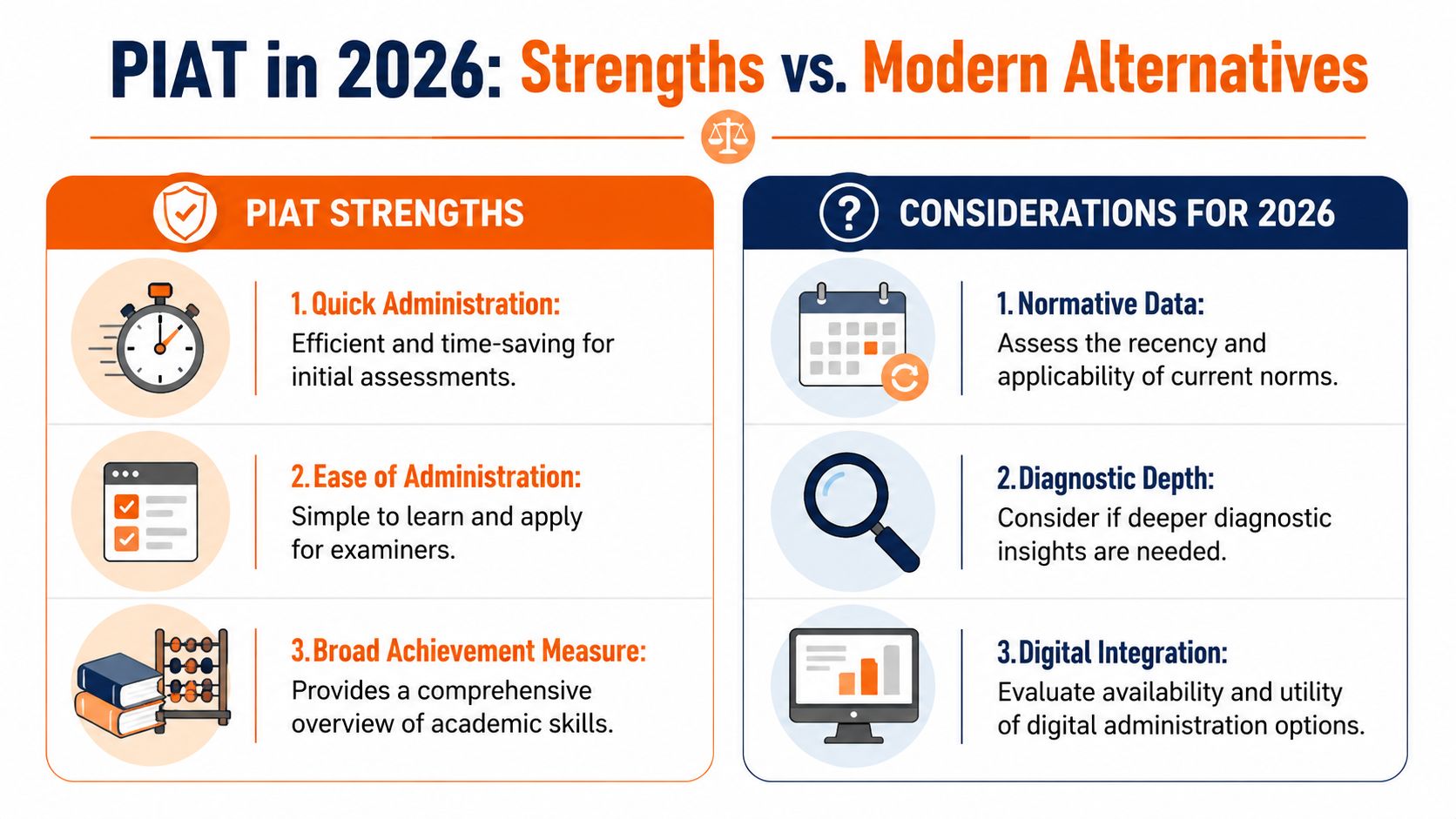
The PIAT is still useful, but only if you're clear about what you're buying with it. You're getting efficiency, breadth, and practicality. You are not getting the deepest available academic analysis.
Where the PIAT still works well
Its strengths are straightforward.
It is efficient: You can get broad academic coverage without a massive testing block.
It is workable across settings: Schools, clinics, and independent practitioners can all use it sensibly.
It supports triage: It helps identify whether a student likely needs a more extensive psychoeducational or neurocognitive workup.
It is easier to explain than some larger batteries: For many families, a broad academic profile is a manageable starting point.
Those are real advantages. If the referral question is broad and your workflow needs a practical first step, the PIAT often makes sense.
Where practitioners need to slow down
Its limits matter just as much.
A key concern is multilingual and culturally responsive use. Summaries often note English and Spanish availability, but that doesn't solve broader linguistic equity concerns. The test is best understood as a low-domain, broad screener, not an all-inclusive diagnostic tool, and results are mainly accessible to English and Spanish speakers, as discussed in this overview of the Peabody Individual Achievement Test and its language-access limitations.
For multilingual learners, the central question is not whether a translated or accessible version exists. The core question is whether the tool can separate language exposure from true academic skill weakness. Broad achievement screeners often struggle there.
Comparing PIAT with larger achievement batteries
If you need deeper diagnostic detail, many practitioners will look at broader batteries such as the WIAT or Woodcock-Johnson. Those tools generally support more fine-grained analysis of academic functioning and are often better choices when eligibility, differential diagnosis, or detailed intervention planning are the main goals.
A practical comparison looks like this:
Need | PIAT | Larger achievement battery |
|---|---|---|
Fast broad screening | Strong fit | Often more than you need |
Detailed diagnostic interpretation | Limited | Better fit |
Initial referral triage | Strong fit | Useful but heavier |
Fine-grained instructional planning | Limited on its own | Better starting point |
If you're comparing options directly, this review of the Wechsler Individual Achievement Test helps frame the kind of depth difference many clinicians are deciding between.
Where digital workflows enter the conversation
Modern practice increasingly asks a different question. Not just “Which achievement test should I use?” but “Which parts of this workflow need a full standardised instrument, and which parts need faster repeatable screening?”
That matters in multilingual, multi-setting, and high-volume environments. A broad screener like the PIAT may still be useful at intake, but some teams now pair academic testing with digital tools that can be repeated more easily across settings to monitor patterns over time.
Operationally, that also means thinking about integration. Teams building connected educational systems may find technical resources on integrating custom webhooks for English learning platforms useful when they're trying to move score and progress data between platforms without relying on fragmented manual processes.
The practical bottom line is simple. Choose the PIAT when you need an efficient, standardised academic snapshot. Choose a larger battery when you need depth. Add modern repeatable screening when your workflow needs faster monitoring between major evaluations.
Effective Reporting and Integrating Your Findings
A good PIAT report doesn't read like a score dump. It reads like a clinical explanation of what the student can do, where the concerns sit, and what should happen next.
Start with the referral question, then describe the academic pattern in plain language. If reading recognition was stronger than comprehension, say what that means functionally. If maths was the weakest area, connect that to classroom concerns without over-claiming. If the profile was uneven because attention, language, or frustration affected performance, say that clearly.
What strong reporting usually includes
A functional summary: Link scores to actual school or daily learning demands.
Observed conditions: Note effort, pacing, language access, and regulation.
A restrained conclusion: State what the PIAT supports, not what it cannot establish alone.
Clear next steps: Additional testing, intervention review, classroom supports, or monitoring.
A parent-friendly report answers three questions well. What did you find, what does it likely mean, and what should we do now?
The best use of the PIAT is often as one part of a layered assessment picture. Broad achievement data can identify concern. More targeted cognitive, academic, behavioural, or classroom-based information can explain the pattern and guide action. That's how the test becomes useful rather than merely complete.
If your team wants a faster way to combine broad screening with repeatable cognitive insight, Orange Neurosciences offers practical tools that fit modern assessment workflows. Their platform helps clinicians, educators, and families gather rapid cognitive data, support triage decisions, and identify when a fuller evaluation is warranted. Visit the site or contact the team to see how it can strengthen your assessment process without adding unnecessary delay.

Orange Neurosciences' Cognitive Skills Assessments (CSA) are intended as an aid for assessing the cognitive well-being of an individual. In a clinical setting, the CSA results (when interpreted by a qualified healthcare provider) may be used as an aid in determining whether further cognitive evaluation is needed. Orange Neurosciences' brain training programs are designed to promote and encourage overall cognitive health. Orange Neurosciences does not offer any medical diagnosis or treatment of any medical disease or condition. Orange Neurosciences products may also be used for research purposes for any range of cognition-related assessments. If used for research purposes, all use of the product must comply with the appropriate human subjects' procedures as they exist within the researcher's institution and will be the researcher's responsibility. All such human subject protections shall be under the provisions of all applicable sections of the Code of Federal Regulations.


© 2026 by Orange Neurosciences Corporation