A Practical Guide to Individual Achievement Tests
Feb 15, 2026
Think of an individual achievement test as a detailed academic check-up for a student. It’s not your typical pass-fail school quiz, but a comprehensive map of what a learner has actually absorbed in core areas like reading, math, and writing. These tests give us a standardized, reliable snapshot of a person's current academic skills.
Decoding Individual Achievement Tests

To really get what an individual achievement test is all about, let’s try an analogy. Imagine you want to get in better shape. A great first step would be a session with a personal trainer who runs a full assessment—checking your strength, endurance, and flexibility.
The trainer wouldn't just label you "fit" or "unfit." Instead, they'd get specific: "Your cardiovascular endurance is excellent, but your upper body strength needs some work, especially in your shoulders." This is exactly what individual achievement tests do for academic skills.
They move past general grades to offer a really granular view of a student's learning profile. These one-on-one assessments are carefully designed to pinpoint exactly where a student shines and where they might need a bit of extra support.
What Do These Tests Actually Measure?
Unlike a classroom test that checks if you remember last week's lesson, individual achievement tests look at the bigger picture. They evaluate a student's cumulative knowledge against a national, age- or grade-based standard. Everything is administered in a controlled, standardized way to make sure the results are objective and reliable. The main goal is to understand a student's current skill level compared to their peers.
This table gives a quick overview of what these tests are designed to measure, helping you immediately grasp their core components.
Key Dimensions of Individual Achievement Tests
Dimension | What It Means | Practical Example |
|---|---|---|
Reading | Assesses everything from basic phonics and word recognition to reading comprehension and fluency. | A student might read a short passage and then answer questions about its main idea, specific details, or the author's tone. |
Mathematics | Evaluates skills ranging from simple calculations and number sense to complex problem-solving and reasoning. | A task could involve solving multi-step word problems or applying geometric principles to find the area of a shape. |
Written Language | Measures abilities like spelling, constructing sentences, and organizing ideas into a coherent story or essay. | A student may be asked to write a short narrative about a specific prompt or edit sentences for grammatical errors. |
As you can see, the focus is on foundational academic skills that are crucial for all other learning.
A Standardized Yardstick for Learning
The real power of these tests is their standardization. Because every student takes the test under the same conditions, the results offer a fair and meaningful comparison. This is absolutely critical for making informed educational decisions.
An individual achievement test is less about judging a student and more about understanding them. It provides the objective data needed to build a bridge between a student's current abilities and their academic potential.
To get the full picture, it's also worth exploring effective alternatives to standardized testing that aim to build real-world skills. Ultimately, these tools are a cornerstone of personalized education. For a deeper dive into how different types of evaluations fit together, you can learn more about the role of https://www.orangeneurosciences.ca/cognitive-assessments in our complete guide.
Why Achievement Testing Is Essential for Student Growth
Knowing what an achievement test measures is one thing, but its real power is in how it fuels meaningful student growth. These assessments are so much more than a score on a piece of paper. They're practical tools that bring clarity and direction to everyone involved—educators, parents, and the students themselves.
Think of individual achievement tests as diagnostic tools. They help us see past the surface symptoms of a learning struggle to find the root cause, which is often more complex than it first appears. With that insight, we can stop guessing and start building learning strategies that actually work.
Pinpointing Specific Learning Needs
Let’s imagine a bright, articulate student in Grade 5 who just can’t seem to put together a decent essay. His grades in language arts are slipping, but nobody’s quite sure why. Is he just unmotivated? Is it a grammar problem? Or is something else going on?
This is where an individual achievement test cuts through the confusion. The results might reveal that his vocabulary and reading comprehension are well above his grade level, but his score on the 'Written Expression' subtest is lagging far behind. Suddenly, the problem isn't a vague "struggles with writing" issue; it’s a specific skill deficit.
That level of detail is gold. Instead of taking a generic approach, the school can now offer targeted support focused on the real building blocks of writing: sentence construction, paragraph organization, and connecting ideas.
Qualifying for Specialized Support
This kind of specific, objective data is often the key that unlocks specialized educational services. To qualify for programs like an Individualized Education Program (IEP) or other targeted supports, schools need clear evidence that a learning challenge exists.
An individual achievement test provides a vital baseline for measuring growth. It captures a student's starting point, making it possible to track progress objectively and adjust strategies as needed to ensure every learner is moving forward.
For instance, schools with a high percentage of students from low-income families (over 40%) can use federal Title I funds for school-wide programs. These funds are often directed based on needs identified through comprehensive assessments, including individual achievement tests, to ensure resources make the biggest possible impact.
Tracking Progress and Celebrating Growth
Finally, you can’t measure growth if you don’t know where you started. An achievement test provides that essential baseline—a clear, standardized snapshot of a student's skills at a specific point in time.
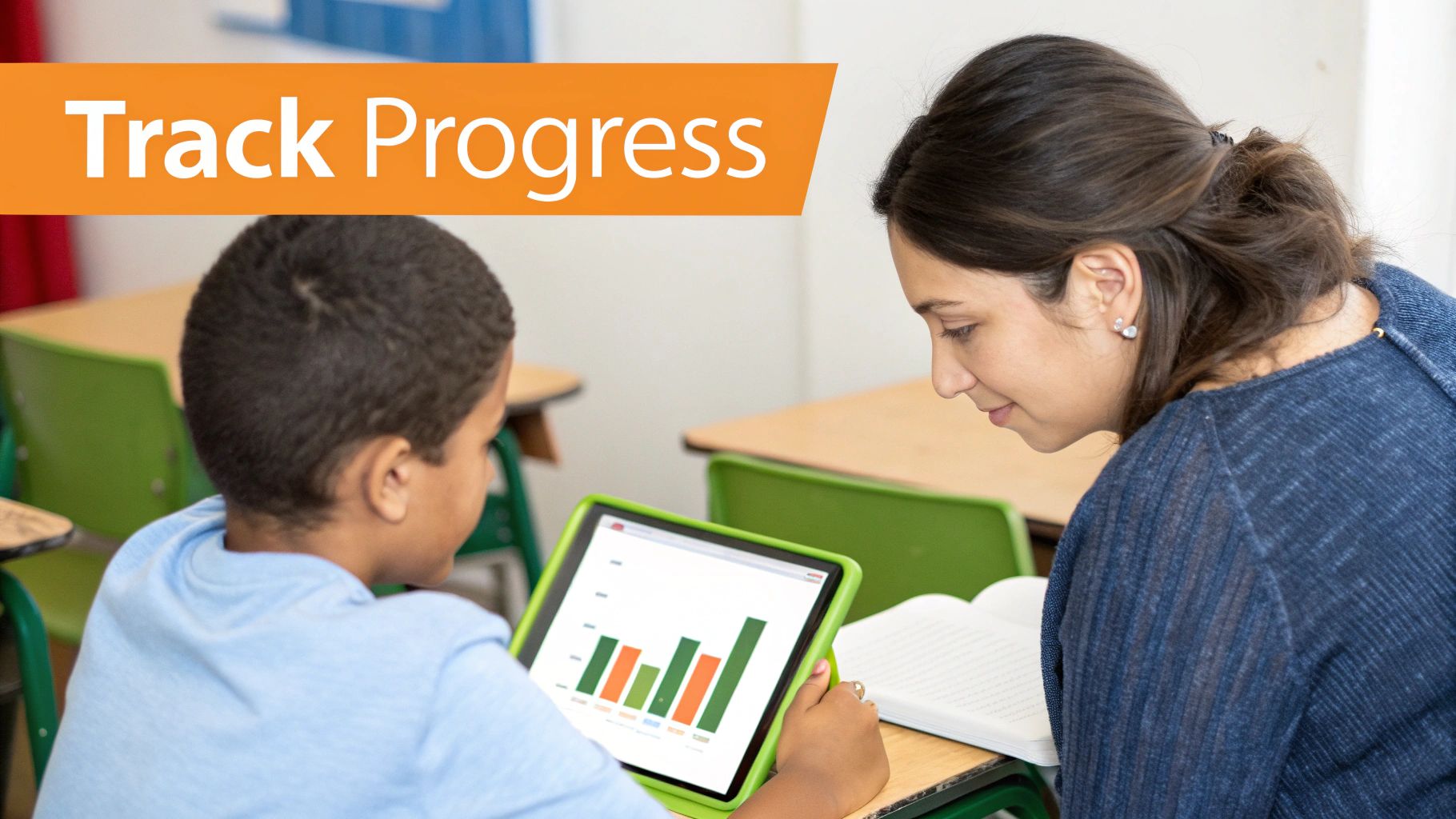
This makes progress monitoring incredibly powerful. A follow-up test a year later can show concrete, evidence-based improvement, which is a huge motivator for the student and their entire support team.
For Educators: It validates that their teaching methods are effective.
For Parents: It provides peace of mind that their child is getting the right help.
For Students: It lets them see their own hard work paying off in a tangible way.
By identifying needs, unlocking support, and tracking progress, individual achievement tests become truly indispensable tools for fostering genuine academic development.
Ready to see how combining achievement data with cognitive insights can create an even more powerful picture of a learner's potential? Explore how Orange Neurosciences bridges this gap by visiting our website today.
Exploring Common Individual Achievement Tests
Once you grasp why individual achievement tests are so valuable, the next logical step is to get familiar with the actual tools psychologists and educators use every day. While there are plenty of assessments out there, a few have earned a reputation as the gold standard for their reliability and depth.
Getting to know them helps pull back the curtain on the assessment process, making a psychological report feel a lot less intimidating.
Think of these tests like different brands of high-end diagnostic equipment in a mechanic's workshop. Each one might have a slightly different look or specialise in certain readings, but they all aim to give a precise, trustworthy picture of what’s happening under the hood. Two of the most respected "brands" in academic assessment are the WIAT and the Woodcock-Johnson tests.
These aren't just simple checklists. They're meticulously designed sets of tasks built to measure specific skills in a standardized way. This is crucial because it ensures that a student’s performance in Toronto can be fairly compared to a student's in Vancouver.
The Wechsler Individual Achievement Test (WIAT)
The Wechsler Individual Achievement Test (WIAT) is a heavyweight in this field—one of the most common achievement tests you'll find in schools and clinics. It’s well-known for its wide-ranging coverage of academic skills, painting a detailed picture of a student's strengths and weaknesses across four key areas.
One of the great things about the WIAT is that it's designed to align with school curriculum standards. This makes its results incredibly practical for mapping out what kind of support a student needs in the classroom. It's also a powerful tool for helping identify specific learning disabilities, especially when achievement scores are compared to a student's cognitive ability (IQ) scores.
So, what does it actually measure?
Reading: This covers the whole spectrum, from basic phonics and reading fluency to understanding the nuances of complex passages.
Math: Tasks look at everything from fundamental calculations to mathematical reasoning and real-world problem-solving.
Written Language: This section evaluates spelling, sentence construction, and the ability to pull it all together into a coherent essay.
Oral Language: Here, the focus is on listening comprehension and a student's skill in expressing their thoughts verbally.
Actionable Example: A classic WIAT subtest like 'Sentence Composition' might show a student a picture of a park and ask them to create a sentence describing the action. This simple task effectively assesses their grasp of grammar and their ability to form contextually relevant sentences. If a student struggles, it provides an immediate target for intervention, such as practicing with sentence-building games.
If you want to dive deeper into this tool, our guide offers a comprehensive look at the Wechsler Individual Achievement Test and its many applications.
The Woodcock-Johnson Tests of Achievement (WJ)
The Woodcock-Johnson Tests of Achievement (WJ) is another cornerstone of academic assessment. Now in its fourth edition (WJ IV), this test is highly regarded for its robust theoretical roots and its incredibly thorough evaluation of academic skills.
The real power of the WJ lies in its diagnostic precision. It doesn't just give you a broad score for a subject like "reading." Instead, it breaks that domain down into very specific clusters of skills, allowing an evaluator to pinpoint exactly where a student's learning process might be hitting a snag. You get scores for things like phoneme-grapheme knowledge and reading rate.
This detailed approach is built on the Cattell–Horn–Carroll (CHC) theory of cognitive abilities, which provides a framework for understanding how broad and narrow abilities are structured.
Connecting academic performance to these underlying cognitive processes is what makes the WJ so valuable for planning truly effective interventions. It gives a nuanced, multi-layered view of a student's academic profile that you just can't get from a simple report card.
Actionable Example: The WJ's 'Passage Comprehension' subtest involves giving a student a short paragraph with a single word missing. The student has to read the text and use context clues to fill in the blank. A poor score here signals a direct need for targeted practice in using context to build vocabulary and comprehension, an insight far more useful than a generic "needs to read more" suggestion.
By understanding what tools like the WIAT and WJ measure, parents and educators can feel more empowered to interpret reports and work together on support plans that actually work. The goal is always the same: to gain clear, actionable insights that help every student find their path to success.
How to Interpret Test Scores and Reports
Getting a report packed with numbers, charts, and technical jargon can feel like trying to read a foreign language. But cracking that code is the most critical step in turning assessment data into real, meaningful support for a student.
Before we even glance at the scores, it’s important to appreciate the concept of standardized administration. This is the bedrock of fair testing. It means every student takes the test under the exact same conditions—from the instructions they hear to the time they’re given. This consistency ensures that the results genuinely reflect a student’s skills, not just random variations in the testing environment.
Decoding the Numbers: Standard Scores and Percentiles
Once you have the report, don't get lost in the numbers. Think of it more like an academic GPS. It’s not just telling you "you are here," but showing a student's precise location on the learning map compared to their peers across the country.
The two most useful "coordinates" on this map are standard scores and percentile ranks.
Standard Scores: These take a student's raw score (how many questions they got right) and place it on a common scale. For most achievement tests, the average score is set at 100, with a standard deviation of 15. This means a score between 85 and 115 is generally considered within the average range.
Percentile Ranks: This one is often the easiest to wrap your head around. A percentile rank shows the percentage of students in the same age or grade group who scored lower. So, if a student lands in the 75th percentile, it means they performed better than 75% of their peers.
It's crucial to remember that a percentile rank is not the same as a percentage correct. A 75th percentile rank doesn't mean the student got 75% of the answers right; it’s a ranking that shows where they stand in a crowd.
Getting a handle on these metrics is the first big step. For those who want to dive deeper into the science behind consistent scores, our article on test-retest reliability is a great resource.
A Practical Example of Score Interpretation
Let's put this into a real-world context. Imagine a Grade 4 student named Maya. Her parents get her achievement test report and are a bit confused. They know she finds math homework stressful, yet she seems to handle basic calculations just fine.
Her report shows the following scores for mathematics:
Subtest Area | Standard Score | Percentile Rank | Interpretation |
|---|---|---|---|
Math Calculation | 112 | 79th | High Average |
Math Fluency | 108 | 70th | Average |
Math Problem Solving | 87 | 19th | Low Average |
At first glance, this looks like a contradiction. How can she be "high average" in one part of math but "low average" in another? This is exactly where the power of these detailed assessments shines through.
The scores tell a very specific story. Maya is great with the mechanics of math—adding, subtracting, multiplying (her Math Calculation score proves it). But her much lower score in Math Problem Solving reveals that she struggles to apply those skills to word problems or tasks that require multiple steps of reasoning.
Turning Insights into Actionable Strategies
This detailed breakdown gives her parents and teachers a precise target. Instead of putting her in a generic math tutoring program that would rehash the calculations she already knows, they can zoom in on the real bottleneck.
Based on this report, they could try:
Targeted Practice: Focus entirely on breaking down word problems into smaller, manageable parts.
Visual Aids: Use drawings and diagrams to help her "see" the problem she needs to solve.
Verbalizing Steps: Encourage her to talk through her process out loud, which can help pinpoint exactly where she gets stuck.
This focused approach is far more effective and way less frustrating for Maya. By understanding the story in the data, her support team can move from confusion to clarity and build a learning plan that actually addresses her specific needs.
Ultimately, an assessment report is a story waiting to be told. It empowers you to ask the right questions and advocate for the right support, turning a page of numbers into a powerful tool for academic growth.
Connecting Achievement Tests to Cognitive Skills
Individual achievement tests are brilliant at showing us what a student knows. They can tell you, for example, that a student aces math calculations but really struggles to understand what they read. But these tests often stop right there, leaving you wondering why that struggle exists in the first place.
This is where the story gets really interesting.
Think of an achievement test like a diagnostic report from a car mechanic. The report flags an issue: "The engine is misfiring." That’s a critical piece of information, but it doesn’t tell you if the root cause is a bad spark plug, a clogged fuel injector, or something else entirely. To actually fix the problem, you have to look under the hood.
That’s exactly the role cognitive assessments play. They look under the hood of the brain to bridge the gap between the "what" and the "why," giving us the complete picture of a learner.
From Academic Symptoms to Cognitive Causes
A student’s performance in school is directly linked to their underlying cognitive skills—the brain's fundamental machinery for thinking, learning, and problem-solving. When an achievement test flags a difficulty, it's almost always a symptom of a weaker cognitive process.
Let’s make this real. An achievement test shows a Grade 6 student has a very low score in "Reading Comprehension." The knee-jerk reaction might be to just make them practice reading more. But what if the real problem isn't about reading at all?
A cognitive assessment could pinpoint the true bottleneck:
Weak Working Memory: The student might not be able to hold onto information from the beginning of a sentence by the time they reach the end, making it impossible to connect ideas.
Slow Processing Speed: Maybe they read the words accurately, but so slowly that the meaning gets lost along the way. By the time they finish a paragraph, they’ve forgotten how it started.
Attention Difficulties: The student could be struggling to filter out distractions in the classroom or even on the page itself, causing them to miss key details in the text.
By pairing achievement data with cognitive insights, we shift from generic support to truly targeted interventions. We stop just treating the symptom (poor comprehension) and start addressing the root cause (like a working memory deficit).
This integrated approach is simply more effective. It saves everyone the frustration of practicing a skill when the underlying cognitive tools needed to master it aren't quite there yet. For a closer look at these foundational abilities, check out our guide on the definition of cognitive skills.
The Power of a Holistic View
When you combine these two types of assessments, you get a powerful, holistic view of a learner. This leads to much sharper support plans and can dramatically cut down on diagnostic delays. It's an approach that’s gaining serious momentum as technology makes sophisticated cognitive assessments more accessible to schools and clinics.
The demand is already exploding. The U.S. cognitive assessment market has hit USD 3.67 billion, largely driven by the need for precise data in neurology and rehabilitation. This trend signals a huge shift toward using platforms like Orange Neurosciences to evaluate core cognitive domains. With the healthcare sector owning a massive 47.7% of the global market share, the U.S. relies heavily on these tools to better understand neurological conditions. Developmental pediatricians, for instance, are using these tests to benchmark child development, which has been shown to reduce diagnostic delays by up to 40%. You can explore more data on the cognitive assessment market to see the full picture of this growth.
Creating Actionable Intervention Plans
So, what does this actually look like for a parent or an educator on the ground? Let's say you have both an achievement report and a cognitive profile from a platform like Orange Neurosciences.
Scenario: A Student with Writing Difficulties
Assessment Finding | Implication and Actionable Step |
|---|---|
Achievement Test: Low score in "Written Expression." The student’s essays are disorganized and lack detail. | This tells us what the problem is. The student is struggling to get their ideas down on paper in a coherent way. |
Cognitive Assessment: Reveals a weakness in "Executive Function," specifically in planning and organization. | This tells us why. The student can’t organize their thoughts before they even start writing. The issue isn't writing; it's planning. |
Integrated Intervention: The support plan now includes exercises to build executive function. This might mean using graphic organizers to map out ideas, breaking writing tasks into smaller steps, and using checklists. |
This combined approach completely changes how we help learners. Instead of just drilling writing skills and hoping for the best, we’re building the cognitive foundation the student needs to become a confident, independent writer.
This is the future of personalized support. By connecting the dots between academic performance and cognitive function, we can build smarter, more effective strategies that empower every learner to reach their true potential. To see how our tools can bring this clarity to your work, we invite you to discover Orange Neurosciences and explore our evidence-based solutions.
Ethical Guidelines for Using Achievement Tests
Using individual achievement tests properly carries some heavy responsibilities. These assessments are powerful tools that can genuinely shape a student's educational path, so using them ethically isn't just a "best practice"—it's an absolute must. Foundational principles like confidentiality, informed consent, and the appropriate use of results are there to protect every single person involved.
Strict ethical guidelines are essential, covering everything from participant well-being to data privacy. For anyone looking to dig deeper, there are fantastic resources covering the core ethical considerations in test administration.
At the heart of all this is a simple truth: a test score is just one piece of a much larger puzzle. It gives us valuable data, but it's not the whole story.
Avoiding the Pitfalls of Misuse
One of the most common ethical missteps is making a huge educational decision based on a single test score. It's a classic trap.
Imagine a student's achievement test results come back in the low-average range. An administrator might jump to the conclusion that the student needs a remedial program, completely overlooking other critical factors.
This tunnel vision ignores the context. What if the student was sick on test day? Or what if their classroom work and the teacher’s own observations show consistent effort and understanding? Making a high-stakes decision without this holistic view is a serious misuse of assessment data.
Ethical assessment demands a comprehensive approach. A single test score should never be the sole determinant for placement, diagnosis, or any other significant educational decision. It must always be integrated with other information, including teacher reports, classroom work, and parent input.
Legal Frameworks and Protections
Fortunately, legal frameworks exist to enforce these ethical standards. In the United States, the Individuals with Disabilities Education Act (IDEA) is a critical piece of this protection. IDEA is very clear: schools must use a variety of assessment tools and strategies to gather relevant academic, functional, and developmental information.
This legal requirement ensures evaluations are fair, comprehensive, and don't discriminate. It legally prevents schools from relying on just one test to decide if a student is eligible for special education services. By understanding these legal safeguards, both parents and professionals can advocate for fair and appropriate evaluations. You can get more familiar with the specific terms and concepts in our guide on the language of assessment.
This is where achievement test data really shines—when it connects with cognitive insights to build a well-rounded intervention plan, as you can see below.
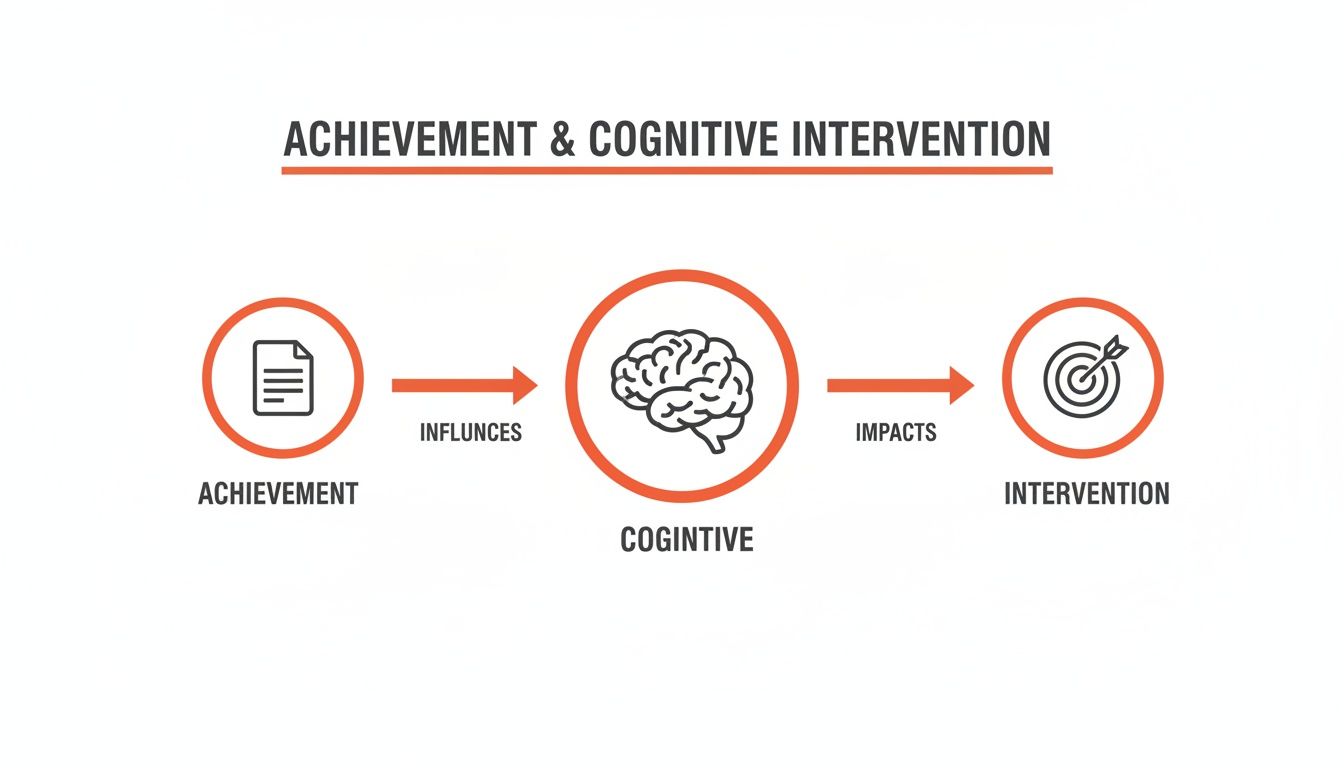
This model shows how it's supposed to work: achievement data points to a need, cognitive assessment explains the why behind it, and a targeted intervention is developed based on both. Ultimately, ethical practice is about using these powerful tools with care, ensuring they always serve the best interests of the learner.
Your Questions, Answered
For parents and educators alike, the world of individual achievement tests can feel a little mysterious. Let's clear up some of the most common questions and give you the confidence to navigate the process.
How Is an Achievement Test Different from a School Test?
Think of it this way: a typical school test is like a pop quiz on a single chapter of a book—say, fractions in math. It checks what a student has learned in the last few weeks.
An individual achievement test, on the other hand, is like assessing how well they've understood the entire story so far. It's a broad, standardized measure of everything they've learned in core subjects, comparing their skills to a national sample of their peers. It's about the big picture, not just a recent snapshot.
How Long Does an Individual Achievement Test Take?
There's no single answer, as it really depends on the specific test and how many areas we're exploring. A comprehensive assessment can take anywhere from 90 minutes to three hours. Don't worry, it's almost always broken up into shorter, more manageable sessions to keep your child focused and prevent them from getting tired.
Remember, the goal of these tests isn't speed but precision. The one-on-one format allows the examiner to observe a student's problem-solving strategies and work habits, providing qualitative insights that go beyond the final score.
Can My Child Prepare for an Achievement Test?
Because these tests measure knowledge built up over years, you can't really "cram" for them. The best preparation has already been happening through consistent schoolwork and regular reading.
Honestly, the most important thing you can do is make sure your child is well-rested and has a good breakfast on test day. That way, they can walk in feeling their best and show what they truly know.
How Often Should a Student Be Tested?
As a rule of thumb, re-testing every one to three years is a good cadence. This gives enough time to see real academic growth but is frequent enough to catch any areas where progress might be stalling, allowing us to adjust educational strategies.
The exact timing often comes down to school policies or the specific requirements of an Individualized Education Program (IEP).
Ready to connect achievement data with underlying cognitive skills for a truly complete picture? Orange Neurosciences provides the tools to move from assessment to actionable, evidence-based intervention. Learn how our platform can support your students or clients today.
Orange Neurosciences' Cognitive Skills Assessments (CSA) are intended as an aid for assessing the cognitive well-being of an individual. In a clinical setting, the CSA results (when interpreted by a qualified healthcare provider) may be used as an aid in determining whether further cognitive evaluation is needed. Orange Neurosciences' brain training programs are designed to promote and encourage overall cognitive health. Orange Neurosciences does not offer any medical diagnosis or treatment of any medical disease or condition. Orange Neurosciences products may also be used for research purposes for any range of cognition-related assessments. If used for research purposes, all use of the product must comply with the appropriate human subjects' procedures as they exist within the researcher's institution and will be the researcher's responsibility. All such human subject protections shall be under the provisions of all applicable sections of the Code of Federal Regulations.


© 2026 by Orange Neurosciences Corporation