A Clinician's Practical Guide to the Montreal Cognitive Assessment Test PDF
Mar 21, 2026
If you're hunting for a Montreal Cognitive Assessment test PDF, you’ve probably realized it's not something you can just download from a quick search. And that’s by design. The official test is only available to healthcare professionals and researchers who go through a mandatory certification. This keeps the MoCA a reliable clinical screener by ensuring it’s used correctly and ethically.
How to Ethically Access the MoCA Test PDF
Getting your hands on a legitimate MoCA test PDF isn't about finding the right link; it’s about completing the required training. Since late 2019, the test's creators have made certification mandatory for any professional use. This isn't just a hoop to jump through—it's what ensures clinicians and researchers like us can administer and score the assessment accurately and consistently.
The whole process is managed through the official MoCA website. You’ll need to register for an account and then complete their one-hour training and certification module. It might sound like a bit of a hurdle, but it’s a necessary step to maintain the test's high standards.
The Mandatory Certification Process
From my own experience, the certification is quite direct. A practical tip is to double-check you’re on the right registration portal, as they have different paths for clinical, academic, and commercial use. Once you're in, the training module gives you a solid walkthrough of the administration and scoring rules, which are non-negotiable for getting reliable results.
This requirement was brought in to protect the integrity of the test itself. Without everyone following the same script, results could be all over the place, which could lead to a serious misinterpretation of someone's cognitive health.
The MoCA was developed in Montreal, Quebec, by Dr. Ziad Nasreddine back in 1996 and quickly became a go-to screener for mild cognitive impairment (MCI). Its power was clear in the original validation study: cognitively healthy controls scored an average of 27.4, while people with MCI averaged 22.1, and those with Alzheimer's disease averaged just 16.2.
What You Get After Certification
Once you pass the training, you unlock the full official MoCA test PDF packet. It’s not just a single form but a suite of documents you'll need.
After you're certified, you'll have access to a few different MoCA versions. Choosing the right one depends on your specific clinical situation. This table breaks it down to help you decide quickly.
Which Official MoCA Version Do You Need?
Version | Primary Use Case | Key Features |
|---|---|---|
MoCA Version 1 | Initial screening for a new patient. | The standard, most widely used version of the test. |
MoCA Version 2 | Re-testing a patient to monitor changes over time. | Different questions to reduce the chance of a patient remembering answers. |
MoCA Version 3 | Subsequent follow-up testing after Version 2 has been used. | Provides another unique set of questions to further minimize practice effects. |
Having these alternate versions is absolutely crucial for tracking a patient's cognitive function over months or years without their scores being inflated simply because they remember the test.
Here’s what else you'll get in your download packet:
Administration Instructions: A detailed guide on how to present each task, what prompts you can and can't use, and how to time sections like the delayed recall.
Scoring Sheets: The official scoring sheets that lay out exactly how to award points across all cognitive domains, making sure your scoring is consistent with global standards.
Starting with the official certification is the only compliant way to use the MoCA. It ensures you’re not just using a valid copy, but that you're also fully equipped to use it properly. For more information, please visit our website or get in touch with our team. And while the paper PDF is a powerful tool, it's also worth knowing about its digital counterparts. For more on that, take a look at our guide on finding the MoCA test online for free.
So, you've gone through the proper channels and now have the official MoCA PDF. That's the first step. Now comes the real work: administering the assessment correctly.
Getting a valid score hinges on a smooth, standardized delivery. Think of it less like a script and more like a carefully controlled experiment. Let’s walk through the core parts of the assessment, and I’ll share some actionable tips to handle common bumps in the road and keep your process consistent every single time.
First things first: the environment. This is non-negotiable. You need a quiet, private space where interruptions are not going to happen. I’ve seen assessments derailed by a phone ringing or someone walking into the room.
Imagine you're testing a 72-year-old who already seems a bit on edge. A calm, comfortable setting can make all the difference, giving you a much truer picture of their cognitive baseline. As a practical step, always tell them upfront: "This is a series of short tasks to check on different thinking skills. It will only take about 10-15 minutes, and there are no trick questions." This framing can significantly reduce anxiety.
This is the official, straightforward path to getting your hands on the MoCA test PDF.
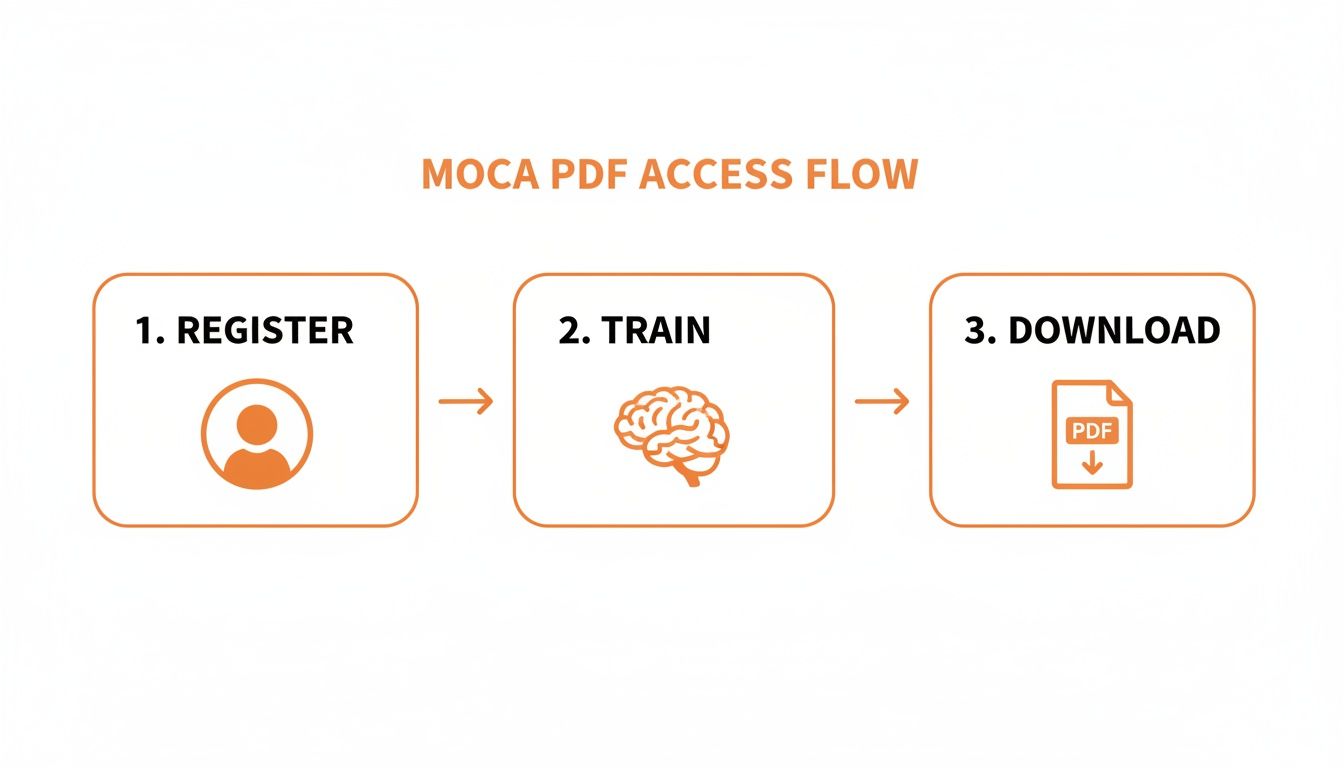
The whole process, from registration to download, is built to make sure every single person using the test is properly trained and knows the rules.
Navigating the Core Cognitive Domains
Each part of the MoCA looks at a different cognitive function. Your job is to give crystal-clear instructions without giving away the answers, even accidentally.
Visuospatial and Executive Function: This is where you find the classic cube copy and the clock-drawing task. A really common mistake here is scoring the clock too generously. For full points, all three parts—the contour, the numbers, and the hands—have to be spot on. Be precise with your scoring and resist the urge to offer vague praise like "good job," which they might take as a sign they're correct.
Naming: This part feels simple, but stick to the script. The person needs to identify the lion, rhinoceros, and camel without you providing any phonetic cues.
Memory: This is a big one. After you read the five words, you need to wait for them to repeat the list back to you before you go any further. They don't get points for this immediate recall, but it's essential for setting up the delayed recall later on. The key is to say, "I am going to read a list of words that you will have to remember now and later on. Listen carefully. When I am through, tell me as many words as you can remember," and then you absolutely cannot repeat the words.
Attention, Language, and Abstraction
These tasks demand focus and the ability to work with information mentally. The way you phrase your instructions is everything.
For the serial 7s subtraction, you’ll say: "Now, I am going to ask you to do some subtractions. I want you to start at 100 and subtract 7, and then keep subtracting 7 from your answer until I tell you to stop." It’s important to note any wrong answers, but let the person keep going from their new number. For instance, if they say "93, 85," you mark the error at 85 but score their next subtraction based on them starting from 85.
You need that same level of precision for sentence repetition and verbal fluency. When you ask for words that start with the letter 'F', give them exactly 60 seconds and stop them right on time. Then, just count the number of unique, valid words they came up with.
Proper administration is not just about following a script; it’s about creating a standardized environment that allows for an individual's true cognitive abilities to be measured. Consistency across every test is what makes the results clinically valuable.
Delayed Recall and Orientation
Delayed recall is often the most sensitive part of the test for picking up on memory issues. You'll ask for the five words you gave them at the start, but—and this is crucial—don't give any hints or category cues at first. If they can't remember a word, then you can offer a category cue (e.g., "one of the words was a type of fabric").
Finally, there’s orientation, which checks their awareness of time and place. Ask for the date, month, year, day of the week, place, and city. Every correct answer gets one point.
For a deeper dive into these steps, our detailed guide on the Montreal Cognitive Assessment instructions breaks down the phrasing even further. And if your workflow involves sending the completed MoCA test or results to another professional, knowing how to fax a PDF can be a surprisingly useful skill to streamline the process.
Nailing these small details in administration will give you the confidence to run the assessment smoothly, which ultimately leads to results that are more reliable and easier to stand by.
Getting the MoCA Score Right: From Numbers to Nuance
Administering the Montreal Cognitive Assessment properly is only half the battle. The real clinical magic happens in the scoring, where raw answers on the Montreal Cognitive Assessment test PDF are translated into genuine cognitive insight. It’s about looking beyond the final number to see the full picture.
So, let's walk through how points are actually awarded and, more importantly, what those points are telling you.
A Closer Look at the Point System
The MoCA is scored out of a possible 30 points. While a score of 26 or higher is generally seen as falling within the normal range, the total score is really just the starting point of your analysis.
Here’s how the scoring breaks down for a few key tasks:
Cube Copy (1 point): The drawing has to be three-dimensional. Every line must be there, relatively parallel, and with no extras. Precision is everything; if it looks flat or disorganized, it gets zero.
Clock Draw (3 points): This one carries a lot of weight. To get all three points, the patient needs to draw the circular contour (1 point), place all the numbers correctly (1 point), and set the hands to the right time (1 point). A mistake in any one of these areas costs that specific point.
Animal Naming (1 point): The task is to name 11 or more animals within 60 seconds. Naming ten or fewer scores a zero. Simple as that.
Delayed Recall (up to 5 points): This is scored first without any cues. You give one point for each of the five words they can recall on their own.
One of the most critical—and often overlooked—steps is the adjustment for education. If a person has 12 years or less of formal education, you must add one point to their total score. This isn't just a minor tweak; it’s essential for preventing a misclassification based on educational background rather than true cognitive decline.
Looking Beyond the Final Score
Analyzing the scores domain by domain is where you’ll find the most valuable information. Recent Canadian normative data really drives this home, showing how much factors like education and age can predict performance. For instance, having under 12 years of education has a -4.38 adjusted impact on expected scores, whereas having 18+ years provides a +2.49 boost. This context is vital for interpreting the MoCA equitably.
Let's look at a couple of real-world scenarios to see how this plays out in a clinical setting.
The goal of scoring isn't just to arrive at a number. It's to understand the pattern of cognitive strengths and weaknesses. A score of 24 can mean very different things for two different people.
Patient Profile A: A Flag for Emerging MCI
Meet Robert, a 74-year-old who scores 23/30. At a glance, this points toward mild cognitive impairment. But let’s dig a bit deeper into his performance:
Visuospatial/Executive: 3/5 (He struggled with the cube and placing the clock hands.)
Memory/Delayed Recall: 1/5 (He only recalled one word without prompting.)
Attention: 5/6 (Just a minor slip-up on the serial subtractions.)
Language & Abstraction: His scores here were excellent.
Actionable Insight: Robert’s profile clearly shows a weakness in memory and executive function, even though his language skills are sharp. This specific pattern is a classic indicator of emerging MCI and absolutely warrants a more thorough neurological follow-up. This is the point to document his profile and refer for more comprehensive testing.
Patient Profile B: Cognitively Healthy with a Caveat
Now, let's consider Susan, who is 68 and has 11 years of education. Her raw score was 25/30. After we apply the one-point educational adjustment, her final score becomes 26/30.
Visuospatial/Executive: 5/5
Memory/Delayed Recall: 4/5
Attention: 4/6 (She lost points on digit span backwards and vigilance.)
Language & Abstraction: Perfect scores.
Actionable Insight: Susan’s final score puts her in the normal range. Her main difficulties were in the attention domain, which could easily be linked to test anxiety or fatigue, rather than a decline in memory or executive function. Your action here is to note this in her file, perhaps ask about sleep or stress, and schedule a routine follow-up rather than an urgent neurological referral.
These examples highlight why analyzing performance across domains is so important—it gives you a much richer, more actionable clinical picture. For a more exhaustive guide on each task's point system, you might find our dedicated article on MoCA test scoring helpful. Mastering these details is how you move from simply collecting data to making truly informed clinical judgments.
Navigating MoCA Copyright and Licensing Rules
When it comes to using the Montreal Cognitive Assessment, understanding the rules around the test PDF is non-negotiable. It’s a matter of ethical and legal practice. The world of copyright and licensing can feel a bit tangled, but once you break it down, staying compliant is straightforward—and it protects your professional integrity.
The biggest change came when the MoCA transitioned from a freely available tool to one requiring mandatory training and certification. This wasn't just red tape; it was a necessary step to ensure that anyone administering the test is actually qualified to do it right. This preserves the test's validity as a reliable screener.
At the end of the day, this is about ensuring your clinical judgment rests on a solid foundation. If you're using an old, unauthorized PDF you found online years ago, you're not just violating copyright. You're also running the risk of using an outdated version, which could lead to flat-out wrong clinical conclusions.
Academic Research vs. For-Profit Clinical Use
How you plan to use the MoCA test PDF really matters, as the licensing requirements are completely different. The creators have set up distinct pathways for academic, non-profit, and commercial groups.
Academic and Non-Profit Use: If you're a clinician or researcher at a university, public hospital, or another non-profit, you'll typically pay a per-user annual fee after you complete the mandatory certification. This licence covers clinical care and non-funded research.
Commercial For-Profit Use: This is the category for anyone in a private practice, a private rehabilitation centre, or any for-profit company. It also applies to contract research organizations (CROs) and pharmaceutical companies using the MoCA in clinical trials.
The distinction is critical. You can't use the test under an academic licence for commercial work—that's a direct violation of the terms of use.
A Practical Scenario for a Private Clinic
Let's walk through a situation I see all the time. Imagine you run a small, private psychology clinic. You want to bring the MoCA into your standard workflow for screening adult patients.
First, you have to recognize that your clinic is a for-profit entity. This means you’re on the hook for a commercial licence. It's not enough for one clinician to get certified and then pass the PDF around the office; every single person administering the test must be individually certified and covered by the licence.
Here’s your actionable checklist:
First, identify every clinician in your practice who will be giving the MoCA.
Next, each of those clinicians must go to the official MoCA website, register, and complete the one-hour training and certification module.
Finally, contact MoCA's representatives to purchase the right commercial use licence for your clinic, making sure it covers all your certified users. This usually involves an annual fee based on the number of people using it.
A common pitfall for private practices is assuming that certification alone is enough. For any for-profit work, certification is the prerequisite, but the commercial licence is the mandatory second step for legal and ethical compliance.
Trying to cut corners here can expose your practice to serious legal risks and undermine the professional standard of care you promise your patients. Taking the time to get this right is a fundamental part of responsibly using the Montreal Cognitive Assessment test PDF.
If you’re trying to figure out how different types of assessments fit into your practice, have a look at our guide on various cognitive tests available online for a broader perspective.
When to Go Beyond the PDF with Digital Assessments
The Montreal Cognitive Assessment test PDF is a staple in clinics everywhere, and for good reason. It’s a trusted, reliable screener that has become the gold standard for flagging potential cognitive concerns. But as any experienced clinician knows, sometimes a static paper test just doesn't give you the full story.
That’s exactly when digital cognitive assessments, like the platform we’ve built at Orange Neurosciences, can make all the difference. Let's look at the real-world situations where moving beyond paper can lead to deeper insights and better care.
For Tracking Subtle Changes Over Time
One of the most important jobs we have is tracking a patient’s cognitive health from one appointment to the next. The MoCA is fantastic for this, especially with its alternate versions that help minimize practice effects. It's built for repeated screening.
In fact, Canadian research has shown just how reliable the MoCA is for this. One study followed individuals over 3.5 years and found that a group with Mild Cognitive Impairment (MCI) saw their average scores drop by -1.83 points. In contrast, cognitively healthy individuals only changed by -0.62 points. With 42% of MCI cases showing a meaningful decline, the test’s value for tracking progression is clear.
But what if you need more detail? A practical example is a patient whose MoCA score remains stable at 24/30, but they report feeling "slower." Digital platforms can pick up on changes that are almost impossible to spot with pen and paper, like a 200-millisecond increase in processing speed. This kind of precision is incredibly valuable when you're trying to see if a treatment is working or simply understand the natural course of a condition.
For Engaging Younger or Anxious Patients
Let’s be honest: formal testing can be intimidating. For kids, or for any patient dealing with anxiety, the clinical feel of a paper test can be a real barrier. I've seen it firsthand—a patient’s anxiety can affect their performance so much that the score doesn't reflect their true abilities.
This is where gamified digital assessments completely change the dynamic.
By turning cognitive tasks into engaging, interactive games, we can create an experience that feels less like a test and more like a challenge. This lowers the stress level and often gives us a much more accurate and representative picture of a person's cognitive function.
Imagine a paediatrician working with a child who has trouble focusing. A standard paper test might lose their interest in minutes. A game-based digital assessment, on the other hand, can measure their attention and executive function while keeping them locked in and engaged.
For Moving Beyond a Simple Score
A score of 24/30 on the MoCA is a critical piece of information, but it doesn't tell you the why. A digital platform, however, provides a level of data that goes far beyond a single number.
Instead of just knowing a patient lost points, you can see:
Heatmaps that show precisely where they struggled on a visuospatial task.
Response Times that measure processing speed for each answer.
Error Patterns that help identify specific issues, like impulsivity or perseveration.
This multi-layered data gives you a much richer, more nuanced understanding of a patient's cognitive profile. For clinicians looking to streamline their analysis of written reports, it’s even possible to use tools that AI summarize PDF documents to quickly distill key findings.
Making the Right Choice: Paper vs. Digital
Deciding between a paper screener and a digital assessment really comes down to what you need to accomplish for your patient. The MoCA PDF is an unbeatable tool for quick, reliable, first-line screening. It's fast, validated, and familiar.
But for deeper analysis, longitudinal tracking, or for specific patient groups, a digital solution might be the better choice. To help illustrate this, here’s a quick comparison of the two approaches.
Paper Screening vs Digital Assessment
Feature | MoCA Test PDF | Orange Neurosciences Platform |
|---|---|---|
Primary Use | Rapid, first-line cognitive screening | In-depth assessment, longitudinal tracking |
Data Output | Single overall score (e.g., 25/30) | Multi-layered data (response times, error patterns, heatmaps) |
Patient Experience | Formal, clinical test format | Gamified, engaging, and less intimidating |
Administration | In-person, requires trained administrator | Remote or in-person, often self-administered |
Precision | Detects significant cognitive changes | Measures subtle changes in speed and accuracy to the millisecond |
Best For | Routine check-ups, initial screening | Monitoring treatment, complex cases, anxious patients, research |
Ultimately, both tools have a place in modern clinical practice. The key is knowing when to stick with the trusted standard and when to embrace the deeper insights that a digital platform can offer.
For more perspectives on this choice, our guide on cognitive assessment online is a great resource. If you're interested in seeing how Orange Neurosciences can help you integrate objective, precise digital cognitive tools into your practice, we’re here to help. Contact us to learn more or to see a demo of our platform in action.
Your Top Questions About the MoCA Test Answered
Over the years, I've seen a lot of the same questions pop up about the Montreal Cognitive Assessment—everything from how to use it day-to-day to how it stacks up against other screeners. Let's dig into some of the most common ones and get you the clear, practical answers you need for those tricky clinical moments.
Can I Use an Old MoCA PDF I Downloaded Years Ago?
I get this question a lot, and the answer is a firm no. If you have an old, non-certified Montreal Cognitive Assessment test PDF sitting on your hard drive from before the rules changed, using it is a major ethical and legal misstep. Since 2019, official certification has been mandatory for any professional use.
Actionable Insight: The only ethical path forward is to delete any old PDFs and go through the official certification process. This not only makes you compliant but also ensures you're using the most up-to-date version of the test, protecting your patients and your professional license.
What Is the Real Difference Between the MoCA and the MMSE?
While both are common screeners, the MoCA and the Mini-Mental State Examination (MMSE) serve different purposes, especially when you suspect Mild Cognitive Impairment (MCI). The MMSE is an older tool, and its major drawback is a "ceiling effect"—many people with subtle cognitive issues can still score within the normal range, causing you to miss an early diagnosis.
The MoCA was built specifically to solve that problem. It digs deeper into higher-level executive functions, which are often the first to show signs of trouble in MCI.
Executive Function: The MoCA’s trail-making, verbal fluency, and abstraction tasks are totally absent in the MMSE. These are absolutely critical for catching early executive dysfunction.
Visuospatial Skills: The MoCA includes a cube copy and a more detailed clock-drawing task. These are far more sensitive to visuospatial issues than the MMSE’s simple intersecting pentagons.
Sensitivity: Study after study has confirmed the MoCA is significantly more sensitive in detecting MCI. Its original validation study clearly showed it could distinguish between healthy older adults and those with MCI.
Actionable Insight: If a patient expresses concern about their memory but scores a 29/30 on the MMSE, don't stop there. Administer the MoCA. It is far more likely to pick up the subtle executive or memory deficits characteristic of early MCI that the MMSE often misses.
While both tests have their place, relying solely on the MMSE might cause you to miss an early window for intervention. The MoCA's focus on complex cognition makes it a more robust screener for MCI.
How Often Can I Retest a Patient with the MoCA?
Longitudinal tracking is key, but you have to be smart about it. If you retest too often with the same version, you'll run into "practice effects," where a patient's score goes up just because they remember the test, not because their cognition has actually changed.
The creators of the MoCA knew this and created alternate versions to get around it. For reliable, long-term monitoring, you absolutely need to cycle through them.
Initial Test: Always start with Version 1 for a baseline screening.
Follow-Up: When it's time to retest, switch to Version 2 or Version 3. This is the only way to be sure you're measuring genuine cognitive change.
Testing Interval: A good rule of thumb is to retest annually for routine monitoring. If you're tracking progress after a specific intervention or dealing with a more rapid decline, you might shorten that to every six months.
Imagine you're monitoring a 78-year-old patient with an MCI diagnosis. You'd use MoCA Version 1 for their baseline. Six months later, you would use Version 2 to see their trajectory. This gives you a much more accurate picture of their cognitive health over time, which is essential for making informed decisions about their care. Using the alternate versions of the Montreal Cognitive Assessment test PDF isn't just a good idea—it's the standard of care.
At Orange Neurosciences, we understand the need for precise, reliable cognitive data. While the MoCA is an excellent screener, our AI-powered platform provides deeper, objective insights to complement your clinical judgment, offering detailed reports on multiple cognitive domains. Explore how our tools can support your practice at https://orangeneurosciences.ca.

Orange Neurosciences' Cognitive Skills Assessments (CSA) are intended as an aid for assessing the cognitive well-being of an individual. In a clinical setting, the CSA results (when interpreted by a qualified healthcare provider) may be used as an aid in determining whether further cognitive evaluation is needed. Orange Neurosciences' brain training programs are designed to promote and encourage overall cognitive health. Orange Neurosciences does not offer any medical diagnosis or treatment of any medical disease or condition. Orange Neurosciences products may also be used for research purposes for any range of cognition-related assessments. If used for research purposes, all use of the product must comply with the appropriate human subjects' procedures as they exist within the researcher's institution and will be the researcher's responsibility. All such human subject protections shall be under the provisions of all applicable sections of the Code of Federal Regulations.


© 2026 by Orange Neurosciences Corporation