A Clinician's Guide to MoCA Test Scoring
Jan 21, 2026
Getting the MoCA test scoring right is the bedrock of its clinical value. It’s what turns a quick 10-minute assessment into a powerful piece of data for spotting cognitive changes. But this isn't just about adding up numbers. It requires sticking to the standardized rules for both giving the test and scoring it, making sure every mark truly reflects a patient's cognitive state.
Why Precise MoCA Test Scoring Matters

Any screening tool is only as good as the clinician behind it. The Montreal Cognitive Assessment (MoCA) is a fantastic instrument for identifying mild cognitive impairment (MCI), but its value hinges entirely on precise, consistent scoring. Even small slip-ups can lead to a false positive—causing a lot of unnecessary worry for a patient—or a false negative, which could delay critical care.
The real strength of the MoCA is its ability to look at multiple cognitive areas at once. It gives us a much richer picture than older screeners by evaluating distinct brain functions.
Let's quickly break down what the MoCA looks at. This table gives a high-level view of the cognitive domains, their point values, and why each one is important in a clinical context.
Quick Overview of MoCA Scoring Domains
Cognitive Domain | Maximum Points | What It Assesses |
|---|---|---|
Visuospatial/Executive | 5 | Planning, organization, and visual perception. |
Naming | 3 | Basic language function through animal identification. |
Memory | 0 (Recall is scored later) | Immediate recall, a key part of the memory assessment. |
Attention | 6 | Concentration and working memory (e.g., digit spans). |
Language | 3 | Complex language skills like sentence repetition. |
Abstraction | 2 | Conceptual thinking and identifying relationships. |
Delayed Recall | 5 | A very sensitive marker for MCI, testing long-term recall. |
Orientation | 6 | Awareness of time, place, and person. |
Each of these domains contributes to a fuller understanding of a person's cognitive health, which is why accurate scoring across the board is so vital.
The Clinical Impact of Accuracy
Every single point on the MoCA matters. The final score helps guide major clinical decisions. While a score of 26 or higher is generally considered normal, the real story is often in the details of how a person got that score.
Proper MoCA scoring is absolutely crucial for catching cognitive decline early. It helps us pick up on the subtle early signs of dementia. Just misinterpreting one response could be enough to push a patient’s score into a different category, which affects everything that follows, from diagnostic workups to treatment plans. For example, incorrectly giving a point for a poorly drawn clock might push a score from 25 (potential MCI) to 26 (normal), preventing a necessary follow-up.
This is exactly why so many clinicians prefer the MoCA. It has shown incredible sensitivity, boasting a 90% detection rate for MCI. For comparison, the older Mini-Mental State Examination (MMSE) only catches about 18% of cases. You can read more about its validation on the official MoCA website. That massive difference really drives home why mastering MoCA scoring isn’t just a technical skill—it’s a clinical responsibility.
Setting the Stage for Accurate Administration
Before you even think about scoring the MoCA, the groundwork for an accurate result has already been laid—or not. The final score is only as reliable as the administration itself. Getting this part right is about more than just finding a quiet room; it’s about creating a controlled environment where the patient can truly show you what they can do, without interference.
Think of it like this: you wouldn't take someone's blood pressure right after they’ve run up a flight of stairs. In the same way, you can't get a trustworthy cognitive score in a chaotic setting. Every little distraction, from a phone ringing down the hall to a TV murmuring in the next room, can pull a person's focus and artificially drag down their score.
Eliminating Hidden Variables
Your goal here is to standardize the experience, making it as consistent as possible for every single patient you see. This consistency is your best defense against skewed results that lead to the wrong clinical conclusions. When the environment and instructions are the same every time, you can feel confident that the score reflects cognition, not just a noisy clinic.
One of the trickiest things to manage is unintentional cueing. As clinicians, our instinct is to be encouraging, but even small, well-meaning gestures can accidentally guide a patient and invalidate their response.
Watch out for these common habits:
Subtle Nodding: This can signal that a patient is on the right track, giving them confirmation they aren't supposed to have.
Changing Your Tone: A shift in your vocal inflection can easily hint at whether an answer is correct or incorrect.
Rephrasing Questions: It might feel helpful, but changing the wording deviates from the script and turns it into a different task than the one used to establish the norms. For example, instead of "Tell me the name of this animal," saying "What do you call this big cat?" is an invalid cue.
The core principle is simple: administer the test exactly as it was designed and validated. Any deviation, no matter how small or well-intentioned, introduces a variable that compromises the reliability of the score. Following the official script isn’t just a recommendation—it’s a requirement for accuracy.
Your Pre-Assessment Checklist
Running through a quick checklist before you begin is a great habit. It helps prevent the common oversights that can throw off an entire assessment. Before you start, just take a moment to confirm a few key things.
Essential Pre-Test Checks:
Sensory Aids: Does the patient have their glasses or hearing aids if they need them? And are they actually working? It’s amazing how often this gets missed. A patient can’t draw a clock they can’t see clearly.
Patient Comfort: Is the patient comfortable? Simple things like needing to use the restroom or being in pain can have a huge impact on concentration.
Clear Understanding: Have you briefly explained the purpose of the assessment in simple terms? A quick, reassuring explanation can lower anxiety. I often say something like, "We're going to do a few brief activities to check on different parts of your thinking, like memory and concentration."
Following standardized procedures is non-negotiable. If you need a refresher on the precise language and steps, reviewing detailed Montreal Cognitive Assessment instructions is the best way to sharpen your skills and ensure every test you administer is on point.
This careful preparation does more than just ensure you get good data; it also builds trust. A calm, professional, and standardized approach helps put patients at ease, allowing them to perform at their best. When you control the environment and your own actions, you create the optimal conditions for a MoCA score you can truly stand behind.
Getting Into the Weeds: Item-by-Item Scoring
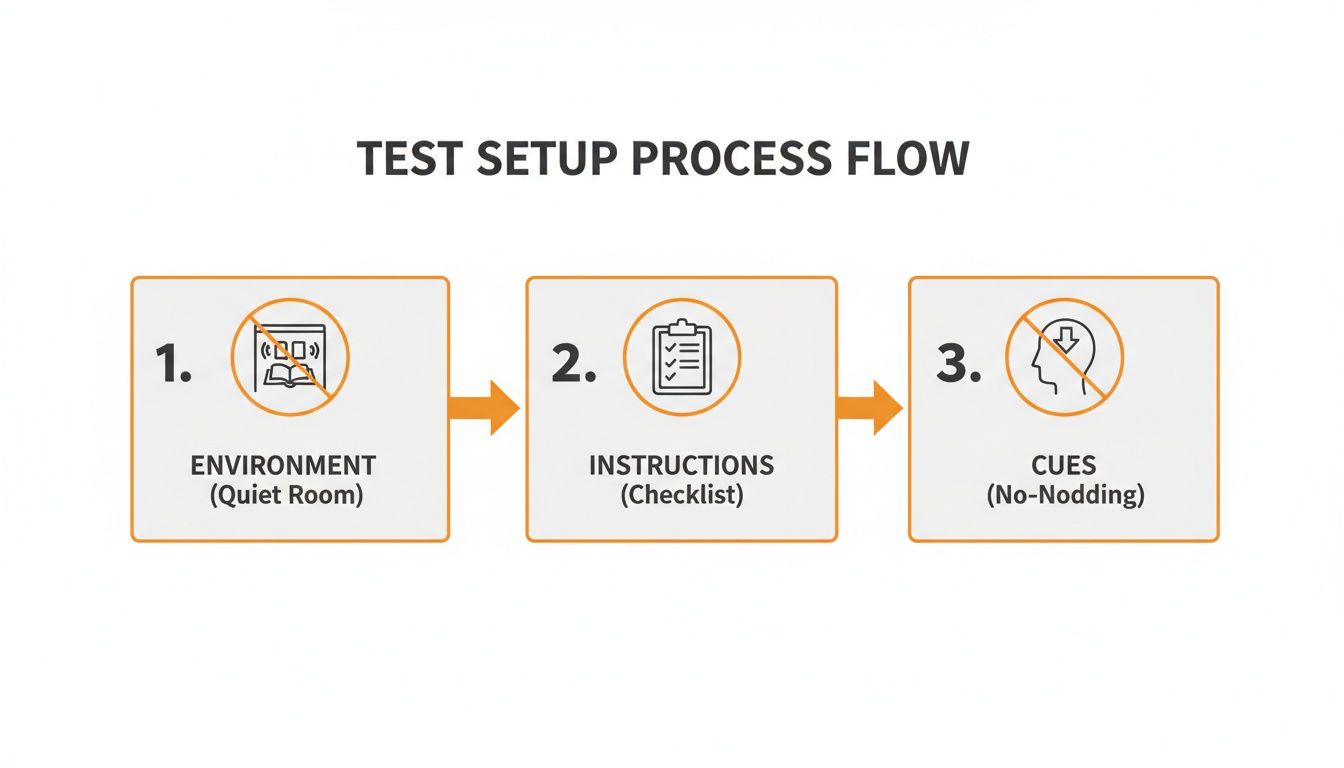
Before you even start scoring, getting the setup right is half the battle. This simple flow—quiet room, clear instructions, no hints—is your foundation. Following these basics ensures the responses you get are valid, making your MoCA test scoring something you can actually stand behind.
The real skill, though, comes in when a patient's answer isn't a clean "correct" or "incorrect." This is where knowing the scoring rules inside and out separates the novice from the expert. It’s not about rote memorization; it's about understanding the intent behind each point so you can handle those tricky, ambiguous responses with confidence.
Let's break down each task and shine a light on the common grey areas you'll definitely run into.
Visuospatial and Executive Functions
This first major section is worth five points and is a frequent source of scoring headaches. These tasks look at a whole range of skills, from connecting dots in a sequence to sketching a 3D cube and drawing a clock.
The Alternating Trail Making task is pretty clear-cut: one point if the sequence is right and no lines cross. Simple. The cube drawing, however, is where subjectivity creeps in.
Cube Drawing (1 point): You can only award the full point if the drawing is clearly three-dimensional, has all the right lines, and no extra ones. The lines should be more or less parallel, and their lengths should be similar. A classic mistake is giving a point for what looks like two overlapping squares without proper connecting lines—that’s a clear 0.
The clock drawing is the most complex item here, worth a total of three points for three separate elements.
Contour (1 point): The circle needs to be mostly round and fully closed. If there's a big gap or it’s a badly misshapen oval, no point is awarded.
Numbers (1 point): All 12 numbers have to be there, with no repeats. They should be in the right order and placed in the correct quadrants. A patient who writes the numbers outside the circle, for example, doesn't get this point.
Hands (1 point): There must be two hands, one obviously longer than the other, pointing to 11:10. Crucially, the hands have to start from the centre of the circle.
One of the most telling errors is "number crowding," where a patient squishes all 12 digits into one-half of the clock face. Even if every number is present, this signals a significant planning deficit and means you have to score 0 for the "Numbers" component.
Naming and Memory
The Naming section is usually straightforward. It's worth three points, and the patient gets one point for each correctly identified animal (lion, rhinoceros, camel). Don't penalize for self-corrections; if they fix it, they get the point.
The Memory task, on the other hand, is a common source of confusion for new assessors. Remember: no points are awarded at this stage. You read a list of five words, the patient repeats them, and you just tick off the ones they got. This is purely to set a baseline for the delayed recall task later on.
Proper administration is key. Read the words at a steady pace of one per second. If they don't get all five on the first go, you read the list a second time. This process is vital for the delayed recall score, but it gives you zero points right now.
Attention and Concentration
This section hits several different aspects of attention and is worth a total of six points. It’s a mix of forward and backward digit spans, a vigilance task (tapping for the letter "A"), and the classic serial 7s subtraction.
Digit Span Forward (1 point): They have to repeat the sequence exactly as you said it.
Digit Span Backward (1 point): They must repeat the numbers in perfect reverse order.
Vigilance (1 point): The point is awarded for zero or one error. An error could be missing an "A" or tapping on the wrong letter. If they make two or more errors, the score is 0.
Serial 7s (3 points): This is where scoring can get tricky. Points are based on the number of correct subtractions starting from 100.
3 points: 4 or 5 correct subtractions.
2 points: 2 or 3 correct subtractions.
1 point: 1 correct subtraction.
0 points: No correct subtractions.
A frequent issue is when a patient makes a mistake early on but keeps subtracting correctly from their new, incorrect number (e.g., "93, 85, 78..."). In this scenario, only the first subtraction ("93") is correct. Every subtraction after that has to be the right value from the previous correct number in the sequence, not their mistake. For a deeper dive into the brain functions these tasks assess, our guide on the definition of cognitive skills is a great resource.
The table below covers a few common situations and the standardized way to handle them.
Common Scoring Scenarios and Correct Actions
Patient Response Scenario | Incorrect Scoring Tendency | Correct Scoring Rule |
|---|---|---|
Clock Drawing: Patient draws all numbers but crowds them into one half of the clock. | Awarding 1 point because all numbers are technically present. | Score 0 for "Numbers." This indicates a visuospatial planning deficit. |
Serial 7s: Patient says "93, 86, 79..." continuing to subtract 7 from their error. | Giving partial credit for subsequent correct subtractions from their new number. | Only the first subtraction (93) is correct. All subsequent subtractions must be from the official correct number. |
Delayed Recall: Patient can't recall "VELVET," is cued with "a type of fabric," and then remembers. | Checking the word off as correct because they eventually said it. | Score 0 for this word. Points are only awarded for spontaneous recall without any cues. |
Sentence Repetition: Patient repeats, "I only know that John is the one to help." (omitting "today") | Giving the point because the gist of the sentence is correct. | Score 0. The sentence must be repeated exactly as stated, with no omissions or substitutions. |
Mastering these specific rules is what makes your scoring reliable and standardized.
Language and Abstraction
The Language section tests a patient's ability to repeat sentences and their verbal fluency.
Sentence Repetition (2 points): Each sentence is worth one point and must be repeated perfectly. Any missed word, substituted word, or extra word means a score of 0 for that sentence. There is no partial credit.
Verbal Fluency (1 point): The patient gets one point if they can name 11 or more words starting with the letter "F" in 60 seconds. Proper nouns (like "Frank"), slang, or different forms of the same word (e.g., "friend," "friendly") don't count.
Abstraction looks at conceptual thinking by asking for the similarity between two items (e.g., "train and bicycle"). This is worth two points.
2 points: Both comparisons are correct and abstract (e.g., "means of transportation," "they are both vehicles").
1 point: Only one of the two comparisons is correct.
0 points: The patient gives a concrete answer (e.g., "they both have wheels") or an incorrect one.
Delayed Recall and Orientation
Delayed Recall is often considered one of the most sensitive indicators of mild cognitive impairment. After a delay of about five minutes, you ask the patient to recall the five words from the beginning of the test.
Spontaneous Recall: Award one point for each word they remember without any hints.
Cued Recall: If a patient is stuck, you can offer a category cue (e.g., for "CHURCH," you might say "a type of building"). If they get it with the cue, you tick the "cue" box on the form but award 0 points for that word. Points are only for unprompted recall.
Finally, the Orientation section is worth six points. The patient needs to state the exact date, month, year, day of the week, place (e.g., clinic name), and city. Each correct item earns one point. You have to be strict here; being off by even one day on the date is scored as incorrect. This rigidity is what ensures the test is standardized.
Ultimately, consistent and precise item-by-item MoCA test scoring is the only way to generate a result that truly reflects a patient’s cognitive state.
Interpreting the Final Score with Clinical Insight
Once you’ve carefully tallied the points from each item, you’re left with a single number. But a raw score on its own is just data; the real clinical skill lies in transforming that number into a meaningful insight. This is where you shift from simple scoring to a more sophisticated interpretation, looking at the whole person behind the score.
The first, most crucial step here is making the education adjustment. This is a non-negotiable part of the MoCA test scoring protocol, designed to correct for the known influence of formal education on test performance.
The rule is straightforward: if an individual has 12 years or fewer of formal education, you add one point to their final total score. For example, if a patient with a high school diploma scores a 24, their adjusted final score becomes 25. This simple adjustment helps prevent false positives, giving you a more accurate picture of their cognitive abilities.
Beyond the Standard Cutoff Score
The most widely cited cutoff for the MoCA is a score of 26 out of 30. A score of 26 or higher is generally considered to be within the normal range. But it's a critical error to treat this number as a rigid diagnostic line in the sand. Think of it as a guideline, not a definitive verdict.
Your clinical judgment must always take precedence. A score of 25 in a highly educated professional with a complex job who is now reporting memory issues is far more concerning than the same score in someone with fewer years of education and no reported difficulties. The context is everything.
Normative data from cognitive assessment research clearly shows that MoCA performance is significantly influenced by both age and education. In one large study, the average MoCA score for the entire sample was 23.8 points, and less than half (47.7%) of all subjects scored above the traditional 26-point cutoff. This really underscores that many cognitively healthy individuals may score below 26, highlighting the need for careful, nuanced interpretation. You can explore more about these findings on MoCA performance variables to get a better handle on the data.
A MoCA score is not a diagnosis; it is a single, valuable data point. It should be integrated with the patient's clinical history, presenting concerns, functional status, and observations from the assessment to form a complete clinical picture.
Contextualizing Score Ranges for Clinical Guidance
While the 26-point cutoff is a useful starting point, different score ranges can help guide your clinical reasoning and determine the right next steps. I like to think of these ranges as different levels of a warning signal, each suggesting a different path forward.
Score of 26-30 (Generally Normal): For most individuals, this score is reassuring. However, if there are clear subjective complaints or a known neurological history, you should still consider the pattern of any missed points.
Score of 18-25 (Potential Mild Cognitive Impairment): This is the classic range where we suspect MCI. A score in this zone strongly suggests that a more comprehensive workup is needed to investigate the cause of the cognitive changes.
Score of 10-17 (Suspected Moderate Impairment): Scores in this range often correlate with more significant functional difficulties in daily life. This may suggest a transition from MCI to a mild dementia, warranting a thorough diagnostic evaluation.
Score below 10 (Likely Severe Impairment): This typically indicates a more advanced stage of dementia, where cognitive deficits are profound and easily observable.
For a deeper dive into applying these ranges in practice, our complete guide on MoCA score interpretation provides additional examples and clinical scenarios. This detailed approach helps you move beyond a simple "pass/fail" mentality.
For further insight into the methods of interpreting assessment results, including total scores and subscales, clinicians can refer to resources on other diagnostic tests. The principles of looking at patterns and context often apply across different assessment tools, like when you're interpreting diagnostic test scores and subscales for other instruments.
Ultimately, interpreting the MoCA score is an art grounded in science. It requires you to blend the objective data from the test with the subjective story of the patient. When you see a score of 23, your first thought shouldn't be "MCI," but rather, "What does this 23 mean for this specific person sitting in front of me?" That question is the key to using the MoCA not just as a screener, but as a powerful tool for exceptional patient care.
Uncovering Patterns with Domain Subscores
The total MoCA score gives you a headline, but the real story is often hidden in the subscores. If you stop at the final number, you're missing the valuable clinical patterns that guide your next steps. A total score can even be misleading if you don't break down how the patient arrived at it.
This is where your clinical detective work begins. It involves digging into the scores for each cognitive domain, from Visuospatial/Executive functions to Memory and Language. Doing this lets you move beyond a simple "impaired" or "unimpaired" label and start pinpointing specific areas of cognitive weakness.
From Total Score to Clinical Narrative
Let's walk through a real-world scenario. A patient scores a 23. This total falls squarely in the range for potential mild cognitive impairment (MCI). But what does that 23 truly represent?
A patient who gets a 23 by losing points mainly on attention and executive tasks presents a very different clinical picture than one who aces those but scores a 1/5 on delayed recall. The first might point toward issues with focus or planning, while the second is a massive red flag for an amnestic MCI, a common precursor to Alzheimer's disease.
This is where your expertise comes in. By analyzing the subscores, you can start to form hypotheses. Is the deficit localized or widespread? Does the pattern align with a particular neurological condition?
The Diagnostic Power of Subscores
In my experience, certain subscores carry more weight than others for specific conditions. The delayed recall section, for instance, is notoriously sensitive for memory disorders. This isn't just clinical wisdom; it's backed by solid research.
In studies focusing on MCI, the standard cutoff of ≤25/30 showed reasonable accuracy. However, looking specifically at the delayed recall subscore (≤2/5) demonstrated an impressive 94% specificity, although with lower sensitivity. This tells us that a very poor memory subscore is a powerful indicator, even if the total score is borderline. You can read more in the research on MoCA specificity in MCI patients.
By dissecting the MoCA test scoring into its component parts, you transform a general screening result into a targeted clinical insight. This analysis doesn't give you a diagnosis, but it sharply focuses your differential and informs what you should investigate next.
Practical Steps for Subscore Analysis
After calculating the total score, take a few minutes to group the results by cognitive domain. I find it helpful to just tally the points for each main section right on the MoCA form itself.
Visuospatial/Executive (Max 5 points): How did they do on the cube, clock, and trail-making task? Low scores here can signal frontal lobe difficulties. For a more detailed look, check out our guide on how to test for executive dysfunction.
Language (Max 3 points): Was there a struggle with sentence repetition or verbal fluency? This could point to a primary language disorder or aphasia.
Attention (Max 6 points): Were points lost on digit span, vigilance, or serial 7s? This could suggest attention deficits that may be impacting other cognitive functions.
Delayed Recall (Max 5 points): This is often the most critical subscore. A score of 0 or 1 here is always a cause for concern, regardless of the total score.
This focused approach helps you write much more informative clinical notes and make more specific recommendations. Instead of just stating "MoCA score is 22," you can document "MoCA score is 22, with significant deficits noted in delayed recall (0/5) and executive function (2/5), suggesting an amnestic and dysexecutive profile." This level of detail provides a much clearer rationale for follow-up testing and care planning.
Common Questions About MoCA Scoring
Even with the official manual in hand, tricky situations pop up when you're administering the MoCA. It happens to everyone. Let's walk through some of the most common questions I hear from clinicians, turning those grey areas into confident, clear-cut decisions.
What if a Patient Refuses to Do a Task?
If a patient simply refuses to try an item, you score it as a zero. It’s perfectly fine to offer a single piece of gentle encouragement—something like, "Why don't we just give it a try?"—but never, ever pressure them.
What's more important is what you do next: document that refusal in your clinical notes. This isn't just an incorrect answer; it's valuable qualitative data. A refusal could signal anything from significant performance anxiety to poor insight into their own deficits. It paints a much richer clinical picture than a simple wrong answer ever could. For instance, noting, "Patient refused clock drawing, stating 'I've never been good at drawing,'" provides crucial context.
Can I Use the MoCA in Other Languages?
Absolutely, but there’s a huge caveat: you must use an official, validated translation. The MoCA has been professionally adapted and normed for dozens of languages, and these versions account for the linguistic and cultural nuances that can throw off item difficulty.
Don't ever try to translate the test on the fly. It completely invalidates the results, as the norms are tied directly to that specific, validated version. To maintain the integrity of your assessment, always download the official language version you need straight from the MoCA website.
The key takeaway here is that standardization is everything. When you use an unvalidated translation or change the instructions, you break that standardization. The final score becomes unreliable and can't be compared against established norms.
How Does the MoCA Compare to Digital Assessments?
The MoCA is a fantastic and trusted screening tool, but it's important to remember it gives you a snapshot of cognition at one specific moment. This is where digital cognitive assessments, like those we've developed at Orange Neurosciences, come in. They offer a much more dynamic and detailed picture.
Digital platforms can provide objective, incredibly precise measurements across a wider range of cognitive domains. They often get the assessment done faster and completely eliminate the chance of manual scoring errors. Some of the biggest advantages include:
Objective Data: Computerized tasks can capture tiny variations in reaction times and subtle performance metrics that are impossible to catch with a paper-and-pencil test.
Longitudinal Tracking: They are perfect for monitoring cognitive changes over time. Since the tasks are dynamic, they are far less susceptible to the practice effects you see with paper tests.
Workflow Integration: Many digital tools can sync directly with electronic health records (EHRs), which is a huge time-saver on the administrative side.
Think of it this way: a digital assessment is a powerful next step when a MoCA screening flags a potential concern. It gives you the deeper insights needed to really sharpen your care plan.
At Orange Neurosciences, we create AI-powered cognitive assessment tools that deliver the kind of precise, objective data needed to support your clinical decision-making. Our platform helps you move beyond a simple screening to a much deeper understanding of your patients' cognitive health.
Find out more about how our solutions can enhance your practice by visiting https://orangeneurosciences.ca. For specific questions or to request a demo, please email us at info@orangeneurosciences.ca. We’re here to help you integrate the next generation of cognitive assessment into your clinical workflow.
Orange Neurosciences' Cognitive Skills Assessments (CSA) are intended as an aid for assessing the cognitive well-being of an individual. In a clinical setting, the CSA results (when interpreted by a qualified healthcare provider) may be used as an aid in determining whether further cognitive evaluation is needed. Orange Neurosciences' brain training programs are designed to promote and encourage overall cognitive health. Orange Neurosciences does not offer any medical diagnosis or treatment of any medical disease or condition. Orange Neurosciences products may also be used for research purposes for any range of cognition-related assessments. If used for research purposes, all use of the product must comply with the appropriate human subjects' procedures as they exist within the researcher's institution and will be the researcher's responsibility. All such human subject protections shall be under the provisions of all applicable sections of the Code of Federal Regulations.


© 2026 by Orange Neurosciences Corporation