Your Guide to the Mini Mental Status Test PDF in 2026
Mar 18, 2026
If you're a clinician looking for a mini mental status test pdf, there's one crucial thing you need to know right from the start. The official Mini-Mental State Examination (MMSE) is a copyrighted instrument. This means that any free PDF versions you might find floating around the internet are often unauthorized copies, and using them can land your practice in legal trouble.
To use the MMSE ethically and legally, you have to get it directly from the copyright holder, PAR, Inc.
Your Quick Guide to the Mini Mental Status Test PDF

While the copyright makes finding a legitimate, free "mini mental status test pdf" a real challenge, you aren't without clear, ethical options. The most straightforward path is to license the official version from the publisher. This is the only way to be certain you’re using the properly validated and standardized tool as it was designed to be used.
For clinics that use the MMSE PDF frequently, thinking about how you manage these files is a practical step. For instance, some practices use digital assets management systems to keep these important clinical documents organised and secure. This actionable step can help streamline your workflow by ensuring every team member has access to the correct, licensed version of the test, preventing the use of unauthorized copies.
Safe and Free Alternatives to the MMSE
If licensing the MMSE isn't practical for your practice, don't worry. Several excellent, validated cognitive screening tools are available for free and are widely respected in the clinical community.
Montreal Cognitive Assessment (MoCA): Many clinicians turn to the MoCA. It’s well-known for its sensitivity in spotting mild cognitive impairment and is free for clinical and non-profit use.
Saint Louis University Mental Status (SLUMS) Exam: Another fantastic free option is the SLUMS. A key feature is that its scoring is adjusted based on the patient's level of education, which is a great help in reducing potential bias.
Having these alternatives in your toolkit gives you the flexibility to conduct reliable cognitive assessments while staying fully compliant. To get a better sense of how these instruments fit into a modern practice, it's helpful to explore the full landscape of cognitive assessments available today.
MMSE Quick Reference
For those new to the MMSE or just needing a quick refresher, the table below breaks down the core components of the test. It’s a handy reference for understanding what each section assesses and how the scoring works at a glance.
MMSE Quick Reference
Cognitive Domain | Example Task | Points Possible |
|---|---|---|
Orientation | Asking the patient for the current date, day of the week, and location. | 10 |
Registration | Naming three unrelated objects and asking the patient to repeat them. | 3 |
Attention & Calculation | Asking the patient to spell "WORLD" backwards or count down from 100 by 7s. | 5 |
Recall | Asking the patient to recall the three objects mentioned earlier. | 3 |
Language & Praxis | Naming objects, repeating a phrase, following commands, and copying a design. | 9 |
This summary covers the 30-point scoring system and the key cognitive functions the MMSE is designed to screen, giving you a solid foundational overview of the assessment.
Understanding the MMSE's Clinical Impact
Back in 1975, the Mini-Mental State Examination (MMSE) arrived on the scene and completely changed the game for clinicians. Developed by Marshal Folstein and his team, it was born from a very real need: a quick, straightforward way to get a number on cognitive function. Before the MMSE, there was a major gap in neurology and geriatric care for a rapid cognitive triage tool that could fit into a busy clinic day.
The genius of the MMSE was its simplicity. A 10-minute administration and a clear 30-point scoring system gave clinicians a quick snapshot of a patient's mental status. It became an invaluable first step, helping to flag individuals who needed a much deeper neuropsychological workup.
A Cornerstone in Cognitive Screening
The MMSE’s rapid adoption across the world really speaks to its practical design. In the rush of a primary care clinic or a hospital ward, it gives healthcare providers an efficient way to screen for cognitive impairment. This early detection is everything—it’s the first step toward getting patients and their families the support they need, right when they need it.
This is especially true in regions with aging populations. For instance, a major study from the University of California, San Francisco (UCSF) looked at MMSE data from over 5,000 older patients in Bay Area hospitals. The results were telling: 28% scored below the 24/30 threshold, suggesting potential impairment. That number jumped to a staggering 42% for patients over the age of 85. You can dig into the full study on the impact of cognitive screening in aging populations.
The MMSE's true impact isn't just in the score. It's in the clinical conversation it starts. It provides a structured, objective data point that helps clinicians decide when to dig deeper.
Real-World Utility and Application
The test gives a broad-strokes look at key cognitive domains—orientation, memory, attention, and language. This makes it a handy tool in a variety of clinical situations, not just dementia screening.
Practical Examples of MMSE Use:
Post-Stroke Assessment: A clinician can use the MMSE to get a cognitive baseline right after a patient has a stroke. Actionable Insight: By re-administering the test at one month and three months post-event, they can track recovery trajectories or spot any new deficits, allowing for timely adjustments to the rehabilitation plan.
Geriatric Annual Wellness Visits: A family doctor might build the MMSE into an annual check-up for an 80-year-old patient. Actionable Insight: This longitudinal data helps monitor for subtle cognitive shifts from one year to the next. A drop of 2-3 points, even if the score is still "normal," can trigger a referral for more comprehensive testing.
Evaluating Delirium: In a hospital, a nurse can administer the MMSE to a patient showing sudden confusion. Actionable Insight: A fluctuating score over a 24-hour period strongly suggests delirium, helping the team differentiate it from an underlying dementia and focus on treating the acute cause (like an infection or medication side effect).
While the MMSE is a fantastic starting point, it's just one tool in the toolbox. To see how it fits in with other instruments, our complete guide on cognitive screening tests for dementia is a must-read. The MMSE's historical weight and sheer ease of use are exactly why so many clinicians still find themselves searching for a "mini mental status test pdf," even with newer digital tools on the rise.
How to Administer the MMSE Correctly
Getting valid, reliable results from the Mini-Mental State Examination hinges on one thing: standardized administration. This is non-negotiable. Whether you're a seasoned neurologist or a student just starting out, you must follow the exact same protocol every single time. This consistency is the very foundation of accurate cognitive screening, ensuring a score from your clinic can be meaningfully compared to one from anywhere else.
This guide breaks down the essential steps for correctly administering each of the 11 tasks. But before you even ask the first question, you need to set the stage. The room should be quiet, well-lit, and as free from distractions as possible. Make sure you're sitting directly in front of the patient to keep them engaged, with any necessary items, like a pen and paper, within easy reach.
This flow chart shows the fundamental role the MMSE has played in clinical workflows since its creation.
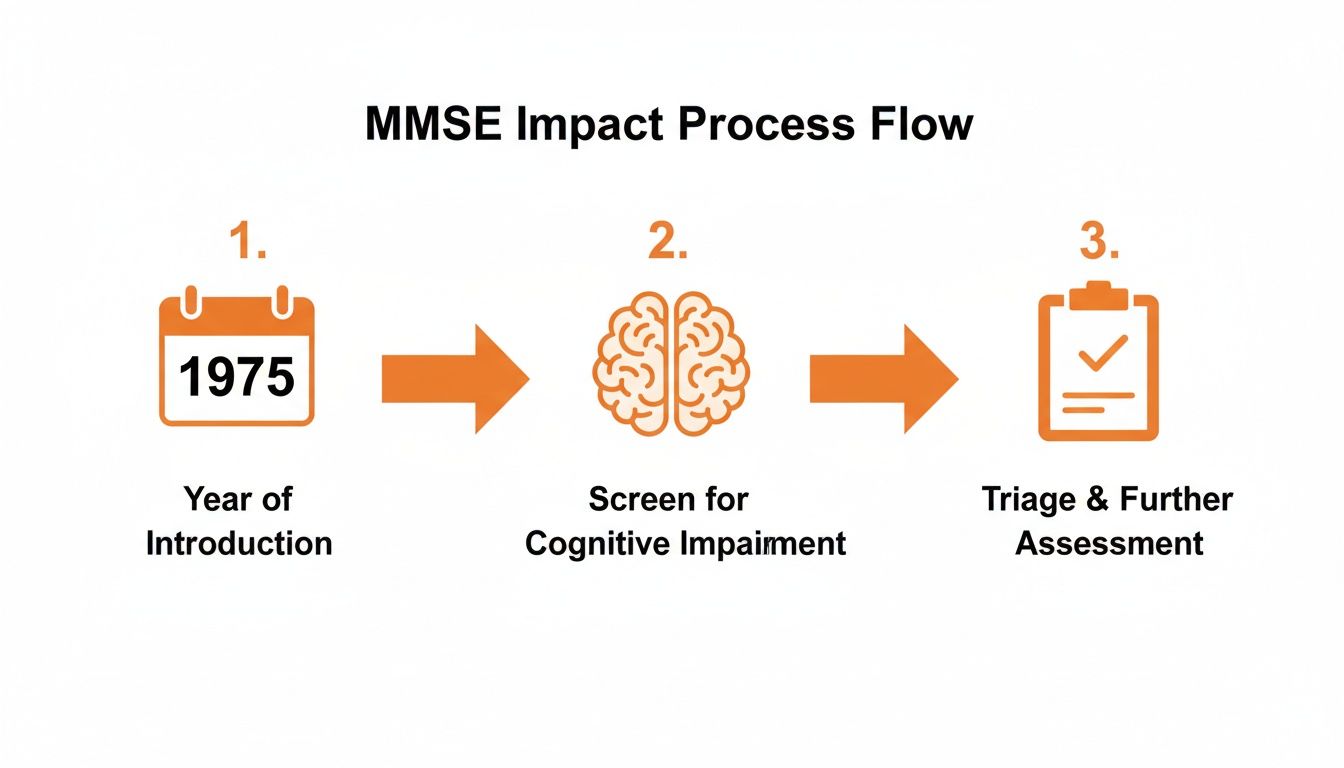
From its introduction in 1975, the test quickly became a clinical staple for cognitive screening. It brought a much-needed structure to the triage process, helping clinicians decide who needs a more in-depth assessment.
A Step-by-Step Administration Protocol
Properly administering the MMSE means sticking to the script. The specific wording and instructions for each task are there for a reason. If you deviate, you risk invalidating the score.
Here’s a breakdown of the core tasks, along with some practical tips from the field:
Orientation to Time (5 points): Ask for the year, season, date, day, and month. It's crucial not to provide any hints. If a patient is close but not exact (for example, saying the 15th when it's the 16th), it is still marked as incorrect.
Orientation to Place (5 points): Ask for the country, province, city, the name of the hospital or clinic, and the floor you are on.
Registration (3 points): Clearly and slowly state three unrelated objects (e.g., "apple," "table," "penny"). Then, ask the patient to repeat them back to you. You score their very first attempt. However, you should repeat the words up to five times if needed to ensure they have registered them for the recall task later on.
Attention and Calculation (5 points): This is the classic 'Serial Sevens' task. Ask the patient to begin at 100 and count backward by 7. You stop them after five subtractions (93, 86, 79, 72, 65). They get one point for each correct number in the sequence.
Actionable Insight: For patients who struggle with math, there's an alternative: ask them to spell the word "WORLD" backward (D-L-R-O-W). It’s critical that you choose only one of these methods—either serial sevens or spelling backward—not both. Make a note on the form which method was used, as this can be relevant for future assessments.
Recall (3 points): Now, ask the patient to name the three objects you told them earlier. You give one point for each correct object they recall without any prompting.
Language, Praxis, and Final Steps
The final part of the MMSE zeroes in on language abilities and the capacity to follow commands. These tasks are a mix of verbal responses and physical actions. To get a better sense of how these pieces fit into a wider evaluation, you can explore our complete guide on the mental state assessment.
Administering the Language and Praxis Tasks:
Naming (2 points): Show the patient two common, everyday objects, like a watch and a pen, and simply ask them to tell you what they are.
Repetition (1 point): Ask the patient to repeat this exact phrase: "No ifs, ands, or buts." To get the point, they have to repeat it perfectly on the first try.
Three-Stage Command (3 points): Give a clear, three-part instruction: "Take this paper in your right hand, fold it in half, and put it on the floor."
Reading (1 point): On a piece of paper, write "CLOSE YOUR EYES" in large, clear letters. Show it to the patient and instruct them to read it and do what it says.
Writing (1 point): Hand the patient a piece of paper and a pen and ask them to write a complete sentence. To earn the point, the sentence must have a subject and a verb and make sense.
Copying (1 point): Ask the patient to copy a drawing of two intersecting pentagons. This is often trickier than it sounds. For the point to be awarded, all 10 angles must be present, and the two shapes must intersect correctly.
Interpreting MMSE Scores for Clinical Insight
So, you've administered the Mini-Mental State Examination and have a raw score. What does that number actually tell you? The next, and most crucial, step is to translate that figure into a meaningful clinical picture.
The MMSE is built on a straightforward 30-point scale. In simple terms, a higher score points to better cognitive function. The classic approach to interpretation relies on established cut-off points to help categorize the results, giving you a starting point for your assessment.
The most widely recognized cut-off score is 24. While it's not a hard-and-fast rule, a score below 24 often signals that a more comprehensive evaluation is probably a good idea. Anything above that is generally considered within the normal range.
MMSE Score Interpretation Guidelines
These general brackets are your first port of call for making sense of an MMSE score. They offer a quick way to begin classifying the potential severity of cognitive impairment.
Score Range | General Interpretation | Clinical Considerations |
|---|---|---|
25-30 | Normal Cognitive Function | Score is within the expected range for healthy adults. Consider the individual's baseline if known. |
21-24 | Mild Cognitive Impairment | Suggests a noticeable decline. This warrants further investigation and monitoring. |
10-20 | Moderate Cognitive Impairment | Indicates significant cognitive difficulties that likely impact daily functioning. A comprehensive neurological workup is needed. |
0-9 | Severe Cognitive Impairment | Represents a profound level of impairment, often requiring significant support for daily activities. |
Remember, these are just guidelines. I can't stress this enough: a score by itself is never a diagnosis. It’s a single piece of data that you absolutely must place within the larger clinical context of the person you're assessing.
Why You Must Adjust Scores for Age and Education
One of the biggest mistakes you can make when interpreting the MMSE is ignoring demographic factors. A person's age and level of education can dramatically influence their score, completely separate from any underlying cognitive issues. Using one cut-off for everyone is a recipe for misclassification—you might miss impairment in a highly educated person or mistakenly flag it in someone with less formal schooling.
The history of the MMSE's use in California, stretching back to 1975, gives us a perfect real-world example. Norms specific to the state, validated with over 1,200 seniors in San Diego, really drove home the need for these adjustments. While 24/30 was a fine benchmark for many, the median score plunged to just 19/30 for people over 80 with less than a high school education. Fast-forward to 2025, and California's Alzheimer's Prevention Program noted MMSE use in 78% of neurology visits. This broad screening identified moderate impairment (scores of 10-18) in 22% of cases, showing just how powerful a nuanced interpretation can be. You can read more on the impact of demographic adjustments in cognitive screening.
Here’s a practical example to illustrate this. Imagine a 75-year-old retired university professor who scores 25/30. While that's technically in the "normal" range, it could be a red flag. Actionable Insight: For this individual, a score of 25 may represent a significant decline from their high baseline. This should prompt you to ask specific questions about their daily functioning—are they having trouble managing finances or complex appointments? This context turns a seemingly good score into a crucial clinical clue.
This is where the real clinical skill comes in. For a deeper look into the subtleties of scoring, our guide on MMSE scoring and interpretation provides more detailed examples and context.
When you start to factor in these variables, you move beyond a raw number and get a much richer, more accurate clinical insight. It’s this careful, thoughtful approach that is absolutely essential for the responsible use of any "mini mental status test pdf" you might be working with.
Recognizing the Limitations of the MMSE
While the Mini-Mental State Examination has been a go-to for quick cognitive screening for decades, it’s far from a perfect tool. As clinicians, we have to be honest about its significant limitations to use it responsibly. Understanding these weak points isn't just about good practice—it's absolutely critical for avoiding misinterpretation and making sure our patients get the right level of care.
A major problem is the MMSE's low sensitivity, especially when it comes to spotting mild cognitive impairment (MCI). It often misses the very subtle slip-ups that signal the early stages of cognitive decline. This means a "normal" score can give a false sense of security, which is a huge gap when we know early detection is the key to effective intervention.
Cultural and Educational Biases
One of the most well-known flaws of the MMSE is how easily scores can be skewed by a person's education and cultural background. The test's structure and questions lean heavily on verbal skills and general knowledge that are more common in educated, Western societies.
This can create real scoring problems:
Someone with less formal education might score poorly not because of a cognitive issue, but simply because they're not familiar with the test's abstract concepts.
A person from a different linguistic or cultural background could have a hard time with specific tasks, like the "serial sevens" calculation or repeating particular English phrases.
These built-in biases can lead to both false alarms and, more worryingly, missed diagnoses. This makes it a less-than-reliable tool when you're working with diverse patient groups.
Ceiling Effects and Diagnostic Gaps
Another big issue is what we call the "ceiling effect." This is what happens when someone who is highly educated or has a high cognitive baseline scores a perfect 30/30, or very close to it, even when they're privately experiencing real, subtle changes in their thinking. Their high baseline essentially masks the problem because the test just isn't challenging enough to pick it up. A high score can mistakenly shut the door on much-needed further investigation.
These aren't just theoretical concerns. The huge number of unofficial MMSE versions floating around has led to score variations as high as 15% in some studies. Even more alarmingly, the test’s insensitivity to mild impairment means it can miss 40-50% of early Alzheimer's cases in high-risk individuals. Research from California has even shown that certain populations, like Asian Americans, can score up to 22% lower simply due to language barriers. You can read more about the research on MMSE score variability and its limitations.
Practical Example: Think of a retired lawyer who comes in reporting memory lapses but scores a 28/30 on the MMSE. Because of the ceiling effect, this seemingly "normal" score could be hiding a genuine early-stage MCI. Actionable Insight: Instead of being reassured by the high score, a savvy clinician would follow up with more challenging tests that probe executive function, such as the Trail Making Test Part B, to uncover deficits the MMSE missed.
Once you understand these limitations, it becomes clear why relying on a "mini mental status test pdf" alone just isn't enough. For a more precise and unbiased picture, modern digital tools are essential. Platforms like Orange Neurosciences offer objective, sophisticated assessments that are built to overcome these traditional biases, giving you the detailed data needed to make clinical decisions with confidence.
The Future of Cognitive Screening: Moving Beyond the PDF
Clinicians and patients still frequently search for a "mini mental status test pdf," but in practice, the field is already looking far beyond static, paper-based forms. We've known about the shortcomings of tests like the MMSE for years—its cultural and educational biases, its frustrating ceiling effects, and its poor sensitivity for picking up on mild cognitive impairment. This has created an undeniable need for a new generation of cognitive assessment tools.
This isn't just about scanning an old form and calling it digital. It's a fundamental move toward dynamic, intelligent platforms that give us a much deeper and more meaningful picture of a patient's cognitive health. These modern tools are designed specifically to overcome the challenges that made older screeners so unreliable in the first place.
Overcoming the Limits of Static PDFs
A digital cognitive assessment platform gives you objective, data-driven analysis that a PDF could never hope to match. It measures cognitive functions with a level of precision that paints a far richer picture of a person’s brain health.
Here’s what that looks like in practice:
Enhanced Precision: Digital tools can capture subtle performance details like reaction time and processing speed, right down to the millisecond. This helps reveal the kinds of small deficits that paper tests almost always miss.
Objective Scoring: The guesswork is gone. Automated, algorithm-based scoring eliminates the subjective judgment needed for tasks like the MMSE’s clock-drawing or pentagon copying, leading to more consistent and dependable results.
Adaptive Testing: Many modern platforms adjust the difficulty of tasks in real-time based on how a patient is performing. This smart design avoids the "ceiling effect" where high-functioning individuals max out the score, and the "floor effect" for those with more significant impairments.
By moving past a simple pass/fail score, digital assessments deliver a detailed cognitive profile. This profile can pinpoint specific areas of weakness, like executive function or working memory, which helps clinicians develop a much more targeted and effective care plan.
As cognitive screening changes, even our idea of a "document" is becoming more fluid. For example, some are exploring how to make static information more accessible, which is an interesting parallel to our own shift from paper to digital. This complete guide on converting PDFs to podcasts shows how static content can be repurposed for new uses, much like we're transforming assessment itself.
Engaging Patients with Gamified Assessments
One of the most practical improvements with modern assessment tools is how they engage patients. Let's be honest, traditional tests can feel sterile, cold, and even intimidating. Digital platforms, on the other hand, often use a gamified, friendly interface.
This approach makes the whole experience less stressful and even enjoyable for patients, which can lead to more accurate data on their actual performance. For a closer look at how these tools are changing clinical practice, our guide to cognitive assessment online offers some valuable context.
Platforms like Orange Neurosciences are a perfect example of this forward-thinking approach. We combine rapid, evidence-based assessment with engaging, game-like interfaces to deliver objective cognitive profiles in under 30 minutes. Our system gives clinicians real-time decision support, helping them build faster, better-informed care plans that cut down on delays and truly improve patient outcomes. This is the natural next step beyond the static PDF—a move toward genuinely personalized and dynamic brain healthcare.
Your Top MMSE Questions, Answered
When you're working with cognitive screening tools, questions are bound to come up. We get it. Think of this section as a quick-reference guide where we tackle some of the most common queries we hear about the Mini-Mental State Examination. Our goal is to clear up any confusion so you can feel confident using the MMSE in your practice.
Is the MMSE a Diagnostic Tool for Dementia?
No, it's not. The MMSE is a screening tool, plain and simple. I often tell clinicians to think of it like a smoke detector: it’s brilliant at telling you there might be a fire, but it can’t tell you how big the fire is or what started it.
A low score on a mini mental status test pdf is a critical signal that a much deeper investigation is needed. A formal dementia diagnosis is a comprehensive process, involving a full patient history, physical exams, lab work, neuroimaging, and often, more in-depth neuropsychological testing. The MMSE is just the first step on that path.
How Long Is an MMSE Score Valid for?
An MMSE score doesn't really have an "expiry date." It’s best understood as a snapshot of a person's cognitive function at one specific moment. Its real power isn't in a single score, but in what you see when you start collecting a series of them over time.
For instance, you might assess a client when they're admitted to your care and then again every month. It’s the pattern—whether the scores are holding steady, getting better, or declining—that tells you the most. That trend gives you far more clinical insight than one isolated score ever could. How often you re-assess should always come down to the clinical context and what's happening with the patient.
A single MMSE score is a data point. A series of MMSE scores tells a story. Actionable Insight: Charting MMSE scores on a patient's graph at each visit provides a clear visual trendline. This actionable data makes it easier to discuss changes with patients and their families and to justify adjustments in their care plan.
Who Can Administer the MMSE?
To get results you can actually rely on, the MMSE has to be administered by a trained healthcare professional. This includes people like physicians, psychologists, nurses, occupational therapists, and researchers who know the standardized protocol inside and out.
Proper training is absolutely key. It’s what keeps well-meaning administrators from making small errors that can completely throw off the score. A trained pro knows not to give subtle hints during orientation questions and understands the precise criteria for scoring something tricky like the intersecting pentagons. It’s this commitment to standardization that makes the scores meaningful.
Are There Official Translated Versions Available?
Yes, there are. Official, properly validated translations of the MMSE exist for many languages. The crucial thing to know is that these must be obtained through the official copyright holder, PAR, Inc.
It’s tempting to use an unofficial translation you might find online, but that’s a risky move. Those versions have rarely been culturally adapted or normed for the population you're testing. A validated translation goes beyond just word-for-word accuracy; it ensures the questions are culturally appropriate, which is fundamental for a fair and accurate cognitive assessment.
While the MMSE has its place, modern practice often calls for more. For a different approach that moves beyond the limits of paper tests, Orange Neurosciences offers evidence-based, AI-powered tools. Our platform can deliver a precise cognitive profile in under 30 minutes, helping you make faster, more informed decisions for the people in your care. To see how our digital solutions can bring more objectivity and engagement to your practice, we invite you to book a demo or contact our team through our website. Visit us at https://orangeneurosciences.ca.
Orange Neurosciences' Cognitive Skills Assessments (CSA) are intended as an aid for assessing the cognitive well-being of an individual. In a clinical setting, the CSA results (when interpreted by a qualified healthcare provider) may be used as an aid in determining whether further cognitive evaluation is needed. Orange Neurosciences' brain training programs are designed to promote and encourage overall cognitive health. Orange Neurosciences does not offer any medical diagnosis or treatment of any medical disease or condition. Orange Neurosciences products may also be used for research purposes for any range of cognition-related assessments. If used for research purposes, all use of the product must comply with the appropriate human subjects' procedures as they exist within the researcher's institution and will be the researcher's responsibility. All such human subject protections shall be under the provisions of all applicable sections of the Code of Federal Regulations.


© 2026 by Orange Neurosciences Corporation