A Guide to the Pattern Recognition Test and How It Works
Dec 16, 2025
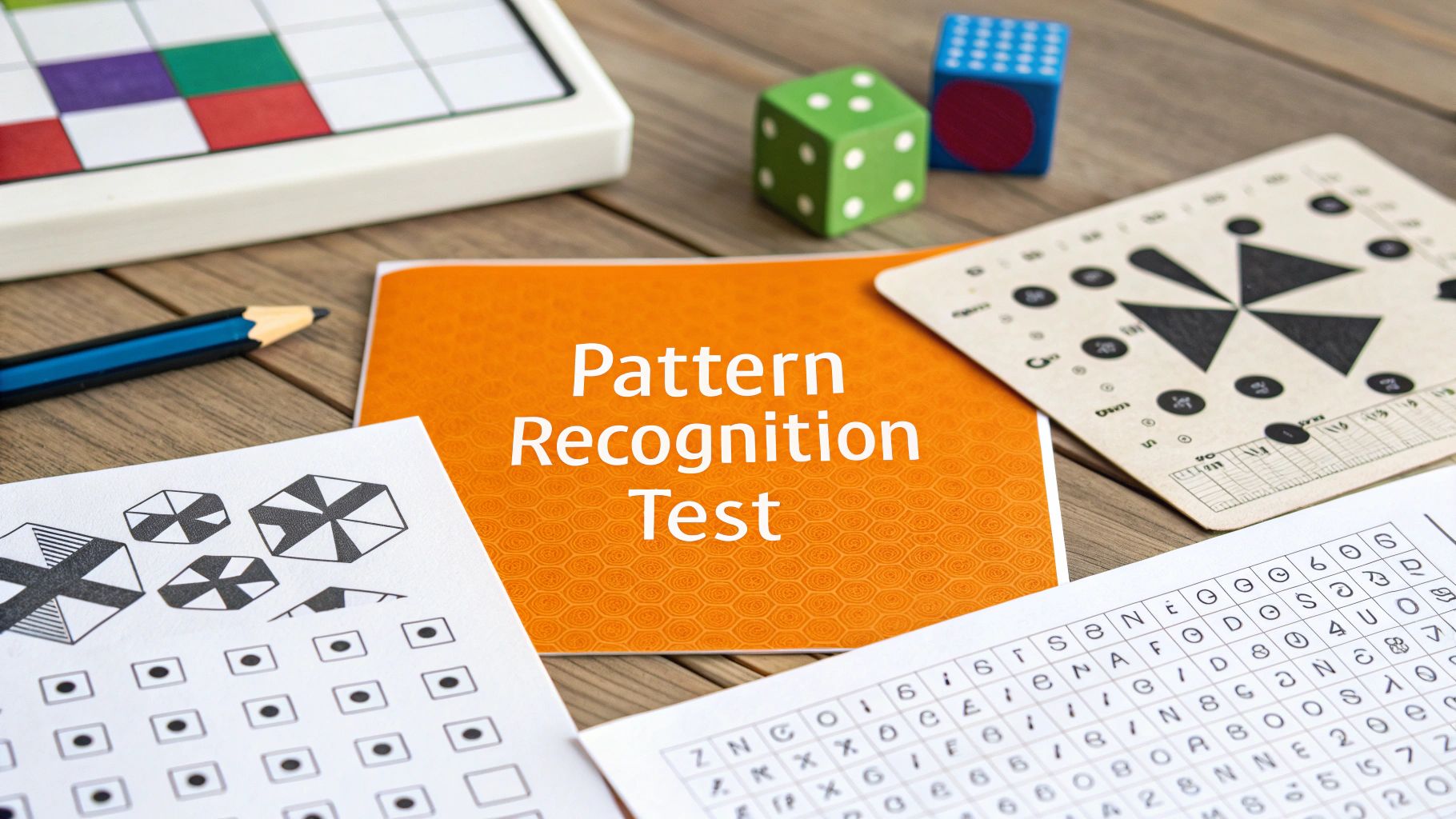
A pattern recognition test is a cognitive tool we use to see how well someone can spot underlying rules, trends, and sequences in visual or abstract information. It’s all about measuring your ability to find the logical thread connecting different pieces and predict what should come next.
What Is a Pattern Recognition Test and Why It Matters
Have you ever had that feeling where you're connecting dots no one else seems to see, like solving a puzzle? That’s the heart of a pattern recognition test. Think of yourself as a detective at a crime scene—you’re searching for hidden clues that, once pieced together, reveal the bigger story. This skill is fundamental to so much of our critical thinking and logical reasoning.
At its core, this kind of assessment will show you a series of shapes, numbers, or figures that all follow a specific, hidden rule. Your job is to crack the code—figure out that rule and use it to find the missing piece of the puzzle. This gives us a direct window into your fluid intelligence, which is your ability to reason and tackle brand-new problems without relying on knowledge you’ve already learned.
The Real-World Impact of Spotting Patterns
The knack for recognizing patterns isn't just an abstract skill for a test; it has huge practical value in both school and work. It's actually a strong predictor of success in any field that leans heavily on analytical thinking and problem-solving.
For example, a student who is strong in pattern recognition might naturally excel in areas like:
Mathematics: Seeing the sequences in algebra (like
x, x+2, x+4...) or understanding geometric transformations.Computer Science: Spotting irregularities in logic to debug code faster.
Science: Recognizing trends in experimental data to form a solid hypothesis.
In the professional world, employers often use a pattern recognition test to find candidates for roles that demand sharp analytical skills. A software developer has to see patterns in code to build efficient algorithms, just as a financial analyst needs to spot trends in market data to make smart investment decisions.
Actionable Insight: A strong ability in pattern recognition is often what separates simple memorization from true understanding. It’s the engine that drives insight, allowing us to move from observing data to making informed predictions about the future.
Ultimately, getting better at this skill is about more than just acing a test. It’s about sharpening your ability to think critically, untangle complex problems, and make sense of a world that’s constantly throwing information at you. Understanding where you stand is a key first step, which is why platforms offering comprehensive cognitive assessments are so valuable for tracking and improving these essential skills.
Exploring the Common Types of Pattern Recognition Tests
When you hear “pattern recognition test,” you might picture a specific type of puzzle. But the truth is, they’re not all cut from the same cloth. Think of it like a detective’s toolkit—you wouldn't use a magnifying glass to analyze financial records. Similarly, these assessments use different formats to zero in on specific cognitive skills. Getting a feel for these types is the first real step to understanding what they’re actually measuring.
At its heart, every pattern recognition test boils down to a simple, powerful process: you spot a rule, figure out how it works, and then predict what should happen next.
This is the fundamental loop your brain goes through, whether you're solving a puzzle with shapes, numbers, or spatial arrangements.
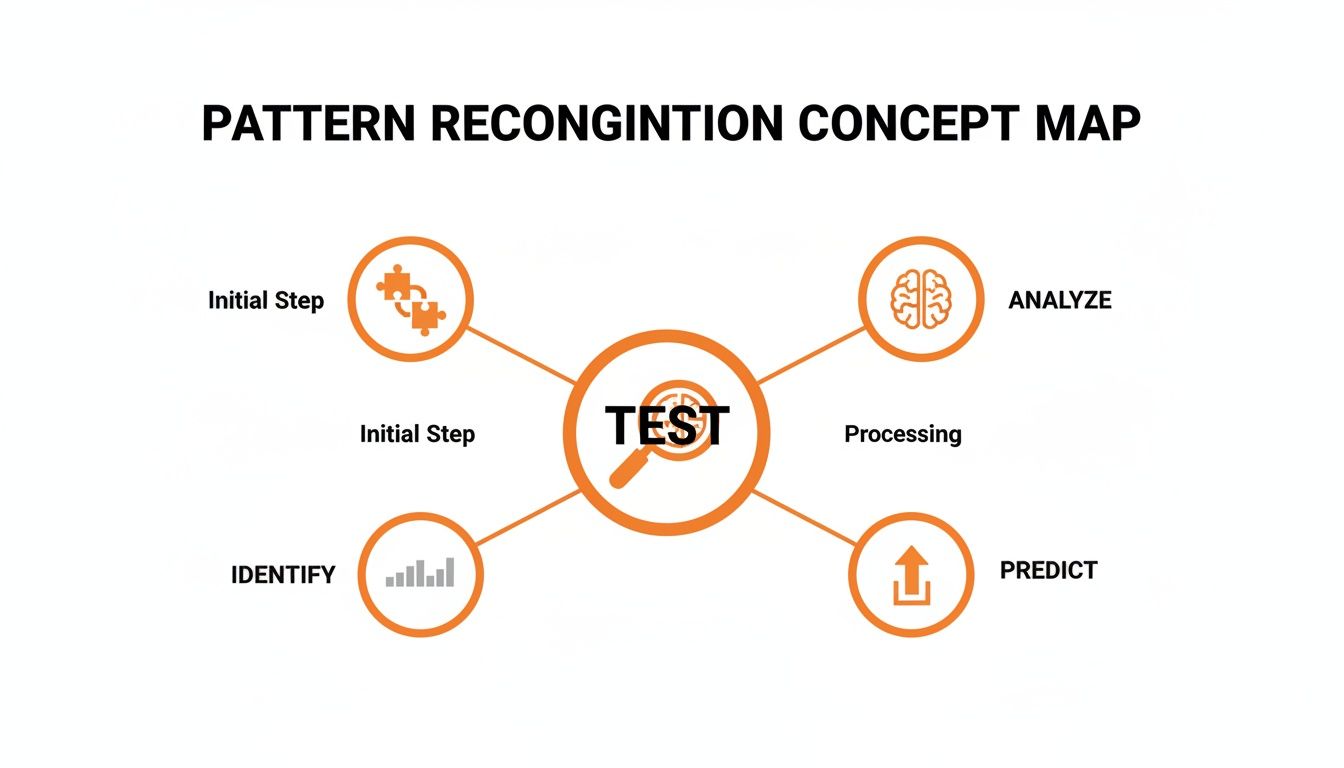
As you can see, every test—no matter the format—hinges on your ability to identify, analyze, and predict. These three actions are the bedrock of successful pattern solving. Let’s look at how they show up in the most common test formats.
To give you a clearer picture, here’s a quick breakdown of the formats you're most likely to encounter.
Common Pattern Recognition Test Formats at a Glance
Test Type | Core Skill Measured | Practical Example |
|---|---|---|
Abstract & Figural | Fluid Intelligence & Inductive Reasoning | A 3x3 grid of shapes where one is missing. The shapes might be rotating, changing colour, or combining according to a hidden rule. |
Numerical Sequence | Logical-Mathematical Reasoning | A series of numbers like |
Spatial Reasoning | Visuospatial Processing & Mental Manipulation | Being shown a flattened 2D "net" of a cube and having to choose which 3D cube could be formed by folding it. |
Each of these formats is designed to challenge a distinct facet of your problem-solving abilities. Let's dig a little deeper into each one.
Abstract and Figural Patterns
This is probably the format that first comes to mind. Abstract or figural reasoning tests present you with a sequence or grid of shapes and symbols, with one piece conspicuously missing. Your job is to decode the logic connecting the figures to deduce the missing element.
A classic setup is a 3x3 grid where every row and column follows a specific rule. For example, maybe the shapes rotate 90 degrees clockwise in each cell, or perhaps a new line or dot is added in each frame. Solving these puzzles often requires you to mentally juggle multiple rules at once—a core component of what we call fluid intelligence.
Numerical Sequence Patterns
Another very common format revolves around numerical sequences. You’ll be given a string of numbers and asked to determine the next one in the series. These can range from straightforward arithmetic progressions to far more complex, multi-layered patterns.
Practical Example: You see the sequence
3, 7, 15, 31, ?. The rule isn't simple addition. It's(previous number x 2) + 1. So, the next number is(31 x 2) + 1 = 63.Actionable Tip: Don't just look at the difference between numbers. Check for multiplication, division, squares, or combined operations.
These tests are a direct measure of logical-mathematical reasoning. It's less about your ability to do quick calculations and more about your knack for discovering the underlying function that drives the sequence. For a closer look at the strategies behind these kinds of challenges, it can be helpful to see guides on how to solve logic puzzles.
Spatial Reasoning Patterns
Spatial reasoning tests are all about your ability to mentally twist, turn, and manipulate objects in two or three dimensions. You might be shown a 2D shape and asked which 3D object could be made by folding it. Or, you could be tasked with mentally rotating a complex figure to see if it matches another one shown from a different angle.
These assessments are absolutely critical for evaluating the skills needed in fields like engineering, architecture, and surgery, where visualizing and manipulating objects in your mind’s eye is a non-negotiable part of the job.
While abstract, numerical, and spatial formats are the big three, other variations do exist. You might come across auditory tests asking you to identify patterns in sounds or symbolic tests using completely unique characters.
Ultimately, getting comfortable with these core types will prepare you for almost any pattern recognition challenge. To see how these assessments fit into a wider evaluation framework, take a look at our complete guide to the different cognitive tests online.
How These Tests Are Used in Education and Learning
In a classroom setting, a pattern recognition test is so much more than an academic exercise. Think of it as a diagnostic lens, giving educators a way to see past the grades on a report card and understand the cognitive gears turning inside a student's mind. It's a powerful tool for pinpointing both incredible potential and specific learning hurdles.
This is particularly true when it comes to identifying learning disabilities. A child struggling with dyscalculia, for instance, often has a really tough time recognizing numerical sequences or seeing the logical rules that govern math problems. A pattern recognition test can shine a spotlight on this exact cognitive gap, providing clear, actionable data so educators can build the right support strategies.
Identifying Potential and Providing Support
On the other side of the coin, these tests are fantastic for spotting students who would thrive in gifted and talented programs. When a student can quickly make sense of complex abstract or spatial patterns, it’s a strong sign of advanced fluid reasoning. This knack for flexible thinking and solving new problems is a hallmark of high intellectual potential, signalling to educators that this learner needs a more enriched curriculum to stay engaged.
The insights from these assessments are what allow educators to truly personalize the learning experience.
Early Intervention: By catching cognitive weaknesses early on, schools can put support systems in place before a student falls too far behind.
Curriculum Customization: For students who fly through these tests, the results justify placing them in advanced courses that genuinely challenge their reasoning abilities.
Actionable Teaching Strategies: A teacher might shift their methods, using more visual aids for a student strong in spatial reasoning or breaking down concepts logically for someone who excels at sequential patterns.
The High Stakes in Standardized Assessments
The real-world importance of pattern recognition becomes crystal clear when you look at high-stakes educational assessments. In the Caribbean, these skills are absolutely essential for exams like the Caribbean Secondary Education Certificate (CSEC). Subjects like Mathematics lean heavily on a student's ability to spot spatial and sequential patterns to solve algebra and geometry problems. The staggering 36% pass rate for Mathematics in 2024 points to a critical gap in these foundational cognitive skills.
Actionable Insight: A student's ability to recognize patterns is directly tied to their academic achievement. It’s the cognitive engine that powers problem-solving, critical thinking, and logical reasoning—skills that are non-negotiable for success in school and in life.
This data really drives home why building these core abilities is so fundamental. For institutions that want to better understand and support their students' cognitive development, a structured assessment platform can be a game-changer. You can learn more about how Orange Neurosciences supports academic institutions with precise cognitive measurement tools. By getting to the root of learning, educators can make an impact that truly lasts.
How to Interpret Test Results in a Clinical Setting
Getting a score from a pattern recognition test isn’t like getting a grade back on a school exam. In a clinical setting, that number is really just the first clue in a much larger investigation into an individual's cognitive health. It’s a single, valuable data point that helps clinicians see the bigger picture.
This score becomes a key piece of evidence when tracking cognitive changes in conditions like dementia, assessing the real-world impact of a traumatic brain injury, or simply building a detailed cognitive profile for a client. The goal is never to label someone with a score, but to use it to help map out a path forward.

From Raw Scores to Meaningful Insights
To make a raw score truly meaningful, clinicians compare it to normative data—basically, a massive dataset of scores from a representative group of people. Think of it like a growth chart for cognitive skills. Just as a paediatrician plots a child's height against the average for their age, a neuropsychologist plots a test score against the average for a similar demographic.
This comparison gives us a percentile rank. If a client scores in the 75th percentile, it means they performed as well as or better than 75% of their peers. This context is what turns an abstract number into a clear, actionable insight.
Actionable Insight: The real power of a pattern recognition test in a clinical context is its ability to quantify an abstract cognitive function. It translates a client's struggle to 'connect the dots' into objective data that can be tracked, compared, and used to guide treatment.
For this comparison to be fair and accurate, the normative data must be culturally and demographically relevant. A test normed on one population may not be a good fit for another, as background and experience can absolutely influence performance. This is a critical factor in providing equitable care. You can learn more about the complete process in our guide on what is a neuropsychological assessment.
Practical Application: A Clinical Case Study
Let’s imagine a 68-year-old retired teacher who comes in reporting increasing difficulty with multi-step tasks like following a new recipe. After a clinical interview and other assessments, she completes a pattern recognition test and scores in the 15th percentile for her age and education level.
This single piece of data doesn't lead to a diagnosis on its own, but it gives us crucial, actionable information:
Objective Evidence: The low score objectively confirms the client's subjective complaints, showing a specific deficit in her fluid reasoning.
Diagnostic Clues: When we combine this with memory tests and her personal history, the result might point toward mild cognitive impairment (MCI) or the early stages of a neurodegenerative condition.
Treatment Planning: The results help therapists design a cognitive rehabilitation plan that specifically targets her problem-solving and executive function skills, perhaps using puzzles or strategic games.
Research consistently shows that factors like age and education have a profound impact on test performance. For instance, a 2023 review of normative data in Latin America and the Caribbean found that on pattern completion tasks, adults' scores could decline by 12-15% per decade after age 40. At the same time, higher education correlated with 20-30% better scores. This really highlights why interpretation must always be personalized. You can discover more insights about these regional cognitive performance findings.
The Link Between Human Cognition and AI
The very same thinking that helps us spot patterns in the world around us is also the engine driving the artificial intelligence that’s becoming a bigger part of our lives every day. It’s a fascinating link—the fundamental logic behind a simple cognitive test is the same logic that, when scaled up, creates some truly incredible technology.
The connection is more straightforward than you might imagine. When you take a pattern recognition test, you’re identifying rules, figuring out how things relate to one another, and making predictions. An AI model does the exact same thing, just on a massive, lightning-fast scale.
Think of it like this: a child learns to identify a cat after seeing just a few examples. They quickly generalize features like pointy ears, whiskers, and a long tail. An AI learns in a similar way, but by analyzing millions of images to pinpoint the statistical patterns that scream "cat." This core ability is what powers:
Medical Image Analysis: AI systems are now trained to spot subtle patterns in X-rays or MRIs that could signal disease, often with remarkable accuracy.
Fraud Detection: Your bank's app relies on AI to recognize unusual spending patterns in real-time, flagging a purchase in another country that doesn’t fit your typical behaviour.
Facial Recognition: From unlocking your phone to social media tagging, these algorithms work by analyzing patterns in facial features to find a match.

A Critical Challenge: Demographic Bias in AI
As powerful as this technology is, it’s not without its pitfalls. AI learns from the data it’s fed, which means any biases lurking in that data can get amplified, leading to some serious real-world problems. This issue is especially stark in facial recognition technology.
Actionable Insight: Understanding pattern recognition is about more than just a test score—it's about critically engaging with the technology that defines our future. It forces us to ask tough questions about fairness, ethics, and the data we use to train these intelligent systems.
A 2019 U.S. government report on facial recognition systems offered a sobering example. The study found major demographic biases, with much higher error rates for people from certain parts of the world. For instance, false negative identification rates were significantly higher for individuals born in the Caribbean and Africa, especially when dealing with lower-quality images from border crossings. People from Eastern Europe, on the other hand, had the lowest error rates.
This is a powerful reminder of why the principles of pattern recognition matter so much. To really get a handle on this cognitive skill, it helps to look at its roots, like understanding cognitive development in early childhood. As AI continues to advance, our awareness of how it thinks—and where it can go wrong—is more important than ever.
By measuring these skills effectively, we can get a clearer picture of both human and artificial intelligence. To see how modern tools can help, take a look at our solution for cognitive assessment.
How Orange Neurosciences Can Help
It’s one thing to understand the theory behind a pattern recognition test. It's another challenge entirely to effectively measure and improve this crucial cognitive skill in a real-world setting. Let's be honest, traditional pen-and-paper assessments can be clunky, time-consuming to administer, and a real headache to score. The whole process often feels frustrating for both the professional and the person being assessed.
This is exactly where modern, thoughtfully designed digital solutions come in. The Orange Neurosciences platform is built to move past these outdated methods. We've worked hard to transform cognitive assessment from a sterile chore into an engaging, interactive experience. Our digital, game-like tools are specifically designed to capture rich, scientifically validated data through an interface that feels less like a test and more like a focused activity.
From Raw Data to Actionable Results
The real magic happens behind the scenes. Our system completely automates the scoring, which not only saves clinicians and educators a ton of time but also eliminates the risk of human error. As soon as an assessment is finished, the platform generates clear, comprehensive reports that turn complex data points into genuinely useful insights.
Instead of just getting a single, static score, you receive a detailed cognitive profile. This opens up a world of possibilities:
Track Skills Over Time: You can easily monitor a student's progress throughout the school year or see how a patient is responding to a particular therapy.
Identify Specific Weaknesses: The reports help you pinpoint the exact cognitive functions that need more support, allowing for truly targeted interventions.
Make Data-Driven Decisions: You'll have objective metrics right at your fingertips to guide educational plans, clinical diagnoses, or therapeutic strategies.
This approach gives you a much more dynamic and nuanced picture of an individual’s cognitive abilities.
Deeper Insights, Less Paperwork
For educators, this means spending far less time buried in paperwork and more time crafting the personalized learning strategies that make a real difference. For clinicians, it means gaining deeper insights into a patient's cognitive health without the administrative slog that usually comes with thorough assessments. Being able to effortlessly track changes in pattern recognition provides a powerful way to measure if an intervention is actually working.
Actionable Insight: By making the assessment process more efficient and the results more accessible, we empower professionals to focus on what truly matters: helping individuals unlock their full potential.
Ultimately, our platform was built to be more than just a better pattern recognition test. It’s a complete framework for understanding, tracking, and supporting cognitive development in a way that is both precise and practical for your day-to-day work in clinical and educational settings.
Ready to see how a modern approach to cognitive assessment can elevate your practice or institution? Explore the solutions offered by Orange Neurosciences and request a demo to see our platform in action.
Orange Neurosciences' Cognitive Skills Assessments (CSA) are intended as an aid for assessing the cognitive well-being of an individual. In a clinical setting, the CSA results (when interpreted by a qualified healthcare provider) may be used as an aid in determining whether further cognitive evaluation is needed. Orange Neurosciences' brain training programs are designed to promote and encourage overall cognitive health. Orange Neurosciences does not offer any medical diagnosis or treatment of any medical disease or condition. Orange Neurosciences products may also be used for research purposes for any range of cognition-related assessments. If used for research purposes, all use of the product must comply with the appropriate human subjects' procedures as they exist within the researcher's institution and will be the researcher's responsibility. All such human subject protections shall be under the provisions of all applicable sections of the Code of Federal Regulations.


© 2026 by Orange Neurosciences Corporation