Understanding the Different Dyslexia Types of Dyslexia
Jan 1, 2026
When most people hear the word "dyslexia," they often picture one specific challenge, like mixing up letters. But the reality is much more nuanced. It's more helpful to think of dyslexia not as a single condition, but as a spectrum of reading challenges.
The most common profiles include phonological dyslexia (trouble processing sounds), surface dyslexia (difficulty with whole-word recognition), and rapid naming deficit (slow processing speed). Getting to grips with these differences is the first real step toward finding the right support for a struggling reader. By understanding the specific challenge, you can take targeted, actionable steps to help.
Decoding Dyslexia: A Spectrum of Reading Challenges
Let's move past the idea that dyslexia is a one-size-fits-all diagnosis. An analogy I find helpful is thinking about athletes. Some are natural-born sprinters, explosive and quick, while others are built for the long haul as marathon runners. Both are incredible athletes, but their strengths, training needs, and event preparations are completely different.
Reading works in a similar way. It’s a complex mental workout that requires the smooth coordination of many different cognitive skills. Dyslexia can impact these skills in various combinations, which is why we see so many unique dyslexia types of dyslexia. This guide will help you understand the most common profiles and provide actionable insights into why one person might struggle to sound out new words, while another reads accurately but incredibly slowly.
A Visual Guide to Dyslexia Types
To get us started, this mind map provides a great visual overview of the main branches of dyslexia. You can see how each type grows from a different root cause.
As the graphic shows, reading difficulties can stem from a breakdown in sound processing (phonological), visual word memory (surface), or the brain's processing speed (rapid naming). We'll dive into each of these next.
Understanding the Core Differences
Pinpointing the distinctions between these subtypes is more than just an academic exercise—it’s the key to unlocking an individual's learning potential with the right support.
To make this clearer, here's a quick guide summarizing the core challenge and observable signs for each of the main dyslexia subtypes.
Quick Guide to Common Dyslexia Subtypes
Dyslexia Type | Core Challenge | Observable Signs |
|---|---|---|
Phonological Dyslexia | Difficulty processing and manipulating the individual sounds (phonemes) in words. | Trouble rhyming, sounding out new words, poor spelling, confusing similar-sounding words. |
Surface Dyslexia | Struggling to recognize words by sight, especially those that don't follow phonetic rules. | Reads words like "yacht" or "colonel" incorrectly by sounding them out; slow reading of familiar words. |
Rapid Naming Deficit | Slow processing speed when it comes to retrieving known information, like letters or numbers. | Accurate but very slow, hesitant reading; difficulty with timed tasks; poor reading fluency. |
Double Deficit Dyslexia | A combination of phonological challenges and a rapid naming deficit. | Significant struggles with both reading accuracy and speed; comprehension is heavily impacted. |
This table shows just how different these profiles can be. A child with phonological dyslexia, the most common type, might not be able to tell you that "cat" and "hat" rhyme. On the other hand, someone with surface dyslexia is forced to sound out every single word because their brain doesn't store a visual dictionary of familiar words. This becomes a huge problem with irregularly spelled words like "enough."
Then you have rapid naming deficit, which is purely a processing speed issue. The person knows the word, but it takes their brain a long time to retrieve it. It’s like having the answer on the tip of your tongue, all the time. Finally, double deficit dyslexia is a challenging combination of phonological issues and slow naming speed, creating a major roadblock for both accuracy and fluency.
Understanding which cognitive skill is affected is not just academic—it directly informs the most effective intervention strategies. A plan for someone struggling with phonological processing will look very different from a plan for someone with a speed deficit.
By mapping out these key differences, we can move from a general label to a more precise and actionable understanding. To learn more about how objective data can clarify these cognitive profiles, visit our website and see how Orange Neurosciences provides the insights you need.
The Sound of Words: Phonological and Auditory Dyslexia
When we start to unpack the different types of dyslexia, phonological dyslexia is the one we encounter most often. It’s a common misconception that dyslexia is a visual problem. In reality, for most, it’s rooted in sound.
Think of words as being built from individual sound-bricks, which experts call phonemes. The word "cat," for instance, is built from three distinct sounds: /k/, /æ/, and /t/.

Someone with phonological dyslexia has a tough time hearing, identifying, and working with these individual sound-bricks. This core difficulty with phonological awareness makes decoding—the act of sounding out new words—feel like an impossible puzzle. It’s not about seeing the letters backwards; it’s about the brain struggling to connect those letters to the right sounds.
What Phonological Dyslexia Looks Like
Because the brain is having a hard time processing the sound structure of language, certain signs often show up, especially in early childhood. You might notice a child having immense difficulty with rhyming games, struggling to clap out the syllables in their name, or being unable to hear the subtle difference between words like "pat" and "bat."
Here are a few real-world examples of what this struggle looks like:
Blending Sounds: If you give them the sounds /sh/, /o/, /p/, they might not be able to blend them into the word "shop."
Segmenting Words: Ask them what sounds are in the word "flag," and they may struggle to isolate /f/, /l/, /a/, /g/.
Manipulating Phonemes: A request like, "Say 'boat' but don't say the /b/ sound," can be incredibly difficult because the concept of pulling one sound out of a whole word just doesn't click.
This goes much deeper than a simple speech issue. It’s a breakdown in the brain's ability to map sounds to letters, which is the absolute foundation of learning to read. And this isn't a rare challenge. It's estimated that dyslexia affects up to 20% of the population, making it the most common learning disability. That means a huge number of students may not be getting the specific phonological support they need to succeed.
Understanding Auditory Dyslexia
A close cousin to phonological dyslexia is auditory dyslexia. This involves a broader difficulty with processing and making sense of spoken language. While phonological dyslexia is specific to the sounds inside words, auditory dyslexia impacts how a person interprets the sounds of language as a whole.
Someone with auditory processing challenges might:
Constantly ask "what?" or need you to repeat instructions.
Get lost trying to follow multi-step verbal directions.
Have a hard time tuning into a speaker's voice in a noisy classroom or playground.
It’s crucial to understand this isn't a hearing problem. Their ears are working perfectly fine, but their brain has trouble sorting and interpreting what it hears. For a deeper dive, our guide on how an auditory processing test can pinpoint these challenges is a great resource.
At its heart, phonological dyslexia is about a struggle with the 'Lego bricks' of language. If you can't feel the shape of the individual bricks, you can't follow the instructions to build words. It makes reading a profoundly frustrating and exhausting task.
Actionable Strategies That Make a Difference
The good news is that these phonological challenges are well-researched, and we have highly effective, evidence-based ways to help. Since the core issue is connecting sounds to symbols, the best interventions are explicit, systematic, and multisensory.
Actionable Insight: Implement multisensory learning at home. When practicing the letter 'b', have your child see the letter, say its /b/ sound, and trace the shape in a tray of sand or shaving cream all at once. This engages multiple senses to build stronger brain connections. Structured literacy programs, especially those based on the Orton-Gillingham approach, are widely considered the gold standard for this reason.
By focusing intently on the sound structure of language, we can give learners the targeted support they need to build a rock-solid foundation for reading and, ultimately, a lifetime of success.
When Words Just Don’t Look Right: Surface and Visual Dyslexia
While phonological dyslexia is all about the sounds of language, other types of dyslexia are rooted in how our brains see and process written words. This is where we run into surface dyslexia and visual dyslexia—two distinct challenges that make reading a slog, even for someone who knows their letter sounds inside and out.
Think about how you recognize a friend’s face in a crowd. You don't stop to analyze their eyes, nose, and mouth individually each time. Your brain just knows the pattern and instantly says, "That's Sarah." This is exactly what fluent readers do with familiar words.
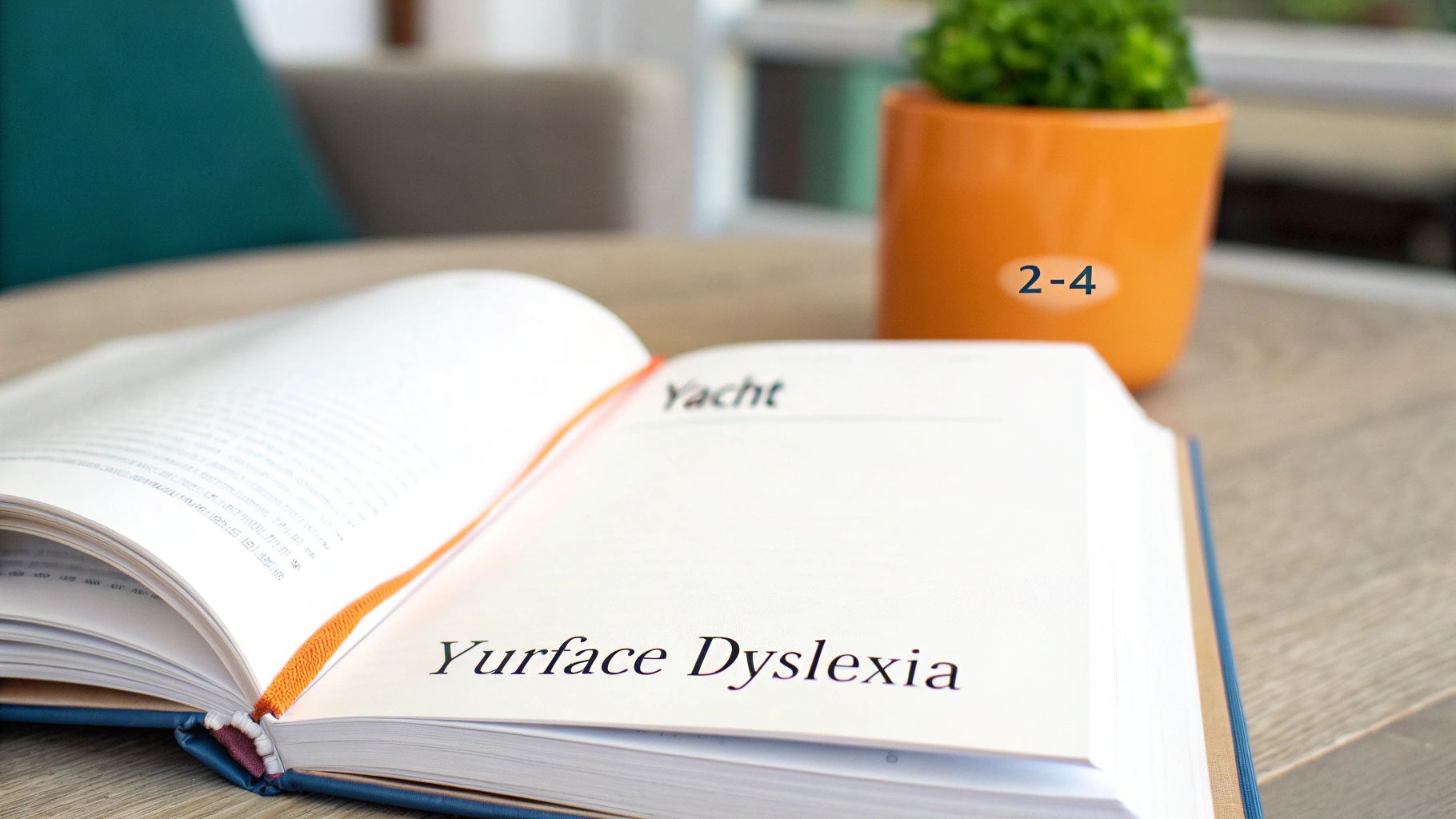
But for someone with surface dyslexia, that instant mental library of "sight words" never quite gets built. Their brain doesn’t store words as whole visual units. Instead, they’re forced to sound out everything, piece by painful piece. This strategy might work for simple, regular words like "cat" or "stop," but it completely breaks down when faced with all the quirky, irregular words English is famous for.
What Surface Dyslexia Looks Like in Practice
This constant need to sound out every word leads to some very predictable—and often frustrating—reading errors. A person with surface dyslexia doesn't just read slowly; their reading patterns reveal a brain working methodically but incredibly inefficiently.
You’ll see things like:
Reading 'island' as 'is-land': The phonetic rules are applied literally, completely missing the silent 's'.
Pronouncing 'yacht' as 'yatched': The word’s spelling doesn’t follow the rules, so the decoding attempt goes off the rails.
Confusing 'colonel' for 'coll-o-nell': This is a perfect example of how the inconsistencies of English make it a minefield for these readers.
This non-stop decoding is mentally draining. Imagine trying to assemble a complex piece of furniture by reading the instructions one letter at a time instead of recognizing whole words. By the time they get to the end of a sentence, so much mental energy has been spent just figuring out the words that there's nothing left for actual comprehension.
Getting Clear on Visual Dyslexia
It’s really important to draw a line between surface dyslexia and what’s often called visual dyslexia. The names are similar, but the core problems are different. Visual dyslexia isn't an issue with eyesight—a person can have 20/20 vision and still struggle mightily.
Visual dyslexia is about a difficulty in how the brain processes and organizes the visual information on a page. The eyes see the letters just fine, but the brain has a tough time keeping everything in the right order.
This processing challenge is tied to the brain's ability to track and make sense of visual sequences, a job handled by a key part of our working memory system. If you want to dive deeper into the mechanics, you can learn more about the role of the visual-spatial sketchpad in our detailed guide.
Practical Strategies for Visual Processing Challenges
When the brain struggles to process text visually, the reading experience can feel chaotic. Letters might seem to jumble together, or lines can appear to blur and move. Luckily, many practical strategies can offer immediate help by bringing some order to the visual chaos.
Actionable Insight: Create a "reading toolkit." This could include a simple index card to block out distracting text, coloured transparent overlays to reduce glare, and access to an e-reader app where you can adjust fonts to something like OpenDyslexic and increase line spacing. Experiment to see which combination reduces visual stress the most.
Effective tools and techniques include:
Using a Reading Guide: Something as simple as a ruler or a coloured overlay placed under the line of text can help the eyes track smoothly and stop them from jumping around the page.
Experimenting with Fonts and Spacing: Some people find that dyslexia-friendly fonts (like Dyslexie or OpenDyslexic) or just adding more space between letters and lines makes text far easier to process.
Using Technology to Your Advantage: Most e-readers and apps let you customize fonts, text size, and background colours. These tweaks can dramatically reduce visual stress.
Visual Tracking Exercises: Specific activities designed to train the eyes to move smoothly from left to right can help build the underlying visual processing skills needed for fluent reading.
By understanding that these types of dyslexia are about visual word memory and processing—not laziness or a lack of trying—we can put targeted, helpful strategies in place. These approaches help create a more stable and predictable reading experience, freeing up the reader to finally focus on what matters: the meaning behind the words.
The Speed Factor: Rapid Naming and Double Deficit Dyslexia
Have you ever met a child who can read words correctly, but does so at a painfully slow pace? This isn't about not knowing the words; it's a different kind of reading challenge altogether—one rooted in speed. This is often a sign of a Rapid Automatized Naming (RAN) deficit, which directly impacts reading fluency.
Think of it like a brilliant librarian who knows exactly where every single book is in a massive library but takes five full minutes to walk over and grab each one. The knowledge is there, but the retrieval speed is so sluggish that the whole process becomes exhausting and inefficient. For someone with a rapid naming deficit, this is exactly what reading feels like. They can decode the words, but that smooth, effortless flow remains just out of reach.

This processing speed bottleneck isn't limited to reading. It's a core cognitive challenge that can pop up in many other areas of life.
What a Rapid Naming Deficit Looks Like
At its heart, a RAN deficit is about the brain's slow retrieval of information that is otherwise well-known. It’s not a knowledge problem, it’s an access problem. How quickly can the brain pull that information from its files?
You might see this show up in a few ways:
A child hesitates for a long time when asked to name a sequence of common objects, colours, or letters.
Reading aloud sounds choppy and laboured, even with familiar words they can identify correctly.
They really struggle with any timed academic task, whether it's a math facts quiz or a reading comprehension test.
This slowness is a huge drain on mental energy. By the time a reader gets to the end of a sentence, they’ve spent so much effort just retrieving each word that there’s very little cognitive horsepower left to actually understand what the sentence means.
When Two Challenges Combine: Double Deficit Dyslexia
Now, what happens when you combine this processing speed issue with the sound-based struggles of phonological dyslexia? You get what's known as double deficit dyslexia, one of the most challenging types of dyslexia to navigate.
Individuals with this profile are fighting a battle on two fronts. They have trouble sounding out new or unfamiliar words (the phonological deficit), and they are slow to recognize familiar words (the rapid naming deficit). This creates a massive barrier to both reading accuracy and fluency, making reading an exceptionally tough task.
Double deficit dyslexia demands a two-pronged intervention strategy. Focusing only on phonics won't cut it, because even if a child’s accuracy improves, the underlying speed issue will still hold them back from becoming a fluent reader.
Actionable Strategies for Building Speed and Accuracy
For individuals grappling with these speed-related challenges, support must target both decoding skills and processing speed. The ultimate goal is to make retrieving sounds, letters, and words more automatic, freeing up the brain to do the important work of comprehension.
Actionable Insight: Use fun, game-based drills to build speed. Use flashcards with letters, numbers, or sight words and a stopwatch. See how many they can name correctly in one minute. Turn it into a game by trying to beat their own score each day. This low-pressure practice builds the neural pathways for faster recall.
Platforms like those developed by Orange Neurosciences use engaging, game-like exercises that adjust to the user's performance in real time. These tools help build the neural pathways required for faster recall, offering a concrete strategy for tackling this complex challenge. By pairing phonics instruction with targeted speed drills, you create a much more comprehensive and effective support system.
Ready to see how objective data can help identify and address these cognitive challenges? Visit our website to learn how our tools provide the clarity needed to create personalized and effective support plans.
From Suspicion to Strategy: The Path to Identification
Recognizing that a child might be struggling with reading is a critical first step. But it almost always leads to a pressing question for parents and educators: what now? The journey from a gut feeling to a clear, actionable strategy means moving from subjective observations to objective data that can light the way forward.
This process starts by noticing the small but persistent signs. It’s about connecting the dots between struggles that might seem unrelated, and understanding they could point to one of the underlying types of dyslexia.
Key Indicators Across Different Age Groups
The signs of dyslexia aren't static; they change as a child grows and the demands of school increase. What looks like a simple delay in a preschooler can become a major learning roadblock for a high school student.
Here are some practical examples of what to watch for at different stages:
Preschool (Ages 3-5): A child in this age group might have persistent trouble recognizing the letters in their own name. They might struggle with rhyming games, like matching "cat" and "hat," or continue using "baby talk" long after their peers have moved on.
Early Elementary (Ages 6-8): This is often when reading instruction really kicks into gear. Key signs include difficulty connecting letters to their sounds, confusing letters that look alike like 'b' and 'd' long after classmates have mastered them, and reading very slowly and hesitantly, even with simple words.
Upper Elementary (Ages 9-12): By this age, reading difficulties often become more obvious. You might notice a student who avoids reading aloud at all costs, spells the same common word differently within the same paragraph, or can't seem to remember basic facts from a text they just read.
Teenagers and Adults: In older students and adults, dyslexia often shows up as a deep-seated avoidance of reading and writing tasks. They might read accurately but at a glacial pace, have extreme difficulty organizing their thoughts for an essay, or struggle to summarize a story or chapter.
Noticing these patterns is the starting point. The next step is to gather objective information to understand the "why" behind these challenges.
Moving from a suspicion to a solution requires a bridge of objective data. Without it, conversations with schools and specialists can feel stuck, based only on anecdotes rather than evidence of a specific cognitive challenge.
Bridging the Gap with Objective Screening
This is precisely where early screening tools become so valuable. A formal diagnosis must be made by a qualified professional, like a psycho-educational psychologist. But before taking that significant step, objective screening can provide a powerful, data-driven snapshot of the core cognitive skills that are often impacted by dyslexia.
Tools like OrangeCheck offer this crucial insight. While it isn't a diagnostic tool, it assesses key cognitive functions like processing speed, working memory, and attention. The results can help clarify whether a child’s struggles are consistent with the cognitive profile of dyslexia.
Actionable Insight: If you suspect a problem, start a simple observation log. Note specific examples: "Tried to read 'house' but said 'horse'" or "Took 10 minutes to write one sentence." This log, combined with objective screening data, creates a powerful evidence-based case when you speak with teachers and specialists. Armed with this information, you can have much more productive and focused conversations.
To get a clearer picture of how assessments work, explore our detailed guide on the various tests for reading difficulties.
By pairing your observations with objective cognitive data, you transform your concerns into a clear strategy. This proactive approach empowers you to advocate effectively for your child or student, ensuring they receive the specific, targeted support they need to thrive.
Building a Support System with Interventions and Accommodations
Once you have a clearer picture of the specific dyslexia types of dyslexia affecting a learner, you can shift from identification to action. Putting together an effective support system isn’t about finding a single magic bullet; it’s about creating a strategic blend of interventions to build skills and accommodations to ensure access.
It’s absolutely vital to understand the difference between these two approaches. Think of it this way: an intervention is like a physiotherapist guiding you through exercises to strengthen a weak muscle. An accommodation is like being given a crutch to help you walk while that muscle heals and gets stronger. You really need both to move forward successfully.
Interventions vs. Accommodations: What Is the Difference?
Let’s break this down a bit more. It's crucial to distinguish between strategies that actively build new skills and those that simply provide a different way to access information. One without the other rarely works. Interventions involve direct instruction and practice designed to strengthen weaker cognitive skills over time. Accommodations are the tools and environmental tweaks that level the playing field right now.
Here's a simple comparison:
Interventions vs Accommodations What Is the Difference
Strategy Type | Purpose | Examples |
|---|---|---|
Interventions | To build and strengthen specific cognitive and academic skills directly. | Structured literacy programs (e.g., Orton-Gillingham), phonics drills, fluency practice, targeted cognitive training exercises. |
Accommodations | To provide alternative ways to access curriculum and demonstrate knowledge. | Audiobooks, text-to-speech software, extra time on tests, providing notes from the board, using a calculator for maths. |
For example, for a student with phonological dyslexia, a powerful intervention is a structured literacy program that explicitly teaches the relationships between sounds and symbols. On the other hand, for someone with surface dyslexia, an intervention might focus on activities that build a robust sight word vocabulary. Great interventions often bring in specialized resources, like finding the right books for dyslexia, that are designed specifically to support their reading journey.
A Data-Driven Approach to Support
Choosing the right strategies is just the starting point. Real, lasting progress comes from carefully monitoring what’s working and being willing to adjust your approach based on objective data. The consequences of not providing effective, early support are massive. Consider this: the economic impact of undiagnosed dyslexia in California is estimated to be around $12 billion every year, partly because a staggering 37% of fourth graders can’t read at a basic level. You can read more about this literacy crisis in this detailed report.
This is where a data-driven approach takes the guesswork out of the equation. Tools from Orange Neurosciences let you track cognitive improvements in key areas like processing speed and working memory. This data gives you clear, undeniable evidence of whether an intervention is hitting the mark or needs to be tweaked. For a deeper look into this, check out our guide on how to improve working memory.
By tracking progress with objective cognitive metrics, you can personalize the support plan for maximum impact, ensuring that every effort contributes to meaningful growth.
This continuous loop—assess, intervene, monitor, adjust—creates a dynamic support system that truly adapts to the learner's changing needs. It ensures you aren’t just throwing spaghetti at the wall to see what sticks, but are implementing strategies that are proven to be effective for that individual.
Ready to take the guesswork out of intervention and build a truly personalized support plan? Visit the Orange Neurosciences website to see how our tools can provide the clarity you need.
Your Questions Answered: A Closer Look at Dyslexia Types
As parents, educators, and individuals start to explore the different facets of dyslexia, questions naturally pop up. Let's tackle some of the most common ones that we hear.
Can Someone Have More Than One Type of Dyslexia?
Absolutely. In fact, it's quite common for the different challenges associated with dyslexia to overlap. The best-known example of this is what specialists call "double deficit dyslexia." This is when someone struggles with both phonological processing (the sound structure of language) and has a rapid naming deficit (slower cognitive processing speed).
This is exactly why a thorough, detailed assessment is so critical. A truly effective support plan has to be built around all the underlying challenges a person faces, not just the most obvious one.
Is Visual Dyslexia the Same as a Vision Problem?
This is a common point of confusion, but the answer is a firm no. It's a critical distinction. Visual dyslexia isn't about the health of the eyes. Someone can have perfect 20/20 vision and still experience visual dyslexia because it's a challenge rooted in how the brain processes information.
An optometrist is the expert for checking the physical health and function of the eyes. But it takes an educational psychologist or another qualified specialist to assess how the brain is processing the visual information it receives for reading.
The issue isn’t with the eyes seeing the letters; it's with how the brain organizes and makes sense of the words and symbols on the page.
Do Different Dyslexia Types Require Different Support?
Yes, they certainly do. While many fantastic teaching strategies benefit all kinds of learners, the most powerful support is always matched to the specific type of dyslexia. A one-size-fits-all approach just doesn't deliver the best outcomes.
Here’s how that looks in practice:
For Phonological Dyslexia: The focus needs to be on intensive, structured literacy instruction. This means explicitly teaching the relationships between sounds and symbols, often using a multisensory approach to make those connections stick.
For a Rapid Naming Deficit: Support will involve targeted exercises designed to build up processing speed and automaticity. The goal is to help the brain retrieve information more quickly and efficiently.
For Surface Dyslexia: Interventions will centre on building a strong mental library of sight words and giving the learner plenty of practice with the many irregularly spelled words in the English language.
Understanding these differences allows us to create a much more precise and effective plan for intervention. And as a person grows, their needs can shift, which is why ongoing assessment is so valuable. For adults who might be wondering about their own profile, learning more about a dyslexia test for adults can be an empowering first step on that journey.
At Orange Neurosciences, we believe that objective data is the key to unlocking truly personalized support. Our tools provide the cognitive insights needed to understand a learner’s unique profile, track their progress over time, and build an intervention strategy that really works. It’s time to take the guesswork out of cognitive care. Find out more at https://orangeneurosciences.ca.
Orange Neurosciences' Cognitive Skills Assessments (CSA) are intended as an aid for assessing the cognitive well-being of an individual. In a clinical setting, the CSA results (when interpreted by a qualified healthcare provider) may be used as an aid in determining whether further cognitive evaluation is needed. Orange Neurosciences' brain training programs are designed to promote and encourage overall cognitive health. Orange Neurosciences does not offer any medical diagnosis or treatment of any medical disease or condition. Orange Neurosciences products may also be used for research purposes for any range of cognition-related assessments. If used for research purposes, all use of the product must comply with the appropriate human subjects' procedures as they exist within the researcher's institution and will be the researcher's responsibility. All such human subject protections shall be under the provisions of all applicable sections of the Code of Federal Regulations.


© 2026 by Orange Neurosciences Corporation