Discover tests for reading: A practical guide to effective assessments
Dec 12, 2025
When we talk about "tests for reading," we're really looking at specialized tools designed to measure a person's abilities in key areas like phonics, fluency, vocabulary, and comprehension. These aren't one-size-fits-all assessments. They can range from a quick quiz in the classroom to a deep diagnostic evaluation, each serving a unique purpose in understanding how someone reads.
Finding the right test is everything. It gives us the crucial, actionable data we need to support struggling learners, track their progress in a meaningful way, and create a clear plan for their success.
Decoding the Different Types of Reading Tests
Stepping into the world of reading assessments can feel a bit overwhelming, almost like trying to learn a new language. The term "reading test" is often used as a catch-all, but in reality, it covers a whole toolkit of specialized instruments.
Think about it this way: a doctor wouldn't use a stethoscope to check a patient's eyesight. In the same way, an educator or clinician needs the right assessment to accurately pinpoint a student's specific reading challenges and strengths.
No single test can possibly measure everything. Some are built to see how quickly and accurately a child can read out loud (that's fluency), while others dive into their ability to grasp the meaning behind the words (comprehension). This is why a variety of tests for reading exist—to paint a clear, detailed picture of a learner’s unique profile.
Getting a handle on the main categories of these assessments is the first and most important step toward making truly informed, actionable decisions.
The Four Core Categories of Assessment
To make things simpler, we can group most reading tests into four main categories, each with a distinct job to do. Think of them as different lenses for viewing a student’s reading skills.
To help you keep them straight, here’s a quick breakdown of the four primary types of reading assessments and what they’re used for.
Quick Guide to Reading Assessment Types
Assessment Type | Primary Purpose | Practical Example |
|---|---|---|
Screening Tests | To quickly identify students who might be at risk for reading difficulties. | A 1-minute oral reading fluency check for all 2nd graders in September. |
Diagnostic Tests | To dig deeper and pinpoint the specific nature of a reading problem. | A comprehensive evaluation of phonological processing after a screening raises a red flag. |
Formative Assessments | To monitor student learning and provide ongoing feedback during instruction. | An "exit ticket" quiz with 3 questions at the end of a reading lesson. |
Summative Assessments | To evaluate what a student has learned at the end of a unit or term. | A final exam on a novel, including vocabulary and theme analysis questions. |
Each of these assessment types plays a vital role in creating a complete picture of a student's reading journey.
Here's a closer look at how they work in practice:
Screening Tests: These are the quick checks. A teacher might use a brief, universal screener with the entire class in September to flag students who might need a closer look. They're all about early identification.
Diagnostic Tests: When a screener raises a red flag, a diagnostic test is the next step. These are more in-depth, often one-on-one, assessments that dig deep to uncover the specific why behind a reading problem, like a weakness in phonemic awareness.
Formative Assessments: These are the ongoing, informal pulse-checks that happen right in the middle of teaching. A pop quiz, an exit ticket after a lesson, or simply observing a student read a paragraph aloud are all examples. They provide actionable feedback that helps teachers adjust their approach on the fly.
Summative Assessments: These tests measure learning at the end of an instructional period. Think of the classic end-of-unit exam or standardized year-end tests. Their goal is to see what a student has retained over a longer stretch of time.
The most effective way to support any learner is to use a combination of these assessment types. A screener identifies a potential issue, a diagnostic test clarifies it, formative checks monitor progress, and a summative test measures overall growth.
When you're exploring different ways to assess reading, it’s also good to know how modern tools can help, especially with those informal checks. For instance, various online quiz creation tools let educators quickly build formative quizzes to check for understanding.
As you start navigating this landscape, learning more about the ins and outs of a test of reading comprehension can also provide valuable context, since it's one of the most critical skills we measure.
What Reading Tests Actually Measure
To really make sense of a reading test result, you have to look under the bonnet and see what’s actually being measured. A single score on a report card rarely tells the whole story. Instead, that number reflects a child’s performance across several interconnected skills, often called the five pillars of reading.
Think of it like building a house. You can't just put up walls without a solid foundation, a sturdy frame, and a reliable roof. In the same way, skilled reading is built on five core components: phonemic awareness, phonics, fluency, vocabulary, and comprehension. Each pillar is unique, but they all have to work together to support strong, confident reading.

Understanding these pillars helps you see past a simple number on a test report and into the real story of a learner’s abilities. This insight is the key to providing targeted, effective support that gets to the root of any reading challenge.
Phonemic Awareness and Phonics
Long before a child can decipher words on a page, they need to hear and play with the individual sounds in spoken language. This is phonemic awareness. It’s purely an auditory skill, completely separate from written letters.
It’s a bit like hearing the individual ingredients in a smoothie. You can taste the banana, the strawberry, and the yoghurt as distinct flavours. In the same way, a child with strong phonemic awareness can hear that the word "cat" is made up of three distinct sounds: /k/, /æ/, and /t/.
Phonics is the logical next step. It’s all about connecting those sounds to the letters and letter combinations on the page. To stick with our analogy, if phonemic awareness is tasting the ingredients, phonics is knowing the recipe—understanding that the letters c-a-t represent those specific sounds you hear.
Practical Example (Phonemic Awareness): An assessor might ask, "What word is left if I take the /k/ sound away from 'cat'?" The correct response is "at." This shows the student can manipulate sounds in their head.
Practical Example (Phonics): A test might include a list of nonsense words, like "vib" or "mep," to see if a student can apply letter-sound rules without just relying on memorized words.
Fluency and Vocabulary
Reading fluency is the ability to read a text with speed, accuracy, and the right expression. It’s the critical bridge between simply decoding words and actually understanding what they mean. A fluent reader doesn't have to painstakingly sound out every single word; their reading flows smoothly and naturally, almost like a conversation.
If phonics is the recipe, then fluency is executing that recipe without a hitch—effortlessly blending all the ingredients to create the final dish. A reader who isn't fluent is like a chef who has to stop and re-read the instructions for every single step. The whole process becomes slow and disjointed.
Vocabulary, of course, is a reader's knowledge of words and what they mean. A broad vocabulary is essential. You can read a sentence fluently but still miss the entire point if you don't know what the words mean. Think of it as having a well-stocked pantry; the more ingredients you have, the more interesting and complex dishes you can create.
A common misconception is that reading fast equals reading well. True fluency is a combination of speed, accuracy, and prosody (reading with expression). A student who zips through a passage but makes lots of errors or reads in a flat monotone is not truly fluent.
Comprehension: The Ultimate Goal
Finally, we arrive at reading comprehension—the ultimate purpose of reading. It’s the ability to process what has been read, interpret it, and pull meaning from the text. All the other pillars exist to support this one critical skill.
Comprehension is like sitting down to truly enjoy and understand the meal you’ve prepared. You can identify the ingredients (phonemic awareness), follow the recipe (phonics), and cook it smoothly (fluency), but the whole effort is incomplete if you can't grasp the final flavour profile and appreciate the dish. A comprehensive assessment may explore these skills in greater depth. To learn more, you can read our guide on what is neuropsychological assessment.
Reading tests measure comprehension in a few different ways:
Practical Example (Detail Recall): After reading a short story about a trip to the zoo, a question might ask, "What was the first animal the family saw?"
Practical Example (Main Idea): A student reads a paragraph about the water cycle and is asked to choose the best title for the passage.
Practical Example (Inference): The text says, "The ground was wet and the sky was grey." A question might ask, "What probably just happened?" The student must infer that it rained.
By breaking down reading into these five pillars, tests give us a detailed diagnostic map. They show us exactly where a learner is thriving and where they might need a bit more support. This clarity helps us move beyond a simple "good" or "bad" reader label and toward a precise, actionable plan for success.
Making Sense of Standardized Reading Tests
When someone mentions "reading tests," what comes to mind? For most people, it’s the big, high-stakes exams that often make the news. These standardized tests are a familiar part of the educational world, but they're also widely misunderstood.
They aren't like the diagnostic or formative tests we use in the classroom to shape day-to-day teaching. A better analogy is to think of them less like a doctor's detailed check-up on a single patient and more like a public health report for an entire community.
These large-scale assessments give us a bird's-eye view, helping us see the big picture when it comes to literacy trends across a city, a province, or even the whole country. The actionable insight here is for policymakers, not individual teachers. The goal isn't to pinpoint one student's specific struggles but to take the temperature of the educational system as a whole.
The Role of National Assessments
A perfect example of this is the National Assessment of Educational Progress (NAEP), often called "The Nation's Report Card." The NAEP won't give you a detailed breakdown of your child's personal reading skills. What it does do is provide a crucial snapshot of how different groups of students are performing on a massive scale.
This "big picture" data is incredibly valuable for policymakers, school administrators, and education researchers. It helps them spot widespread challenges, identify achievement gaps between different demographics, and make smarter decisions about where to invest resources and energy.
Actionable Insight: If NAEP results show a steady drop in reading comprehension among fourth-graders across a province, education leaders might use this data to advocate for new curriculum, fund more teacher training, or boost spending on early literacy programs. It’s all about steering the entire ship, not just fixing a leaky pipe in one cabin.
Understanding Proficiency Levels
One of the key features of these tests is their use of proficiency levels, like 'Basic,' 'Proficient,' and 'Advanced.' These labels can seem a bit fuzzy, but they're designed to create a consistent benchmark for everyone.
Basic: This suggests a student has partial mastery of the foundational skills and knowledge expected for their grade level.
Proficient: This indicates solid academic performance and a good handle on challenging subject matter.
Advanced: This signifies superior performance that goes above and beyond grade-level expectations.
When you see these terms in a news report, remembering their purpose is key. A student scoring at the 'Proficient' level is considered to be meeting the standard for their grade. These benchmarks are the yardstick we use to measure how the entire system is doing.
Recent NAEP reading scores and state profiles have shared some sobering data. One report found that a large percentage of students across the country were performing below proficient levels. This shines a light on the ongoing work needed in reading education, especially as we recover from pandemic-related learning disruptions.
While these numbers can feel alarming, they are most powerful when used to drive high-level policy change, not to judge an individual school or teacher. For a closer, more personal look at a student's academic skills, other types of tests for reading are far more suitable. For a great example, check out our deep dive into the Wechsler Individual Achievement Test (WIAT) to see how assessments can create a detailed individual profile.
At the end of the day, knowing the real purpose behind standardized tests empowers everyone, from parents to principals. It helps us correctly interpret the data we see and advocate for the systemic supports all our readers need to succeed.
How to Choose the Right Reading Test
With a sea of options out there, picking the right one from all the different tests for reading can feel like a daunting task. The secret is to start with a clear goal. What are you actually trying to figure out? Are you trying to pinpoint a specific snag, check in on recent progress, or get a big-picture view of learning after a school term?
Choosing the right test is a bit like picking the right tool for a job around the house. You wouldn't use a sledgehammer to fix a leaky faucet. In the same way, the assessment you select has to line up perfectly with the question you're asking about a student's reading.
Matching the Test to Your Goal
The most effective way to cut through the confusion is to work backward from your objective. This simple shift in thinking immediately points you toward a logical choice and ensures you get the exact information you need to make a real difference.
Let's walk through a few common scenarios with actionable examples:
Goal: Pinpoint a Specific Issue.
Scenario: Your second-grader is really struggling to sound out simple words.
Actionable Insight: A broad comprehension test is the wrong tool. You need a phonics-focused diagnostic test. This will zoom in on their ability to connect letters to sounds, getting right to the root of the problem.
Goal: Check on Progress.
Scenario: You're a teacher who just wrapped up a two-week unit on vocabulary.
Actionable Insight: Use a quick, formative classroom quiz. This gives you instant feedback on whether students have learned the new words, letting you adjust your teaching plan for the next day.
Goal: Evaluate Overall Learning.
Scenario: You're a school administrator who needs to measure reading growth across an entire grade level at the end of the year.
Actionable Insight: A summative, standardized assessment makes the most sense. It delivers the high-level data needed to evaluate the curriculum's effectiveness across the board.
This decision tree gives you a great visual for how your goal can steer you to the right type of reading test.
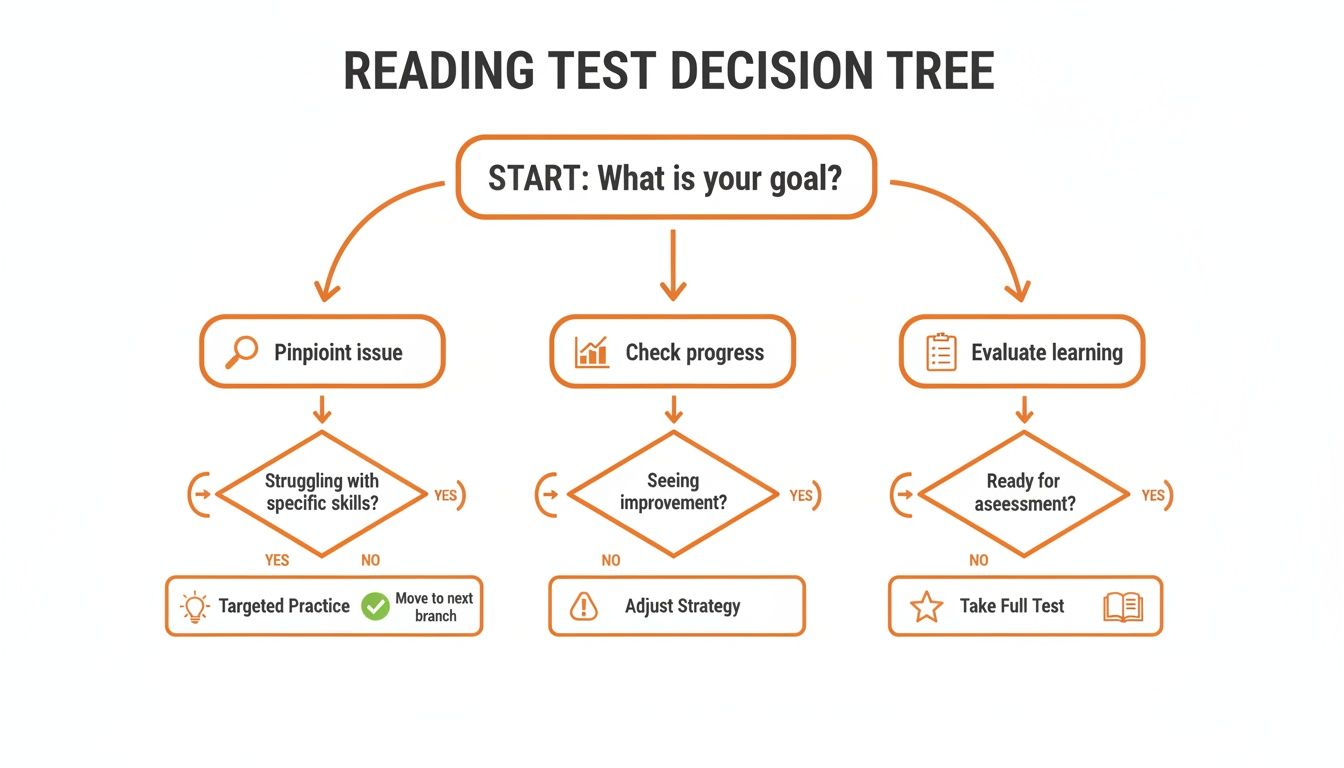
As you can see, starting with your specific "why"—whether it's diagnosing an issue or just checking in—narrows down the possibilities in a hurry.
Comparing Common Reading Tests
To give you an even clearer picture, let's look at some common tests for reading, who typically uses them, and what they’re built to measure. Think of this table as a practical guide for when you're weighing your options.
Selecting a Reading Test by Goal and Setting
Test Type/Example | Primary User | Skills Measured | Best For |
|---|---|---|---|
DIBELS (Dynamic Indicators of Basic Early Literacy Skills) | Teachers | Phonemic awareness, phonics, fluency | Quick screening of early literacy skills in K-6. |
Classroom Quiz | Teachers | Vocabulary, comprehension | Informal, formative checks on recent instruction. |
Woodcock-Johnson Tests of Achievement | Psychologists, Specialists | Broad reading skills (decoding, comprehension) | A deep, diagnostic evaluation for a complete profile. |
State Standardized Test | Administrators | Grade-level comprehension and analysis | Summative evaluation of system-wide performance. |
This comparison highlights how different tools serve very different purposes, from a quick classroom check-up to a full diagnostic workup.
The most powerful insights often come from a combination of assessments. A teacher might use DIBELS for initial screening and then follow up with informal classroom quizzes to monitor the progress of at-risk students throughout the year.
It’s also important to remember that sometimes, reading difficulties can be linked to how the brain processes sounds. If a student struggles with phonics despite great instruction, it might be worth exploring an auditory processing testing guide to see if there's an underlying issue at play.
Ultimately, selecting the right test is all about asking the right questions first. By clearly defining your goal from the get-go, you can confidently choose an assessment that provides genuinely helpful insights to support every single learner.
Turning Test Results into an Action Plan
Getting the results from various tests for reading is a big moment, but it's really just the starting line. The true power of any assessment isn't in the scores themselves—it's in the focused, collaborative action that comes next. A report full of numbers can feel cold and abstract, but with the right mindset, you can turn those data points into a clear, concrete plan for a student's success.
Think of a test score as a single signpost on a map. It tells you exactly where you are at this moment, but it doesn't tell you which road to take. To build a reliable roadmap, you first need to understand what that signpost means and then work together to chart the best course forward.

This is how we transform assessment from a simple judgment into a powerful tool for growth. It’s how we make sure every student gets the precise support they need to really thrive.
From Numbers to Narratives
Before you can build a plan, you have to speak the language of the test report. Metrics like percentiles and grade equivalents are thrown around a lot, but they can be genuinely confusing. Let's break them down.
Percentile Rank: This simply shows how a student's score stacks up against their peers. A score in the 75th percentile means the student performed as well as or better than 75% of the students in the same comparison group. It’s all about relative standing.
Grade Equivalent: This one is often misinterpreted. It compares a student’s performance to the average performance of students at a certain grade level. A fourth-grader with a grade equivalent of 2.5 is performing like an average second-grader in the fifth month of school. Crucially, this does not mean they are reading at a second-grade level. It’s just a comparison point, not a placement directive.
Knowing how to use these results is key. Digging into understanding formative vs. summative feedback can help you decide if the data is meant for quick, in-the-moment adjustments or for evaluating learning at the end of a unit.
Case Study: Creating a Targeted Plan
Let’s make this real. Imagine a third-grader named Leo whose latest reading assessment shows a mixed bag.
Leo's Results:
Reading Fluency: 15th percentile
Reading Comprehension: 70th percentile
At first glance, this seems contradictory. How can his comprehension be so solid if his fluency is that low? This is where the data starts to tell a story. It suggests Leo understands what he’s reading, but the act of decoding the words is slow and exhausting for him. His brain is working overtime just to sound things out, so he reads at a snail’s pace.
This specific data profile points us directly to an actionable plan.
Identify the Core Issue: The bottleneck isn't comprehension; it's fluency.
Select the Right Strategy: The focus should be on building automaticity and speed. Practical activities include repeated readings of familiar passages, paired reading with a stronger reader, and using a timer to track words-per-minute on short texts.
Set a Measurable Goal: Instead of a vague goal, we get specific: "Leo will increase his words correct per minute by 15% over the next eight weeks." This is a clear target everyone can work towards.
This targeted approach, born from the test data, is infinitely more effective than a generic "just practice reading more" plan. It pinpoints the exact skill holding him back and tackles it head-on.
Building a Collaborative Roadmap
The most successful action plans are team efforts, bringing together the parent, teacher, and student. Everyone has a role to play. The urgency for this kind of collaboration is clear from national trends. We know from data on test-retest reliability statistics how important consistent measurement is, and consistent support is even more critical.
A strong plan starts with a conversation where everyone is on the same page. Here are actionable questions to ask:
Based on these results, what is our #1 priority?
What specific activities will we do at school, and what can we do at home for 15 minutes each day?
How will we track progress (e.g., a weekly chart), and when is our next check-in meeting?
What is one goal the student can own and be proud of?
This teamwork ensures support is consistent, whether the student is in the classroom or at the kitchen table. To help you structure this crucial conversation and start turning those test results into a personalized roadmap for success, visit our website to download a free, easy-to-use action plan template.
Common Questions About Reading Assessments
Diving into the world of reading assessments can feel overwhelming, and it’s bound to bring up a lot of questions. Whether you're a parent trying to make sense of a test report or an educator deciding which tool to use, having concerns is completely normal. We're here to offer clear, reassuring, and practical answers to some of the most common questions we hear.
Our goal is to pull back the curtain on the assessment process, giving you the confidence to take the right next step. When you understand the ins and outs of different tests for reading, you become a much stronger advocate for your student or child.
What Is the Difference Between a Screener and a Diagnostic Test?
This is one of the first and most important questions people ask. Getting this distinction right is crucial because it often determines what kind of support a student will receive.
Think of it like a visit to the doctor's office. A screener is like the initial check-up where a nurse quickly takes your temperature and blood pressure. It's a fast, simple way to flag any potential issues. It won't tell you why you have a fever, only that you have one.
A diagnostic evaluation, on the other hand, is the deep dive that follows. This is when the doctor orders blood work, asks a battery of detailed questions, and uses specialized tools to uncover the root cause of that fever. It’s a thorough investigation designed to arrive at a precise diagnosis.
Actionable Insight: If a screening test shows your child is "at risk" for reading difficulties, your next step is to ask for a diagnostic test to find out exactly why. Is it a problem with phonological awareness, rapid naming, or another specific challenge often linked to dyslexia?
A screener simply raises a red flag. A diagnostic evaluation investigates what caused it. Understanding this difference ensures you're asking for the right kind of assessment at the right time.
How Often Should My Child Be Assessed?
There's no single answer here—the right frequency depends entirely on the purpose of the test. The goal is to find that sweet spot between gathering valuable data and avoiding needless stress for the student.
Here’s a general guide to assessment schedules:
Screening Tests: These are usually given to all students at key points in the year, often once or twice a year (like in the autumn and winter). This helps educators spot potential problems early and check the overall health of their literacy program.
Formative Assessments: These should be happening all the time. Think of them as the informal, ongoing check-ins—like exit tickets, quick quizzes, or classroom observations—that teachers use daily or weekly to shape their instruction.
Diagnostic and Summative Tests: These are used much more selectively. A comprehensive diagnostic is only necessary when a major concern has been flagged. Big summative tests, like year-end standardized exams, typically happen just once a year.
The key is to avoid over-testing. Anxious kids don't perform at their best, and that can really skew the results. A thoughtful assessment plan uses different tools for different jobs, making sure the data stays fresh and relevant without burning out the learner.
What Should I Do if I Disagree with School Test Results?
It’s jarring to see test results that just don't seem to line up with the child you know. If you find yourself in this position, the first and most important thing to do is open up a conversation.
Start by setting up a meeting with your child's teacher and, if you can, the school's reading specialist or psychologist. The best approach is to go in with an open mind and a spirit of collaboration.
Here are a few actionable steps you can take:
Ask for a Walk-Through: Ask them to walk you through the report, score by score. Have them explain what each number means and how it connects to what they see from your child in the classroom day-to-day.
Share Your Observations: You are the expert on your child. Bring specific examples from home that seem to contradict the test results. Practical Example: "The report says his vocabulary is low, but at home, he uses incredibly sophisticated words when he talks about dinosaurs. Can we figure out why that might not be showing up here?"
Discuss the Test Conditions: Ask about the testing environment itself. Was the child feeling okay that day? Was it a timed test, which might have caused anxiety? Little things can sometimes have a big impact on performance.
If you’ve had that meeting and still feel concerned, you have the right to request an independent educational evaluation (IEE) from a qualified professional outside the school. This can provide a valuable second opinion and a more complete picture of your child's strengths and needs.
How Do I Know if a Test Is Reliable?
When you’re relying on test data to make big decisions, you have to be able to trust it. That’s where reliability comes in. A reliable test is one that produces stable, consistent results over time.
One of the most important metrics for this is test-retest reliability. It answers a simple question: If a student takes the same test on two different days (with no new teaching in between), will they get more or less the same score? If the scores are very close, the test has high test-retest reliability.
Think of it like a good bathroom scale. If you step on it three times in a row, you expect it to show the same weight each time. A scale that gives you a different number every time is unreliable, and you wouldn't trust it to track your health. The same is true for tests for reading.
This consistency is everything. It ensures that a score reflects a student’s true ability, not just random luck or a fluke performance. For those who want to get into the nuts and bolts, you can learn more about how experts measure this in our guide to test-retest reliability statistics. When choosing an assessment, especially for high-stakes decisions, always look for one with strong, documented evidence of reliability.
Answering these questions is just the start. The landscape of reading assessment can be complex, but with the right information, you can navigate it with confidence and make choices that lead to real, meaningful progress for every learner.
At Orange Neurosciences, we are dedicated to providing clinicians, educators, and families with the objective data needed to support cognitive health. Our AI-powered platform offers precise cognitive assessments that deliver a clear profile of a learner's strengths and weaknesses, enabling faster, better-informed care plans. To see how our tools can remove the guesswork and provide a clear path forward, explore our solutions at https://orangeneurosciences.ca. For practical tips and updates, sign up for our email newsletter.

Orange Neurosciences' Cognitive Skills Assessments (CSA) are intended as an aid for assessing the cognitive well-being of an individual. In a clinical setting, the CSA results (when interpreted by a qualified healthcare provider) may be used as an aid in determining whether further cognitive evaluation is needed. Orange Neurosciences' brain training programs are designed to promote and encourage overall cognitive health. Orange Neurosciences does not offer any medical diagnosis or treatment of any medical disease or condition. Orange Neurosciences products may also be used for research purposes for any range of cognition-related assessments. If used for research purposes, all use of the product must comply with the appropriate human subjects' procedures as they exist within the researcher's institution and will be the researcher's responsibility. All such human subject protections shall be under the provisions of all applicable sections of the Code of Federal Regulations.


© 2026 by Orange Neurosciences Corporation