Your Guide to the Dyslexia in Adults Test
Feb 1, 2026
If you've spent your entire life feeling like reading, writing, or just staying organized is an uphill battle, getting a formal dyslexia in adults test can feel like finding a missing piece of the puzzle. It’s not about questioning your intelligence. Far from it. It's about finally understanding a lifelong, neurobiological difference so you can find strategies that work with your brain, not against it.
Why Consider A Dyslexia Test In Adulthood

Think about a brilliant project manager. They're amazing at creative problem-solving and can lead a team with ease, but they live in constant dread of writing detailed reports. Maybe they misread crucial emails under pressure, struggle to hit deadlines because of organizational hurdles, or feel a wave of anxiety before any task that involves a lot of reading. This isn't a hypothetical situation; it's a daily reality for countless undiagnosed adults with dyslexia.
These challenges don’t just disappear after graduation. They follow you into your professional and personal life, creating a hidden layer of frustration and self-doubt that can be incredibly isolating. Many adults just chalk it up to being "bad at spelling" or a "slow reader," never realizing there’s a concrete neurological reason for their difficulties.
Moving Beyond Labels To Find Solutions
For an adult, seeking a dyslexia test is less about getting a label and more about getting a user manual for your own brain. It’s the first real step toward leaning into your natural strengths while getting targeted support for the areas where you need it.
A formal diagnosis offers powerful validation. It explains lifelong patterns that might have been dismissed by others (or even yourself) as carelessness or a lack of effort. That understanding alone is empowering and can do wonders for your self-esteem and professional confidence. The societal impact of undiagnosed learning differences is huge. In California's adult literacy crisis, for instance, research suggests that a staggering 70% to 85% of illiteracy in adults could be linked to dyslexia.
A diagnosis is a roadmap, not a final destination. It points you toward personalized strategies, accommodations, and technologies that align with how your brain actually processes information, turning daily struggles into manageable tasks.
Gaining Actionable Insights For Daily Life
At the end of the day, a dyslexia assessment is all about arming you with practical, actionable insights. For example, if you constantly struggle to absorb what you read, figuring out how to improve reading comprehension skills can be a crucial part of that journey.
An assessment paves the way for real, practical changes in your life, such as:
Workplace Accommodations: It gives you the standing to request tools like text-to-speech software, ask for instructions verbally, or get extra time on written assignments. For instance, you could ask your manager to provide meeting agendas in advance or summarize key takeaways in an audio message instead of a lengthy email.
Effective Strategies: You can finally learn proven methods for organizing information, managing your time, and tackling reading-heavy projects without feeling overwhelmed. A practical tip might be using a mind-mapping app to organize your thoughts for a report before you start writing.
Targeted Support: With objective data from tools like those developed at Orange Neurosciences, you can track your progress and see which specific interventions are actually working.
To get a clearer picture of the entire evaluation process, take a look at our guide on what a learning disabilities assessment involves. Understanding your unique cognitive wiring isn't just about coping; it's the key to truly thriving.
Screening vs. Diagnostic Testing: What’s the Real Difference?
When you first start looking into a dyslexia in adults test, you'll quickly run into two terms: screening and diagnostic testing. It’s easy to mix them up, but they play very different roles on the path to getting clear answers.
Here’s a practical way to think about it: a dyslexia screener is like a smoke detector. It’s a fast, easy-to-use tool designed to signal that there might be a fire. It alerts you to the risk.
A full diagnostic test, on the other hand, is the entire fire department showing up for a comprehensive investigation. They don’t just confirm there’s a fire; they pinpoint its exact origin, size, and nature. This tells them exactly what tools are needed to handle the situation. Both are critical, but they serve different purposes at different times.
The Role of a Dyslexia Screener
A dyslexia screener is a preliminary tool—it’s the first step. Its job is to identify adults who may be at risk for dyslexia. Crucially, a screener does not provide a diagnosis. Think of it as an indicator, flagging patterns that are commonly associated with dyslexia.
Modern screeners, like those we’ve developed at Orange Neurosciences, provide objective data on the cognitive skills that often prove challenging for individuals with dyslexia. They measure core abilities such as:
Phonological Awareness: How well you can hear, identify, and play with the individual sounds in spoken words.
Processing Speed: How quickly you can take in visual information and make sense of it.
Working Memory: Your brain's "sticky note" ability to hold and manipulate information for short tasks.
For instance, a screener might ask you to rapidly decide if two made-up words rhyme or to repeat a series of numbers in reverse order. If your performance consistently falls below a certain threshold in these key areas, the screener flags you as "at risk," which is a strong signal that it’s time for a deeper look. If you're wondering whether to take this next step, an online screener is a low-commitment way to get more data.
When a Full Diagnostic Evaluation Is Necessary
While a screener is an excellent starting point, a formal diagnosis can only come from a comprehensive diagnostic evaluation. This is a much more intensive process, always conducted by a qualified professional like a clinical or educational psychologist. This is the official assessment you need to get documentation for accommodations at work or in post-secondary education.
A diagnostic test goes far beyond just identifying risk. It involves a battery of standardized tests that build a complete profile of your cognitive and academic strengths and weaknesses. The goal isn't just to confirm dyslexia but also to rule out any other potential reasons for the difficulties you're experiencing. You can dive deeper into what this involves in our article on the full neuropsychological assessment process.
The need for accurate, professional testing is enormous. Research suggests that 15% to 20% of the general population has dyslexia, yet countless adults have slipped through the cracks, never getting the diagnosis they needed. This gap means many people navigate their careers and daily lives without understanding the root of their challenges or having access to the right support.
A screener asks, "Is there smoke?" A diagnostic test answers, "Where's the fire, how big is it, and what's the best way to put it out?"
The final report from a diagnostic evaluation provides a detailed analysis of your unique cognitive profile and, if appropriate, a formal diagnosis. More importantly, it delivers personalized recommendations for strategies, tools, and interventions that can help you succeed. It's the official key to unlocking the support you deserve.
Comparing Dyslexia Screeners and Diagnostic Evaluations
To make the distinction crystal clear, here’s a breakdown of the key differences between a quick screening and a full diagnostic workup. Your actionable insight here is to start with a screener to gauge your risk level before committing to the time and expense of a full evaluation.
Feature | Dyslexia Screener (e.g., OrangeCheck) | Full Diagnostic Test |
|---|---|---|
Primary Purpose | To quickly identify adults who are at risk for dyslexia. | To provide a formal diagnosis, rule out other conditions, and create a detailed cognitive profile. |
Who Conducts It? | Can be self-administered or facilitated by a non-specialist. | A licensed professional (e.g., psychologist, neuropsychologist). |
Time Commitment | Short, typically 15-30 minutes. | Extensive, often taking 4-8 hours over one or more sessions. |
Scope | Focused on key cognitive indicators of dyslexia. | Comprehensive, assessing a wide range of academic, cognitive, and processing skills. |
Cost | Low-cost or free. | Significant investment, often ranging from $1,500 to $5,000+. |
Outcome | A risk assessment (e.g., "at-risk" or "not at-risk"). | A detailed report with a formal diagnosis and personalized recommendations. |
Best For | A quick, accessible first step for anyone with concerns. | Securing official accommodations and developing a targeted support plan. |
Ultimately, both screeners and diagnostic tests have an important place. A screener is the perfect tool to start your journey, offering quick, data-driven insights without a major commitment. A full evaluation is the definitive step for getting the formal diagnosis and tailored plan needed to truly thrive.
What a Dyslexia Test Actually Measures
When you hear “dyslexia test,” you probably picture someone reading a tricky paragraph out loud. While that can be part of it, a proper dyslexia in adults test is much more sophisticated. It’s less like a final exam and more like a mechanic running diagnostics on a car—the goal is to see how all the individual cognitive parts are working together.
Instead of getting lost in technical terms, let’s pull back the curtain and look at what these assessments really measure, using some real-world examples.
The Brain’s Sound System: Phonological Processing
At the very heart of dyslexia is a challenge with phonological processing. This is simply your brain's knack for hearing, identifying, and playing with the individual sounds (or phonemes) inside spoken words. This skill is the absolute foundation for connecting sounds to letters, which is how we learn to read in the first place.
Think of language as a big Lego structure. Someone with strong phonological awareness can easily see and handle each individual brick. They can take the word ‘plate,’ mentally pop off the ‘p’ sound, and know they’re left with ‘late.’ They can hear the separate sounds /k/, /a/, and /t/ and instantly blend them into the word ‘cat.’
A dyslexia assessment will probe this skill in a few different ways:
Phoneme Deletion: You might be asked, "What word is left if you take the /s/ sound out of 'stack'?" (The answer is tack).
Blending: A clinician might say the sounds "/b/ /a/ /g/" and ask you to fuse them into a single word (bag).
Rhyming Tasks: You could be asked to quickly spot which word in a set doesn't rhyme, which tests your ability to isolate and compare word sounds.
Struggles in this area explain why spelling is often so difficult for adults with dyslexia. If you can’t clearly hear the sequence of sounds in a word, writing them down in the right order is a massive challenge.
The Brain's Sticky Note: Working Memory
Next up is working memory, which is basically your brain’s temporary mental sticky note. It’s the cognitive space where you hold onto and juggle information just long enough to get something done—like remembering a phone number while you dial it, or following a colleague’s multi-step instructions.
When you're reading, your working memory is firing on all cylinders. It holds the start of a sentence in your mind while you decode the end, letting you piece together the full meaning. If that "sticky note" has a small capacity or the ink fades too fast, comprehension can fall apart.
A classic practical example is trying to take notes in a meeting. By the time you’ve processed and written down the first point, the speaker is already on their third, and the second point has completely vanished from your mind.
This is a critical area a dyslexia in adults test will examine, often using tasks like asking you to repeat a string of numbers or letters backward. A weak working memory doesn't just affect reading; it can have a big impact on organization and problem-solving, too.
The Brain's Response Time: Processing Speed
Processing speed is exactly what it sounds like: how quickly your brain can take in information, figure out what it means, and respond. It’s not a reflection of intelligence, but rather the efficiency of your mental wiring. Think of it as the difference between a high-speed fibre internet connection and old-school dial-up—both get you the information, but one does it much, much faster and with a lot less frustration.
For an adult with dyslexia, slow processing speed can be a major bottleneck. For example, when reading an important email, their brain may take just a fraction of a second longer to recognize letters, link them to sounds, and assemble words into sentences. This delay accumulates, making reading feel slow, exhausting, and incredibly laborious.
A common task used to measure this is Rapid Automatized Naming (RAN). You might be shown a page full of familiar items—like colours, letters, or objects—and asked to name them as fast as you can. A noticeable delay in this task is a classic flag for the processing hurdles linked to dyslexia. For a deeper dive into these kinds of evaluations, our guide on the different types of tests for reading is a great resource.
These core areas—phonological processing, working memory, and processing speed—are just a few of the critical engines a comprehensive dyslexia assessment investigates. By measuring these underlying functions, clinicians can build a clear, objective picture of an individual's unique cognitive profile. It’s this detailed map that moves beyond a simple label and points the way toward effective, personalized support.
Your Step-by-Step Guide to the Assessment Process
Realizing you might need a formal dyslexia in adults test is the first step. The next is figuring out how the actual assessment works, which can feel a bit like a black box from the outside. Let's pull back the curtain and walk through the typical clinical workflow so you know exactly what to expect.
Stage 1: The Initial Consultation and Background Review
The whole journey kicks off with an initial meeting with a qualified professional, usually a neuropsychologist or an educational psychologist. This first sit-down is less about formal testing and more about having a conversation. It's the clinician's chance to hear your story and understand the specific challenges that brought you here.
You’ll be asked to share a pretty detailed background history, and this is far more than just a formality—it’s a critical piece of the diagnostic puzzle. To prepare, you can start gathering this information now:
Early Development: Were there any speech delays when you were a child?
Academic History: What was school like for you? Did reading or spelling feel like a constant battle? Did teachers ever raise concerns?
Work History: What kinds of hurdles have you faced in your career? Do you find yourself avoiding tasks like writing reports or long emails?
Family History: Does anyone else in your family have similar struggles with reading or learning?
You might find yourself sharing how you aced math but dreaded being called on to read aloud in class, or how you now depend on your partner to proofread anything important. Every one of these details helps the clinician start to build a preliminary picture of your unique cognitive profile.
Stage 2: The Formal Testing Session
This is where the real deep dive happens. It usually involves a few hours of one-on-one testing, sometimes split into a couple of sessions to keep you from getting too tired. The most important thing to remember is that this isn't a test you can pass or fail. The goal is simply to get a clear measurement of how your brain handles different kinds of information.
The tests are all standardized, which means your performance is compared against a huge, representative sample of people your age. This is what allows the psychologist to pinpoint a specific pattern of cognitive strengths and weaknesses. You'll likely work through a variety of tasks designed to assess those key domains we talked about earlier.
This infographic gives a simple visual of some of the key metrics a dyslexia test will explore.
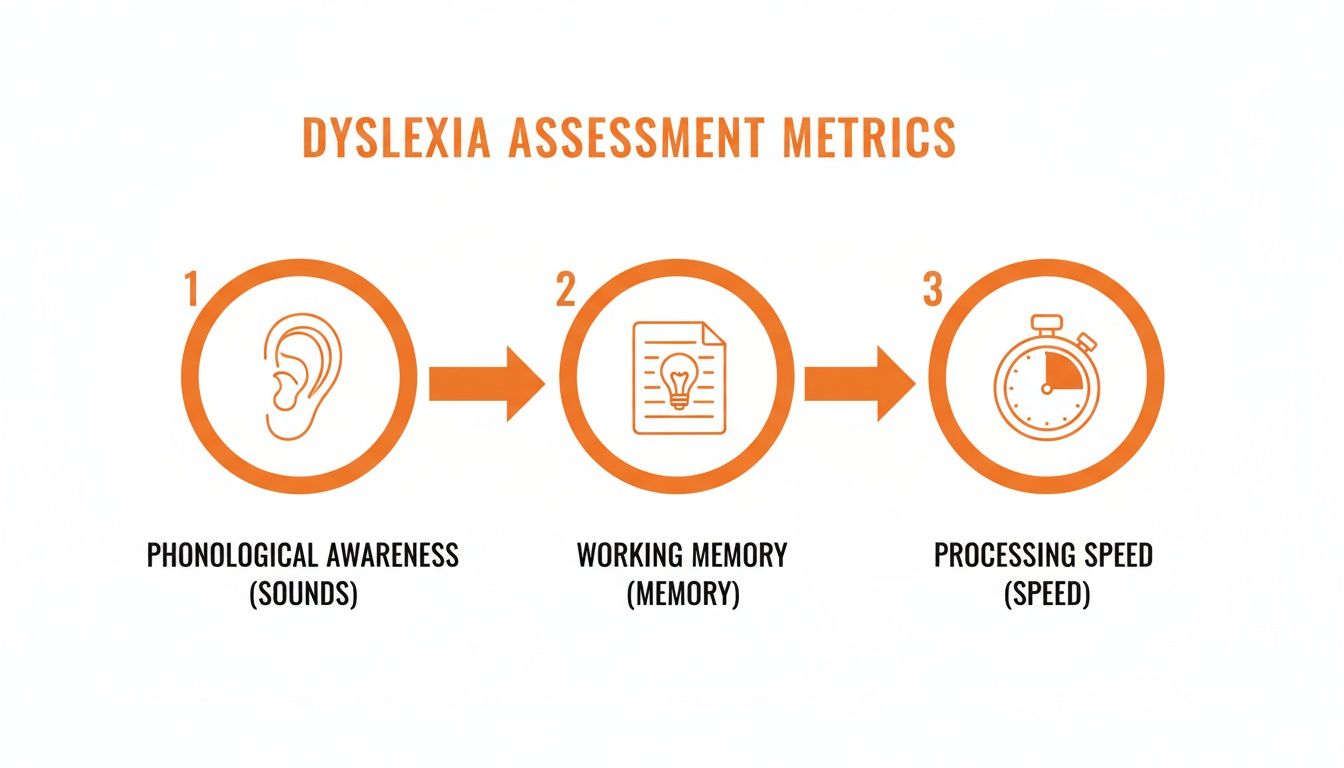
As you can see, the assessment looks closely at how your brain processes sounds, holds onto information for short periods, and deals with visual information quickly.
Stage 3: Scoring, Interpretation, and Reporting
Once the testing is done, the clinician’s work is far from over. They'll score every test and comb through the data, looking for a very specific pattern. To diagnose dyslexia, they’re searching for a clear gap between your overall intellectual ability and how you perform in areas like phonological processing or reading speed.
The report doesn't just give you a label; it gives you a detailed roadmap. It outlines your unique cognitive strengths—areas where you excel—and connects them to the specific challenges you face, providing a clear 'why' behind your lifelong struggles.
All of this analysis is then put together in a comprehensive written report. This document will lay out all your test scores, explain what they mean in plain English, and, if the results support it, provide a formal diagnosis. This report is your key to getting accommodations at work or in post-secondary education.
Stage 4: The Feedback Session and Action Plan
The final piece of the puzzle is the feedback session. This is where the clinician sits down with you and walks you through the report, making sure you understand every part of the findings. It's your opportunity to ask questions and really connect the dots between the test results and your own lived experiences.
More importantly, this session ends with a solid action plan. Based on your unique profile, the report will offer personalized, actionable recommendations. These could include things like:
Specific assistive technologies: For example, "Use the 'Speechify' app to listen to long documents instead of reading them."
Practical strategies: Such as, "Use the Pomodoro Technique for time management to maintain focus during writing tasks."
Referrals to specialists, such as reading tutors or executive function coaches.
This is also where modern digital tools can come into play. Platforms from Orange Neurosciences, for instance, can be used to build data-driven intervention plans that use objective measurements to track your progress over time. To understand how these evaluations fit into the bigger picture, you can check out our guide on what is cognitive assessment. From start to finish, the entire process is designed to leave you with clarity and a clear path forward.
How to Find and Prepare for Your Assessment
Deciding to pursue a formal dyslexia in adults test is a huge step. So, what’s next? Let’s get practical and talk about finding the right person to guide you through this and what you can do to get ready for the day of your assessment. This isn’t about studying for an exam; it's about making sure the experience is as clear and helpful as possible.
Finding the Right Professional
Honestly, finding the right clinician is the single most important part of this journey. You need someone who has specific experience assessing learning differences in adults, not just in kids. The challenges of dyslexia show up differently in the workplace or in higher education, and you want an expert who truly gets those nuances.
Look for a registered neuropsychologist or educational psychologist. These professionals have the specialized training needed to conduct the kind of deep-dive cognitive and academic testing that provides real answers. As you start your search, it can be really helpful to get some perspective on what makes a good fit. This guide to choosing the right professional has some great pointers.
Once you have a shortlist, treat your first phone call or email like a mini-interview. Don't be shy about asking direct questions before you commit.
Experience: "Could you tell me about your specific experience assessing dyslexia in adults?"
Process: "What does your assessment process look like from start to finish?"
Cost: "What is the total cost for the evaluation, and what exactly does that cover? Are there payment plans available?"
Outcome: "What kind of report will I get? Will it be detailed enough for me to request accommodations at work or school?"
That initial chat will tell you a lot about their approach and whether you feel comfortable with them. Go with your gut.
How to Prepare for Your Assessment Day
Let's be clear: you can't "study" for a dyslexia assessment. Trying to "beat the test" completely misses the point, which is to get an accurate snapshot of your cognitive wiring. The best way to prepare is to take care of yourself and gather some useful background information.
Your Practical Preparation Checklist:
Prioritize Rest: This is non-negotiable. Get a good night's sleep before your appointment. A tired brain simply won't perform at its peak, and that could easily skew the results.
Eat a Good Meal: Have a solid breakfast or lunch beforehand. Your brain is a high-energy organ, and it needs fuel to stay focused through several hours of testing.
Gather Your History: Pull together any documents that might help the psychologist see the bigger picture. Think old report cards with teacher's comments, past performance reviews from jobs, or even notes you've jotted down about your own struggles.
Manage Anxiety: It's totally normal to feel nervous. Try some breathing exercises or whatever helps you stay calm. And remember this: you cannot fail. This is simply a process of discovery.
Many adults have spent years, even decades, struggling without knowing why. The need for a proper assessment is very real. In the U.S., it's estimated that among adults reading below a 7th-grade level, a staggering 50-80% have learning disabilities, with dyslexia being a major factor.
If you're not quite ready to jump into a full diagnostic evaluation but are curious about your cognitive profile, an online screener can be a great first move. You can explore our online cognitive assessment tools to get a feel for your strengths and weaknesses. Taking these small steps can empower you to walk into a formal assessment feeling prepared and confident.
Common Questions About Adult Dyslexia Testing
Thinking about getting a formal dyslexia in adults test? It's a big step, and it’s completely normal to have a ton of questions swirling around. Most people wonder about the process, the price tag, and what it all really means for them. Let's clear up some of the most common ones.
Is It Really Worth Getting Tested for Dyslexia as an Adult?
For so many adults, the answer is a resounding yes. A diagnosis often brings this incredible wave of relief—finally having a name for the challenges you've faced your whole life. It’s the official key that can unlock accommodations at work, like getting access to assistive technology or being granted extra time for written assignments.
But it goes deeper than that. An assessment gives you a personalized roadmap. Instead of trying generic advice that doesn't quite fit, you get targeted, evidence-based strategies that actually work for you, helping you rebuild confidence and find better ways to navigate your professional and personal life.
How Much Does a Dyslexia Test Cost?
This is a big one. A full diagnostic evaluation isn't cheap, and the price can swing quite a bit, usually falling somewhere between $1,500 to over $5,000. What you end up paying really depends on the clinician’s level of expertise and where you live.
Getting insurance to cover it can be a bit of a maze. Some plans might pay for a portion if it’s considered medically necessary for a related condition, but many providers see it as an educational assessment and won't cover it. Your best bet is to call your insurance company directly and ask about your specific benefits. Another route to explore is university psychology clinics, which sometimes offer high-quality assessments for a lower cost.
Can I Fail a Dyslexia Test?
Let's get this straight: you absolutely cannot "fail" a dyslexia test. This isn't an exam with a pass-fail grade, and it has nothing to do with how intelligent you are.
An assessment is simply a diagnostic tool. Its only job is to uncover a specific pattern of cognitive strengths and weaknesses. The goal is just to see how your brain processes information and if that pattern lines up with the known profile of dyslexia.
Think of it more like a data-gathering mission than a performance. The only outcome is clarity.
What Happens After I Receive a Diagnosis?
Getting a diagnosis is really just the start of a new, more empowered chapter. You’ll get a detailed report from your assessment that includes recommendations tailored specifically to your cognitive profile. This could mean working with a specialist, starting to use tools like text-to-speech software, or learning new organizational strategies that play to your strengths.
This report is your official ticket for requesting accommodations at work or in school. It also creates a clear baseline, so if you begin targeted interventions, you have a way to track your progress. For example, you could use this information to find training programs designed to strengthen specific cognitive skills and then use objective data to see how far you've come.
Ready to take that first step toward understanding your own cognitive profile? While it's not a diagnostic tool, Orange Neurosciences provides objective data to help you and your clinician make clear, informed decisions.
Visit our website or contact us by email to learn how our evidence-based cognitive assessment tools can support your journey. Find out more at https://orangeneurosciences.ca.
Orange Neurosciences' Cognitive Skills Assessments (CSA) are intended as an aid for assessing the cognitive well-being of an individual. In a clinical setting, the CSA results (when interpreted by a qualified healthcare provider) may be used as an aid in determining whether further cognitive evaluation is needed. Orange Neurosciences' brain training programs are designed to promote and encourage overall cognitive health. Orange Neurosciences does not offer any medical diagnosis or treatment of any medical disease or condition. Orange Neurosciences products may also be used for research purposes for any range of cognition-related assessments. If used for research purposes, all use of the product must comply with the appropriate human subjects' procedures as they exist within the researcher's institution and will be the researcher's responsibility. All such human subject protections shall be under the provisions of all applicable sections of the Code of Federal Regulations.


© 2026 by Orange Neurosciences Corporation