A dementia test online: A practical guide to how it works and next steps
Feb 6, 2026
Googling "dementia test online" can feel like a big, uncertain step, but it’s a proactive way to get a handle on your cognitive health. The best way to think about an online cognitive test is to compare it to a home blood pressure cuff. It's an easy-to-use tool that gives you a starting point—some initial data to see what's going on. It’s absolutely not a final diagnosis, but it’s a solid first step that can lead to more meaningful conversations with your doctor.
Your First Step in Understanding Brain Health
Taking that first step to explore your cognitive health is always the hardest, but it's also the most important. The thought of an online assessment can be intimidating. You might worry about what it involves, whether it's accurate, and what the results could mean. But these tools aren't there to deliver a scary verdict; they're designed to empower you with objective information.
Let’s think about a real-life situation. Maybe you’ve noticed a loved one has become more forgetful—misplacing their keys more than usual or struggling to remember a conversation you just had. Jumping straight to "you need to see a doctor" can feel confrontational. A gentle, at-home cognitive screening can be the perfect bridge. It’s a low-stress way to look at cognitive function and turn those vague worries into actual data points.
Why an Online Test Is a Practical Starting Point
An online cognitive assessment gives you a crucial baseline. Think of it as a snapshot of your brain's performance at a specific moment in time, measuring key areas like memory, attention, and problem-solving. This initial data is incredibly valuable for a few reasons:
It establishes a benchmark. This creates a reference point, making it so much easier to track any cognitive changes over time.
It helps with doctor's visits. Walking into an appointment with a report from a validated test gives your doctor specific information to work with, right from the get-go. This leads to a much more productive conversation.
It promotes early awareness. Spotting potential cognitive shifts early on can open the door to timely interventions and better management strategies down the road.
An online test isn't about diagnosing a condition by yourself. It’s about arming yourself with the right information to ask the right questions and seek professional guidance with confidence.
Ultimately, these digital tools take the mystery out of the first stages of a cognitive assessment. They turn a process that often feels complex and intimidating into a manageable, actionable step. By understanding what a cognitive assessment truly is, you can move forward with clarity and purpose. For a deeper dive into the fundamentals, you can learn more about what is a cognitive assessment in our detailed guide. This knowledge helps you take control of your brain health journey, ensuring your next steps are both informed and effective.
What an Online Dementia Test Actually Measures
When you take a dementia test online, it’s doing a whole lot more than just asking you to remember a list of words. Think of it less like a pop quiz and more like a detailed workout for your brain. These assessments are carefully designed to measure specific cognitive domains—the core functions your brain relies on every single day to think, act, and navigate the world.
Instead of spitting out a simple "pass" or "fail," a high-quality online cognitive assessment gives you rich, objective data. It paints a detailed picture of your cognitive strengths and can shine a light on areas that might need a bit more attention. This information is a crucial first step, turning vague worries into concrete data that you and your doctor can actually work with.
Beyond Simple Memory Quizzes
While memory is certainly a key piece of the puzzle, a truly comprehensive test looks at the bigger picture. It evaluates how different parts of your brain team up to handle complex tasks. These cognitive domains are the fundamental building blocks of your day-to-day life.
The flowchart below shows how the data from these tests fits into the broader diagnostic journey, starting from that initial data gathering and leading to a much more productive conversation with your doctor.
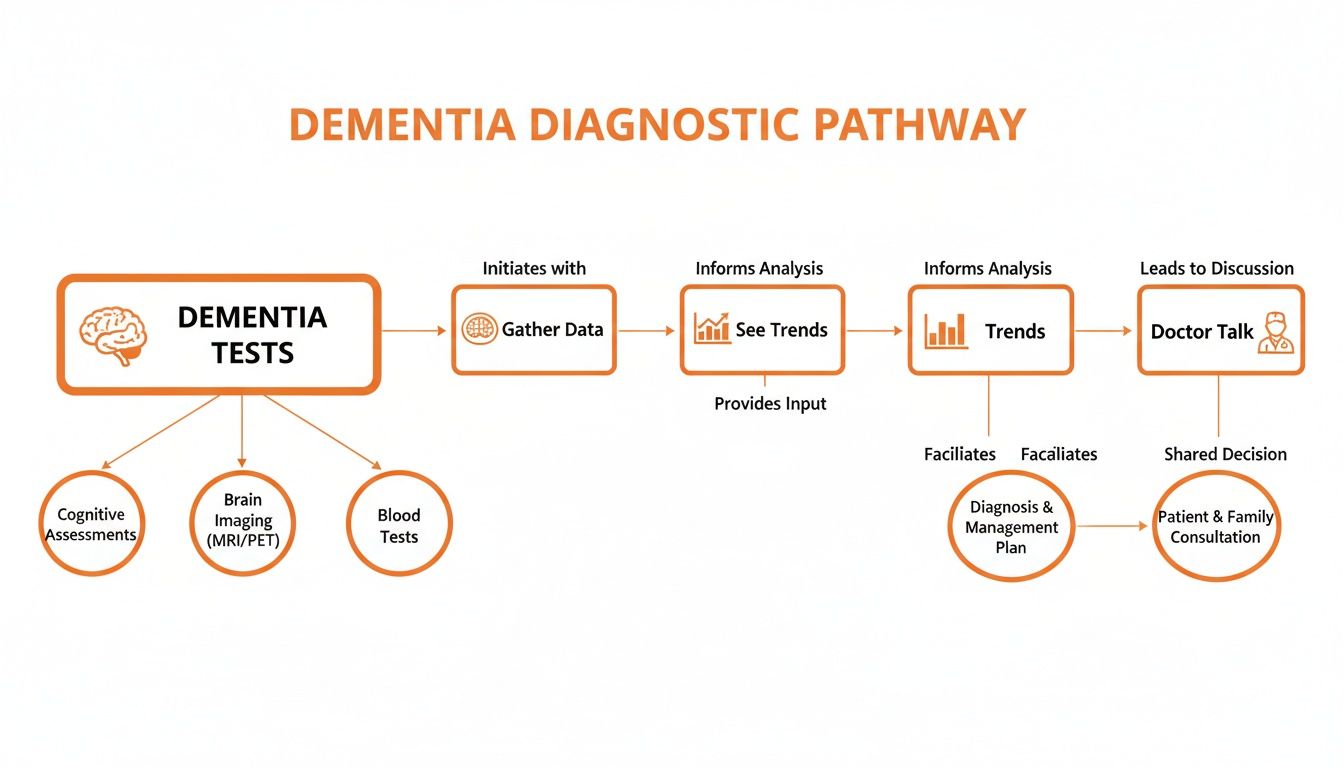
As you can see, an online test is the starting point. It’s about gathering objective information that helps identify trends, which in turn fuels an informed medical consultation.
To get a clearer idea of what's being measured, let's break down the main cognitive areas these tests explore.
| Key Cognitive Domains Assessed in Online Tests |
| :--- | :--- | :--- |
| Cognitive Domain | What It Involves | Everyday Example | | Executive Function | Planning, problem-solving, organising, and managing time and attention. The brain's "CEO." | Planning a multi-stop shopping trip, including the most efficient route and what to buy at each store. | | Attention | The ability to focus on a specific task while tuning out distractions. | Reading a book in a noisy café or concentrating on a conversation at a busy family dinner. | | Processing Speed | How quickly you can take in information, make sense of it, and react. | Reacting to a sudden stop sign or a ball rolling into the street while you're driving. | | Memory | Recalling information, both short-term (like a phone number) and long-term (like childhood events). | Remembering items on a grocery list you didn't write down or recalling a story from your past. | | Visuospatial Skills | Understanding what you see and how objects relate to each other in space. | Assembling flat-pack furniture from a diagram or parallel parking a car. | | Language | Understanding and using spoken or written words to communicate. | Finding the right word during a conversation or understanding the plot of a movie. |
These domains don't work in isolation; they're all interconnected. A good assessment looks at them holistically to create a full cognitive profile.
The Brain's CEO: Executive Function
One of the most critical areas these tests look at is executive function. You can think of this as the CEO of your brain. It’s in charge of planning, organising, solving problems, and managing your time and attention.
A perfect real-world example is planning that multi-stop shopping trip. Your executive function helps you figure out the most efficient route, remember which list goes with which store, and adapt on the fly if one shop is unexpectedly closed. An online test might measure this by asking you to solve a puzzle that requires you to plan several steps ahead.
Attention and Processing Speed
Next up are attention and processing speed. Attention is your brain's ability to lock onto a task while filtering out distractions, like trying to read a book in a loud café. Processing speed, on the other hand, is how quickly you can take in new information, understand it, and respond.
Think about driving. You have to process road signs, monitor other cars, and react to a sudden brake light—all in a split second. A game-like assessment might test this by having you quickly tap specific shapes or colours as they appear on the screen, measuring both your accuracy and your reaction time.
Perception and Visuospatial Skills
Finally, these tests often evaluate perception and visuospatial skills. These are the abilities that allow you to make sense of what you see and understand how objects relate to one another in physical space. Assembling flat-pack furniture is a classic real-world test of this skill—you have to interpret 2D diagrams and translate them into a 3D object.
An online task might measure this by asking you to mentally rotate an object to see if it matches another or to copy a complex drawing. This data helps round out your complete cognitive profile. By evaluating these distinct but interconnected domains, you get a much more holistic view of your brain's performance.
If you're interested in the specifics, you can learn more about the different types of clinically-validated cognitive assessments and how they work. This foundational understanding is key to making sense of your results and having a truly productive conversation about your brain health.
Choosing the Right Type of Online Cognitive Test
Dipping your toes into the world of online cognitive testing can feel a bit overwhelming, kind of like walking into a massive library without a map. There are countless options out there, but they aren't all created equal, and not every test will give you the answers you're looking for.
When you're searching for a dementia test online, the most important thing to know is what you want to get out of it. Are you just doing a quick, personal check-in on your own brain health? Or maybe you're a concerned family member trying to figure out if there's a reason to worry. Your goal will determine which tool is right for you.
Let’s break down the main categories so you can make a choice that makes sense for your situation.
Simple Self-Report Questionnaires
The most common and accessible starting point is the self-report questionnaire. You've probably seen these before—they're often just pen-and-paper tests that have been put online. A popular one is the Self-Administered Gerocognitive Exam (SAGE).
These tests are easy to find, free, and convenient. You can usually print them out or fill them in right on the screen. Most take only 10 to 15 minutes to complete and ask questions about things like memory, orientation, and basic reasoning.
But here’s the catch: their biggest strength is also their greatest weakness. Since you're the one answering the questions and scoring the test, the results are entirely subjective. They depend on your own honesty and self-awareness, which can sometimes be influenced by the very cognitive changes you're trying to measure.
Actionable Insight: Questionnaires like the SAGE test are a decent first step. They can raise awareness and get a conversation started. But they just don't provide the objective, hard data needed for a real understanding of your cognitive function. Use them to open a door, not to get a definitive answer.
Interactive Gamified Assessments
A huge leap forward from static questionnaires are the interactive, gamified assessments. These aren't just simple quizzes. They are scientifically designed tasks cleverly disguised as engaging games. Instead of asking if you have memory problems, they measure your memory directly by challenging you to complete a specific task.
For instance, a test might gauge your processing speed by having you tap on certain shapes as they pop up on the screen. It doesn't just track whether you got it right or wrong; it measures your reaction time down to the millisecond. That’s a level of detail a questionnaire could never capture.
This approach is so much more powerful, and for good reason:
Objective Data: It measures what you can do, not just what you think you can do, taking all the guesswork out of it.
Engaging Format: The game-like feel makes the whole process less stressful and more motivating.
Comprehensive Metrics: It can look at multiple cognitive areas at once, from your executive function to attention and visuospatial skills.
Tools like these paint a much richer, more detailed picture of your cognitive profile. They turn abstract ideas like "attention" into real, measurable data points, giving you a clearer map of your cognitive strengths and weaknesses.
Clinical-Grade Screening Tools
At the very top, you’ll find clinical-grade screening tools, like the platform we’ve developed here at Orange Neurosciences. These are built not just for you to use at home, but to be seamlessly integrated into a professional healthcare setting. They take the engaging and objective nature of gamified tests and back them up with rigorous scientific validation.
These platforms are designed from the ground up to produce reliable data that a doctor can actually use and trust. For example, while a tool like the SAGE test is often considered more sensitive than the MMSE for spotting early cognitive issues, it always requires professional follow-up. If you want to dive deeper into how clinicians compare these tools, our guide on the MoCA vs the MMSE is a great resource.
Clinical-grade tools generate detailed reports that are easy for anyone to understand and align with established medical criteria, like the DSM-5 guidelines for neurocognitive disorders. This closes the gap between a personal screening and a professional medical evaluation, giving your doctor a valuable head start. The whole point is to provide data that is not just interesting, but truly actionable. Choosing an evidence-based platform ensures the results from your online dementia test are a credible, solid foundation for what comes next.
What an Online Test Can and Cannot Tell You
So, you’ve just finished an online dementia test. You’re looking at a score or a report, trying to figure out what it all means. It's so important to have the right perspective from the very beginning.
Let's be crystal clear about one thing: no online test can diagnose dementia. A proper diagnosis is a detailed medical journey guided by a qualified healthcare professional. It’s simply not something a website can do.
Think of an online screening tool as a smoke detector. It’s designed to alert you that something might be wrong. It can't tell you if it's a small kitchen fire or something more serious, but its warning is the critical first signal to call in the experts. An online cognitive test works the same way—it provides an initial heads-up, not the final word.

What an Online Test Can Do for You
A well-designed, scientifically-backed online test isn't just a quiz; it serves a few really important purposes. It can take those vague feelings of worry and turn them into something more concrete you can actually look at. That’s a powerful first step in taking charge of your cognitive health.
A good test can:
Provide a Cognitive Baseline: It offers a snapshot of how your brain is performing right now, creating a valuable benchmark you can refer back to later.
Identify Areas for Discussion: The results can pinpoint specific cognitive areas—like memory, attention, or problem-solving—that might be worth bringing up with your doctor.
Empower You for Your Appointment: Showing up to a doctor's appointment with a detailed report is much more productive than simply saying, "I've been feeling foggy." It gives your physician structured, helpful information right away.
What an Online Test Cannot Do
It's just as vital to understand the limits of these tools. An online test is for screening, not diagnosing. It can't possibly figure out the root cause of any cognitive changes you might be noticing.
Here’s what a test can't tell you:
If You Have Dementia: A score that falls outside the typical range isn't a diagnosis. It’s a flag—an indicator that a more thorough, in-person evaluation is a sensible next step.
The Cause of Your Symptoms: Countless things can mess with your cognitive performance, and a simple online test can't sort through them all.
The Specific Type of Dementia: Telling the difference between conditions like Alzheimer's disease, vascular dementia, or Lewy body dementia requires a comprehensive clinical workup.
Actionable Insight: Treat your results as a conversation starter, not a conclusion. Your next step should always be to schedule an appointment with your doctor to discuss the findings and determine what, if anything, should happen next.
Factors That Can Influence Your Results
Your score on any given day isn't fixed in stone. Life happens, and plenty of temporary factors can sway your cognitive performance and, in turn, your test results.
Think about these common variables:
Stress and Anxiety: Being under a lot of stress can seriously impact your focus and ability to recall things.
Lack of Sleep: We all know this one. A rough night's sleep can leave your brain feeling slow and dull.
Medication Side Effects: Some common medications can cause "brain fog" or other cognitive symptoms.
Technical Glitches: Even something as simple as a spotty internet connection or a noisy room can throw off your performance.
Keeping these things in mind helps put your results into a broader, more realistic context. It's why this information should be used to guide your next steps, not to label yourself. This is especially critical in places facing significant challenges. For instance, California's Alzheimer's epidemic claims over 17,300 lives each year, with a mortality rate of 44.5 per 100,000 people. These stark numbers underscore why getting timely, professional medical advice is so important. You can read more in this research about California's Alzheimer's impact.
At the end of the day, telling the difference between a temporary cognitive blip and a more persistent condition is a complex job for a professional. Check out our guide on Mild Cognitive Impairment vs. dementia to get a clearer picture of how these conditions are properly evaluated.
How to Discuss Your Results With Your Doctor
So, you've taken an online dementia test and have the results in hand. This isn't a moment for alarm—it's a moment for clear-headed action. Think of that report not as a final verdict, but as a conversation starter. Its whole purpose is to help you move from a vague sense of worry to a tangible, productive discussion with your doctor.
Taking these results to a healthcare professional is the single most important next step. The report is your opening statement, a way to begin a dialogue about your brain health. Your doctor is your partner in this, ready to help you make sense of the data, place it in the context of your overall health, and figure out what should come next.

Preparing for a Productive Appointment
Walking into your doctor's office prepared can make all the difference. When you're organised, you can steer the conversation with confidence instead of feeling anxious or overwhelmed. The idea is to give your doctor the complete picture so they can give you the best possible advice.
Here’s a simple checklist to get your thoughts and materials organised before you go:
Bring the Full Test Report: Don't just show up with the final score. If you can, print out the entire report, especially if it breaks down your performance across different cognitive areas like memory, attention, and executive function.
List Specific, Real-World Examples: This is absolutely vital. A test score is abstract, but real-life stories make it concrete for your doctor. Instead of saying, "My memory is bad," try to be more specific.
Practical Example 1: "Last Tuesday, I got lost driving to the grocery store—a route I've taken for 20 years."
Practical Example 2: "I've had trouble following the plot of my favourite TV show lately; I keep forgetting who the characters are."
Practical Example 3: "I started cooking dinner last night and completely forgot I’d left the stove on until the smoke alarm went off."
Note Any Changes in Mood or Behaviour: Have you been feeling more irritable, anxious, or withdrawn? Have friends or family mentioned any shifts in your personality? Jot these down. They can be important pieces of the puzzle.
Compile a List of All Medications: This includes everything—prescriptions, over-the-counter drugs, and any vitamins or supplements you take. Some medications have side effects that can mimic cognitive issues.
Being this prepared helps your doctor connect the dots between the test data and your day-to-day experience.
Key Questions to Ask Your Doctor
Once you're in the appointment, having a few questions ready will help guide the discussion and ensure you leave with a clear path forward. This is your health, and you are your own best advocate.
Consider asking things like:
"Based on this report and what I've told you, what are your initial thoughts?"
"What other factors could be contributing to these cognitive changes?"
"What are the next steps for a more thorough evaluation?"
"Are there any lifestyle changes I can make right now to support my brain health?"
Actionable Insight: Don't leave the appointment without a clear plan. This could be a referral to a specialist, a schedule for follow-up blood tests, or specific lifestyle changes to implement. Your goal is to walk out with a concrete list of next steps.
Bridging the Gap Between Screening and Care
The scale of this challenge is huge. For instance, Orange County is a prime example of California's dementia challenge, with over 164,000 residents affected by dementia or mild cognitive impairment. This situation really highlights the urgent need for efficient, reliable ways to start the diagnostic process. You can learn more about California's dementia statistics to understand the bigger picture.
This is precisely where clinically-validated platforms like Orange Neurosciences come in. Our reports are specifically designed to be shared with healthcare professionals. They provide objective, structured data that a doctor can immediately understand and use, effectively bridging the gap between an at-home screening and professional medical care.
While you're discussing the results, it's also a good idea to think about broader support. If you find mental and emotional challenges coming up, exploring options like online psychotherapy and counselling can be incredibly helpful. Your cognitive health is deeply connected to your overall well-being. By taking this report to your doctor, you’re not just asking for answers; you are kick-starting a partnership for your health.
How Professionals Use Digital Cognitive Screenings
Digital cognitive screenings aren't just for you and me; they've quickly become indispensable tools in professional healthcare. For clinicians, these platforms are a way to efficiently gather objective, reliable data, completely changing how cognitive health is tracked and managed. It’s a leap from subjective observation to data-driven care planning.
Think about a primary care physician who starts using a quick digital cognitive screening during the annual check-up for all patients over 65. This simple step establishes a vital cognitive baseline for every single person. When a patient comes back the next year, the doctor can compare new results against this baseline, making it far easier to spot subtle but important changes that might otherwise fly under the radar.
Streamlining Care in Different Settings
The real-world applications are vast, saving valuable clinical time while actually improving the quality of care. A busy therapist, for instance, can track a patient's recovery after a brain injury using regular digital assessments to objectively measure progress. This data gives them clear proof of what's working and helps fine-tune rehabilitation exercises.
In long-term care facilities, staff can use these tools to keep a close eye on residents' cognitive health. An unexpected dip in a resident's scores can trigger an early-warning alert, prompting a clinical review long before a major decline becomes obvious. This proactive approach allows for earlier interventions, which can make a world of difference to someone's quality of life.
Actionable Insight: If you're managing care for a loved one, ask their healthcare provider if they use digital cognitive monitoring. It can be a powerful tool for collaborative care, giving both you and the medical team objective data to track progress and make informed decisions together.
Making Data-Driven Decisions
The real strength of these tools is their ability to deliver consistent, objective metrics. This is especially critical when you look at the scale of the challenge. For example, an estimated 720,000 people aged 65 and older are living with Alzheimer's in California alone, and that number is expected to jump by over 20% by 2025. You can get more details on the rising dementia rates in California. That reality makes efficient and accurate screening more crucial than ever before.
Professional platforms like Orange Neurosciences are built specifically for this need, creating detailed reports that fit right into clinical standards. To get a better sense of the in-depth evaluations that often follow a screening, our guide on what is a neuropsychological assessment offers some great context.
After talking through the results with a doctor, it's also helpful to understand the practical side of things. Resources that offer tips on how to work with dementia patients can be an incredible source of insight for families and caregivers alike.
Got Questions About Online Dementia Tests? We Have Answers.
Thinking about an online cognitive test for yourself or someone you care about can bring up a lot of questions. It's completely normal to wonder about things like timing, privacy, or even what to do if someone is hesitant. We've put together some clear, direct answers to the questions we hear most often to help you feel more confident moving forward.
Our aim here is to cut through the confusion and give you the practical information you need to make the best decisions for your cognitive health.
How Often Should I Take an Online Cognitive Test?
When it comes to monitoring your brain health, consistency is really the key. A good rule of thumb is to take a test to get a baseline reading, and then check in again every 6 to 12 months. This rhythm helps you track your cognitive patterns over time and notice if any real changes are happening.
But if you or a loved one notices a sudden or major shift in memory or thinking skills, don't just keep re-testing online. The best move is to book an appointment with your doctor right away. And when you do take a follow-up test, try to keep the conditions the same—use the same assessment, in the same quiet room, around the same time of day. This helps make sure your results are as comparable as possible.
Are My Results From an Online Dementia Test Private?
Your privacy is non-negotiable. Any reputable platform will have serious security measures in place, like strong encryption and adherence to health privacy laws, to protect your personal data. It’s always a smart move to read a platform’s privacy policy before you start.
Be wary of those simple, free online quizzes that might not have tight security. Clinical-grade platforms are built differently; data security is fundamental to their design. They work to keep your results confidential and will only share them with your explicit permission, like when you decide to generate a report to share with your doctor.
Actionable Insight: Before using any online health tool, spend two minutes checking for a "Privacy Policy" link, usually at the bottom of the homepage. Look for keywords like "encryption" and "HIPAA compliant" (if you're in the US) to ensure your data is being handled responsibly.
Can an Online Test Differentiate Types of Dementia?
No, an online test can’t tell you the specific type of dementia someone might have, like Alzheimer's disease, vascular dementia, or Lewy body dementia. Figuring out the exact cause of cognitive decline is a complex medical detective story that requires a full workup by a specialist.
A formal diagnosis usually involves a combination of things, including:
A detailed neurological exam
Brain imaging, like an MRI or CT scan
Blood tests to check for other possible causes
A deep dive into your complete medical history
Think of an online screening tool as an early-alert system. Its job is to flag potential issues that need a closer look from a professional. It’s the first step that points you in the right direction, not the final answer.
What if a Loved One Refuses to Take a Test?
This is an incredibly common—and sensitive—situation. If a loved one is pushing back against the idea of a test, it’s crucial to lead with empathy, not pressure. Often, that resistance is rooted in fear or denial, so a gentle, understanding approach is your best bet.
Try changing the language. Instead of a "dementia test," maybe call it a "brain health check-up." This can lower the anxiety around the topic. You could even suggest doing it together, turning it into a supportive activity rather than a solo ordeal.
If they're still not open to it, try connecting it to a specific, real-world concern. You might say, "I've noticed you've been having a bit of trouble with your medications lately, and I'm worried. How about we just mention it to the doctor at your next check-up?" Sometimes, hearing the suggestion from a family doctor during a routine visit can make it feel like a normal part of healthcare, not a confrontation.
Taking that first step to understand your cognitive health is a powerful, proactive move. At Orange Neurosciences, we're here to provide objective, evidence-based tools that give you the reliable data you need for those important conversations with your doctor. Our platform is built to offer clear insights into your cognitive function, putting you back in control of your brain health journey.
Take the first step today. Explore our scientifically validated cognitive assessments and see how we can support your journey to better brain health at https://orangeneurosciences.ca.
Orange Neurosciences' Cognitive Skills Assessments (CSA) are intended as an aid for assessing the cognitive well-being of an individual. In a clinical setting, the CSA results (when interpreted by a qualified healthcare provider) may be used as an aid in determining whether further cognitive evaluation is needed. Orange Neurosciences' brain training programs are designed to promote and encourage overall cognitive health. Orange Neurosciences does not offer any medical diagnosis or treatment of any medical disease or condition. Orange Neurosciences products may also be used for research purposes for any range of cognition-related assessments. If used for research purposes, all use of the product must comply with the appropriate human subjects' procedures as they exist within the researcher's institution and will be the researcher's responsibility. All such human subject protections shall be under the provisions of all applicable sections of the Code of Federal Regulations.


© 2026 by Orange Neurosciences Corporation