Cognitive Therapy for ADHD: Practical Techniques to Boost Focus
Mar 23, 2026

Cognitive therapy for ADHD isn't about "trying harder." It’s a practical, evidence-based way to give you the skills to manage your own thoughts, emotions, and actions.
Instead of fighting against your brain, you learn to work with it. Think of it as rewiring the brain's "air traffic control system" to improve focus, get organized, and handle emotional ups and downs. The goal here is to create lasting changes in how your brain functions day-to-day. For instance, rather than just forcing yourself to sit still, you'll learn actionable techniques to break down overwhelming tasks into manageable steps, making focus a natural outcome, not a constant battle.
How Cognitive Therapy Actually Reshapes the ADHD Brain

Let's be honest—the term 'cognitive therapy' can sound a bit clinical and intimidating. At its heart, it's really just a systematic way to train your mind to better handle life's demands. It’s like getting a personal trainer for your brain, targeting the specific areas where ADHD creates friction.
This isn’t just about putting a bandage on symptoms. It’s about building foundational mental skills from the ground up. The process starts by spotting and challenging the unhelpful thought patterns that so often come with ADHD—like the feeling of being overwhelmed that fuels procrastination, or the self-doubt that stops you from even starting a task.
Building a Practical Toolkit for Real-World Challenges
Cognitive therapy gives you a toolbox of strategies to tackle those all-too-familiar ADHD hurdles. The idea is to make executive functions—things like planning, prioritizing, and staying on task—feel less like a constant struggle and more like a deliberate, practiced skill.
It works by breaking down huge, intimidating goals into small, manageable steps. It’s an incredibly practical approach designed to bring real, noticeable improvements to your life at school, at work, and in your relationships.
Here’s an actionable example for a student struggling with a massive research paper:
Step 1: Use the "Pomodoro Technique." Set a timer for just 15 minutes and brainstorm any and all ideas, no matter how messy. When the timer goes off, take a 5-minute break.
Step 2: After your break, set another 15-minute timer to sketch out a simple outline with three main points.
Step 3: For the final 15-minute block, focus only on finding sources for the very first point.
This small shift turns the paralyzing thought of "This is impossible" into the actionable plan, "I can do these three small things." Over time, this builds the momentum and confidence needed to break the cycle of avoidance that many people with ADHD know so well.
A core belief in cognitive therapy is that by changing how you think and what you do, you can literally change how your brain is wired. This is the science of neuroplasticity, and it’s what makes these strategies so powerful for long-term growth.
Of course, this isn't a one-size-fits-all fix. Modern, measurable therapy plans, like those we're pioneering at Orange Neurosciences, use data-driven insights to build truly personalized programs. By first understanding an individual's unique cognitive profile, we can target interventions exactly where they’re needed most, creating a clearer and more efficient path toward improvement. You can learn more in our guide that explains what is cognitive function and why it's so important.
When you hear “cognitive therapy for ADHD,” it’s easy to assume it’s a one-size-fits-all solution. But that couldn't be further from the truth. The reality is more like a specialist's toolkit, with different tools designed to tackle very specific challenges.
Getting a handle on these differences is the first step to finding the right kind of support—whether it's for you, your child, or a client you're working with. Let's break down the main types. Think of them not as competing methods, but as complementary experts you'd bring in for different parts of a big project.
Cognitive Behavioural Therapy: Your Mindset Coach
First up is Cognitive Behavioural Therapy (CBT). Picture a mindset coach whose entire job is to help you untangle the connections between your thoughts, your feelings, and what you end up doing. For someone with ADHD, this web is often knotted with procrastination, frustration, and a whole lot of self-criticism.
CBT doesn't aim to directly "fix" core ADHD symptoms like inattention. Instead, it goes after the secondary problems that crop up around them. It’s all about learning to spot and challenge the automatic negative thoughts that can sabotage your best efforts before you even get started.
Here’s a practical, actionable scenario for tackling a messy desk:
The Automatic Thought: “This is a total disaster. I'll never get this done. Why am I always so disorganized?”
The Feeling: A wave of overwhelm and shame hits, making you want to run.
The Action: You grab your phone and start scrolling, which only reinforces the whole cycle.
A CBT therapist helps you catch that first thought and reframe it. You learn to swap it for something more realistic and, most importantly, actionable. Something like, "Okay, this desk is a mess. I will set a timer for 10 minutes and clear just one corner." That small mental shift breaks the emotional paralysis and makes it possible to actually begin.
Cognitive Training: The Brain's Gymnasium
Next, we have Cognitive Training, which is best thought of as a dedicated gym for your brain. While CBT works on your mindset, cognitive training directly exercises the underlying mental muscles—the core cognitive functions that ADHD can weaken, like working memory, processing speed, and sustained attention.
It's a lot like a strength and conditioning program. You don’t just "try harder" to lift something heavy; you perform specific, repetitive exercises that build the required muscle over time. Cognitive training programs use targeted, often game-like activities to strengthen these crucial neural pathways.
At the heart of this is neuroplasticity—the brain's incredible ability to reorganise itself by forging new connections. Consistent, focused practice can genuinely improve the efficiency of the brain's "wiring" for things like focus and memory.
For example, a training task might involve remembering a sequence of flashing lights and then repeating it. As you improve, the sequences get longer and faster, constantly pushing your working memory to adapt and grow stronger. This is a world away from just talking about your challenges; it's about actively building the raw cognitive horsepower needed to overcome them.
Executive Function Coaching: Your Personal Project Manager
Finally, there’s Executive Function Coaching. If CBT is your mindset coach and cognitive training is your brain's gym, then an executive function coach is your personal project manager. This approach is intensely practical, focusing on one thing: translating cognitive skills into real-world results.
This type of coaching bridges the often-massive gap between knowing what you should do and actually doing it. A coach works with you side-by-side to build customized systems for managing time, organizing your space, and planning projects, all tailored to the unique wiring of an ADHD brain.
Here’s what that looks like in action:
Time Management: Your coach helps you implement a visual timer or the Pomodoro Technique to break down work into focused, 25-minute sprints followed by a 5-minute break. This makes long tasks feel less daunting.
Organisation: Together, you create a “launch pad” by the front door with a designated home for keys, your wallet, and work bags to end those frantic last-minute searches.
Planning: The coach helps you break down a huge project (like applying for a new job) into a visual timeline on a whiteboard with small, concrete daily tasks, like "Update LinkedIn profile summary" or "Find 3 job postings."
This approach is less about the "why" and all about the "how." It provides the structure and accountability needed to implement new strategies until they become second nature.
To help you see how these approaches stack up, here’s a quick comparison.
Comparing Cognitive Therapy Approaches for ADHD
This table offers a simple, at-a-glance look at the three main cognitive therapies we've discussed. Use it to quickly understand where each one focuses and what kind of challenges it's best suited for.
Therapy Approach | Core Focus | Best For | Example Activity |
|---|---|---|---|
Cognitive Behavioural Therapy (CBT) | Changing negative thought patterns and emotional responses linked to ADHD. | Managing anxiety, procrastination, low self-esteem, and emotional dysregulation. | Identifying and reframing an automatic negative thought, like "I'll never finish this," to something actionable. |
Cognitive Training | Directly strengthening core cognitive functions like memory, attention, and processing speed. | Building the underlying "mental muscles" needed for focus and task completion. | A digital game that challenges working memory by having you repeat increasingly complex sequences. |
Executive Function Coaching | Building practical, real-world skills and systems for organization and time management. | Turning cognitive abilities into consistent, real-life habits and routines. | Creating a visual calendar and breaking a large project into small, manageable steps with a coach's support. |
Each of these therapies plays a vital role, and often, the most effective plan involves a combination of them. The key is to match the right tool to the right problem.
You can learn more about the different evidence-based cognitive therapies and how they target specific challenges in our detailed guide.
The Science of Rewiring an ADHD Brain
Have you ever wondered what’s actually happening inside the brain during cognitive therapy for ADHD? It's not just some abstract mental exercise; it's a real, physical process. At the heart of it all is a remarkable concept called neuroplasticity—the brain's incredible, built-in capacity to change its own structure and function based on what we do and experience.
Think of your brain's neural connections like paths through a dense forest. The first time you try to forge a new path, the journey is tough and slow. But the more you walk that same route, the clearer and wider it becomes, making it the easier path to follow. Cognitive therapy works on that exact principle.
Every time you practice a new focusing technique or challenge an unhelpful thought, you are physically strengthening the specific neural pathways for that skill. With enough repetition, these "mental paths" for things like planning, focus, and emotional control become the brain's new default. The old, overgrown trails of distraction and impulsivity start to fade into the background.
From Practice to Physiology
This "rewiring" isn't just a convenient metaphor—it's a measurable, physiological change. The entire point of targeted cognitive exercises is to shift how your brain operates on a fundamental level, moving from a state of constant, effortful control to one where these new skills feel much more automatic. This is where the science gets really interesting, because we can now see signs of this change happening.
One of the key ways we can track this is by looking at brainwave activity using an electroencephalogram (EEG). Over years of research, scientists have identified certain brainwave patterns that are commonly associated with ADHD symptoms.
This is why cognitive therapy for ADHD in Canada is increasingly guided by these neurophysiological insights. For instance, research consistently points to a link between a higher ratio of slow-wave (theta) to fast-wave (beta) brain activity and the symptoms of ADHD. This theta/beta ratio has been directly correlated with slower reaction times, and one major meta-analysis found a medium effect size of 0.62 for this difference between kids with ADHD and their peers.
Making New Brain Habits Stick
Understanding these brain markers helps explain why cognitive therapy is so effective. The work isn't just about surface-level behaviour management; it's about systematically training the brain to generate more of that focused, "beta-wave" activity when it's needed, and less of the dreamy, "theta-wave" state during tasks that demand concentration. Over time, this helps normalize brain activity patterns.
This means that with every cognitive exercise you complete, you're not just learning a new trick. You are an active participant in remodelling your own brain.
The ultimate aim of cognitive therapy is to make executive function skills so well-practiced that they become habitual. The brain is an efficiency machine; it loves shortcuts. By repeatedly strengthening these new pathways, you are essentially creating new, healthier shortcuts for your brain to use automatically.
This is what makes the skills learned in therapy stick around, making them useful in new situations long after the formal sessions are over. If you want to dive deeper, you can also explore our guide on how a brain scan for ADHD fits into a full evaluation.
Cognitive therapy uses the principles of neuroscience to provide real, tangible methods for strengthening your ability to pay attention. For more practical advice on this, you can learn how to train your brain to focus.
Putting Cognitive Therapy into Practice
It's one thing to talk about cognitive therapy in theory, but what does it actually look like day-to-day? How do abstract ideas like “challenging negative thoughts” or “strengthening working memory” translate into real-world actions for someone with ADHD?
Let’s bridge that gap. We’ll walk through two very different, practical scenarios: first, a child using a modern, game-based cognitive training tool, and second, an adult applying a classic Cognitive Behavioural Therapy (CBT) technique to finally tackle procrastination.
A Child’s Journey with Gamified Cognitive Training
Meet Leo, a 10-year-old who has a tough time with working memory. Following multi-step instructions at school is a constant source of frustration. His therapist suggests a gamified cognitive training program that, to Leo, just feels like playing on a tablet.
Here is an actionable insight into how this works:
The Challenge: A sequence of colourful creatures appears on the screen, one by one, in different spots. Once they vanish, Leo’s job is to remember the sequence and tap the locations in the exact order.
Real-Time Adaptation: At first, the sequences are short and sweet—just two or three creatures. As Leo gets them right, the program’s AI gently ups the ante, adding another creature. If he starts to miss a few, it dials the difficulty back down. This keeps him in that sweet spot of being challenged but not discouraged.
The Outcome: Leo isn’t just playing a game; he's doing targeted reps for his brain's working memory circuits. This kind of consistent, adaptive practice helps forge stronger neural pathways for holding and using information. We dive much deeper into this connection in our guide to working memory and ADHD.
This is neuroplasticity in action. Consistent cognitive exercises build stronger neural connections, which ultimately leads to better real-world focus and function.
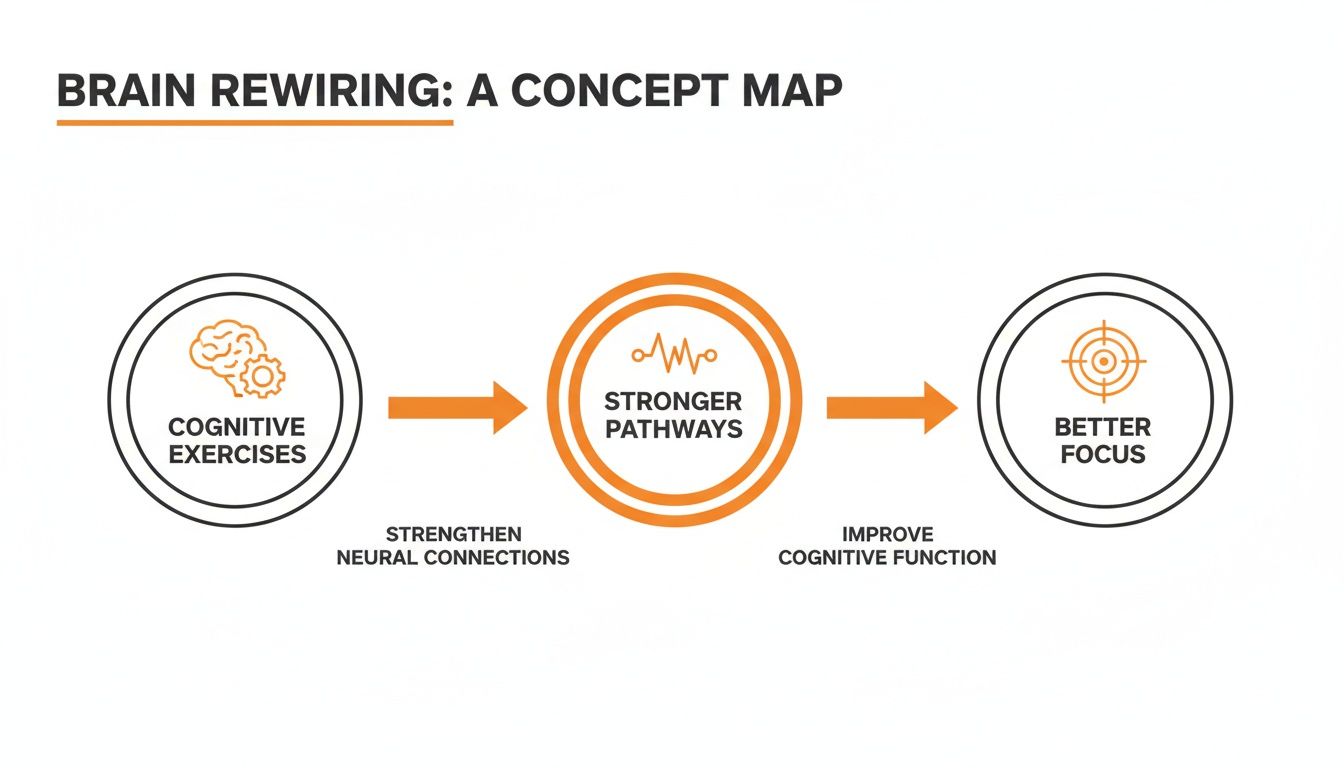
This targeted training is the engine driving that change, turning screen time into tangible cognitive gains.
An Adult’s Guide to Overcoming Procrastination with CBT
Now, let’s turn to Maya, a graphic designer whose career is stalled by a familiar cycle: she constantly puts off starting large client projects, leading to stress and last-minute panic. She decides to try a foundational CBT exercise to break the pattern.
Her current task is a big one—a new brand guide for a client—and the mere thought of it is paralyzing. She grabs a notebook and uses a simple CBT framework to untangle her thoughts.
Step 1: Identify the Automatic Negative Thought (ANT). The second Maya thinks about the project, her brain serves up a familiar line: “This is going to be a disaster. I don’t even know where to begin, and the client will hate whatever I do.”
Step 2: Challenge and Reframe the Thought. She stops and asks herself, is that thought 100% true? Of course not. She’s handled big projects before. She then reframes it into something more honest and helpful: “Okay, this project feels huge, but I can start with just one small piece, like the colour palette.”
Step 3: Create a Concrete Action Plan. That simple reframe makes the next step feel possible. Maya sets a tiny, non-threatening goal: “I will spend just 25 minutes gathering inspiration for the colour palette. That's it.” This small, defined task is enough to break the paralysis and start building momentum.
This structured process—identify, challenge, and replace—is the heart of cognitive therapy for ADHD. It turns a massive emotional spiral into a series of small, manageable problems to solve.
Of course, pairing these internal strategies with external support is a game-changer. Exploring ADHD-friendly organization tools can make a huge difference in managing the day-to-day chaos.
Here in Canada, cognitive therapy—especially through game-based tools—is showing incredible promise for ADHD. One key study found that after using a cognitive retraining tool, children's pre-treatment hyperactivity scores dropped from an average of 84.166 to 52.500. Impulsivity scores fell from 83.166 to 52.666, a truly massive clinical effect.
These examples show that cognitive therapy isn't just about talking; it's about building a toolkit of actionable skills for a better-functioning brain.
Measuring Progress and Proving It Works

Real progress in cognitive therapy for ADHD isn't just about feeling better—it’s about having the cold, hard data to prove it. How do you actually know if the strategies are strengthening cognitive functions? The only way is to move beyond guesswork and establish a clear, data-driven starting point.
This whole process kicks off with a comprehensive cognitive profile. Think of it like a personal trainer who first measures your strength, flexibility, and endurance before even thinking about a workout plan. Without that initial baseline, any progress is just a feeling, and feelings can be tough to prove.
Establishing Your Cognitive Baseline
The very first step in any worthwhile therapy plan is to get a handle on exactly what you’re working with. Modern assessment tools can objectively measure the core executive functions that ADHD often affects, giving everyone a detailed snapshot of an individual's cognitive landscape.
And this isn't some long, drawn-out affair. Today's advanced platforms can deliver this crucial baseline surprisingly quickly, capturing precise data on the areas that matter most.
Attention: The ability to lock onto a task while tuning out all the noise.
Working Memory: The mental juggling act of holding and using information to get something done.
Executive Function: The brain's own project manager for planning, organising, and self-control.
Processing Speed: How quickly a person can take in information and react to it.
This kind of objective data strips away all the ambiguity from treatment planning. It gives therapists, parents, and individuals a clear, shared understanding of specific strengths and weaknesses, making sure that therapy is targeted with precision from day one.
Objectivity is the foundation of effective therapy. When you start with a clear, measurable cognitive profile, you replace assumptions with concrete data, creating a direct path from assessment to targeted, personalized intervention.
Tracking Growth and Fine-Tuning Interventions
Once therapy is underway, that initial baseline becomes the yardstick for measuring everything that follows. Ongoing tracking and real-time analytics are non-negotiable parts of modern cognitive therapy for ADHD. They give therapists the power to see growth as it happens, pinpoint areas where someone might be hitting a wall, and adjust the plan on the fly.
This continuous feedback loop is what makes the therapy so effective. It allows for a dynamic and responsive approach, a far cry from a static, one-size-fits-all model. If a particular exercise isn't moving the needle, the data will show it, prompting a quick switch to a different strategy.
This data-driven method also provides tangible proof of improvement that can be shared with clients, parents, and even insurance providers. It transforms the conversation from, "I think I feel more focused," to, "Here's a graph showing a 15% improvement in your sustained attention over the past eight weeks." It’s this measurable progress that validates all the hard work and keeps motivation high.
If you're curious about how this process works, you can find more information about our comprehensive cognitive assessments and see how they guide effective treatment.
Your Next Steps to Get Started
Alright, you've taken in a lot of information. But knowing the "what" and "why" behind cognitive therapy is one thing—turning that knowledge into a real plan of action is where the magic happens. This is the part where we move from theory to reality.
Let's break down the first steps for everyone involved, whether you're a clinician, a parent, or someone looking to take control of your own ADHD journey.
Guidance for Clinicians and Educators
The real game-changer for any practice is moving beyond subjective reports and getting a firm, objective baseline. Think of it as taking a clear "before" picture. A comprehensive cognitive assessment gives you exactly that, allowing you to design truly targeted interventions and, just as importantly, show measurable progress over time.
This data-driven approach doesn't just sharpen your clinical judgment; it gives your clients and students tangible proof that their hard work is paying off. It turns the therapeutic process into a genuine partnership, backed by clear, undeniable metrics.
Here’s an actionable insight: Before starting a cognitive training program with a new client, administer a baseline assessment. The results might pinpoint a specific deficit—like a 1.2-second delay in processing speed. With that data, you can build the initial therapy sessions around exercises that directly target that skill.
Advice for Parents and Individuals
Becoming a strong advocate for yourself or your child starts with asking the right questions. For parents, this means going into meetings with your child’s school or healthcare team ready to talk about their approach to building cognitive skills. Ask them directly if they use objective tools to track progress beyond what you see on a report card.
For adults with ADHD, this is all about empowerment. When you're looking for a specialist, seek out professionals who use modern, evidence-based methods. In that first consultation, don't be afraid to ask how they measure cognitive function and how they'll track your improvement. This ensures you’re partnering with someone who values a precise, results-oriented path forward.
Your journey toward better focus and control is unique. The right approach is one that is personalized to your specific cognitive profile, continuously monitored, and adapted to your progress.
Taking that first step can feel like a lot, but you don't have to figure it out alone. Exploring the right tools and finding specialists who can provide expert guidance is the key. We invite you to visit the Orange Neurosciences website to learn more about our assessment tools or to book a free counselling session. Let's build your personalized path to success together.
Your Questions About Cognitive Therapy for ADHD, Answered
As you start to think about what comes next, it’s completely normal to have some practical questions pop up. Getting a handle on the specifics of cognitive therapy—from how long it takes to how it works—is the best way to make a decision you feel good about. Let’s walk through some of the most common questions we hear from families and individuals.
How Long Until I See Results?
This is usually the first thing people want to know. While everyone’s path is different, you can often expect to notice the first shifts in self-awareness and mindset within a few weeks of starting therapy consistently. These early wins usually involve spotting unhelpful thought patterns and gaining a greater sense of control.
But building solid, lasting skills in areas like working memory, planning, and managing emotions takes a bit more time. You're looking at several months of focused, consistent work to see significant, durable changes in executive functions.
Progress isn't always a straight line, and that's exactly why objective tracking tools can be so helpful. They let you see the small, incremental gains you're making, which is a great motivator when the day-to-day progress feels slow.
Can Cognitive Therapy Replace Medication?
This is a big one for many people. The straight answer is that cognitive therapy can be a powerful standalone treatment, but it also works incredibly well in partnership with medication. For many, combining the two gives the most complete and lasting results.
Think of it this way: medication can help level the playing field by improving focus and calming hyperactivity. That, in turn, makes it much easier to actually engage with the therapeutic exercises and get the most out of them.
The real goal of cognitive therapy is to equip you with lifelong skills and strategies, so you can manage your own executive functions. As these skills become second nature, some people find they can reduce their reliance on medication—always, of course, under the close guidance of their doctor. The therapy gives you the "how-to" manual, while medication can provide the stability needed to learn it.
The core difference is that therapy teaches skills, while medication manages symptoms. A successful, long-term strategy often involves using both to their greatest advantage, creating a robust support system for the ADHD brain.
Can I Do These Exercises at Home?
Absolutely. How we approach cognitive therapy has changed so much, making it more accessible than ever. While traditional CBT often meant in-person sessions with a therapist, many of the best modern cognitive training programs are built specifically to be used right at home.
This shift has been a game-changer for keeping people consistent and engaged. Digital tools offer some clear advantages:
Accessibility: You can do your sessions whenever and wherever it works for you, fitting them into a packed schedule without constant trips to a clinic.
Engagement: Many programs use game-like exercises that are simply more fun and motivating than old-school drills, which is especially important for kids and teens.
Data Sharing: Your progress can be shared securely and remotely with your clinician or educator. This allows them to see how you're doing and fine-tune the program when needed.
This kind of flexibility removes a lot of the old barriers to getting help, putting powerful, evidence-based tools directly into the hands of the people who need them. Ready to move beyond questions and start building a plan? At Orange Neurosciences, we provide the objective data and personalized tools needed to create a clear path forward. Explore our cognitive assessments or book a free counselling session on orangeneurosciences.ca to begin your journey.
Orange Neurosciences' Cognitive Skills Assessments (CSA) are intended as an aid for assessing the cognitive well-being of an individual. In a clinical setting, the CSA results (when interpreted by a qualified healthcare provider) may be used as an aid in determining whether further cognitive evaluation is needed. Orange Neurosciences' brain training programs are designed to promote and encourage overall cognitive health. Orange Neurosciences does not offer any medical diagnosis or treatment of any medical disease or condition. Orange Neurosciences products may also be used for research purposes for any range of cognition-related assessments. If used for research purposes, all use of the product must comply with the appropriate human subjects' procedures as they exist within the researcher's institution and will be the researcher's responsibility. All such human subject protections shall be under the provisions of all applicable sections of the Code of Federal Regulations.


© 2026 by Orange Neurosciences Corporation