Can a Brain Scan for ADHD Give a Real Diagnosis in 2026?
Mar 10, 2026
So, you're wondering if a brain scan for ADHD can give you a clear, definitive diagnosis. It’s a question we hear all the time from families looking for answers. The short answer is no—at least, not in the way you might think and not as a standard part of a clinical diagnosis today.
While you'll find plenty of fascinating brain imaging studies online, those scans aren't yet ready for your doctor's office.
The Search for an Objective ADHD Diagnosis
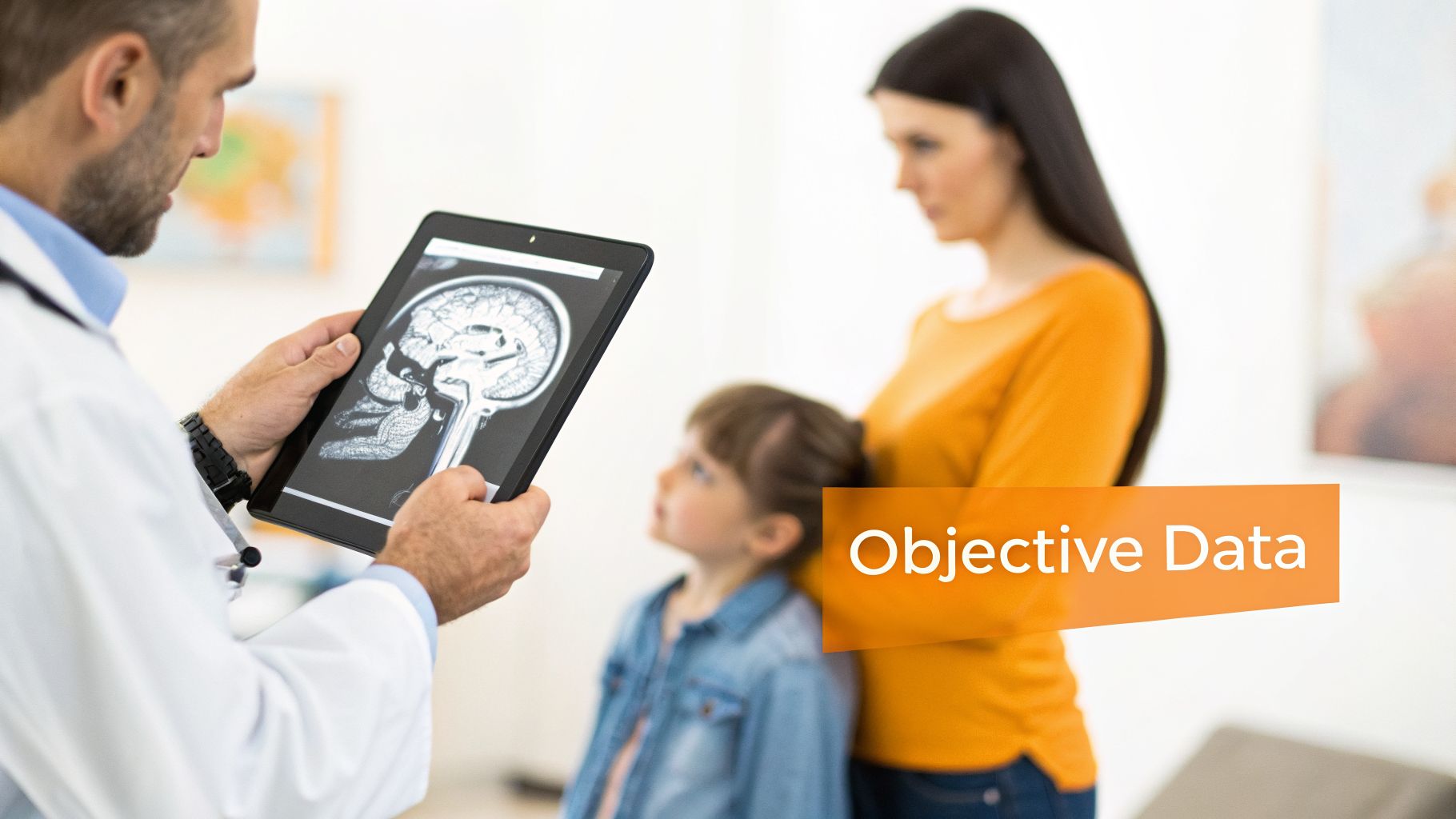
The road to an ADHD diagnosis can feel a bit foggy. The standard process leans heavily on things like behavioural checklists, interviews with parents, and notes from teachers. These are absolutely vital pieces of the puzzle, but they are subjective. It's completely understandable why families are left wondering if they're seeing the whole picture.
For example, a parent might report their child "never listens," while a teacher might say the child is "easily distracted in groups." These are helpful observations, but they are open to interpretation. This uncertainty is what drives the search for something more concrete. People want a clear, biological marker—an objective piece of data that can confirm what the questionnaires and observations suggest. This is exactly why the idea of getting a brain scan for ADHD is so appealing. It feels like it could offer a data-driven answer.
What Brain Scans Can (and Cannot) Tell Us
In research labs, neuroimaging techniques have given us incredible insights into the ADHD brain. Think of a standard MRI scan like a beautifully detailed map of a city's streets. It shows you the physical structure—every road, building, and park—with perfect clarity.
But that map can't tell you anything about the city's pulse. It won't show you the morning rush hour, the frustrating traffic jams, or the quiet side streets that locals use as shortcuts. In the same way, a structural brain scan reveals the physical anatomy of the brain, but it doesn't capture the real-time, functional challenges that are the hallmark of ADHD, like struggles with attention, impulse control, or planning.
This is the key difference between what we can do in research versus in a clinic:
In Research: Scientists use tools like functional MRI (fMRI), SPECT, and quantitative EEG (qEEG) to study large groups of people. By comparing averages, they've found subtle differences in brain structure, activity, and communication networks in people with ADHD.
In a Clinic: The problem is, these are just averages. There's so much overlap between the brains of people with and without ADHD that a scan simply isn't reliable enough to diagnose one single person.
The real issue is this: a brain scan shows us the hardware, but ADHD is a challenge with the brain's operating system. It’s about how the brain’s networks communicate and regulate tasks, not just what they look like in a static picture.
This gap between research and clinical reality has spurred the development of newer, more accessible technologies that can offer the objective data families are looking for. To get a better sense of how all these pieces fit together, check out our comprehensive guide to ADHD, which walks through the entire diagnostic journey. The goal is to move beyond subjective reports and towards measurable insights that lead to truly effective, personalized support.
How Brain Scans Work in ADHD Research
When people hear ‘brain scan for ADHD,’ they often picture a machine that can look inside the skull and definitively spot the problem. The reality, at least for now, is quite a bit more complex.
It helps to think of these different imaging techniques as highly specialized tools in a researcher's toolkit. Each one is designed to measure something very specific about the brain, from its physical layout to its real-time activity. While they give us fascinating clues in a lab setting, they don't function like a simple test in a doctor's office.
Let's walk through the most common technologies used in ADHD research. We'll use some practical examples to explain what each scan actually does and what it’s like to have one.
Structural MRI (sMRI): The Brain’s Blueprint
A structural Magnetic Resonance Imaging (sMRI) scan is like getting a highly detailed 3D blueprint of the brain. It uses powerful magnets and radio waves to capture static, high-resolution pictures of the brain’s anatomy—its size, shape, and the thickness of its different regions.
What it Measures: The brain's physical structure, including the volume of grey matter (where thinking happens) and white matter (the brain's internal wiring).
Practical Example of the Experience: You lie still inside a large, tube-shaped machine. It's quite loud, with a lot of clicking and banging noises, so you’ll almost always be offered earplugs or headphones. The scan itself is painless and usually takes about 30-45 minutes.
What Researchers See in ADHD: When scientists compare large groups of people, some studies show subtle average differences. For example, some research suggests that certain brain areas involved in attention and impulse control might be slightly smaller or develop more slowly, on average, in people with ADHD.
But these are just group averages. The natural variation between individuals is so massive that an sMRI can't be used to diagnose any one person. It’s like knowing that one city has slightly narrower streets on average than another; you can't tell which city a single street belongs to just by looking at its width.
Functional MRI (fMRI): Tracking Brain Traffic
If an sMRI gives us a static map, then a functional MRI (fMRI) is like watching live traffic data flow across that map. It doesn't track individual brain cells, but instead measures changes in blood flow. When a region of the brain gets busy, it calls for more oxygen-rich blood, and an fMRI is designed to detect precisely that change.
This is how researchers can see which parts of the brain "light up" when a person is asked to do something, like solve a puzzle or try to maintain focus.
Key Insight: The colourful images you see from an fMRI aren't direct pictures of brain activity. They are statistical maps showing which areas had a significant increase in blood flow during a specific task compared to a resting state. The colours simply represent the statistical strength of that activity.
Practical Example of the Experience: The setup is the same as a standard MRI, but this time you’ll be asked to perform simple tasks while inside the scanner. For instance, you might be shown a series of letters on a tiny screen and told to press a button every time you see the letter 'X'. The point is to see how your brain responds to this attention-demanding challenge in real time.
SPECT and qEEG: Other Windows into Brain Function
Beyond MRI, researchers have a few other methods for looking at brain function from different angles.
SPECT (Single-Photon Emission Computed Tomography): This scan also measures blood flow, but with a different technique. A tiny, safe amount of a radioactive tracer is injected into the bloodstream, and a special camera tracks where it travels in the brain. It gives a snapshot of brain activity patterns over a few minutes. Researchers have used it to identify differences in blood flow to the prefrontal cortex in groups of people with ADHD.
Quantitative EEG (qEEG): This technique measures the brain's electrical activity—its brainwaves. You can think of it as listening to the "hum" of the brain's electrical engine. A cap fitted with many sensors is placed on the scalp to record these signals. A qEEG analysis then generates a "brain map" that visualizes patterns of electrical activity. Some research has pointed to specific patterns, like an excess of slow-wave activity (theta waves) in the frontal lobes, being more common in groups with ADHD.
These technologies have been absolutely crucial in building our modern understanding of ADHD as a neurodevelopmental condition. They consistently point to differences in the brain networks responsible for our executive functions—things like attention, self-regulation, and planning.
But as we've seen, what works for comparing large groups in a research lab doesn't translate into a reliable diagnostic test for an individual. Fortunately, this is where modern, accessible methods come in. These tools are filling the gap by providing objective cognitive data that is both practical and clinically useful. To see how this data is applied, you can explore the Orange Neurosciences solution for cognitive assessment.
The Gap Between Research and a Real-World Diagnosis
You’ve likely seen those incredible brain images in the news, showing breakthroughs in ADHD research. So, it’s natural to wonder: why can’t your doctor just order a brain scan for ADHD and get a clear, simple answer for your child?
The answer gets to the heart of a tricky statistical problem—the difference between what’s true for a large group and what’s useful for one single person.
Think about it this way. On average, men are taller than women. That’s a well-known statistical fact. But you would never try to guess someone's gender based on their height alone, right? There’s just too much overlap; plenty of women are taller than plenty of men. A single person's height is just one piece of data, and it’s almost meaningless without more context.
That’s the exact challenge we face with using brain scans for an ADHD diagnosis. Researchers can find tiny, average differences in brain structure or function when they compare massive groups—say, 100 people with ADHD versus 100 people without. But for any one individual, the variations are so huge that their scan results will almost certainly fall into that massive area of overlap. It becomes impossible to say which group they belong to from the scan alone.
Why Group Averages Don't Work for Your Child
To dig a little deeper, we need to talk about two crucial ideas in any medical test: sensitivity and specificity.
Sensitivity: This tells us how well a test correctly spots people who actually have the condition. A test with high sensitivity won’t miss many people who truly have ADHD.
Specificity: This measures how well a test correctly clears people who do not have the condition. A highly specific test won’t accidentally label someone with ADHD when they don’t have it.
The different scans used in research are each looking for different things, as you can see below.
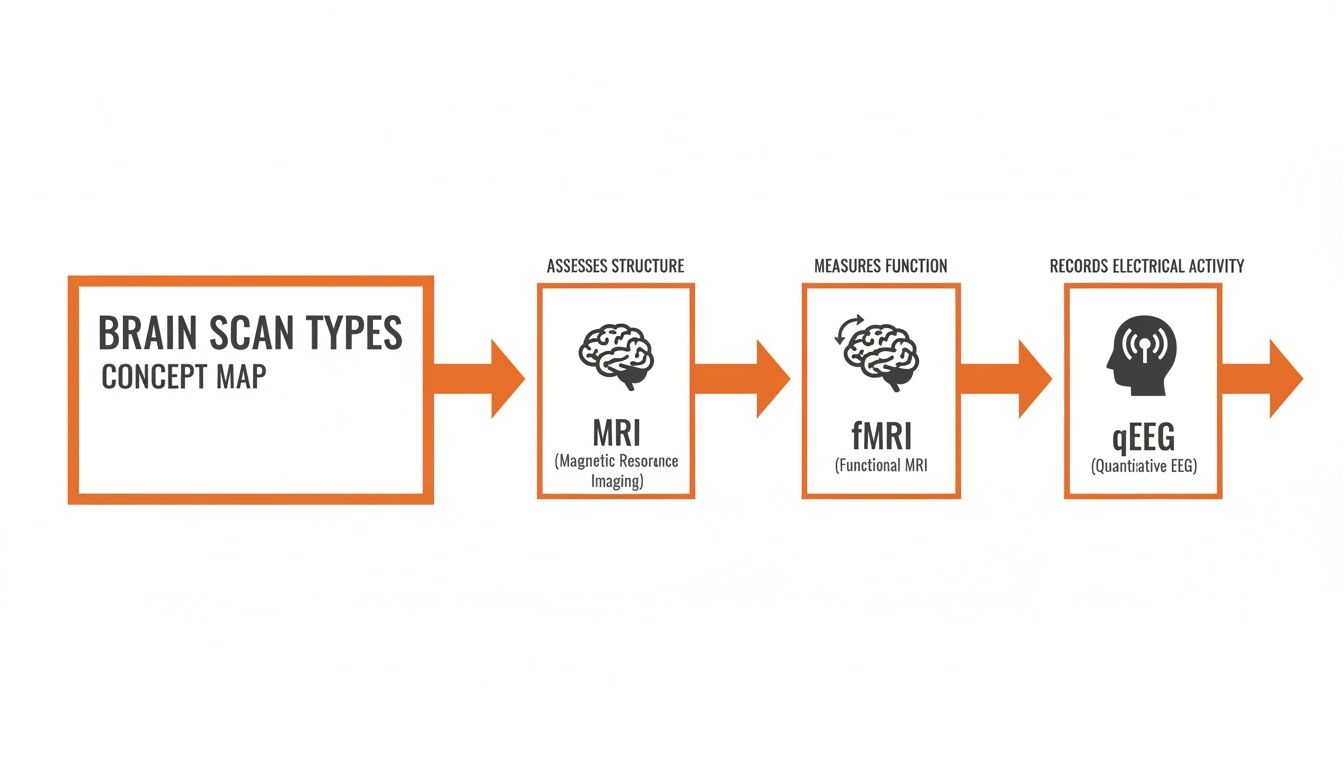
This map shows how scans can measure structure (MRI), real-time function (fMRI), or electrical brain activity (qEEG). The problem is, none of these methods currently have the sensitivity and specificity needed to work as a standalone diagnostic tool for ADHD. They can hint at group-level patterns but aren’t reliable enough for an individual. This is where a test's consistency becomes vital; you can learn more about why high test-retest reliability is essential for any diagnostic assessment.
For a brain scan to be truly useful for diagnosis, it would need to be incredibly accurate on both fronts—ideally hitting 90% or higher for both sensitivity and specificity. Right now, no imaging technique for ADHD even comes close. A test that’s only 70% accurate might sound okay, but it would get it wrong for 3 out of every 10 people. That means misdiagnoses, unnecessary treatments, and missed chances to provide the right kind of support.
What Major Medical Bodies Say
Because of this diagnostic shortfall, the world’s leading medical organizations have established clear guidelines: brain scans should not be used for a routine ADHD diagnosis. This isn’t just an opinion; it’s a conclusion based on a thorough review of all the scientific evidence we have.
For families here in Canada, the Canadian Paediatric Society and CADDRA (the Canadian ADHD Resource Alliance) set the standard. Their guidance mirrors the position of their American counterparts, like the highly influential American Academy of Pediatrics (AAP), which puts it bluntly:
"The clinical diagnosis of ADHD is based on the history and observation of a child’s behaviour. At present, there is no validated diagnostic test for ADHD…In general, neuroimaging is not warranted to make the diagnosis of ADHD."
This guidance is there to protect patients. It prevents them from going through expensive and often stressful procedures that can’t deliver a clear answer. It reaffirms that a comprehensive clinical evaluation—which includes detailed interviews, a deep dive into behavioural history, and standardized rating scales—is still the gold standard.
The goal is always to build a diagnosis from a complete picture of a child’s life and challenges, not from a single, inconclusive data point.
When a Brain Scan for ADHD Is Actually Necessary
Given that neuroimaging isn’t part of a standard ADHD assessment, it’s fair to wonder: when is a brain scan for ADHD actually needed? The answer is surprisingly straightforward. A doctor will only turn to this technology when they spot symptoms that just don’t fit the typical picture of ADHD.
In these specific instances, the scan’s job isn’t to confirm ADHD. Its purpose is entirely different—it’s a crucial safety measure to rule out other serious medical conditions that can sometimes masquerade as inattention or hyperactivity.
Think of it this way: your family doctor is like a skilled mechanic. For routine ADHD-like symptoms, they'll perform standard checks—clinical interviews, rating scales, and reviewing developmental history. But if you report something unusual, like a sudden and dramatic personality change, that's like telling the mechanic you heard a loud bang from the engine. It’s a signal to look deeper for a more significant problem.
Spotting the "Red Flags"
For any clinician, certain “red flag” symptoms immediately signal that something more than a neurodevelopmental difference might be at play. Their presence should always prompt a serious conversation about whether a deeper medical investigation, which might include a brain scan, is the right next step.
So, what should you watch out for? Here are practical examples:
Sudden and Severe Onset: A child who has always been an organized A-student suddenly can't focus, remember assignments, or follow conversations. This rapid change over just days or weeks is not typical ADHD.
New Neurological Signs: A child starts having staring spells (potential seizures), complains of intense morning headaches that cause vomiting, or suddenly becomes clumsy and has trouble walking in a straight line.
Loss of Acquired Skills: A seven-year-old who was a chatterbox suddenly starts struggling to find words or form sentences, losing language skills they had already mastered.
A Recent Head Injury: A teenager gets a concussion during a hockey game and, in the weeks following, develops severe problems with attention and impulse control that weren't there before.
A brain scan in these situations acts as a critical safety net. It ensures that a treatable neurological issue, like a brain tumour or hydrocephalus (fluid on the brain), isn't being missed by simply labelling everything as ADHD.
Ruling Out Conditions That Mimic ADHD
It’s easy to see how some symptoms could overlap. To help clarify, here’s a look at how common ADHD signs compare to the red flags that might point a doctor toward ordering a scan.
Neuroimaging Indications vs. ADHD Symptoms
Symptom/Sign | Commonly Associated With ADHD? | May Warrant Neuroimaging? | Practical Example of a Condition to Rule Out |
|---|---|---|---|
Difficulty sustaining attention | Yes | No (unless onset is sudden and severe) | |
Persistent, severe headaches | No | Yes | A scan checks for a potential brain tumour or increased pressure. |
Impulsivity and hyperactivity | Yes | No | |
Seizures or convulsions | No | Yes | A scan looks for structural causes of epilepsy. |
Forgetting daily tasks | Yes | No | |
Sudden loss of balance or coordination | No | Yes | A scan can rule out a tumour in the cerebellum. |
Lifelong pattern of disorganization | Yes | No | |
Rapid loss of previously learned skills | No | Yes | A scan investigates for brain injury or a degenerative disorder. |
As the table shows, the decision to order a scan is driven by symptoms that fall well outside the established criteria for ADHD. It’s a process of elimination aimed at finding the true root cause of the problem.
Some of the conditions a clinician may want to rule out with a brain scan include:
Brain tumours or cysts
Hydrocephalus
The effects of a stroke or other vascular issues
Evidence of a traumatic brain injury (TBI)
Certain types of infections or inflammatory brain conditions
Understanding when a scan is justified helps families and clinicians make clear-headed, informed decisions. It moves the conversation away from searching for a magical ADHD "test" and toward using imaging as a powerful, targeted tool for specific medical concerns.
If you’re preparing for a comprehensive evaluation, we invite you to explore the solutions we’ve developed at Orange Neurosciences to support families on this journey.
A Modern Alternative: Objective Cognitive Testing
So, if routine brain scans for ADHD aren't the answer that families and clinicians are hoping for, what is? The desire for objective, biological data is completely understandable. But maybe the solution isn’t in a picture of the brain’s structure, but in measuring how it actually performs. This is where objective cognitive assessments come in, offering a genuinely helpful, accessible, and clinically sound alternative.
Think of it like a physical fitness test. You wouldn't just take a photo of someone's muscles to see how strong they are. You’d put them through their paces—you'd measure their running speed, how much they can lift, and their endurance. Objective cognitive assessments do the exact same thing, but for the brain. They’re like a 'cognitive fitness test' that gives us specific, measurable data on brain performance.
From Pictures to Performance Metrics
Instead of looking at a static image of the ‘gym equipment’—the brain's structure—these assessments measure how well that equipment actually works. They give us hard data on the very cognitive domains that ADHD often affects.
Actionable Insight: This shift from looking at structure to measuring function provides the concrete information clinicians and families need, but without the steep costs, radiation exposure (from SPECT scans), and long wait times tied to neuroimaging. Because these digital assessments are game-based, they're far more engaging for kids and adults, making the whole process less stressful and often more revealing.
The real breakthrough is this: objective cognitive testing moves us past subjective questionnaires and into the world of real numbers. We get quantitative data on how a person's brain actually performs on tasks that demand attention, memory, and executive function. That data helps clarify a diagnosis, sets a clear baseline before treatment, and lets us track progress over time.
A Rapid and Precise Cognitive Profile
Modern platforms like Orange Neurosciences have really honed this approach, offering tools that can generate a full cognitive profile with surprising speed and efficiency. An assessment like OrangeCheck, for example, can be done in under 30 minutes and deliver a detailed report on key cognitive areas.
Attention: How well can a person hold their focus and tune out distractions? The test measures this through reaction times and consistency.
Memory: How well can they absorb and recall new information? It looks at both short-term and working memory.
Executive Function: How skilled are they at planning, organizing, and controlling impulses? The assessment tracks the speed and accuracy of their decisions.
This is the kind of practical, easy-to-read report card these assessments provide, giving families and clinicians a clear summary of how someone is performing.
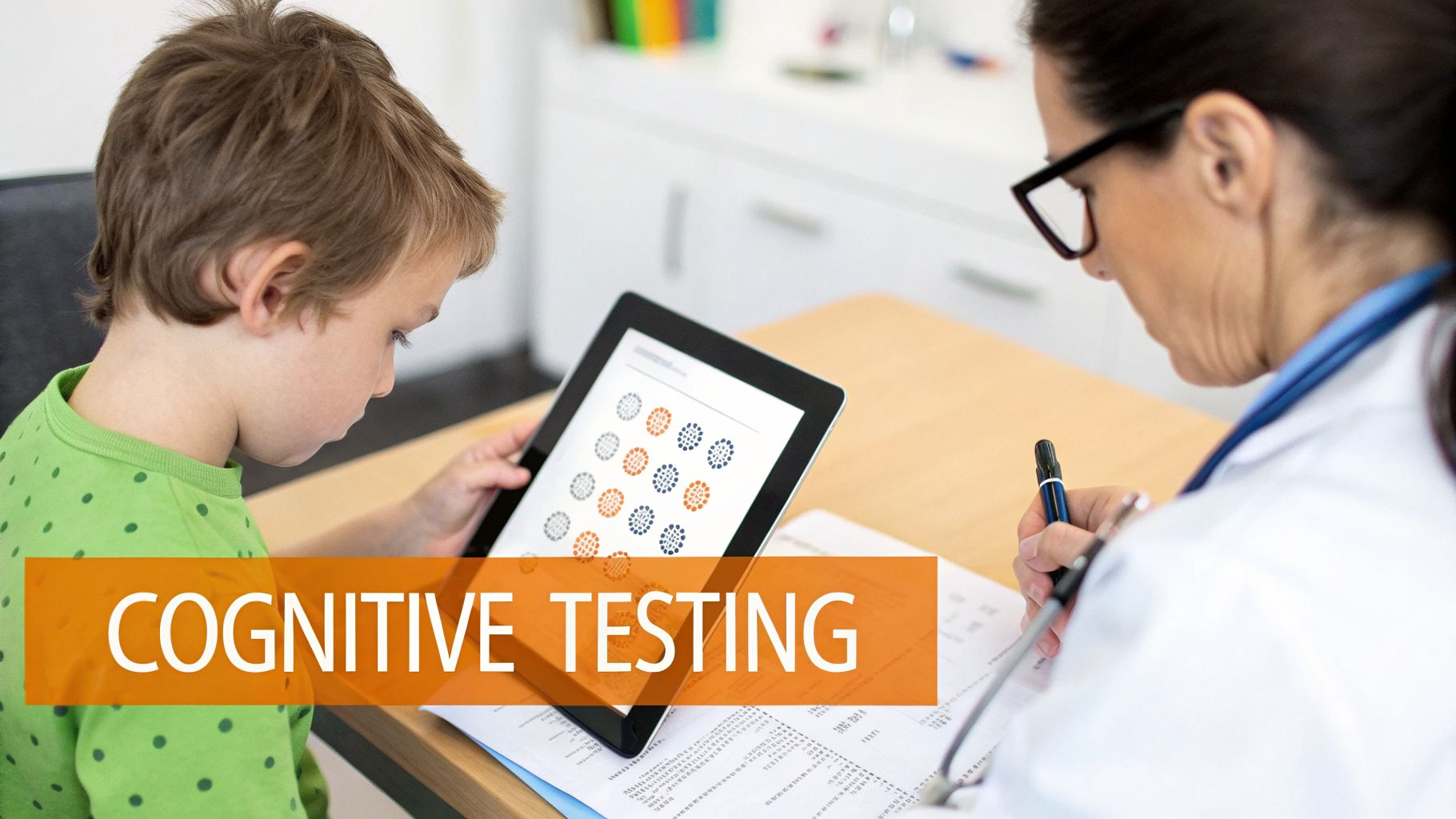
What you get is a set of tangible, easy-to-understand metrics. Suddenly, complex cognitive functions are translated into a scorable performance profile that makes sense.
Practical Example: A report might show a child has average memory skills but scores in the 10th percentile for sustained attention. This specific data point is incredibly actionable. It tells parents and teachers that the child's issue isn't that they "don't listen," but that their brain struggles to maintain focus over time. The solution isn't to repeat instructions louder, but to break tasks into smaller chunks and provide frequent check-ins. This information gives everyone a solid foundation for building targeted support strategies, both at home and at school.
Your Next Steps for a Comprehensive Evaluation
Getting to the bottom of an ADHD evaluation can feel like navigating a maze, but you now have a much clearer map. We've established that the idea of a single “brain scan for ADHD” is still a thing of the future, not a tool in your doctor’s office today.
But that doesn’t mean you’re stuck with guesswork. The need for objective, reliable data is more important than ever, and fortunately, it’s also more solvable. Let’s put all the pieces together into a practical, step-by-step approach for parents and clinicians.
A Practical Four-Step Guide
Start with a Comprehensive Clinical Evaluation: This is your non-negotiable first stop. You’ll need to connect with a qualified professional—a paediatrician, psychiatrist, or psychologist who truly gets ADHD—for a deep dive into your child's developmental and medical history.
Complete Validated Questionnaires and Interviews: These tools are vital. They help paint the full picture of the challenges a person faces in different settings, like at home versus at school. They tell the qualitative story that numbers alone simply can't capture.
Integrate Objective Cognitive Assessment: This is where you get the hard data you’re looking for. Using an assessment tool like OrangeCheck provides a solid, data-driven baseline of cognitive abilities. It measures performance in key areas like attention and executive function, putting real numbers to the functional difficulties your child might be experiencing.
Know the Red Flags for Neuroimaging: It’s crucial to remember that a brain scan is meant to rule out other medical issues, not to diagnose ADHD. Keep an eye out for specific warning signs—like new seizures or a sudden and unexplained loss of skills—that would warrant a referral for a scan.
Embracing this blended approach—combining expert clinical judgment with modern, objective data—is the most effective way forward. It moves the diagnostic process beyond subjective reports and provides a solid foundation for building effective, evidence-based support plans.
Take Action Today
The challenge of getting objective data for an ADHD diagnosis has a real, accessible solution. Today's tools offer the quantitative insights needed to back up clinical decisions and give families clear, understandable reports. As you think about building a support system, it's also helpful to learn how SEL supports neurodiverse students who may benefit from different kinds of interventions.
Whether you're a clinician wanting to add objective data to your practice or a parent seeking a more complete picture of your child’s cognitive profile, we're here to help. You can learn more about what this process involves in our guide on what is a neuropsychological assessment.
Ready to see how it works? Request a demo of the Orange Neurosciences platform today by visiting our website or emailing our team. Take the next step toward confident, data-driven cognitive care.
Frequently Asked Questions
It’s completely normal to have questions when navigating the world of ADHD assessment, especially as new technologies enter the conversation. We hear a lot of the same queries from families and clinicians, so we’ve gathered the most common ones here to give you some clarity.
Will Insurance Cover a Brain Scan for an ADHD Diagnosis?
This is one of the first questions families ask, and the short answer is no. In Canada, a brain scan for an ADHD diagnosis is not typically covered by provincial health plans or private insurance.
The reason is simple: major medical and psychiatric bodies don't recommend brain imaging as a routine tool for diagnosing ADHD. Insurance plans reserve coverage for procedures that are considered medically necessary, and for an ADHD diagnosis alone, a scan doesn't currently meet that standard. There is, however, an exception. If your doctor suspects an underlying issue that might be mimicking ADHD symptoms—like a seizure disorder or the effects of a head injury—a scan ordered for that specific reason might be covered.
What Is the Difference Between a qEEG and a Clinical EEG?
It’s easy to get these two mixed up, as the names are so similar. A clinical Electroencephalogram (EEG) is a standard medical test that neurologists have used for decades, primarily to look for seizure activity. It records the brain's raw electrical signals to spot the very specific patterns that point to conditions like epilepsy.
A quantitative EEG (qEEG), or “brain mapping,” is a bit different. It takes the same raw EEG data and runs it through sophisticated software, comparing an individual's brainwave patterns to a large database of what’s considered "typical" for their age. While some researchers find qEEG useful for studying group differences in conditions like ADHD, it hasn't been adopted as a standard diagnostic tool in mainstream clinical practice.
Practical Example: A clinical EEG is like an electrician checking your home’s wiring for a major fault, like a short circuit. A qEEG is more like an analyst creating a detailed report on your home's overall energy consumption compared to the neighbourhood average. Both use the same core information (electrical signals) but for very different, specific purposes.
Can Brain Scans Show If ADHD Medication Is Working?
In a research lab? Absolutely. Scientists often use tools like fMRI to observe precisely how stimulant medications change brain activity and connectivity in people with ADHD. These studies give us incredible insight into how the medications work, often showing that they help normalize activity in the brain networks responsible for attention and executive function.
But in a regular clinic, this just isn't done. Using a brain scan for ADHD medication monitoring is impractical, incredibly expensive, and frankly, unnecessary for day-to-day care. A good clinician can tell if medication is helping far more effectively—and affordably—by tracking real-world changes through parent and teacher checklists, clinical observation, and objective cognitive performance tests.
Ready to move beyond the search for a single scan and get the objective data you need? Orange Neurosciences provides a practical, accessible way to measure cognitive function and track progress. Discover how our evidence-based platform can support your diagnostic and treatment journey by visiting https://orangeneurosciences.ca or emailing us to request your personalized demo.
Orange Neurosciences' Cognitive Skills Assessments (CSA) are intended as an aid for assessing the cognitive well-being of an individual. In a clinical setting, the CSA results (when interpreted by a qualified healthcare provider) may be used as an aid in determining whether further cognitive evaluation is needed. Orange Neurosciences' brain training programs are designed to promote and encourage overall cognitive health. Orange Neurosciences does not offer any medical diagnosis or treatment of any medical disease or condition. Orange Neurosciences products may also be used for research purposes for any range of cognition-related assessments. If used for research purposes, all use of the product must comply with the appropriate human subjects' procedures as they exist within the researcher's institution and will be the researcher's responsibility. All such human subject protections shall be under the provisions of all applicable sections of the Code of Federal Regulations.


© 2026 by Orange Neurosciences Corporation