Your Guide to Taking an Alzheimer's Online Test
Mar 7, 2026
An Alzheimer's online test is a way for you to check for early signs of cognitive change, right from your own home. Think of it not as a diagnosis, but as a crucial first step—a valuable starting point if you have concerns about your memory or thinking. This guide will give you actionable insights on how to use these tools responsibly and what steps to take next.
The Growing Need for Early Cognitive Screening
It usually starts small. You forget a name you’ve known for years, misplace your keys for the third time this week, or find yourself grasping for a word that used to come easily. For so many families, these are the first quiet whispers that something might be changing with a loved one’s health.
That initial flutter of worry can quickly grow. For example, a daughter might notice her father, once the life of the party, now asking the same questions over and over during a single phone call. He seems lost in places he’s known his whole life, like the route to his favorite park. She knows she needs to do something, but the path to a formal diagnosis is often a long one, filled with waiting lists for specialists. It’s in this gap—between the first nagging concern and a proper clinical evaluation—that accessible tools become so important.
Why Early Signals Are Often Missed
During a routine check-up, a busy family doctor may only have a handful of minutes to talk about cognitive health. Without a fast, dependable way to screen for potential problems, those subtle early signs are all too easy to chalk up to normal ageing. This is a huge miss. Early detection is everything when it tomes to planning for better management and care.
Actionable Insight: The best time to intervene is when symptoms are at their mildest. Waiting for a full evaluation can mean losing precious time. An actionable step you can take is to document specific instances of memory loss or confusion to share with a doctor, which makes the conversation much more productive.
The Scale of the Public Health Challenge
This isn’t just a personal worry for individual families; it's a massive public health issue. The number of people living with cognitive decline is frankly staggering, and it's putting an incredible strain on our healthcare systems. Take California, for example, which is facing an unprecedented Alzheimer's crisis with over 719,700 residents currently affected. That number is projected to jump by a shocking 127% by 2040. And women continue to be hit hardest, making up nearly two-thirds of all Americans with the disease. You can dig deeper into these startling numbers on the Alzheimer's crisis.
This is where an Alzheimer's online test can make a real difference. It bridges the gap between a private worry and a productive conversation with a doctor, empowering you with objective information.
These online screeners offer a practical way forward by:
Giving you a quick, accessible baseline of your cognitive function.
Encouraging you to be proactive about your brain health.
Providing your doctor with preliminary data that can justify a closer look.
The goal isn't to diagnose yourself, but to be informed and prepared. To see what a clinically validated assessment looks like, we invite you to learn about our evidence-based platform at Orange Neurosciences and see how professionals use these tools.
What Is an Alzheimer's Online Test, Really?
When you hear the term “Alzheimer's online test,” it’s easy to picture a quick quiz that spits out a definitive yes-or-no answer. But the reality is a bit more nuanced—and frankly, a lot more useful. It's vital to know from the outset that these online tools are screeners, not diagnostic instruments.
A great way to think about it is like a smoke detector in your home. Its job is to alert you to the possibility of a problem. It can’t tell you if it's a small kitchen mishap or something more serious, and it certainly can’t put out the fire. It simply provides a critical, early warning so you can call in the professionals. An online test does something similar: it detects potential signs of cognitive change, but it can’t diagnose Alzheimer's disease.
This is often the very first step in a longer journey, one that starts with a private worry and leads to a conversation with a doctor.
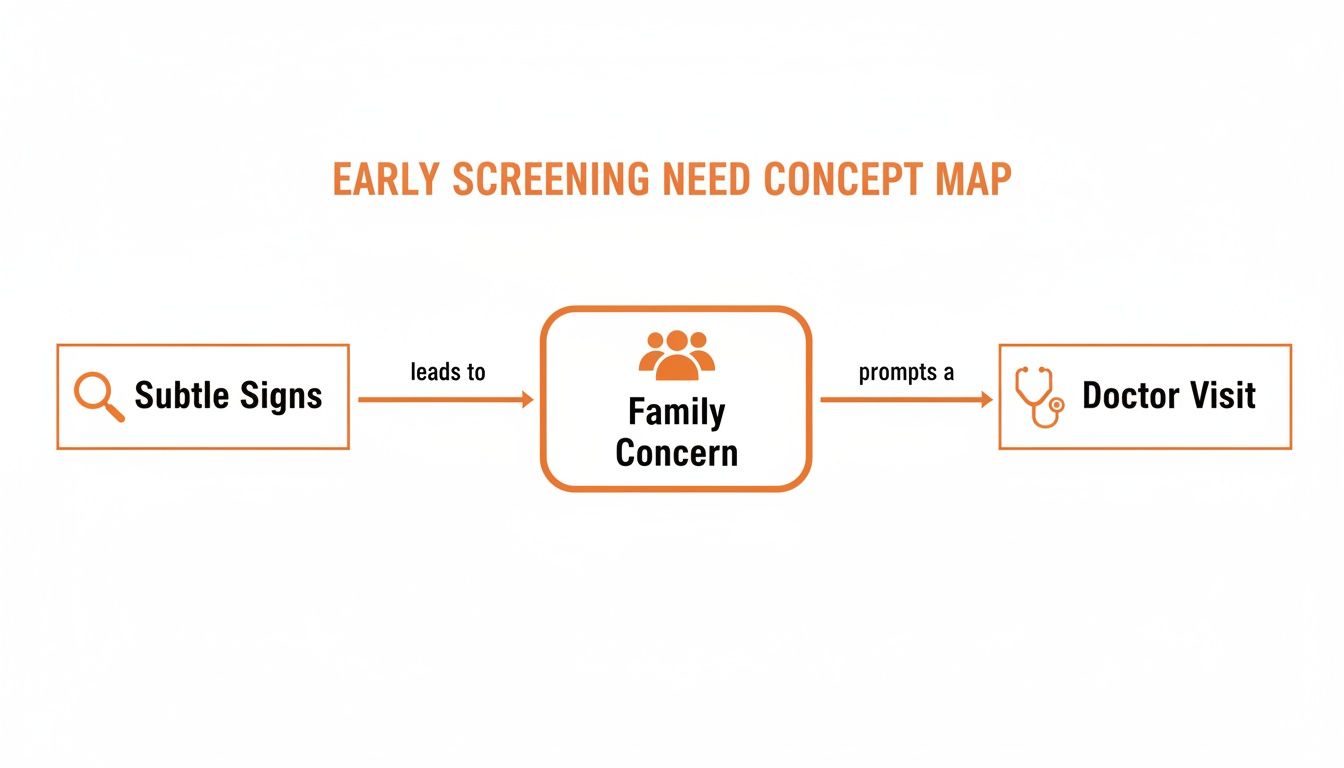
As you can see, that initial concern often encourages a visit to a healthcare professional, which is the most important next step after any kind of screening.
What Kinds of Online Screeners Are Out There?
Not all online tests are built the same. They can range from very basic questionnaires to sophisticated digital assessments that are even used in clinical settings. Knowing the difference will help you manage your expectations.
The simplest tools you'll find are self-assessment quizzes. These are usually short lists of questions about your day-to-day experiences with memory, mood, or thinking—for example, asking "How often in the last month have you had trouble finding the right word?" or "Have you recently felt disoriented in familiar places?" While they can be a good starting point for self-reflection, their value is limited because they're entirely subjective.
More advanced tools go far beyond simple questions to provide a more objective look at cognitive health. To get a better sense of how these work, you can explore our in-depth guide on what a cognitive assessment truly entails.
Diving Deeper: Clinically-Inspired Digital Assessments
A much more robust category of Alzheimer's online test is the digital cognitive assessment. These tools are specifically designed to be objective, presenting you with a series of tasks or games that measure distinct cognitive abilities.
Instead of asking how you feel your memory is, they actually measure it. These platforms often assess abilities such as:
Working Memory: A task might involve remembering a sequence of numbers and then repeating them in reverse.
Attention and Concentration: You could be asked to track a moving object on the screen while actively ignoring distractions.
Executive Function: This might look like a game that requires you to plan ahead, solve problems, and shift your strategy as the rules change.
Actionable Insight: The real power of these digital tools lies in their ability to capture objective performance data—things like response time, accuracy, and consistency. This kind of data provides a much clearer signal than a subjective feeling and gives you something concrete to discuss with a healthcare provider.
To make things clearer, here’s a quick breakdown of the different tools you might encounter.
Comparing Types of Online Cognitive Screening Tools
Test Type | What It Measures | Typical Format | Best For |
|---|---|---|---|
Self-Report Questionnaires | Perceived changes in memory, mood, and daily function. | Multiple-choice questions about personal experiences. | Initial self-reflection and identifying subjective concerns. |
Gamified Cognitive Tasks | Specific domains like attention, memory, and processing speed. | Interactive games or timed puzzles. | Gaining a more objective, data-driven snapshot of cognitive function. |
Digital Pen-and-Paper Versions | A broad range of cognitive functions (e.g., MMSE or MoCA). | Digitized versions of traditional clinical screening tests. | A structured screening that mimics what might happen in a clinic. |
In the end, whether it’s a simple questionnaire or a gamified assessment, the purpose of an Alzheimer's online test is to empower you. It helps transform a vague worry into a tangible data point, giving you the confidence to take the most important step of all: talking to a professional. If you're curious about what a clinically validated assessment platform looks like, we encourage you to visit our website and see the evidence-based approach at Orange Neurosciences.
Understanding Test Accuracy and Limitations
When you’re looking into an Alzheimer's online test, it’s completely natural to want a simple, clear answer. But it’s so important to go in with your eyes open, understanding what these tools can and can’t do. The truth is, no online screener—no matter how sophisticated—is 100% perfect. That's the most critical thing to remember.
Let's think of it like a weather forecast app on your phone. Some apps are extremely sensitive and will ping you with a rain alert for every little cloud that passes by.
Sure, you’ll never get caught in a surprise downpour. But you’ll also find yourself carrying an umbrella around on perfectly sunny days. In the world of medical screening, we call this a false positive—the test flags a problem that isn’t really there.
The Problem of False Positives and False Negatives
Of course, the opposite can also happen. An app with low sensitivity might completely miss a coming storm, leaving you soaked without any warning. This is a false negative, where the test fails to detect a problem that genuinely exists.
When we apply these ideas to an Alzheimer's online test, they carry real emotional weight.
A False Positive: Getting a scary result when your cognitive health is perfectly fine can cause a tidal wave of anxiety for you and your family. For example, a person might get a poor score simply because they were tired or stressed, leading to weeks of unnecessary worry.
A False Negative: Receiving an "all-clear" score when there are real, underlying changes can create a dangerous sense of reassurance. This might lead you to put off seeing a doctor, losing precious time when early intervention could make a real difference.
Actionable Insight: An online screening test is just one piece of a much larger puzzle. The result isn't a diagnosis. It's a single data point that tells you whether it's time to take a closer look. Your next step should always be a conversation with a healthcare professional, not another online search.
Why Perfection Is Not the Goal
Even the most advanced diagnostic aids being developed, like new FDA-cleared blood tests, aren’t flawless. Research shows some of these incredible new tests are highly accurate but still give inconclusive results about 20% of the time, meaning more follow-up is needed.
This isn’t a sign of a bad test; it’s just a reflection of how complex our brains are. The human brain isn’t a simple machine with an on/off switch. Your sleep quality, stress levels, medications, or even the time of day can all affect how you perform on an online test.
This is exactly why a high-quality test must be both reliable and repeatable. You can read our guide on test and retest reliability to see why getting consistent results over time is just as crucial as a single accurate score.
The real purpose of an Alzheimer's online test is not to hand you a final verdict. It’s to act as a responsible first alert. It gives you the information you need to be an informed partner in your own health.
How to Choose a Credible Online Cognitive Test
With so many options popping up online, how can you tell a genuinely useful Alzheimer's online test from a simple quiz just trying to get your data? It’s a bit like choosing a mechanic for your car; you wouldn’t just hand over the keys to the first person with a wrench. You’d look for credentials, experience, and transparency.
Knowing what to look for is the key to making an informed choice. Let's walk through the green flags and red flags to watch out for.
Look for Scientific Proof
First things first: is this test backed by science? This is the most important question you can ask. A credible tool will be proud of its scientific roots and won't be shy about showing them off. It should be built on established neuropsychological principles and, ideally, validated through proper research.
Here are a few green flags to look for:
Links to Research: Reputable platforms will often link directly to peer-reviewed studies that have tested the tool's validity.
Expert Creators: Check the "About Us" page. Was the test developed by actual neuroscientists, psychologists, or clinicians? Clear credentials add a lot of weight.
Transparency About What’s Measured: The test should be upfront about which cognitive domains it assesses, like working memory, executive function, or processing speed.
A huge red flag is any test making bold claims without a shred of evidence. Vague marketing fluff like "our unique algorithm" means absolutely nothing without real data to support it.
Evaluate Promises and Privacy
This is where you need to put on your consumer-savvy hat. The way a platform talks about its capabilities and handles your information reveals a lot about its integrity.
The most glaring red flag is any online test that promises a "diagnosis." As we've covered, only a qualified medical professional can diagnose Alzheimer's disease. Any tool claiming it can is overstating its purpose and simply can't be trusted.
Actionable Insight: A credible online test will always be transparent about its limitations. It will clearly state that it is a screening tool, not a diagnostic one. Your actionable step is to immediately close any website that promises a diagnosis online.
Just as important is your data privacy. Your cognitive health data is incredibly sensitive and personal. Before you click "start," find the privacy policy. It should clearly explain how your data is stored, used, and protected. For any clinical-grade tool, compliance with health data protection laws is non-negotiable.
Example Evaluating a Fictional Test
Let's put this into practice. Imagine you come across a test called "MindSharpener 360." Here’s how you'd size it up:
The Promise: The website’s headline screams, "Get Your Instant Alzheimer's Diagnosis in 10 Minutes!" This is a massive red flag. No online tool can provide a diagnosis.
The Science: You dig around but can't find any information about the creators, and there are no links to research papers. The "How It Works" page is full of buzzwords but doesn't name any specific cognitive functions it measures. Another red flag.
The Privacy: To get your results, you have to enter your email and phone number, but a privacy policy is nowhere to be found. That’s three red flags.
In this scenario, "MindSharpener 360" is clearly not a credible tool. For a deeper look at what goes into a high-quality screener, you might find our comprehensive cognitive screening test online guide helpful. The principles for choosing a good test are similar across many at-home health assessments. To better understand this, you could look at a guide for navigating services like online lab tests UK, which often explains the criteria for finding reputable providers.
Where Evidence-Based Platforms Fit In
This is where platforms like Orange Neurosciences are fundamentally different. These tools aren't just simple online quizzes; they're evidence-based assessments designed for clinical use. They are built to integrate directly into a healthcare professional's workflow, providing objective and detailed data to help them make better-informed decisions.
Instead of spitting out a simple "pass/fail" score, these platforms precisely measure performance across multiple cognitive domains. This gives clinicians the rich, granular data they need to guide the next steps in a person's care journey. If you're ready to take a positive step, visit our website to learn how our validated tools can provide you with a reliable baseline for your cognitive health.
Interpreting Your Results and Planning Next Steps
Finishing an online Alzheimer's test can leave you with a swirl of emotions—part relief, part anxiety. You’ve taken a proactive step, which is huge. But now you have a result, and the big question is: what does it actually mean?
It’s completely natural to feel a bit on edge. The single most important thing to hold onto right now is that this result is not a diagnosis. Think of it as one piece of information, a snapshot in time that adds to your larger health picture. It’s a starting point for a conversation, not a final word.
How you respond to this information is what truly matters for your long-term brain health.
If Your Results Are Normal
Receiving a score in the normal or healthy range often feels like a massive weight has been lifted. While this is certainly good news, it’s not a signal to forget about your cognitive health. Quite the opposite, in fact.
View this result as a powerful motivator. It’s the perfect opportunity to double down on brain-healthy habits.
Here are a few actionable steps you can take right now:
Embrace a Brain-Healthy Diet: Focus on foods packed with omega-3s, antioxidants, and essential vitamins. For example, try adding a handful of walnuts to your breakfast or swapping red meat for salmon once a week.
Stay Physically Active: Aim for at least 150 minutes of moderate exercise each week. This could be as simple as a 30-minute brisk walk five days a week.
Keep Your Mind Engaged: Challenge your brain by picking up a new hobby, learning an instrument, or playing strategy games. Building this "cognitive reserve" is one of your best defences.
Prioritize Quality Sleep: Getting 7-9 hours of good sleep isn't a luxury; it's when your brain performs vital maintenance. Actionable tip: Try setting a consistent bedtime and avoiding screens for an hour before sleep.
A normal score gives you a baseline. It's a fantastic starting point for a lifelong commitment to keeping your brain in top shape.
If Your Results Are Concerning
Seeing a score that falls outside the typical range can be frightening. The first thing to do is take a deep breath and try not to panic. This result is not a life sentence. It’s a clear, direct signal to take the most important next step: schedule an appointment with your doctor.
An online test result gives you something concrete to bring to the table, making it easier to start a conversation you might have been hesitant to have.
Actionable Insight: An online test result is the beginning of a conversation, not the end of one. It empowers you with the information needed to seek professional guidance promptly.
Going into that appointment prepared will make your conversation far more productive. Here’s a quick guide on what to bring:
Your Test Results: Have a printed or digital copy of your score from the Alzheimer's online test ready to share.
A Log of Specific Changes: For a couple of weeks, jot down specific moments when you noticed a memory lapse or cognitive struggle. Instead of just saying, "I'm more forgetful," be specific: "I couldn't remember my neighbour's name last Tuesday," or "I got disoriented driving to the grocery store."
A List of All Medications: Include everything—prescriptions, over-the-counter drugs, and any supplements you take. Some can have side effects that affect cognition.
Your Questions: Write down anything you want to ask your doctor so you don't forget in the moment.
Taking action now is about taking control. In a place like California, where an estimated 719,700 residents are living with Alzheimer's, early screening is vital. You can read more in this comprehensive report on Alzheimer's in California.
For more support, you may also want to check out our guide on how to understand your MoCA score interpretation.
Bringing these results to a professional is the responsible and empowering thing to do. To help you feel confident in that important discussion, we invite you to sign up for our newsletter to receive a free guide on how to talk about cognitive concerns with your doctor.
How Professionals Use Advanced Cognitive Assessments
A simple Alzheimer's online test can be a helpful starting point, but a new generation of evidence-based platforms is fundamentally changing how healthcare professionals look at cognitive assessment. These powerful tools, like the ones we’ve developed here at Orange Neurosciences, don't replace a doctor's clinical judgment. Far from it.
Think of them as a modern lab test for the brain. When your doctor orders a blood test, they get precise data on things like cholesterol or blood sugar. That test doesn't diagnose anything on its own; it gives the clinician clear, objective information to guide their expertise. Our platforms do the same for cognitive function, providing precise, measurable data to support a more accurate and efficient care journey.
This shift to data-driven insights moves the conversation from a patient’s subjective feeling of "I'm just more forgetful lately" to a clinician holding a detailed report that shows, for example, a 15% decline in working memory over the last six months. That's a game-changer.
How This Looks in a Real Clinic
The true value of these platforms shines when you see how they fit into the day-to-day work of different healthcare providers. They're built to integrate smoothly into existing workflows, saving precious time and offering a much clearer path for patient care.
Here are a few real-world examples:
A Family Doctor: During a routine annual physical for an older patient, a doctor can use a tool like OrangeCheck. In less than 30 minutes, they have a solid cognitive baseline. If the results are normal, fantastic—it’s now a benchmark for the following years. If a potential issue flags, the doctor has the clear, objective data needed to justify a referral to a specialist.
A Rehabilitation Therapist: A therapist helping a stroke survivor can use the platform to track cognitive recovery in a tangible way. By assessing skills like attention and processing speed before and after therapy, they can objectively measure what's working and fine-tune the care plan.
A Memory Clinic Specialist: Faced with a long waitlist, a clinician can use a detailed cognitive profile to help decide which patients need more invasive or expensive testing first. The objective data helps triage care, prioritizing those who need an urgent, deep-dive evaluation.
Actionable Insight: These tools build a crucial bridge between a person's initial concern and a specialist's diagnosis. They arm clinicians with the objective evidence they need to make faster, more confident decisions. If you're a clinician, visit our site to see how our platform can integrate into your workflow.
If an initial screening, whether online or in a clinic, points toward potential cognitive decline, the next step is always to connect with a professional. This may also involve looking into available support networks, such as specialised Alzheimer's care in Bromley or similar services in your own community that provide expert guidance and assistance.
The Clear Benefits for Healthcare Professionals
When clinics and hospitals integrate these platforms, the improvements in both efficiency and quality of care become obvious. The benefits speak for themselves:
Saving Time: Quick, automated assessments free up a clinician's valuable time for patient interaction and treatment.
Reducing Costs: Objective data helps rule out or confirm the need for more expensive, invasive diagnostic procedures.
Objective Care Planning: The data provides a rock-solid foundation for creating, monitoring, and adjusting treatment plans.
Scalable Assessments: They make it possible to apply consistent, reliable screening across a large patient population with ease.
Ultimately, these platforms aren't just about spotting problems. They're about managing brain health proactively and with precision. To see these tools in action, we invite you to explore our in-depth guide on cognitive assessment online.
A Few Common Questions
Thinking about online Alzheimer's tests? It's natural to have questions. Let's walk through some of the most common ones that come up.
Can an Online Test Actually Diagnose Alzheimer’s?
The short answer is no. An online test can’t, and shouldn’t, give you a diagnosis for Alzheimer’s disease or any other type of dementia. Think of them as screening tools, not diagnostic ones.
For example, a thermometer can tell you you have a fever, but it can’t tell you if it’s the flu or a bacterial infection. Similarly, an online test can flag potential cognitive issues, but only a doctor can determine the cause after a full clinical workup.
How Often Should I Consider Taking One?
This really comes down to your individual circumstances. If you're a healthy adult with no specific worries, taking a test once to set a baseline and then checking in annually can be a smart, proactive step.
But, if you’re already feeling concerned about changes in your memory or thinking, don’t just wait to retest. Your most actionable step is to talk with your doctor. For anyone using a platform as part of a clinical plan, your doctor will guide you on the right schedule for testing.
Are My Results Private and Secure?
Your privacy is absolutely critical. You should only ever use tests from reputable providers who are completely transparent about their privacy policy and how they handle your data.
Actionable Insight: A credible provider will clearly state if they are compliant with health data privacy regulations like HIPAA in the United States or PIPEDA in Canada. If a website makes it hard to find its privacy policy, that's a red flag. Your action is to close the site and look for a more transparent provider.
Navigating your cognitive health journey begins with reliable information and trustworthy tools. At Orange Neurosciences, we're focused on providing evidence-based digital solutions that give healthcare professionals the clear, precise data they need to support your care.
To see how our platform works within a clinical setting and to get more actionable insights for your brain health, we invite you to explore our solutions.
Orange Neurosciences' Cognitive Skills Assessments (CSA) are intended as an aid for assessing the cognitive well-being of an individual. In a clinical setting, the CSA results (when interpreted by a qualified healthcare provider) may be used as an aid in determining whether further cognitive evaluation is needed. Orange Neurosciences' brain training programs are designed to promote and encourage overall cognitive health. Orange Neurosciences does not offer any medical diagnosis or treatment of any medical disease or condition. Orange Neurosciences products may also be used for research purposes for any range of cognition-related assessments. If used for research purposes, all use of the product must comply with the appropriate human subjects' procedures as they exist within the researcher's institution and will be the researcher's responsibility. All such human subject protections shall be under the provisions of all applicable sections of the Code of Federal Regulations.


© 2026 by Orange Neurosciences Corporation