Your Guide to the Adult Dyslexia Test and What Comes Next
Jan 2, 2026
An adult dyslexia test is a crucial step for spotting the cognitive hallmarks of dyslexia in people who were never diagnosed as children. It can be as simple as an informal online screening to identify common traits, or it can be a formal diagnostic assessment with a qualified professional to get an official clinical diagnosis.
Why Getting an Adult Dyslexia Test Can Be a Turning Point
Millions of adults navigate their daily lives wrestling with challenges, never realizing that undiagnosed dyslexia might be the root cause. This goes far beyond just reading. It's about a unique way of processing the world that can impact everything from remembering verbal instructions to managing your email inbox.
For example, you might read an important email three times but still feel like you've missed the main point. Or you might find that after a long day of reading reports, you're more exhausted than your colleagues. So many adults quietly battle these difficulties, blaming themselves for what they see as personal failings instead of recognizing it's just a different kind of neurological wiring.
Getting an assessment is often the first real step toward validation. It provides a name for lifelong patterns and, more importantly, unlocks actionable strategies that are designed for your specific cognitive profile.
Understanding Your Path to Clarity
Getting tested doesn't have to be a daunting experience. There are essentially two main routes you can explore, and each serves a distinct purpose.
Before diving into a full assessment, it's helpful to know the landscape. This table breaks down the two main options you'll encounter.
Quick Guide to Adult Dyslexia Assessment Options
Understand the key differences between a quick screening and a full diagnostic assessment to choose the right first step for you.
Assessment Type | Primary Goal | Conducted By | Key Outcome |
|---|---|---|---|
Informal Screening | To identify potential "red flags" and dyslexia traits. | Often self-administered online. | Provides initial insights; not a diagnosis. Suggests if a formal test is needed. |
Formal Diagnostic Assessment | To provide an official, clinical diagnosis of dyslexia. | A qualified professional (e.g., neuropsychologist). | A comprehensive report for accommodations at work or school. |
Choosing the right path depends entirely on what you need. A screening is a fantastic, low-stakes starting point, while a formal diagnosis is the key to unlocking official support.
A diagnosis isn’t an endpoint; it's the beginning of a new, more informed chapter. It allows you to understand your cognitive strengths and build an actionable toolkit for success in both your career and personal life.
The Impact of Undiagnosed Dyslexia
The scale of this issue is massive and often goes unnoticed. For instance, research from 2020 revealed a staggering 52% of adults in California struggle with reading proficiency, putting the state at the very bottom of U.S. literacy rankings.
Digging deeper, studies connect 70-85% of adult illiteracy directly to dyslexia. This suggests hundreds of thousands of working-age adults could be silently affected, which can limit their job prospects and independence.
This hidden struggle chips away at confidence and can stall a career. But gaining clarity changes the entire game. Understanding your neurotype is the key that unlocks your true potential.
Awareness is growing everywhere, and resources are becoming easier to find. For more region-specific information, you can check out our guide on dyslexia in Canada. The ultimate goal is to move from a place of confusion to one of clarity, trading self-doubt for self-advocacy and actionable strategies.
Screening Tools Versus Formal Diagnostic Assessments
Taking the first step to figure out if you might have dyslexia is a big deal. But what happens next? Knowing your options is the key to moving forward with confidence. Your journey really starts with a choice between two very different paths: an informal screening or a formal diagnostic assessment.
Think of it like this: a screening tool is like that free blood pressure cuff you see at the pharmacy. It’s quick, easy to access, and gives you an initial reading. It can’t diagnose a heart condition, but it can absolutely give you a heads-up that something needs a closer look by a professional. That’s exactly the role an adult dyslexia screener plays.
A formal diagnostic assessment, on the other hand, is like booking a full evaluation with a cardiologist. It’s a deep, detailed process run by a specialist who uses a whole battery of tests to give you a definitive clinical answer. This is the only way to get an official diagnosis of dyslexia.
The Role of Dyslexia Screening Tools
A dyslexia screening tool is your first line of defense for spotting potential red flags. These are usually online quizzes or digital platforms, like OrangeCheck, built to quickly check for common signs of dyslexia. They aren’t meant to give you a diagnosis, but they do give you objective data about your cognitive patterns.
For instance, a screener might ask you to do tasks that measure:
Phonological awareness: How well you can hear and play with the individual sounds in words.
Rapid naming: How quickly you can name a series of familiar things, like letters, numbers, or colours.
Working memory: How well you can hold onto information while you're doing something else, like remembering a phone number just long enough to find a pen and write it down.
The results provide a snapshot of your cognitive profile, pointing to potential weak spots that often line up with dyslexia. This information can be incredibly validating. For many people, it’s the first piece of real evidence that their struggles aren't about a lack of effort. Understanding the different types of evaluations is a key part of this initial stage, and you can learn more about the purpose of a cognitive screening test online to see how it fits into the bigger picture.
When to Pursue a Formal Diagnostic Assessment
If a screening tool raises some red flags, or if you need official paperwork for accommodations at work or school, a formal diagnostic assessment is your next logical step. This is a much more intense and personalized evaluation carried out by a qualified professional—like a neuropsychologist, educational psychologist, or a speech-language pathologist.
A formal assessment is the only path to a clinical diagnosis. It provides the detailed report required for workplace accommodations, academic support, and access to specialized resources.
The process involves a battery of standardized tests that can take several hours, sometimes spread over a few appointments. It goes much deeper than a screener, looking at a wide range of cognitive skills to rule out other things that could be causing your difficulties, such as ADHD or other learning disabilities. A formal assessment gives you the complete picture of your unique cognitive strengths and challenges.
Comparing Your Options at a Glance
So, how do you choose? It really comes down to your immediate needs and long-term goals. Here’s a simple breakdown to help you decide which adult dyslexia test is the right starting point for you.
Feature | Dyslexia Screener | Formal Diagnostic Assessment |
|---|---|---|
Purpose | Identifies potential traits and suggests next steps. | Provides a clinical diagnosis and comprehensive report. |
Accessibility | Often online, quick, and low-cost or free. | Requires an appointment with a specialist; can be costly. |
Outcome | Personal insight and data to share with a professional. | Official documentation for accommodations at work or school. |
Best For | Individuals in the early stages of exploring dyslexia. | Those needing official support or a definitive answer. |
Ultimately, both paths have a crucial role to play. A screening empowers you with initial insights and data to point you in the right direction, while a formal assessment gives you the clinical certainty and the documentation you need to advocate for yourself effectively.
What a Comprehensive Dyslexia Test Actually Measures
A formal dyslexia assessment isn't just about reading a few paragraphs out loud. Think of it more like a diagnostic deep dive—a specialist looking under the hood to see how your brain's unique engine processes language. It's not about asking if you can read, but understanding how your brain manages all the complex steps involved.
This process goes way beyond a simple reading check. It’s about building a detailed map of your cognitive strengths and the specific areas that present a challenge. Once you understand the core components being evaluated, you see why a thorough test is so crucial for creating a helpful profile, not just sticking a label on things.
This flowchart shows the key difference between a quick screening (a preliminary check) and a full diagnostic assessment, which provides that detailed cognitive map.
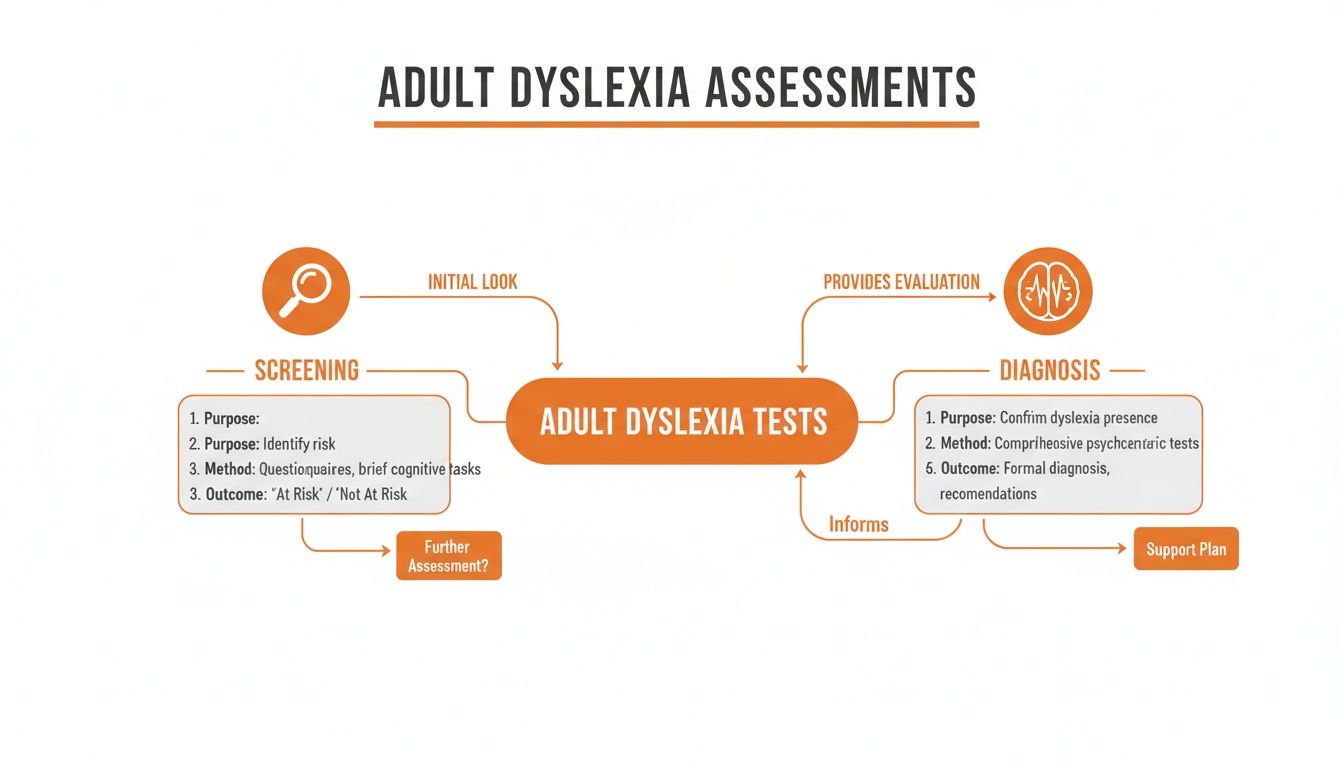
As you can see, a screening simply flags potential issues. A real diagnosis, however, delivers the in-depth analysis needed for official accommodations and truly targeted support.
The Core Cognitive Puzzle Pieces
A proper evaluation looks at several interconnected cognitive skills. It pieces together a complete picture of how an individual's brain is wired for language.
Here's a breakdown of what's being measured during a formal test and how it shows up in everyday life.
Key Cognitive Areas in a Dyslexia Evaluation
Cognitive Domain | What It Measures | A Real-World Example of a Challenge |
|---|---|---|
Phonological Processing | The ability to hear, identify, and play with the individual sounds (phonemes) in spoken words. | Struggling to sound out an unfamiliar name from a meeting agenda or remembering a multi-syllable technical term. |
Decoding & Fluency | The speed and accuracy of connecting letters to sounds to read words, and the ability to read text smoothly. | Reading an important email word-by-word, feeling like you're always a step behind everyone else in grasping the message. |
Working Memory | Your brain’s "mental sticky note"—the ability to hold and manipulate small bits of information for immediate use. | Forgetting the second and third steps of a verbal instruction moments after your manager gives it to you. |
Processing Speed | How quickly you can take in information, understand it, and begin to respond. | Finding it difficult to keep up with note-taking during a fast-paced presentation; the speaker is always three points ahead. |
Rapid Naming | The ability to quickly name a series of familiar items (like letters, numbers, or colours) on sight. | A delay in retrieving the right word during a conversation, even when you know exactly what you want to say. |
By examining each of these areas, a clinician can pinpoint the specific bottlenecks that are making reading and language-related tasks feel so effortful.
Phonological Processing: Hearing the Sounds in Words
At its very core, dyslexia often comes down to how we process the sounds of language. Phonological processing is your brain's ability to recognize and manipulate these sounds. It’s what lets you know that "chair" and "bear" rhyme, or that if you take the /s/ sound out of "speak," you're left with "peak."
To measure this, a test might ask you to repeat nonsense words like "blonkerstapple" or delete sounds from words. It's a direct look at the brain's sound-processing hardware.
Decoding and Rapid Naming: The Speed of Language
Another critical area is how quickly you can connect what you see to what you know. Rapid Automatized Naming (RAN) measures how fast and accurately you can name a series of familiar things like letters or colours. It's a test of your brain's retrieval speed.
This skill is tightly linked to reading fluency. Slow rapid naming often predicts slow, choppy reading because the brain struggles to make that instant connection between a letter and its sound. You can learn more about these evaluation methods in our guide to different types of tests for reading.
Working Memory and Processing Speed: The Brain's Bandwidth
Think of working memory as your brain's active RAM. It's the mental scratchpad you use to hold onto information while you're working with it. An assessment might test this by having you listen to a string of numbers and repeat them backwards.
Processing speed is about how quickly you can take in information, make sense of it, and react. It's the "clock speed" of your brain for a given task.
One of the most powerful insights from an assessment is seeing how these domains interact. For example, slow processing speed can easily overwhelm a limited working memory, making it nearly impossible to follow complex instructions or take notes during a meeting.
It's Not Just Dyslexia: Ruling Out Other Conditions
A thorough assessment is also essential for what’s called a differential diagnosis. Many conditions have overlapping symptoms, and without an expert evaluation, it's easy to get it wrong.
For instance, there is a 30-50% overlap between dyslexia and ADHD. A good assessment is designed to untangle these threads, identifying whether one or both conditions are present. It moves past simple reading checks to create a precise profile of your neurological wiring.
By measuring these distinct cognitive domains, a formal adult dyslexia test gives you clarity. It helps you understand why certain things are so hard and gives you the map you need to find the right support and strategies for your unique brain.
Your Roadmap for Navigating the Assessment Process
Deciding to finally get tested for dyslexia as an adult can feel like a huge, uncertain step. But the path to getting clear answers doesn't have to be confusing. Think of this as your roadmap, breaking down the journey from that first inkling something is off to a formal diagnosis.
It all starts with recognizing the signs in your own life. This isn't just about struggling with books; it's about noticing consistent patterns that throw sand in the gears of your daily routines.
Do you find yourself rereading the same email five times, but the meaning just won't land? Do you instinctively avoid tasks that involve a lot of reading or writing, like drafting reports or even just following complex instructions? These are the real-world flags that suggest it’s time to take a closer look.
Step 1: Recognize the Signs and Document Your Experience
Before you even start looking for a professional, the most powerful first step is to gather your own evidence. Put on your detective hat and start investigating your own history. Your personal experiences are the clues that give an evaluator crucial context.
Start a simple list or journal of the challenges you run into regularly. This documentation is incredibly valuable.
Workplace Hurdles: Jot down specific examples. Practical example: "Took me 2 hours to write a one-page summary email; my colleague finished in 30 minutes."
Personal Life Challenges: Think about things like constantly forgetting items on a list, mixing up dates and times for appointments, or just feeling completely drained after reading for a short while. Practical example: "Missed a doctor's appointment because I misread the time on the confirmation text."
Historical Context: If you can, dig up old school report cards or performance reviews. Look for any comments about your reading, spelling, or organizational skills.
This isn't about diagnosing yourself. It's about organizing your thoughts and having concrete examples ready. This simple prep work will make your first consultation with a professional so much more productive.
Step 2: Find the Right Professional
Once you have a better handle on your challenges, the next move is finding a qualified expert. You need to connect with someone who specializes in learning disabilities in adults, not just children.
Focus your search on professionals with titles like:
Neuropsychologists
Educational Psychologists
Clinical Psychologists (with a specialty in learning assessments)
A great place to start is by checking with your provincial psychological association or the disability resource centre at a trusted university. When you reach out to a potential evaluator, have some questions ready. You want to make sure they're the right fit.
Don't be afraid to ask about their specific experience with adult dyslexia. A great question is, "What's your process for telling the difference between dyslexia and other conditions like ADHD?" This shows you're an informed partner in your own assessment.
Step 3: Prepare for the Assessment Sessions
After you've chosen a professional, you can get ready for the actual assessment. Your evaluator will walk you through everything, but there are a few things you can do to help the process go smoothly. The main thing is to bring all the notes and documents you gathered in step one.
The assessment itself is usually spread over one or more sessions. It’s designed to be thorough, not to trip you up. The goal is just to get an accurate snapshot of your cognitive strengths and weaknesses. So, the best thing you can do is show up well-rested and ready to give it your best shot.
To get a more detailed look at what these evaluations involve, check out our complete guide on the learning disabilities assessment process. Following this roadmap can turn what feels like a daunting task into a clear, empowering path toward understanding yourself better.
Turning Your Test Results Into Action-Focused Solutions

Getting back your diagnostic report from an adult dyslexia test can feel a bit like being handed a map to a country you've never visited. It's full of clinical terms, percentile scores, and data that might seem more confusing than helpful at first glance.
But that report isn't the destination. It’s the starting point for a new, more informed chapter of your life. The real power of a diagnosis comes from turning all that data into a concrete action plan. It's about shifting from understanding why some things feel so hard to building strategies that work with your brain's unique wiring.
Think of a diagnosis as the objective evidence you need to finally advocate for yourself. It reframes challenges you've faced for years, not as personal failures, but as the expected outcomes of a specific neurological profile. Now, you can start building your toolkit for success.
From Diagnosis to Daily Strategy
Your report will point to specific cognitive areas, like working memory or processing speed. The first step is to draw a straight line from these clinical findings to your real-life experiences.
Did the test show a weakness in phonological processing? Suddenly, it makes sense why you struggle to sound out new client names during a meeting. This connection is everything. It turns abstract scores into a practical roadmap for what you need. From there, you can start building a support system with targeted tools and strategies.
A huge part of this is figuring out how to improve reading comprehension skills. This goes way beyond just reading faster; it’s about making sure the information you take in actually sticks.
Building Your Support Toolkit
With a clear diagnosis in hand, you can seek out support and accommodations with confidence. This isn't about looking for an unfair advantage—it’s about levelling the playing field so you can truly show what you're capable of.
Here are a few practical next steps to consider:
Workplace Accommodations: You may now be eligible for reasonable adjustments at work. This could mean getting software that reads text aloud (text-to-speech), asking for meeting agendas ahead of time, or getting a bit more time on writing-heavy projects.
Assistive Technology: Start exploring tools designed for the dyslexic mind. There are amazing apps that turn speech into text, mind-mapping programs that let you organize ideas visually, and smart pens that record audio as you write. These can be game-changers.
Professional Support: Think about working with a coach who specializes in adult dyslexia. They can help you craft personalized strategies for things like time management, organization, and communication in a way that aligns with how your brain works.
A diagnosis is a tool for self-advocacy. It gives you the language and the evidence to explain what you need to succeed, whether you're talking to a manager, a professor, or even family members.
A Practical Example: Turning Data Into Action
Let's look at a real-world case. Sarah, a marketing manager, always felt like she had to work twice as hard as her colleagues. She was a genius at creative strategy but dreaded writing detailed reports and long emails, often spotting typos only after hitting "send."
Her adult dyslexia test showed significant challenges with working memory and processing speed, but off-the-charts scores in visual-spatial reasoning. This was a lightbulb moment. It explained exactly why she could design a brilliant campaign visual in her head but struggled to hold onto all the details while trying to write about it.
Armed with this knowledge, Sarah took action:
She requested accommodations: She started using speech-to-text software for her first drafts. This let her get her ideas down fast without getting stuck on spelling and grammar.
She changed her workflow: She began using mind-mapping software to visually outline her projects before writing, playing directly to her visual strengths.
She educated her team: She explained to her manager that she thrives with verbal briefings and visual aids, which immediately led to more productive and less stressful meetings.
Sarah's diagnosis didn't change her abilities; it changed her approach. By understanding her own cognitive profile, she built a system that minimized her challenges and amplified her incredible strengths. It completely transformed her career. Your test results can do the same for you.
If you’re ready to get that kind of clarity, a cognitive screener can be a great first step. Feel free to contact us at Orange Neurosciences to learn how our tools can provide the objective data you need to begin your journey.
A Guide for Clinicians Using Digital Assessment Tools
For those of us in psychology, education, and healthcare, bringing digital tools into our practice can be a powerful way to sharpen our diagnostic process. When used ethically, cognitive screeners—like those from Orange Neurosciences—give us objective, preliminary data before we commit a client to a full neuropsychological evaluation.
These tools aren't here to replace your clinical judgment. Not at all. Think of them as a highly efficient assistant for gathering baseline data. By benchmarking key cognitive functions like working memory, attention, and processing speed, you get a head start on understanding your client from the very first interaction.
This initial data helps you decide if a comprehensive adult dyslexia test is truly necessary. It streamlines your workflow, saves valuable clinical hours, and lets you take a more focused, evidence-based approach right from the get-go.
Integrating Screeners Into Your Clinical Workflow
Weaving digital screeners into your practice can make a real difference in both your efficiency and patient outcomes. The trick is to view them as a preliminary step—one that informs your diagnostic path, rather than dictating it.
This objective data becomes a fantastic conversation starter with clients. It allows you to take abstract cognitive concepts and show them in concrete numbers, which helps build a more collaborative and insightful dialogue about what they're experiencing. For a deeper look into this process, check out our complete guide on using cognitive assessment online tools in a clinical setting.
Ultimately, this approach helps you build more personalised and effective intervention plans.
From Data Points to Actionable Insights
The true power of digital screeners is unlocked when you translate their output into your clinical decision-making. The goal is to move beyond the raw scores and see the story they tell about your client's unique cognitive profile.
Here’s a practical workflow you can use:
Administer the Screener: Use a tool like OrangeCheck during your initial client intake to get those baseline cognitive metrics on the board.
Review the Profile: Look at the results for any flags that line up with the challenges your client described. For instance, low scores in phonological processing and working memory might be a strong signal that a full dyslexia evaluation is the right next step.
Frame the Conversation: Use the visual data from the screener to walk the client through your clinical reasoning, showing them why you recommend further testing. It’s about transparency and education.
Inform Intervention: If a diagnosis is confirmed, that initial data becomes incredibly useful for shaping a highly personalised support plan that targets the specific cognitive domains needing the most attention.
By integrating digital screeners, you are not automating diagnosis; you are enhancing your ability to make data-driven decisions. This process ensures your clinical expertise remains central while being supported by precise, objective measurements.
Staying current with new technologies is simply part of modern clinical practice. Being aware of advanced digital resources like AI Tutoring Software can open up new avenues for intervention and support strategies you can offer.
In the end, these tools help you build a much more complete picture of your client's cognitive landscape. That leads to better-informed diagnoses and more effective, personalised care.
Answering Your Questions About Adult Dyslexia Testing
Thinking about getting tested for dyslexia as an adult naturally brings up a lot of questions. Getting clear, straightforward answers is the best way to feel confident about what to do next. Let's tackle some of the most common concerns people have.
How Accurate Are Those Free Online Dyslexia Tests?
Think of free online tests as a helpful first step, not a final destination. They're informal screeners, a bit like a pre-visit questionnaire at a doctor's office, designed to see if you show common dyslexic traits. They can offer some great personal insight, but they simply can’t provide a clinical diagnosis.
For a diagnosis that holds weight, you need a comprehensive assessment from a qualified professional. They use a standardized, controlled process to look at multiple cognitive areas. So, while online tools are fine for exploring the possibility, a specialist is the only one who can give you a definitive answer.
Is It Really Worth It to Get Tested as an Adult?
For most people, the answer is a resounding yes. It can be an incredibly validating and empowering experience. A formal diagnosis is often the key that unlocks legal accommodations at work or in university, like getting extra time on exams or accessing specialized software.
A diagnosis isn’t just about getting a label; it’s about getting an explanation. It gives you a roadmap to your own cognitive profile, helps you build strategies that actually work, and lets you reframe past struggles into a new understanding of your unique strengths.
How Can I Tell if It’s Dyslexia or ADHD?
This is a really common question, and for good reason. The symptoms, especially around things like organization and focus, can look very similar on the surface. But they are two distinct conditions. Dyslexia is at its core a language-based learning disability that makes reading and decoding difficult. ADHD, on the other hand, is a neurodevelopmental disorder that impacts executive functions—things like attention, impulse control, and time management.
Because the two conditions often co-occur, the only way to get an accurate picture is through a comprehensive evaluation by a professional who can assess for both. This is crucial for making sure any support plan you create is targeting the right challenges.
Ready to move from questioning to clarity? The journey starts with gathering real, objective data about your cognitive profile. At Orange Neurosciences, our screening tools are designed to provide precise, evidence-based insights that can help you and your clinician map out the best path forward. Explore our solutions to begin your journey.
Orange Neurosciences' Cognitive Skills Assessments (CSA) are intended as an aid for assessing the cognitive well-being of an individual. In a clinical setting, the CSA results (when interpreted by a qualified healthcare provider) may be used as an aid in determining whether further cognitive evaluation is needed. Orange Neurosciences' brain training programs are designed to promote and encourage overall cognitive health. Orange Neurosciences does not offer any medical diagnosis or treatment of any medical disease or condition. Orange Neurosciences products may also be used for research purposes for any range of cognition-related assessments. If used for research purposes, all use of the product must comply with the appropriate human subjects' procedures as they exist within the researcher's institution and will be the researcher's responsibility. All such human subject protections shall be under the provisions of all applicable sections of the Code of Federal Regulations.


© 2026 by Orange Neurosciences Corporation