VR Fitness Game in Clinical Practice: A Practical Guide

A VR rhythm game has accumulated more than 18.53 million hours of Beat Saber gameplay on Steam, and metabolic testing estimated an average expenditure of 6.55 calories per minute of active play. Those figures make the game's appeal visible, but they don't establish a clinical benefit. In practice, a VR fitness game is most useful when a clinician can see what a participant did in each session, compare performance with their own starting point, and use the results to guide the next step.
That distinction matters in rehabilitation clinics, care homes, schools, and community programmes. A headset can make movement engaging, but novelty alone doesn't show whether a session was safe, whether someone completed the intended dose, or whether their performance changed. Treat the game as a measurable activity, not a treatment by default.
What a VR Fitness Game Actually Is
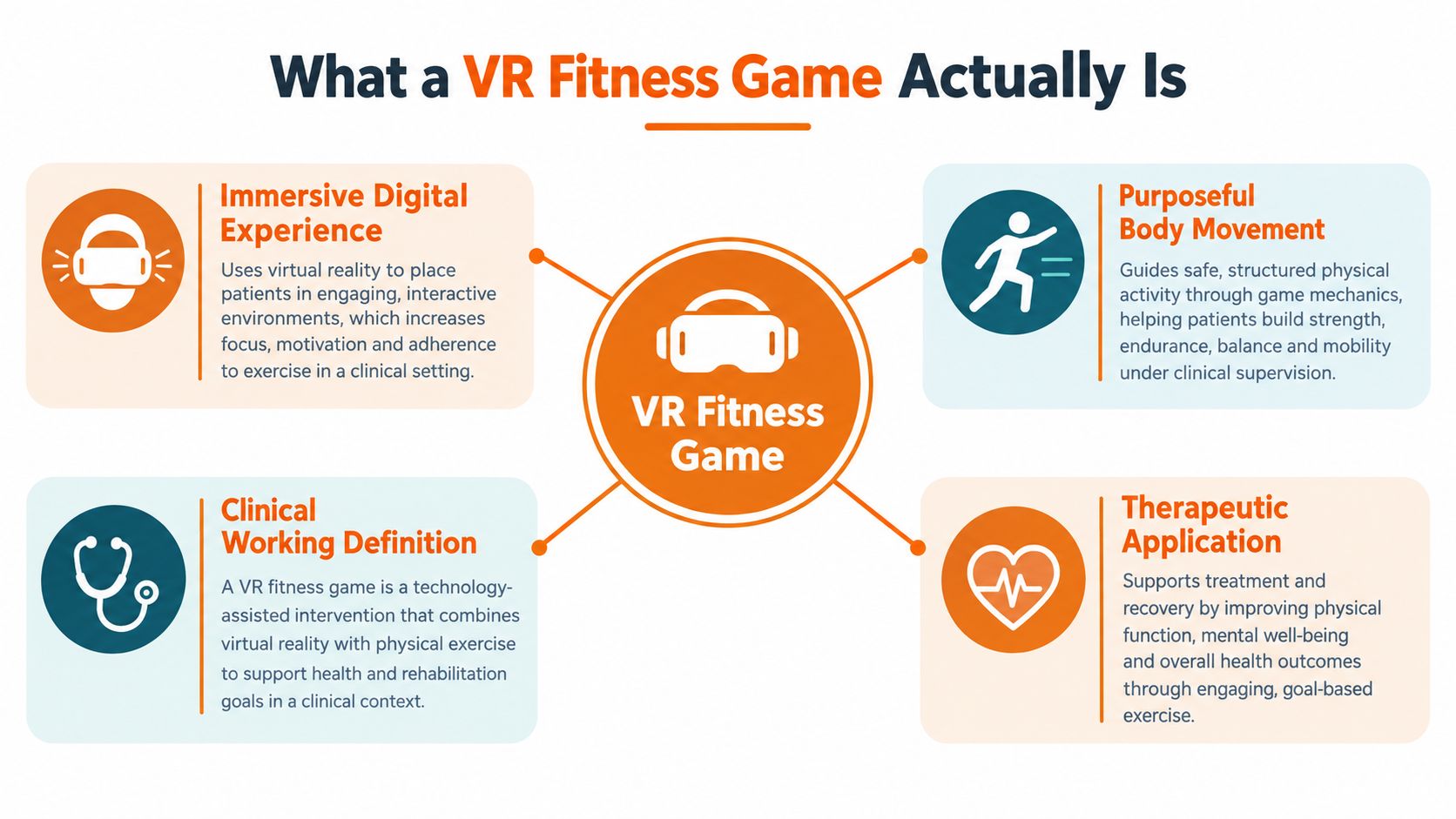
A VR fitness game is an immersive digital experience that asks the player to move purposefully. The movement might be reaching, striking, rowing, dancing, or shifting weight. What separates a fitness game from an ordinary sedentary video game isn't the headset or the visual design. It's whether the activity produces physical effort that can be measured.
Researchers collaborating with San Francisco State University's Department of Kinesiology assessed VR games using oxygen consumption and heart-rate measurements. In a related 2018 study, 41 participants aged 18–39 played three games while researchers monitored physiological responses. All three reached moderate-to-vigorous exercise intensity, comparable to running at approximately 5 miles per hour or vigorous cycling. The researchers also estimated that roughly 30% of the VR games available at the time delivered substantial exercise. The study's findings were reported in coverage of VR fitness research.
Those findings offer a practical caution: don't assume every game with active-looking graphics provides a workout. A game may require little movement, or its motion may be too light or brief to deliver the intensity a programme needs. For selection, ask what the participant does, how long they do it, and whether the session's movement and intensity can be tracked.
Use a clinical vocabulary
A few terms keep teams focused on results rather than headset time:
Session: One scheduled period of activity, with a start, finish, and record of what the participant completed.
Dose: The planned amount and intensity of movement, including session duration and frequency.
Baseline: A participant's initial performance, measured before interpreting later results.
Change score: The difference between a participant's later performance and their own baseline.
Adherence: Whether the participant attended and completed the sessions as planned.
This vocabulary is useful because the clinical question isn't just whether a participant enjoyed a game. It's whether they safely completed the intended activity and whether session-level results show a meaningful change for that person. A useful primer on how movement can be organised for a health purpose is Aspen Falls Wellness's overview of therapeutic exercise.
Think of the headset as a delivery method and the game as a task environment. A VR fitness game becomes a more credible intervention when the team can define the movement, record the dose, and interpret performance against an individual baseline.
Evidence for Physical and Cognitive Benefits
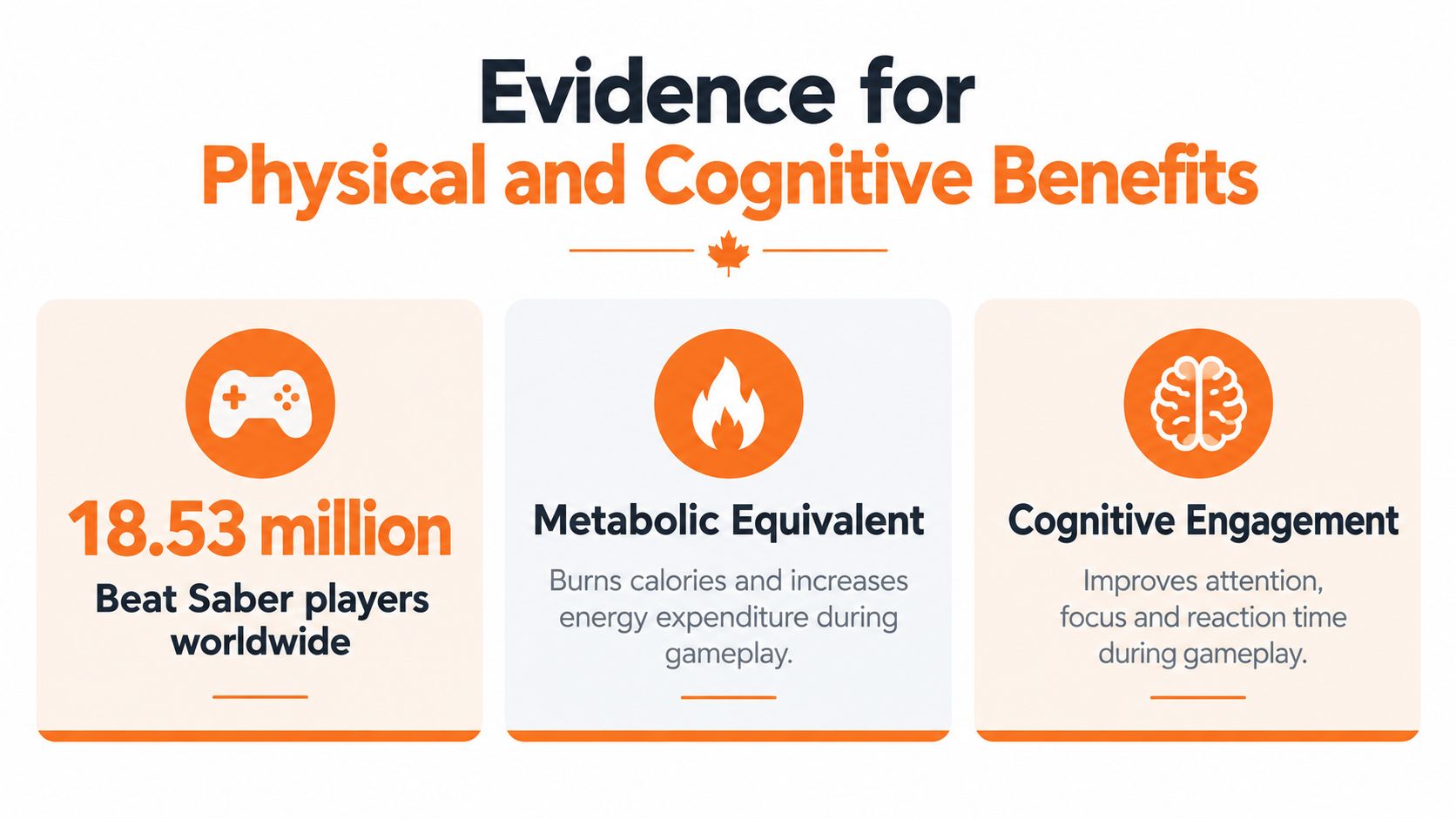
The Beat Saber figures show why commercial reach and clinical efficacy must be kept separate. The California-based Virtual Reality Institute of Health and Exercise, created to study and rate the health impact of VR and augmented-reality experiences in collaboration with San Francisco State University's Kinesiology department, reported more than 18.53 million hours of Beat Saber gameplay among Steam users. Its metabolic testing put average active-gameplay expenditure at 6.55 calories per minute. Applying that rate to recorded playtime produced an estimate of at least 4.639 billion calories expended across that gameplay. The institute describes its VR exercise ratings and testing work.
That aggregate is an estimate, not verified weight loss or a clinical outcome. It combines platform playtime estimates with laboratory metabolic testing. It tells a programme manager that movement-based play can attract sustained use. It doesn't show that every player received the same dose, experienced the same physiological response, or gained the same health benefit.
Track task performance, not just scores
A small Ontario pilot illustrates a different kind of evidence. Thirteen community-dwelling older adults completed 18 seated VR-exergame sessions over six weeks, using Tai Chi, rowing, and fishing tasks. The system automatically recorded repetitions, completion times, response times, distance travelled, and in-game errors. Researchers observed significant improvements in Tai Chi completion time, rowing efficiency, and fishing response time. The pilot report describes the intervention and its measures.
These results are useful as feasibility evidence and as a model for data capture. They don't prove population-wide efficacy, particularly given the small sample and seated format. But they show why a team should preserve task and motion measures across sessions: an improving response time or more efficient task completion says more about an individual's performance than a high game score alone.
A practical distinction helps keep reporting honest:
Engagement data show whether participants played and returned.
Performance data show how they completed specific tasks.
Clinical outcomes require appropriate assessment and cautious interpretation.
For teams considering how visual tasks can fit into mental-health settings, Premiere Education's course on visualisation as a mental-health tool provides useful context. For rehabilitation programmes, this overview of rehabilitation and performance can also help frame how activity data might sit alongside broader performance measures.
Where VR Fitness Games Are Already Working
A seated exergame, a standing rhythm game, and a culturally attuned dance experience solve different problems. The right choice depends on who will use it, what movement they can safely perform, and what the programme needs to learn from each session.
In a New Brunswick government-supported project, 47 seniors took part in a comparison of VR exercise with usual activity. Twenty-four participants completed 20–30-minute sessions three to five times weekly for eight weeks, while 23 continued their usual exercise routine. The project concluded VR exercise may suit seniors who can sit or stand for at least 20 minutes, have no condition that prevents mild-to-moderate exercise, and have someone available to supervise. That's a useful scheduling example for a care home, not permission to use the same routine for every resident. The New Brunswick project outlines its approach and implementation considerations.
In rehabilitation, the Ontario seated pilot used Tai Chi, rowing, and fishing tasks and tracked performance measures rather than relying only on self-report. A seated format can make movement more manageable for participants who aren't ready for standing play. It also gives staff a clearer chance to observe posture, reach, fatigue, and task completion.

Match the programme to the community
Language and cultural fit are not optional extras if a programme is intended to serve a multilingual community. A 2025 Cedars-Sinai initiative recruited more than 100 Los Angeles residents for English- and Spanish-language focus groups testing Latin dance-inspired VR exercise, with participants aged 18–70. The project targets predominantly Latino communities in South and East Los Angeles and aims to address obesity and type 2 diabetes risk, while following the public-health target of 150 minutes of moderate activity weekly. By April 2025, the protocol reported 44 focus-group participants. Cedars-Sinai describes the community-engaged initiative.
For a programme serving participants at home, staff should also ask whether the experience makes sense in the participant's language, whether the household has enough safe space, and whether equipment and internet access are practical. The same questions apply to schools and family programmes: a game that works for one group may be inaccessible or unappealing to another.
Youth programme design also benefits from distinguishing age groups rather than treating children and adolescents as one audience. Statistics Canada reported that children aged 5–11 averaged 61.3 minutes of moderate-to-vigorous activity daily, compared with 46.3 minutes for adolescents aged 12–17. Average daily screen time was 2.3 hours for younger children and 3.8 hours for adolescents; boys recorded 60.1 minutes of activity compared with 47.1 minutes for girls. Statistics Canada's physical-activity and screen-time data provide the comparison.
Those figures don't prescribe a treatment plan, but they can prompt more thoughtful outreach. A school coordinator might test short, structured sessions with adolescents, then ask whether girls find the activity welcoming and comfortable. Orange Neurosciences' neurorehabilitation overview offers related context for teams considering digital activities in rehabilitation settings.
How to Choose and Implement a VR Fitness Game
Start with the participant and the intended movement, not the game catalogue. A standing rhythm game may suit an active adult who can move freely. A seated upper-body task may be a better fit for someone in rehabilitation or a care home. The headset should support the programme's workflow, but it shouldn't decide the exercise dose.
Use Case | Movement Type | Session Length | Supervision | Data Capture |
|---|---|---|---|---|
Active adult exercise | Standing, full-body or rhythm-based | Set a tolerable planned dose | Individual monitoring may be sufficient for a suitable user | Record completed minutes and session attendance |
Older-adult care setting | Seated or standing, selected for balance and mobility | Use the planned short session and adjust to tolerance | Arrange supervision where needed | Track completion, response, and symptoms |
Rehabilitation programme | Seated or low-impact, matched to the task | Begin within the participant's capacity | Clinician or trained staff oversight | Capture task-level measures and errors |
Multilingual community programme | Movement selected with participants | Schedule around access and retention | Community or programme support as appropriate | Record attendance, language preference, and completion |
Check five practical dimensions
First, identify whether the game requires standing, seated play, upper-body movement, or full-body movement. Then confirm that the intended session length is realistic. Canadian research protocols include seated sessions of approximately 15–20 minutes three times per week over six weeks for the Seas The Day exergame, while another Canadian study used a prescribed 20–30-minute dose three to five times weekly. The Seas The Day protocol sets out its seated schedule and eligibility rules. These are examples of study designs, not universal prescriptions.
Next, clarify supervision and access. Can staff see the participant's posture and surroundings? Is there enough clear floor space? Can the headset be adjusted and cleaned between users? Does the experience provide language access that suits the population? Finally, check whether it records session-level information or only a game score.
Practical rule: If the platform can't help you tell what the participant did, how long they did it, and whether they completed the planned session, it's a poor fit for outcome monitoring.
An adult Canadian clinical trial offers a concrete planning benchmark. Adults aged 19–64 who were doing less than 75 minutes of vigorous activity weekly were assigned to a Supernatural VR programme or a wait-list control for 10 weeks. Participants were instructed to complete 75 minutes of medium-intensity VR activity each week, treated by the study as equivalent to 75 minutes of vigorous activity under Canadian physical-activity guidance. A schedule of three 25-minute sessions or five 15-minute sessions makes completed minutes easier to audit. The trial registration describes the Supernatural programme.
Before launch, test the room and headset with a staff member, confirm a clear movement area, and write down how sessions will be scheduled and recorded. For teams selecting activities that also support cognitive training, this overview of cognitive therapies offers further context.
Measuring Outcomes and Integrating Assessment
A useful VR dashboard should answer more than “Did the participant play?” Record the task, the completed dose, and the performance measures that matter to the programme. In the Ontario seated exergame pilot, the system captured repetitions, completion times, response times, distance travelled, and in-game errors. That combination helped researchers review performance over repeated sessions instead of relying only on participants' recollections.
Build a repeatable measurement workflow
Begin with a first-session baseline. Record the participant's performance on the selected tasks, along with attendance, completed minutes, and any relevant symptoms or assistance required. Keep the tasks and recording method consistent across later sessions, so a change in completion time or error count is interpretable rather than an artefact of a different setup.
Then calculate each participant's change score against their own baseline. Don't compare a participant's game score with another person's and call the difference progress. A practical example: if someone completes a rowing task more efficiently at reassessment, check that their session dose and task conditions were comparable before interpreting the change.
Where cognitive function is relevant, pair VR performance with a separate cognitive assessment rather than treating game metrics as a diagnosis. The Orange Neurosciences Cognitive Skills Assessment covers attention, memory, executive function, perception, processing speed, and eye-hand coordination, and produces an individualized cognitive profile in under 30 minutes. These domains can provide additional context for interpreting task performance, but a game score alone can't establish a cognitive change or clinical condition. An overview of cognitive assessment tools can help teams think through assessment options.
A workable clinic flow is straightforward:
Screen and establish a baseline. Use an appropriate rapid assessment and record the participant's starting task performance.
Deliver a fixed dose. Keep the schedule consistent, and log completed sessions, minutes, tasks, and symptoms.
Reassess at planned intervals. A programme might compare results at six and twelve weeks, then adjust the next cycle based on attendance, task-level change, and cognitive assessment results.
For remote or hybrid programmes, teams may also need a clear process for documenting care delivered between visits. MedAmerica Rehab Center's guide to remote therapeutic monitoring provides relevant background for thinking through that workflow.
The final report should distinguish adherence, task performance, and cognitive assessment. If a participant misses sessions, that is different from attending consistently without a change in task performance. Keeping those outcomes separate gives clinicians, families, and funders a more useful account of what happened.
Safety, Screening, and Accessibility
VR exercise isn't universally safe just because it's a game. A California State University, Northridge study involving exercise for people with spinal cord injury identified possible risks including seizures, cardiovascular complications, dehydration, physical fatigue, soreness, cramps, and spasms. A clinician should treat these as reasons to screen and monitor, not as a generic warning to ignore or an automatic diagnosis of risk for every user. The study discusses exercise considerations for people with spinal cord injury.

Set a stop rule before play begins
The Seas The Day protocol gives providers specific issues to consider for a seated exergame. Its exclusions include moderate or severe dementia, a Montreal Cognitive Assessment score below 18, substantial motion sickness, relevant middle-ear disease, and conditions that prevent exercise, including a cardiac pacemaker. Its eligibility rules also require participants to be able to perform light-to-moderate activity safely without physician approval under the Get Active Questionnaire. These criteria belong to that protocol, so providers should apply their own clinical screening and local procedures rather than treating them as a universal checklist.
Before a session, confirm the participant can use the headset safely, understand the task, and maintain a stable seated or standing position. Start with an appropriate warm-up, keep initial effort modest, and include a cooldown. Stop the activity if the participant develops dizziness, nausea, instability, unusual pain, or marked fatigue. If a participant has a neurological or cardiovascular condition, involve the appropriate clinician and define the supervision plan before introducing exercise.
Accessibility also affects safety. A seated or low-impact mode can reduce balance demands for an older adult or rehabilitation patient. For a multilingual programme, language and cultural fit matter to comprehension and continued participation; Cedars-Sinai's English- and Spanish-language Latin dance focus groups offer a community-engaged example, as described earlier. Check practical barriers at home, including available space, internet access, headset fit, and privacy. For guidance on exercise considerations after concussion, see this overview of exercise for concussion.
A 30-60-90 Day Plan for Clinicians and Program Managers
Days 1–30: Define the participant group, choose a suitable headset and game, and set screening, supervision, and stop rules. Record each participant's baseline, including cognitive assessment when relevant to the programme. Decide in advance which session-level measures will guide review.
Days 31–60: Begin at a consistent dose, such as three 20-minute sessions weekly. Log completed minutes, attendance, task performance, and symptoms. Review missed sessions early; access barriers or discomfort may explain absences better than motivation.
Days 61–90: Reassess each participant and compare results with their own baseline. Continue, adjust the dose, or arrange additional support, including ReadON game-based digital therapy where appropriate. Treat VR activity and cognitive assessment as complementary tools, not substitutes for professional judgement.
Teams can connect VR session records with cognitive profiling through Orange Neurosciences. Its cognitive assessment, individualized profiles, reassessment, and multilingual workflows can help organise training and reporting around participant needs. Cognitive skills assessments and rapid screening can sit alongside session-level VR data, giving teams a clearer basis for individual planning and progress monitoring.

Orange Neurosciences' Cognitive Skills Assessments (CSA) are intended as an aid for assessing the cognitive well-being of an individual. In a clinical setting, the CSA results (when interpreted by a qualified healthcare provider) may be used as an aid in determining whether further cognitive evaluation is needed. Orange Neurosciences' brain training programs are designed to promote and encourage overall cognitive health. Orange Neurosciences does not offer any medical diagnosis or treatment of any medical disease or condition. Orange Neurosciences products may also be used for research purposes for any range of cognition-related assessments. If used for research purposes, all use of the product must comply with the appropriate human subjects' procedures as they exist within the researcher's institution and will be the researcher's responsibility. All such human subject protections shall be under the provisions of all applicable sections of the Code of Federal Regulations.


© 2026 by Orange Neurosciences Corporation