Vanderbilt Rating Scale: ADHD Assessment Guide 2026
A parent arrives with a folder of school notes. A teacher has circled “easily distracted”, “blurts out answers”, and “doesn't finish work”. At home, the same child can spend ages building with blocks but melts down over homework. Everyone sees a problem, but no one is fully sure what the problem is.
That's where many ADHD evaluations begin. Not with certainty, but with a pattern that feels inconsistent, frustrating, and hard to describe cleanly. Families often worry about labels. Teachers worry about learning loss and classroom disruption. Clinicians worry about missing something important.
The Vanderbilt Rating Scale helps organise that uncertainty. It doesn't settle the whole question by itself, but it gives adults a shared structure for describing what they're seeing, in the places where the child lives and learns.
Used well, it can move a team from “something feels off” to “here's what shows up at home, here's what shows up at school, and here's what needs closer review”.
Untangling Childhood Behavioural Challenges
A Year 3 teacher says, “He knows the material, but he drifts halfway through every task.” A parent says, “At home, getting dressed and starting homework turns into a battle.” Those comments may describe ADHD. They may also reflect anxiety, a learning difficulty, poor sleep, family stress, or several things happening together.
That's why behavioural concerns need structure early. Without it, meetings become a collection of anecdotes. One adult remembers the interruptions. Another focuses on emotional outbursts. Someone else says the child is “fine when interested”, which is often true and still doesn't answer the clinical question.
When concerns are real but unclear
Take a common example. A child forgets instructions in class, loses worksheets, and gets up repeatedly during seated work. At home, the same child can focus intently on video games but can't start a simple reading task without repeated prompting. Parents then hear conflicting messages and wonder whether the child is choosing not to focus.
The first job isn't to argue over motivation. It's to gather consistent observations.
A structured rating scale does that better than a free-form conversation alone. It helps a parent and teacher describe frequency, setting, and impact using the same language. That's often the first point at which the picture becomes clinically useful.
Good assessment starts by comparing behaviour across environments, not by chasing the loudest story in the room.
Why a shared tool helps
The Vanderbilt Rating Scale works well at this stage because it gives adults a disciplined way to report what they see. It's especially helpful when school and home reports seem different, or when a family has been told several versions of the child's difficulties.
For educators and parents trying to pair assessment with support, broader reading on cognitive therapy for ADHD can also help frame what happens after concerns are identified.
The practical value is simple. Before discussing diagnosis, medication, school supports, or therapy, you need a clean baseline. The Vanderbilt helps create one.
What Is the Vanderbilt ADHD Rating Scale
The Vanderbilt ADHD Rating Scale is a structured screening tool used to collect observations about ADHD-related symptoms and day-to-day functioning from adults who know the child well. In practice, that usually means a parent or caregiver form and a teacher form.
It was developed through the National Institute for Children's Health Quality, often shortened to NICHQ, and it is widely used in paediatric and developmental settings because it translates everyday observations into a format clinicians can review systematically.

What it is designed to do
The key point is that the Vanderbilt is a screening tool, not a stand-alone diagnosis. It helps identify whether a child's reported symptoms are concerning enough to justify a fuller clinical evaluation.
It is designed for children aged 6 to 12 and aligns with the diagnostic criteria for ADHD outlined in the DSM according to the NICHQ Vanderbilt assessment scales overview.
That age range matters. A tool can be very useful and still have clear limits. If you're assessing an adolescent, a university student, or an adult, you'd usually choose a different instrument. Families who are comparing pathways across age groups may also find this overview of ADHD diagnosis for adults and children useful because it explains how evaluation changes with developmental stage.
What the forms usually capture
The forms are built to capture more than distractibility. They typically ask adults to rate behaviours linked to:
Inattention, such as difficulty sustaining focus or following through
Hyperactivity and impulsivity, such as fidgeting, interrupting, or acting before thinking
Related behavioural concerns, including oppositional or conduct-type features
Emotional concerns, including anxiety or low mood indicators
Performance and impairment, such as classroom functioning, relationships, and schoolwork
This broader design is one reason the scale is so useful in busy practice. A child may be referred for “possible ADHD”, but the ratings can reveal a more complicated picture. For example, a teacher may endorse distractibility while a parent mainly describes moodiness and avoidance. That doesn't invalidate the form. It tells you where to look more carefully.
Practical rule: Treat the Vanderbilt as a map of reported concerns, not as the final answer to why those concerns exist.
A positive screen means the child warrants closer assessment. A negative screen doesn't end the conversation if history, observation, or school performance still raises concern. Good clinicians hold both things at once.
How to Administer the Scale for Accurate Results
How you give the Vanderbilt matters almost as much as how you score it. The form is simple, but poor instructions lead to poor data. If a rater rushes, skips items, or answers based on a single bad week, the result becomes less reliable.

Who should complete it
At minimum, you want input from:
A primary caregiver who sees the child regularly in home routines
At least one teacher who knows the child well in academic and social settings
If the child has more than one major school environment, such as a classroom teacher and a learning support teacher, additional perspectives can help. The point isn't to collect endless forms. The point is to capture behaviour across settings where ADHD symptoms may or may not appear.
A school-facing overview of ADHD assessment in BC can help teams think through referral pathways and practical coordination.
How to set up raters for useful answers
Don't just hand over the paperwork. Give a short explanation. Tell raters that you're looking for a pattern of behaviour, not a judgment about whether the child is “good” or “difficult”.
I usually tell adults to keep four things in mind:
Think across routine life, not only the worst day.
Answer every item, even if you're unsure. A best estimate is better than a blank.
Use the scale as written. “Often” and “Very Often” shouldn't be used loosely.
Rate what you observe, not what you assume the child intends.
Here's a practical example. A teacher may mark a child as frequently not finishing seatwork. A parent may be tempted to mark the same item lower because homework eventually gets done with one-to-one supervision. Both ratings can be accurate because they describe different contexts.
Common administration mistakes
A few errors come up repeatedly in clinics and schools:
Pitfall | Why it causes trouble | Better approach |
|---|---|---|
Giving no instructions | Raters use different standards | Explain that consistent observation matters more than opinion |
Using only one setting | You lose context | Gather home and school perspectives |
Leaving blanks | Scoring becomes muddy | Review forms before the visit ends |
Treating the form like a verdict | It narrows thinking too early | Use it as one part of a broader assessment |
When scores surprise you, check the instructions first. A confusing form completion process creates false disagreement.
If a parent says, “He never acts like that at home,” and a teacher says the opposite, don't assume one of them is wrong. Ask about task demands, noise level, structure, fatigue, and emotional triggers. The form starts that conversation. It doesn't replace it.
Scoring and Interpreting the Vanderbilt Results
Once the forms are complete, the next task is disciplined scoring. Many people become unsure at this point. They can see the ratings, but they're not fully confident about what counts as a meaningful pattern.
The safest way to score the Vanderbilt is to treat it as a repeatable workflow rather than a rough impression.
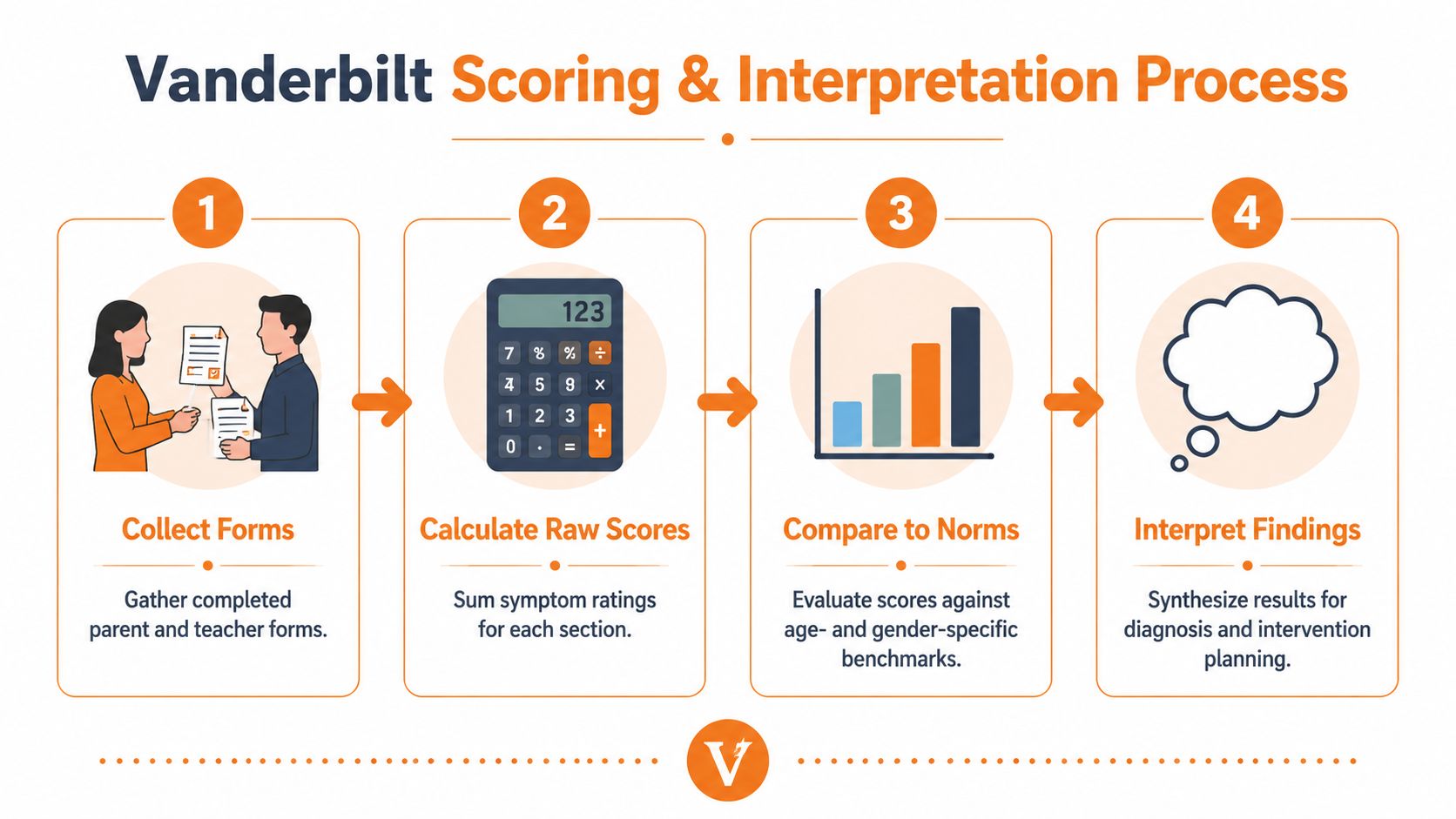
Start with the symptom domains
For the core ADHD symptom areas, you're looking for ratings that rise to a clinically significant frequency. On the Vanderbilt, that means counting items rated 2, “Often”, or 3, “Very Often”.
For the core cut-offs, the inattention subscale is considered a positive screen when 6 or more items are scored as 2 or 3. The hyperactivity and impulsivity subscale uses the same threshold of 6 or more items. That scoring rule comes from the earlier NICHQ reference already noted above.
A practical example helps. Suppose a teacher form shows repeated endorsements for losing focus, failing to finish work, seeming not to listen, being disorganised, avoiding sustained mental effort, and forgetting daily tasks. If those endorsed items fall at the “Often” or “Very Often” level often enough to meet threshold, the inattention screen is positive on that teacher form.
Use a simple scoring routine
A consistent process keeps interpretation cleaner.
Score the parent form separately
Count clinically significant responses within each symptom cluster.Score the teacher form separately
Don't merge the forms into one combined total. Each setting tells its own story.Mark which domains cross threshold
One form may suggest inattention while the other highlights impulsive behaviour.Review the performance items
Symptoms matter, but so does whether they affect real-world functioning.
This separation matters clinically. A child may show substantial inattention at school and much less at home. That doesn't mean the scale failed. It may mean the demands of independent classroom work expose the problem more clearly than home life does.
A Vanderbilt score is most useful when you ask, “Where is the difficulty showing up, and under what demands?”
Don't ignore impairment
Many readers focus only on the symptom counts. That's a mistake. Behavioural symptoms become more clinically meaningful when they are paired with impairment. In ordinary language, you're asking whether these behaviours are interfering with learning, relationships, routines, or classroom functioning.
A practical approach is as follows:
High symptom ratings with little impairment may call for watchful follow-up, contextual review, or investigation of situational triggers.
High symptom ratings with clear impairment strengthen the case for a fuller ADHD evaluation.
Mixed symptom ratings with marked impairment often signal the need to look beyond ADHD alone.
For example, a child may not strongly cross symptom thresholds but still have major academic decline, emotional distress, or classroom avoidance. In that case, the Vanderbilt is telling you not to stop. It is not telling you the child is fine.
What about the other sections
The Vanderbilt also includes screening content for common co-occurring concerns. Those areas can be clinically valuable because many referred children don't present with “pure ADHD”. A child may look inattentive because they are anxious, overwhelmed by a learning problem, oppositional in one setting, or emotionally dysregulated.
That broader pattern often matters more than a headline score.
Consider this sample interpretation:
Observation pattern | What it may mean clinically |
|---|---|
Parent and teacher both show elevated inattention | Stronger case for cross-setting review of ADHD symptoms |
Teacher elevated, parent not elevated | School demands may be exposing a problem not obvious at home |
Parent elevated, teacher not elevated | Consider home stress, routines, sleep, or different expectations |
ADHD symptoms plus emotional concerns | Widen the assessment rather than narrowing it |
The most common scoring mistake isn't arithmetic. It's overconfidence. People see a positive screen and jump straight to diagnosis. A careful clinician uses the score to decide what needs to be explored next.
Understanding the Scale's Strengths and Limitations
The Vanderbilt is useful because it captures behaviour from people who see the child in real life. That's a genuine strength. Parents observe mornings, evenings, homework, siblings, and transitions. Teachers observe sustained attention, group expectations, seatwork, waiting, and peer interactions. Few clinic-based tools can replace that ecological value.
What the scale does well
The Vanderbilt is strong at surfacing patterns that deserve attention. If several adults are independently describing distractibility, impulsive behaviour, disorganisation, and functional difficulty, that matters. The form also gives clinicians a standard language, which reduces the chaos of purely anecdotal reporting.
That's why it works well as an early filter. It helps decide who needs deeper evaluation, what questions to ask next, and which settings deserve closer scrutiny.
For clinicians thinking about overlapping presentations, reading about comorbidity in ADHD is often useful because many “ADHD-like” behaviours sit alongside anxiety, learning issues, sleep problems, or emotional dysregulation.
Where clinicians and families get tripped up
A smoke detector is a good analogy. It's designed to alert you to possible danger. It is not designed to tell you whether the smoke came from toast, a pan on the cooker, or a house fire.
The Vanderbilt works in a similar way. It's good at flagging concern, but it doesn't explain the source of the concern.
That limitation matters in cases like these:
An anxious child who looks inattentive because worry blocks concentration
A child with a reading disorder who avoids tasks and appears oppositional during literacy work
A sleep-deprived child who is restless, irritable, and forgetful
A bright child in an underchallenging classroom who appears disengaged rather than globally inattentive
A positive Vanderbilt result should widen your curiosity before it narrows your conclusion.
The scale is also still based on human observation. Adults differ in tolerance, expectations, insight, and context. One teacher may rate blurting as frequent and disruptive. Another may see the same behaviour in a more flexible classroom and rate it lower. That's not noise to discard. It's part of the child's real-world story.
Beyond the Vanderbilt Integrating Digital Cognitive Assessments
The Vanderbilt tells you what adults observe. It does not directly measure the cognitive systems that may be driving those observations. That gap matters in modern clinical work.
If a parent and teacher both report distractibility, you still need to know more. Is the child struggling mainly with sustained attention? Working memory? Inhibitory control? Processing speed? Task persistence? Emotional interference? The rating scale can suggest the direction, but it can't answer those questions on its own.
Why objective data changes the conversation
This is where digital cognitive assessments fit naturally into workflow. They don't replace the Vanderbilt. They complement it.
A practical sequence looks like this:
Step one
Collect parent and teacher ratings to identify reported symptom patterns and settings of concern.Step two
Review history, school function, emotional context, sleep, and learning factors.Step three
Add an objective cognitive assessment when the picture is still broad, when symptoms conflict across settings, or when treatment planning needs more precision.
Subjective and objective tools answer different questions. A rating scale asks, “What do adults notice?” A cognitive assessment asks, “How is the child performing on tasks that tap attention, memory, control, and executive function?”
A workflow example from everyday practice
Consider a child whose Vanderbilt forms suggest inattentive symptoms at school, milder concerns at home, and a fair amount of academic underperformance. Without further data, the team may debate whether this is ADHD, anxiety, a learning problem, or simple poor fit with the classroom.
A digital cognitive assessment can help sharpen that discussion. If the child shows clear weaknesses in sustained attention and executive control, that supports one line of inquiry. If attention looks relatively intact but memory and processing demands are the weak points, the care plan may shift. If the profile is uneven and emotional factors appear prominent, that changes follow-up again.
That's the practical value. Better differentiation. Better conversations with families. Better referrals.
Clinics building flexible staffing models sometimes need the same kind of workflow clarity for team roles as well, especially when services extend across schools, telehealth, and rehabilitation. In that context, resources such as remote PA jobs are relevant because modern assessment pathways often involve distributed support staff, not just one clinician in one room.
Why this approach fits current practice
Digital tools are especially helpful when you need to:
Clinical need | Why a digital cognitive tool helps |
|---|---|
Conflicting raters | Adds task-based data instead of relying only on opinion |
Broad symptom picture | Helps separate attention problems from other cognitive bottlenecks |
Treatment planning | Gives a more specific profile to guide intervention targets |
Monitoring change | Supports repeat measurement over time with a consistent format |
For readers comparing options, this guide to cognitive assessment tools gives a useful overview of where these tools fit and how they can support structured follow-up.
The strongest workflow today is rarely “rating scale only”. It is usually layered. History, observation, school input, rating scales, and objective cognitive data each contribute something different. When those pieces align, the clinical picture becomes clearer. When they don't, that discrepancy is often the most important finding.
Common Questions About Using the Vanderbilt Scale
What if parent and teacher scores don't match
This is common. Don't treat it as a failure of the tool.
Start by asking where the child is most stressed, most independent, and most expected to self-regulate. A child may look settled at home because routines are heavily scaffolded, but struggle at school where organisation and sustained effort are less supported. The reverse can also happen.
Use disagreement as a prompt for better questioning, not for choosing sides.
Can the Vanderbilt be used for teenagers or adults
Not as your main tool. Earlier in the article, the validated age range was noted. Outside that range, choose an age-appropriate instrument and a broader clinical review.
Trying to stretch a child measure into adolescence or adulthood usually creates more confusion than clarity.
How often should it be repeated
The best answer is clinical, not automatic. Repeat it when you need to reassess symptoms after a meaningful change, such as a treatment adjustment, a school transition, or a new concern raised by family or staff.
If you administer it too often without a clear reason, people start rating from memory or expectation rather than fresh observation.
Can it track treatment progress by itself
It can help, but it shouldn't stand alone. If scores improve, ask whether schoolwork, relationships, daily routines, and emotional strain have improved too. If scores don't change, check whether the issue is treatment failure, inconsistent implementation, a co-occurring condition, or a mismatch between symptom report and the child's actual functional gains.
Questions about medication effects can become especially tangled when anxiety is also present, so families often benefit from balanced reading on ADHD medications and anxiety.
The Vanderbilt is at its best when it stays in its lane. It structures observation well. It supports monitoring. It helps you decide what needs further review. It doesn't replace clinical judgement.
If you want a more complete picture than rating scales alone can offer, Orange Neurosciences provides digital cognitive assessment tools that help clinicians, educators, and families add objective data to ADHD workflows. That can make the next step after a Vanderbilt screen clearer, faster, and easier to act on.

Orange Neurosciences' Cognitive Skills Assessments (CSA) are intended as an aid for assessing the cognitive well-being of an individual. In a clinical setting, the CSA results (when interpreted by a qualified healthcare provider) may be used as an aid in determining whether further cognitive evaluation is needed. Orange Neurosciences' brain training programs are designed to promote and encourage overall cognitive health. Orange Neurosciences does not offer any medical diagnosis or treatment of any medical disease or condition. Orange Neurosciences products may also be used for research purposes for any range of cognition-related assessments. If used for research purposes, all use of the product must comply with the appropriate human subjects' procedures as they exist within the researcher's institution and will be the researcher's responsibility. All such human subject protections shall be under the provisions of all applicable sections of the Code of Federal Regulations.


© 2026 by Orange Neurosciences Corporation